

In this post:
Account-based marketing is a B2B strategy that points sales and marketing at a defined set of high-fit accounts, treating each account or tight cluster as its own market. Instead of chasing the largest possible pile of leads, you pick the companies worth winning and go deep on them.
ABM flips the usual order of operations. Traditional demand gen casts a wide net and sorts the leads later. Account-based marketing starts from the accounts you want, then works inward to the people inside them.
TL;DR
The moment a team buys a platform and uploads an account list, they start calling the whole thing ABM, and what they're usually doing is demand generation with a narrower audience and a bigger invoice.
Real account-based marketing rests on two disciplines that get skipped constantly, sharp account selection and genuine sales alignment. It works the account as its unit and scores itself on pipeline from named accounts, while MQL volume stays out of the conversation.
Buy the tool last, after you've picked the accounts and agreed who owns them with sales, and then personalize enough to be worth the buyer's time.
What account-based marketing actually means once you strip out the buzzword
The core idea is simple and the execution is not. You treat each target account as a market of one, with its own buying committee, its own context, and its own reasons to care.
That starts with a real ideal customer profile, and a list of logos you'd like to land doesn't count. Fit carries the entire foundation, because every later step compounds on the accounts you chose.
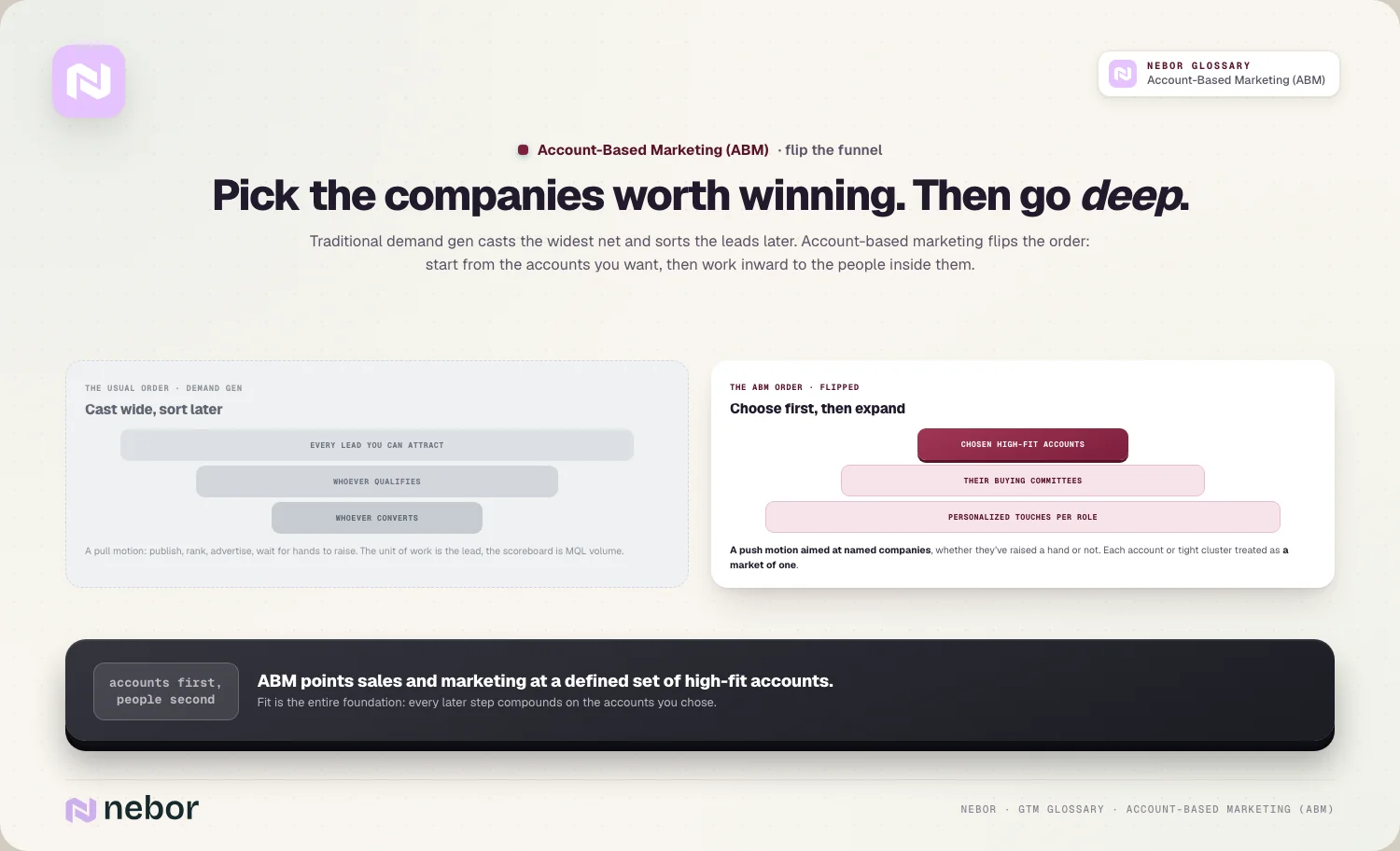
If you get the list wrong, no amount of personalization will save it. If you get it right, even modest outreach lands, because you're talking to companies that match what you sell.
Why account-based marketing works the way it does, and where it came from
ABM is not a new idea dressed up in software. The thinking goes back to how the best enterprise reps have always sold, by treating a handful of big accounts as their whole world and learning everything about them.
The thing that changed is scale, because for decades you could only do that kind of deep, custom work on a few mega-accounts, with a human researching and tailoring each one by hand.
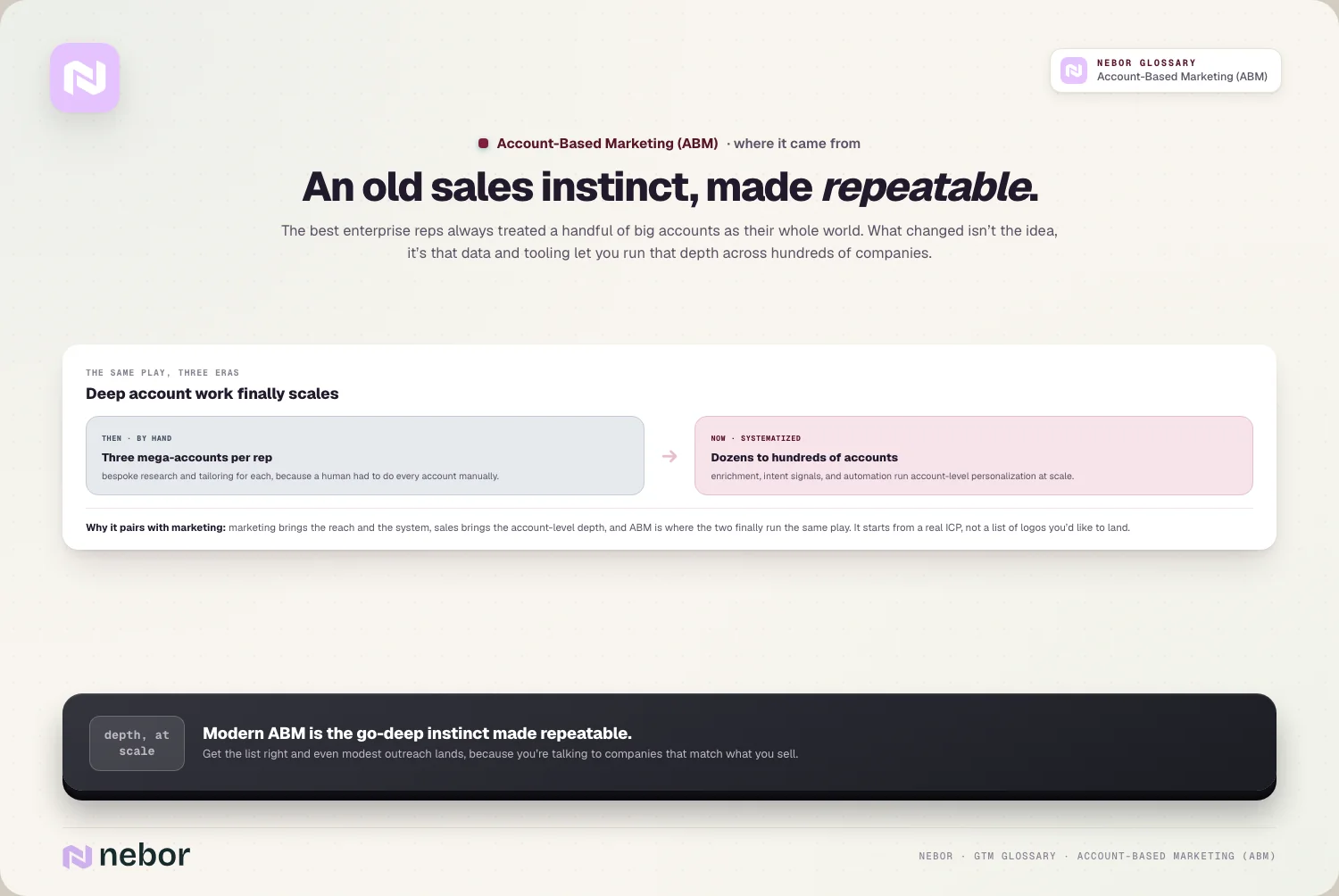
Then the data and tooling caught up. Enrichment, intent signals, and automation now let teams push account-level personalization across dozens or hundreds of companies instead of a lucky three.
So modern ABM takes an old sales instinct, going deep on the accounts that matter, and makes it repeatable at scale. That's why it pairs so naturally with marketing. Marketing brings the reach and the system, sales brings the account-level depth, and ABM is where the two finally work the same play.
Why ABM and lead generation pull your team in different directions
Demand generation chases a quantity of leads. Account-based marketing chases a quality of accounts. Those are different goals, and they pull a team in different directions.
Demand generation is a pull motion, where you publish, rank, advertise, and wait for interested buyers to raise a hand. ABM is a push motion aimed at named companies whether they have raised a hand yet or not.
The two are not enemies, and the best programs use both. We have written before about why a GTM motion beats a lead-gen motion, and ABM is where that shows up most clearly.
How the three tiers of ABM, one-to-one, one-to-few, and one-to-many, really differ
ABM works at three different depths instead of being one single motion, and the difference between them comes down to how many accounts share a single campaign.
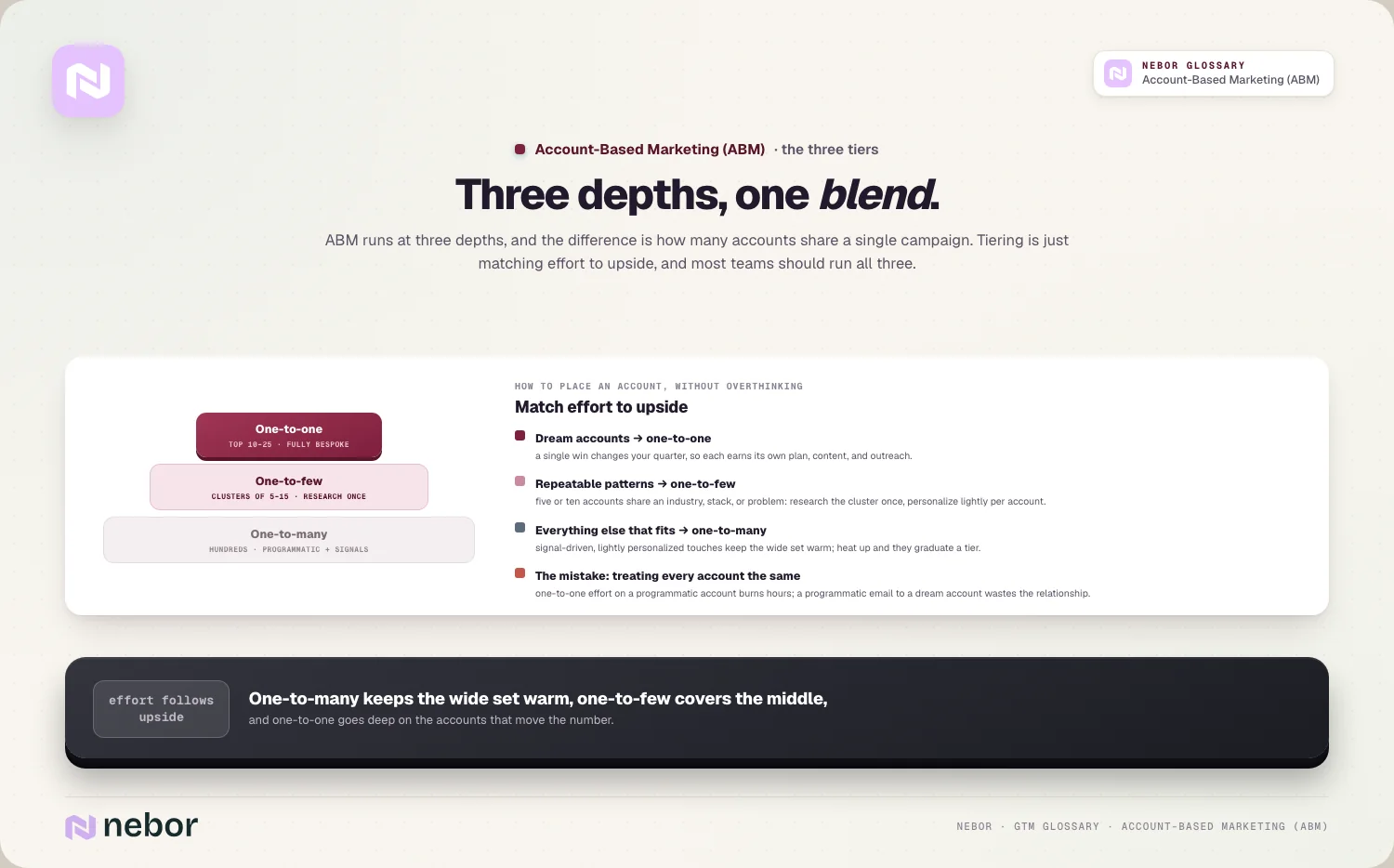
One-to-one ABM is fully bespoke work for a single strategic account, usually the top 10 to 25 names on your list. Each gets its own plan, content, and outreach.
One-to-few ABM applies that thinking to clusters of five to fifteen accounts that share an industry or a problem, so the research scales across a handful at once.
One-to-many ABM, also called programmatic, personalizes lightly across hundreds of lower-tier accounts using firmographics and signals rather than hand-built campaigns.
Most programs work best when they blend all three. One-to-many keeps a wide set warm, one-to-few covers the middle, and one-to-one goes deep on the accounts that move the number.
How you decide which tier each account belongs in without overthinking it
Picking tiers feels harder than it turns out to be. You don't need a perfect model here, just a sensible way to spend your effort where it pays back the most.
Put your handful of dream accounts in one-to-one. These are the names where a single win changes your quarter, so they earn fully bespoke work. The effort per account is high and the count is low.
Drop the solid, repeatable patterns into one-to-few. When five or ten accounts share an industry, a tech stack, or a problem, you can research the cluster once and personalize lightly per account, so the effort scales across the whole group.
Everything else that still fits goes in one-to-many. You keep these warm with signal-driven, lightly personalized touches, and you watch for any of them to heat up and graduate to a higher tier.
The mistake is treating every account the same. If you give a one-to-many account one-to-one effort, you burn hours you don't have. If you give a dream account a programmatic email, you waste the relationship. Tiering is just matching effort to upside.
Why buying an ABM platform is nowhere near the same thing as doing ABM
Here's the most common way we watch ABM die. A team buys a platform, uploads a list, points the same nurture emails at it, and reports MQLs back to the business.
That's demand gen wearing an ABM label. The tool isn't the strategy, and a target account that gets the same generic email as everyone else isn't getting account-based treatment at all.
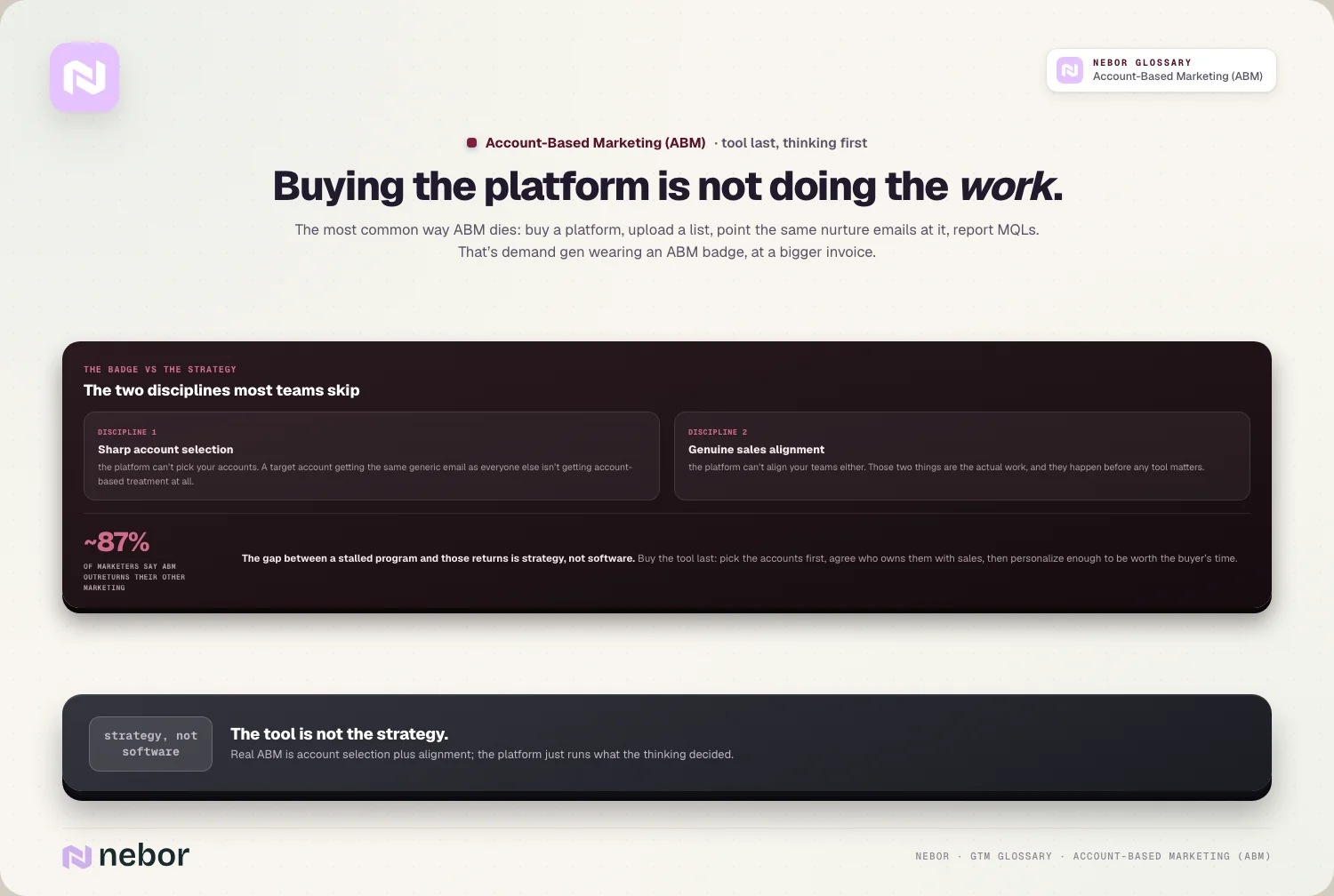
The returns from the real version are hard to argue with. In repeated industry surveys, around 87% of marketers say ABM delivers higher returns than their other marketing. The gap between those two outcomes comes from the strategy, and the software has very little to do with it.
Why account-based marketing lives or dies on your sales and marketing alignment
ABM usually starts inside marketing, and that's exactly where it quietly breaks. The moment marketing picks the accounts without sales, the program becomes two teams working parallel campaigns that never meet.
Account selection has to be a joint decision. Sales knows which accounts are real, which have a live trigger, and which already have a champion inside, while marketing knows fit at scale. The program needs both sides of that knowledge.
Then you have to reach the whole buying committee instead of pinning the deal on one contact. In our own inbound meeting workflow, multi-threaded deals close near 30% while single-threaded ones land near 5%. Multi-threading the account is the entire point of going account-based.
How you build a target account list your sales team will really work
A target list is where most ABM programs are won or lost, and most of them are lost early because the list was built badly. A good list is small, agreed, and grounded in real fit.
Start from the ICP and leave the revenue dreams out of it. Pull the firmographic traits your best customers share, like size, industry, model, and tech stack, and use those to define who belongs.
Then bring sales into the room before the list is final. Reps will tell you which accounts have a live opening, which have a buried relationship, and which have burned a past rep. That context never lives in firmographic data.
Keep it tight enough to work with real depth. A list of two thousand accounts isn't a target list, it's a database, and nobody works a database with any care. A few hundred well-chosen accounts, tiered and owned, beats a giant pile every time.
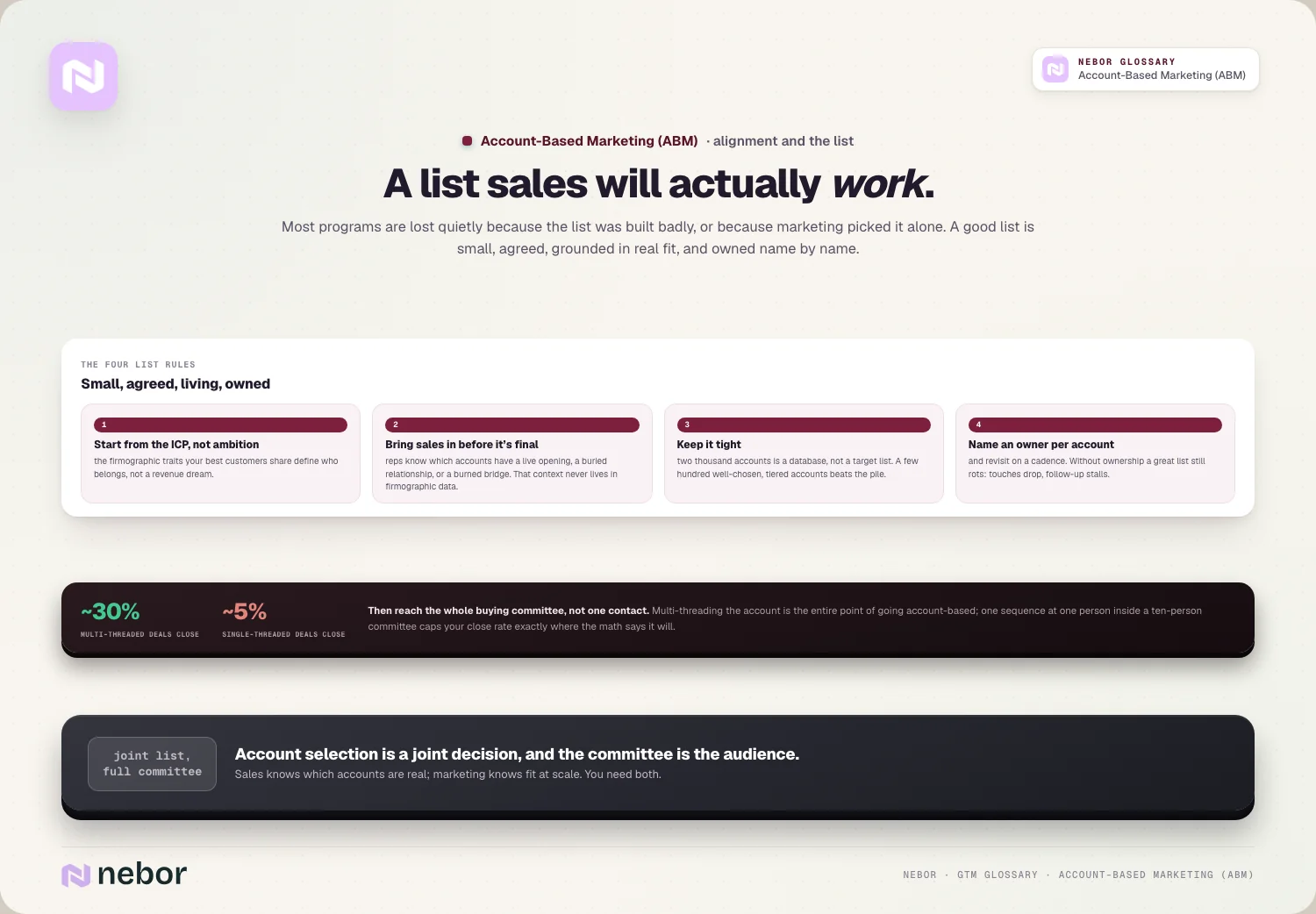
Last of all, treat the list as a living thing, because accounts age out, new ones start to fit, and signals shift. Revisit it on a regular cadence so the program stays pointed at companies that still match.
One more thing makes a list work in practice, and that is ownership. Every account on the list should have a named rep attached to it, so nobody can claim later that the account fell between two people.
Without that, a great list still rots, because touches get dropped and follow-up stalls. With it, the list becomes a real working surface instead of a spreadsheet nobody opens.
How you actually do ABM, from account selection through to orchestration
The sequence that works is boring, and that's exactly why it works. Start by building the target list on fit, with sales and marketing agreeing on the ICP and the tiers.
Map the buying committee inside each account so you know who you're trying to reach. Then personalize by tier, deep for one-to-one, templated but relevant for one-to-few, and signal-driven for one-to-many.
Handle the touches as campaign orchestration inside a wider GTM system, where a real buying signal triggers a coordinated move across channels. This is the heart of signal-based selling applied at the account level.
Score the whole program at the account level, tracking account engagement, pipeline created from target accounts, and win rate, and let the qualification metric move up to the account with a marketing qualified account rather than counting MQLs.
How inbound signals make your account-based marketing far warmer
People hear "account-based" and picture cold outbound into a big company. That's only half the motion, and on its own it's the harder half.
The warmest version of ABM is signal-led. You watch your target accounts for real buying behavior, like a fitting account showing up in your deanonymized website traffic, hitting your pricing page, or a known buyer landing in a new role.
When a signal shows up, you already know two things that cold outbound never does, the account fits and the timing is right now. That turns a guess into a warm, well-timed reach into the committee.
That's the reason inbound-led outbound works so well inside ABM. Inbound tells you which of your chosen accounts are in motion, and the account-based machinery makes sure you reach the whole committee instead of just the one person who browsed.
The accounts were always going to be yours to win, and the signal simply tells you when to move.
It also fixes a timing problem that pure outbound never solves. Cold outbound has no idea whether an account is in a buying window or fast asleep, so you guess and most of your guesses are early.
Inbound signals close that gap for you. When a fitting account starts researching, you know the window is open right now, and you can put your best, most coordinated effort into the few accounts that are warming up instead of spreading it thin across everyone.
That's the real advantage of ABM with your inbound and outbound stitched together. You stop working named accounts on a calendar and start moving on them the moment they show you they're ready.
How you measure account-based marketing without slipping back into lead counting
The fastest way to ruin an ABM program is to keep scoring it like demand gen. If the only number anyone reports is MQLs, the team drifts back toward volume without anyone ever deciding to.
Move the scoreboard up to the account. Track account engagement, meaning how many of the right roles inside a target account are interacting with you beyond one stray form fill.
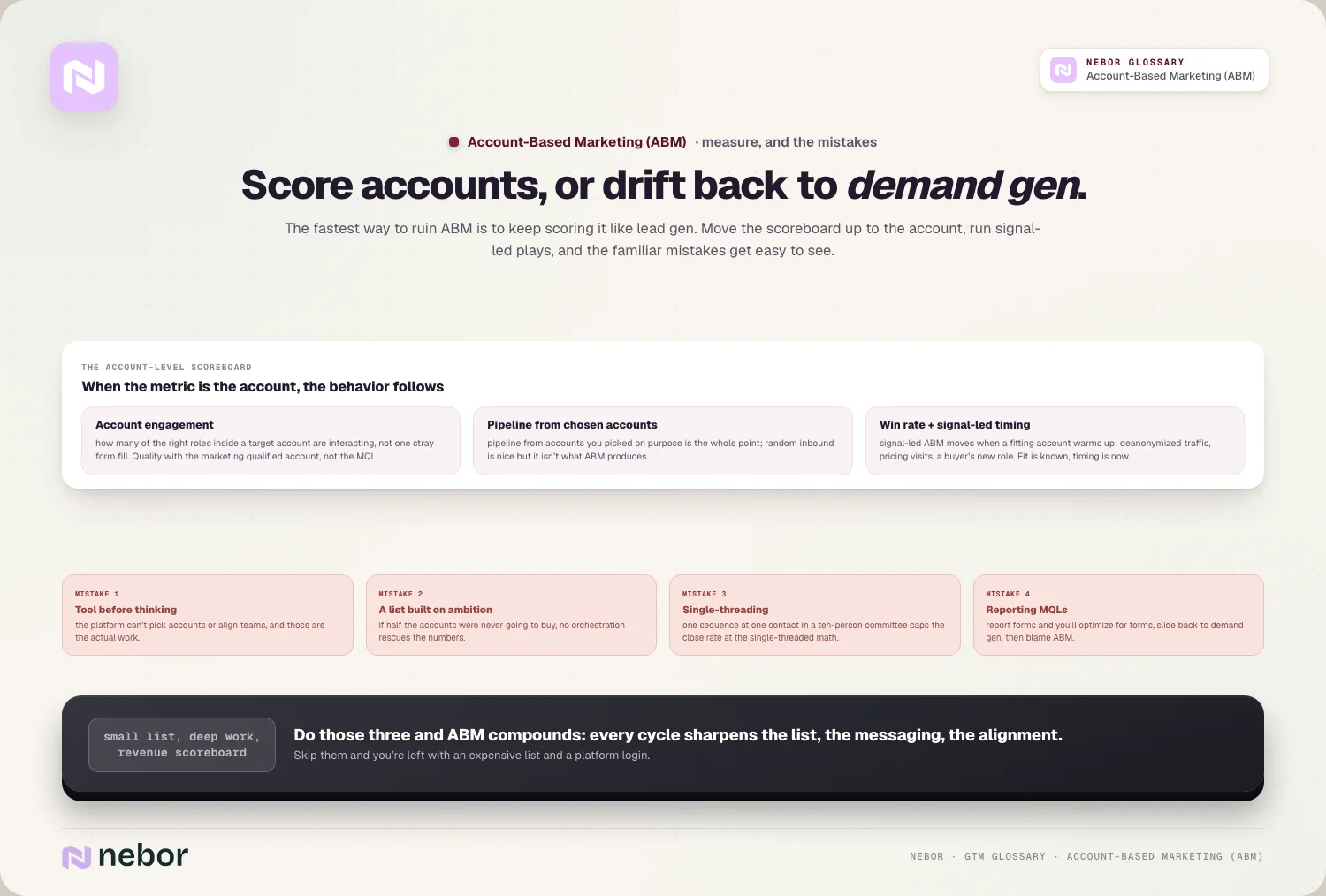
Watch pipeline from target accounts as its own number, because pipeline that comes from accounts you chose on purpose is the whole point. Pipeline from random inbound is nice, but it isn't what ABM is supposed to produce.
Then track win rate and deal size on those accounts, and lean on the marketing qualified account instead of the MQL as your unit of qualification. When the metric is the account, the behavior follows, because nobody gets rewarded for pushing forms at companies that never move.
The mistakes that make ABM look like it failed when the strategy was never really tried
When a team tells us ABM didn't work for them, the strategy is rarely the culprit. Usually one of a few familiar mistakes hollowed it out.
The first is buying the tool before doing the thinking. The platform can't pick your accounts or align your teams, and those two things are the actual work.
The second is a list built on ambition instead of fit. If half your target accounts were never going to buy, no amount of orchestration rescues the numbers.
The third familiar mistake is single-threading the account. One sequence at one contact inside a ten-person committee isn't account-based, and it caps your close rate exactly where the single-threaded math caps it.
The fourth is measuring the wrong thing. If the report is built on MQLs, the team optimizes for forms, slides back into demand gen, and then blames ABM when the pipeline doesn't show up. Once the metric is fixed, a lot of the other mistakes get easier to see.
What separates account-based marketing that compounds from a program that stalls
A forty-account, one-to-few program for a Series B software company shows the difference clearly. Marketing and sales build the list together from a tight ICP, then split it into a dozen one-to-one names and a set of industry clusters.
Each cluster gets content built around its own specific problem instead of a generic deck. The team maps the buying committee in every account, so outreach reaches the economic buyer, the champion, and the evaluator with different messages.
When an account shows a fit and intent match, the play goes out across email, LinkedIn, and a rep call inside days. Success means pipeline from those forty accounts, and the number of forms filled stays out of the conversation.
The list is small, the work is deep, and the scoreboard is revenue from accounts you chose on purpose. If you do those three things, ABM compounds, because every cycle sharpens the list, the messaging, and the alignment.
If you skip them, you're left with an expensive list and a platform login, which is exactly where most of the stalled programs we meet ended up.
Share this post
ABM
Marketing
Glossary
Related glossary items
Understanding the core GTM concepts




Ready to build your pipeline











