

In this post:
Demand capture and demand creation are the two halves of how you generate pipeline, and most teams lean far too hard on one of them. Demand capture means converting the people already looking for a solution like yours. Demand creation means making people want it in the first place.
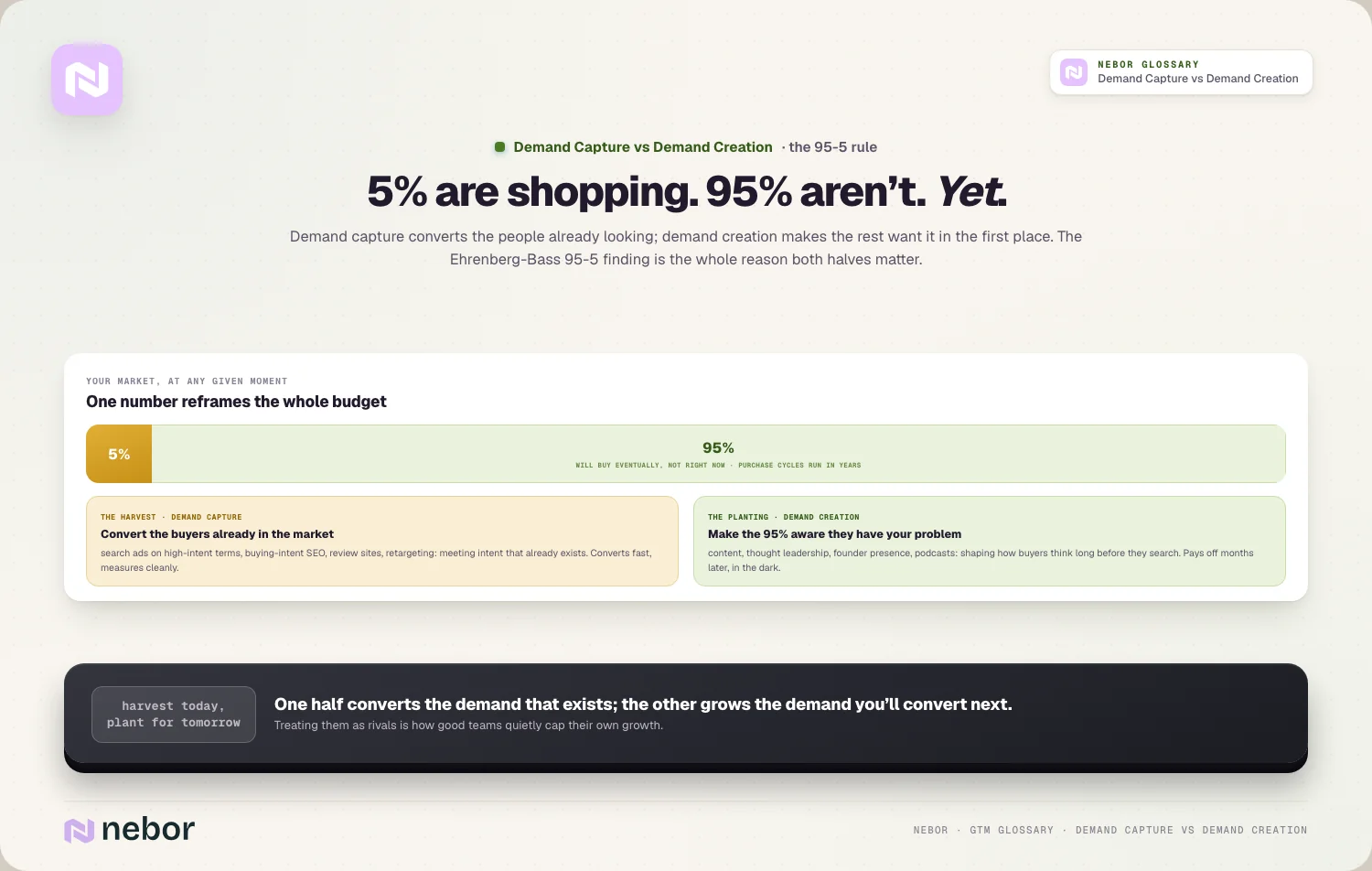
The difference sounds academic until you look at the numbers. At any given moment, only about 5% of your buyers are in the market, and the other 95% aren't ready yet. That split is the whole reason both halves matter.
One half harvests the demand that exists today. The other grows the demand you'll convert tomorrow, and treating them as rivals is how good teams cap their own growth without meaning to.
TL;DR
Demand capture is about converting existing demand, the small slice of buyers actively searching right now. Demand creation is about generating new demand, making the much larger group of not-yet-ready buyers aware they have a problem you can solve.
Most teams over-invest in capture because it's easy to measure. The trouble is that capture only harvests demand that something else created, and there's only so much of it at any one time.
If you only capture, you fight competitors over the same 5% and hit a ceiling. If you only create, you build awareness with no way to convert it. The durable play is to create demand and capture it well, even though only half of that is easy to track.
What does demand capture actually mean for your pipeline this quarter?
Demand capture is everything you do to convert buyers who are already in the market. These are people who have recognized their problem, decided to fix it, and started looking, and your job is to be there when they do.
The tactics are the trackable, bottom-of-funnel ones. Search ads on high-intent keywords, SEO for terms buyers type when they're ready, review-site presence, and retargeting all belong here. They work because they meet buying intent that already exists.
Capture feels great because it converts quickly and measures cleanly. Someone searches, clicks, and books a demo, and you can draw a straight line from spend to pipeline. That clarity is exactly why teams fall in love with it, and why they over-do it.
So what is demand creation, and why is it the harder of the two?
Demand creation is the work of generating interest among people who aren't looking yet. Instead of meeting existing demand, you're building it, by making buyers aware of a problem or planting your name before they ever start a search.
This is the world of content, thought leadership, founder presence, podcasts, and education. It's also where content-led outbound and, at its most ambitious, category design live. You're shaping how people think about their problem long before they're ready to buy.
It's harder than capture for two reasons. The payoff arrives later, often months after the work, and it's much tougher to measure. That combination makes demand creation easy to underfund, even though it's what fills the pipeline capture later drains.
Why does the 95-5 rule decide how you should split your effort?
The split between these two isn't a matter of taste, it's a matter of math. Research for the LinkedIn B2B Institute, carried out by the Ehrenberg-Bass Institute, found that at any given time only about 5% of your buyers are in the market, while 95% are not.
Purchase cycles drive the whole thing, because companies replace a given service every few years, so in any quarter only a small fraction are actively shopping. The other 95% will buy eventually, but not right now.
That single fact reframes the entire plan. If you only ever talk to the 5% buying today, you ignore the 95% who will buy tomorrow, and you compete with everyone else for a tiny, expensive slice of the market.
The rule also explains why brand work isn't fluffy. When the 95% finally enter the market, they remember the names they already trust, so the creation you did months ago is what makes your capture cheap and easy when their moment comes.
How do you tell which bucket any given tactic really belongs in?
This trips up almost every team we advise, because the same channel can do either job depending on how you use it. The honest test is to ask whether the tactic meets demand that already exists or builds demand that doesn't yet.
A high-intent search ad on "best SDR agency" is capture, because the buyer is already looking. A LinkedIn post that teaches a prospect why their current prospecting is broken is creation, because they weren't searching for anything when they read it.
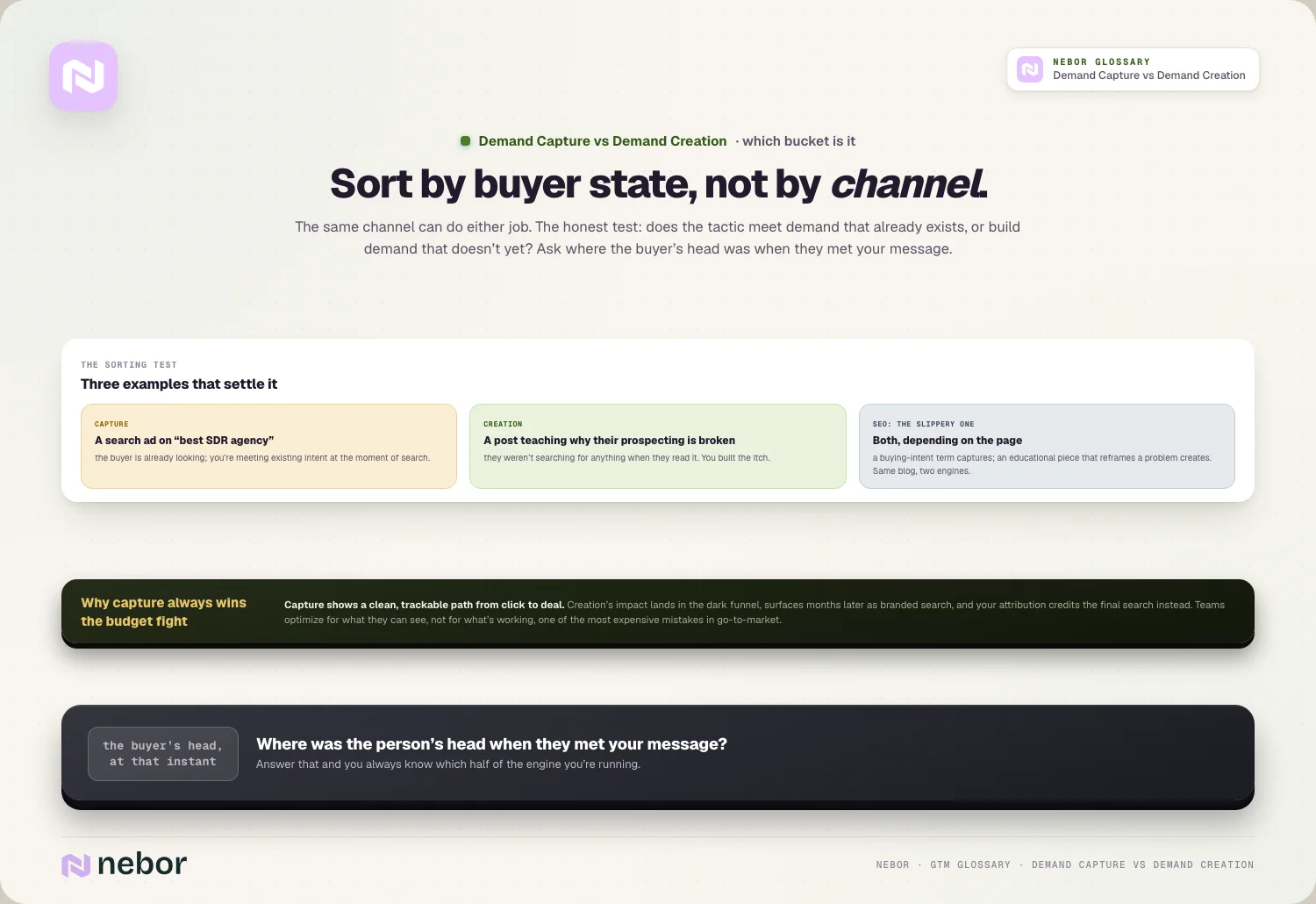
SEO is the slippery one, since it spans both. A page ranking for a buying-intent term like our piece on the best growth agency captures, while an educational article that reframes a problem creates, even though both live on the same blog.
So don't sort by channel, sort by buyer state. Ask where the person's head was the instant they met your message, and you'll always know which half of the engine you're really using.
Why do most teams quietly over-invest in capture and starve creation?
The pull toward capture is almost gravitational, and it comes down to measurement. Capture shows up cleanly in your reports, with a trackable path from click to deal, so it always looks like the more efficient choice.
Demand creation behaves in exactly the opposite way. Most of its impact happens in the dark funnel, where someone hears your founder on a podcast, remembers your name months later, and shows up as branded search. Your multi-touch attribution credits that final search and misses the creation work that caused it.
So teams keep pouring budget into the channel that looks measurable and starving the one that actually feeds it. They're optimizing for what they can see instead of what's working, which is one of the most expensive mistakes in go-to-market.
Why does a capture-only strategy eventually hit a wall?
Leaning entirely on capture feels efficient right up until it doesn't. The problem is that the in-market 5% is a fixed pool at any moment, and you're not the only one fishing in it.
As more competitors chase the same high-intent keywords and ready buyers, the cost of capturing each one climbs, and your customer acquisition cost rises with it. You end up paying more and more to win the same finite demand, with no relationship built before the buyer started shopping.
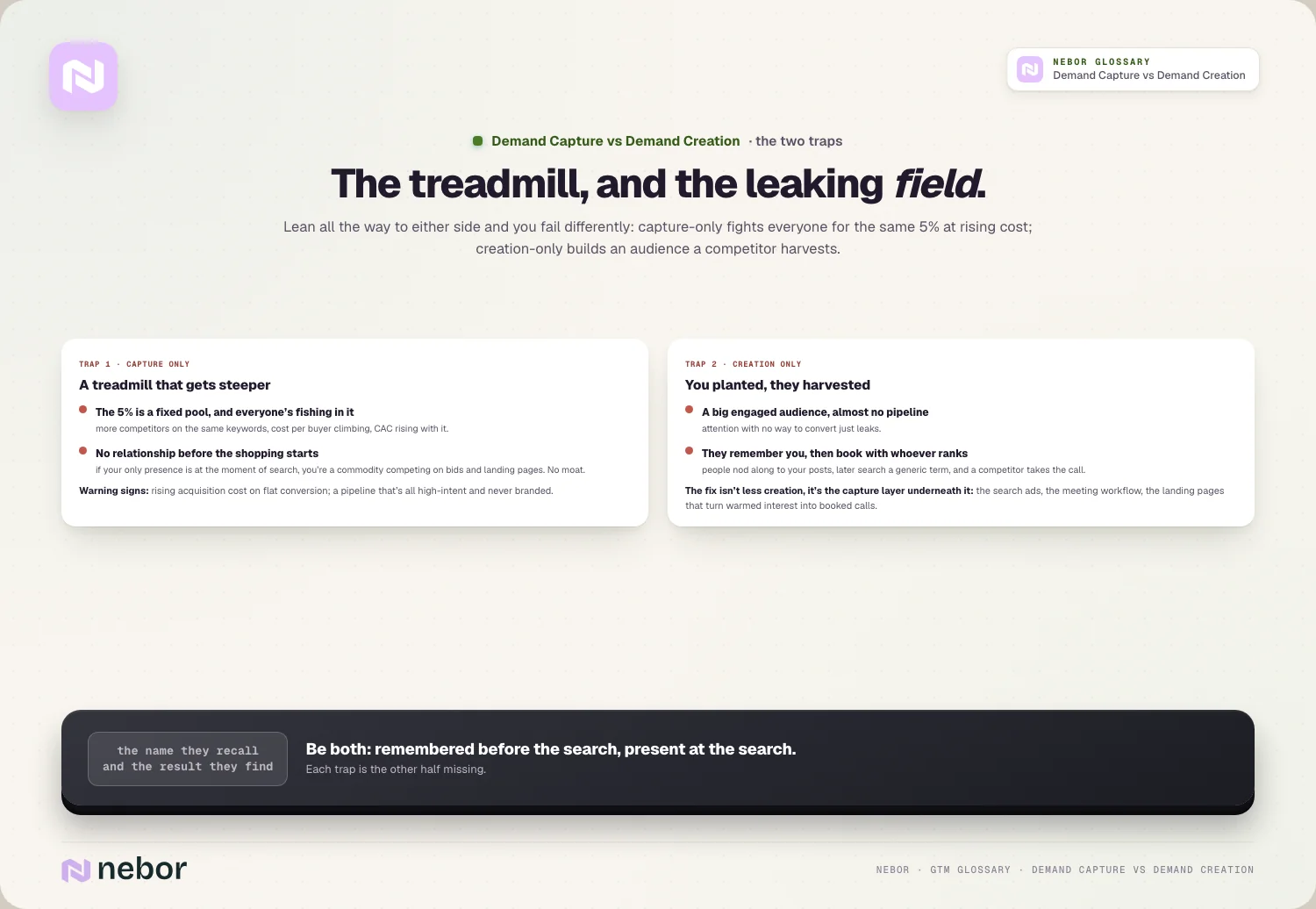
And it builds no moat, because if your only presence is at the moment of search, you're a commodity competing on bids and landing pages. Capture without creation is a treadmill that gets steeper over time.
What happens if you swing too far the other way and only create?
The opposite mistake is just as real, and it tends to hit content-heavy and founder-led teams. You can build a big, engaged audience and still generate almost no pipeline, because you never gave attention a way to convert.
Demand without a path to capture just leaks. People learn your name, nod along to your posts, and then go search a generic term and book a demo with whoever ranks, because you weren't there at the buying moment. You planted the field and let a competitor harvest it.
This is why creation alone is a trap for the impatient and the patient alike. The impatient quit before the payoff, and the patient keep creating without building the search ads, the inbound meeting workflow, and the landing pages that turn warmed-up interest into booked calls.
The fix isn't less creation, it's adding the capture layer underneath it. You want to be the name they remember and the result they find when they finally go looking.
What are the warning signs you've leaned too far into capture?
There are a few tells that show up before the numbers go bad, and learning to read them early saves you a painful quarter. The clearest one is a rising acquisition cost on flat conversion, where you're paying more to win the same buyers you always did.
Another is a pipeline that's almost entirely high-intent and almost never branded. If nobody books a call because they already knew your name, you're harvesting demand other people created and building none of your own.
Watch your win rate against competitors too. If you keep showing up in deals as one of five logos the buyer found by searching, you have no relationship advantage, and you're competing on price and landing pages instead of trust.
And notice if growth stalls the moment you stop spending. A capture-only engine has no flywheel, so it goes quiet the second the ad budget pauses, while a balanced engine keeps producing pipeline from the demand you created months ago.
How should the balance between the two shift as your company grows?
The right mix isn't fixed, it moves with your stage, your budget, and how crowded your category is. Very early, and we tell young companies this plainly, capture often wins by default, because you need revenue now and you can't afford to wait months for creation to pay off.
As you find product-market fit and a bit of budget, you start funding creation deliberately, because you've learned that capture alone is capping you. This is usually when teams build their first real content-led outbound motion and lean into founder presence.
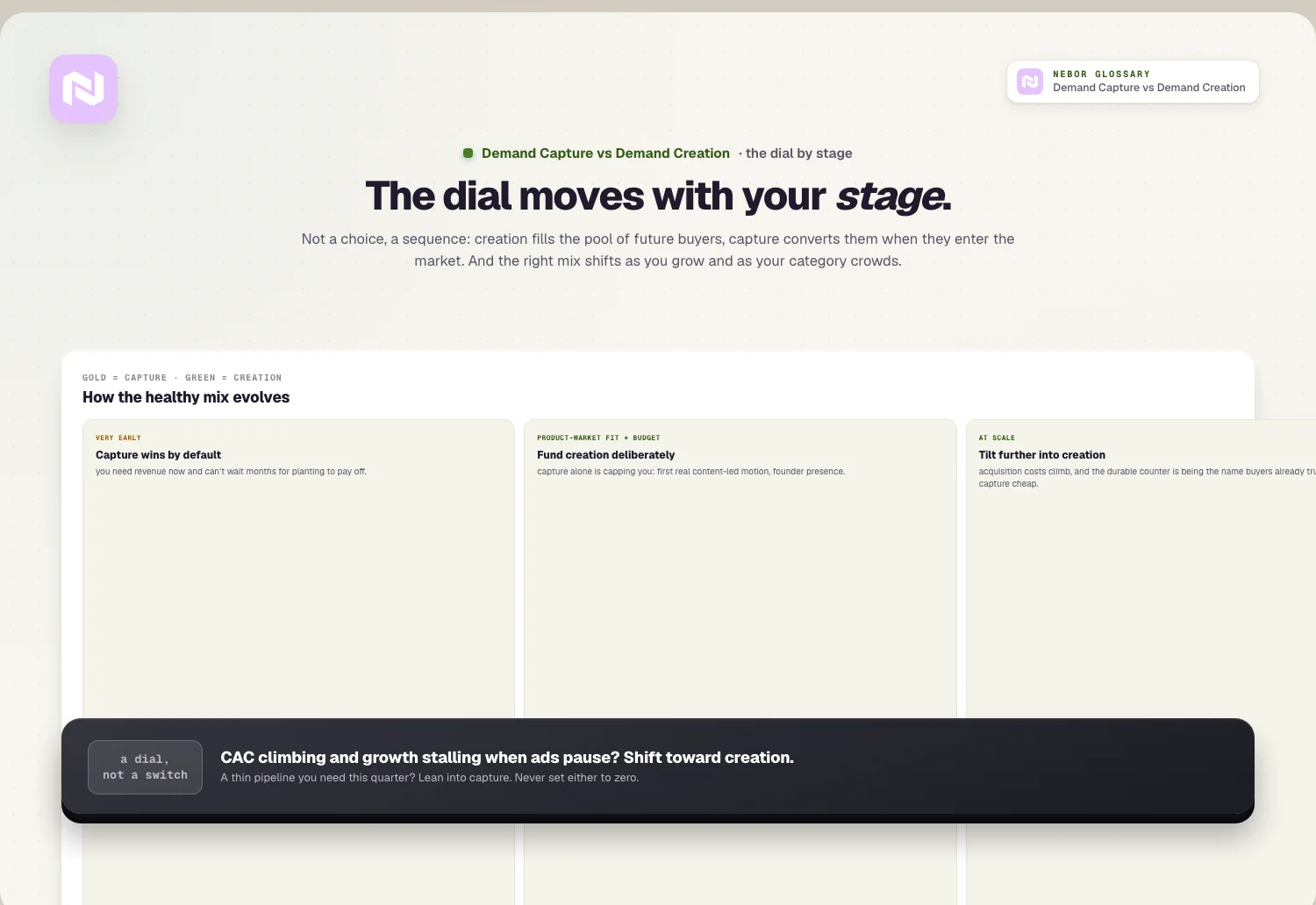
At scale, the weighting tilts further toward creation, because your acquisition costs are climbing and the only durable way to fight that is to be the name buyers already trust. Mature companies invest heavily in brand precisely to keep their capture cheap.
Crowding shifts the math as well, because the more competitors are bidding on the same intent, the more a creation moat is worth. A contested category should push you toward building demand earlier than a quiet one would.
How do demand creation and demand capture work together in practice?
The two form a sequence, with creation filling the pool of future buyers and capture converting them when they finally enter the market. You need the first to keep the second from drying up.
A healthy program does both at once. You create demand patiently, knowing most of it pays off later, and you capture it sharply when buyers raise their hand. A cold-to-warm pipeline is one way the two connect, warming future buyers now so they convert more easily later.
The right balance shifts with your stage. Earlier companies often weight toward capture to drive immediate revenue, while more established ones lean further into creation to lower acquisition costs and build a durable pipeline. What never works is pretending one of them is optional.
What's a simple budget split you can start from and adjust later?
If you're staring at a blank plan, you don't need a perfect formula, you need a reasonable starting point you can adjust. A common rule of thumb borrowed from the same brand research is to weight a healthy chunk of spend toward long-term creation and the rest toward near-term capture.
The exact ratio depends on your stage, but the mistake to avoid is putting creation at zero because it doesn't show up cleanly in reports. Even a modest, steady creation budget keeps your future pipeline from drying up.
Treat the split as something you revisit rather than set once. If your acquisition costs are climbing and growth slows when you pause ads, that's a signal to shift more toward creation, while a thin pipeline you need filled this quarter argues for leaning into capture.
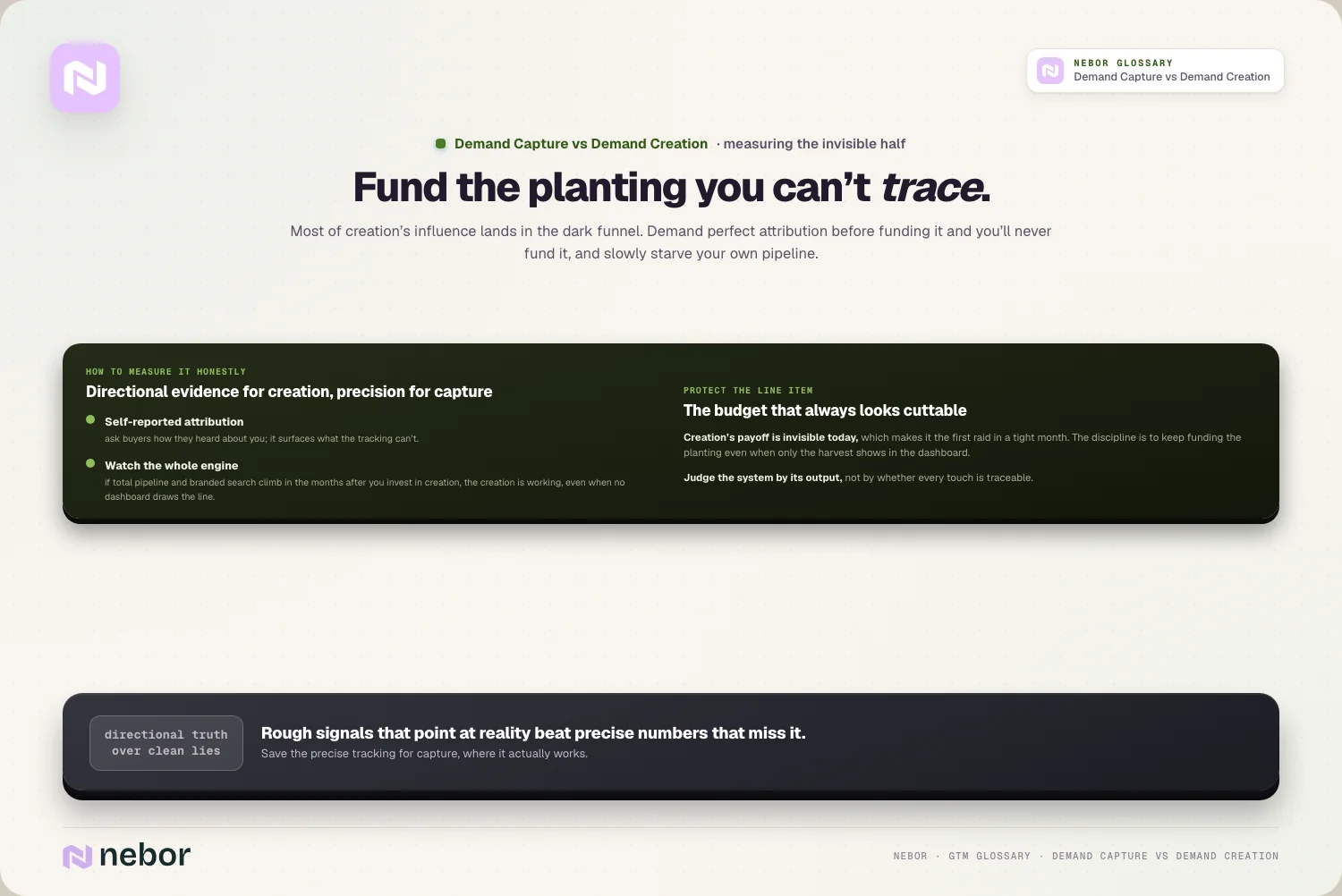
And protect the creation budget from raids. It's the line item that always looks cuttable in a tight month, precisely because its payoff is invisible today, so the discipline is to keep funding the planting even when only the harvest shows up in your dashboard.
Why is measuring demand creation so hard, and what should you do about it?
The honest problem with demand creation is that you can't track it cleanly, and pretending otherwise leads you astray. Most of its influence lands in the dark funnel, invisible to your analytics.
The fix is to change how you measure rather than forcing a false straight line. Lean on self-reported attribution, simply asking buyers how they heard about you, and watch whether overall demand and branded search rise when you invest in creation.
Those signals are rougher than a click report, but they're closer to the truth.
The mindset is to accept directional evidence for the creation work and save precise tracking for capture. If you demand perfect attribution before funding creation, you'll never fund it, and you'll slowly starve your own pipeline.
A useful habit is to look at the whole engine instead of each channel in isolation. If total pipeline and branded search climb in the months after you invest in creation, the creation is working, even if no single dashboard can draw the line for you.
Judge the system by its output instead of by whether every touch is traceable.
Why capture only ever harvests what creation has already planted
Farming is the honest picture for all of this. Demand creation is planting, and demand capture is harvesting. You can harvest as efficiently as you like, but you can only bring in what was planted, and if nobody planted anything, there's nothing to capture except what your competitors grew for you.
That's why the strongest teams don't treat these as rival budgets fighting for the same dollar. They plant steadily through content, thought leadership, and trust, accepting that most of it pays off later, and they harvest sharply when buyers are finally ready.
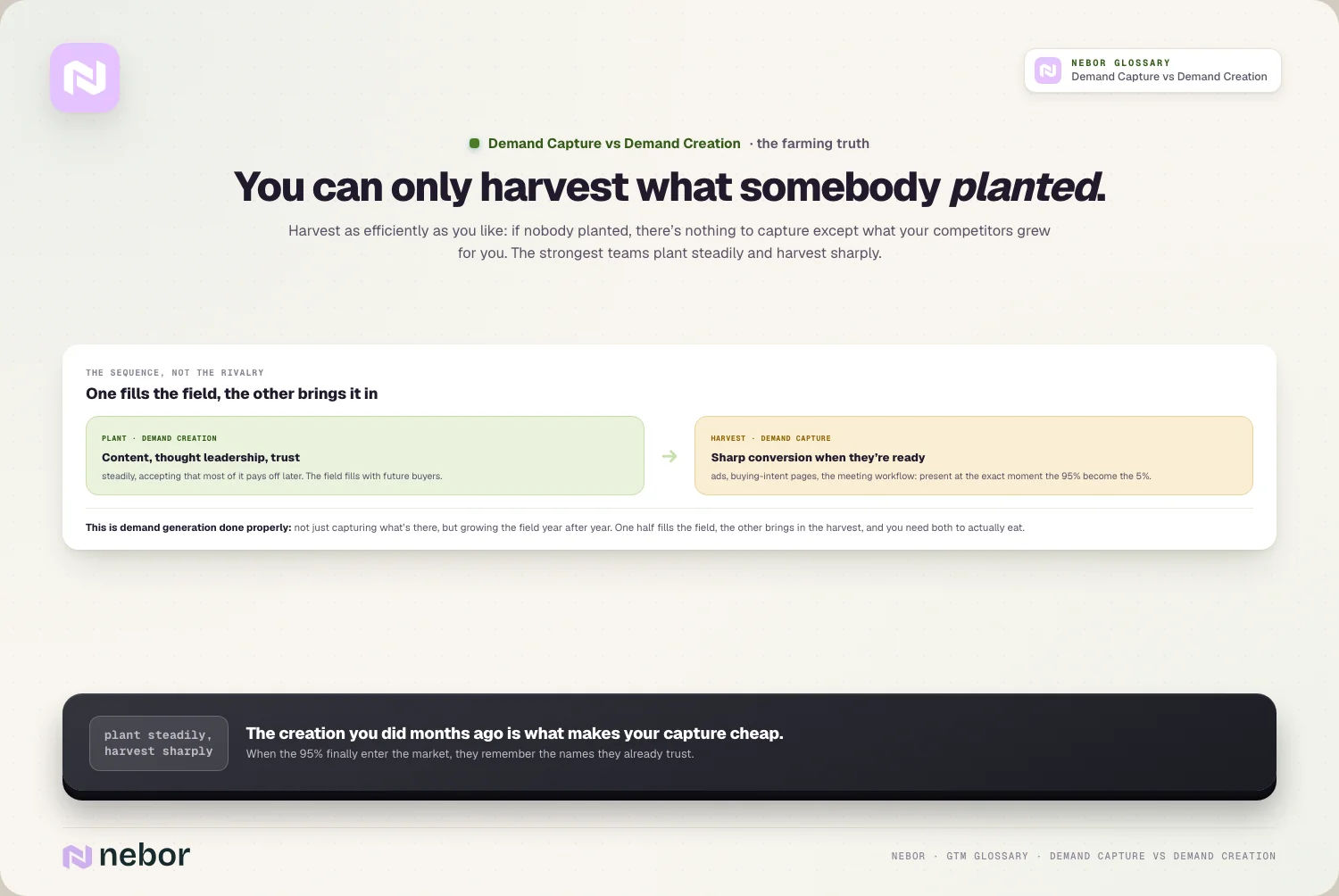
This is also the deeper meaning behind demand generation done properly, which goes beyond capturing what's there and grows the field year after year. One half fills the field and the other brings in the harvest, and you need both if you want to eat.
Share this post
Marketing
Glossary
Related glossary items
Understanding the core GTM concepts




Ready to build your pipeline











