

In this post:
Most reps work a deal through one person. They find a friendly contact, build rapport, and pour all their energy into that single relationship. It feels efficient, and it's how the majority of deals get worked.
It's also how the majority of deals die without a visible cause.
Multi-threading is the practice of building relationships with several people inside the same target account at once, instead of relying on one contact to carry the whole deal. It means engaging the buying committee instead of a single champion.
The term shows up most in B2B sales, where purchases are rarely one person's decision. The bigger the deal, the more people are around the table, and multi-threading is how you sell to all of them instead of hoping your one contact sells for you.
TL;DR
Multi-threading means engaging multiple stakeholders in an account at the same time, usually three to five or more, rather than working the deal through a single point of contact.
Modern B2B buying is a group decision, and the average deal now involves around 10 to 11 stakeholders, so one relationship leaves most of the room uncovered.
The payoff is large, because single-threaded deals close at roughly 5%, while multi-threaded ones with five or more people engaged close at around 30%.
The strange part is that most teams still don't do it. The majority of opportunities are in the CRM with one contact attached, which is the single most common reason a deal stalls when your champion goes quiet.
So what does multi-threading mean once you get past the buzzword?
Multi-threading means you deliberately build more than one relationship inside an account you're trying to win. Instead of a single thread of communication, you weave several.
In practice that's the difference between knowing one director and knowing the director, their VP, a peer in another department, and the person who'll actually sign.
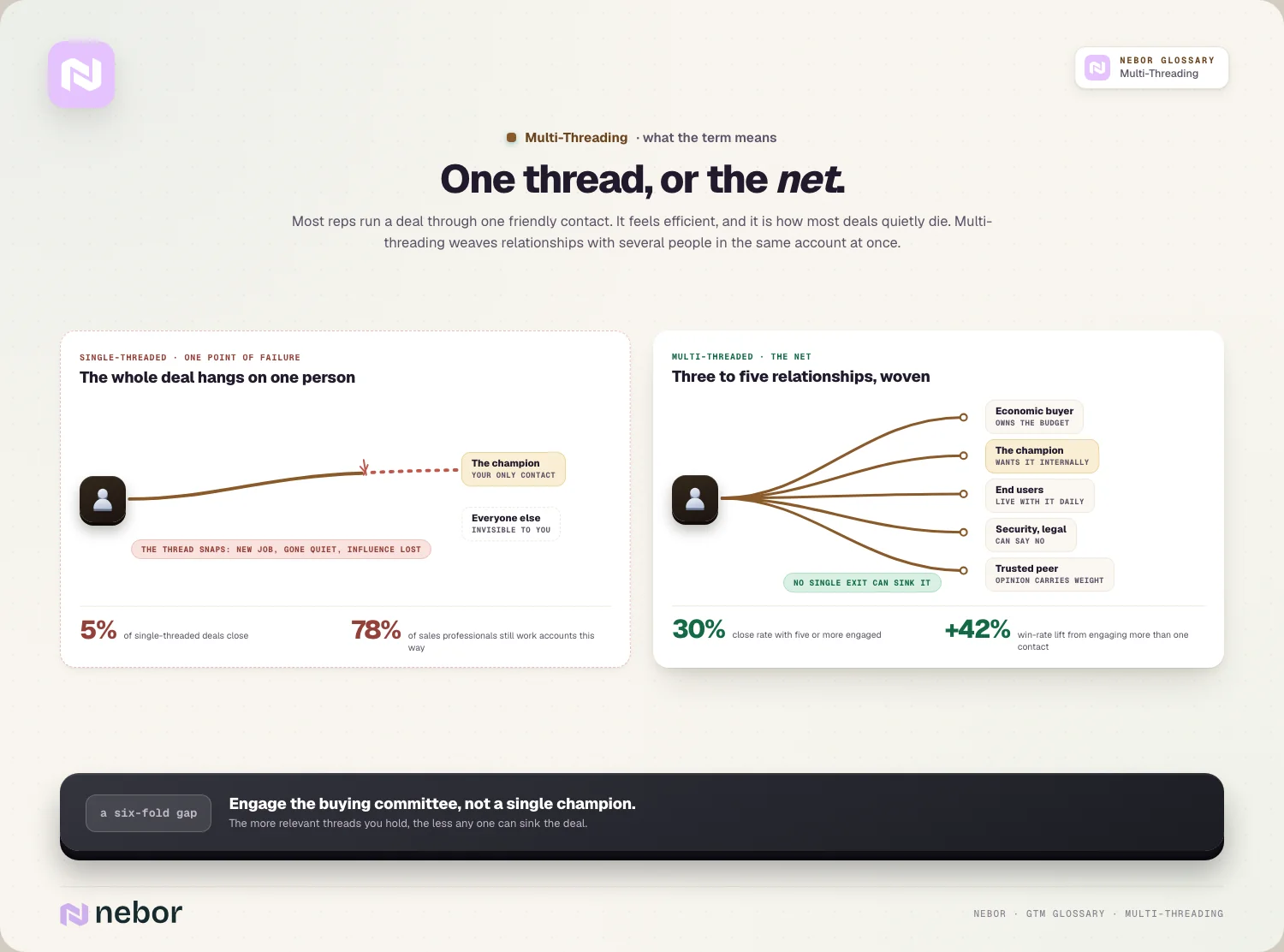
Each of those relationships is a thread. The more relevant threads you hold, the less any single one can sink the deal.
Let's also be clear about what it isn't, because multi-threading isn't spamming everyone in the company with the same pitch. You map the specific people involved in this decision and engage them with messages that fit their role, without blasting every email you can find.
Why has multi-threading become non-negotiable in modern B2B?
The simple reason is that buying changed. A decade ago you could sell to one decision-maker, and today almost nobody buys alone.
The average B2B purchase now pulls in roughly 10 to 11 stakeholders, and enterprise deals can climb past fifteen. Finance, security, legal, and the actual users all weigh in.
If you only know one of those people, you're blind to most of the decision. You can't see the objections forming in rooms you're not in, and you can't answer them.
There's also the fragility problem, because when a deal rides on one contact, that contact is a single point of failure.
They get a new job, they go on leave, they lose internal influence, or they simply stop replying to your team. If they were your only thread, the deal goes dark and you never quite know why.
Multi-threading fixes both problems at once, giving you eyes across the committee, and it means no single person leaving can kill the deal.
How much does single-threading really cost you in closed deals?
The gap between the two approaches is bigger than most people expect, and it matches what we watch happen in real pipelines, because this is anything but a small optimization.
Single-threaded deals close at about 5%, while multi-threaded deals with five or more stakeholders engaged close at around 30%, a six-fold difference.
Even partial multi-threading helps, because engaging more than one contact on a deal lifts win rates by roughly 42%, and the effect grows on larger deals.
The frustrating part is the adoption gap. Despite all this, around 78% of sales professionals still take a single-threaded approach on the accounts they're trying to close.
That gap is also your opening, because if most of your competitors work deals through one person, the team that maps the whole committee has a structural edge.
So who exactly should you be threading into a target account?
The honest first step is to figure out who's really involved, because it's usually more people than your champion admits. Buying committees are bigger and quieter than they look.
A useful way to think about it is by role in the decision instead of job title. You want the economic buyer who controls the budget, the champion who wants this internally, and the end users who'll live with it.
This is where a clear ideal customer profile starts paying you back. It tells you which roles tend to matter in your kind of deal, so you're mapping a known shape instead of starting from a blank account every time.
You also want the people who can say no. That's often security, legal, finance, or procurement, the folks who don't buy your product but can block it.
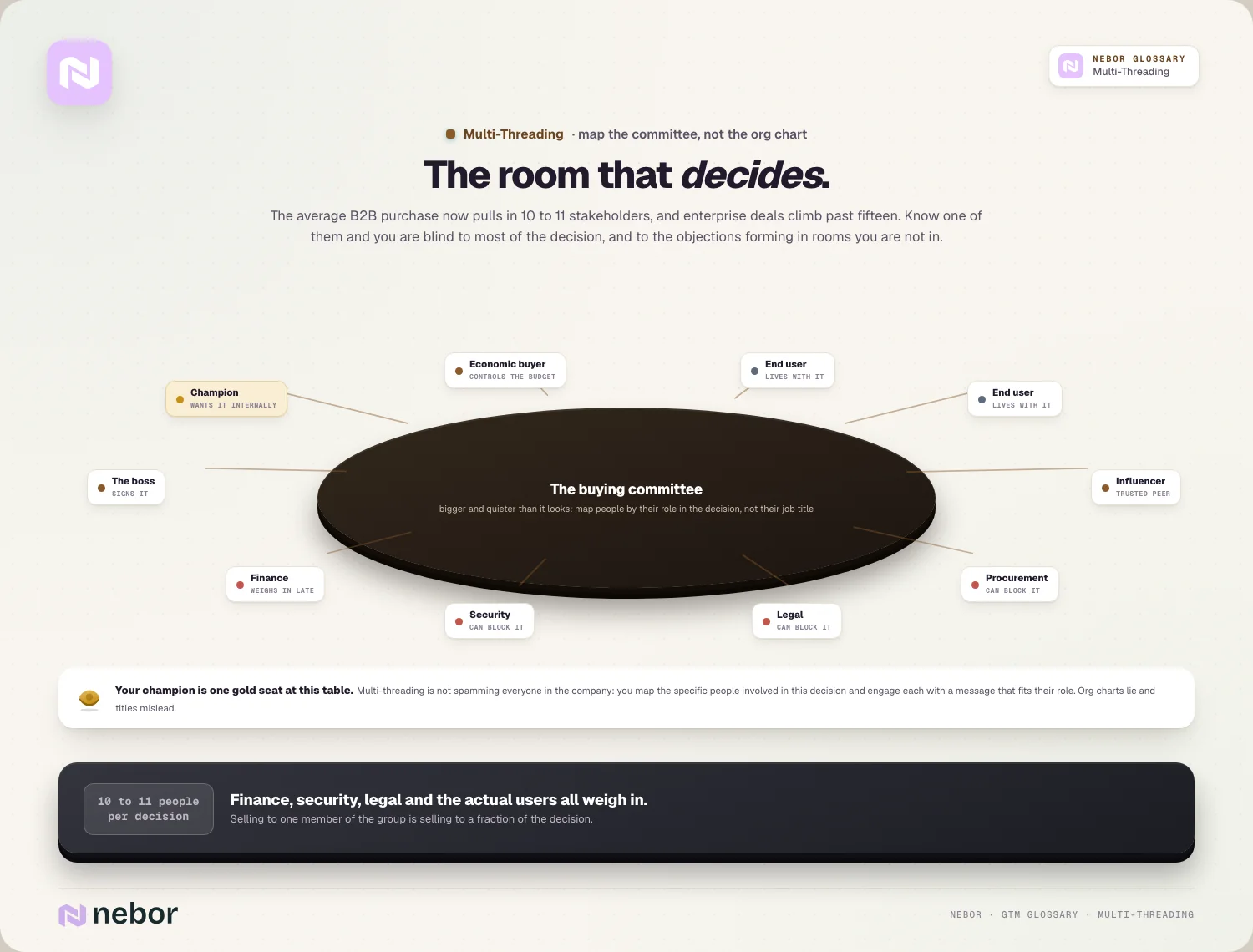
And then there are the influencers, the peers and advisors whose opinion your champion trusts, even if they have no formal seat in the process.
Finding these people is its own skill. Org charts lie and titles mislead, and that's the reason a repeatable way to find the decision makers automatically beats guessing from a LinkedIn search.
This is also where it connects to account-based marketing, because ABM and multi-threading share the same core unit. You work the account as a whole instead of a single lead.
How do you multi-thread without annoying everyone at the account?
The fear that stops most reps is reasonable, and clients ask us about it constantly. They worry that contacting several people at one company will feel pushy, or that going around their champion will burn the relationship.
When it's done carelessly, it does, so the method matters as much as the intent.
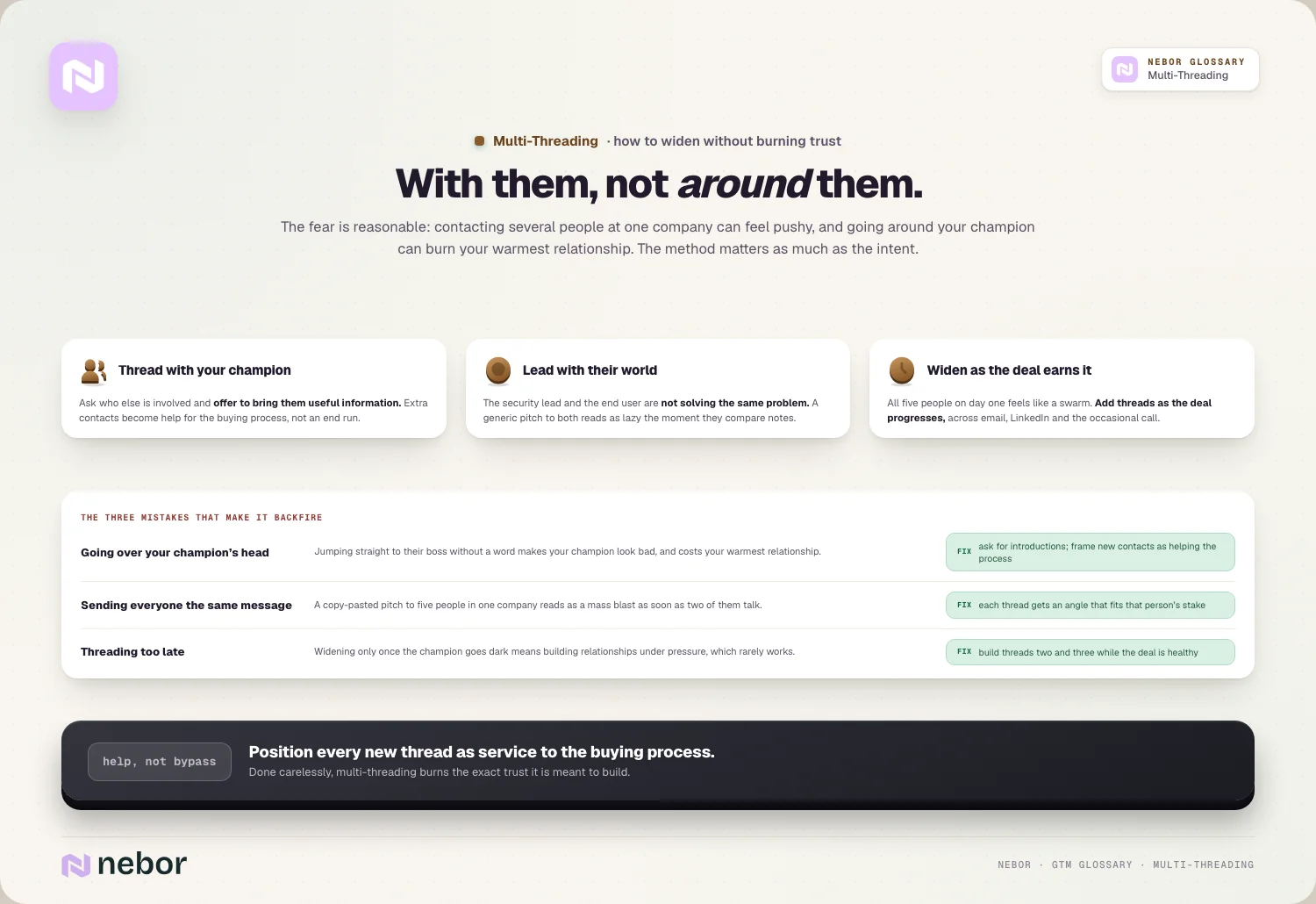
The cleanest move is to thread with your champion instead of behind them. You ask who else is involved and offer to bring them useful information, which positions extra contacts as help rather than a way around them.
When you do reach others directly, lead with relevance to their world. The security lead cares about a different thing than the end user, so the same generic pitch to both reads as lazy.
Timing helps too, because you don't need to engage all five people on day one, which would feel like a swarm. You widen the threads as the deal earns it, the same patient logic behind good multi-channel outreach.
Spreading across channels makes all of this easier, because reaching different stakeholders by email, LinkedIn outreach, and the occasional call lets you meet each person where they pay attention.
Where does multi-threading start, on outbound or on inbound?
People assume multi-threading is purely an outbound, sales-led tactic. It's just as important on the inbound side, and arguably easier there.
When a lead comes in warm, you already have a foot in the door. The mistake is treating that warm contact as the whole account instead of your entry point into it.
A single inbound form fill is a thread. The job is to use it to map and reach the rest of the committee before the first real conversation.
This is exactly what a good inbound meeting workflow does. It identifies the buying committee behind a single booking so you walk into the call already multi-threaded.
It's a core part of inbound-led outbound too. One person raising their hand is a signal to engage their colleagues on top of replying to them.
So the answer is both sides at once. Outbound multi-threading maps a cold account from scratch, while inbound multi-threading expands outward from a warm signal, and the skill is the same.
What signals tell you it's time to add another thread to a deal?
Multi-threading isn't a one-time setup, it's something you keep doing as the deal moves. Reading the right cues tells you when to widen.
The most obvious cue is your champion going quiet. If replies slow down, that's not the moment to wait politely, it's the moment you're grateful you built other threads.
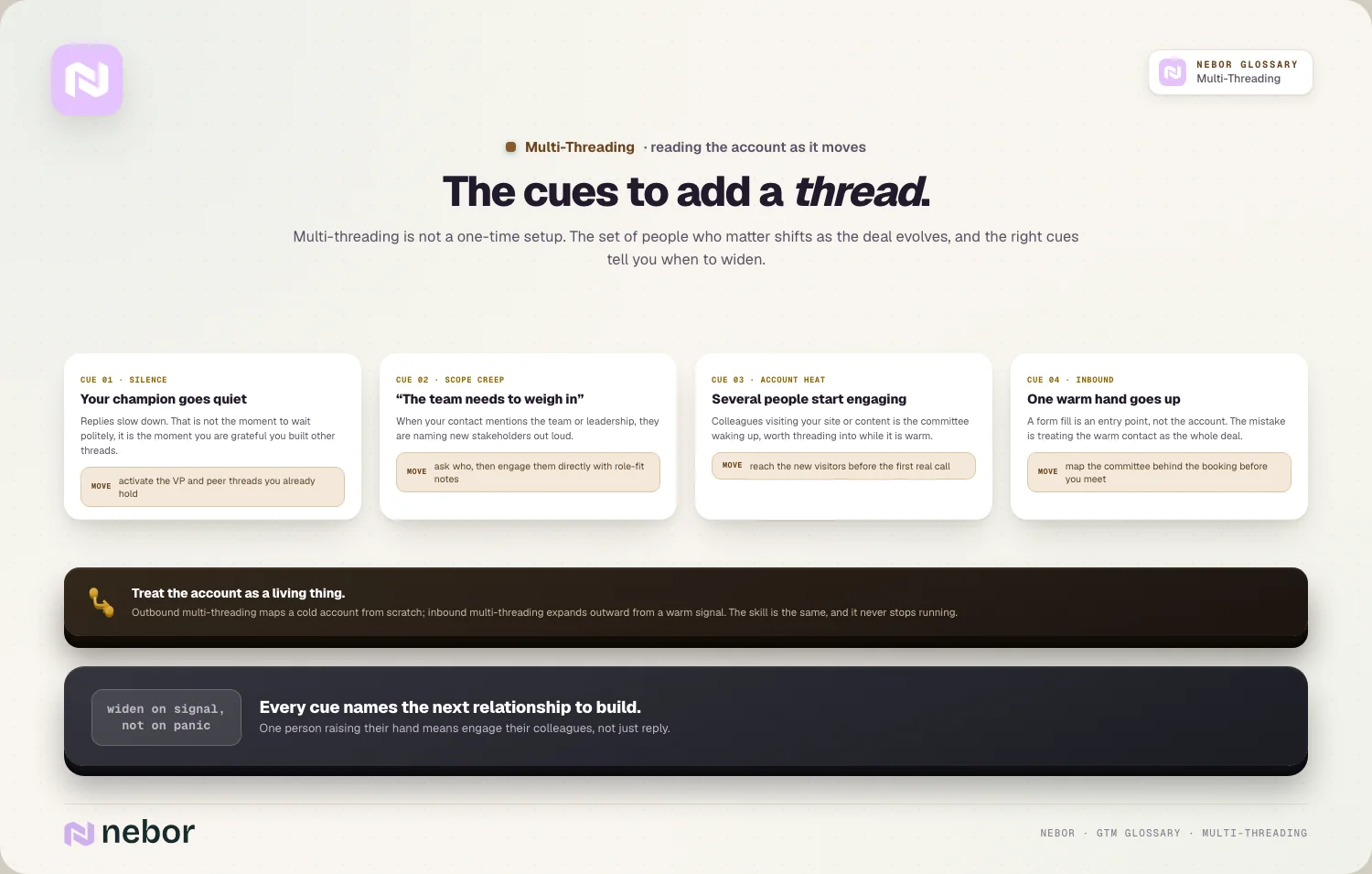
Scope creep is another cue, because when your contact mentions that "the team" or "leadership" needs to weigh in, they're naming new stakeholders you should be engaging directly.
Buying signals across the account are a cue too. If several people from one company start engaging with your content or site, that's the committee waking up, and worth threading into.
The point is to treat the account as a living thing. The set of people who matter shifts as the deal evolves, so your threads should shift with it.
How do you keep all these threads straight across a full pipeline?
Holding four or five relationships per account in your head works for one deal. It falls apart across a full pipeline, which is why multi-threading needs a system on top of discipline.
The foundation is your CRM actually reflecting reality. Most don't, because roughly 70% of opportunities still have a single contact attached, which means the data itself is single-threaded.
The first fix costs nothing at all. Every real stakeholder gets logged against the account, with their role in the decision, so the deal's true shape is visible to anyone who looks.
From there, tooling does the heavy lifting. Enrichment fills in the committee, and a Clay-style build can surface who's missing from an account and prompt you to engage them.
That's the same backbone behind any system that can automate sales prospecting and fit inside a wider go-to-market system. Multi-threading becomes one job that engine handles instead of a manual chore.
What multi-threading looks like inside one real deal, played two ways
It helps to see the difference play out, because the abstract version sounds obvious while the single-threaded trap is easy to fall into. Here's the same deal played two ways.
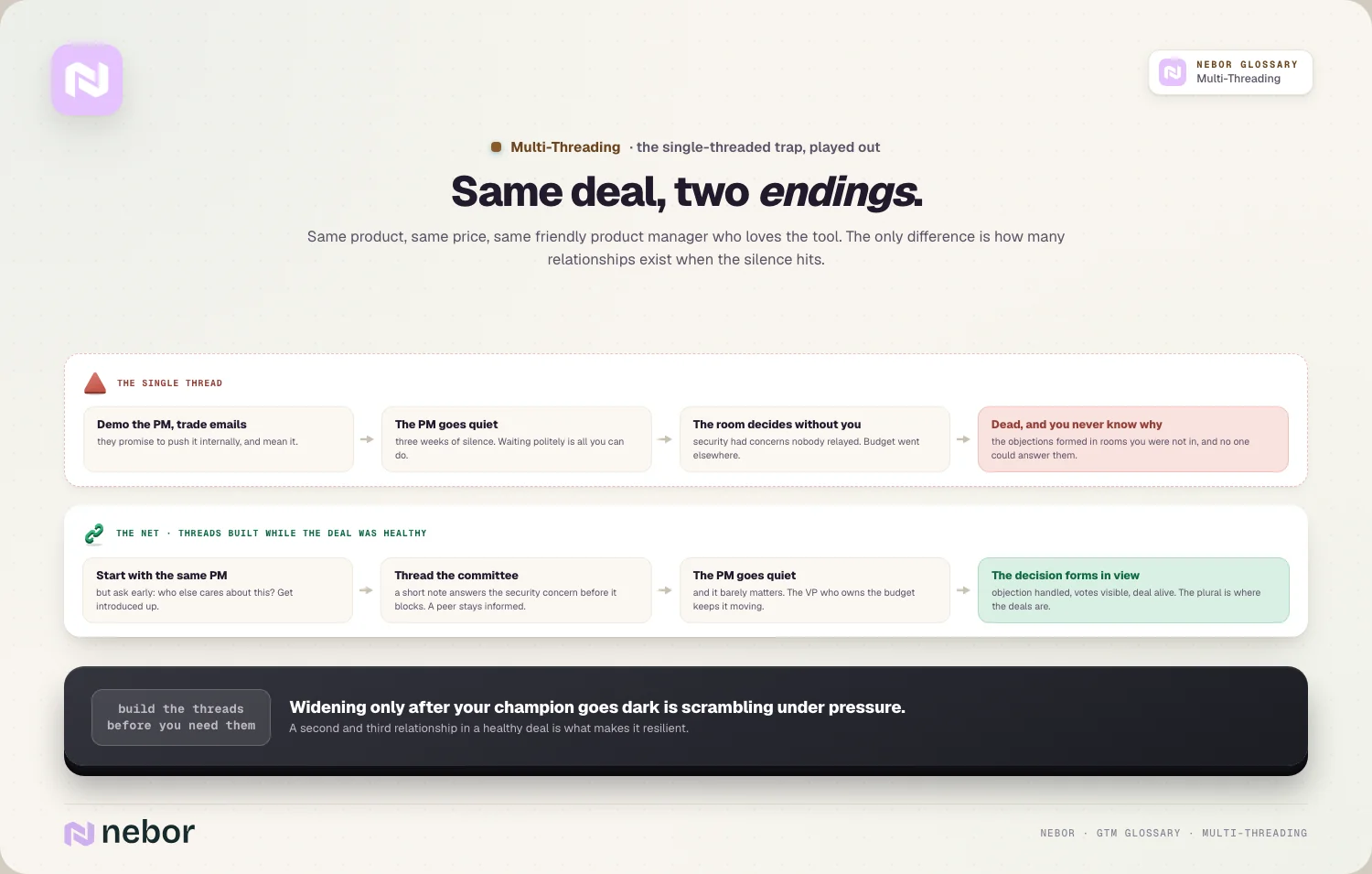
In the single-threaded version, a rep connects with a friendly product manager who loves the tool. They demo, they trade emails, and the PM promises to push it internally.
Then the PM goes quiet for three weeks. When they resurface, the budget went elsewhere, security had concerns nobody relayed, and the rep never had a chance to respond. The deal is dead and the rep barely understands why.
In the multi-threaded version, the rep starts with the same PM. But early on they ask who else cares about this and get introduced to the VP who owns the budget.
They send the security lead a short note answering the concern before it becomes a blocker. They keep a peer in a neighboring team informed because that person's vote carries weight.
When the PM goes quiet, it barely matters. The VP keeps the deal moving, the security objection is already handled, and the rep can see the decision forming in real time. Same product, same price, completely different outcome.
The mistakes that make multi-threading backfire on good reps
Multi-threading can go wrong, and when it does it usually traces back to a handful of avoidable errors. Knowing them upfront saves a lot of burned trust.
The first is going over your champion's head. If you jump straight to their boss without a word, you can make your champion look bad and lose your warmest relationship in the account.
The fix is to thread through them where you can. You ask for introductions and frame extra contacts as a way to help the buying process rather than bypass it.
The second is sending everyone the same message. A copy-pasted pitch to five people in one company reads as a mass blast the moment two of them compare notes.
Each thread needs an angle that fits that person's stake in the decision. The finance contact and the end user are not solving the same problem.
Threading too late is the third, because if you only widen out once your champion goes dark, you're scrambling to build relationships under pressure, which rarely works.
The threads have to exist before you need them. Building a second and third relationship while the deal is healthy is what makes you resilient when it isn't.
How do you measure whether you're really multi-threaded or not?
Most teams think they multi-thread more than they do, and in our experience it pays to measure it honestly instead of going on gut feel. A few simple numbers tell the truth.
The most basic is contacts per opportunity. If your open deals average one or two contacts each, you're single-threaded no matter what the playbook says.
A healthier target is several engaged stakeholders per active deal, with engaged meaning they've replied or shown interest, because logged but cold contacts don't count.
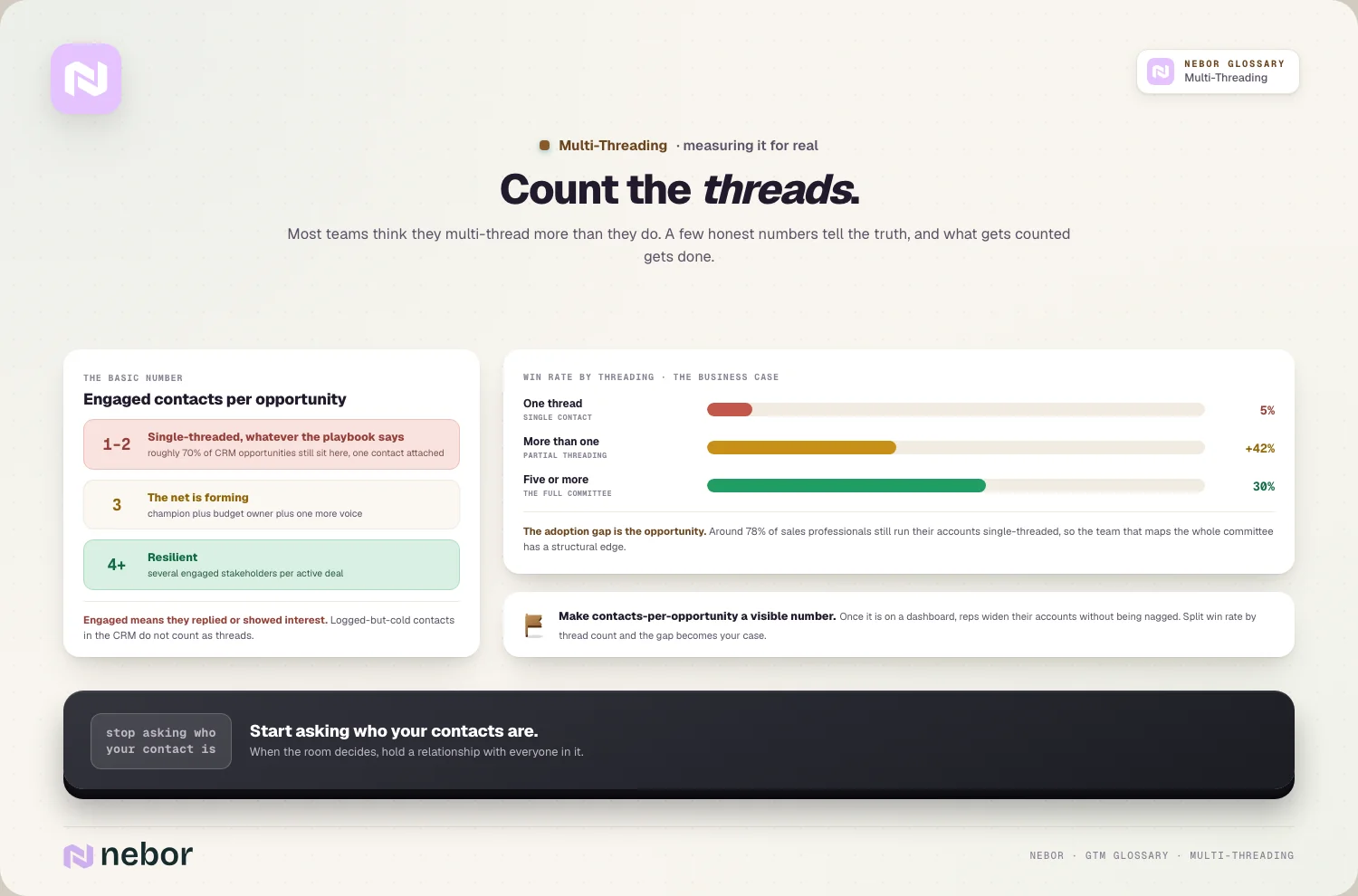
Win rate split by thread count deserves tracking too. If deals with four or more contacts close far better than deals with one, that gap is your business case for threading harder.
Crediting the right touches across all those people is its own challenge, which is where multi-touch attribution comes in. It keeps you from over-rewarding the last conversation and ignoring the threads that set up the win.
The point of measuring is behavioral in the end, because what gets counted gets done, and once contacts per opportunity is a visible number, reps start widening their accounts without being nagged.
Why the plural in contacts is where the bigger deals get won
Multi-threading, past all the tactics, comes down to one idea. A deal is a decision made by a group, so selling to one member of that group is selling to a fraction of the decision.
Single-threading feels safe because one relationship is easy to manage. But that comfort is exactly what makes it fragile, since the whole deal now depends on a person you don't control.
The teams that win bigger deals aren't necessarily better at the pitch. They're better at making sure that when the room decides, they have a relationship with everyone in it.
That's the real shift, moving from who your contact is to who your contacts are. The plural is where the deals are.
Share this post
Outbound
Conversations
RevOps
Glossary
Related glossary items
Understanding the core GTM concepts




Ready to build your pipeline