
8 Best Cold Calling Agencies in 2026 (And What Most of Them Get Wrong)

In this post:
Cold calling still works in B2B going into 2026. What does not work is the way most teams set it up.
If you are reading this, your reps probably spend more time hunting for leads, updating spreadsheets, and leaving voicemails than they spend talking to qualified prospects.
When they do get a real human on the phone, the conversation goes cold because the rep walked into it without research or context.
Maybe you tried hiring SDRs internally and watched ramp time eat your quarter before anyone booked a real meeting. Or you outsourced before and got burned by generic scripts, unqualified meetings, and dials that pretended to be a pipeline.
Either way, you need a clearer path forward, one that tells you which cold calling agencies actually deliver and which ones just book meetings on paper.
You also want to know whether the traditional cold-caller-as-a-service motion is the right shape for the way you sell at all.
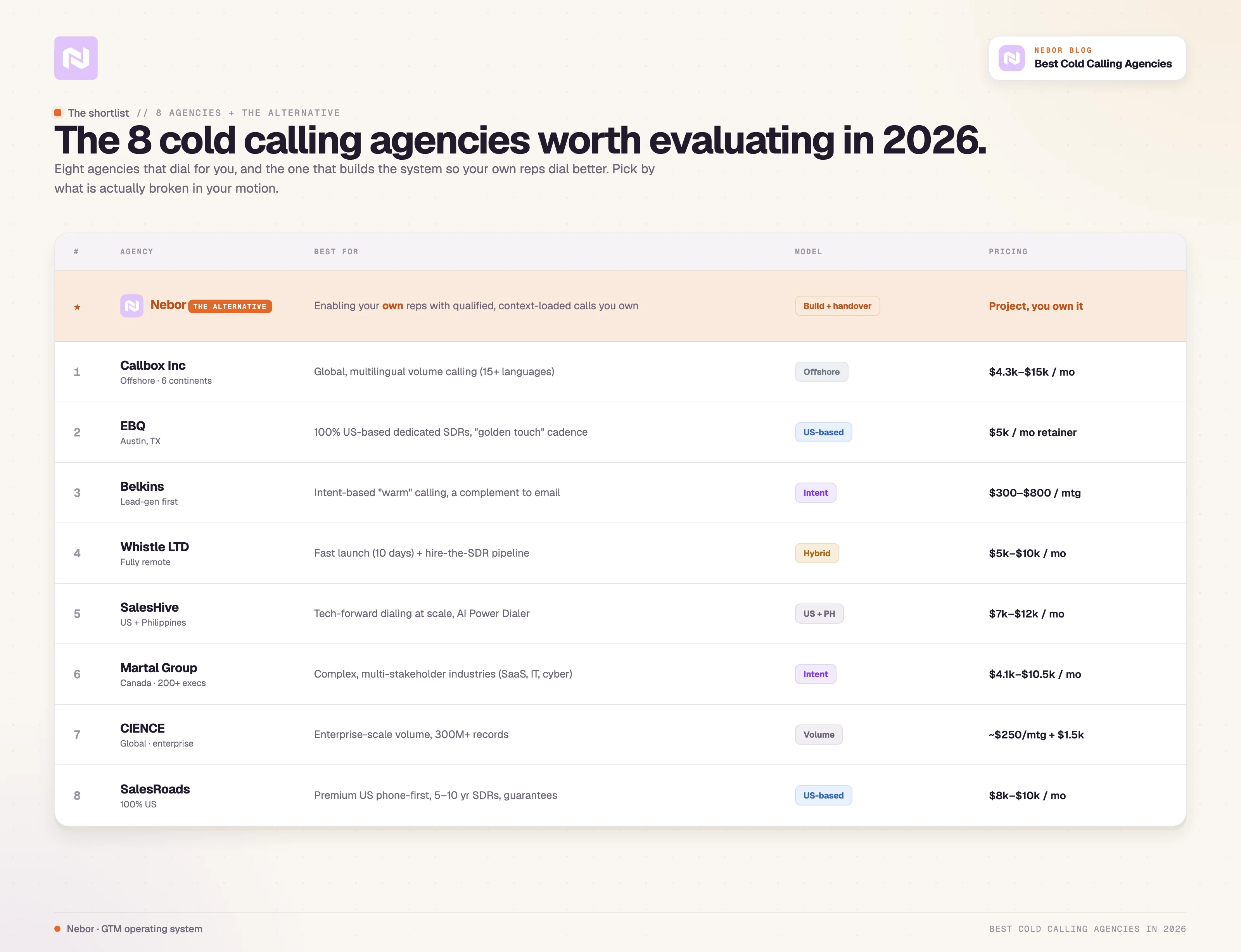
This post breaks down the 8 cold calling agencies worth evaluating in 2026.
It also walks through how we approach the problem at Nebor, where we do not do cold calling for clients but build the workflows, buying signals, and data systems that make our clients' own callers far more effective.
Let’s get started.
Note: Most cold calling agencies sell you dials. More callers, more hours on the phone, and a script that assumes whoever picks up has a reason to care.
We don't put people on phones. We build what your existing callers are missing: a number that connects, a reason the company is worth calling this week, and something true to say in the first sentence. Your reps stop spending the morning assembling the list they'll call in the afternoon.
All of it is built in your own accounts, so the day we finish you keep the machine that feeds the phone.
Book a 15-minute call and we'll show you how it would work for your team.
TL,DR
How Nebor enables your cold calling/lead generation and why we are the best agency for your needs
First thing you should understand about us is that Nebor does not do cold calling for businesses. We do not have a floor of SDRs or cold callers dialing through lists on your behalf.
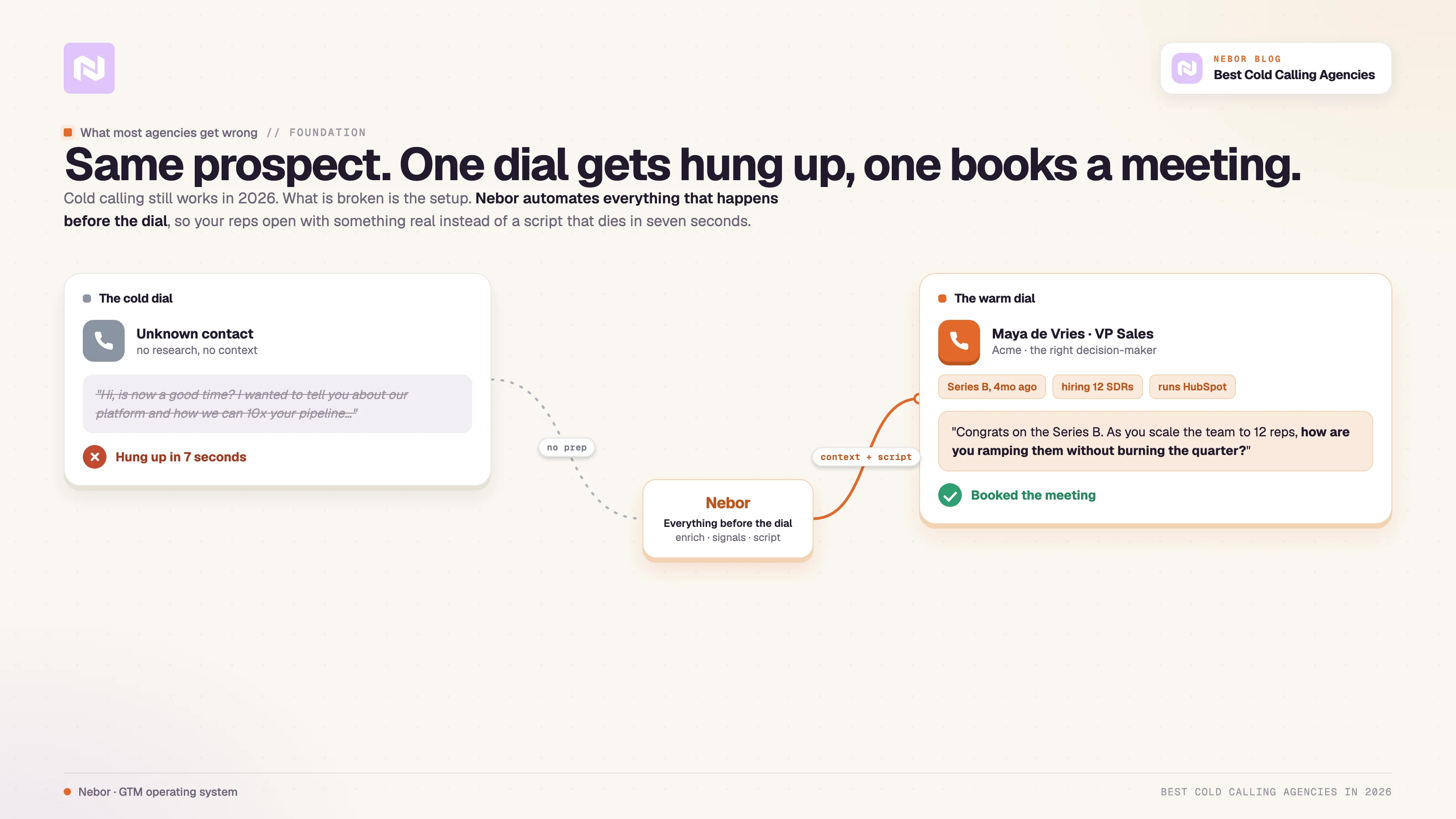
What we do build is outbound prospecting and sales workflows that make your cold calling dramatically more effective. The outcome is that your reps walk into every call with sales-qualified context, instead of dialing through cold lists hoping someone picks up.
Think about what separates a great cold caller from an average one.
Confidence and a clean script help, but neither matters if the rep does not know who they are calling, why that prospect should care, and what to say that connects to something real in the prospect's world.
That is exactly what we build for you. We are a GTM infrastructure agency founded by former salespeople who spent over a decade doing outbound themselves before they ever built automation for clients.
We take the calling process you already have and automate everything that happens before the rep picks up the phone, so your callers spend their day in real conversations instead of in research tabs.
Andrew and Yannick (our founding team) both come from senior sales backgrounds. We understand the pain of prospecting because we ran the dials ourselves before we ever wrote a Clay workflow.
Our approach is structurally different from traditional cold calling agencies. We build workflows that keep going long after the engagement ends, feeding your team with new opportunities every day without you having to think about it.
Here is a quick walk-through of what we actually build.
We design an outbound workflow that feeds your sales reps with leads to call
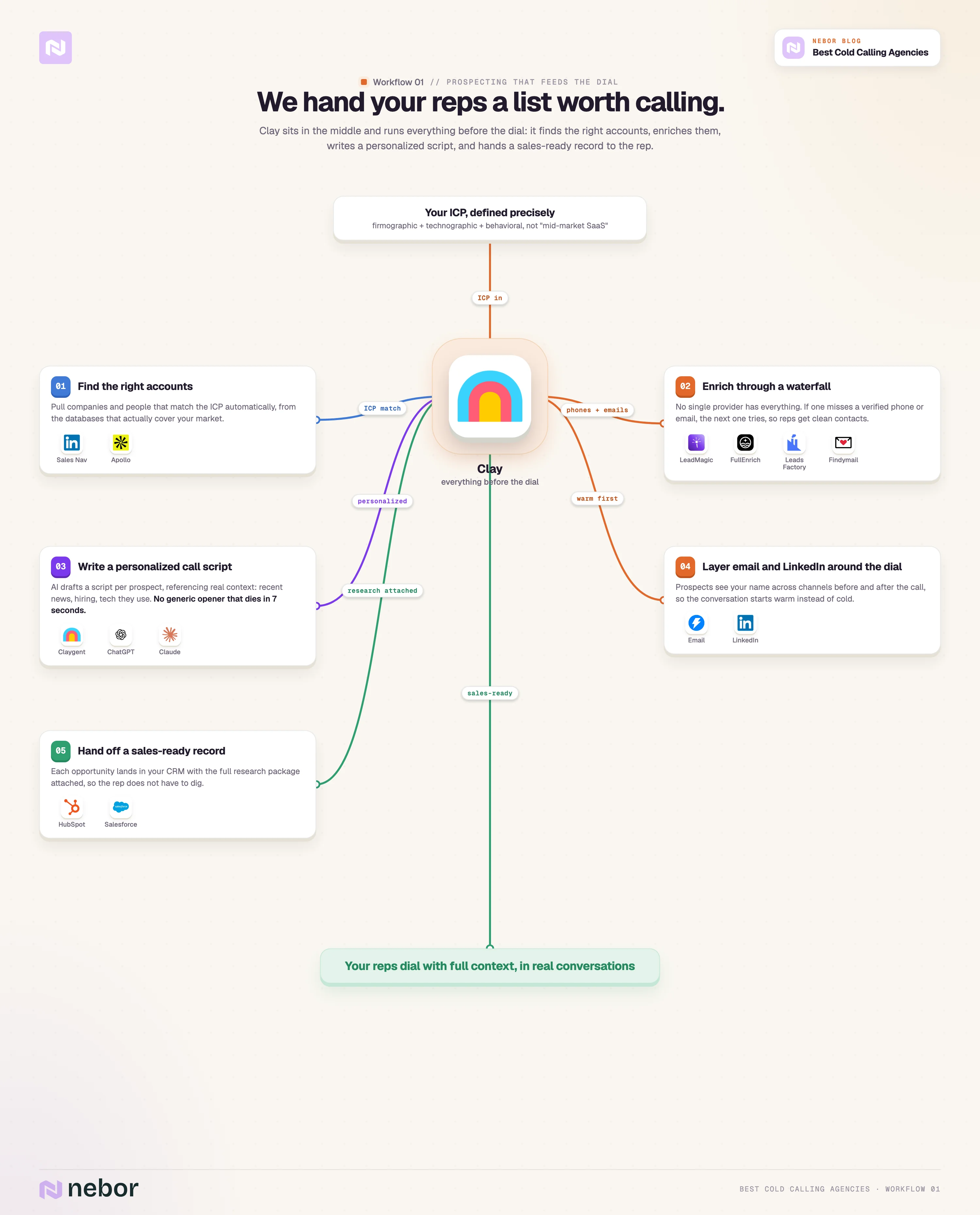
Everything starts with understanding who you are actually trying to reach. We sit down with your team to define your ICP with real precision.
Forget about the vague descriptions like mid-market SaaS companies. We are talking about specific firmographic criteria, technographic signals, and behavioral indicators that separate good-fit prospects from noise.
Once we understand your target market, we build a prospecting workflow inside Clay that finds these companies and people automatically.
We pull from LinkedIn Sales Navigator, Apollo, and other databases to identify accounts that match your criteria. Then we pass them through waterfall enrichment using LeadMagic, FullEnrich, LeadsFactory.io and Findymail to fill in the data gaps.
Waterfall enrichment matters because no single data provider has everything. If one tool cannot find a verified phone number, we try another. If the email bounces through one source, we verify through a second and third.
This means that your sales reps end up with clean, accurate contact information instead of outdated records that waste their time.
But we do not stop at contact data. We use AI through Claygent, ChatGPT, or Claude integrations to generate personalized cold call scripts for every prospect.
These scripts reference real information we gathered during enrichment, things like recent company news, hiring activity, technology they use, or challenges specific to their industry.
Your reps walk into calls armed with context. Instead of generic openers that get hung up on inside seven seconds, they lead with something relevant to what is actually happening at that company that week.
That shift moves connection-to-meeting rates in a way reps can feel inside the first week.
Once we have qualified prospects and scripts ready, we hand off sales-ready opportunities to your team through HubSpot, Salesforce, or whatever CRM you use. Each record arrives with the full research package attached, so your rep does not have to dig.
Phone is not the only channel we layer in. We fold cold email and LinkedIn into the same workflow, so your prospects see your company across multiple channels before and after the call.
When someone receives your cold call and already recognizes your name from a LinkedIn message they saw yesterday, the conversation starts warm. That is the entire point of layering channels around the dial.
You get an intent data and buying signal workflow that provides your team with leads to call
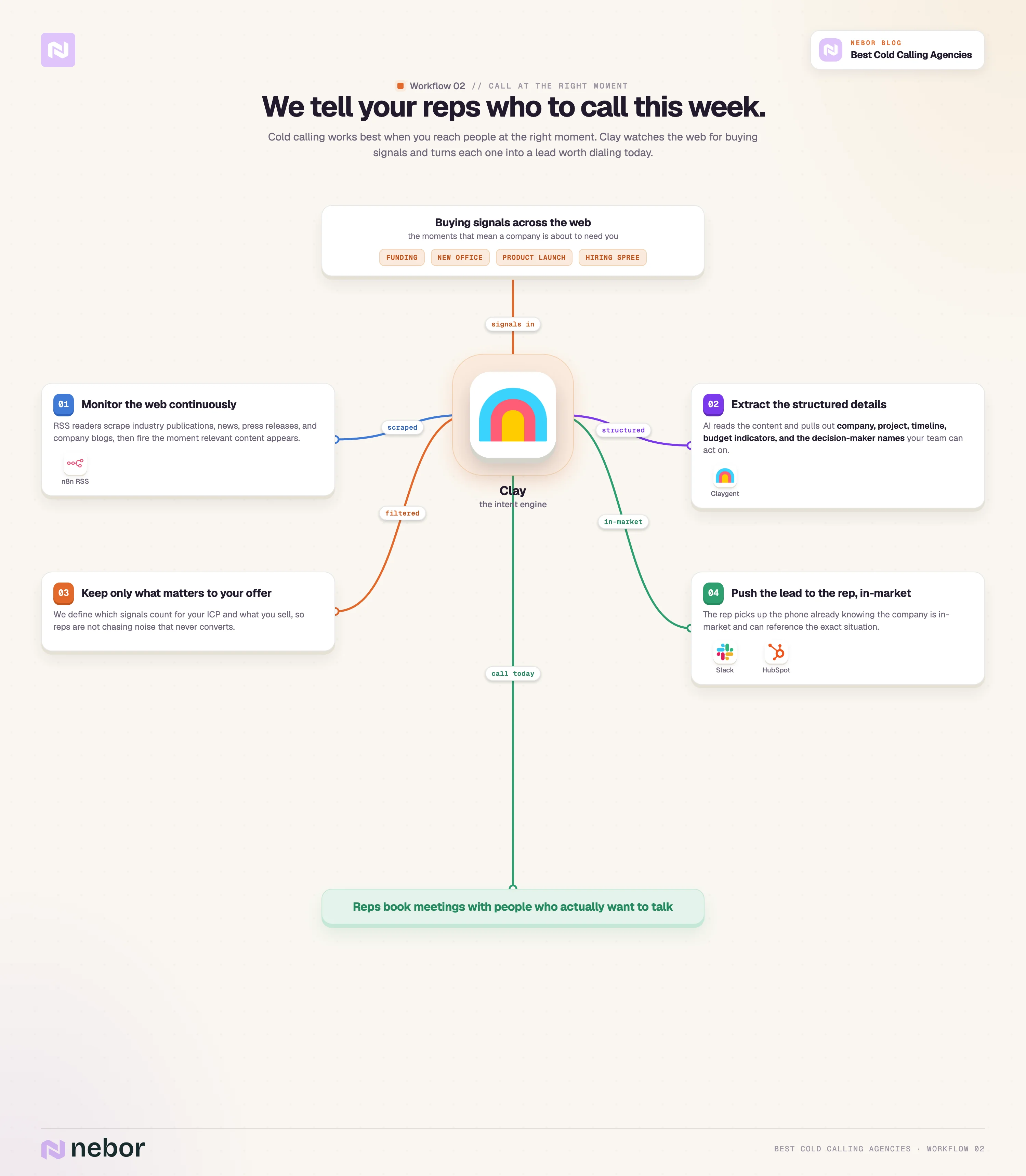
Cold calling works best when you reach people at the right moment. Most agencies ignore timing entirely and blast through lists without any awareness of whether prospects are even in-market for what you sell, and we built our entire intent layer to fix that.
We build RSS feed monitoring workflows that capture buying signals from across the web and push them directly into Clay.
Imagine a company announces they are moving to a new office, raising funding, launching a new product line, or hiring aggressively in a specific department. These signals indicate they are about to need solutions like yours.
We determine what signals matter for your business based on your ICP and what you sell. Then our system scrapes industry publications, news sites, press release databases, and company blogs automatically.
When relevant news appears, Claygent (through prompts we set up) analyzes the content and extracts structured data your team can use, things like company name, project details, timeline, budget indicators, and decision-maker names.
By the time your sales rep picks up the phone, they already know the company is in-market and can reference the specific situation that makes the outreach relevant.
This is the signal-based outbound motion in action, and it is how you start booking meetings with people who actually want to talk.
You get inbound lead qualification and sales enablement plus manual input workflow creation
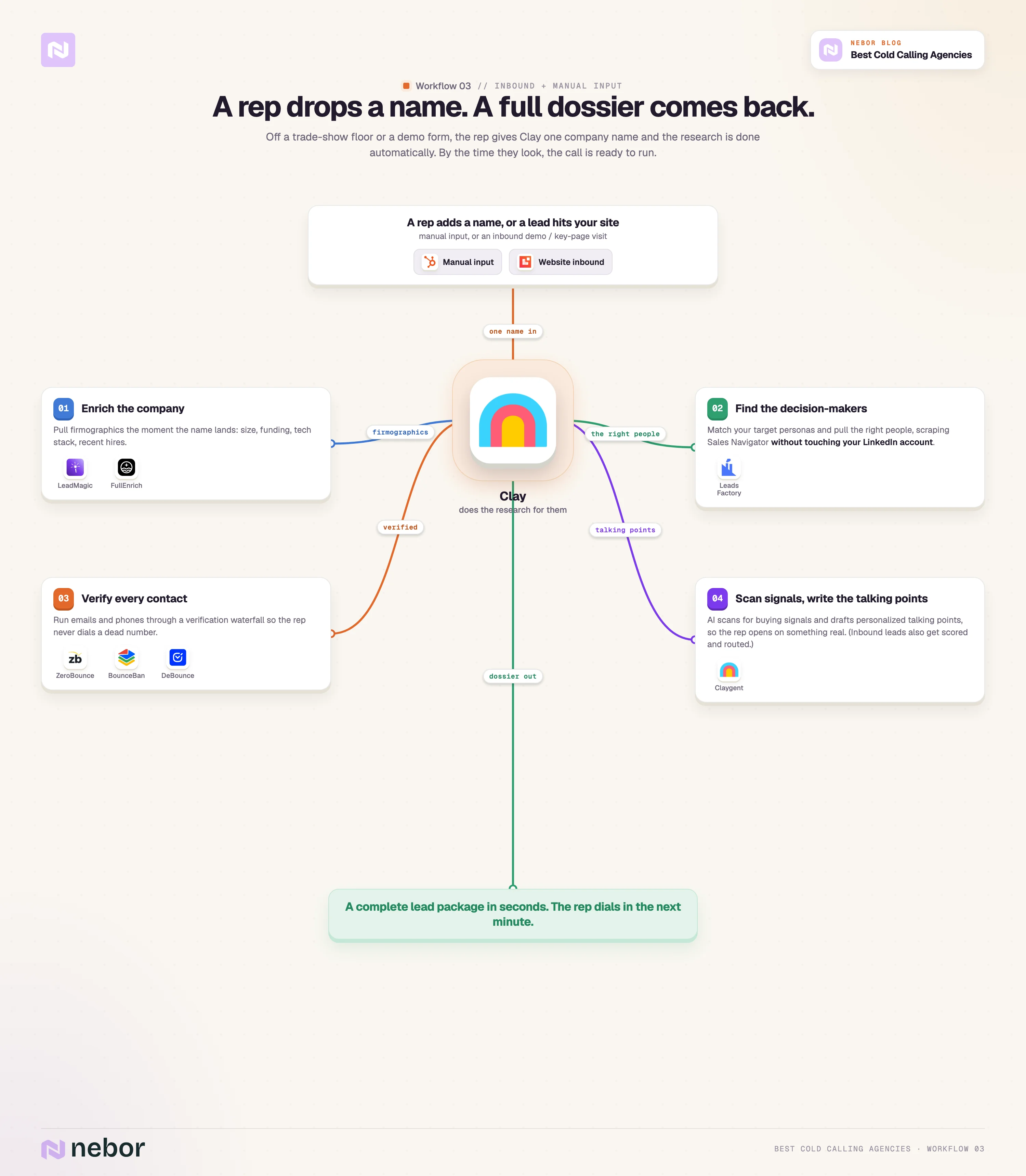
Your outbound engine is only part of the equation. We build manual input workflows that let your sales reps add leads to your CRM with minimal information and have all the research done for them automatically within seconds.
Here is what that looks like in practice. Your sales rep walks off a trade show floor and drops a single company name into HubSpot, and from there the system handles everything else.
A Clay workflow behind HubSpot enriches the company with firmographic data, finds decision-makers matching your target personas, verifies contact information, scans for buying signals, and generates personalized talking points.
By the time your rep goes back to look at the record, a complete lead package is waiting for them.
We also design a workflow that handles inbound leads from your website, the same inbound-led outbound motion we have written about in detail.
When someone requests a demo or spends time on some of your key pages, the system automatically enriches their profile, scores them against your ICP criteria, and routes qualified opportunities to the right rep immediately.
That means no more leads waiting in a queue while competitors reach out first.
What makes these systems work is how they connect. Your outbound prospecting, intent monitoring, and inbound qualification all feed into the same Clay-powered backbone.
Data flows cleanly from one workflow to another, and your sales team operates from a single source of truth instead of juggling disconnected tools.
This is what we mean by an owned GTM system. Each workflow is useful on its own, but the real value lands when they connect into one machine your team owns and operates after we leave.
Why our sales and automation experience matters and what it means for you
You have seen terms like waterfall enrichment and Clay workflows throughout this post. None of it is magic, even though the output can feel that way. It is a deliberate selection of tools, each chosen for a specific reason, connected in ways that solve real sales problems.
Clay is the center because nothing else can do what it does
Clay is the command center where everything comes together. Think of it as a smart spreadsheet that connects to dozens of data sources, applies AI prompts on every row, and automates research tasks that would take hours manually.
In our workflows, Clay serves as the data hub where all your signals and enriched information lives. It functions as the research engine, using AI to analyze content automatically.
It pulls company and contact data from multiple providers through waterfall enrichment. And it connects to your CRM and other tools through native integrations and webhooks.
Without Clay, you would manually copy and paste between a dozen tools or pay for stitched-together solutions that do not actually talk to each other.
We have written before about why most Clay implementations fail, and the short version is that Clay only works when the workflows around it come from someone who has actually done sales themselves.
Note: Most cold calling agencies sell you dials. More callers, more hours on the phone, and a script that assumes whoever picks up has a reason to care.
We don't put people on phones. We build what your existing callers are missing: a number that connects, a reason the company is worth calling this week, and something true to say in the first sentence. Your reps stop spending the morning assembling the list they'll call in the afternoon.
All of it is built in your own accounts, so the day we finish you keep the machine that feeds the phone.
Book a 15-minute call and we'll show you how it would work for your team.
We use multiple data providers because no single one has everything
No single data provider has accurate information for every company and every contact. If you only use Apollo, you miss contacts that Lusha has indexed.
If the email address you pulled is outdated, your message bounces and your sender reputation takes a hit you will spend weeks recovering.
That is why we build waterfall enrichment into every workflow. For contact data, we layer LeadMagic, FullEnrich, and Findymail together.
For email verification, we add ZeroBounce, BounceBan, and DeBounce on top. Yes, we use them all together, on purpose, for redundancy.
LeadsFactory.io finds decision-makers with one big advantage over the alternatives. It scrapes LinkedIn Sales Navigator without requiring your personal account.
Your LinkedIn profile stays safe while you walk away with contacts that come with verified emails and phone numbers.
n8n and other tools fill the gaps Clay cannot
Clay does not natively monitor RSS feeds in real time. That is where n8n earns its place in our stack. It watches news sites and industry publications continuously, then sends webhooks into Clay the moment relevant content appears.
For website visitor identification, we use Leadinfo in Europe for GDPR-compliant company-level tracking and RB2B in the US for person-level identification. The market you sell into decides which one actually works for you.
AI through Claygent, ChatGPT, or Claude integrations handles the analysis. We engineer prompts to extract structured data like company names, project timelines, and buying signals from articles and web content.
What your team actually experiences
Imagine a sales rep spots a potential account at a trade show. In the old world, researching that lead takes 15 to 30 minutes.
In our system, the rep adds the company name to HubSpot and selects Manual Input as the data source. That is it.
Behind the scenes, the HubSpot record triggers a Clay workflow. Clay enriches the company through multiple providers, finds decision-makers through LeadsFactory.io, scans for buying signals through AI analysis, and pushes everything back to HubSpot automatically.
By the time your rep checks the record, a complete lead package is waiting in HubSpot, with verified contacts, personalized talking points, and the full research history attached. The rep can pick up the phone in the next minute and have a real conversation.
The rep did not think about Clay or data providers. They added a lead and received complete information back. That is what we mean by building systems you own.
8 best cold calling agencies to consider in 2026
Here are 8 cold calling agencies worth evaluating for your business.
1. Callbox Inc
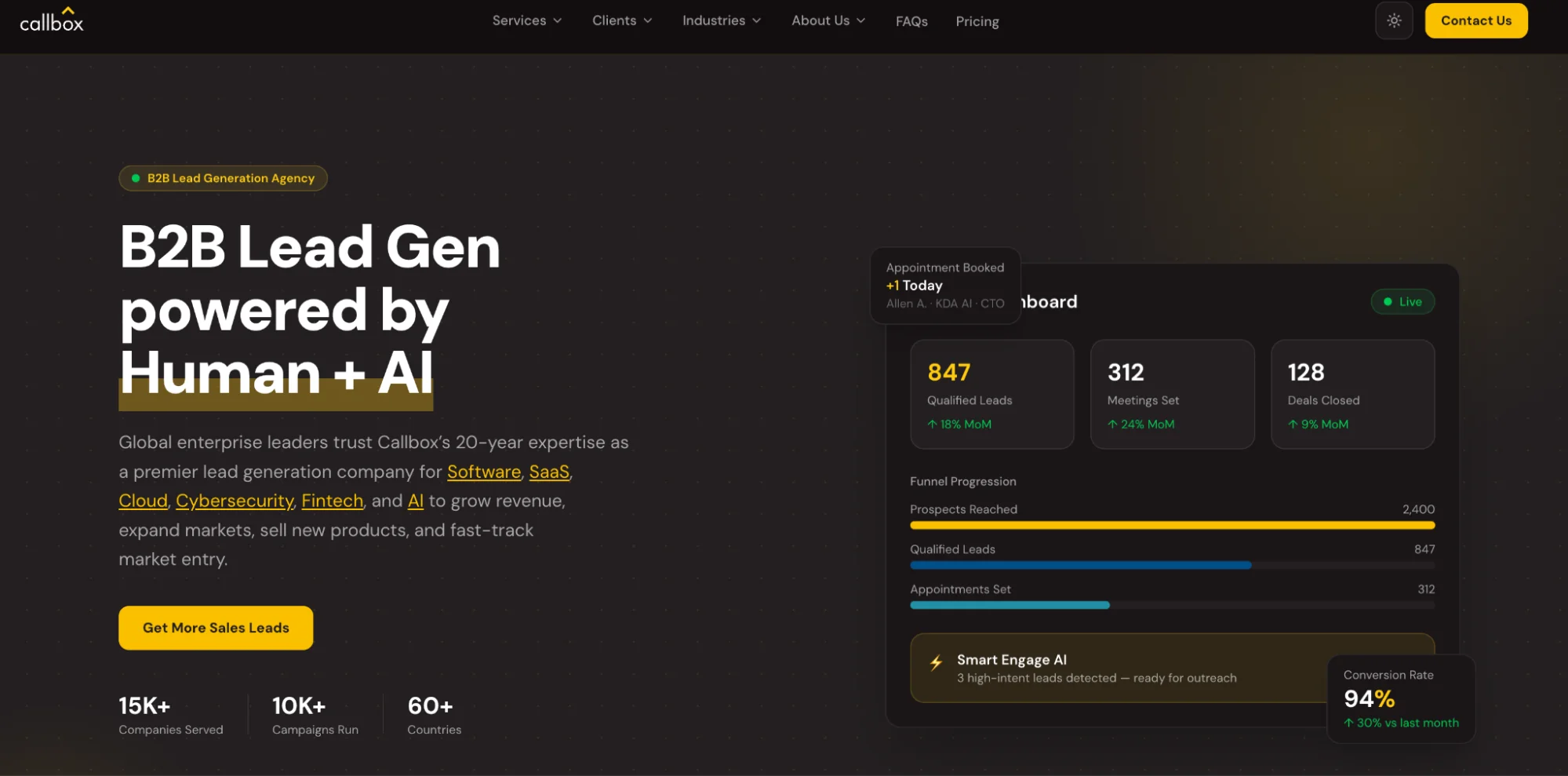
Callbox has been making outbound calls since 2004, when they started as a B2B inbound call center before branching into outbound calling services the following year.
Today they handle telemarketing operations (outbound cold calling services) across six continents with a team primarily based in the Philippines.
Their cold calling process starts with building prospect lists from their proprietary database of 125+ million B2B contacts.
Their callers work from custom scripts tailored to each campaign, conducting discovery calls to identify business challenges and qualify decision-makers before booking appointments.
Callbox trains their agents on both prepared scripts and objection handling, and their calling teams coordinate across time zones to reach prospects during business hours globally, with multilingual support available in 15+ languages including English, Mandarin, Spanish, and Thai.
Pros:
Twenty years of telemarketing experience across multiple industries
Proprietary database with 125+ million B2B contacts for list building
Multilingual calling capabilities in 15+ languages
Global calling coverage across six continents and time zones
Structured script development process for each campaign
Cons:
Core calling team is offshore in the Philippines, which may affect rapport with North American prospects
Some reviews mention callers struggle to pivot when conversations go off-script
Premium pricing can be prohibitive for smaller companies
Less transparency around specific call metrics and conversion rates
Larger organization means variable caller quality depending on assigned team
Pricing: Clients on Clutch report paying anywhere from $4,300 to $15,000 monthly.
How they compare to Nebor: Callbox provides offshore callers to dial through lists, while Nebor builds systems that feed your own sales reps with qualified opportunities and call intelligence.
If you want to enable your internal team with better data, personalized call scripts, and warm prospects to call, Nebor is the better fit.
2. EBQ
EBQ operates out of Austin, Texas, and has been in the business since 2006. They are known for their 100% US-based cold callers, which they position as essential for quality interactions with North American prospects.
They use a cold calling process that they call the "golden touch" call cadence, which mixes cold calls with follow-up emails and voicemails in a structured sequence.
They assign you SDRs who work directly inside your CRM, whether Salesforce or HubSpot, logging every dial, connect, and conversation outcome in real time.
EBQ assigns dedicated SDRs to each account rather than rotating callers. This means the same person learns your business, practices your talking points, and handles objections specific to your offering.
They provide direct access to your assigned callers and project managers, so you can listen to calls and refine scripts together.
Pros:
100% US-based callers ensure cultural alignment for North American markets
Dedicated SDRs learn your specific business and talking points
Works directly in your CRM for real-time visibility into calling activity
Proprietary "golden touch" call cadence maximizes contact rates
Direct access to your calling team for script coaching and call reviews
Cons:
Higher cost than offshore alternatives
Results can vary widely based on assigned team quality
Minimum commitment required for most engagements
Better suited for tech companies, limiting industry versatility
Some clients report inconsistent results despite consistent activity
Pricing: Flat monthly retainer per dedicated resource starting at $5,000 per month, with typical engagements ranging from $5,000 to $10,000+ monthly.
How they compare to Nebor: EBQ provides US-based callers to dial your prospects, while we build automated sales systems that multiply your existing team's calling effectiveness.
If you lack internal capacity to make calls entirely, EBQ fills the gap. If you have reps but need better lists, personalized scripts, and warm intelligence before they dial, Nebor is the better fit.
3. Belkins
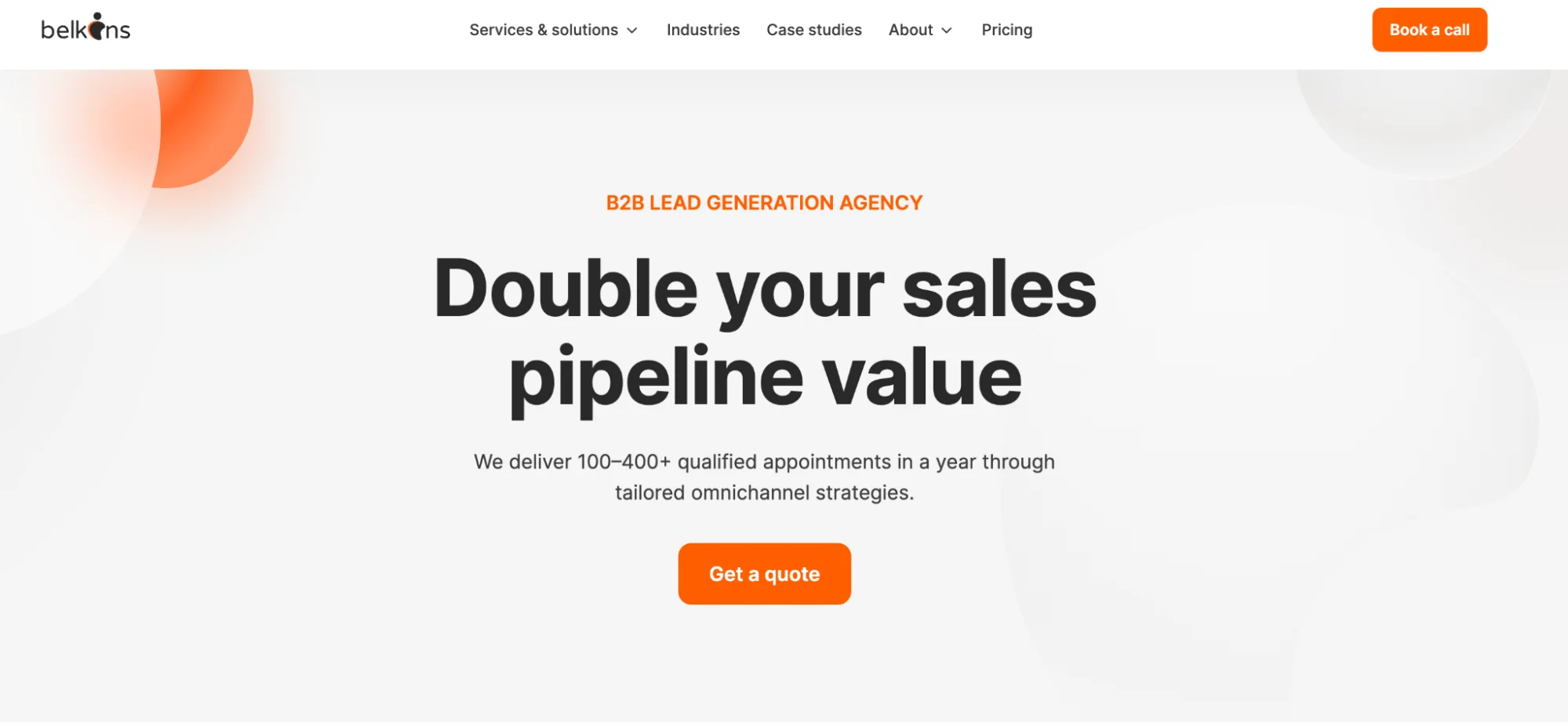
Belkins is primarily a B2B lead generation agency, but they have built a cold calling practice focused on what they call "intent-based calling."
Instead of dialing through cold lists, their SDRs call prospects who have already shown engagement signals like email opens, link clicks, or LinkedIn activity.
This warm calling approach means their callers reach prospects who recognize the brand name and have some context for the conversation. Belkins claims this produces a 20% higher conversion rate compared to pure cold calling.
Their cold calling process includes dedicated account managers and calling agents assigned to each campaign. They use AI to analyze call recordings to coach callers and refine messaging.
Belkins operates calling teams across multiple time zones for global coverage. However, keep in mind that cold calling is secondary to their email expertise. If phone outreach is your primary channel, they may not be the strongest fit.
Pros:
Intent-based calling reaches warmed-up prospects rather than cold contacts
AI-driven call analysis and coaching improves caller performance
Tailored scripts customized for each audience segment and campaign
Global calling coverage across multiple time zones
Strong lead research and verification before calls are made
Cons:
Cold calling is secondary to email, not their core specialty
Premium pricing compared to pure calling agencies
Less transparency around call volume metrics and dials-to-connect ratios
Better suited as complement to email campaigns than standalone calling
Pay-per-appointment model requires clear qualification criteria
Pricing: Belkins offers cold calling services typically bundled with broader campaigns. They have pay-per-meeting options at $300 to $800+ per qualified appointment. Full-service programs including calling cost $5,000 to $14,800 monthly.
How they compare to Nebor: Belkins warms up prospects through email before their SDRs call, while we build the systems that give your own reps the same advantage. We have written more on the Belkins alternatives space for teams choosing between models.
4. Whistle LTD
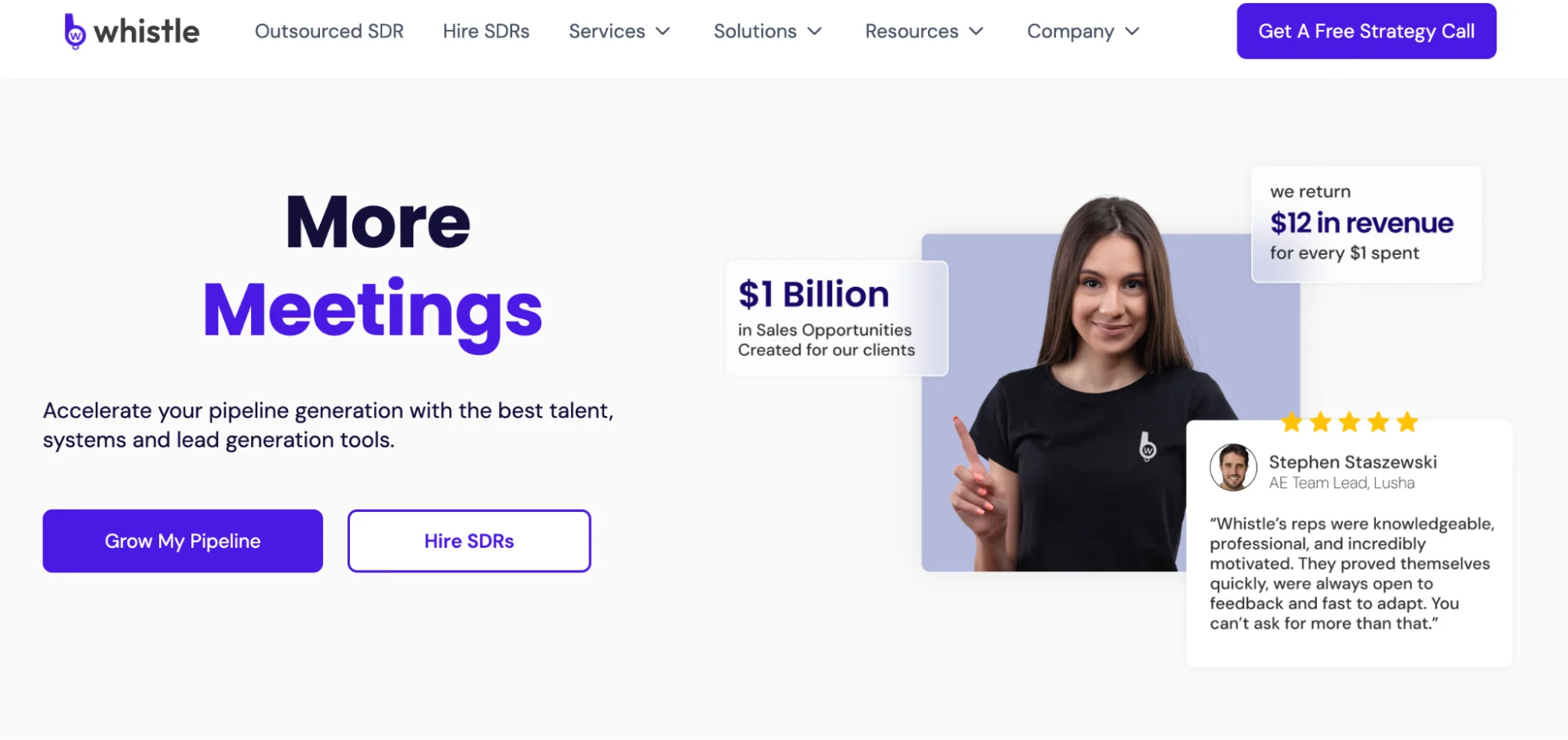
Whistle entered the SDR outsourcing market in 2020 with a 100+ person fully remote calling team. They accept only 0.2% of SDR applicants, which they talk about as a quality filter for their callers.
Their calling operation can launch within 10 business days of signing. This speed comes from their standardized onboarding process, where they learn your ICP, develop call scripts, and train callers on your value proposition before going live.
Whistle's SDRs make calls as part of structured cadences that include phone, email, and LinkedIn touches. Their calling approach requires clients to have a clear ICP and sales process already defined. They are not the right fit for companies still figuring out who they should be calling.
One real differentiator is their "Hire SDRs" program, where you can hire a Whistle caller full-time after the engagement if they performed well on your account. This creates a pipeline from outsourced calling to in-house team building.
Pros:
Rigorous SDR vetting accepts only 0.2% of applicants
Fast 10 business day campaign launch
Option to hire proven callers full-time through their placement program
Remote-first model hires based on calling ability, not location
HubSpot Platinum Partner for CRM integration
Cons:
Requires clear ICP and sales process before engagement
Not suitable for small businesses or low-ticket products
Younger company with less established track record than veterans
Remote model means no in-person training visits
Costs can add up with performance bonuses on base retainer
Pricing: Their pricing starts around $1,000 per month base with performance bonuses. Typical fully-loaded costs reach $5,000 to $10,000 monthly depending on call volume and results.
How they compare to Nebor: Whistle provides outsourced callers making dials, while we learn your business and systematize your prospecting so your internal reps call better-qualified prospects.
5. SalesHive
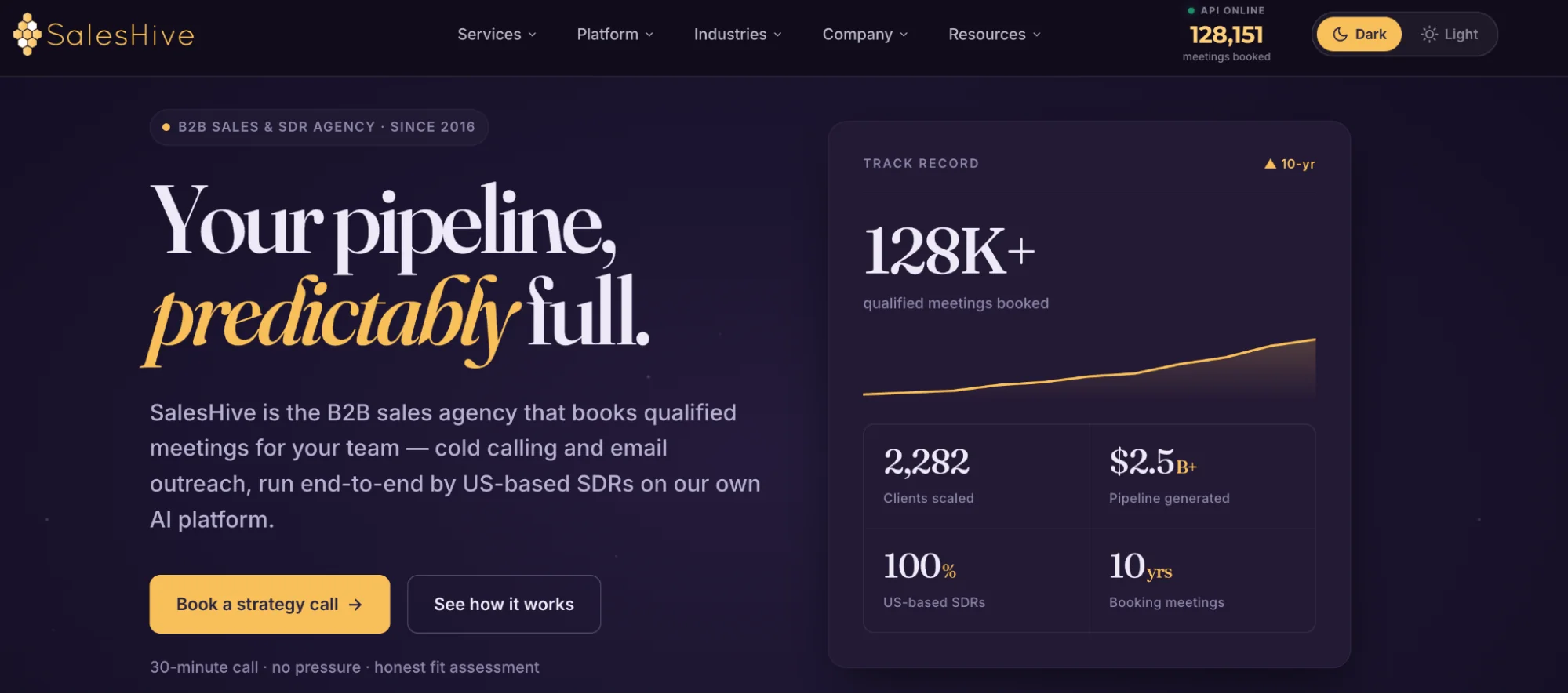
SalesHive positions themselves as a dedicated cold calling agency with both US-based and Philippines-based SDR options. They have booked over 117,000 meetings through their calling programs and generated more than $2.1 billion in sales pipeline.
Their calling operation goes through a proprietary AI-powered Power Dialer that provides one-click dialing, A/B script testing, and real-time call analytics. The dialer includes built-in DNC compliance and time-zone enforcement to ensure calls only go out during legal hours.
Every SalesHive caller works with a dedicated SDR Manager who holds regular coaching sessions and reviews call recordings.
They create custom sales playbooks for each client and conduct weekly strategy calls to optimize scripts based on what they are hearing on calls.
Pros:
Dual US and Philippines calling options for quality-cost balance
AI-powered Power Dialer with one-click dialing and real-time analytics
Built-in DNC compliance and time-zone enforcement
Dedicated SDR Managers with regular call coaching sessions
Custom playbooks and weekly strategy optimization calls
Known as one of the leading B2B cold calling services
Cons:
Philippines callers may struggle with complex B2B conversations
Some reviews mention focus on call volume over conversation quality
Variable experience depending on assigned calling team
Technology-forward approach may feel impersonal to some buyers
Enterprise focus means SMBs receive less attention
Pricing: US-based packages cost $7,000 to $12,000 per month depending on channel mix and touch volume. Philippines packages come in notably lower.
How they compare to Nebor: Like the other cold calling agencies, SalesHive provides calling teams making dials on your behalf, while we build the infrastructure that makes every call your team makes more effective.
6. Martal Group
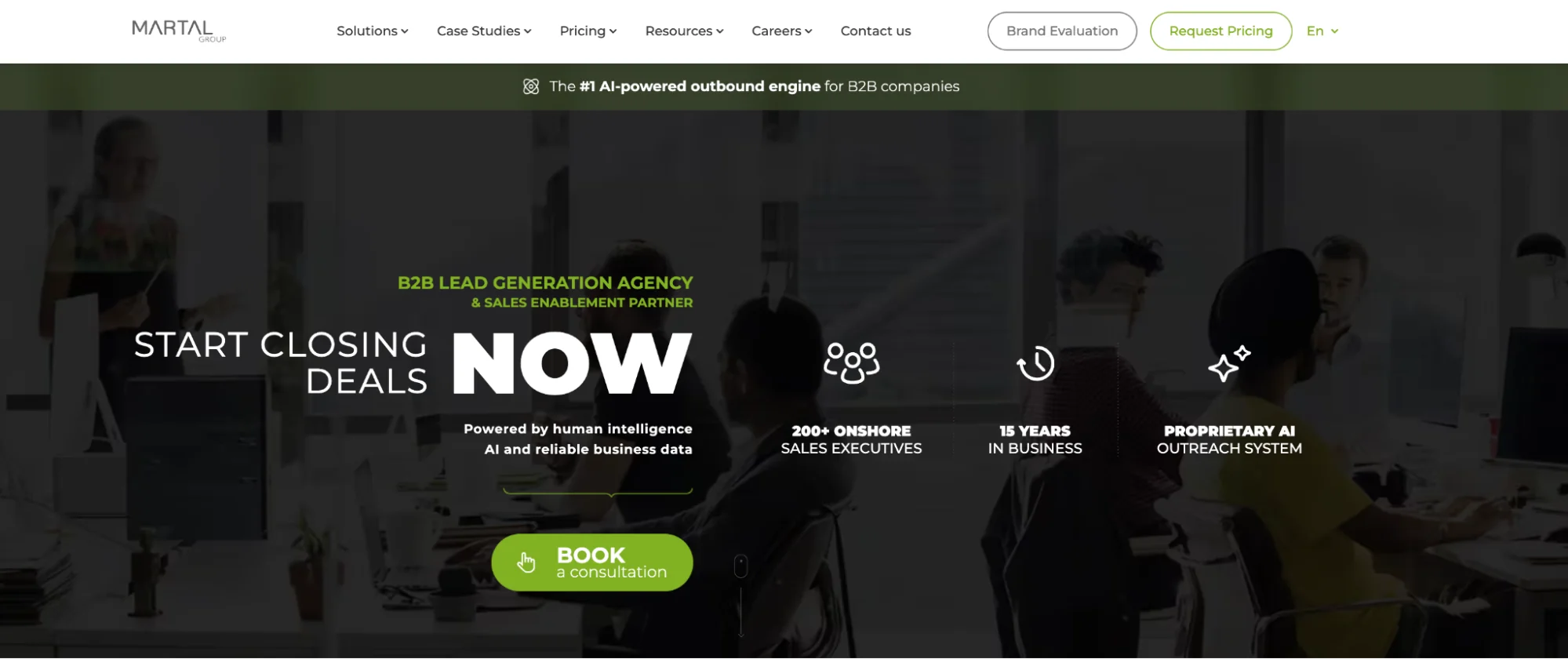
Martal Group is based in Canada with 200+ sales executives globally. Their cold calling operation combines experienced onshore callers with an AI sales dialer that optimizes call times and provides talk tracks.
Their calling approach centers on prospect timing, and they use intent and technographic data to prioritize call lists so their callers reach prospects who are already showing buying signals instead of dialing blindly down a list.
Martal's cold callers specialize in complex industries like SaaS, IT services, cybersecurity, manufacturing, and healthcare, where decision cycles involve multiple stakeholders. As you can guess, their callers are not entry-level SDRs but experienced sales executives.
Their cold calling also blends into broader outbound campaigns. You get phone touches coordinated with email and LinkedIn touches, in what they describe as making cold outreach warm.
Pros:
Experienced onshore sales executives, not entry-level SDRs
AI sales dialer optimizes call timing and provides talk tracks
Specialization in complex industries with multi-stakeholder sales
Intent data prioritizes calling lists for better timing
Onshore teams in North America, Europe, and Latin America
Cons:
Higher pricing reflects executive-level talent
Longer ramp-up time than simpler calling programs
May be more comprehensive than needed for basic appointment setting
Calling bundled into broader campaigns rather than standalone
Fractional model can feel less dedicated than full-time resources
Pricing: They offer custom retainer-based models with typical engagements starting around $5,000 per month. Reviews suggest $4,100 to $10,500 monthly depending on scope.
How they compare to Nebor: Where Martal puts experienced executives on the phone for you, we build the alternative that puts your own reps in a position to win those same conversations. If you need experienced callers handling complex multi-stakeholder cycles, Martal is one of the best options.
If you want your internal team to have the same call intelligence, personalized scripts, and full outbound motion behind them without renting another agency to do it, Nebor fits better.
7. CIENCE
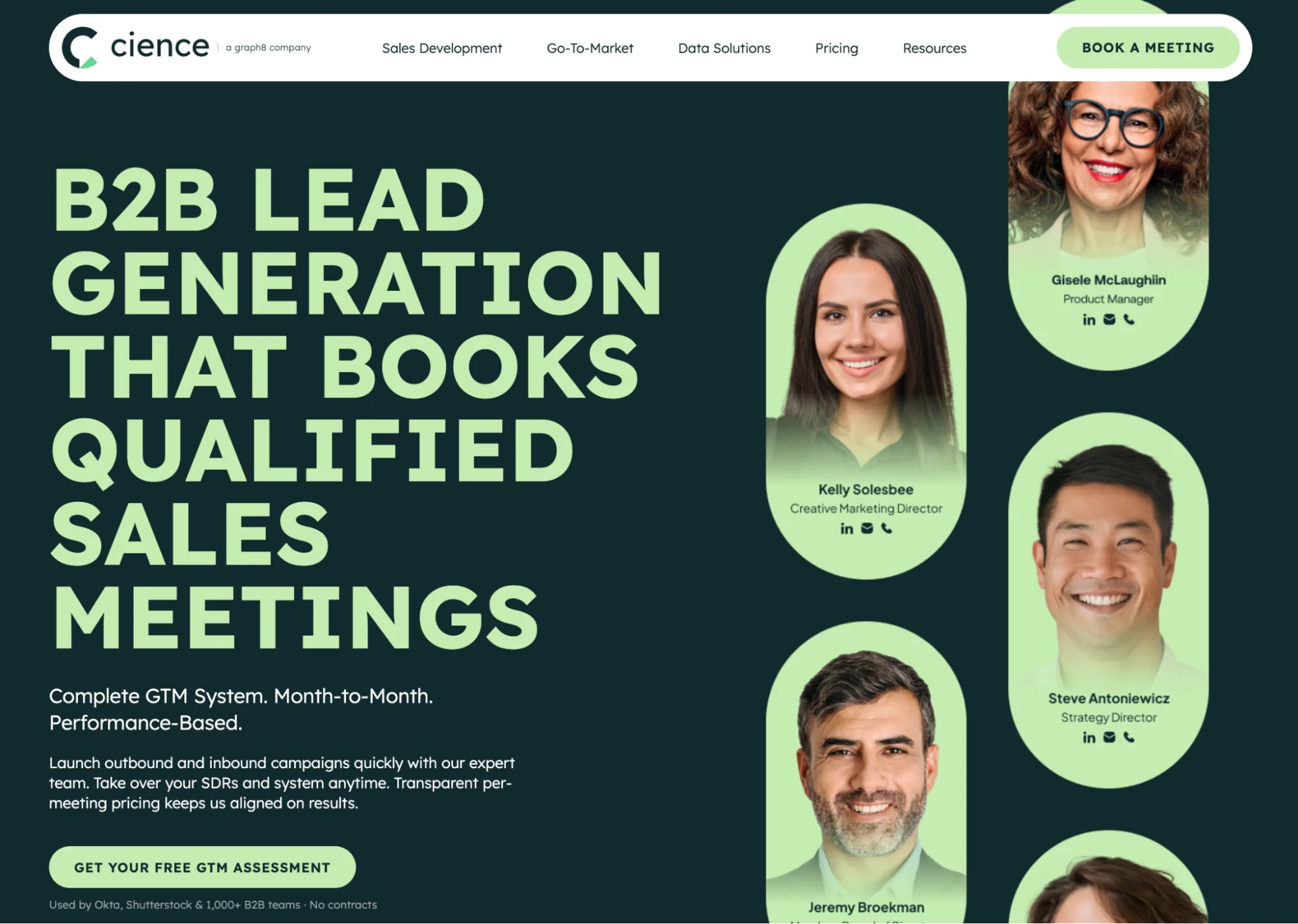
CIENCE is a Denver-based company with 201 to 500 employees that combines human SDRs with AI-powered technology for cold calling.
They have worked with over 2,500 organizations and emphasize their telemarketing as a core component of multi-channel outreach.
Their calling operation uses trained telemarketers experienced in call opening, asking sharp discovery questions, walking through value propositions, and setting appointments.
Their SDRs work with prospect lists they build from their database of 300 million records, qualified by CIENCE research teams.
CIENCE also uses conversational analytics and AI to constantly improve call quality and outcomes.
CIENCE is known more for volume than personalization. Some reviews note a focus on activity metrics rather than conversation quality. Account manager turnover is also an issue, which can disrupt continuity for you.
Pros:
Large SDR teams across time zones for global calling coverage
AI and conversational analytics improve call quality over time
Database of 300+ million records for prospect list building
Extensive experience across 162+ B2B industries
Enterprise-grade infrastructure for large-scale calling programs
Cons:
Volume-focused approach sometimes prioritizes quantity over quality
Mixed reviews on lead quality and customer service
Complex pricing structure with multiple fees and add-ons
High account manager turnover noted in some reviews
Technology platform can feel complicated to navigate
Pricing: Their GTM System Setup costs $5,000 one-time (or $2,500 for qualified startups). Ongoing fees include roughly $250 per held meeting plus $1,500 monthly retainer plus $499 monthly platform license.
How they compare to Nebor: CIENCE handles large-scale calling operations on your behalf, while we build outbound sales infrastructure you own and that keeps going on autopilot after we leave.
8. SalesRoads
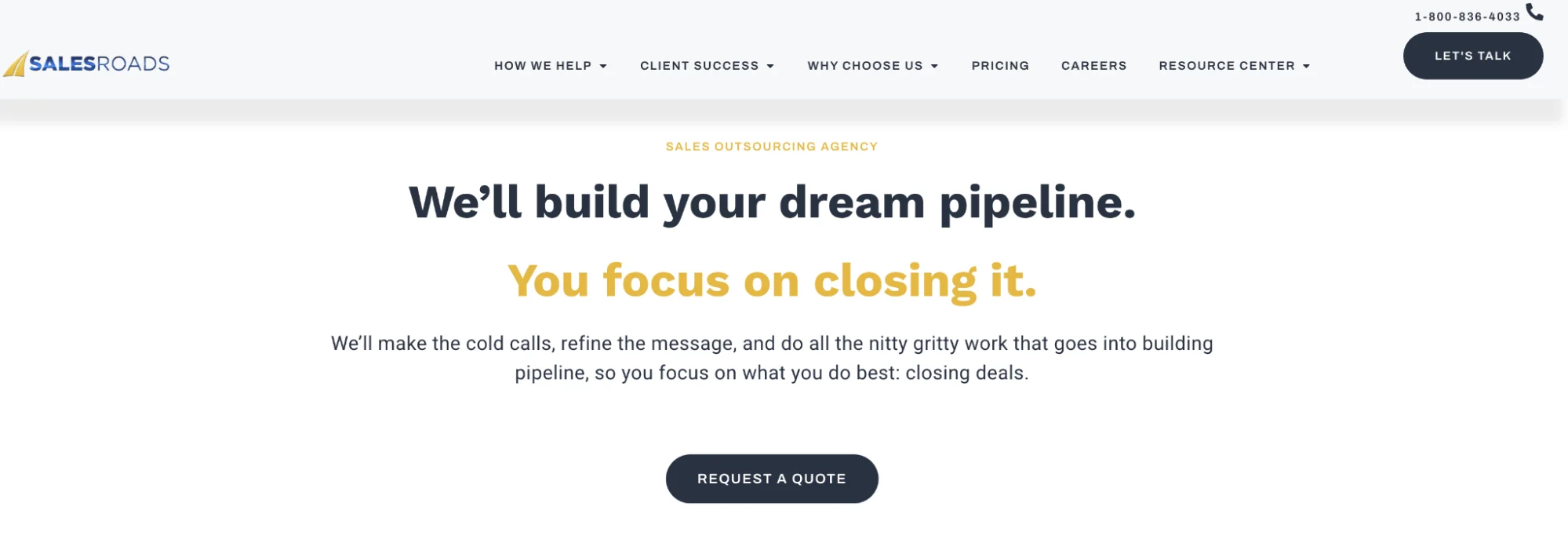
SalesRoads operates a 100% US-based team and takes a phone-first approach to cold calling. Their SDRs average 5 to 10 years of sales experience, which raises the floor on what a connected call actually sounds like.
Their cold calling approach starts with a discovery process where they learn your business, goals, and marketplace challenges. From there they develop what they call a demand generation playbook that tailors their calling strategy to your specific brand voice and value proposition.
SalesRoads invests heavily in SDR training, and the discipline shows up in how dedicated sales coaches manage every caller. Coaches review recordings, monitor connection rates, and track weekly conversion from calls to appointments. They hold regular reviews of call lists and activity to see exactly what is converting and what is not.
Their calling operation also combines outbound dials with AI-boosted email cadences, though the phone remains their clear primary channel.
Pros:
100% US-based SDRs with 5-10 years average experience
Phone-first expertise with deep cold calling specialization
Dedicated sales coaches manage and review every caller
Custom playbooks tailored to your brand voice and pitch
Performance guarantees provide accountability for results
Cons:
Premium pricing reflects US-based, high-touch model
Phone-focused approach offers less multi-channel breadth
Setup and training process can take longer than competitors
Higher minimum investment excludes smaller companies
No LinkedIn outreach in their standard approach
Pricing: Typical engagements cost $8,000 to $10,000 per month with minimum investments starting around $9,500 for 4 weeks. Month-to-month with no long-term commitment required.
How they compare to Nebor: If you want the best US-based callers handling your phones, SalesRoads excels. If you want to feed qualified opportunities and call intelligence to your own team, Nebor delivers the infrastructure.
The best cold calling service models that are available to you today
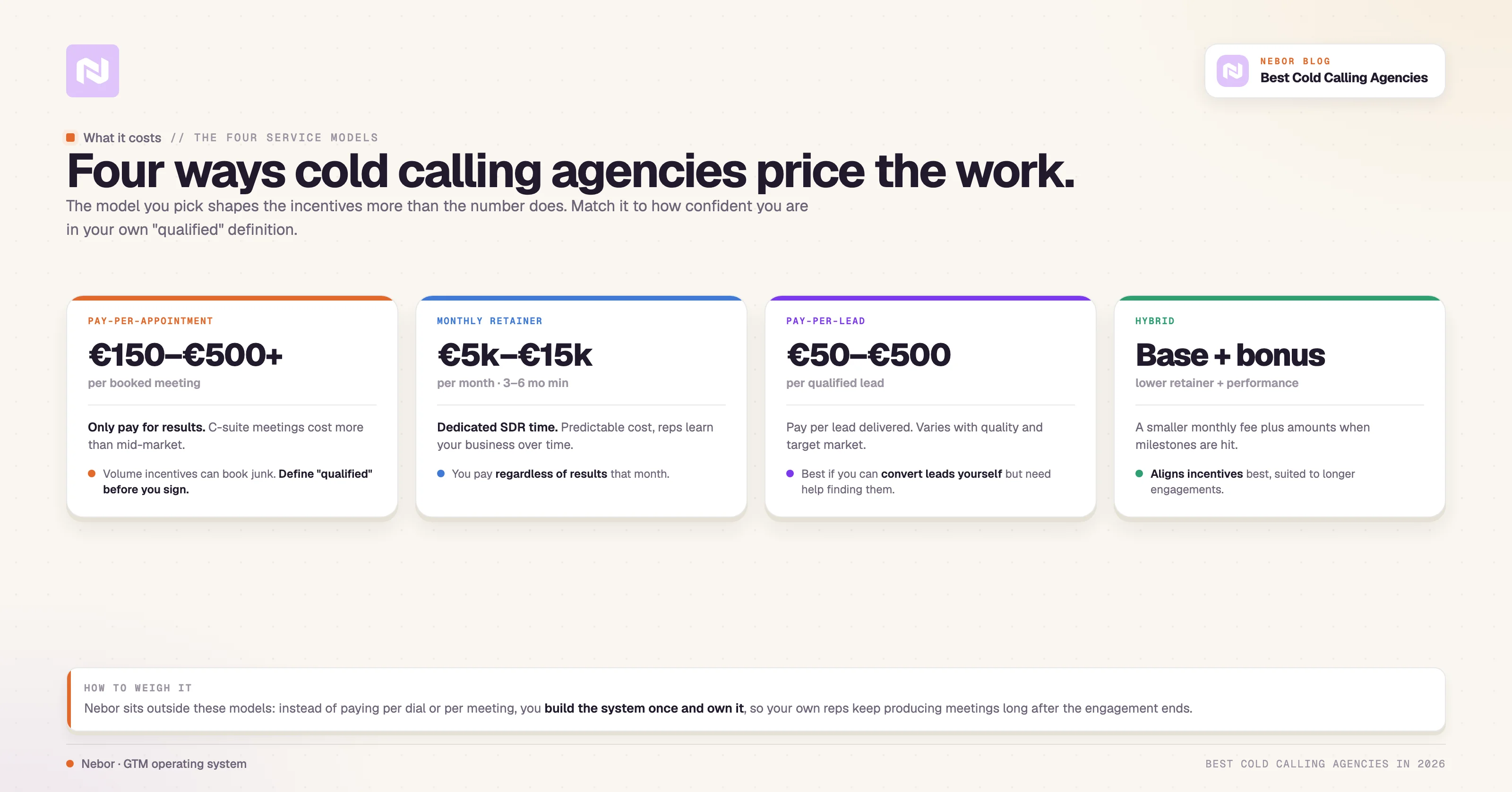
Worth understanding how cold calling agencies typically structure their pricing before you compare quotes. There are four main models you will encounter.
Pay-per-appointment pricing
You pay for each meeting booked, usually ranging from €150 to €500 or more per appointment depending on your market and the seniority of contacts you target.
Enterprise deals with C-suite executives command higher rates than mid-market meetings with department managers.
This model sounds attractive because you only pay for results. The catch is that agencies incentivized purely by meeting volume sometimes book lower-quality appointments that waste your closers' time.
Make sure you define "qualified" clearly before signing any pay-per-appointment agreement, because the definition is where the model lives or dies.
Monthly retainer pricing
You pay a flat fee for dedicated SDR time, usually with minimum commitments of three to six months. Retainers typically range from €5,000 to €15,000 per month depending on team size and scope.
This model gives you more control and consistency. You get predictable costs and dedicated attention from reps who learn your business over time. The downside is that you pay regardless of results, which makes upfront vetting the most important part of the engagement.
Pay-per-lead pricing
Less common than the other models, pay-per-lead means you pay for qualified leads delivered rather than meetings booked. This works well for companies with strong internal sales teams who can convert leads themselves but need help finding them.
Pricing varies widely depending on lead quality requirements and target market. Expect anywhere from €50 to €500 per lead.
Hybrid models
Many agencies combine a base retainer with performance bonuses. You pay a lower monthly fee plus additional amounts when certain milestones are hit. This aligns incentives better than pure retainer while giving you cost predictability.
Hybrid models often work best for longer engagements where both parties invest in building a program together.
What you should expect your cold calling agency to handle in 2026
Before you decide to work with a cold calling agency, here is what a good partner should deliver.
Outbound calling and appointment setting
The core deliverable. SDRs make calls on your behalf, navigate gatekeepers, engage decision-makers, handle objections, and book qualified meetings on your sales team's calendar.
Expect volume benchmarks, typically 50 to 100 dials per rep per day, with connection rates around 7% and meeting conversion around 2% of total dials.
Script development and iteration
Your agency should develop custom scripts tailored to your value proposition, ICP pain points, and competitive positioning. Scripts should evolve based on call performance data and feedback from you, as well as from actual conversations.
Lead list building and enrichment
Good agencies build targeted prospect lists using tools like ZoomInfo, Apollo, or LinkedIn Sales Navigator. They should verify contact information before dialing to avoid wasting time on bad data.
Know that some agencies charge extra for list building while others include it in their retainer.
CRM updates and reporting
Your agency should log every call, outcome, and conversation in your CRM. You should receive regular reports covering activity metrics, meeting rates, pipeline contribution, and qualitative feedback from conversations.
Transparency here separates serious agencies from fly-by-night operations.
Follow-up cadences often combined with email
Modern cold calling rarely works in isolation, which is why your agency should coordinate phone outreach with email sequences and LinkedIn touches to maximize touchpoints.
Research shows it takes an average of eight touchpoints to convert a B2B lead, so agencies that rely solely on calling leave money on the table.
Hire Nebor to enable your team with the best opportunities for cold calling so your sales reps can close deals
You have read through 8 cold calling agencies that can put people on the phones for you. Each has strengths worth considering depending on your situation.
But we want to leave you with a different way of thinking about this challenge.
Cold calling itself is not the thing that is broken. What is broken is the way most companies set up the inputs around it.
They hire agencies to blast through lists without proper targeting, give reps phone numbers without context or personalization, and treat calling as a standalone activity instead of one touchpoint in a coordinated multi-channel motion.
At Nebor, we take the opposite approach. We build the systems that feed your callers with qualified, enriched, personalized opportunities every working day.
We monitor buying signals so your team reaches out when the timing is right. We automate the tedious research so reps spend their time talking to people who actually want to hear from them.
The agencies listed above can book meetings. We help you build an outbound sales engine that produces meetings predictably and at scale, a machine you own and control.
Our workflows are built on Clay, n8n, Instantly, and the rest of our tool stack to create infrastructure that keeps delivering value long after the engagement ends.
If you are tired of renting an SDR floor and ready to build sales systems that work on autopilot, this is the model we have built our whole agency around. We are not the right fit if you want a vendor to dial for you forever.
We are the right fit if you want your own team set up with the same engine the best calling agencies sell, except you own it after we leave.
Note: Most cold calling agencies sell you dials. More callers, more hours on the phone, and a script that assumes whoever picks up has a reason to care.
We don't put people on phones. We build what your existing callers are missing: a number that connects, a reason the company is worth calling this week, and something true to say in the first sentence. Your reps stop spending the morning assembling the list they'll call in the afternoon.
All of it is built in your own accounts, so the day we finish you keep the machine that feeds the phone.
Book a 15-minute call and we'll show you how it would work for your team.


Related Articles


By clicking Sign Up you're confirming that you agree with our Terms and Conditions.