
In this post:
Your CRM is supposed to be the single source of truth your whole revenue team trusts. The problem is that for most companies, that source of truth is quietly full of lies, and everyone is making decisions based on it anyway.
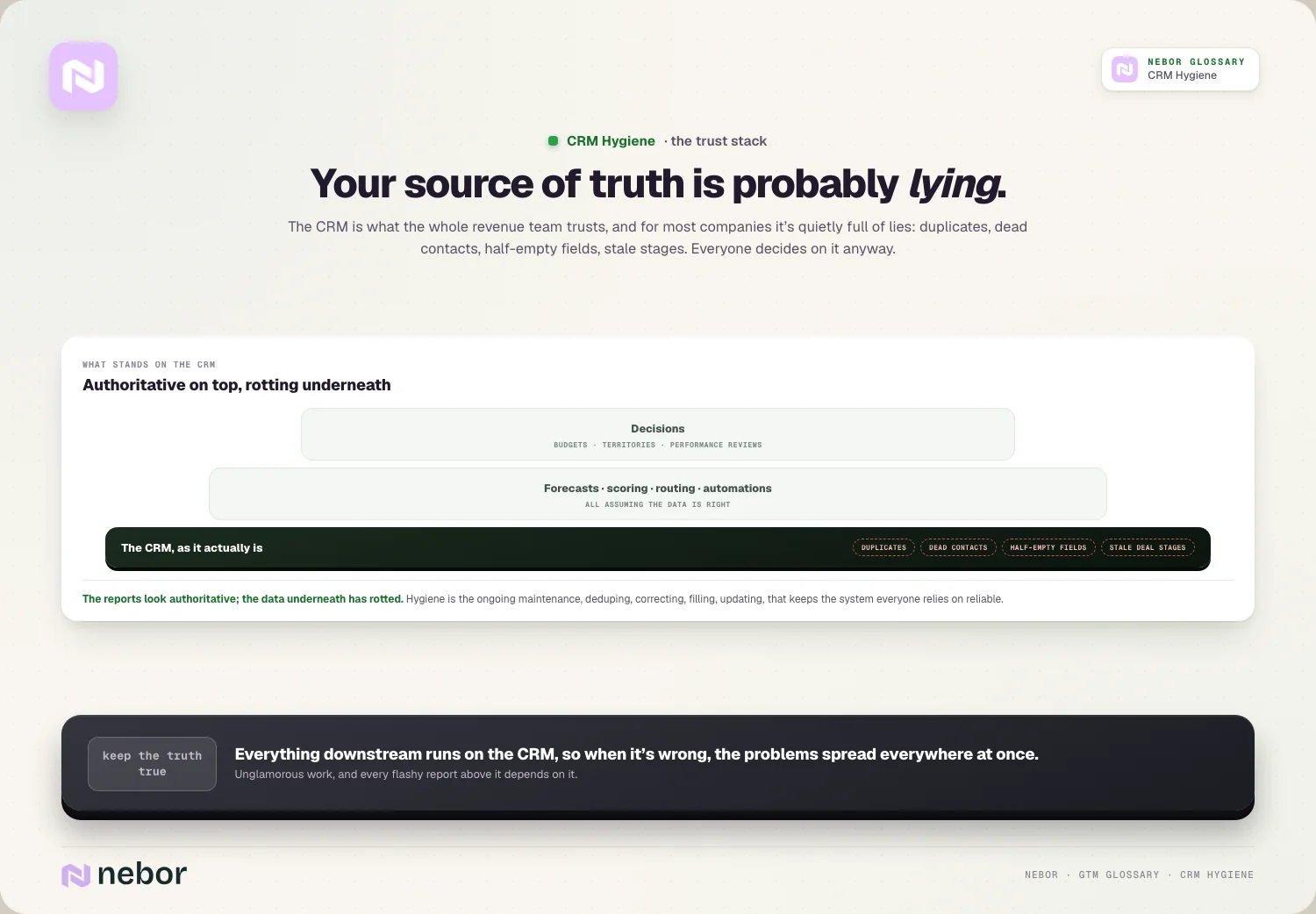
Duplicate records, dead contacts, half-empty fields, and stale deal stages pile up until the system everyone relies on can't be relied on. The reports look authoritative, but the data underneath them has rotted.
CRM hygiene is the practice of keeping your CRM data clean, accurate, complete, and current, by removing duplicates, fixing errors, filling gaps, and updating stale records. It's the ongoing maintenance that keeps your source of truth actually true.
Everything downstream depends on your CRM, so the stakes are structural. Your forecasts, your scoring, your routing, and your automations all assume the data is right, so when it isn't, the problems spread everywhere at once.
TL;DR
CRM hygiene is the ongoing work of keeping your CRM data clean, accurate, complete, and current, through deduplication, correction, enrichment, and regular updates.
Your CRM is the foundation everything is built on, and dirty data breaks forecasting, scoring, routing, and automation, so poor hygiene corrupts your whole revenue operation from below.
The numbers are honestly alarming, with the vast majority of CRM data incomplete, stale, or duplicated, and reps lose a large share of their time dealing with bad data.
The demanding part is that hygiene is never finished. Data decays continuously, so CRM hygiene works as an ongoing discipline with processes and automation instead of a one-time cleanup project.
So what is CRM hygiene, and what work does it really involve?
CRM hygiene is the practice of keeping the data in your CRM healthy. It covers everything that makes a record trustworthy: accuracy, completeness, consistency, and freshness.
The work breaks into a few recurring parts. You remove duplicate records, correct errors, fill in missing fields, standardize formats, and update or archive data that's gone stale.
It applies to all your CRM data. Contacts, accounts, deals, and activity records all need maintenance, since any of them can become inaccurate, incomplete, or duplicated over time.
The goal is a CRM you can trust. When the data is clean, the reports, forecasts, and automations built on it are reliable, which is the entire point of having a CRM in the first place.
So CRM hygiene is really about protecting your source of truth. It's the maintenance that keeps the system everyone depends on accurate enough to deserve that trust.
It's unglamorous work, which is part of why it gets neglected. Nobody gets excited about merging duplicate records, but that quiet maintenance is what keeps every flashy report and automation above it honest.
How bad is the average CRM really, once you look at the numbers?
Before fixing CRM hygiene, it helps to grasp how widespread the problem is, and the CRMs we've audited are usually worse than their owners admit.
Most CRM data is flawed in some way, with Salesforce's own research finding around 91% of CRM data is incomplete, stale, or duplicated, meaning the majority of records have something wrong with them.
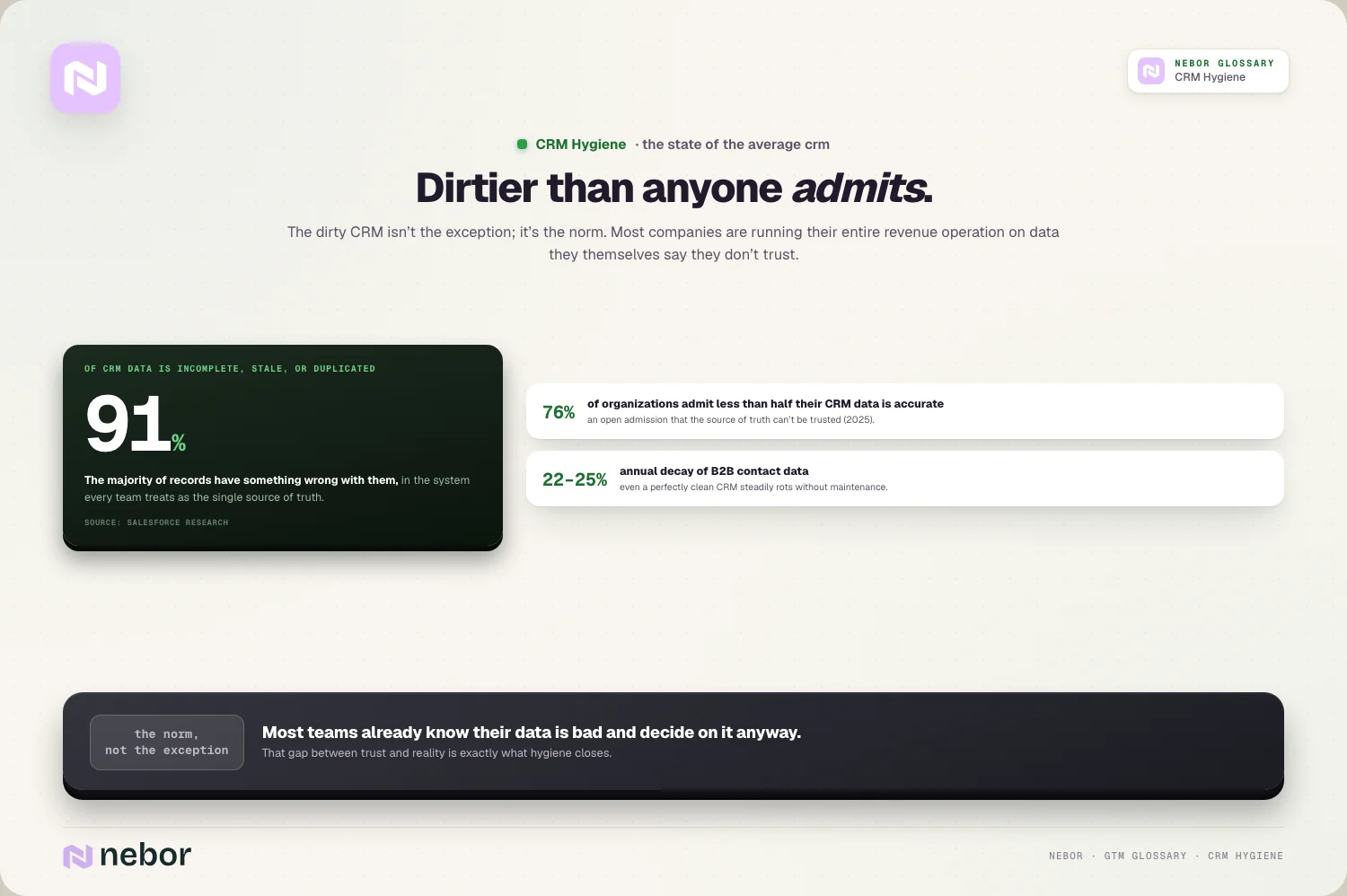
Teams already know their data is bad, because in one 2025 report,76% of organizations said less than half their CRM data is accurate, an open admission that the source of truth can't be trusted.
And the decay never pauses, with B2B contact data degrading at roughly 22 to 25% per year, so even a clean CRM steadily rots without maintenance.
So the dirty CRM isn't an exception, it's the norm across most companies. They're steering their entire revenue operation with data they themselves admit they don't trust, which is exactly the problem hygiene addresses.
What does dirty CRM data cost you across a year of decisions?
The cost of poor CRM hygiene is easy to underestimate, because the damage is spread out and indirect, but added up, it's substantial.
The financial hit is larger than most budgets admit, with Gartner estimating poor data quality costs organizations around $12.9 million per year on average, through wasted effort, bad decisions, and lost opportunities.
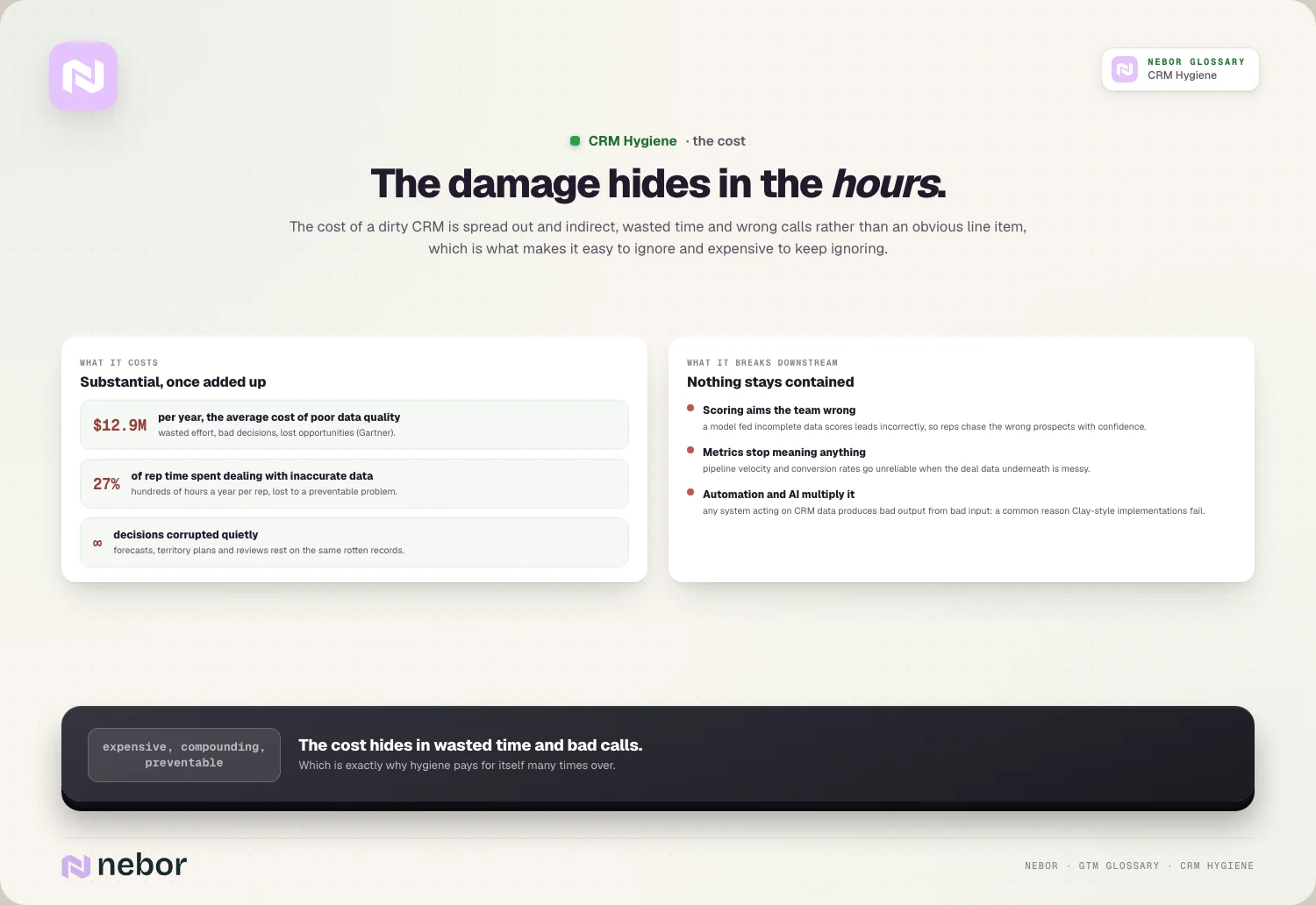
It drains your reps too, because salespeople spend around 27% of their time dealing with inaccurate data, which is hundreds of hours a year per rep lost to a problem clean data would prevent.
And it corrupts decisions, because forecasts, territory plans, and performance reviews all rest on CRM data, so when the data is wrong, the decisions built on it are wrong too.
So dirty data isn't a minor annoyance, it's an expensive, compounding drag on the whole business. The cost hides in wasted time and bad calls, which is exactly why hygiene pays for itself many times over.
How does dirty data break everything downstream of the CRM itself?
The real danger of poor CRM hygiene is how far the damage spreads. Bad data refuses to stay contained, spreading into every system built on it.
It breaks your scoring first, because a lead scoring model fed incomplete or wrong data scores leads incorrectly, so your team chases the wrong prospects with confidence.
It distorts your metrics too, where pipeline numbers like pipeline velocity and conversion rate become unreliable when the underlying deal data is messy, so you can't tell what's really happening in your pipeline.
And it poisons your automation, because any system that acts on CRM data, including AI tools, produces bad output from bad input, which is a common reason Clay and similar implementations fail.
So CRM hygiene isn't an isolated data chore off to the side. It's the foundation that determines whether everything built on the CRM works or produces confident garbage, and that reach is what makes it so consequential.
What causes CRM data to go bad even when nobody is touching it?
Understanding why CRMs get dirty helps you prevent it. The causes are constant and mostly structural instead of one-off mistakes.
Natural decay is the biggest, because people change jobs and companies change constantly, so records go stale on their own through data decay, even when no one touches them.
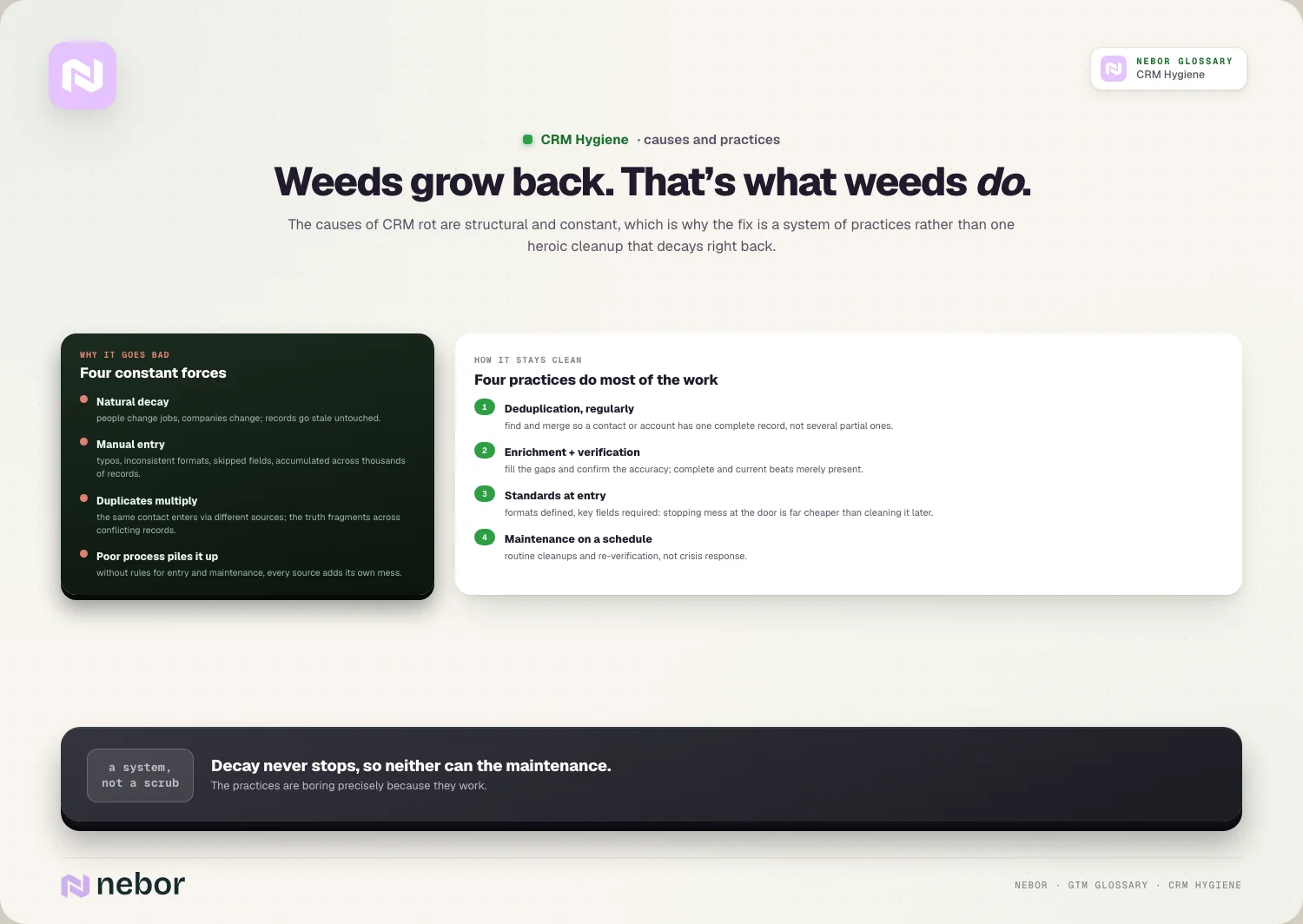
Manual entry adds its own errors, because typos, inconsistent formats, and skipped fields creep in whenever reps enter data by hand, and they accumulate across thousands of records.
Duplicates multiply on top of that, as the same contact or account gets entered more than once through different sources or imports, fragmenting the truth across several conflicting records.
And poor process lets it all pile up, because without rules for how data enters and gets maintained, every source adds its own mess, so the CRM degrades faster than anyone can clean it.
How do you keep a CRM clean without turning it into a second job?
Good CRM hygiene works as a system instead of a heroic cleanup, and in our experience a few practices do most of the work.
Deduplication comes first in any workable routine. Regularly finding and merging duplicate records keeps the truth in one place, so a contact or account has a single, complete record instead of several partial ones.
Enrichment and verification come next, with gaps filled through data enrichment and accuracy confirmed through contact verification, keeping records complete and current.
Standards at entry handle the prevention, because defining how data should be formatted and requiring key fields stops mess from entering in the first place, which is far cheaper than cleaning it later.
And regular maintenance holds it all together, with routine cleanups and re-verification scheduled instead of waiting for a crisis, keeping the CRM healthy as decay works against it.
Why does CRM hygiene always end up being a RevOps responsibility?
CRM hygiene tends to fall through the cracks unless someone owns it, which is where RevOps comes in. The function exists partly to solve this.
Revenue operations owns the systems and data across the revenue teams, which makes the CRM and its hygiene squarely their responsibility.
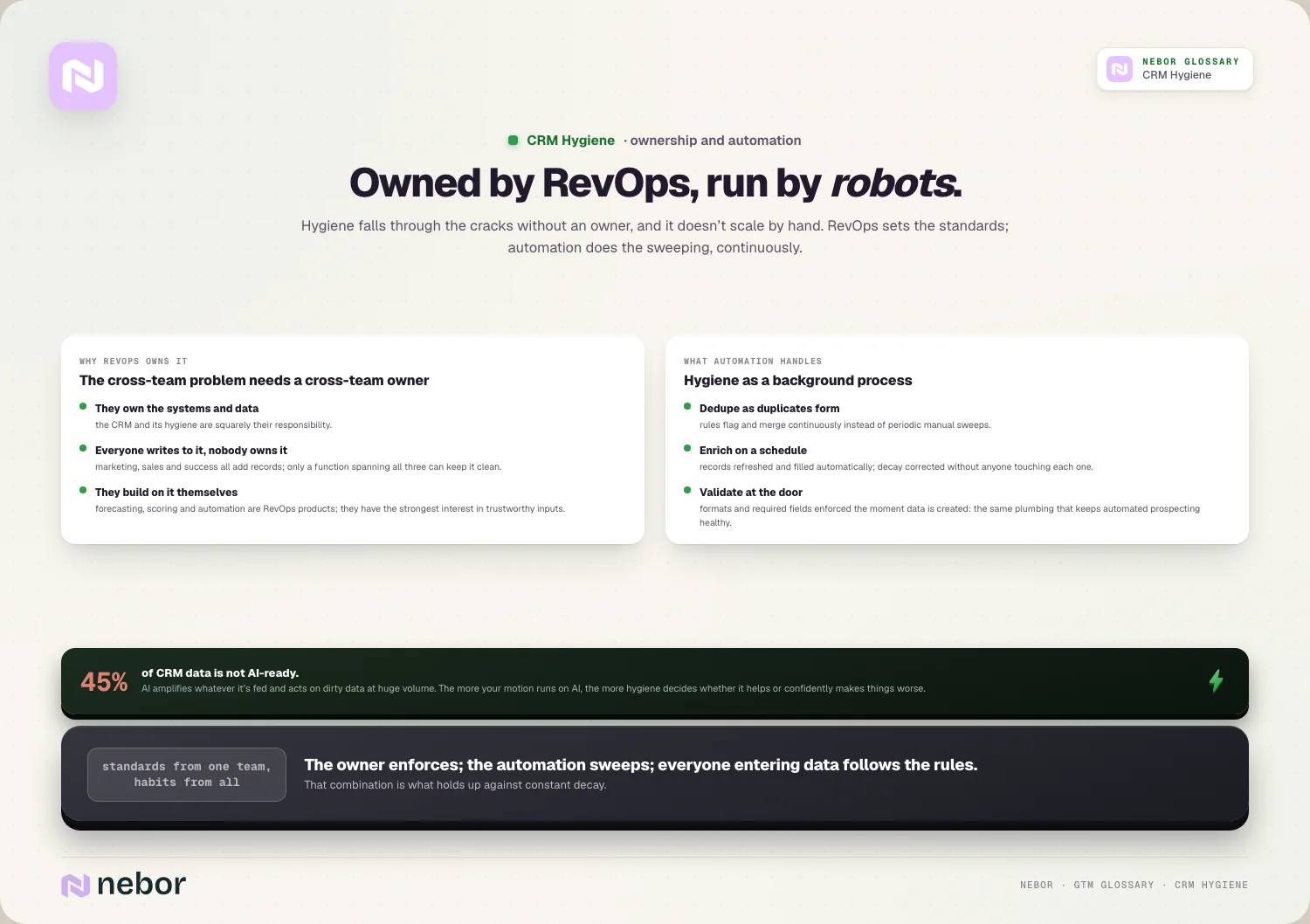
It's a cross-team problem by nature, because marketing, sales, and customer success all write to the CRM, so no single team can keep it clean on its own, and that's exactly the reason a function that spans all of them has to own it.
It's also foundational to their own job, because RevOps builds forecasting, scoring, and automation on the CRM, so they have the strongest interest in keeping the data those things depend on clean.
So CRM hygiene counts as core RevOps work instead of an afterthought or a side task. It's part of maintaining the revenue engine, since the engine only performs on data it can actually trust.
How does automation help with CRM hygiene at any real volume?
Keeping a CRM clean by hand doesn't scale, so we build automation into every setup that handles real volume. It changes hygiene from a chore to a background process.
Automated deduplication catches duplicates as they form. Rather than periodic manual merges, rules can flag and merge duplicates continuously, keeping records consolidated.
Automated enrichment keeps the data current too, because systems can refresh and fill records on a schedule, so decay gets corrected without someone manually updating each one.
Validation at entry prevents mess at the source. Automated checks can enforce formats and required fields the moment data is created, stopping bad data before it ever enters the system.
This is the same plumbing behind systems that automate sales prospecting. The automation behind outreach depends on clean data, so building hygiene into it keeps both the data and the motion healthy.
How do you measure your CRM hygiene instead of guessing at it?
You can't manage hygiene you don't measure, so a few metrics tell you the real state of your CRM. They turn a vague sense of mess into something trackable.
Completeness leads the list of useful metrics. Measuring what share of records have their key fields filled tells you how usable your data really is, because a half-empty record is barely better than none.
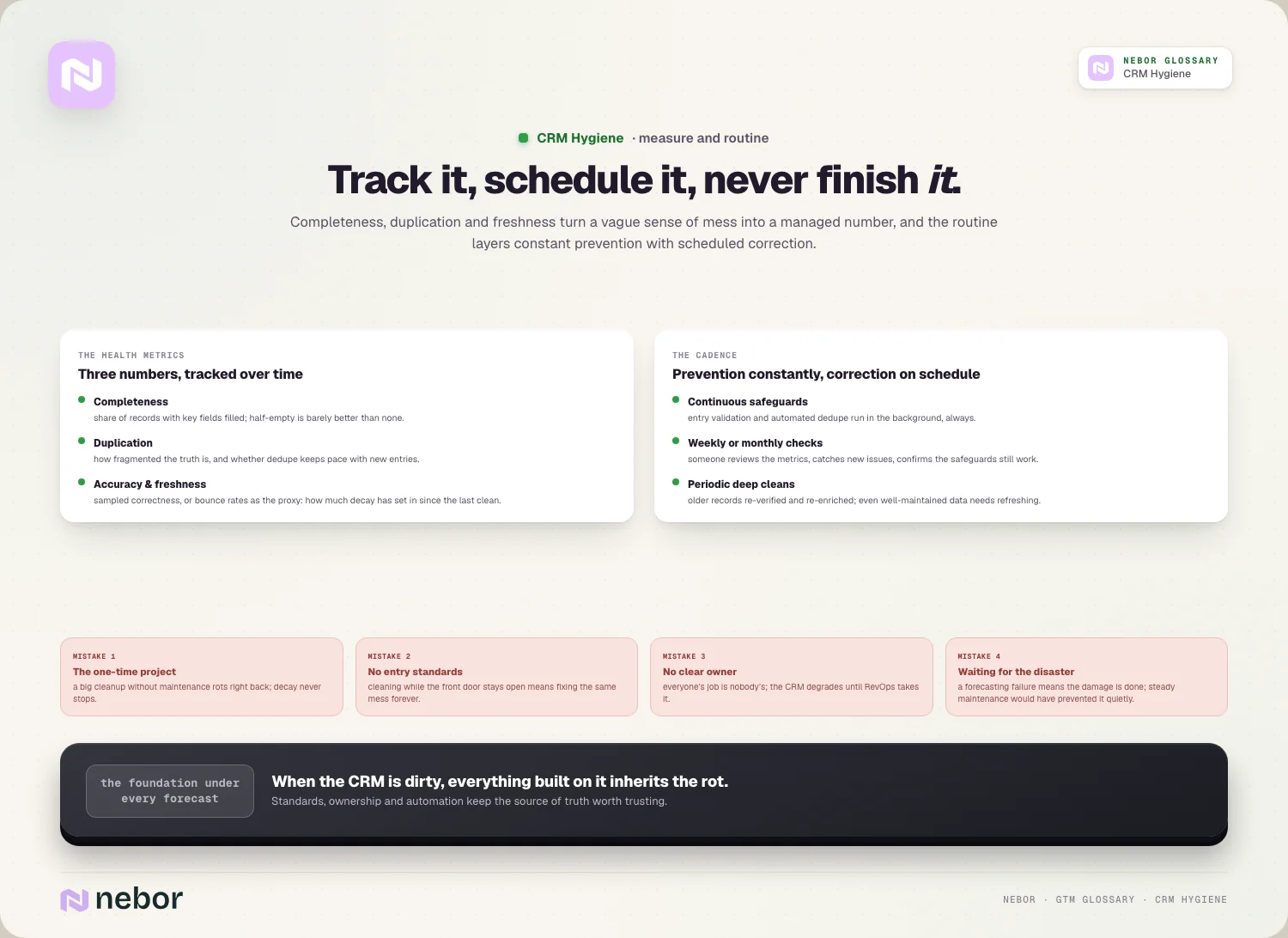
Duplication comes second, with tracking how many duplicate records exist showing how fragmented your truth is, and watching that number tells you whether deduplication is keeping up.
And accuracy and freshness close the set, where sampling records to check how many are still correct, or watching bounce rates as a proxy, reveals how much decay has crept in since your last cleanup.
So hygiene deserves measuring like any other health metric you care about. Tracking completeness, duplication, and accuracy over time turns CRM hygiene from a vague gut feeling into a managed discipline you can improve.
What does a working CRM hygiene routine look like week to week?
Hygiene works best as a routine rather than a rescue mission, so it helps to picture the cadence. A healthy operation does a few things on a schedule.
Continuous safeguards work underneath everything, with validation at data entry and automated deduplication working constantly in the background, stopping mess before it accumulates.
Regular checks come on top, where on a weekly or monthly rhythm, someone reviews data quality metrics, catches new issues, and confirms the automated safeguards are working.
And periodic deep cleans finish the job, because on a longer cycle you re-verify and re-enrich older records, given that even well-maintained data decays and needs refreshing.
So a hygiene routine layers constant prevention with periodic correction. The continuous parts keep new mess out, and the scheduled parts clean up the decay that always slips through anyway.
Why does CRM hygiene matter even more now that AI depends on it?
CRM hygiene has always mattered, but AI raises the stakes sharply. The reason is that AI feeds directly on your data.
AI passes along whatever it's fed, at scale. When you point AI tools at your CRM to score leads, write outreach, or surface insights, they produce results based on whatever data is there, good or bad.
The data often isn't ready for that job, with Validity's 2025 report finding around 45% of CRM data is not AI-ready, so AI tools end up generating outputs from stale, incomplete, or duplicated information.
Bad data also scales much faster with AI, because the same automation that makes it powerful means it acts on dirty data at huge volume, spreading the errors far faster than any human could by hand.
So clean data is now a prerequisite for AI, well beyond tidy reports. The more you lean on AI across your motion, the more CRM hygiene becomes the difference between AI that genuinely helps and AI that confidently makes things worse.
What are the common CRM hygiene mistakes that let the rot back in?
CRM hygiene fails in a few predictable ways. Avoiding them keeps your source of truth trustworthy.
Treating it as a one-time project tops the list, because a big cleanup feels productive, but without ongoing maintenance the CRM just rots again, given that decay never stops.
Having no entry standards comes next, where cleaning data while leaving the front door open to mess means you're forever cleaning up the same problems.
No clear owner is the organizational one, because when hygiene is everyone's job, it's nobody's job, so the CRM degrades until someone, usually RevOps, takes responsibility.
And there's ignoring it until it breaks, because waiting for a forecasting disaster or a failed campaign to finally address hygiene means the damage is already done, when steady maintenance would have prevented it.
Why your source of truth stays true only if someone keeps it true
CRM hygiene deserves its priority because your CRM is the foundation your whole revenue operation stands on. When the data is dirty, every forecast, score, and automation built on it inherits the rot, often without anyone realizing.
The deeper point is that the average CRM is far dirtier than teams admit, and the cost is hidden in wasted time and bad decisions rather than an obvious line item. That makes it easy to ignore and expensive to keep ignoring.
The honest reality is that hygiene is never finished. Data decays continuously, so keeping a CRM clean takes standards, ownership, and automation instead of a one-time scrub that rots away again.
So if your team doesn't trust the CRM, or your forecasts keep missing, the cause is often in the data itself. Treating CRM hygiene as ongoing, owned, and automated is what turns your source of truth back into something true.
That clean foundation is what every part of a go-to-market system depends on, right down to the clean list building that feeds it. Get the data right, and everything built on top of it gets more trustworthy.
Share this post
RevOps
CRM
Data
Glossary
Related glossary items
Understanding the core GTM concepts



Ready to build your pipeline