

In this post:
Intent signals are the specific, observable behaviors that suggest a company is moving toward a buying decision, like visiting your pricing page, reading vendor comparisons, or posting new job openings. They're the individual clues that a buyer is in motion, picked up from things they actually do.
Every account gives off these signals all the time, and in our experience most go unnoticed. A prospect reads a comparison article, another visits your site twice in a week, a third suddenly hires for a role your product supports, and each of those is a small flag that something is happening.
The skill is reading those flags well, because not every signal means the same thing and most teams either ignore them or chase all of them indiscriminately. Knowing which intent signals matter, how strong each one is, and what to do about it is what separates timely outreach from noise.
TL;DR
Intent signals are the concrete behaviors and events that suggest a company is entering or moving through a buying cycle, like pricing page visits, competitor comparisons on review sites, repeated content consumption, or relevant new job postings.
They matter because they tell you who's leaning in right now, so your team can reach out at the moment of interest instead of guessing. A well-read signal turns cold outreach into a well-timed follow-up.
The hard part is that signals vary wildly in strength and freshness, and acting on weak or stale ones wastes effort. The teams that win rank signals by how strongly they indicate intent, watch for several stacking together, and act fast while the signal is still live.
So what exactly is an intent signal, and what counts as one?
An intent signal is a single observable action or event that hints a company may be interested in buying. It's the atomic unit of buyer interest, one concrete behavior you can point to, rather than a vague sense that an account might be in the market.
Examples make it concrete, like a VP reading a blog post about the category, a company posting three new roles your product supports, someone visiting your pricing page twice in a week, or an account reading X versus Y comparisons on a review site.
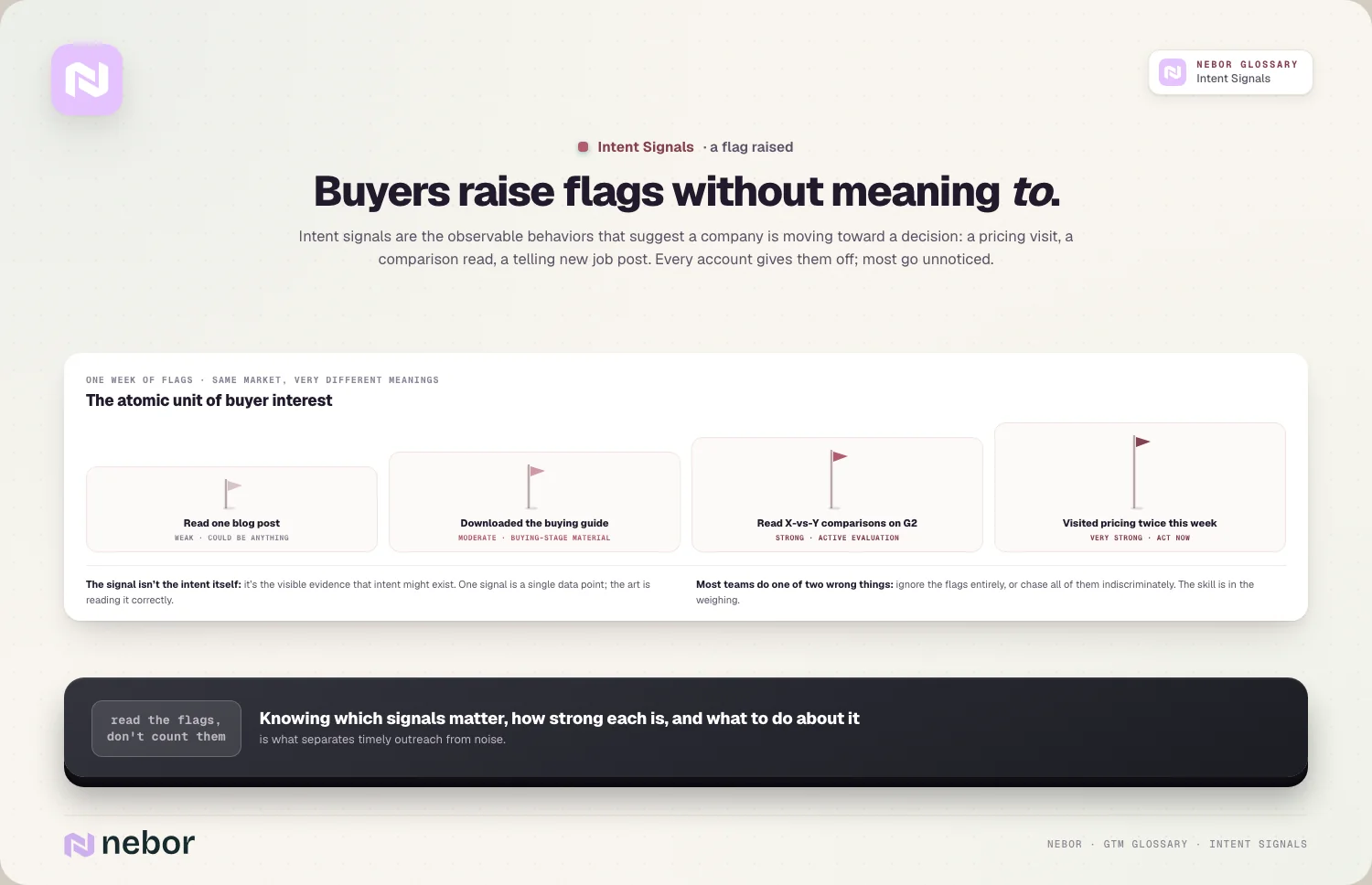
Each of these is a discrete signal, a thing that happened, which you can detect and act on. The signal isn't the intent itself, it's the visible evidence that intent might exist.
Each one works like a flag a buyer raises, often without meaning to. People reveal where their attention is going through what they read, visit, and hire for, and intent signals are those revealing actions, captured so you can notice them.
One signal is a single data point, and the art is in reading it correctly and knowing what, if anything, to do about it.
How are intent signals different from intent data as a category?
These two terms are deeply related and constantly mixed up, so let's put a clean line between them. One is the individual clue, and the other is the broader practice of collecting clues.
An intent signal is a single observable behavior, like one pricing page visit or one comparison-page view.
Intent data is the broader category of behavioral data that captures and aggregates many such signals, often as a product you buy or a feed you tap into.
So intent signals are the raw events, and intent data is the organized collection and delivery of them, which means every intent signal is a piece of intent data, but the term signal keeps your focus on the individual, actionable event.
This distinction matters in practice because it changes how you think. Talking about intent data can make it sound like a feed you subscribe to and trust, while talking about intent signals keeps you focused on the specific behaviors and whether each one means anything.
Reading signals well is what makes any intent data useful, because the data is only as good as your ability to interpret the individual signals inside it.
How do intent signals relate to buying signals and buying intent?
Intent signals belong to a family of related ideas, and untangling them keeps your thinking sharp, because they differ mainly in scope.
Buying intent is the buyer's actual state of being inclined to purchase, the real readiness inside them. Intent signals are the specific behavioral evidence that suggests that state.
Buying signals is a slightly broader term that includes intent signals but also covers other cues that an account is a good moment to engage, like fit changes or trigger events.
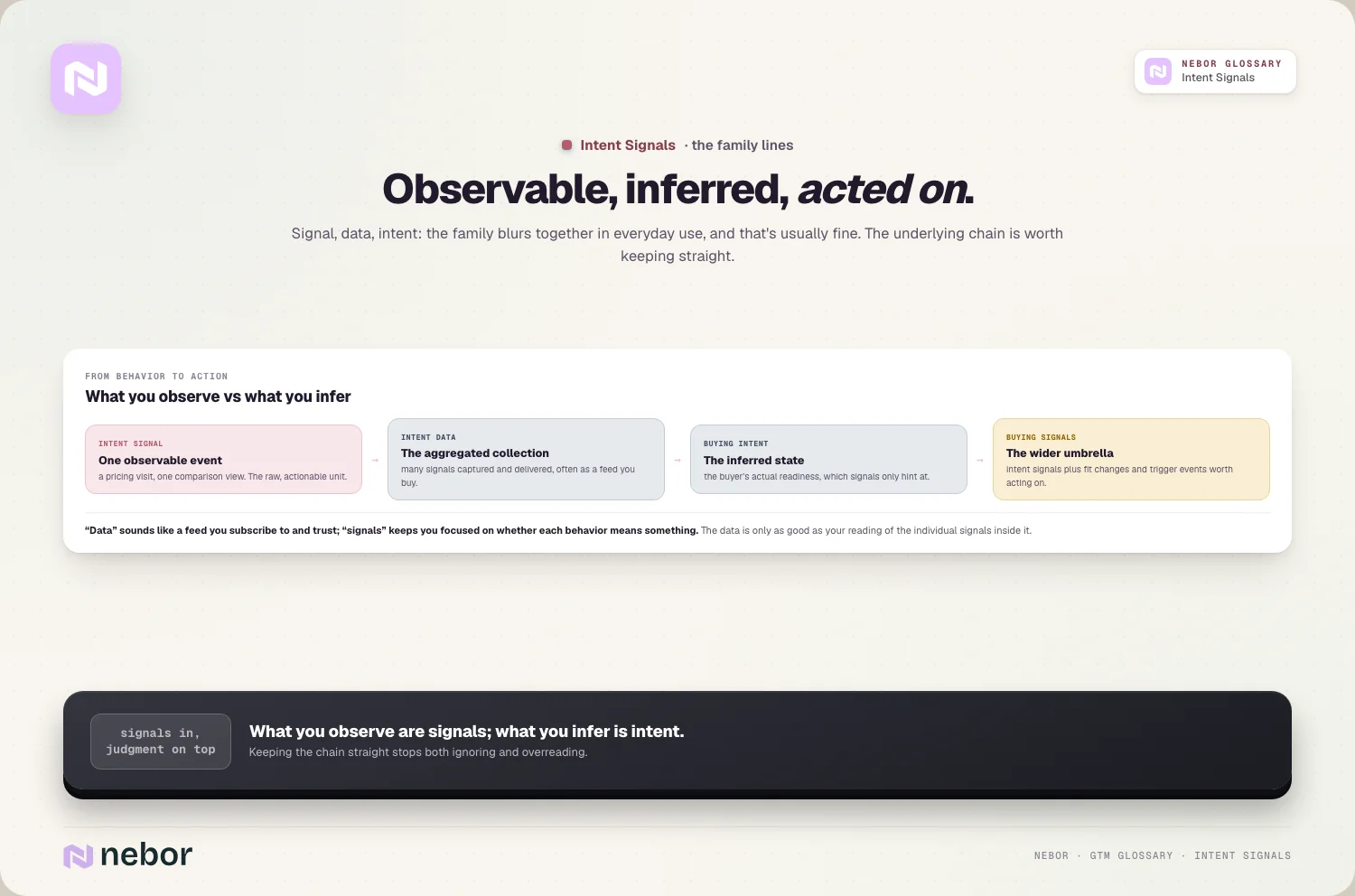
So buying intent is the state, intent signals are the behavioral evidence of it, and buying signals is the wider umbrella of all the cues worth acting on.
In everyday use these terms blur together, and that's usually fine, but the underlying logic deserves keeping straight. What you observe are signals, what you infer from them is intent, and the whole point of watching signals is to detect intent early enough to act.
Keeping that chain straight, from observable behavior to inferred state to action, is what stops you from either ignoring real signals or overreading weak ones.
What are the main types of intent signals, and which can you trust?
Intent signals come from different places, and where a signal comes from tells you a lot about how much to trust it. Grouping them by source is the most useful way to sort them.
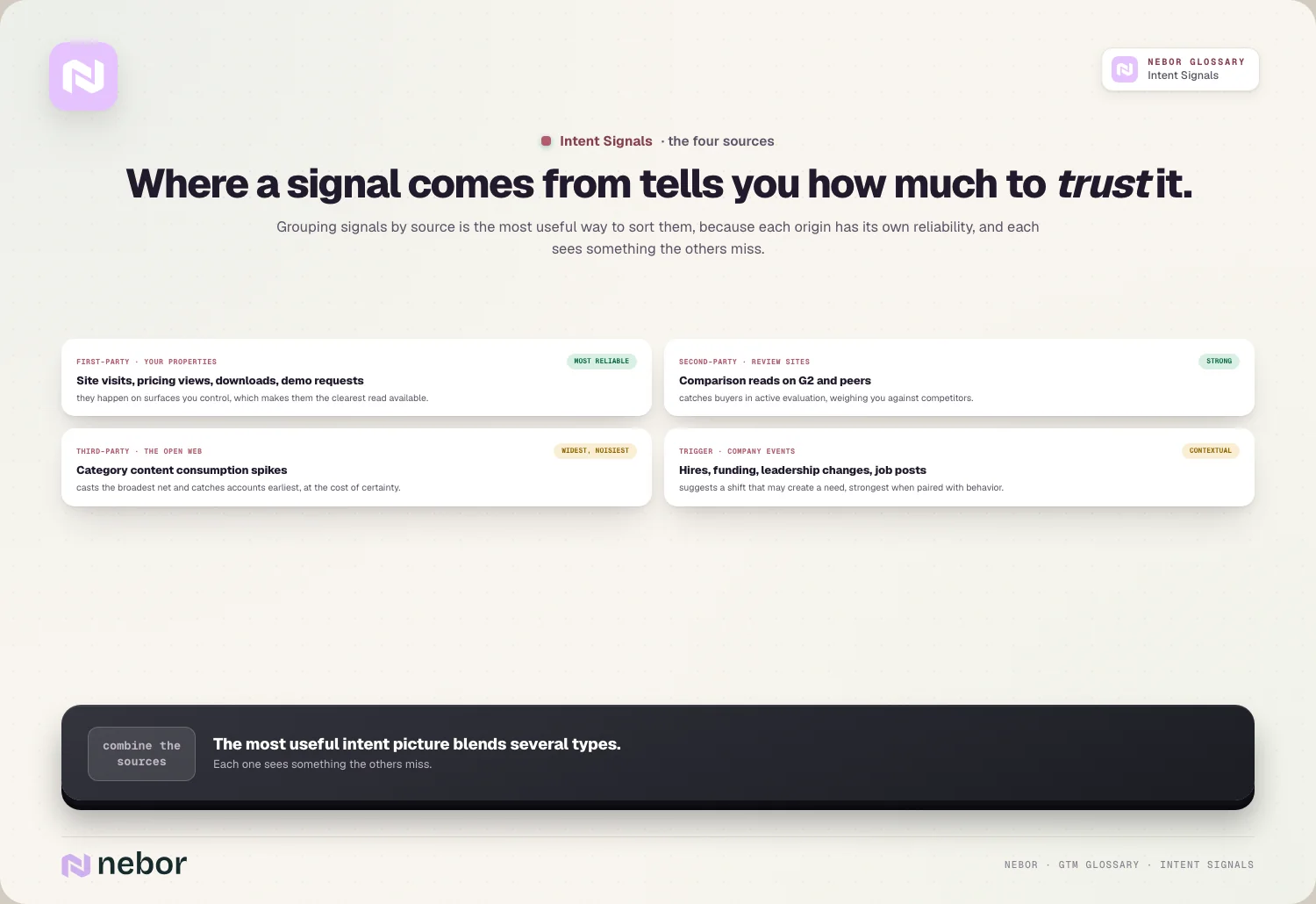
The main types break down by origin.
First-party signals, from your own properties, like website visits, pricing page views, repeat visits, content downloads, and demo requests, which are the most reliable because they happen on surfaces you control.
Second-party signals, from partners like review sites, such as an account reading comparisons of you or a competitor on G2, which are valuable because they catch buyers in active evaluation.
Third-party signals, from across the open web, like a company consuming far more content than usual about your category, which cast the widest net but are the noisiest.
Trigger signals, from company events, like new hires, funding, leadership changes, or job postings, which suggest a shift that may create a need.
Each type has its own strength and reliability, with first-party being the clearest and third-party being the broadest but least certain. The most useful intent picture combines several types, because each one sees something the others miss.
Why isn't every single intent signal worth acting on right away?
It's tempting to treat every signal as an opportunity, but that's a fast way to waste effort and annoy people. Signals vary enormously in what they really mean.
A single visit to your blog is a very weak signal, because people read content for all kinds of reasons that have nothing to do with buying, while two visits to your pricing page plus a demo-page view is a much stronger one.
Treating those as equal, and reaching out hard to both, means you spend the same energy on idle browsers as on real prospects, and you risk a pushy, mistimed message to someone who was just reading.
Not every flag is a buying flag, and acting as if it is undermines the entire approach.
This is why reading signals means weighing them instead of just counting them. The questions that matter are how strongly a signal indicates real buying behavior, how recent it is, and whether it fits a pattern.
A weak, old, isolated signal is barely worth a glance, while a strong, fresh, repeated one is worth immediate attention, and the discipline is telling those apart rather than chasing everything.
What makes one intent signal strong and another barely a whisper?
Since reading signals well is the entire skill, it helps to know what makes one strong. A few factors do most of the work.
The first is how close the behavior is to a buying decision, because visiting a pricing page or comparing vendors is much closer to buying than reading a top-of-funnel article.
The second is recency, because a signal from today reflects current interest while one from two months ago may be long cold, so fresh signals far outweigh stale ones.
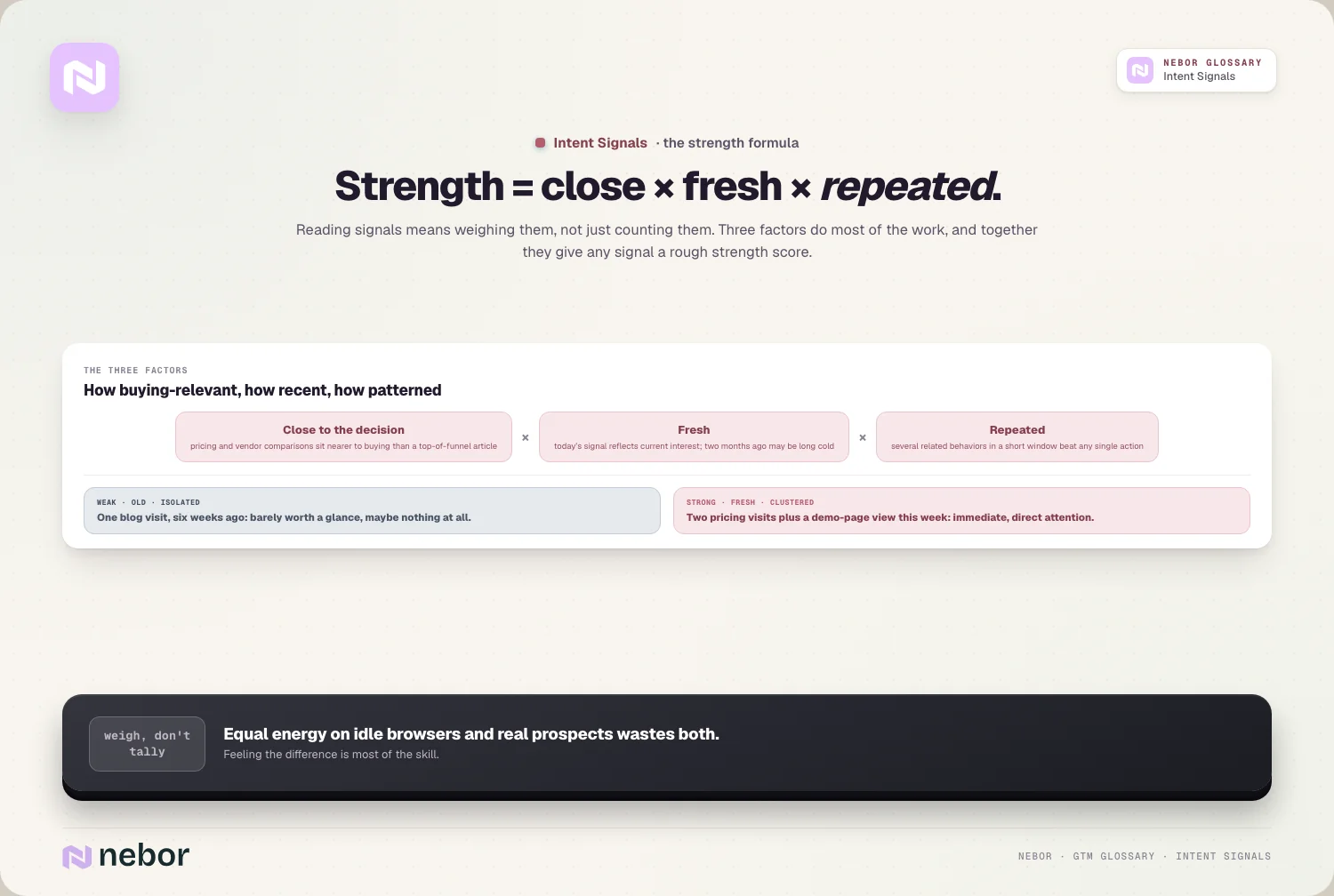
The third is repetition and pattern, because a single action could be anything, but the same account showing several related behaviors in a short window is a much more convincing sign that something real is happening.
Those three together give you a rough strength score for any signal, based on how buying-relevant, how recent, and how repeated it is.
A high-intent action that's fresh and part of a cluster deserves fast, direct outreach, while a weak, old, one-off signal might deserve nothing at all. Learning to feel that difference is most of the skill of working with intent signals.
Why does signal stacking matter so much more than any single event?
One of the most important ideas in reading intent is that signals are far more meaningful together than apart. A single signal is a guess, while several stacked signals are close to a conclusion.
Any one behavior can be misleading, because a person might visit your pricing page out of idle curiosity or read a comparison for a project that goes nowhere.
But when the same account shows multiple signals at once, like a pricing visit, a comparison read, and a relevant new job posting in the same week, the odds that something real is happening jump dramatically.
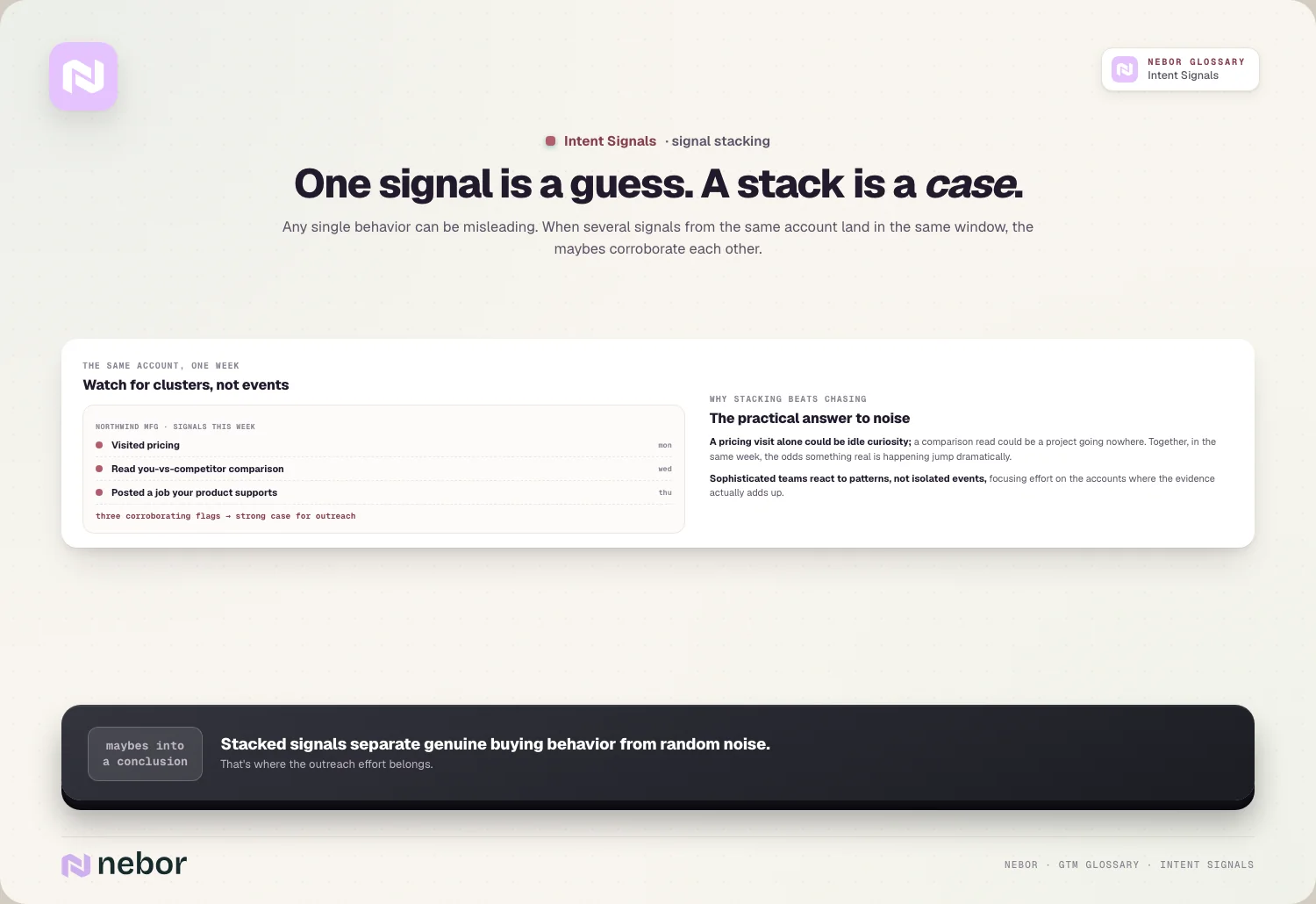
The signals corroborate each other, turning a collection of maybes into a strong case for outreach.
This is why sophisticated teams look for patterns rather than reacting to isolated events. Instead of chasing every single signal, they watch for accounts where signals cluster, because that stacking is what separates genuine buying behavior from random noise.
Signal stacking is the practical answer to the noise problem, because it lets you focus your effort on the accounts where the evidence adds up.
How do intent signals fit together with your fit scoring model?
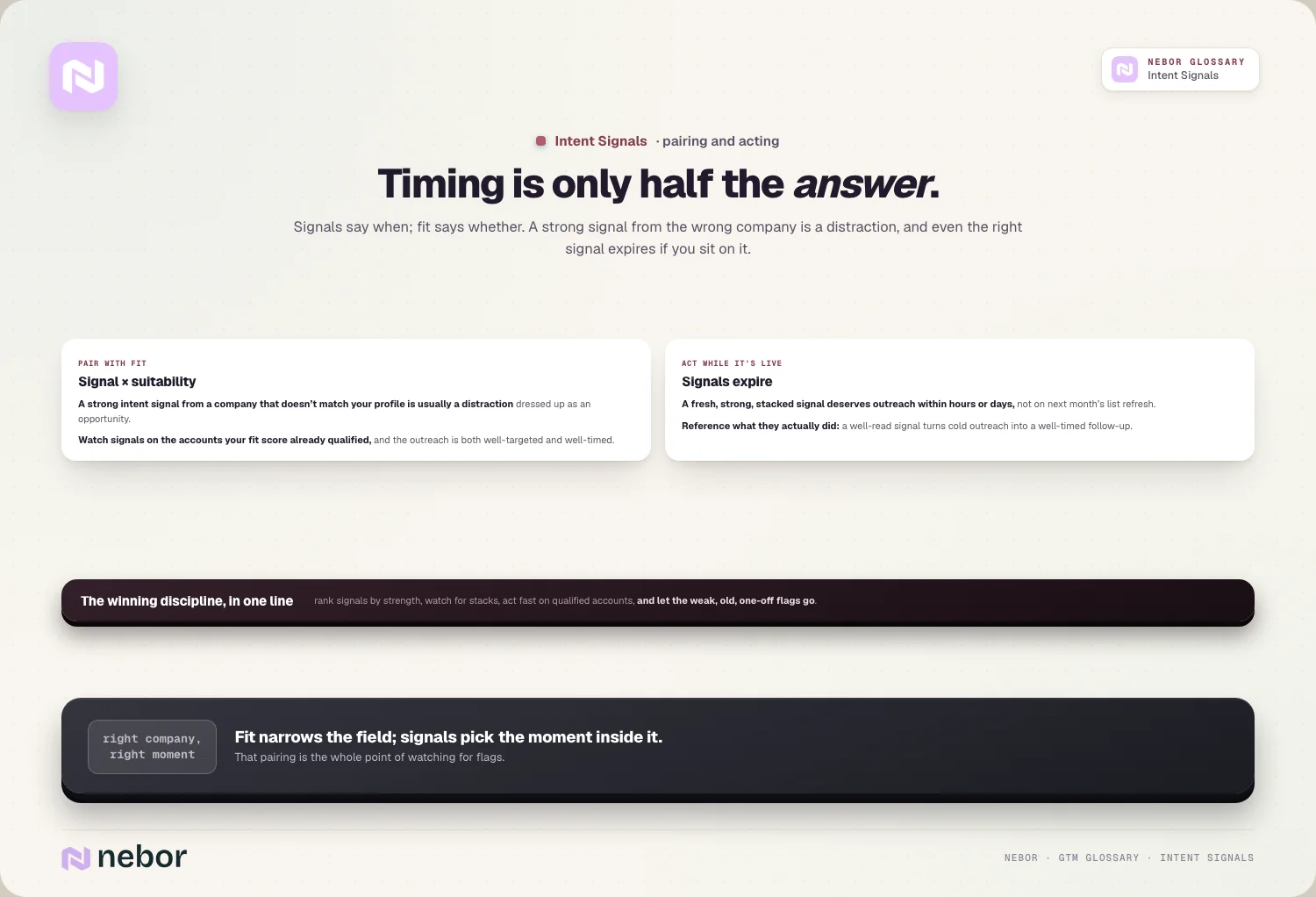
Intent signals tell you about timing, and they're most powerful when paired with fit, which tells you about suitability. Acting on one without the other leads you astray.
A strong intent signal from a company that doesn't match your profile is usually a distraction, because even active interest doesn't help if you can't serve them well. A perfect-fit account with no current signals is worth nurturing but not chasing hard yet.
This is the fit score versus intent score distinction, where fit answers who and intent signals answer when, and you want both pointing the same way before you commit real effort.
In practice, you use your ICP scoring model to know which accounts are worth pursuing at all, then watch those accounts for intent signals to know when to move.
Signals tell you to act now, and fit tells you whether this account was ever worth acting on, so combining them keeps you from spending your best, most-timely effort on companies that were never a match.
The combination is what turns raw signals into focused, well-aimed outreach.
How should you act on intent signals once one of them lands?
A signal is only useful if it leads to the right action at the right time, so the real question is what to do when one lands. The answer depends on the strength of the signal.
For strong, fresh, stacked signals, the move is prompt, relevant outreach that reflects what the account actually did, which is the essence of signal-based selling and inbound-led outbound.
You reach out while the interest is live, with a message tied to the specific behavior, instead of a generic template.
For weaker signals, the right action might be lighter, like adding the account to a nurture track or simply watching for more signals to stack before you reach out directly.
Speed matters more than almost anything here, because a signal's value decays fast as interest cools.
A strong signal acted on within a day is worth far more than the same signal acted on a week later, which is why the best teams build systems that route fresh signals into your reps' hands quickly.
Many of these signals start as anonymous activity, so identity resolution is often what turns a signal you can see into an account you can contact, which is the exact job the website visitor tracking workflow does for our clients.
How do intent signals shine a light into the dark funnel for you?
Intent signals are one of the few tools that let you see buying activity you'd otherwise miss entirely. That hidden activity is a big part of why they matter.
Most buyer research happens quietly, off your properties and outside your view, in what's called the dark funnel.
Buyers read, compare, and evaluate for a long time before they ever identify themselves, and by the time they raise a hand, most of their decision is already shaped.
Intent signals, especially third-party and review-site signals, are how you catch some of that hidden research, surfacing accounts that are deep in evaluation without having told you anything directly.
This is why intent signals have become so valuable as buying journeys have gone more private.
They give you a partial window into the research that used to be completely invisible, letting you reach in-market accounts before they reach you, or before they finalize a shortlist that doesn't include you.
The signals don't reveal the whole dark funnel, but they reveal enough of it to change who you reach and when.
What are the common intent signal mistakes that waste good timing?
A handful of mistakes show up in nearly every team we watch start working with intent signals, and most come from misreading what a signal means. Naming them helps you read signals better.
The biggest is treating all signals as equal, reacting to a weak blog visit the same way you'd react to a pricing-page-plus-demo pattern, which wastes effort and produces mistimed outreach.
Close behind is acting on single signals instead of waiting for them to stack, so you chase isolated events that often mean nothing.
Then there's ignoring recency, reaching out on a signal that's already gone cold, and reaching out with a generic message that doesn't reflect the signal at all, which throws away the timing advantage.
There's also the mistake of detecting signals but acting too slowly, letting fresh interest fade before anyone moves.
The remedy reads the same for every one of them. You weigh signals by strength and recency, look for stacking before you commit, act fast while the signal is live, and tailor the outreach to the specific behavior that triggered it.
Why intent signals reward careful reading over instant reacting
Intent signals, in the end, are the visible breadcrumbs buyers leave as they move toward a decision, and their whole value depends on how well you read them.
Reacting to every signal is as useless as ignoring them all, because the edge comes from interpretation on top of detection.
The teams that win with intent signals weigh each one by how close it is to buying, how fresh it is, and whether it's part of a cluster, then act fast and relevantly on the strong patterns while letting the weak noise go.
They pair signals with fit so their best effort goes to the right accounts, and they build the systems to act while the interest is still live.
The mindset that works is to treat each signal as a question instead of a command. A signal asks whether something real is happening, and your job is to read the strength, the timing, and the pattern well enough to answer, then move quickly when the answer is yes.
Share this post
Intent
Data
Glossary
Related glossary items
Understanding the core GTM concepts




Ready to build your pipeline











