
In this post:
First-party data is information you collect yourself, directly from your own customers and prospects. Third-party data is information collected by someone else, aggregated, and sold to you. The difference is who gathered it, and it changes almost everything about how much you can trust it.
That distinction has quietly become one of the most important in go-to-market. First-party data is yours, exclusive, and accurate, while third-party data is broad, shared, and increasingly shaky as privacy rules tighten.
Most teams use both, and they should, but they often misunderstand the trade-off. Knowing what each type is good for, and where each one falls short, is what lets you build targeting and personalization that actually hold up.
TL;DR
First-party data is data you collect directly, from your site, your product, your CRM, and your conversations. Third-party data is data gathered by others and bought in, usually for reach and enrichment.
First-party is more accurate, exclusive to you, and built on a real relationship, but it only covers people who have already engaged with you. Third-party is broad and catches accounts early, but it's shared with everyone and less reliable.
The smart move is to use each for what it's best at. Lean on first-party for accuracy, personalization, and your strongest signals, and use third-party to widen your reach and find accounts before they ever reach you.
So what's the actual difference between first-party and third-party data?
The whole distinction comes down to one question, which is who collected the data in the first place. That single fact determines its accuracy, its exclusivity, and how much you can rely on it.
First-party data is anything you gather directly through your own interactions, like what people do on your website, in your product, on your forms, and in your CRM. You own it, you know exactly how it was collected, and nobody else has it in the same form.
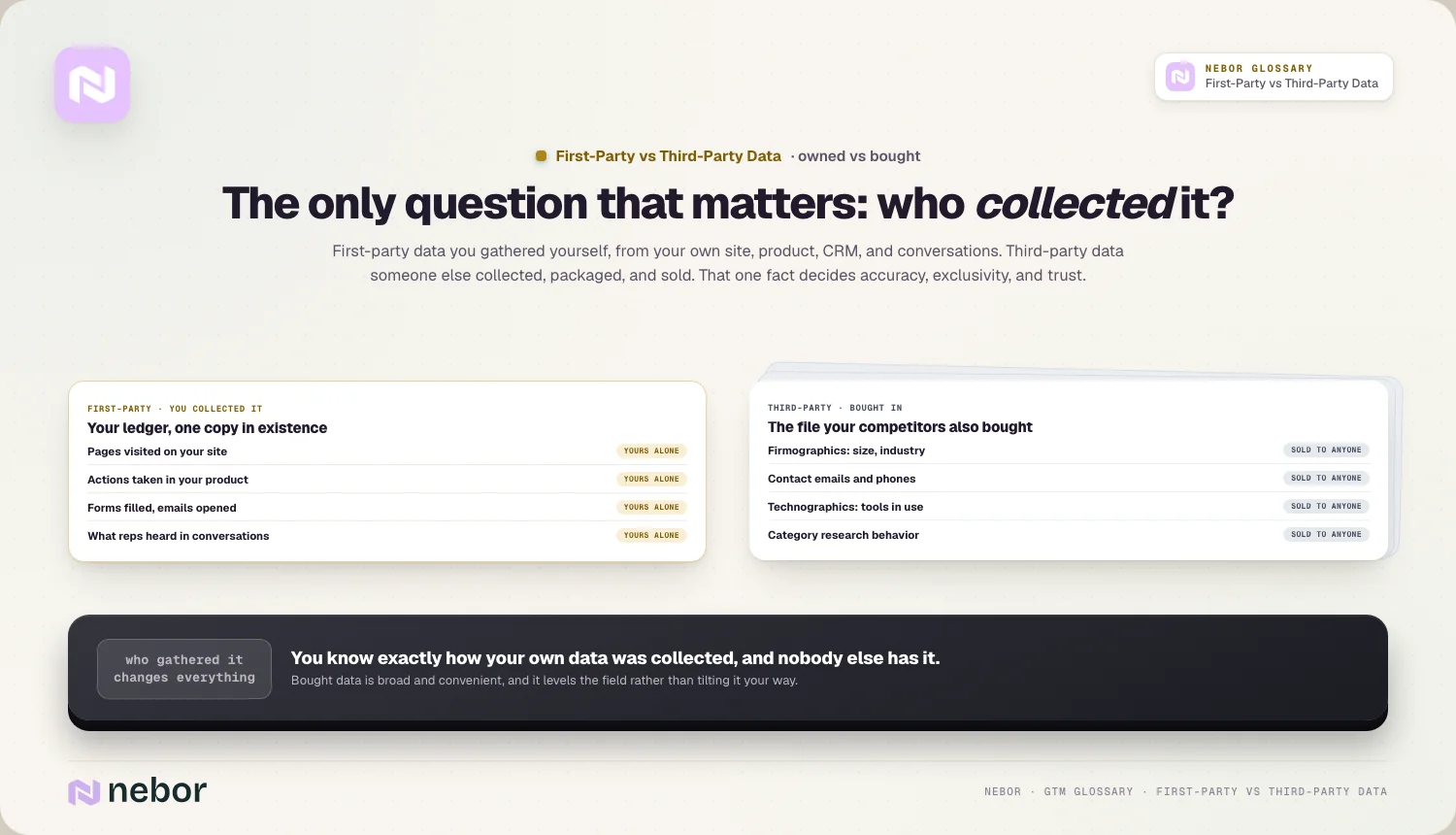
Third-party data comes from the opposite direction. Someone else, usually a data provider, collected it across many sources, packaged it up, and sold access to it. It's broad and convenient, but you don't fully know how it was gathered, it can be out of date, and your competitors can buy the exact same data.
What counts as first-party data, and why is it your most valuable kind?
First-party data is everything you learn directly from your own audience, and it's the most valuable because it's both accurate and yours alone. No one else has it the way you do.
It includes what people do on surfaces you own, like the pages they visit on your site, the actions they take in your product, the forms they fill in, the emails they open, and the conversations your reps have with them.
There's also a special, even stronger version called zero-party data, meaning the things people tell you deliberately, like answering a question about their needs.
The reason it's so valuable is that it's grounded in a real relationship. Someone who sat on your pricing page is telling you something specific about their interest in you, which no purchased dataset can match.
First-party data is also the foundation of your strongest signals, because behavior on your own surfaces is the clearest sign of real interest.
What counts as third-party data, and what is it really good for?
Third-party data is information you buy from outside, collected by a provider across the wider market rather than from your own audience. It has real uses, as long as you understand what it is.
It includes the firmographic, contact, technographic, and behavioral data that powers most data enrichment, bought from a data provider that maintains a large database.
It's how you fill in a company's size and industry, find a contact's email, or learn what tools an account uses, for companies that have never interacted with you.
Its great strength is reach and earliness. Third-party data lets you know about and target companies before they've ever visited your site, which first-party data simply can't do, because first-party only exists once someone engages with you.
So third-party is what casts the wide net, finding the right kind of accounts across a market you couldn't observe on your own.
Where does second-party data fit between the other two categories?
There's a third category people forget, and it falls neatly between the other two. Second-party data is simply someone else's first-party data, shared with you directly.
In practice this means a partner or another company giving or selling you the data they collected from their own audience.
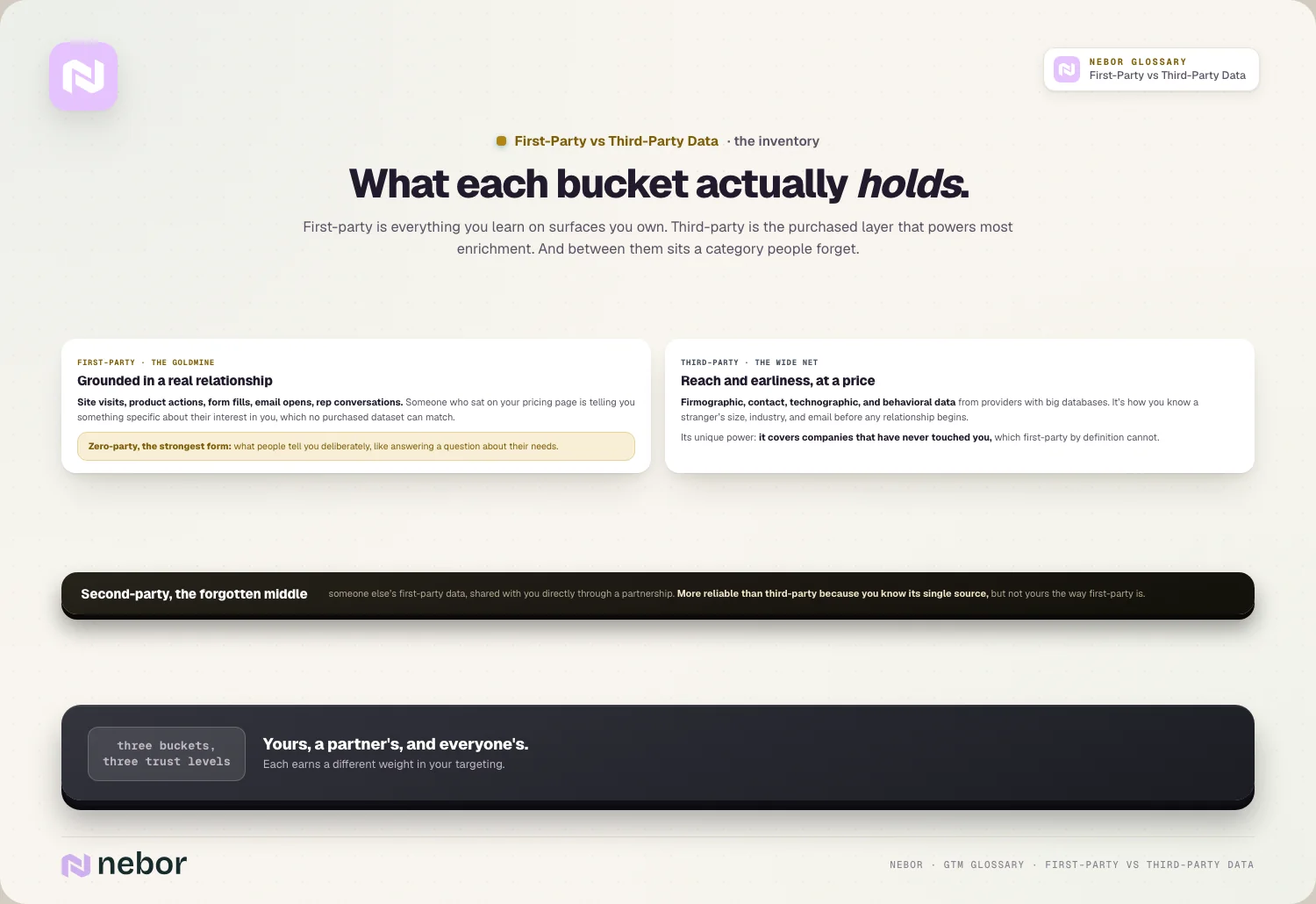
It's more reliable than typical third-party data, because you know its single source and how it was gathered, but it isn't yours the way first-party is, because it came from someone else's relationship.
Second-party data shows up in partnerships and data-sharing arrangements, like co-marketing or referral relationships where each side shares what they know. It's less common than the other two, but it's a useful middle ground, combining some of the trust of first-party with some of the reach of third-party.
Why is first-party data more accurate and trustworthy than third-party?
The accuracy gap between the two is real, and it shapes how much weight you should give each. First-party data is more trustworthy for a few structural reasons.
You control how first-party data is collected, so you know it's current and you know what it means. When someone fills in your form today, that data is fresh and unambiguous.
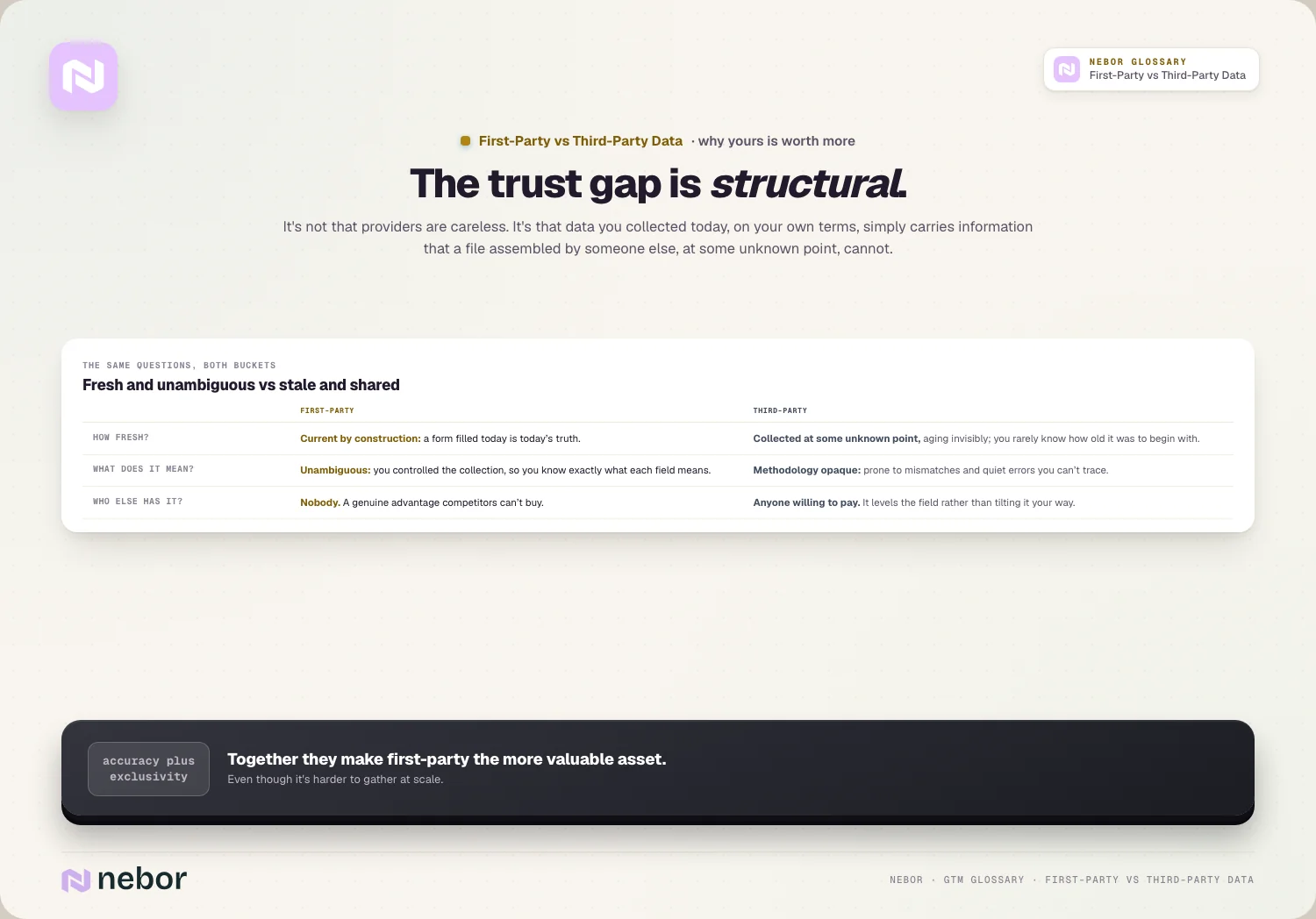
Third-party data, by contrast, was collected at some unknown point by someone else, so it's more prone to being stale, mismatched, or simply wrong, and it suffers the same data decay as everything else, often without you knowing how old it was to begin with.
Exclusivity adds a second layer to the gap. First-party data is yours alone, which makes it a genuine advantage, while third-party data is available to anyone willing to pay, so it levels the field rather than tilting it your way.
Accuracy and exclusivity together are why first-party data is the more valuable asset, even though it's harder to gather at scale.
Why is third-party data getting weaker, and what's driving the shift?
The balance between these two has been shifting toward first-party, and the reasons matter, because they change where you should invest. Third-party data has come under real pressure in the last few years.
The main driver behind the shift is privacy. Tightening regulations and changes by the big platforms, like the long decline of third-party cookies and stricter rules on tracking, have made it harder to collect and use third-party data the way the industry once did.
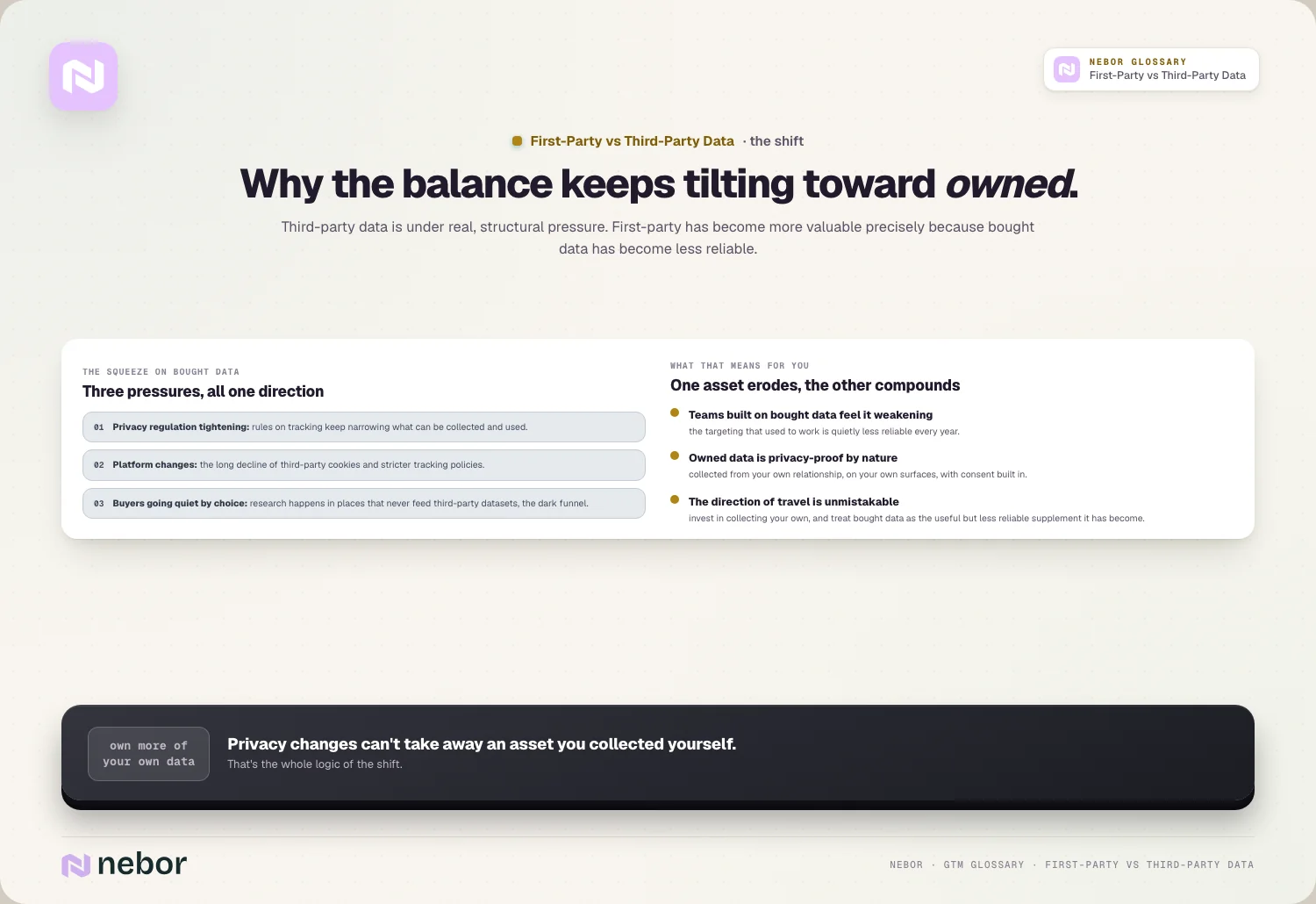
Buyers are also more private by choice, doing their research in places that don't feed third-party datasets, which is part of why so much now happens in the dark funnel.
The result is that first-party data has become more valuable precisely because third-party data has become less reliable.
Companies that built their targeting on bought data are finding it weaker than it used to be, while those that invested in collecting their own data have an asset that privacy changes can't take away. The direction of travel is clearly toward owning more of your own data.
How should you use first-party and third-party data together?
The point isn't to pick a side, it's to use each for what it does best, and the strongest programs combine the two deliberately, because they cover different gaps.
You use third-party data for reach and early discovery, sweeping the market for the right kind of accounts and to enrich records for companies that have never touched you. It's how you know who exists and which companies fit your profile before any relationship begins.
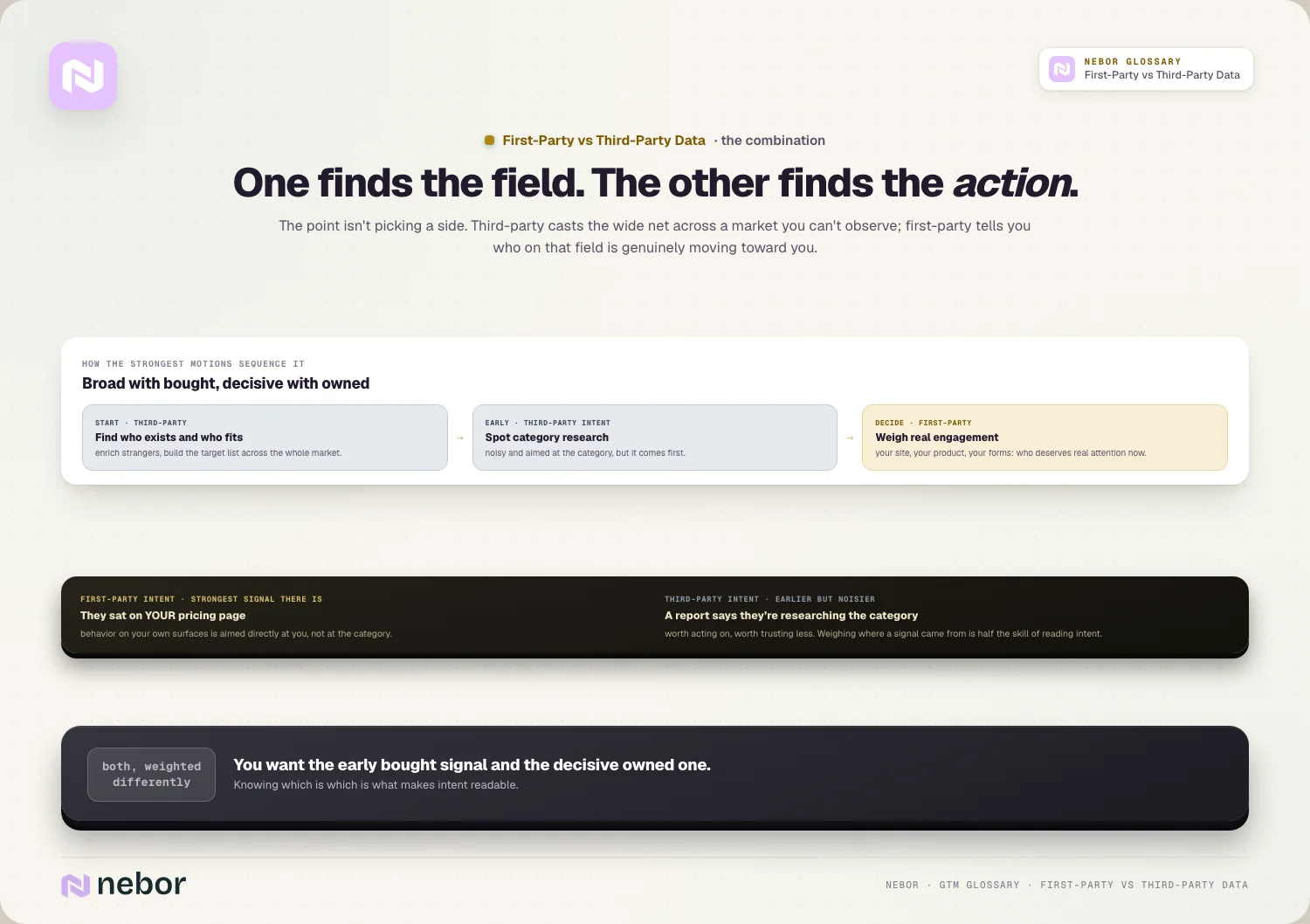
You use first-party data for accuracy, personalization, and your strongest signals, since it tells you who's genuinely engaging and what they actually did on your surfaces.
The best motions we build start broad with third-party targeting and then lean hard on first-party signals to decide who deserves real attention now. One finds the field, the other tells you where the action is.
How does this distinction apply to intent data specifically?
Nowhere does the first-party versus third-party split matter more than with intent, so it deserves its own section. The two kinds of intent behave very differently.
First-party intent is what people do on your own surfaces, like visiting your pricing page or using your product, and it's the strongest intent signal there is, because it's aimed directly at you.
Third-party intent is research behavior off your site, bought as intent data, which catches accounts earlier but is noisier and aimed at the whole category rather than at you specifically.
This is why reading buying intent well means weighing where the signal came from. A first-party signal from your own site counts for far more than a third-party report that an account is researching your category, even though the third-party one might come first.
You want both, but you trust them differently, and knowing which is which is half the skill.
What are the common mistakes teams make with first versus third-party data?
Most missteps here come from treating the two types as interchangeable, which they aren't. Each mistake wears down your targeting in its own way.
The most common one we see is over-trusting third-party data, treating a bought signal as if it were as reliable as a first-party one, and then chasing accounts on shaky evidence.
The opposite mistake is ignoring first-party data, holding a pile of real behavior from your own site and product while spending heavily on bought data that's less accurate.
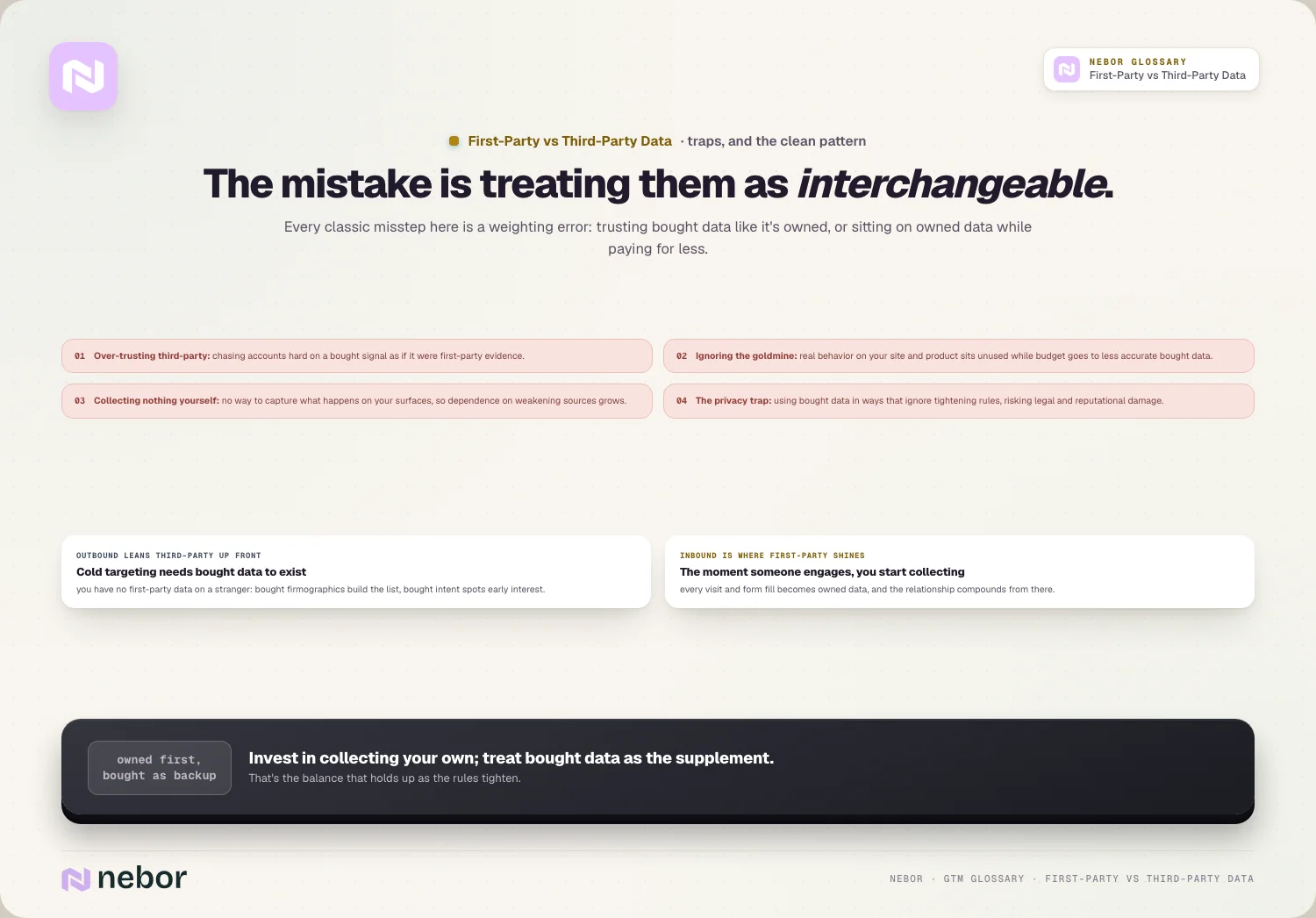
A third is failing to collect first-party data at all, with no real way to capture what people do on your surfaces, so you stay dependent on third-party sources that keep getting weaker.
There's also the legal side, where using third-party data in ways that ignore tightening rules puts you at real reputational risk.
Every one of these gets fixed the same way. You invest in collecting and using your own first-party data, while treating third-party data as the useful but less reliable supplement it has become.
How does the first versus third-party split play out across the funnel?
Both motions use both kinds of data, just weighted differently, and the pattern is fairly clean once you see it.
Outbound leans more on third-party data up front, because you have to find and reach accounts that have never interacted with you.
You use bought firmographic and contact data to build the target list and bought intent to spot early interest, because you have no first-party data on a stranger yet. Third-party is what makes cold targeting possible at all.
Inbound is where first-party data shines, because the moment someone engages, you start collecting your own data on them. A website visitor who deanonymizes, a form fill, or a product action is all first-party, and it's far stronger than anything you could buy.
So outbound tends to start with third-party and warm into first-party as a relationship forms, while inbound is first-party from the first touch.
How do you collect more first-party data without waiting around?
If first-party data is so valuable, the practical question is how to get more of it, because it only exists once people engage with you. The good news is there are several reliable ways to capture it.
The biggest source in the builds we do is identifying who's already on your surfaces. Tools that deanonymize your website visitors turn anonymous traffic into named first-party data, and good identity resolution ties a person's actions across your site, product, and emails into one picture.
Beyond that, product usage, form fills, event sign-ups, and your reps' notes from conversations all generate first-party data worth keeping.
The key is to treat collection as deliberate instead of accidental. Most of the setups we've audited leak first-party data constantly, letting visitors and product actions go uncaptured, when a bit of intent and the right tools would turn all of it into an owned asset that compounds.
Does first-party data scale the way third-party data always seems to?
There's an honest trade-off to name here, which is that first-party data doesn't scale the way bought data does. Its great strength is also its limit.
First-party data only exists for people who have interacted with you, so a small or young company simply doesn't have much of it yet.
Third-party data, by contrast, is available for vast numbers of companies you've never touched, and that's exactly why you still need it for reach. You can't do cold outbound on first-party data you don't have.
So the two scale differently, and that shapes how you use them. You buy third-party data to reach the many, and you build first-party data to deeply understand the few who engage. The first-party asset grows over time as more people interact with you, which is part of why investing in it early pays off later.
Why owning your own data is the quiet advantage that keeps compounding
The first-party versus third-party distinction is really a question of ownership, and ownership is where durable advantage lives. The data you collect yourself is accurate, exclusive, and immune to the privacy changes eroding everyone's bought data.
The teams that understand this invest in their own data layer, capturing what people do on their surfaces and treating those signals as the most valuable data they hold, while using third-party data for the reach it provides without leaning on it for truth.
That balance gives them the best of both, the breadth of bought data and the trustworthiness of owned data.
The mindset that works is to treat first-party data as an asset you build and compound over time, and third-party data as a service you rent for reach.
As privacy keeps tightening and bought data keeps weakening, the companies that own more of their own data will keep pulling ahead, because the one thing nobody can take from them, or sell to their competitors, is the data they gathered themselves.
Share this post
Data
Intent
Glossary
Related glossary items
Understanding the core GTM concepts



Ready to build your pipeline











