

In this post:
Right now, real buyers are on your website. They're reading your pricing, comparing your features, and weighing whether to reach out, and you have no idea who almost any of them are.
That invisibility is a strange thing to accept. You spend heavily to attract those visitors, then watch the overwhelming majority leave without a trace, taking their interest with them.
Website visitor deanonymization is the practice of identifying the anonymous visitors on your site, revealing the companies and sometimes the people behind your traffic. It puts names on visits that would otherwise stay silent.
A visit carries real interest behind it. Someone researching your product is far warmer than a cold name on a list, so seeing who they are changes what you can do.
TL;DR
Website visitor deanonymization identifies the anonymous companies and people visiting your website, turning untracked traffic into named accounts and contacts you can follow up with.
Most of your site traffic never identifies itself, so deanonymization recovers a slice of the warm interest that would otherwise walk away unseen.
It works by combining methods, IP-to-company matching, first-party tracking with enrichment, and identity graphs, to match visits to records.
The honest limitation is that match rates are partial and often overstated. Company-level identification catches a meaningful share, person-level far less, so it works as a strong signal source instead of a complete visitor list.
What is website visitor deanonymization, and what does it reveal?
Website visitor deanonymization is the work of figuring out who your anonymous website visitors are. By default, most visitors are just numbers in your analytics, and deanonymization puts names to some of them.
The goal is to recover lost signal. Every identified visitor is a company or person who showed interest by coming to your site, which is information you can use to reach out or prioritize.
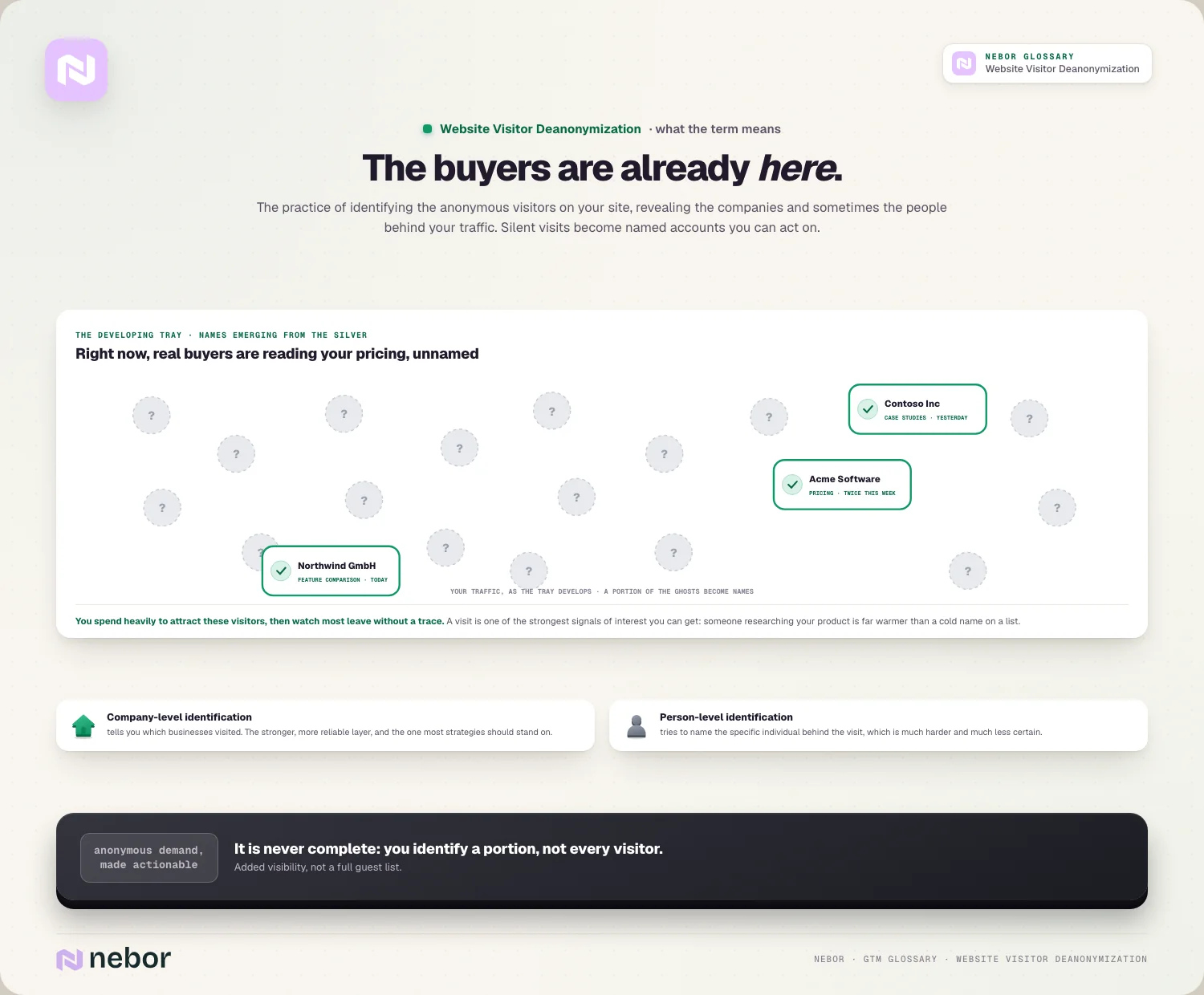
It operates at two distinct levels of precision. Company-level identification tells you which businesses visited, while person-level identification tries to name the specific individual, which is much harder.
One expectation deserves setting early, because the identification is never complete. You identify a portion of your visitors, so deanonymization adds visibility without ever handing you a full guest list.
So website visitor deanonymization is really about turning anonymous demand into actionable accounts. It makes a part of your invisible traffic visible enough to do something with.
Why does so much of your website traffic stay invisible by default?
To understand deanonymization, you have to appreciate how much interest goes unseen. The default state of web traffic is anonymity.
The vast majority of visitors never identify themselves. They compare options long before they'd ever fill out a form, so you see activity without names attached.
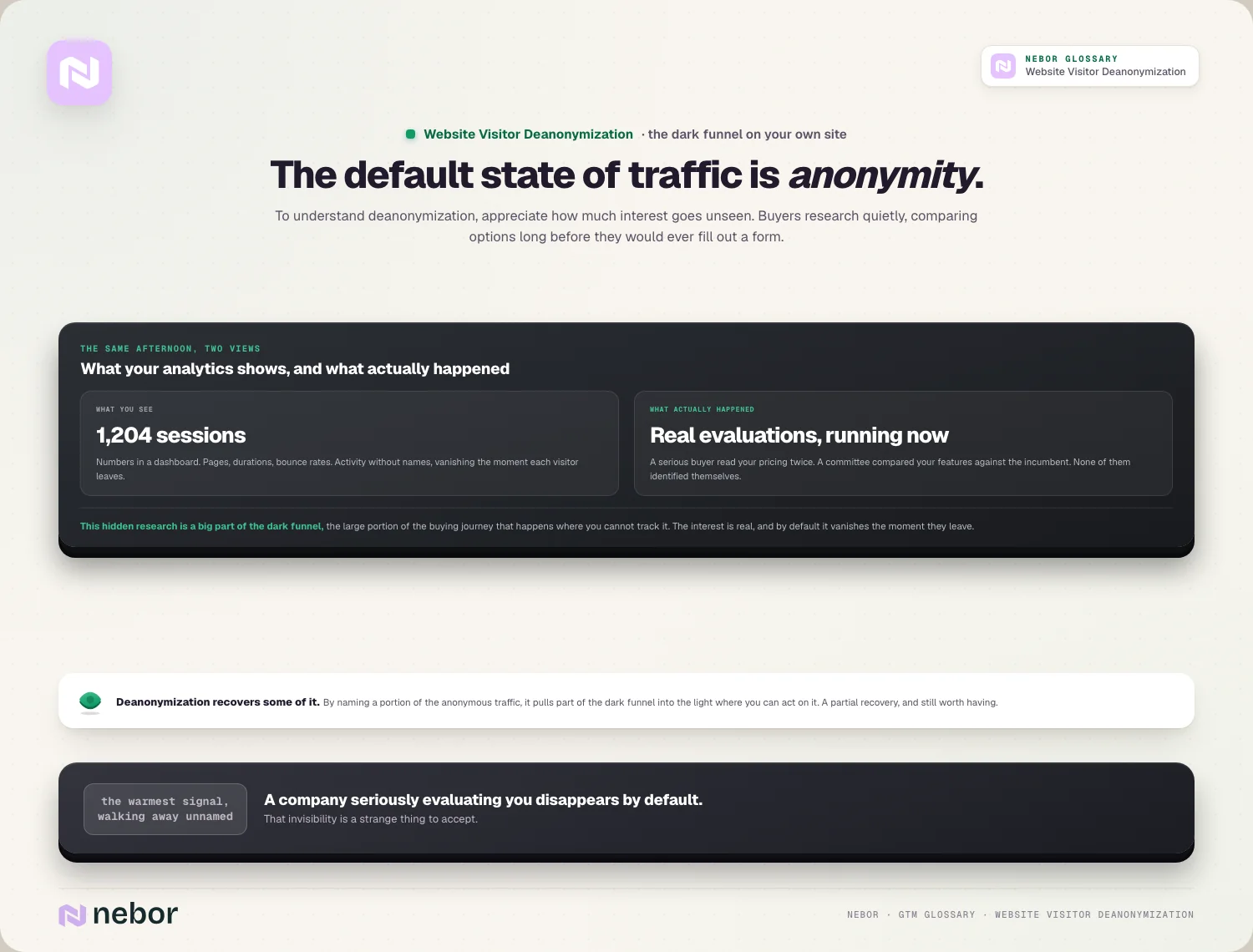
This hidden research is a big part of the dark funnel, the large portion of the buying journey that happens where you can't track it. The interest is real, and it stays hidden from you.
That invisibility costs you real opportunities every week. A company seriously evaluating you is interest at its warmest, and by default it vanishes the moment they leave your site.
Website visitor deanonymization exists to recover some of that. By naming a portion of the anonymous traffic, it pulls part of the dark funnel into daylight where you can act on it.
How does website visitor deanonymization work under the hood?
Deanonymization is a combination of methods working together instead of one technique, and each catches visitors the others miss.
IP-to-company matching is the oldest method of the three. This is reverse IP lookup, which maps a visitor's IP address to the organization that owns it, revealing the company behind the visit.
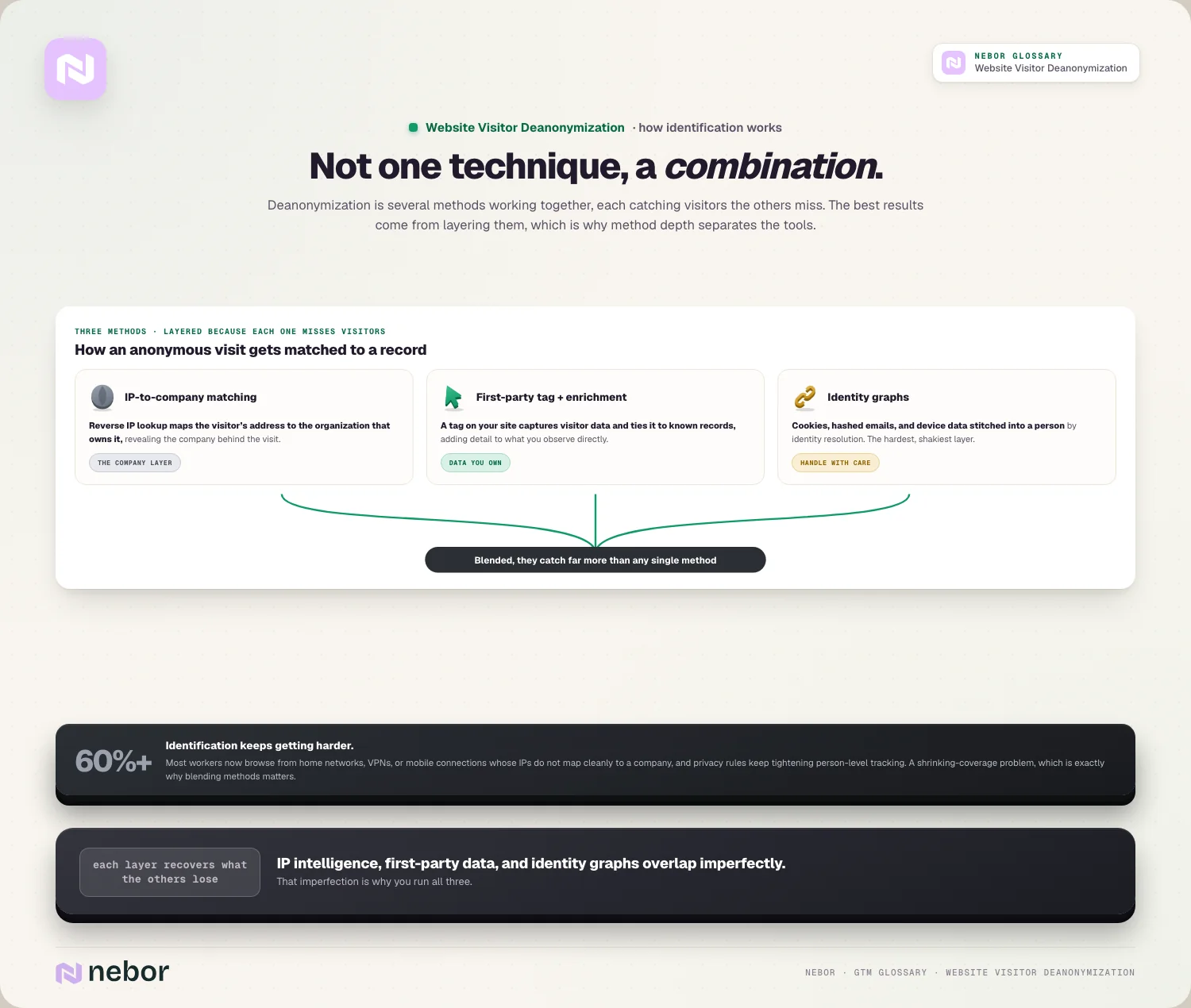
First-party tracking with enrichment adds a second layer. A tag on your site captures visitor data and ties it to known records through data enrichment, adding detail to what you observe directly.
Identity graphs push the identification toward the person. These match anonymous visitors to individuals using cookies, hashed emails, and device data, which is the work of identity resolution stitching signals into a person.
Modern tools blend all three of these. Combining IP matching, first-party data, and identity graphs catches far more than any single method, so the best results come from layering them.
What match rates should you plan around when you evaluate this?
Vendor claims and measured reality diverge sharply here, so realistic expectations belong in your plan from the start.
Company-level identification is the stronger of the two layers. It typically matches around 30 to 65% of B2B visitors through IP intelligence, which is enough to surface real accounts.
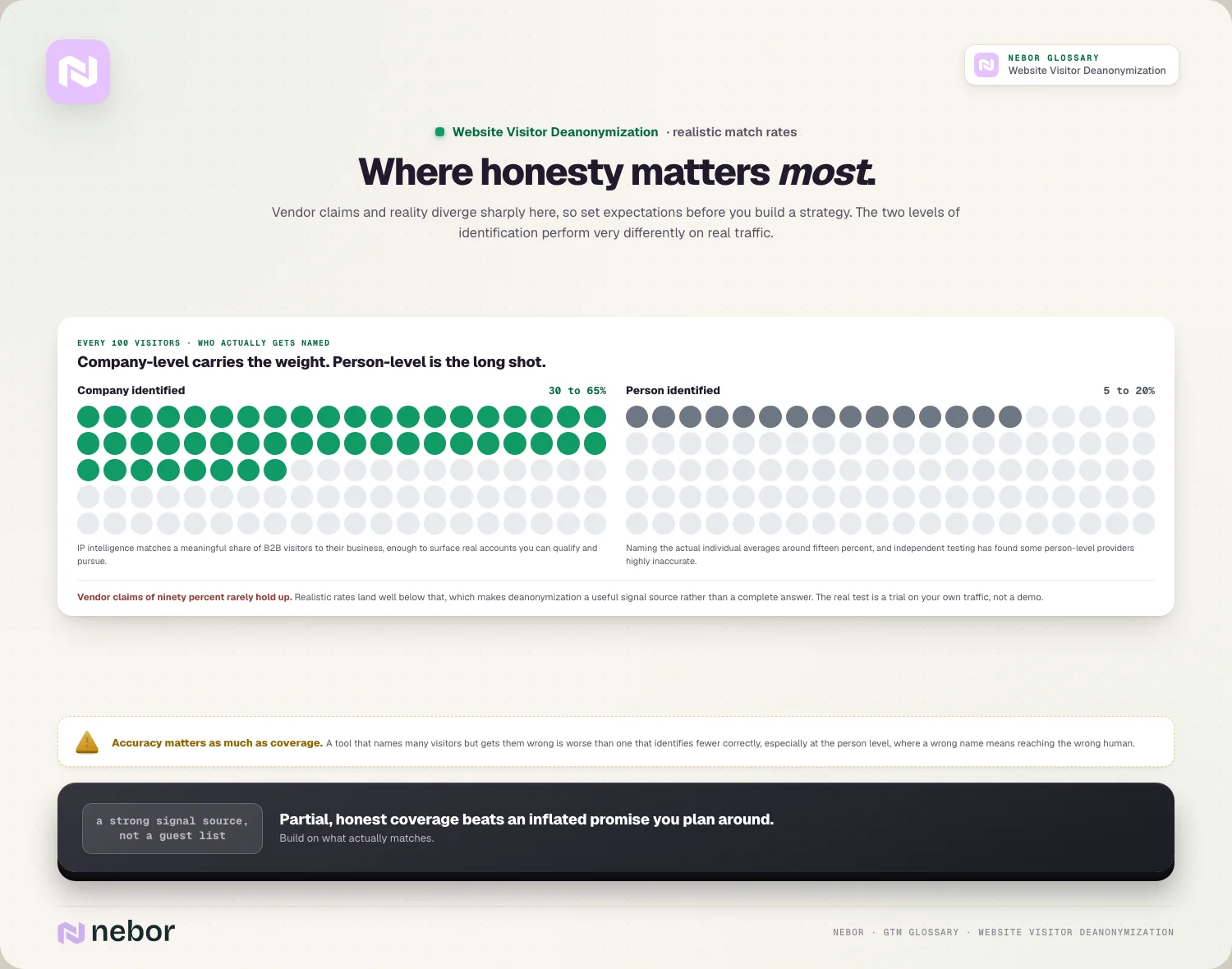
Person-level identification is far weaker than the company layer. Naming the actual individual instead of the company matches roughly 5 to 20% of visitors, with an average around fifteen percent.
Accuracy is a real concern alongside coverage. Independent testing has found some person-level providers highly inaccurate, so the names you get aren't always right, which matters before you act on them.
So the numbers deserve honest treatment in your planning. Vendor claims of ninety percent rarely hold up, and realistic match rates land well below that, which makes deanonymization a useful signal source and nothing more absolute than that.
Why has identifying visitors gotten harder over the past few years?
The trend has been working against identification for years, because the old assumptions about web traffic have broken down.
Remote work is the biggest factor by far. Over 60% of workers browse from home networks, VPNs, or mobile connections, and those IPs don't map cleanly to a company.
Privacy changes add more friction on top. Cookie restrictions and tracking limits make person-level identification harder, and those match rates keep falling as a result.
The combined effect is real and measurable. A meaningful chunk of your traffic simply can't be identified with current methods, no matter which tool you use.
So deanonymization is a shrinking-coverage problem instead of a solved one. This is exactly why blending methods matters, because each one recovers visitors the others lose.
What happens after a visitor gets identified, and who does the work?
Identifying a visitor is only useful if you act on it well. The value of deanonymization lives entirely in what happens next.
Qualification has to come before any outreach happens. A visiting company only matters if it fits your profile, so you filter identified traffic down to the accounts worth pursuing.
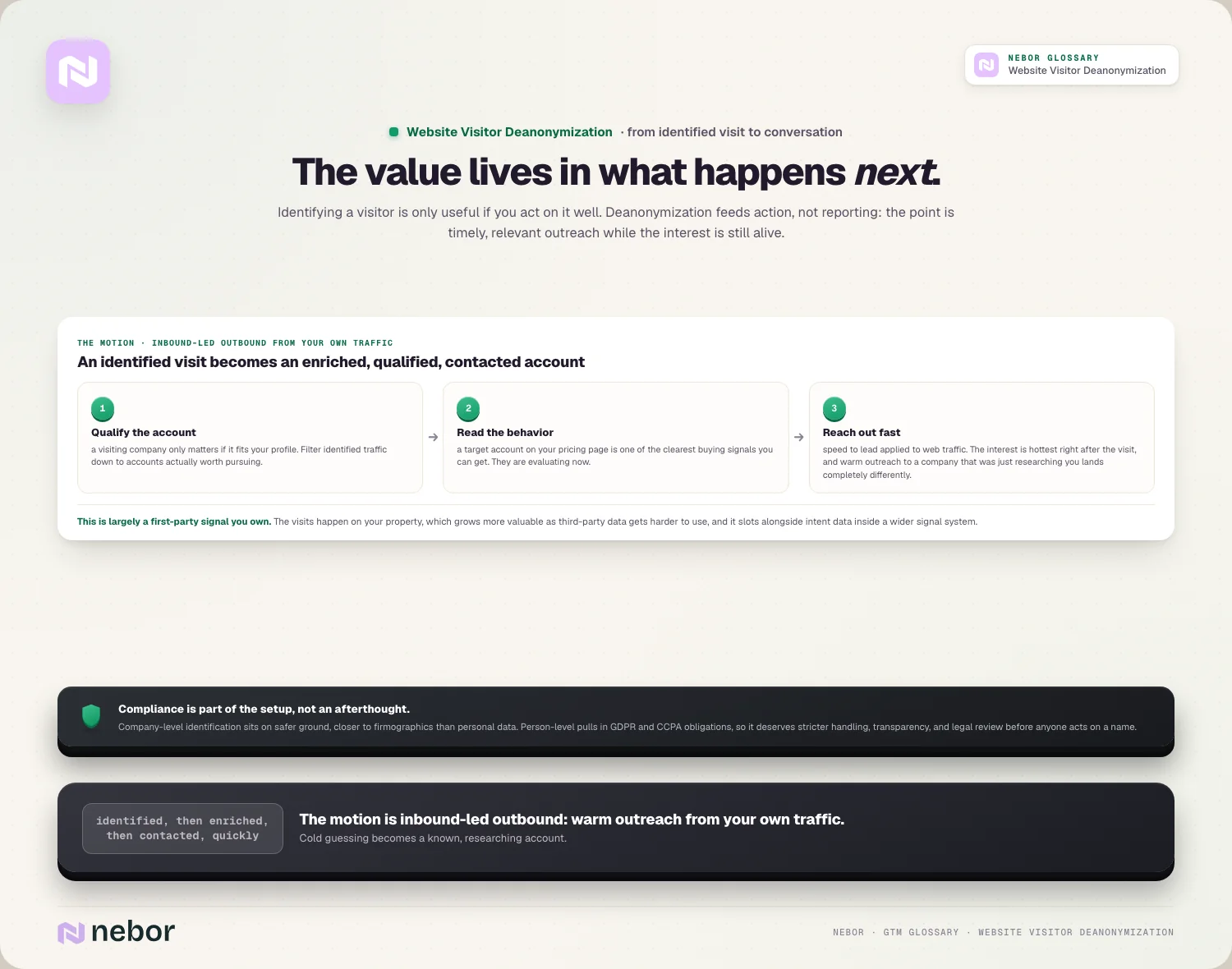
The behavior is a signal in itself. A target account on your pricing page is a strong intent signal and one of the clearest buying signals you can get, telling you they're evaluating now.
Then the clock starts ticking. The interest behind a visit cools within days, so the speed to lead principle applies with full force to identified traffic.
So deanonymization exists to feed action instead of reporting. The point is to turn an identified visit into timely, relevant outreach while the interest is still alive.
How does deanonymization power an inbound-led outbound motion?
Website visitor deanonymization supplies the raw material for one of the strongest modern motions, making warm, timely outbound from your own traffic possible.
That motion is inbound-led outbound, where interest someone showed on your site becomes the trigger for proactive outreach to the right people at that company.
The temperature of the conversation changes entirely. You're contacting a company you know was just researching you, so your message has a reason the prospect can feel, even if you never state it.
A website visitor tracking workflow wires this together in practice, with identified visitors triggering enrichment and outreach automatically.
We build this chain for clients regularly, and the website visitor workflow examples walk through how an identified account becomes an enriched, qualified, contacted opportunity without manual digging.
How does deanonymization relate to the data strategy you're building?
Website visitor deanonymization connects directly to how you think about data ownership, because it's largely a first-party signal you control.
The visits happen on your own property, which makes them a form of first-party versus third-party data that you own. That's valuable as third-party data gets harder to use.
It complements the external signals you buy. Identified visits work alongside intent data and other sources, so combining them gives a fuller picture than any one feed.
It feeds a broader signal system as well. Deanonymized visits are one input into a wider effort to detect intent, and they belong inside any serious signal motion.
So deanonymization amounts to more than a visitor tool, forming part of how you own your data. The more of your own traffic you can see, the less you depend on buying signals from outside.
Is website visitor deanonymization compliant, and where is the line?
Anything that identifies anonymous visitors raises privacy questions, and the answer differs by level of identification.
Company-level identification stands on much safer ground. Knowing a business visited is closer to firmographic information than to personal data about an individual.
Person-level identification needs a far more careful hand. Naming individuals and contacting them based on browsing pulls in privacy rules like GDPR and CCPA, which vary by region and carry real obligations.
The responsible approach is transparency and restraint. You use the signal to reach good-fit businesses with clear privacy practices, and you leave the rest of your traffic alone.
So compliance deserves a seat at the design table. Company-level deanonymization handled thoughtfully is reasonable, while person-level identification deserves stricter handling and legal review.
How do you choose a deanonymization tool from a crowded market?
The market is crowded with visitor-identification tools, and a few factors separate them far more than the marketing does.
Honest match rates come first on the checklist. Many vendors quote best-case numbers, so the real test is how a tool performs on your own traffic, ideally in a trial instead of a demo.
Accuracy matters every bit as much as coverage. A tool that names many visitors but gets them wrong is worse than one that identifies fewer correctly, especially at the person level.
Method depth is a signal of quality. Tools that blend IP matching, first-party tracking, and identity graphs tend to outperform ones leaning on a single method.
And integration counts more than it seems. A tool that pushes identified visits straight into your enrichment and outreach is far more useful than one that just shows you a dashboard you have to check.
Does deanonymization pay off for smaller sites or only bigger ones?
A fair question is whether you need heavy traffic for this to be worthwhile, and the honest answer hinges on who visits more than how many.
High-traffic sites surface more raw matches, simply because more visitors mean more identifiable accounts. At scale, deanonymization can produce a steady stream of accounts.
But a smaller site can benefit plenty. If your traffic is low but highly targeted, even a handful of identified good-fit accounts a week can justify the whole setup.
Fit decides the value far more than volume does. A few visits from ideal-fit enterprises can be worth more than a flood from people who will never buy.
So the enterprise-only framing sells it short. The question that decides it is whether the companies visiting you are worth identifying, and for most B2B sites with good-fit traffic, some clearly are.
What are the common mistakes with website visitor deanonymization?
Deanonymization gets misused in a few predictable ways, and we keep seeing the same ones when teams show us their setups. Knowing them keeps your expectations and approach realistic.
Building plans on inflated match rates comes first, because a strategy that assumes ninety percent identification collapses when reality lands far lower.
Trusting person-level data blindly follows, because given the accuracy problems, acting on a named individual without sanity-checking can mean reaching the wrong person entirely.
Chasing every identified visit dilutes the effort, because not every company on your site is a fit, so skipping qualification wastes energy on accounts that were never prospects.
And identifying without acting fast forfeits the prize, because a deanonymized visit you follow up on days later has gone cold, which wastes the timing advantage that made it valuable.
Should you lean on company-level or person-level identification first?
Given the gap in match rates and accuracy, a practical question is which level to lean on, and for most teams we advise starting at company-level.
Company-level identification is more reliable and more accurate. Knowing which businesses are on your site is dependable enough to act on, and it covers a larger share of your traffic.
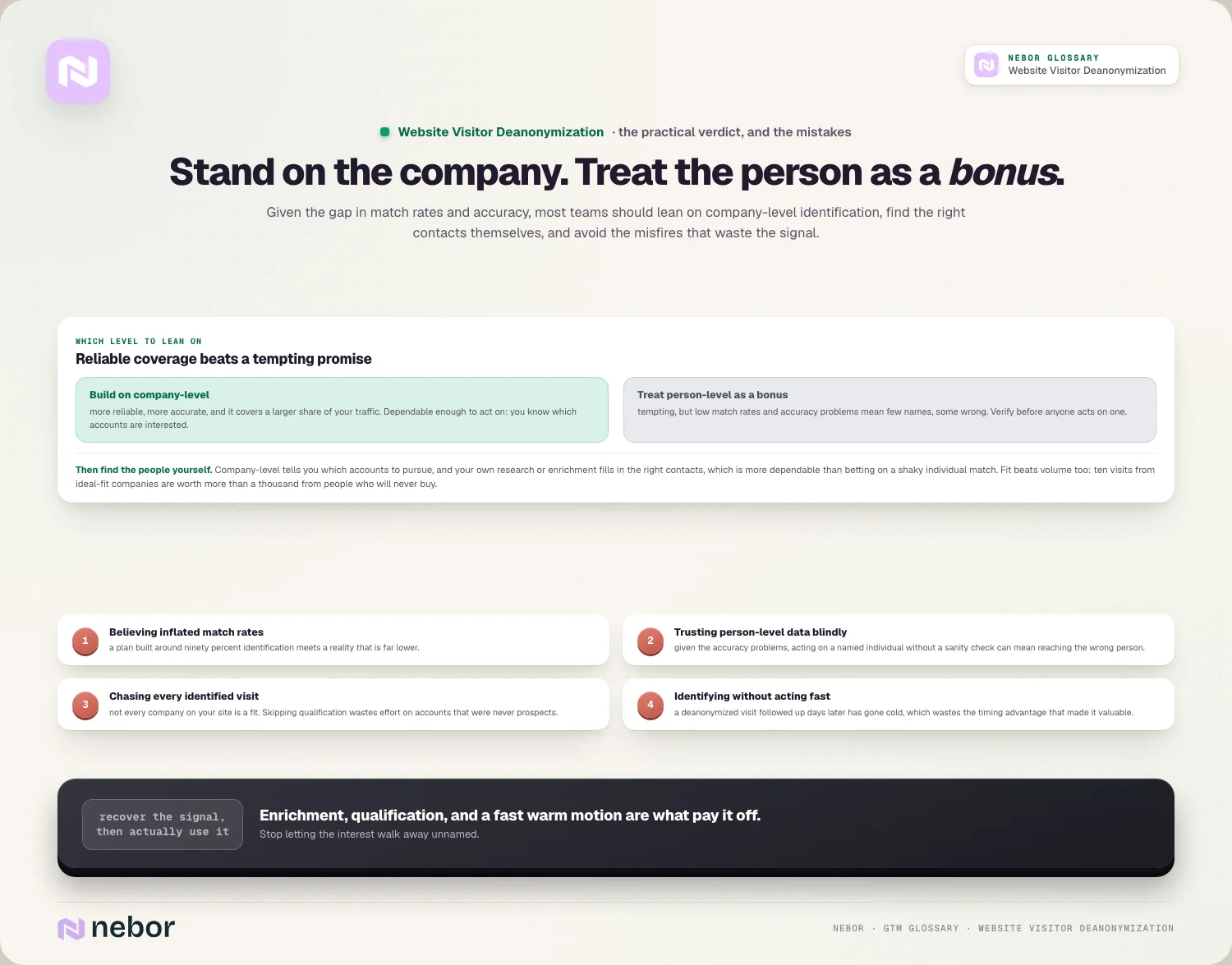
Person-level promises more while reliably delivering less. Naming the exact individual is tempting, but the low match rates and accuracy problems mean you often get few names, and some of them are wrong.
A sensible approach is to build on company-level and treat person-level as a bonus. You reliably know which accounts are interested, then find the right contacts yourself instead of trusting a shaky individual match.
So weight your strategy toward the stronger signal. Company-level deanonymization tells you which accounts to pursue, and your own research or enrichment fills in the people, which is more dependable than betting on person-level data alone.
Why putting names on your invisible traffic changes what your team can do
Website visitor deanonymization matters because the interest on your site is real and mostly wasted. Most of your traffic stays anonymous, and naming even a portion turns silent interest into accounts you can act on.
The honest framing is a partial recovery rather than a full solution. Match rates are limited, person-level data is shaky, and a large share of traffic stays invisible, so it works best as one signal among several.
The real value is in what you do with it. An identified, good-fit company researching you is a warm signal, and reaching out quickly and relevantly is where deanonymization pays off.
So if your best buyers are browsing and vanishing, deanonymization is how you stop losing all of them. When you pair it with enrichment, qualification, and a fast inbound-led outbound motion, it turns part of your invisible traffic into real conversations.
That warm signal is exactly the kind a modern go-to-market system is built to act on. The visitors are already interested, and deanonymization is simply how you stop letting that interest walk away unnamed.
Share this post
Inbound
Intent
Data
Glossary
Related glossary items
Understanding the core GTM concepts




Ready to build your pipeline