

In this post:
Buying intent is how likely a person or company is to make a purchase, read from what they're doing. It's the readiness to buy behind their behavior, the thing you're trying to gauge when you decide who to reach out to and when.
Here's the part that trips everyone up. You never observe intent itself, only actions, like a pricing-page visit or a category search, and you infer the intent behind them.
Everything else in this corner of go-to-market, the signals, the data, the scores, is just machinery for making that inference better. If you get good at reading intent, you reach buyers while they're still deciding. If you read it wrong, you waste time chasing accounts that were never going to buy.
TL;DR
Buying intent isn't something you can observe. It's a probability you estimate from behavior, and most teams estimate it badly.
The usual mistake is treating activity as intent. A content download isn't a buyer raising their hand, it's someone grabbing a PDF. Real intent only exists when fit, a reason, and timing all line up at once, aimed at your kind of solution.
First-party intent, what people do on your own site and product, is more reliable than third-party data, because it's about you and not just the category. If you read it honestly, weigh it against fit, and act fast, you'll often reach good accounts before your competitors even know they're in play.
So what are you really trying to read when you talk about buying intent
Buying intent is the readiness to buy behind someone's behavior. It's a state of mind, an estimate of how close an account is to a decision instead of a fact you can point at.
That estimate stays a probability from start to finish. A pricing-page visit doesn't mean someone will buy, it just nudges the odds that they might. You're stacking small pieces of evidence into a confident-enough guess.
This framing matters because it changes how you treat everything downstream. Once you accept that intent is inferred, you stop chasing single actions as if they were proof, and you start building a fuller picture before you act.
Why you never see intent directly, only the shadow it leaves behind
You can't measure intent the way you measure revenue, because intent lives in someone's head, and all you ever get are the traces they leave behind.
Those traces are behaviors, like visiting a page, searching a topic, downloading a guide, or booking a demo. Each one is a shadow cast by the real thing, and your job is to read the shadows well enough to guess the shape that made them.
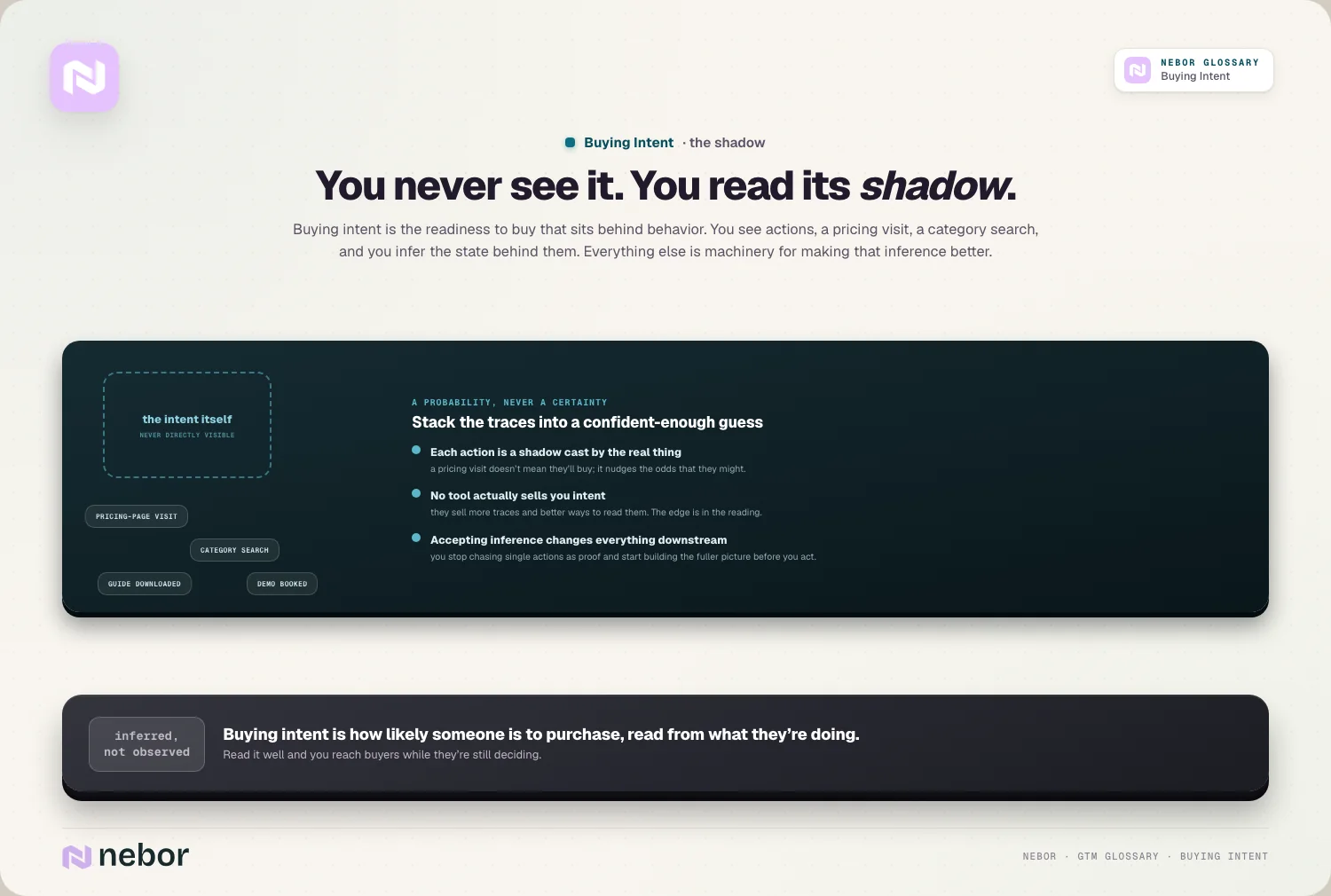
That's why no tool can sell you intent. They sell you more traces and better ways to read them, which is a distinction we'll come back to in a moment.
The three things that all have to be true before you've got real buying intent
Real intent takes three ingredients lined up at once, and missing any of them leaves you with something weaker that only looks like intent.
The first ingredient is fit, because the account has to be the kind of buyer you serve, and a perfect-looking signal from a company that will never buy is worthless. The second is a reason, some problem or event creating a genuine need to act now rather than someday.
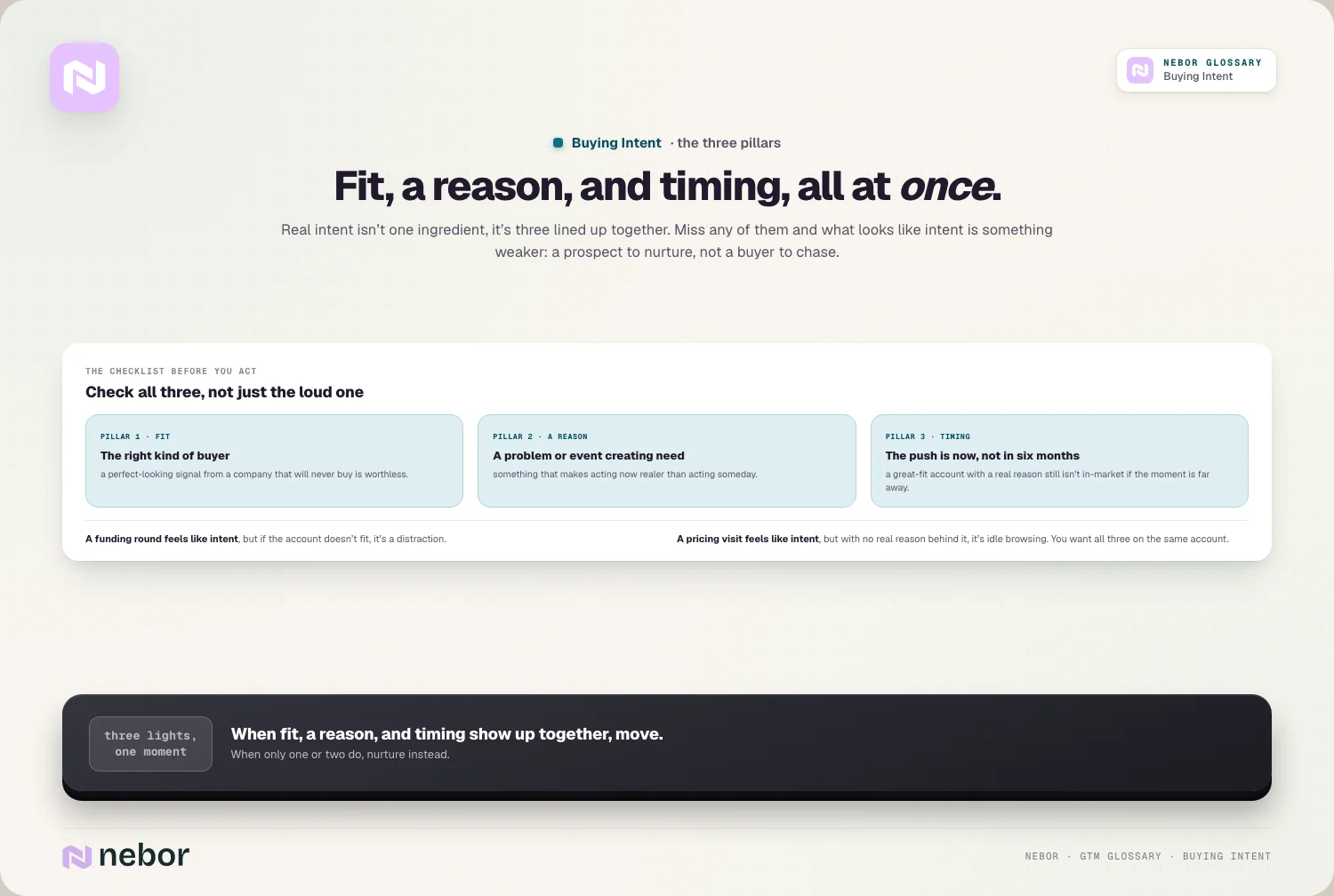
The third ingredient is timing, because even a great-fit account with a real reason isn't in-market if the push is six months away. When fit, a reason, and timing all show up together, you have something worth moving on. When only one or two do, you have a prospect to nurture instead of a buyer to chase.
The useful habit is to check all three before you act instead of just the loud one. A funding round feels like intent, but if the account doesn't fit, it's a distraction.
A pricing visit feels like intent too, but with no real reason behind it, it's idle browsing. You want the moment all three show up on the same account.
How buying intent is different from the signals and the data you go out and buy
These words get used interchangeably, and they really shouldn't be, because buying intent is the underlying state while the rest are ways of guessing at it. Buying signals are the individual pieces of evidence you read to infer it. Intent data is that evidence packaged and sold, usually third-party.
So intent is what you want to know, and signals and data are how you guess at it. A pricing visit is a signal, and a vendor report that an account is researching your category is intent data.
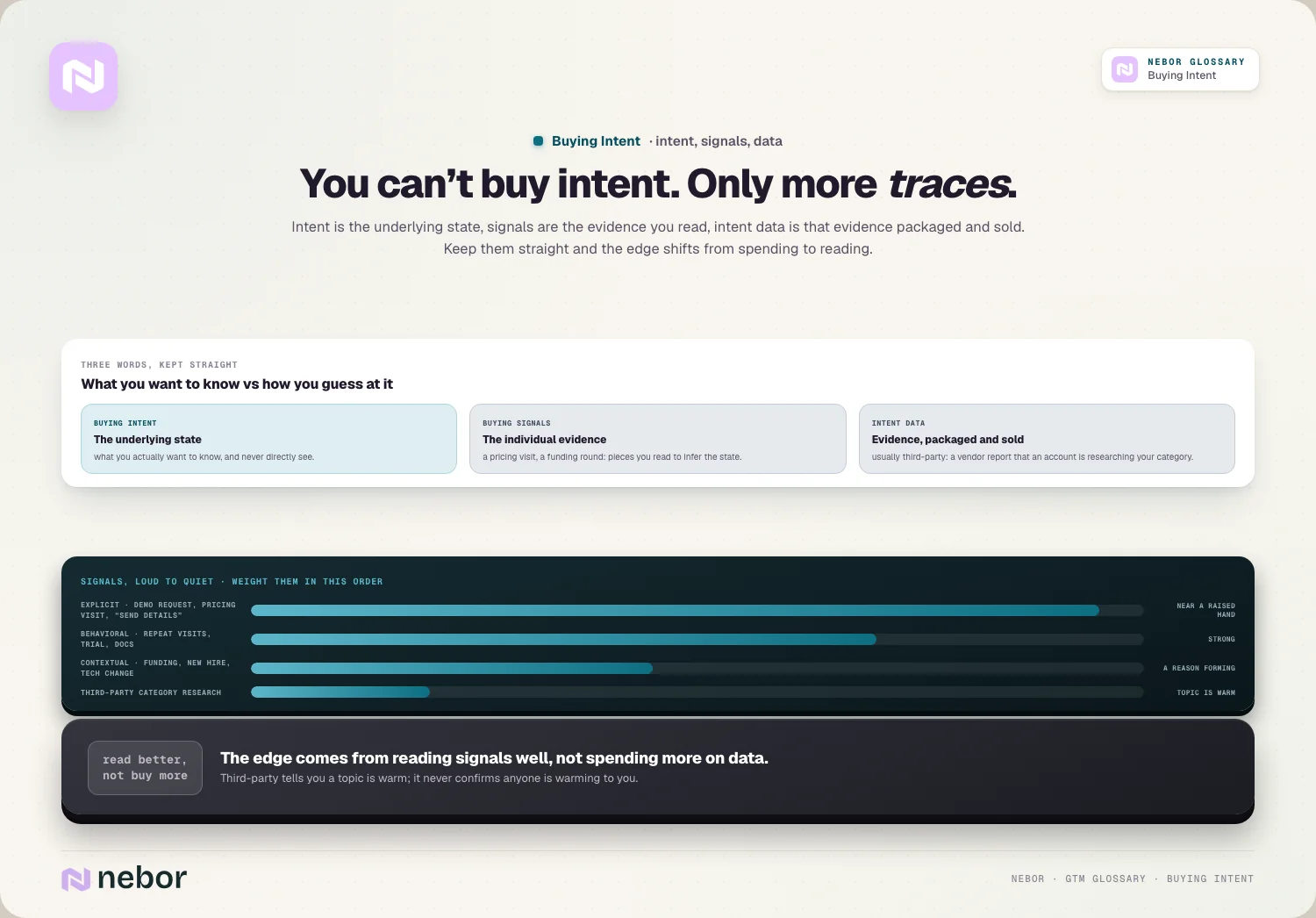
Neither one is intent itself, and intent signals are just the slice of signals specifically about active research.
Keeping this straight has a real payoff. You can't buy intent, you can only buy more signals, so the edge comes from reading them well instead of spending more on data.
The different kinds of buying signals you'll be reading, from loud to quiet
Not every signal carries the same weight, and it helps to sort them by how much they actually tell you. Some are loud and explicit, some are quiet and circumstantial, and you read them differently.
The loudest are explicit ones, like a demo request, a pricing-page visit, or a reply that says "send me details." These are close to a hand raised, and they deserve fast action. Just under them come behavioral signals, like repeated visits, a product trial, or someone digging through your docs.
Quieter still are contextual signals, the trigger events like funding, a relevant new hire, or a tech change that creates a reason to act even before the account does anything on your site.
And weakest of all is category-level research bought as third-party data, which tells you a topic is warm but never that anyone is warming to you specifically. If you weight them in that order, you'll guess intent far better.
Why the activity you're tracking probably isn't intent at all
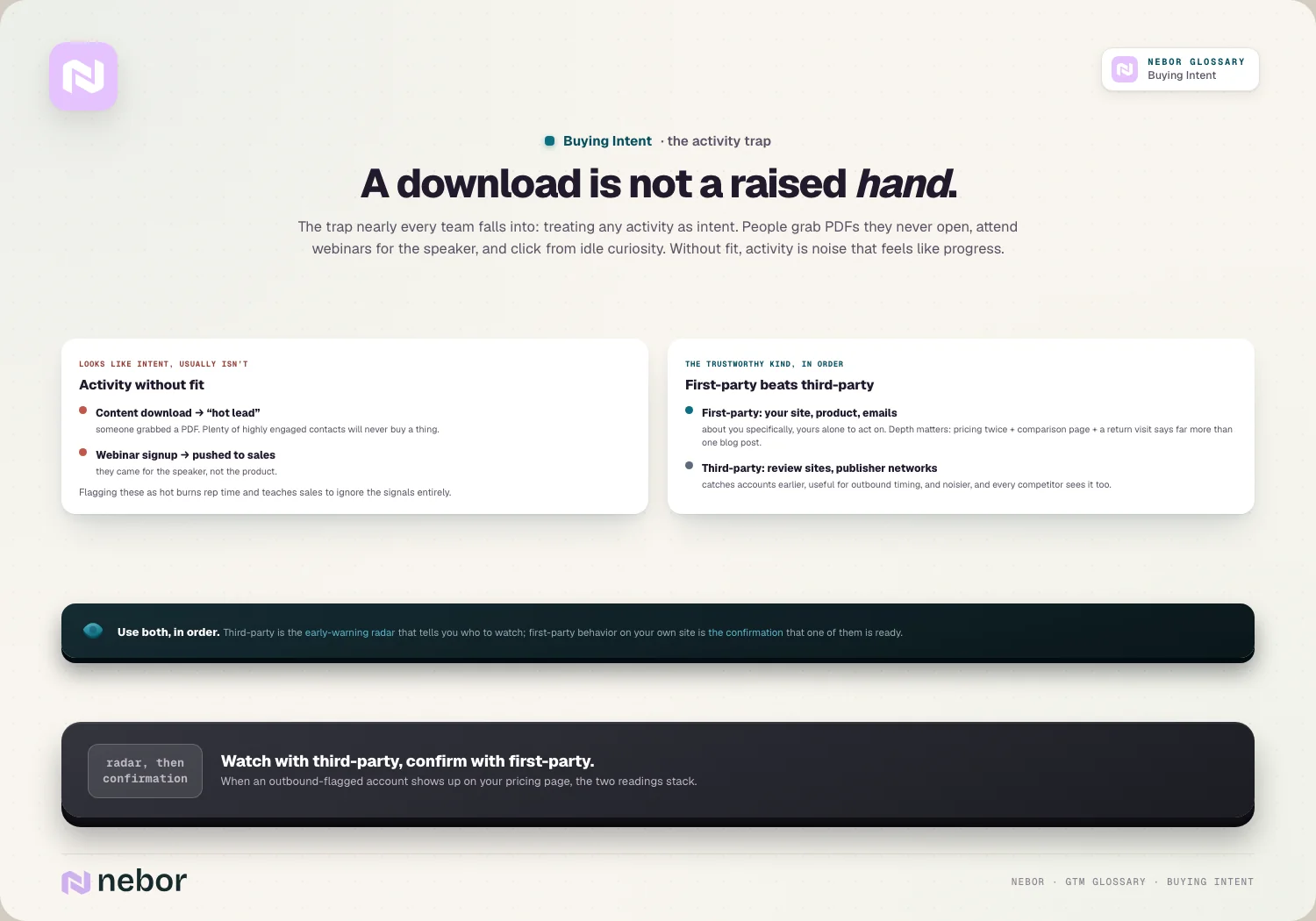
This is the trap nearly every team falls into. They treat any activity as intent, so a content download or a webinar signup gets flagged as a hot lead and pushed to your reps.
It usually isn't hot in the slightest. People grab PDFs they never open again, follow links out of idle curiosity, and attend webinars for the speaker rather than the product. Plenty of highly engaged contacts will never buy a thing.
Without fit underneath it, activity is just noise that feels like progress. That's why fit comes before intent in every setup we build. Confirm the account matches your ICP first, then let intent decide the timing, and that's exactly the job the split between fit scoring and intent scoring exists to do.
Which intent you should trust more, the kind you own or the kind you buy
Not all intent evidence is equal, and the split that matters most is first-party versus third-party, because the two tell you very different things.
First-party intent is what people do on surfaces you own, your site, your product, your emails. It's the strongest kind, because it's about you specifically instead of the category. Someone lingering on your pricing page tells you something a category report never could, and it's yours alone to act on.
Third-party intent comes from outside, like review sites and publisher networks. It catches accounts earlier, before they ever reach you, which helps outbound timing, but it's noisier and every competitor can see it too.
We lean hard on first-party, like the website visitor workflow that reads what real visitors do on your own site.
The smart move is to use both, in order. Let third-party data tell you which accounts to watch, and let first-party behavior tell you when one of them is actually ready. The category report is your early-warning radar, and your own site is the confirmation.
There's a depth point that gets missed here. First-party intent covers more than whether someone showed up, it covers what they did.
A visitor who reads one blog post is browsing, while a visitor who hits your pricing page twice, opens the comparison page, and comes back the next day is telling you something much stronger. The richer the first-party behavior, the closer you get to reading intent for real.
How buying intent shows up differently in inbound and in outbound
The same idea plays out in two motions, and each one reads intent from the opposite end, so both deserve a look.
On the inbound side, the buyer comes to you and leaves first-party traces, a pricing visit, a demo request, a deanonymized session. The intent is strong and specific, and everything comes down to speed to lead, reacting before the moment passes. Our inbound meeting workflow is built around exactly that.
On the outbound side, you're reading intent before the buyer ever touches you, mostly from third-party data and trigger events. The intent is weaker and noisier, so you lean harder on fit and on the reason behind the outreach.
Both motions are reading the same thing, but inbound reads it loud and late, and outbound reads it quiet and early.
The best programs blur the line between the two on purpose. They use outbound's early, quiet signals to decide who's worth watching, and they wait for inbound's loud, first-party behavior to confirm the moment.
When an outbound-flagged account suddenly shows up on your pricing page, those two readings stack, and the intent you're looking at is about as real as it gets.
How to measure the buying intent in front of you right now
Reading intent well means putting a rough number on it instead of just sensing it. The way we score it, you weigh the signals you're seeing and turn them into an estimate of how in-market an account really is.
A few things raise that estimate reliably. Signals aimed at you beat signals aimed at the category, recent beats old, repeated beats one-off, and a senior stakeholder beats a junior one. Stack several strong signals on the same account and your confidence climbs fast.
Keep intent and fit as two separate scores, though, because they answer different questions. Fit asks whether they're worth selling to at all, and intent asks whether now is the moment. You act when both are high, and you nurture when fit is high but intent is still low.
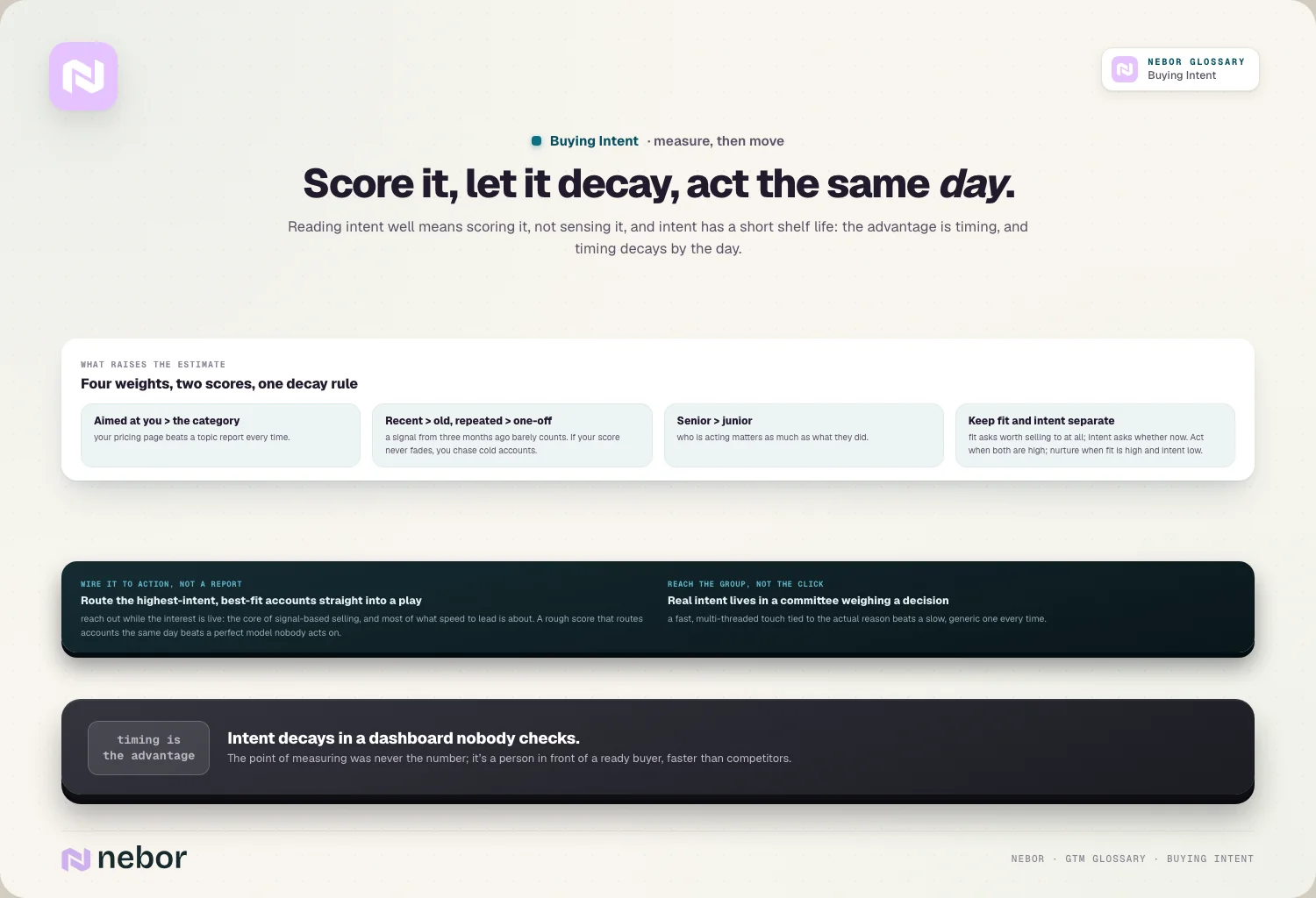
One more rule keeps the score honest. Let intent decay over time, because a signal from three months ago barely counts. If your score never fades, you'll keep chasing accounts that went cold weeks ago and wondering why nobody replies.
Be careful not to over-engineer the score, either. A perfect-looking model that nobody acts on is worth less than a rough one that routes the right accounts to your reps the same day.
The point of measuring intent was never the number, it's getting a person in front of a ready buyer faster than your competitors do. If the scoring adds delay instead of speed, it's working against you.
How to act on the buying intent you've spotted before it goes cold
Intent has a short shelf life, and that's the whole point of reading it. The advantage is timing, and timing decays by the day as the buyer moves on or a competitor gets there first.
So wire intent to fast action instead of a weekly report. Route the highest-intent, best-fit accounts straight into a play from your pipeline and reach out while the interest is still live, which is the core of signal-based selling and most of what speed to lead is about.
When you do reach out, reach the whole buying committee and skip the one-contact shortcut, because real intent lives in a group of people weighing a decision and never in a single click alone.
A fast, multi-threaded touch tied to the real reason beats a slow, generic one every time.
The intent-reading mistakes that quietly cost you deals you should have won
Most intent programs go wrong in the same handful of ways. The first is buying third-party intent data before confirming fit, so the team chases in-market accounts that were never a match in the first place.
The second is the activity trap we covered, counting any click as intent. The third is acting too slowly, letting good intent decay in a dashboard nobody checks. The fourth is reading intent on one person and forgetting the rest of the committee around them.
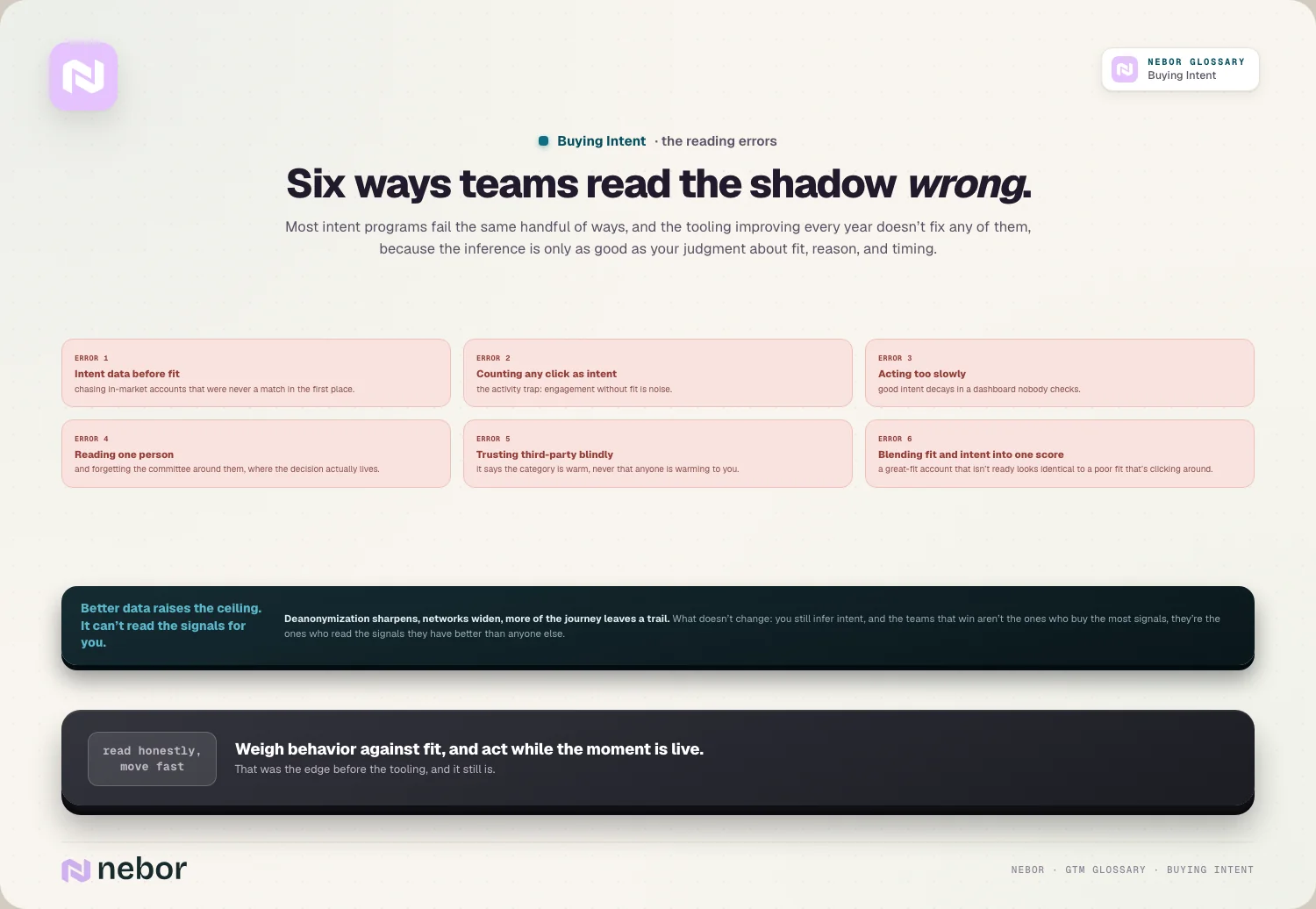
The fifth is trusting third-party data blindly. It tells you a category is warm, but it never confirms anyone is warming to you, so treat it as a starting point for outreach and never as a reason to skip your own judgment.
And the last one is mixing fit and intent into a single score. When you blend them, a great-fit account that isn't ready looks the same as a poor-fit account that's clicking around, and you lose the one distinction that tells you whether to act now or wait.
Where reading buying intent is heading, and what stays the same
The tooling keeps getting better at catching traces. Deanonymization is sharper, third-party networks are wider, and product analytics surface intent earlier than they used to. More of the buying journey leaves a readable trail every year.
What doesn't change is the core truth. You still never see intent, you infer it, and the inference is only as good as your judgment about fit, reason, and timing. Better data raises the ceiling, but it can't read the signals for you.
In our experience, the edge was never owning the most intent data, and it still isn't. The edge is reading honestly what the behavior is telling you, weighing it against whether the account is even a fit, and moving fast while the moment is still live.
The teams that win at intent read the signals they have better than anyone else, and that skill costs nothing to buy.
Share this post
Intent
Data
Glossary
Related glossary items
Understanding the core GTM concepts



Ready to build your pipeline











