

In this post:
You can infer a great deal about a prospect from their behavior. You can watch what they click, guess at their needs, and buy data that estimates their situation. But all of that is inference, and inference can be wrong in ways you never find out about until a deal falls apart.
Zero-party data skips the guessing step entirely. It's the information a prospect tells you outright, on purpose, so instead of estimating what they want, you know it because they said so. That directness makes it the most reliable and trusted data you can have.
Zero-party data is information a prospect explicitly and intentionally shares with you, such as survey responses, stated preferences, declared intent, or self-reported needs and challenges. It's volunteered directly instead of observed or inferred from behavior.
The distinction carries weight because volunteered information is both more accurate and more trusted. A buyer who tells you their goal directly has given you something no behavioral guess or purchased dataset can match.
That's why zero-party data is the top of the reliability hierarchy.
TL;DR
Zero-party data is information a prospect deliberately volunteers, like stated needs, preferences, or intent, instead of data you observe or infer from behavior.
It's the highest-trust tier of data, because the buyer chose to share it directly, which makes it both more accurate and more consent-friendly than inferred data.
It's technically a subset of first-party data, but the key difference is that it's explicitly declared instead of passively collected from behavior.
Its value depends on getting buyers to share, so the real work is creating reasons for prospects to tell you directly what you'd otherwise have to guess.
What zero-party data is precisely and where it really comes from
Zero-party data is information a prospect chooses to give you directly. It's declared instead of detected, and that declaration is what sets it apart from every other data type.
It's volunteered explicitly by the prospect, on purpose. A prospect answers a question, states a preference, or shares a goal on purpose, so you have their own words instead of an inference about them.
It covers the buyer's intent, needs, and preferences. Zero-party data often captures what a buyer wants, the challenge they're facing, or what they're actively looking for, exactly the context that tends to be hardest to guess.
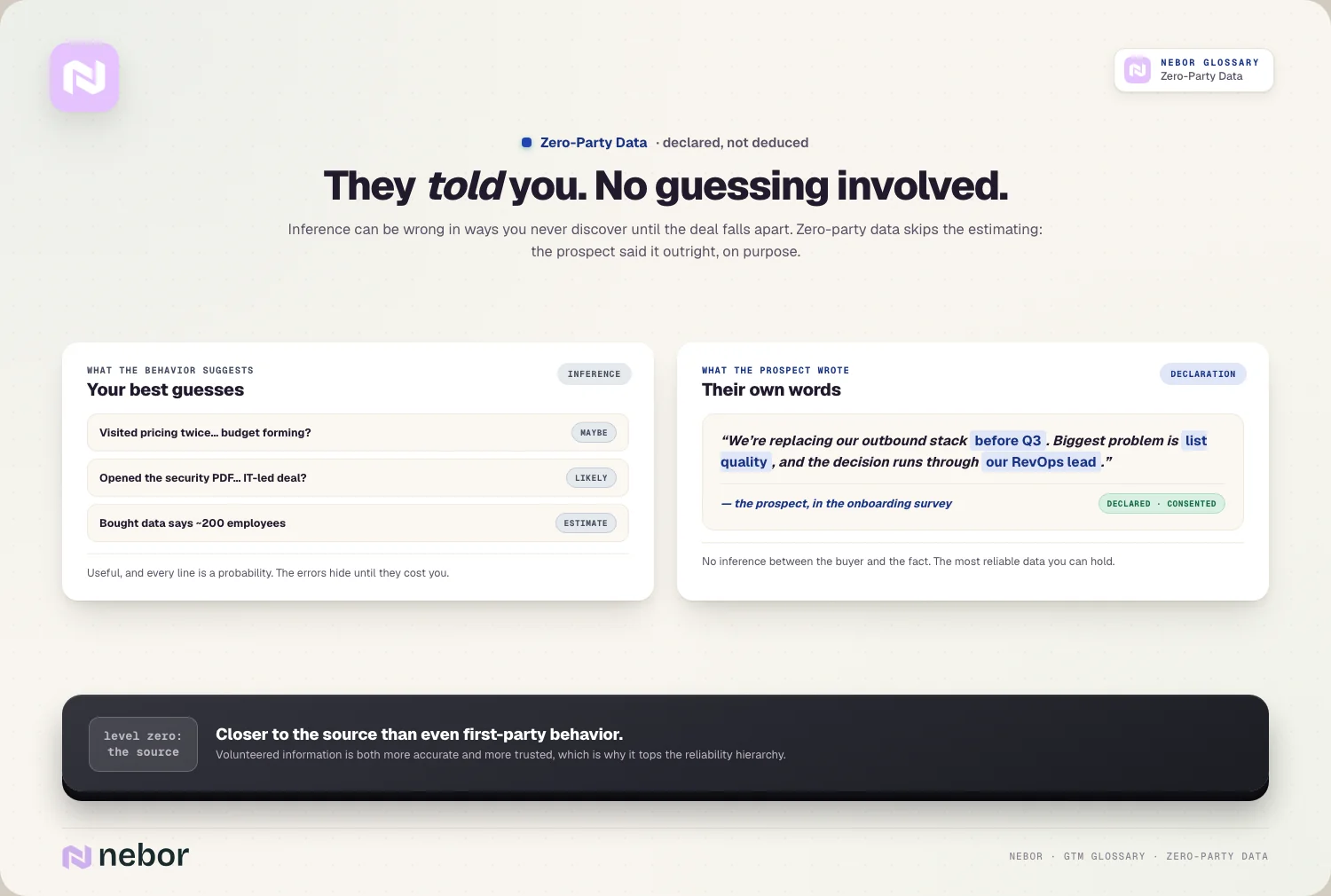
It comes from direct exchanges with the buyer. Surveys, forms, preference selections, and conversations are where zero-party data is gathered, because those are moments a prospect actively tells you something.
So zero-party data is the information a buyer hands you willingly. It's the difference between knowing what someone wants because they told you and estimating it from their behavior, a meaningful gap in reliability.
The name captures the idea rather neatly. It is level zero, closer to the source than even first-party data, because there's no observation or inference between the buyer and the fact you hold.
How zero-party data differs from ordinary observed first-party data
Zero-party data is often grouped with first-party data, and the two are related, but the distinction deserves a clear line. It comes down to declared versus observed.
First-party data gets observed from behavior on your properties. It's the behavior you collect on your own channels, like which pages a prospect visits or which emails they open, gathered by watching what they do.
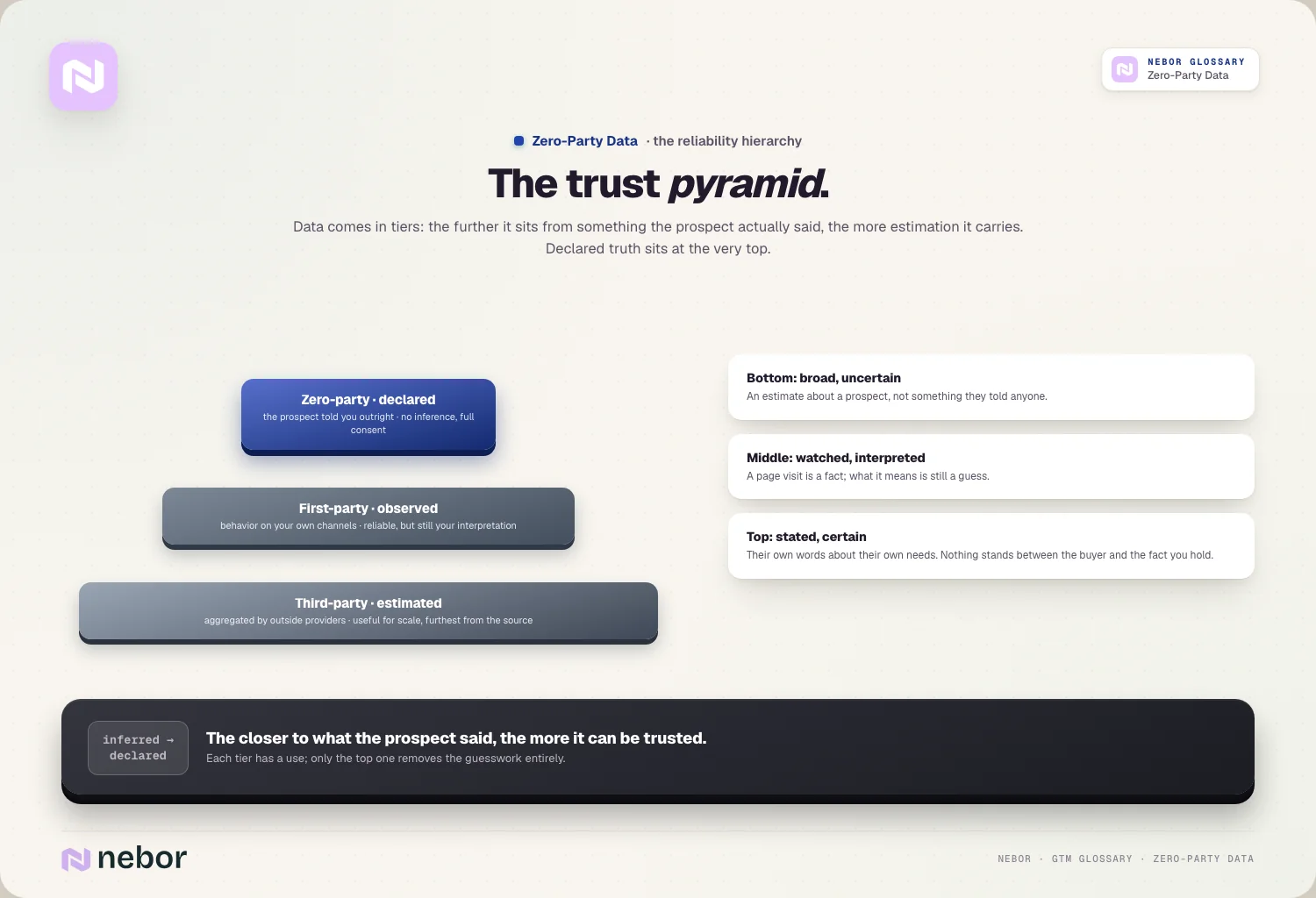
Zero-party data is declared by the person themselves. It's what a prospect explicitly tells you, so instead of inferring intent from a page visit, you have their stated intent in their own words.
One is inference, the other is fact. First-party behavior lets you guess at motivation, while zero-party data gives you the motivation directly, which removes the guesswork.
So zero-party data is the declared subset of first-party data. Both come from your own relationship with the prospect, but one is watched and the other is willingly shared, the heart of the first-party versus third-party data picture.
Why zero-party data is the top of the reliability hierarchy
Data comes in tiers of trust, and zero-party is the very top. Understanding the hierarchy shows why it's so valuable.
Third-party data is the least certain end. Aggregated by outside providers, it's useful for scale but is an estimate about a prospect instead of anything they told you directly.
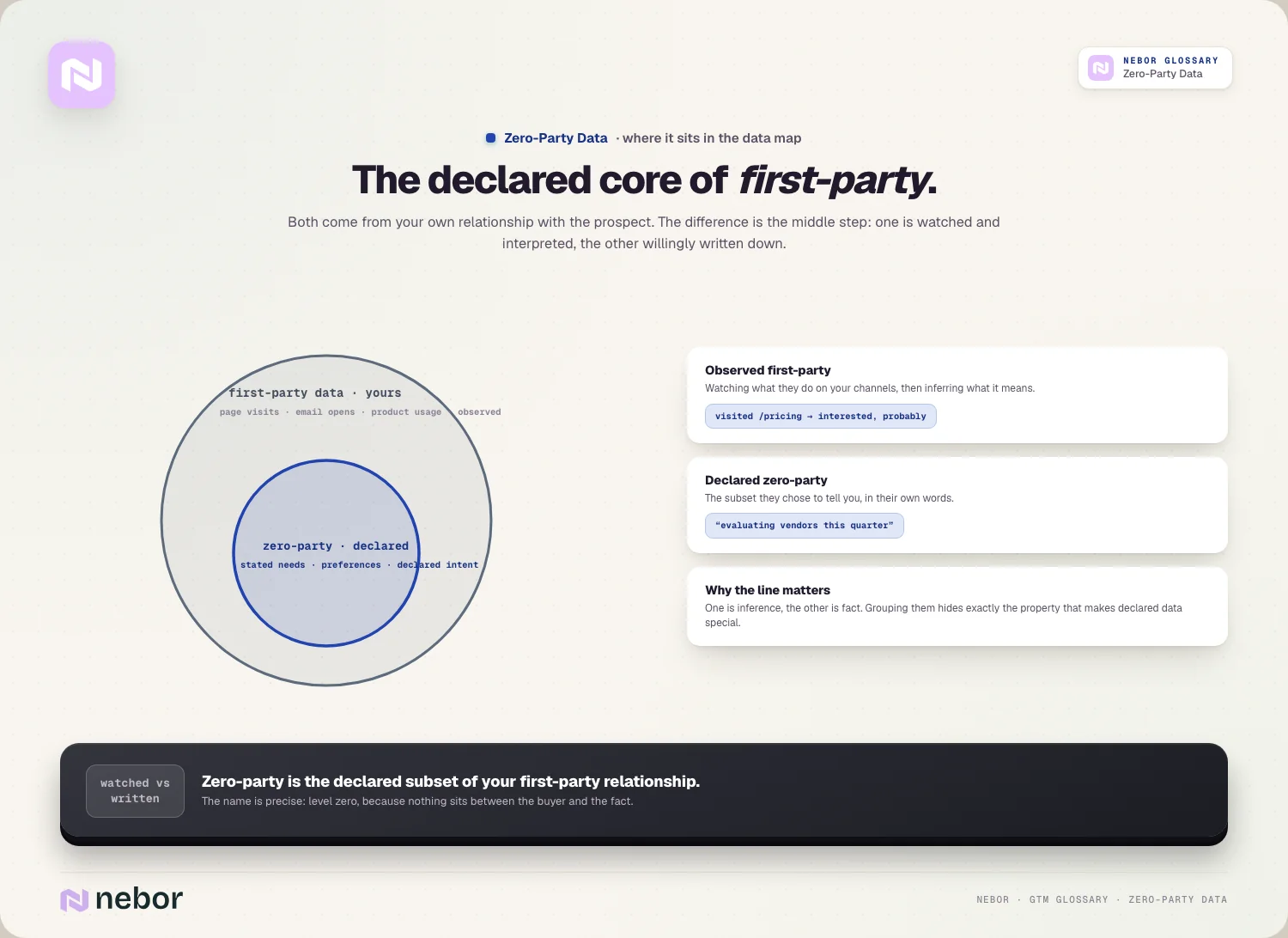
First-party behavior stands a step higher on the ladder. Observing a prospect on your own channels is more reliable than bought data, but it's still inference about what their actions mean.
Zero-party data earns the most trust of all. Because the prospect volunteered it, there's no inference involved, which makes it the highest-trust, highest-consent tier of data.
So the hierarchy climbs from inferred to declared. The closer data gets to something the prospect told you outright, the more you can trust it, which puts zero-party data firmly at the peak.
Why zero-party data matters more in an increasingly privacy-first world
The rise of privacy concerns has made zero-party data more important than ever. It's built on exactly the consent that regulations demand.
Inferred data faces regulatory scrutiny that grows every year. Tightening privacy rules and buyer wariness make behavioral tracking and purchased data more fraught, which erodes the data types built on inference.
Volunteered data sidesteps that entire class of problem. Because a prospect chose to share zero-party data, it carries clear consent, so it holds up as privacy expectations rise.
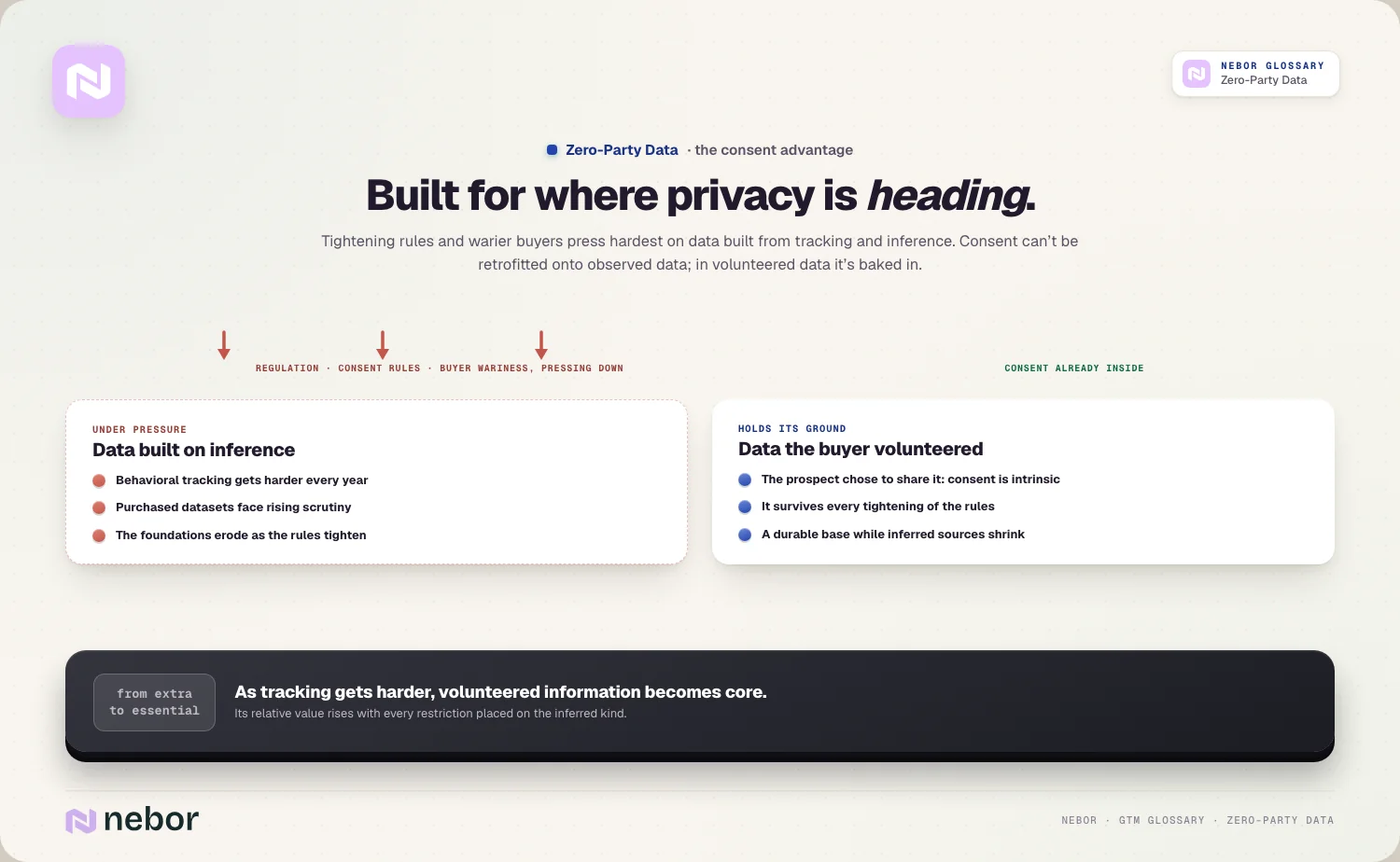
It's a foundation that stays durable over time. As other data sources face restrictions, the information buyers willingly give you becomes a more reliable base to build on, because consent is baked in.
So zero-party data is well suited to where privacy is heading. Its consent-first nature makes it resilient as the rules tighten around inferred and third-party data, which raises its relative value.
This is a real shift in emphasis. As tracking gets harder, the information buyers choose to give you moves from a nice extra to a core part of how responsible teams learn about their market.
How zero-party data compares to intent data and behavioral inference
Zero-party data and intent data both aim at understanding what a buyer wants, but they get there very differently. One asks the prospect while the other makes an educated guess.
Intent data infers interest from patterns of behavior. Intent data estimates that an account is researching your category based on behavioral signals, powerful but probabilistic.
Zero-party data has the buyer state the interest outright. Rather than inferring interest from behavior, zero-party data has the prospect declaring their need directly, so there's no probability involved.
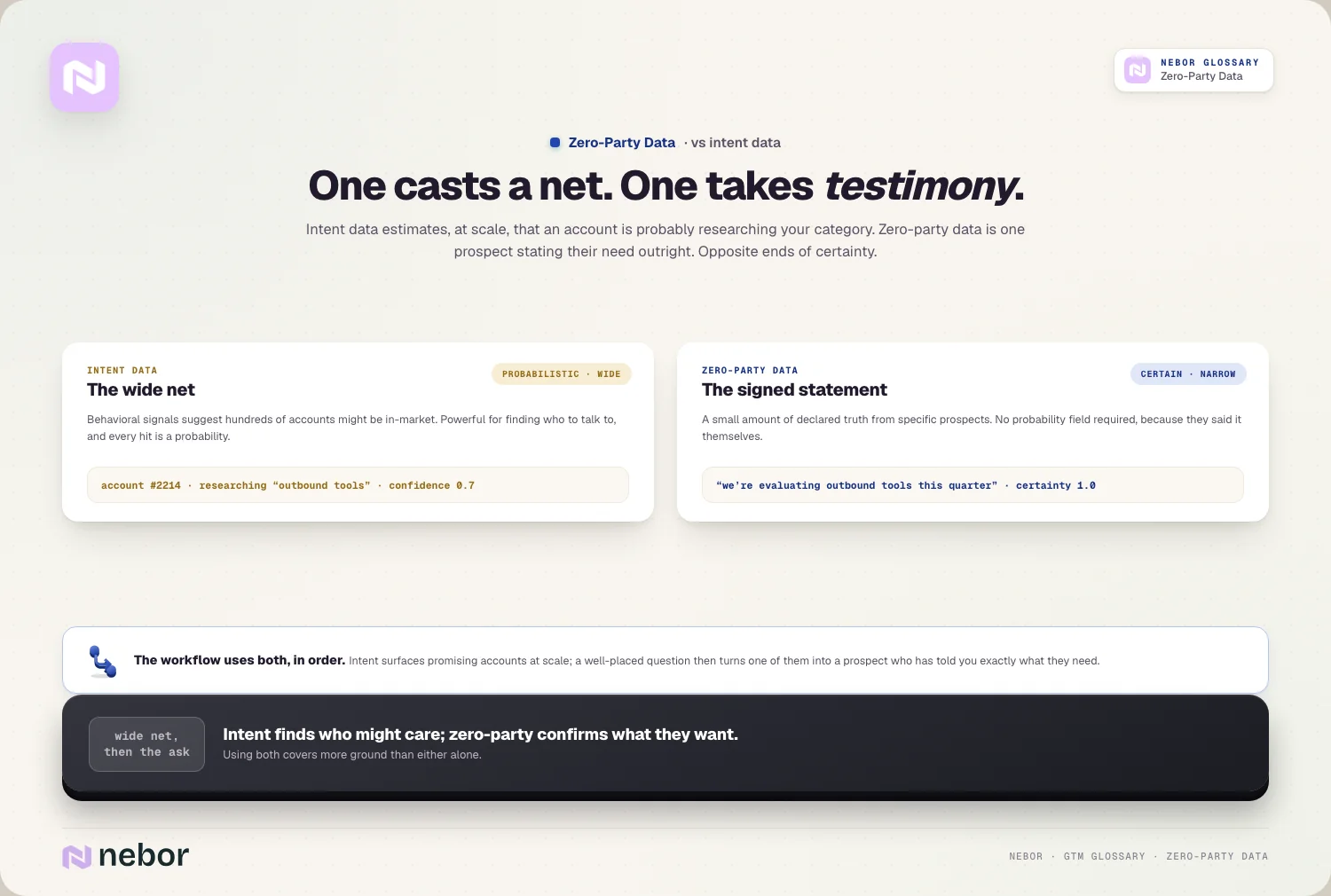
The two complement each other better than they compete. Intent data finds accounts that might be interested at scale, while zero-party data confirms and deepens what specific prospects told you they want.
So the two are at opposite ends of certainty. Intent data casts a wide, probabilistic net, while zero-party data gives you a small amount of certain, declared truth, and using both covers more ground.
A good workflow uses each for its strength. Intent surfaces who to talk to at scale, and a well-placed question then turns a promising account into a prospect who has told you exactly what they need.
How zero-party data sharpens your targeting and personalization
The practical payoff of zero-party data shows up in how precisely you can target and personalize. Declared information from real buyers makes both far sharper.
It refines the picture of your ideal customer. What prospects tell you about their needs sharpens your ideal customer profile with real, stated evidence instead of assumptions.
It deepens the personas your team writes. A buyer persona built partly on what buyers say about their own goals is more accurate than one built on inference alone.
It powers relevance that's real instead of performed. Since zero-party data captures stated needs, it lets you personalize around a prospect's stated wants, the foundation of real personalization at scale.
So zero-party data makes your outreach more relevant because it's grounded in fact. Personalizing around what a buyer explicitly told you beats personalizing around what you merely guessed, and that grounding is why declared data lifts response.
How to collect zero-party data from your prospects the right way
The wrinkle with zero-party data is that prospects have to choose to share it, so collecting it takes deliberate effort. In the builds we do, a few collection approaches work reliably well.
Ask directly and keep the asking simple. Well-designed surveys, forms, and preference questions give prospects a low-friction way to tell you what they want, the most direct method there is.
Offer something of genuine value in return. People share more when they get something back, so a useful assessment, tool, or tailored result gives prospects a reason to volunteer information.
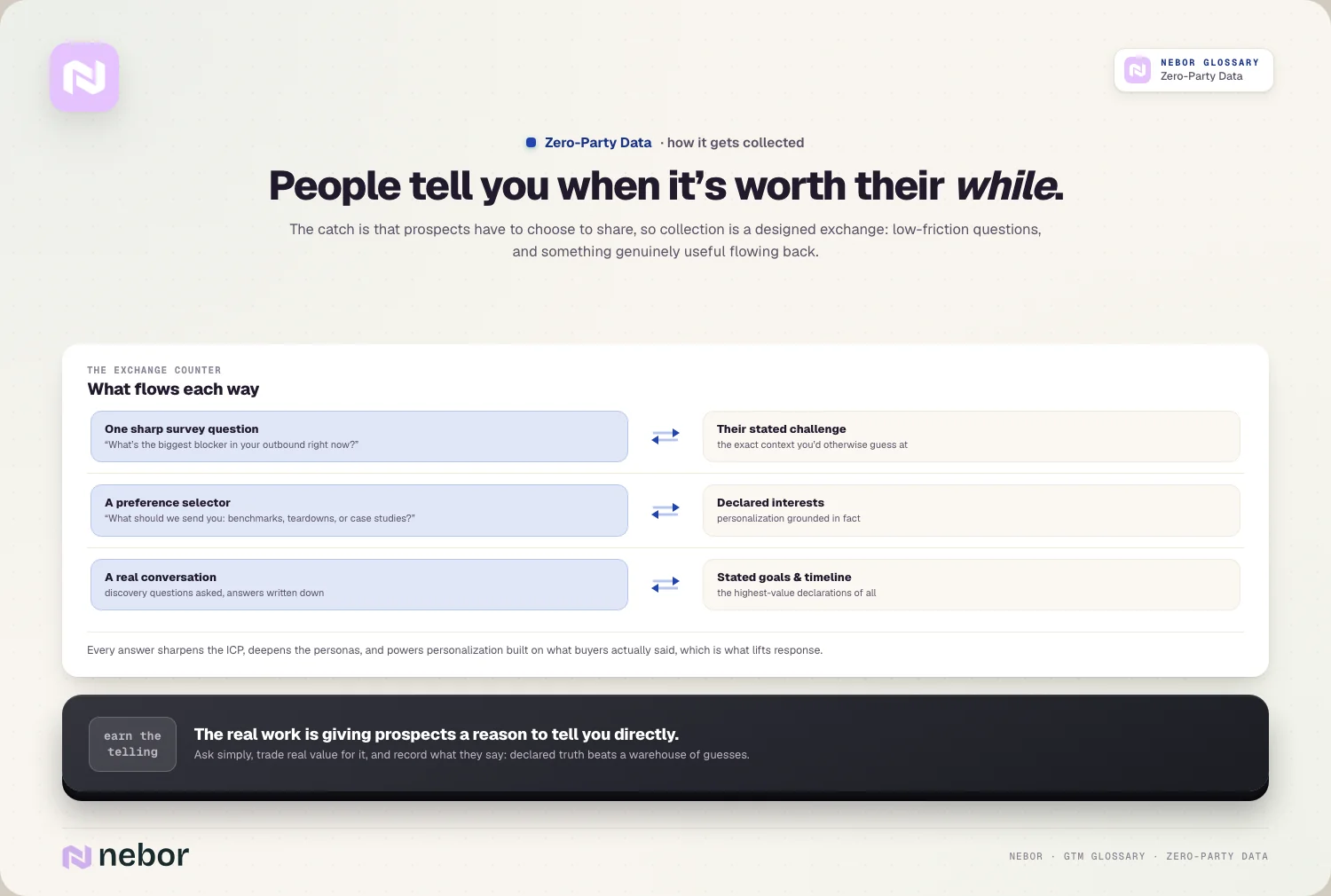
Capture it inside a flow the prospect is already in. Moments like inbound enrichment on a form or a conversation with a rep are natural points to ask a question or two that yield declared data.
So collecting zero-party data is about creating good reasons to share. The information is valuable precisely because it's volunteered, so the real work is making the exchange genuinely worthwhile for the prospect.
Keep each individual ask light and specific. A short, relevant question a prospect can answer in seconds gathers far more than a long form, because every extra field lowers the odds they bother to respond at all.
Why zero-party data has to be handled carefully once you have it
Because zero-party data is given in trust, mishandling it does more damage than mishandling other data. The consent that makes it valuable also creates obligations.
It carries an expectation along with it. A prospect who shares information directly expects it to be used respectfully and for their benefit, so misusing it breaks the trust that produced it.
Accuracy still needs upkeep as circumstances change. Stated preferences can change, so zero-party data still benefits from data hygiene to keep it current instead of acting on outdated declarations.
Using it well pays off on both sides. Acting visibly on what a prospect told you, by tailoring the experience to their stated needs, rewards their trust and encourages them to share more.
So zero-party data is a trust relationship on top of a dataset. Handling it respectfully keeps prospects willing to share going forward, and that willingness is what makes the whole approach sustainable.
How zero-party data fits into your wider overall data strategy
Zero-party data is powerful, but it works best as one layer in a fuller data picture. It complements instead of replaces the other types.
It anchors the rest of your data. Declared data provides certain ground truth that makes your inferred and enriched data more trustworthy, because you can check the guesses against what buyers said in their own words.
It pairs cleanly with the enrichment you already do. Combining what a prospect told you with data enrichment fills in the firmographic data around their stated needs, so you get both the declaration and the full context.
It's smaller in volume but sharper in meaning. You'll always have less zero-party data than inferred data, so the strategy is to use its certainty where it matters most instead of expecting it to cover everything.
So zero-party data is the high-trust core of a broader strategy. It's the certain center that the larger, less certain layers of data are built around and checked against.
Think of it as ground truth for the rest. When enriched or inferred data disagrees with what a buyer directly told you, the declared version wins, which makes zero-party data a useful reference point across your whole database.
How zero-party data helps you qualify prospects more accurately
One of the most practical uses of zero-party data is in deciding which prospects are worth pursuing. Declared information makes your qualification calls sharper.
It answers the core qualification questions directly. When a prospect states their budget, timeline, or need, you have real answers to the questions lead qualification tries to establish, instead of inferring them.
It reduces the effort wasted on mismatches. Knowing what a prospect truly wants keeps reps from chasing poor-fit deals, because the declared data flags mismatches early.
It speeds up the conversations that matter. A prospect who has told you their situation lets you skip basic discovery and get to a relevant conversation faster.
So zero-party data feeds qualification with facts instead of guesses. Asking prospects the right questions and acting on their answers is a direct way to work better-fit deals from the start.
The common mistakes teams make when they use zero-party data
Zero-party data gets mishandled in a few predictable ways, and we keep seeing the same ones when teams walk us through their data stack. Avoiding them is what keeps the asset valuable.
The biggest is never collecting it in the first place. Relying entirely on inferred and purchased data means never asking prospects directly, which leaves the most reliable information on the table.
Another is asking without giving anything back. Requesting information without offering value in return gets low response, because prospects share more when the exchange benefits them.
A third is ignoring what they said. Collecting declared preferences and then never acting on them wastes the data and breaks the trust that made a prospect share, a failure we advise clients to treat as seriously as losing the data itself.
The last is letting it go stale. Treating a one-time declaration as permanent truth ignores that stated needs change, so zero-party data still needs refreshing over time.
Why zero-party data is really about earning direct buyer honesty
The deepest way to understand zero-party data is that it's the product of trust, because a prospect shares directly only when they see a reason to. That makes a steady flow of it a real sign of a healthy relationship as much as a marketing asset.
The way to earn it, then, is to give before you take. You offer something useful first, and what a prospect shares back is the reward for that value instead of something you quietly extracted.
That's also why the source strengthens or weakens based on how you treat it. Act visibly on what prospects tell you and they share more, but ignore or misuse it and the willingness dries up fast, because this is a relationship you maintain instead of a dataset you own.
A go-to-market motion that earns and honors zero-party data is therefore building on the most trustworthy foundation in a modern go-to-market system. It grounds the outreach you automate sales prospecting around in what buyers told you outright instead of what you managed to guess.
Share this post
Data
Marketing
Glossary
Related glossary items
Understanding the core GTM concepts




Ready to build your pipeline











