

In this post:
Two people on a sales team can argue all afternoon about which subject line is better. One swears by short and punchy, the other by a question, and both are completely confident, even though neither of them knows.
A/B testing settles that argument with data instead of opinion. You send two versions, measure which one gets more replies, and let the numbers decide instead of the loudest voice in the room.
A/B testing cold email is the practice of sending two versions of an email that differ in one element, then comparing the results to see which performs better. It replaces guessing about what works with evidence.
The part that gets missed is that doing it badly is worse than skipping it entirely. A test done on too few emails produces random noise that looks like a result, so you confidently learn the wrong lesson and double down on it.
TL;DR
A/B testing cold email means sending two versions that differ in one variable, like the subject line or opener, to a comparable audience, then measuring which gets a better response.
Its value is that it replaces opinion with evidence. Instead of guessing what resonates, you learn what actually moves your reply rate, then build on what works.
The discipline is in doing it right, testing one variable at a time, using a large enough sample, and checking the result is real rather than random.
Sample size is where it usually falls apart. Cold email reply rates are low, so small tests produce noise that looks like signal, which means most casual A/B tests teach the wrong lesson.
What is A/B testing in cold email, and how does one test work?
A/B testing is a simple idea applied carefully. You create two versions of an email, the A and the B, that are identical except for one element, then send each to a comparable group.
The single difference is the whole point. By changing only one thing, you can attribute any difference in results to that one variable, rather than guessing among many changes at once.
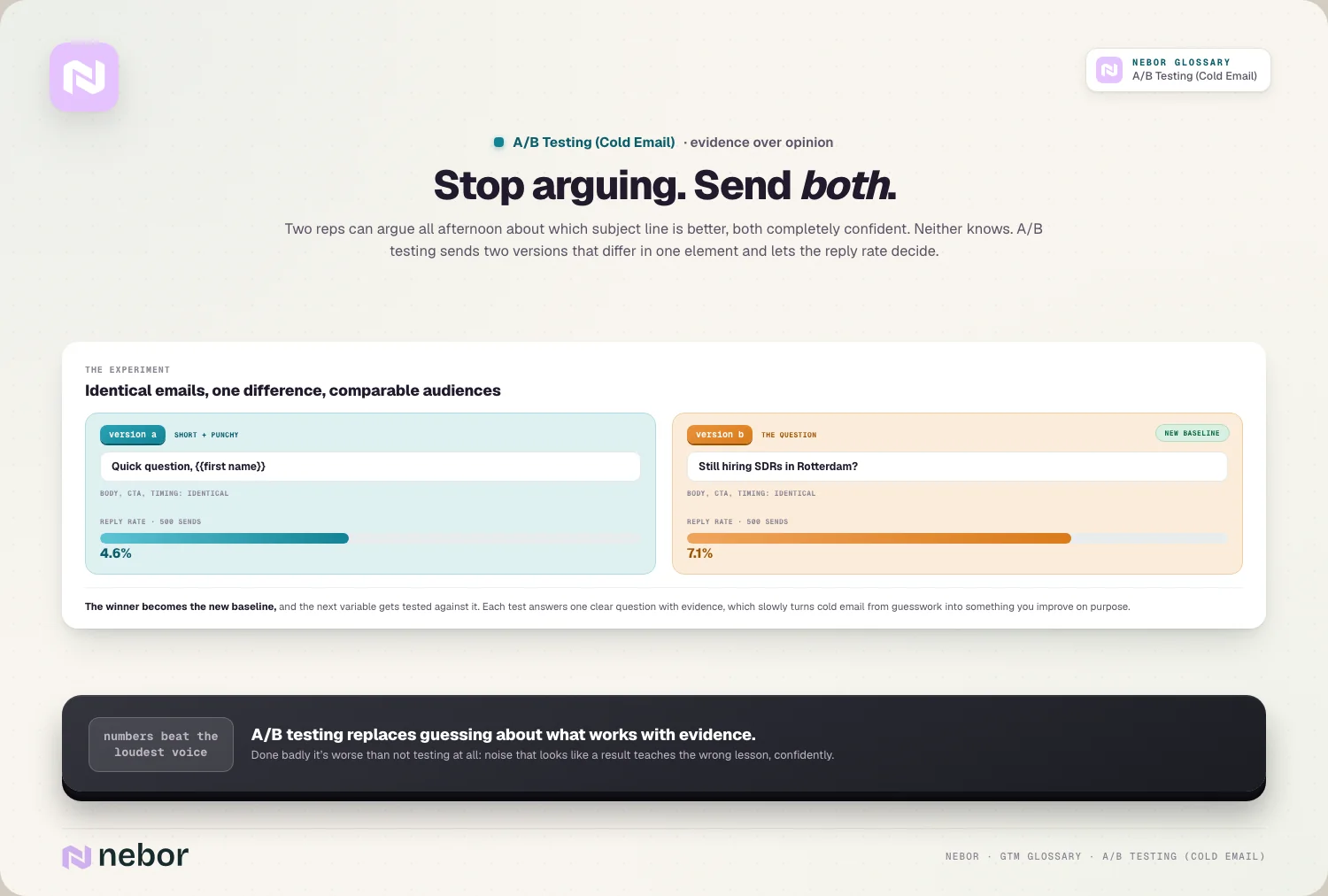
From there you measure how each version performed. Usually that means comparing the reply rate of each version, because replies are the truest measure of whether a cold email actually worked.
The version that performs better wins, and becomes your new baseline. Then you test the next variable against that winner, improving step by step over time.
So A/B testing is really structured learning. Each test answers one clear question with evidence, which slowly turns your cold email from guesswork into something you actively improve.
What should you test first when everything about it feels testable?
Not everything deserves a test, and knowing what moves the needle saves your testing budget. We watch the same few elements matter most in cold email, over and over.
The subject line is the classic place to start, because it decides whether your email gets opened, so testing length, a question versus a statement, or personalization is a common first move.
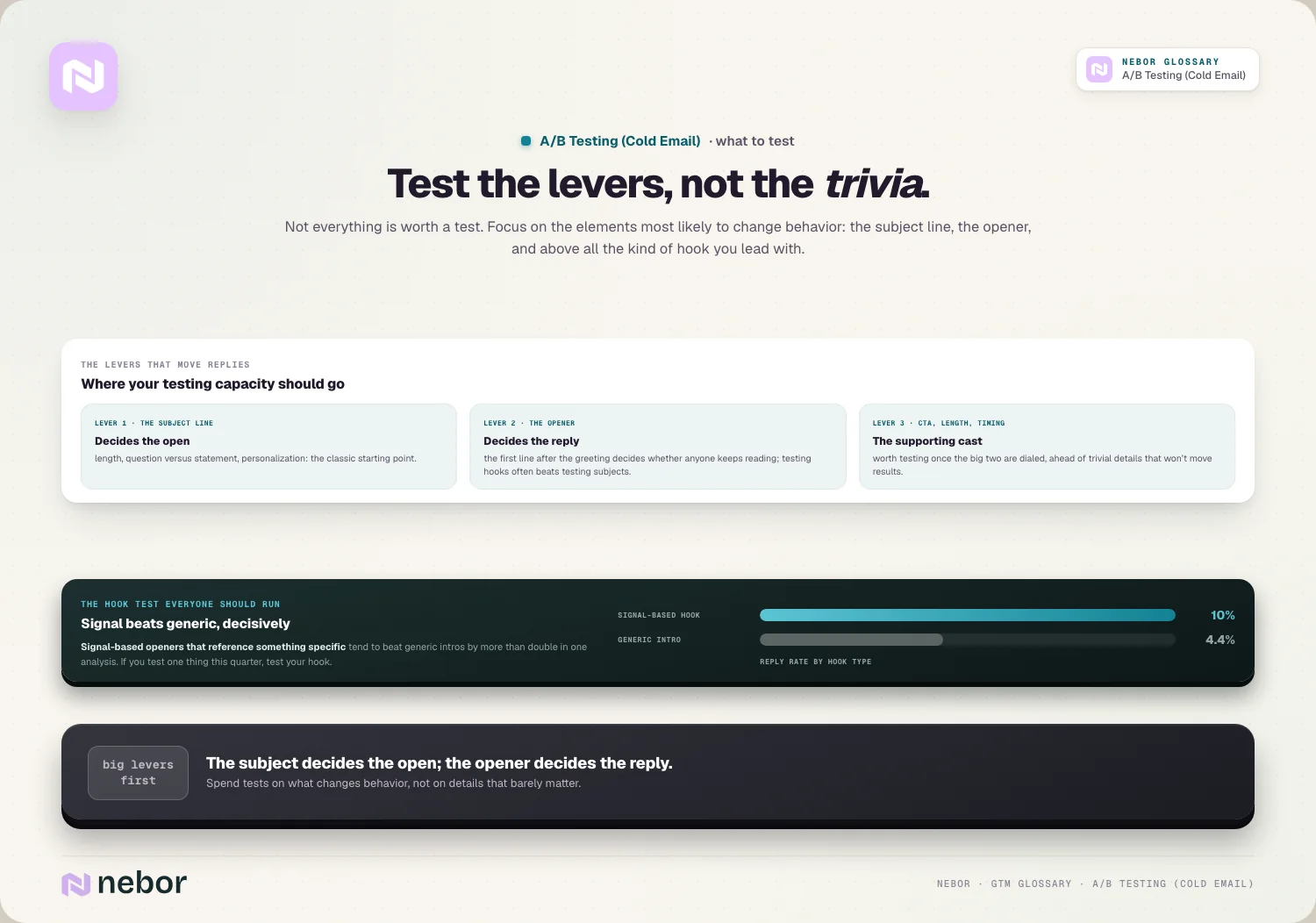
The opener matters even more for replies, because the first line after the greeting decides whether someone keeps reading, and testing different hooks often has a bigger impact than the subject.
Hook type deserves its own tests, because signal-based openers that reference something specific tend to beat generic intros, with one analysis showing around a 10% reply rate for signal hooks versus 4.4% for generic ones.
Beyond those, you can test the call to action, the length, and the timing. The rule is to focus on the elements most likely to change behavior, rather than testing trivial details that won't move results.
Why is testing one variable at a time so important to the result?
The single most common testing mistake is changing too much at once. Understanding why this breaks the test is key to doing it right.
If you change the subject line and the opener and the call to action all at once, and version B wins, you've learned nothing useful. You can't tell which change caused the difference.
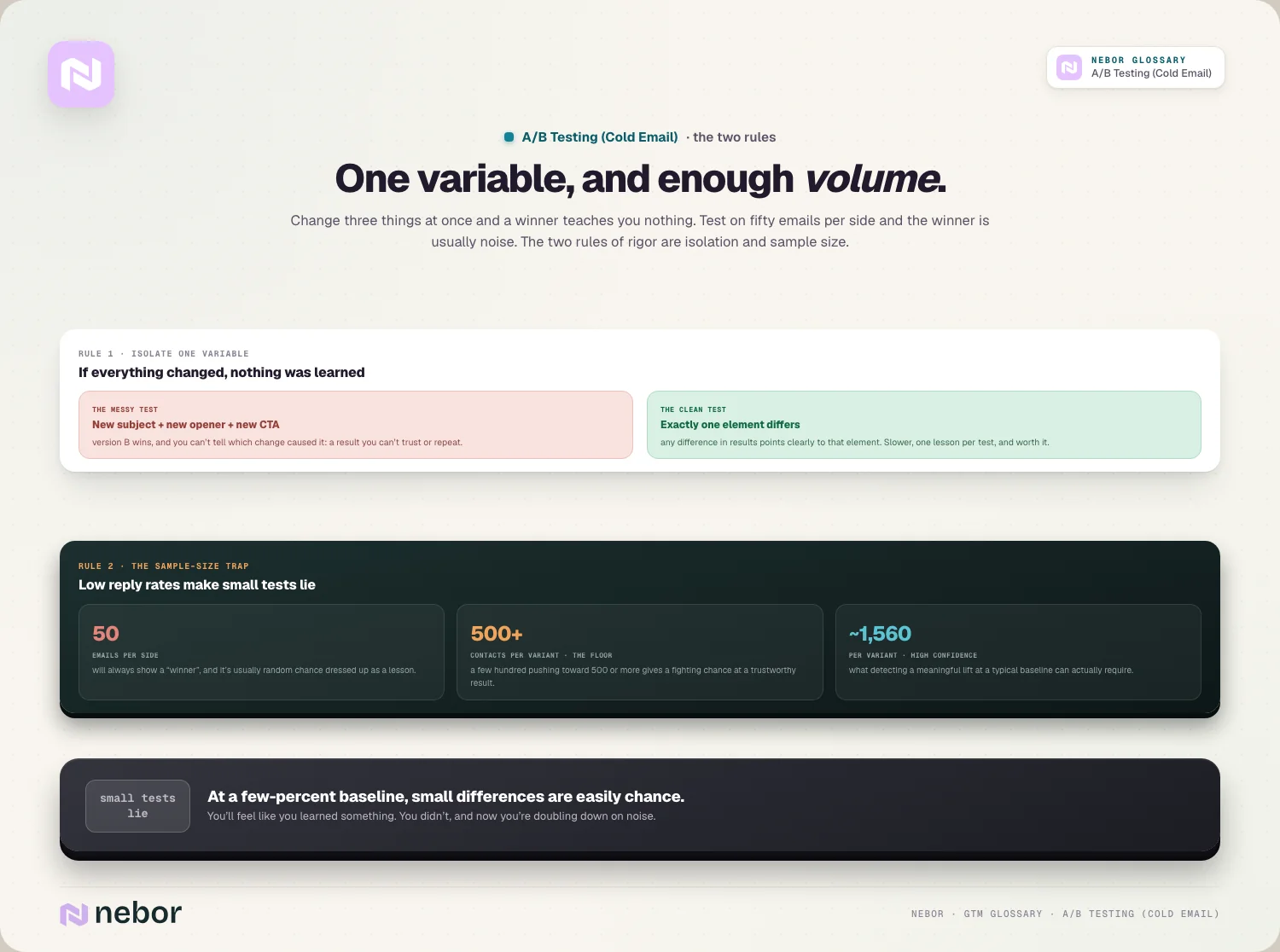
Isolating one variable is what fixes this. When the two versions differ in exactly one element, any difference in results points clearly to that element, which is the entire purpose of the test.
It does mean the learning arrives more slowly, because you can only learn one thing per test, so improving a whole email takes a series of tests instead of one big experiment.
So discipline beats speed in this corner of outbound. A series of clean, single-variable tests teaches you real lessons, while one messy multi-variable test just gives you a result you can't trust or repeat.
Why does sample size make or break a cold email test every time?
This is where most cold email A/B testing falls apart, and in our experience it deserves more attention than everything else combined. The problem is that cold email reply rates are low.
Low rates translate directly into noise, because when your baseline reply rate is only a few percent, small differences between versions can easily be random chance instead of a real effect.
The math offers no mercy on this. At a typical baseline, detecting even a meaningful lift can require around 1,560 emails per variant for high confidence, far more than most teams send in a test.
A practical floor keeps the whole exercise honest. Starting at a few hundred contacts per variant and pushing toward 500 or more gives you a fighting chance at a trustworthy result.
So the hard truth is that small tests lie. A test on fifty emails per side will show a winner, but that winner is usually noise, which means you learned nothing while feeling like you learned something.
How do you know a result is real instead of just random luck?
Beyond sample size, you need a way to judge whether a difference is meaningful. This is what statistical significance is for.
Statistical significance asks one question of your data. Is the difference between A and B large enough, given your sample size, that it's unlikely to be pure chance?
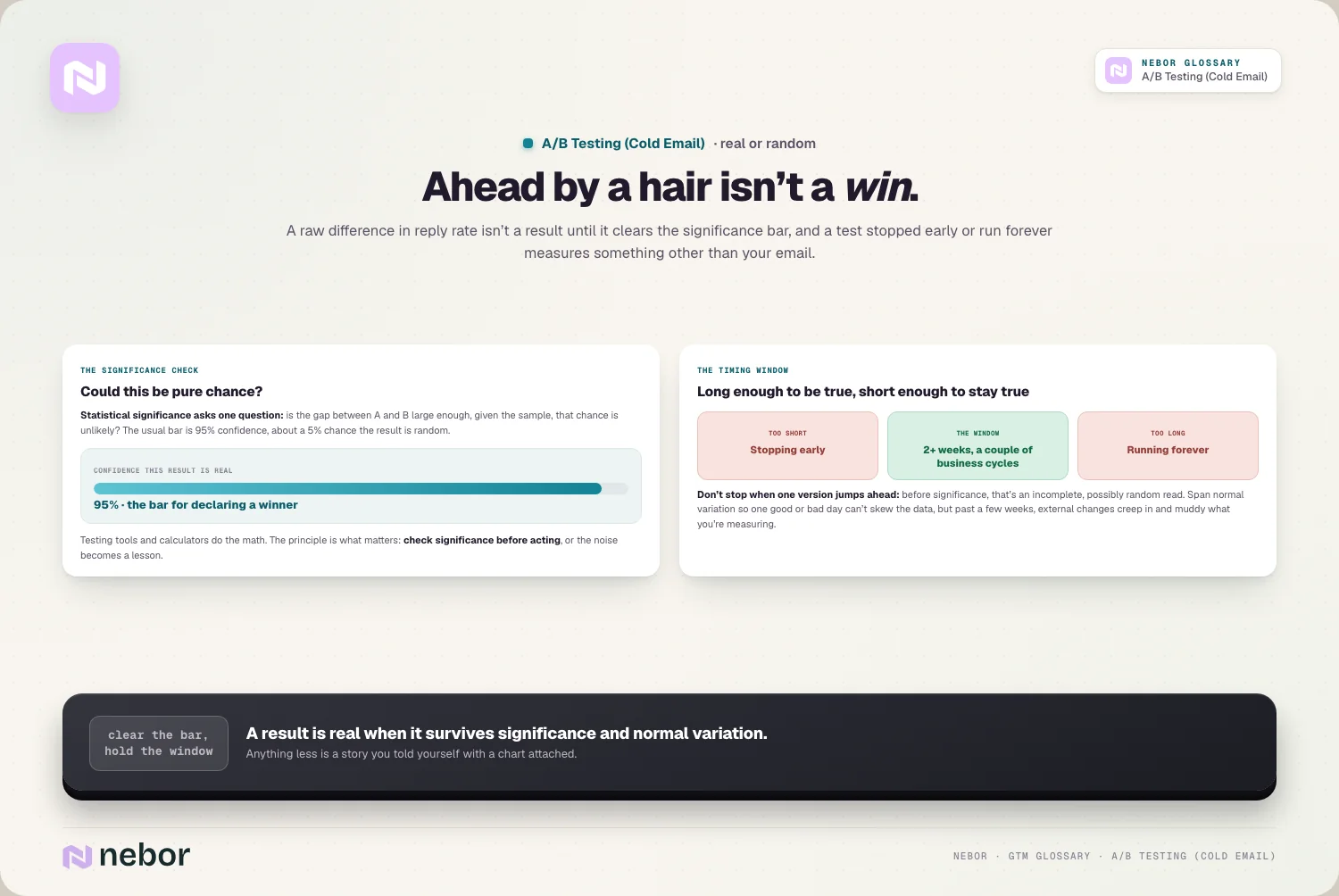
The common threshold is 95% confidence. Reaching that level means there's only about a 5% chance the result is random, which is the usual bar for declaring a real winner.
You don't have to do the math by hand. Testing tools and significance calculators handle it, but the principle is what matters, which is that a raw difference in reply rate isn't a result until it clears that bar.
So the habit is to check significance before acting on anything. A version that's ahead by a hair on a small sample hasn't won, it's just noisy, and treating that as a lesson is how teams fool themselves.
How long should a cold email test go before you call it?
Sample size isn't the only requirement, timing matters too. Testing for the wrong duration introduces its own errors.
The first rule is to not stop early. Even if one version jumps ahead quickly, ending the test before it reaches significance means acting on an incomplete, possibly random result.
You also want to span normal variation. Keeping a test open for at least two weeks, across a couple of business cycles, removes the effect of a single good or bad day skewing the data.
Leaving it open forever backfires too, because stretching a test beyond a few weeks lets external changes creep in and muddy what you're measuring.
So the right window balances both needs. Long enough to gather a real sample across normal variation, short enough that the world doesn't change underneath your test.
How does A/B testing fit into the rest of your outbound system?
A/B testing isn't a one-off trick, it's a habit that compounds across your whole motion. It works best wired into how you do outbound.
It's the engine of continuous improvement, because testing variables across your email sequence and sales cadence over time is how each step gets steadily sharper instead of staying static. Systematic testing is also the core of sequence optimization, the practice of refining your whole outreach flow based on evidence.
It guides personalization too, because testing which angles lift replies tells you where personalization at scale deserves the effort and where it doesn't.
So testing belongs in your outbound playbook as a standing practice. The teams that win treat their outreach as something to test and improve instead of something to write once and leave alone.
How do you set up a clean cold email test from the very start?
A trustworthy test is mostly about a few setup choices, and we hold every test we build for clients to the same four. Getting them right is what separates a real result from noise.
The first is splitting your audience randomly and evenly. Each version should go to a comparable group, so the only difference between them is the variable you're testing instead of who received it.
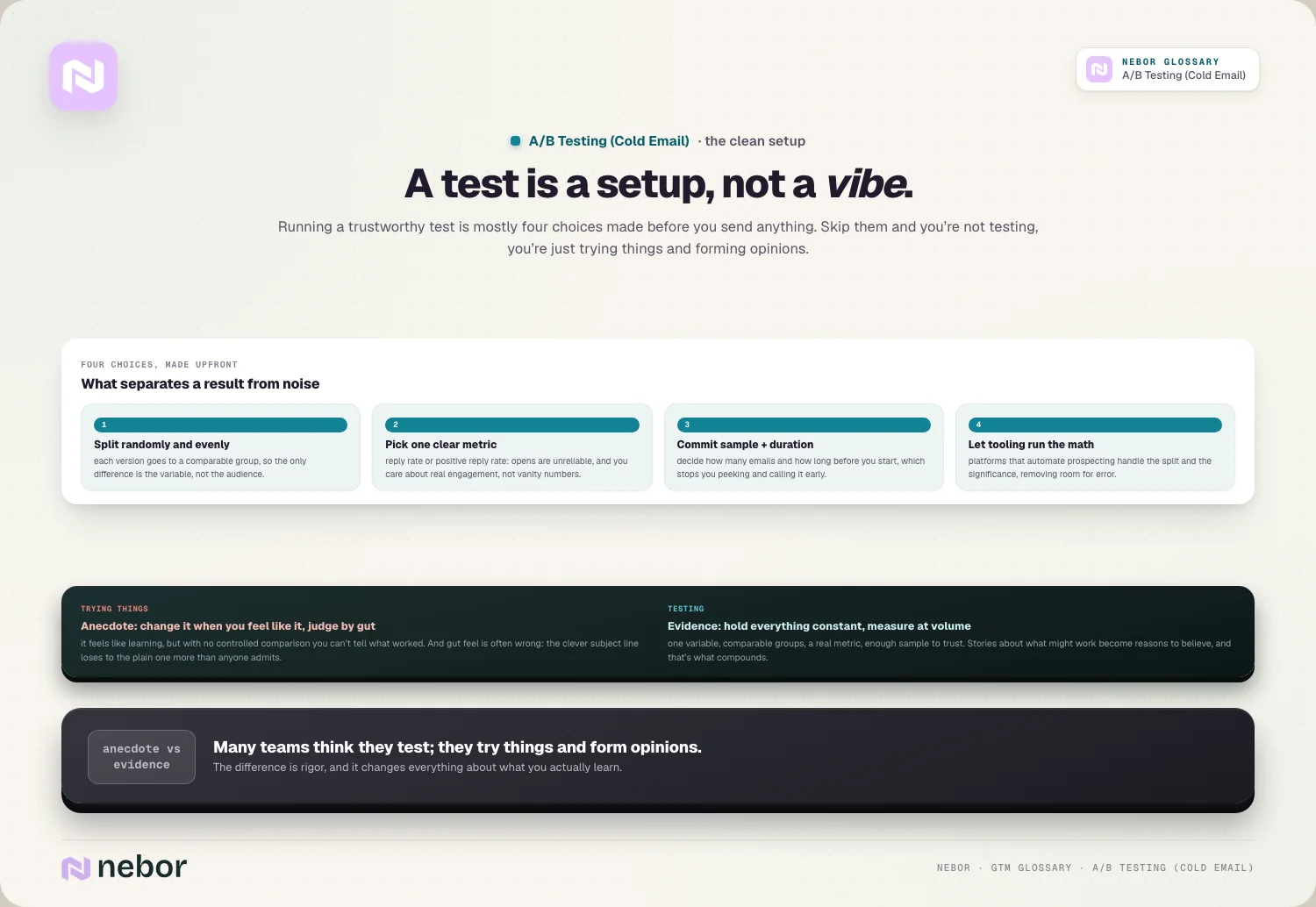
The second is picking one clear metric. For cold email that's usually reply rate, or positive reply rate, because opens are unreliable and you care about real engagement instead of vanity numbers.
The third is committing to the sample and duration upfront. Deciding how many emails and how long before you start stops you from peeking and calling a winner too early.
The fourth is using tooling that handles the split and the math. Platforms that automate sales prospecting often handle the test, divide the audience, and calculate significance, which removes a lot of room for error.
What's the difference between real testing and just trying things?
Many teams think they test, but they really just try things and form opinions. The difference is rigor, and it changes everything about what you learn.
Trying things is changing your email whenever you feel like it and judging by gut. It feels like learning, but with no controlled comparison, you can't tell what worked.
Testing, by contrast, is controlled and measured. You hold everything constant except one variable, send to comparable groups, and judge by a real metric with enough volume to trust.
The distinction matters because gut feel is often wrong in cold email. A subject line that feels clever can underperform a plain one, and only a real test reveals that.
So the line is between anecdote and evidence. Trying things gives you stories about what might work, while testing gives you reasons to believe, which is what compounds over time.
What are the common mistakes with cold email A/B testing to avoid?
A/B testing goes wrong in a few predictable ways, and most are about rigor. Knowing them ahead of time keeps your tests honest.
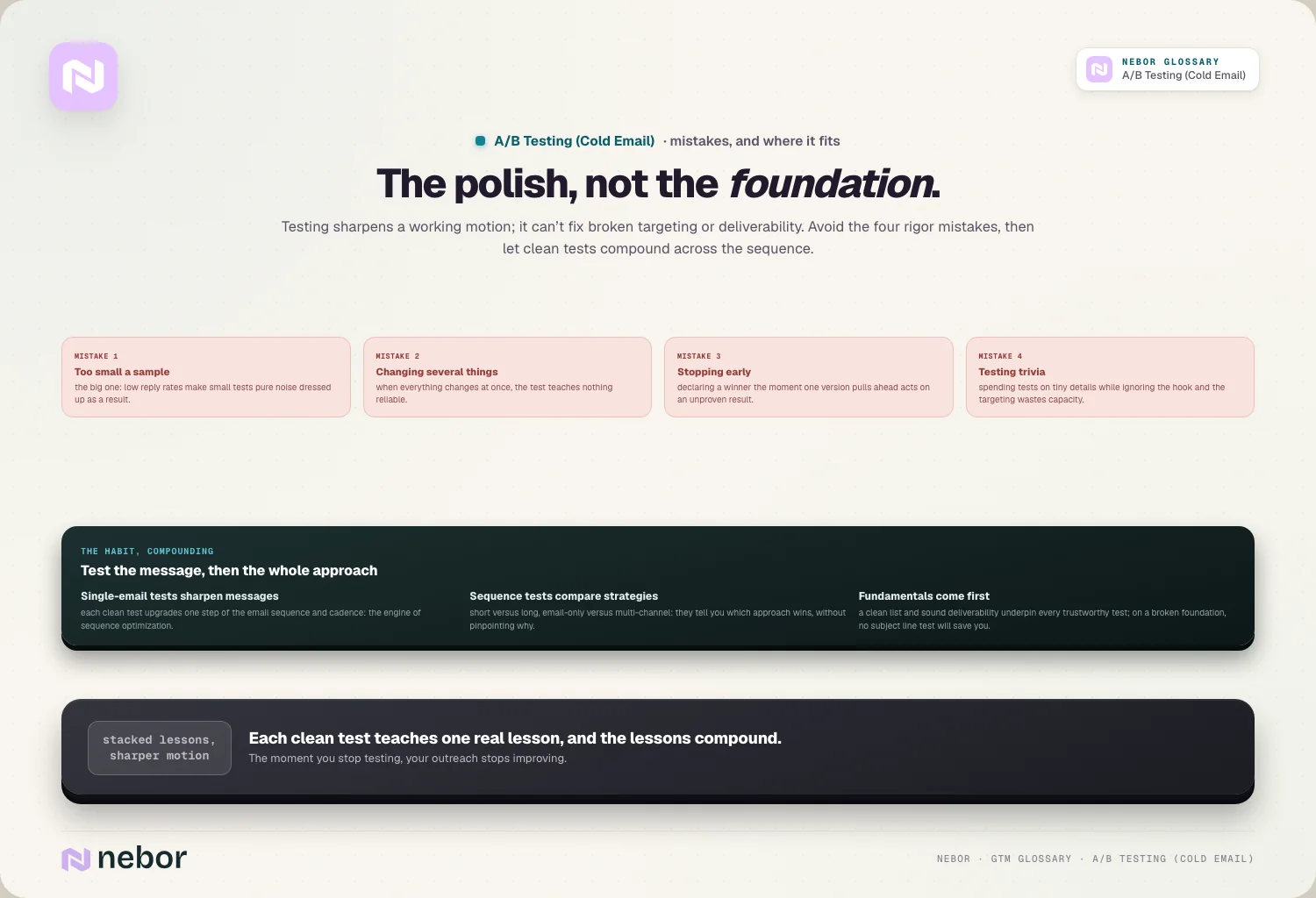
The big one is testing on too small a sample, since low reply rates make small tests pure noise dressed up as a result.
Close behind is changing more than one variable, because when several things change at once, you can't tell what caused the difference, so the test teaches nothing reliable.
Stopping early comes next, where a winner gets declared the moment one version pulls ahead, acting on a result that hasn't yet proven it's real.
And there's testing trivial things, spending your tests on tiny details while ignoring the big levers, like the hook or the targeting, which wastes your testing capacity on changes that barely matter.
How does testing relate to the rest of your outreach quality work?
A/B testing improves what you already have, but it can't fix a broken foundation. It works best on top of the fundamentals.
Testing optimizes a motion that already works. If your targeting and deliverability are sound, testing sharpens your messaging, but if they're broken, no subject line test will save you.
It also pairs with techniques like rotation and variation. Tools such as spintax vary your wording to protect deliverability, which is a different goal from testing but part of the same craft of refining cold email.
And it depends on a clean audience. Testing on a poorly built list gives you unreliable results, so good list building underpins trustworthy tests.
So testing works as the polish on top instead of the foundation underneath. It makes good outreach better, and that's the reason it pays off most once the basics under it are already solid.
Can you A/B test a whole sequence instead of just a single email?
A/B testing usually focuses on a single email, but the same logic extends to entire sequences. The challenge is keeping it rigorous as the test gets bigger.
You can test sequences against each other. One version might use a different cadence, channel mix, or overall structure, and you compare which sequence books more meetings overall.
Attribution gets much harder at that bigger scale. With many variables across a whole sequence, it's tougher to know what caused a difference, so sequence tests tell you which approach wins without explaining exactly why.
That's still useful at a higher level. Testing a short sequence against a long one, or an email-only flow against a multi-channel one, answers real strategic questions even without pinpointing the cause.
So the strongest programs test at both levels. Single-email tests sharpen individual messages, while sequence tests compare whole approaches, and using both keeps you improving the details and the strategy at once.
Why disciplined testing turns cold email into something you improve
A/B testing exists to replace opinion with evidence in a place where opinion usually wins. Instead of arguing about what works in cold email, you find out, then build on it.
The deeper value comes from the compounding. Each clean test teaches one real lesson, and stacked over time, those lessons turn a mediocre outreach motion into a sharp one.
The honest requirement is rigor, because cold email reply rates are low, and without a big enough sample, one variable at a time, and a real significance check, your tests produce noise that feels like insight.
So if your team keeps debating subject lines and openers, the debate itself is the sign you should be testing. Done with discipline, A/B testing turns outbound into something you improve on purpose, and the arguments finally get settled by data.
That evidence-driven habit is exactly what powers a serious go-to-market system. It's also a habit the top outbound experts never drop, because the moment you stop testing, your outreach stops improving.
Share this post
Outbound
Glossary
Related glossary items
Understanding the core GTM concepts




Ready to build your pipeline











