
In this post:
Most teams build an outreach sequence once, launch it, and never touch it again. The emails go out on autopilot for months, and whatever reply rate they happen to get is the reply rate they keep.
Meanwhile a competitor working the same list but improving their sequence steadily pulls ahead.
Sequence optimization is the discipline that closes that gap. It's the ongoing work of testing and refining a sequence, one element at a time, so it keeps getting better instead of decaying while the market moves on.
Sequence optimization is the systematic process of improving an outreach sequence by testing its components, from subject lines to timing to structure, and keeping what performs best. It turns a static sequence into one that steadily climbs toward a higher reply rate.
The payoff is large because the baseline is low, and we see the gap constantly in the campaigns clients bring us. The average B2B cold email reply rate lands around 3.43%, while teams that test with discipline routinely push past 8%, which is the difference optimization makes.
TL;DR
Sequence optimization is the ongoing process of testing and refining an outreach sequence, so it keeps improving instead of staying unchanged for months.
It works by testing one element at a time, because changing several at once makes it impossible to know what moved the results.
The elements worth optimizing include subject lines, openers, calls to action, sequence length, and timing, each of which can meaningfully shift replies.
The gains are real, because disciplined testing can lift reply rates well above the low industry average, but it requires patience and proper method to avoid false winners.
What sequence optimization involves in the day-to-day practice
Sequence optimization is the practice of continuously improving your outreach instead of setting it and forgetting it. You treat the sequence as something to keep refining instead of finalizing.
It starts from a clearly measured baseline. You measure how your current sequence performs today, so you have a firm reference point to improve against instead of guessing at changes.
It tests changes one deliberate step at a time. You try a variation on one element, compare it against the original, and keep whichever wins, so every change is earned by real evidence.
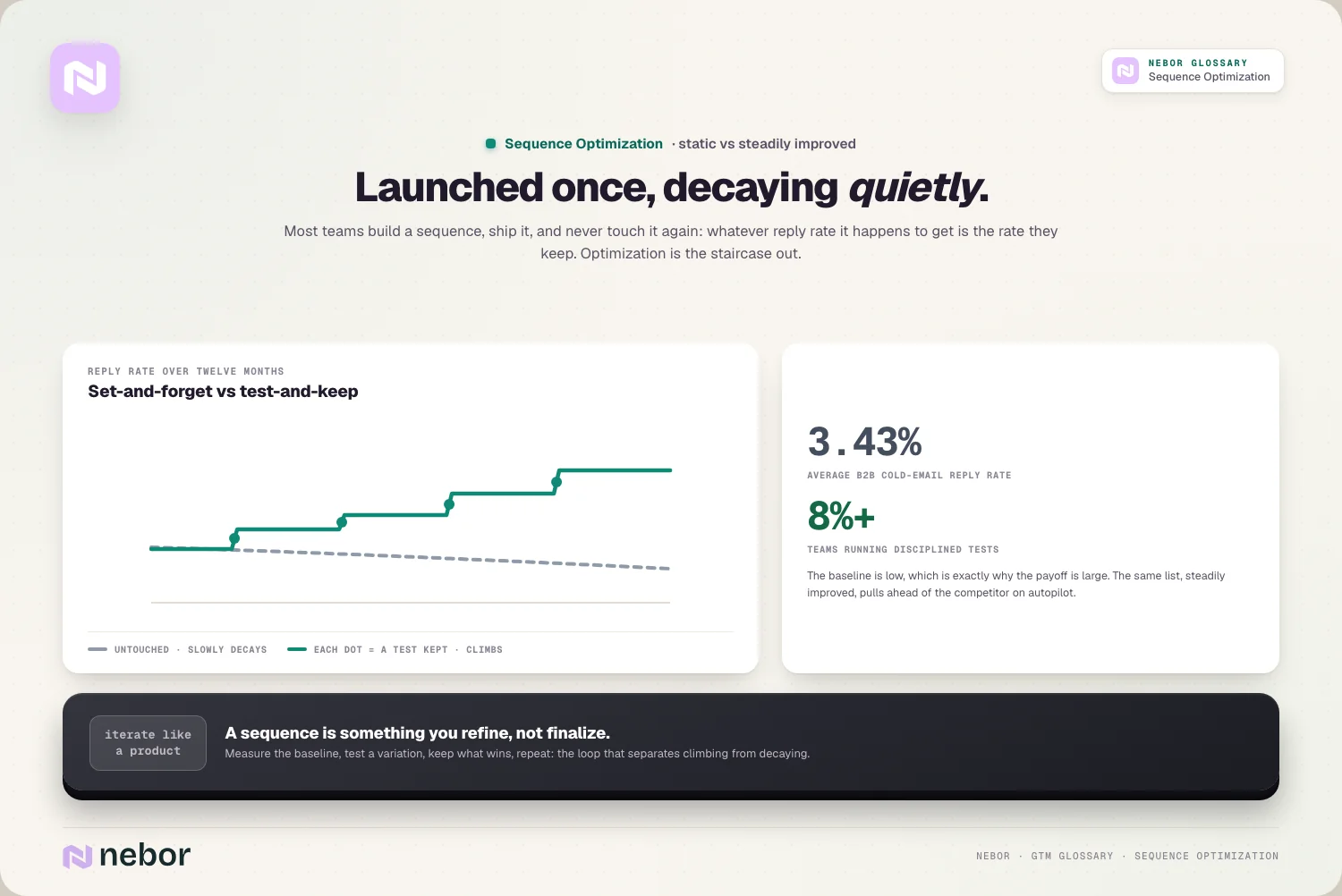
It repeats as an ongoing cycle without a finish line. Optimization is a continuous loop instead of a one-off project, so you keep testing new elements as the market and your list evolve.
So sequence optimization is a habit of steady, measured improvement. It's the difference between a sequence that slowly decays and one that keeps climbing toward better results.
The mindset shift we push clients toward is treating outreach as a product. Instead of a fixed asset you ship once, the sequence becomes something you iterate on, the same way every other high-performing system improves.
Why you can really only test one element of a sequence at a time
The single most important rule in sequence optimization is discipline about variables. Changing more than one thing at once makes the whole exercise useless.
Multiple simultaneous changes hide the true cause. If you alter the subject line and the call to action together and replies rise, you can't tell which change did it, so you learn nothing you can reuse.
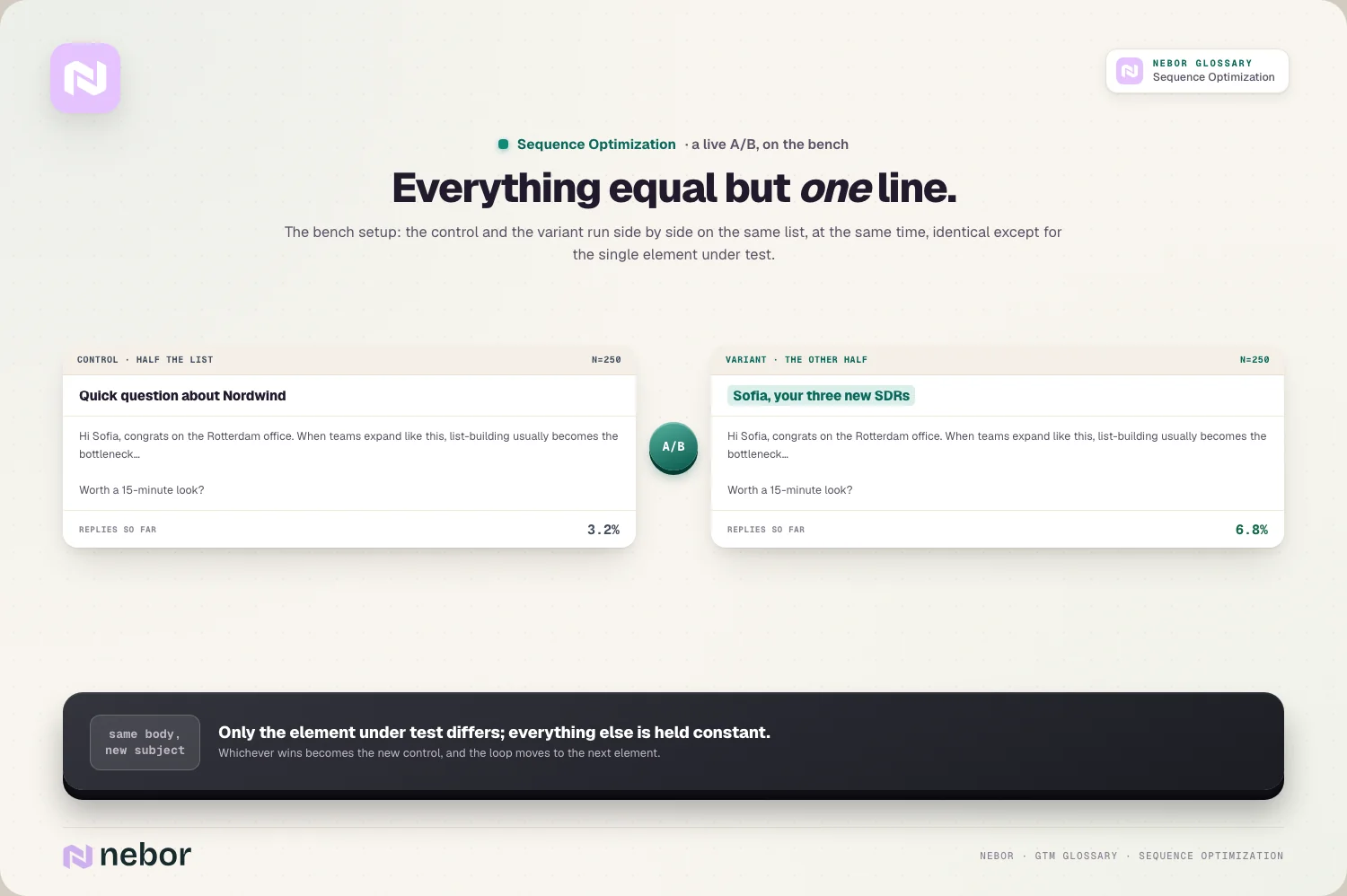
One variable at a time gives a clean answer. Testing a single element against your control tells you exactly what moved the result, which is knowledge you can then apply with confidence.
The order you test in matters too. A sensible approach is to test the subject line first, then the opener, then the CTA, then length, so each layer builds on the one before it.
So isolating one variable is what makes optimization real instead of superstition. Without it, you're just changing things and hoping, which teaches you nothing durable.
Which elements of a sequence deserve optimizing first and hardest
Not every part of a sequence matters equally, and knowing where to focus saves effort. A few elements move results the most.
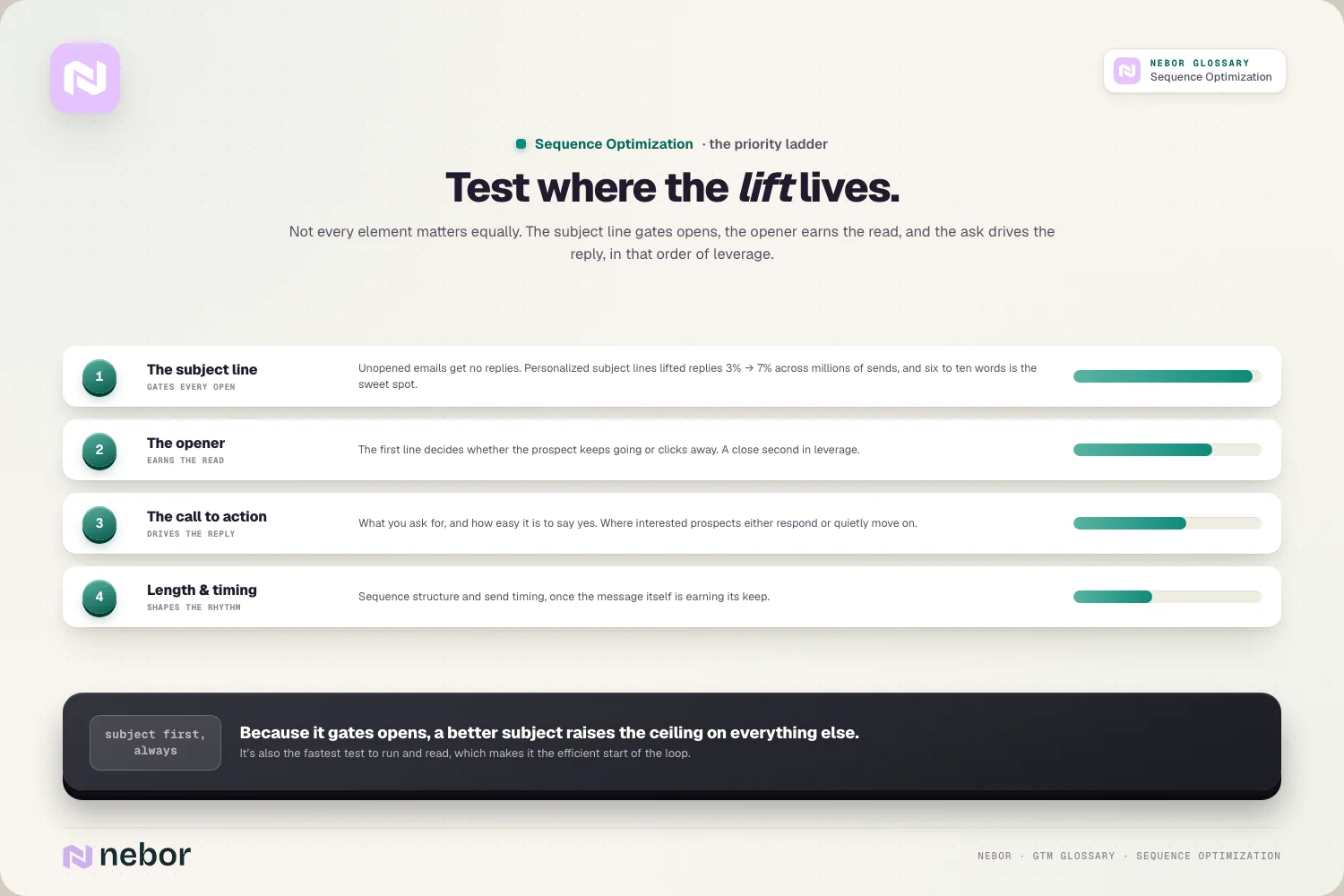
The subject line decides whether anyone opens. It determines whether your email gets read at all, so it's usually the first and highest-impact thing to test.
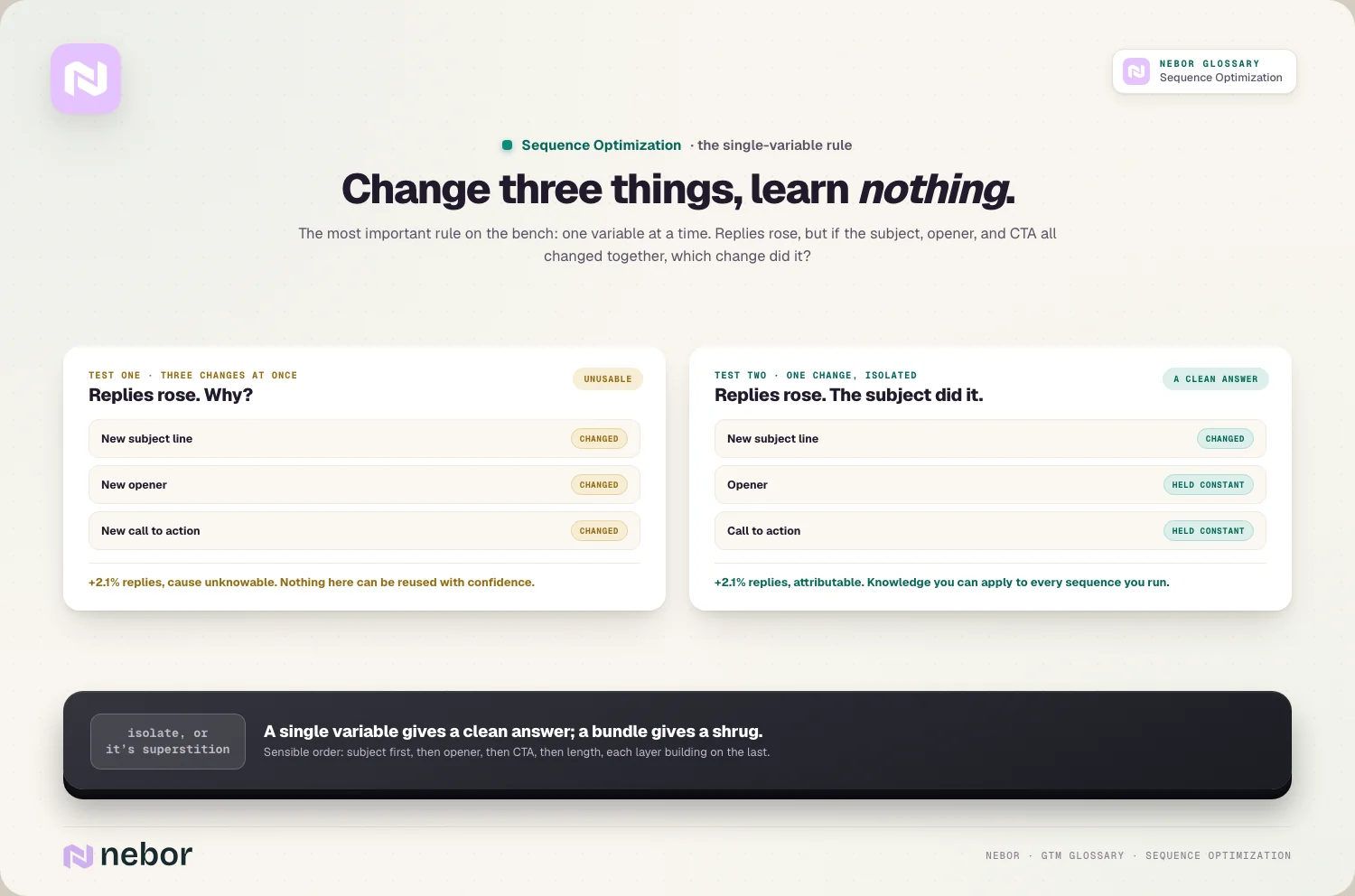
The opener earns the read that follows. The first line after the subject line decides whether the prospect keeps going or clicks away, so it's a close second in importance.
The call to action is what drives the replies. What you ask for, and how easy it is to say yes to, directly shapes whether an interested prospect responds or silently moves on.
So the highest-value targets are the subject line, opener, and ask. These are where small improvements produce the biggest lifts in replies, so optimization efforts usually start there instead of elsewhere.
Why the subject line is the highest-impact thing to test first
Among all the elements, the subject line deserves special attention because of how much it moves. A better subject line lifts everything downstream.
It gates the entire email behind it. No matter how good your message is, an unopened email gets no reply, so the subject line is the first bottleneck to clear.
Personalization moves it more sharply than anything. Across millions of emails, personalized subject lines lifted reply rates from 3% to 7%, a 133% jump, which shows how much this one element matters.
Length has a well-documented sweet spot to find. Subject lines of roughly six to ten words tend to outperform both very short ones and long ones that get cut off on mobile.
So the subject line is where optimization often pays off first. Because it gates opens, improving it lifts the ceiling on every other element in the sequence.
It's also the fastest element to test. Since subject lines are short and get read early, you can try and read subject-line tests quickly, which makes them an efficient place to start the optimization loop.
How to test a sequence without accidentally picking a false winner
The most common way sequence optimization goes wrong is calling tests badly. A few method rules keep your results honest.
Sample size matters before anything else does. You need a minimum of around 200 emails per variant, because fewer than that produces results that are just noise instead of signal.
Timing has to match across the variants. Launching variants at the same time of day and day of week keeps timing differences from polluting the comparison.
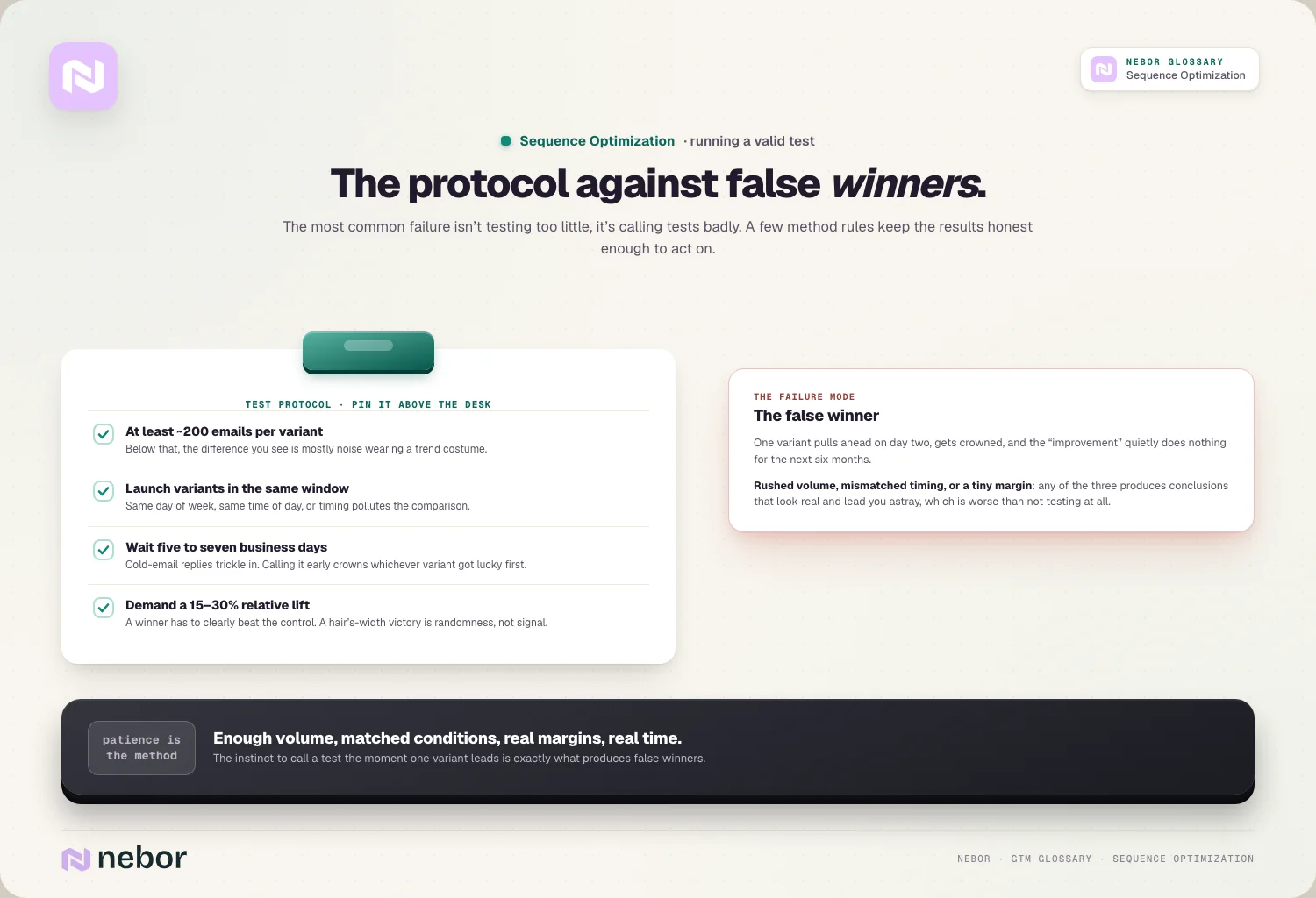
Patience is essential to a clean read. Cold email replies trickle in over days, so you wait five to seven business days before calling a test, or you risk crowning a false winner.
So a valid test needs enough volume, matched conditions, and time. Rushing any of these produces conclusions that look real but lead you astray, which is worse than never testing.
This is why patience is a real skill here. The instinct to call a test the moment one variant pulls ahead is exactly what produces false winners, so disciplined waiting is part of doing it right.
Why a real winning variant has to clear a genuinely meaningful margin
A subtle trap in optimization, and one we keep seeing, is treating any improvement as a win. Small differences are often just randomness instead of a real effect.
Tiny lifts usually turn out to be noise. A variant that beats your control by a hair may simply have gotten lucky, so acting on it can mean adopting a change that doesn't help.
A real winner clears a meaningful threshold. A meaningful result shows at least a 15 to 30% relative lift over the control, which is large enough to trust as a genuine improvement.
The margin is what protects you from noise. Requiring a clear gap before declaring a winner keeps you from chasing statistical noise and constantly changing a sequence for no real benefit.
So optimization demands a real bar for success. A winner has to clearly beat the control, or you're better off keeping what you have, and that bar is what keeps testing productive instead of busywork.
How to optimize the structure and length of your whole sequence
Beyond individual messages, the shape of the whole sequence deserves optimizing too, because its length and spacing meaningfully affect results.
Length has a well-documented sweet spot to find. For B2B cold outreach, three to five steps tends to work best, because most replies come early while later steps catch stragglers.
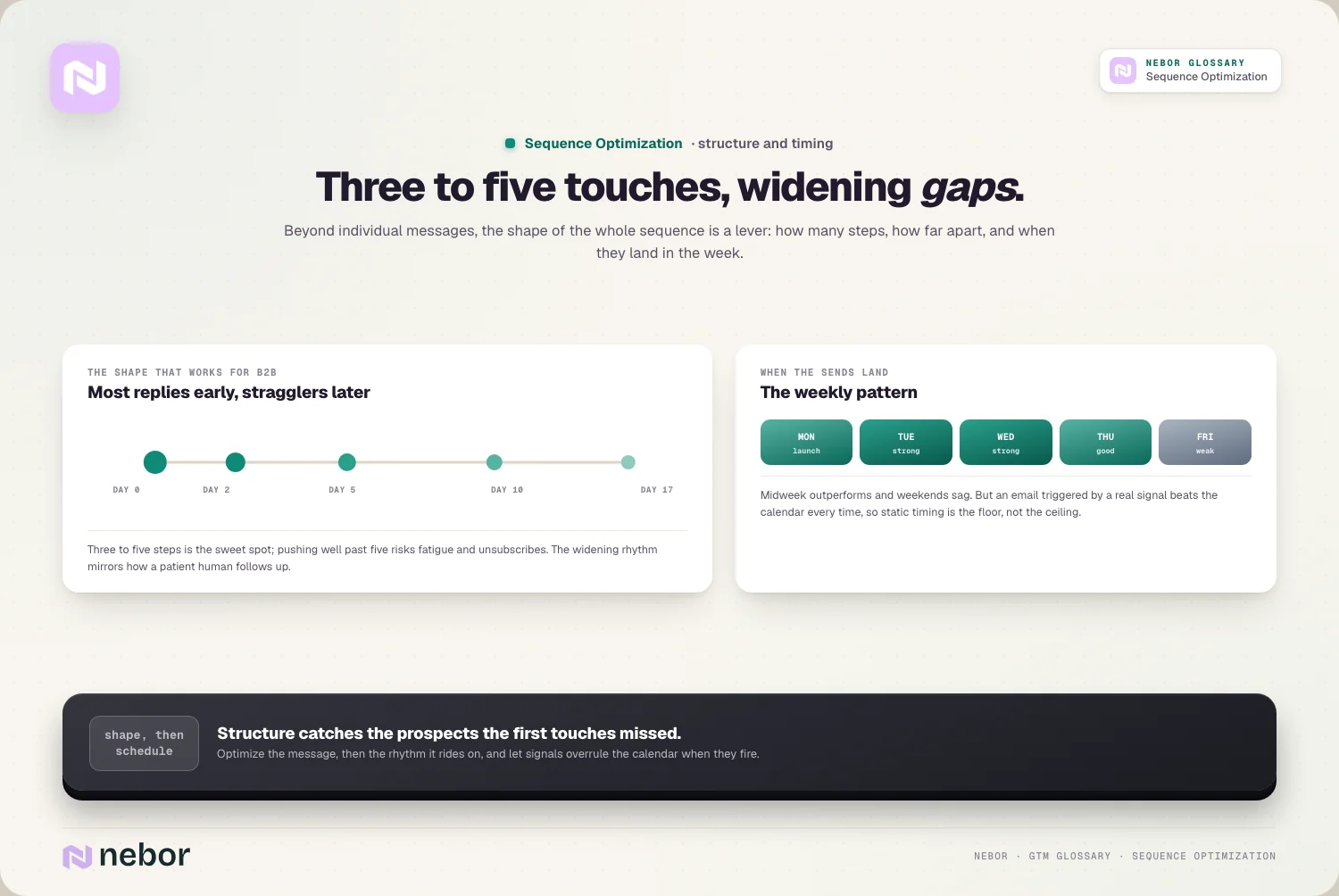
Too many steps end up backfiring on you. Pushing well past five touches risks fatigue and unsubscribes, so more is not automatically better, which is a common mistake.
Spacing shapes the rhythm your prospects feel. Widening the gaps as the sequence goes, from a couple of days early to a week later, mirrors how a patient human would follow up.
So optimizing structure means finding the right number of touches and timing. This is where a well-built follow-up sequence earns its replies, because the later steps of a full email sequence catch prospects the first ones missed.
Why timing is one of the most powerful levers you can optimize
Timing turns out to matter as much as content, and it's often under-optimized. When you send can move results dramatically.
Static timing has its known, published patterns. Midweek tends to outperform, and Mondays are good for launching sequences, while Fridays and weekends consistently see lower engagement.
But timing driven by live signals beats the calendar. An email sent within a day or two of a relevant trigger event achieves three to five times higher response, regardless of the day.
So the biggest timing win isn't the clock. Reaching a prospect right after a meaningful change at their company, the heart of signal-based selling, beats any fixed schedule.
So optimizing timing means moving from static to signal-driven. Sending when a prospect is most receptive, beyond just the statistically best day, is where the largest timing gains live.
How sequence optimization relates to A/B testing your cold email
Sequence optimization and A/B testing are closely linked, and it helps to see how they fit. Testing is the method, optimization is the goal.
A/B testing is the technique inside it. Trying A/B tests on cold email is how you compare a variant to a control and learn what works.
Optimization is the broader practice around it. It's the ongoing program of repeating those tests across every element, then applying what you learn, so the sequence keeps improving.
The two depend on each other completely. Optimization without rigorous testing is guesswork, while testing without a plan to apply the results is wasted effort.
So A/B testing is the engine and optimization is the vehicle. The tests generate the knowledge, and optimization is the discipline of using it to make the sequence steadily better over time.
How sequence optimization fits your wider cadence and channels
Sequence optimization doesn't only apply to a single email track, it extends across the whole outreach motion. The same discipline improves the entire rhythm.
It sharpens the whole cadence you build. The steps and timing you optimize become a tighter sales cadence, so the whole flow gets better over time, well beyond one email.
It reaches across every channel you use. Testing how email works alongside calls and social, the substance of multi-channel outreach, optimizes the sequence as a coordinated whole instead of one channel in isolation.
It applies to the base email too. Even the underlying cold email template benefits from the same testing, so improvements compound across every message in the sequence.
So optimization scales beyond a single track. Applying it to your whole cadence and every channel is what turns a decent motion into a consistently improving one.
How to optimize personalization and messaging across a whole list
Personalization is one of the strongest levers, but optimizing it across many prospects is its own challenge. The goal is relevance that still scales.
Relevance lifts every metric at the same time. More personalized messages consistently outperform generic ones, so improving how well your sequence speaks to each prospect raises replies.
Scale is the constraint you have to manage. Personalizing every message by hand doesn't scale, so personalization at scale techniques are what let you optimize relevance across a whole list.
Test the level of personalization quite deliberately. You can optimize how much and what kind of personalization works best, because more isn't always better and some approaches feel forced.
So optimizing personalization means finding relevance that scales. The best sequences feel written for each prospect while still going out at volume, which is a balance you tune through testing.
The common mistakes teams make when they optimize a sequence
Sequence optimization fails in a few recognizable ways, and each wastes the effort. Avoiding them is what keeps the process productive.
The biggest is not optimizing at all. Setting a sequence once and never testing it leaves the easy gains of steady improvement completely untouched.
Another is testing too many things at once. Changing multiple elements together makes results impossible to interpret, so you learn nothing you can reuse.
A third is calling tests too early. Declaring a winner before enough volume and time makes you chase false results, which can be worse than not testing.
The last is optimizing content while ignoring deliverability. A perfectly tuned sequence that lands in spam gets no replies at all, so the reply rate you're optimizing depends entirely on getting delivered first.
Why sequence optimization is a compounding advantage over time
The real value of sequence optimization is that its gains stack up in a way one-off tactics never do, because each improvement builds on the one before it, and in our experience the compounding is what teams underestimate most.
Small lifts compound into large ones over months. A better subject line, then a better opener, then better timing each add up, so a series of modest wins produces a sequence far stronger than the original.
It widens the gap on your competitors. While others keep static sequences, a team that optimizes steadily pulls ahead, because the same list produces more meetings with a sharper sequence.
It never really finishes, and that's by design. Because markets and buyers keep shifting, there's always something to test, so optimization is a durable source of edge instead of a task you complete.
A team that treats sequence optimization as a continuous habit builds one of the most reliable advantages in a modern go-to-market system. It's how the outreach you automate sales prospecting around gets better every month instead of slowly going stale.
Share this post
Sequences
Glossary
Related glossary items
Understanding the core GTM concepts




Ready to build your pipeline











