

In this post:
Send the exact same email to a thousand people and mailbox providers notice. A stream of identical messages is one of the clearest fingerprints of mass mail, and it's exactly the pattern spam filters are built to catch. Spintax is one way senders try to blur that fingerprint.
It works by swapping words and phrases so each copy comes out slightly different. Rather than a thousand identical emails, you send a thousand near-identical ones, each with small variations that make the batch look less like a single template blasted to everyone.
Spintax, short for spinning syntax, is a formatting technique that generates multiple variations of a message using brackets and a pipe symbol. When the email sends, the system randomly picks one option from each set, so every copy is worded a little differently.
The whole point is deliverability instead of personalization. Spintax varies the wording to avoid the repetitive-content pattern that filters flag, but it doesn't change the substance for each prospect, and that distinction matters more than it first appears.
TL;DR
Spintax is a syntax that generates worded variations of an email, using brackets and pipes to list alternatives the system picks from at random on each send.
Its purpose is deliverability, because varying the wording makes a batch look less like identical mass mail, which helps avoid the spam filters that flag repetitive content.
It varies wording while leaving the substance untouched, so it isn't real personalization, and treating it as a substitute for relevance is a common and costly mistake.
Used lightly it helps, but overusing it backfires, because spinning every other word creates its own detectable pattern and risks shipping weak variations.
What spintax is exactly and how the spinning syntax does its work
Spintax is a way to write one email that produces many worded variations. You embed choices in the text, and the system picks one from each when sending.
The syntax itself is simple to read. You wrap alternatives in curly brackets and separate them with a pipe symbol, so a greeting written as a set of options becomes several possible greetings.
Each send picks one option at random. When the email goes out, the platform selects one option from every bracketed set, generating a unique combination for that recipient.
The result is many versions of one email. A single spun template can produce hundreds of slightly different messages, all saying essentially the same thing in a range of different words.
So spintax turns one written email into a pool of variations. It's a mechanical way to make each copy in a batch a little different from the others, without writing each one by hand.
You can also nest groups inside each other. A bracketed set can contain another set inside it, which lets a single template produce a large number of combinations from just a few choices, though nesting also makes errors easier to introduce.
Why identical mass emails trip spam filters in the first place
To see why spintax exists, it helps to understand what it's fighting. Spam filters treat repetition as a warning sign.
Identical content repeated across hundreds of sends looks automated. When a provider sees the same exact message sent to many recipients, that pattern signals mass mail instead of a personal email.
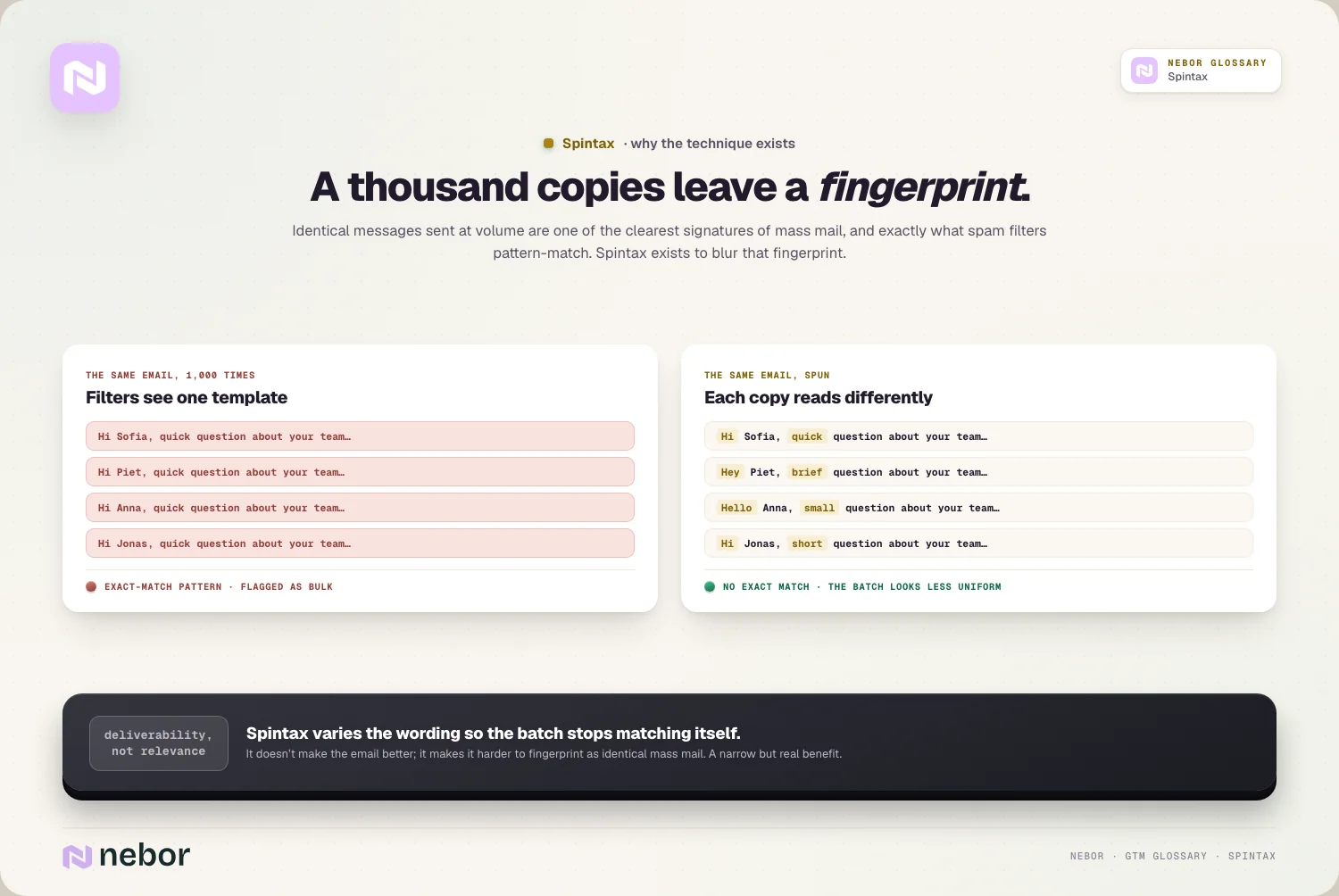
Repetition is exactly what pattern detection feeds on. Filters are built to spot templated content, so a batch of identical emails is easy for them to recognize and treat with suspicion.
That suspicion then hurts your deliverability across the board. Content that looks mass-generated is more likely to be filtered to spam, which drags down whether your email reaches the inbox at all.
So identical batches are a real liability. The very sameness that makes mass sending efficient is exactly what makes it detectable, which is the core problem spintax tries to reduce.
How spintax helps your cold email avoid looking mass-templated
Spintax addresses the repetition problem directly by making each email different. That variation is what reduces the templated fingerprint.
It breaks the exact-match pattern filters hunt for. Because each cold email comes out worded differently, filters can't match them all as one identical template.
It reduces the mass-mail signal in your sends. A batch of varied messages looks less like a single blast, which lowers the chance the whole send gets flagged as bulk content.
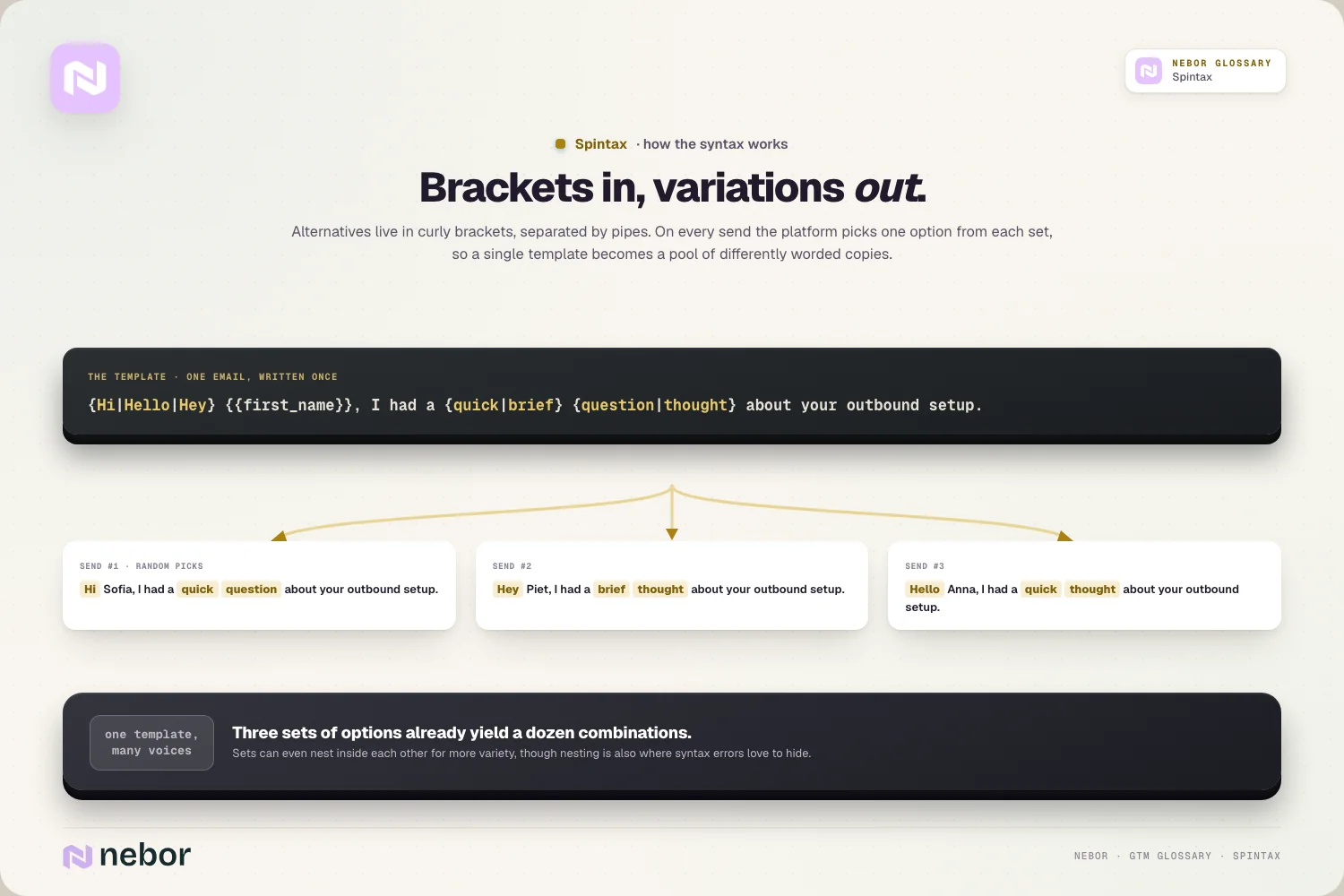
It supports your deliverability in a general way. By softening the repetition that filters watch for, spintax is one small factor that helps protect email deliverability across a campaign.
So spintax works by making a batch look less uniform. It doesn't make your email good, it just makes it harder to fingerprint as identical mass mail, which is a narrow but real benefit.
The effect stays modest by design, and that's fine. Filters weigh many signals, so a bit less content sameness helps at the margin instead of transforming your deliverability on its own.
Why spintax is not at all the same thing as real personalization
The biggest misunderstanding about spintax is treating it as personalization. It changes the words while the relevance stays exactly where it was, and the difference is fundamental.
Spintax varies the wording of a message and nothing else. Swapping one greeting or phrase for another changes how the email reads, but the message means the same thing to every recipient.
Real personalization varies the substance of what you're saying. Genuine personalization at scale references something specific and true about each prospect, which spintax can't do since it just shuffles preset options.
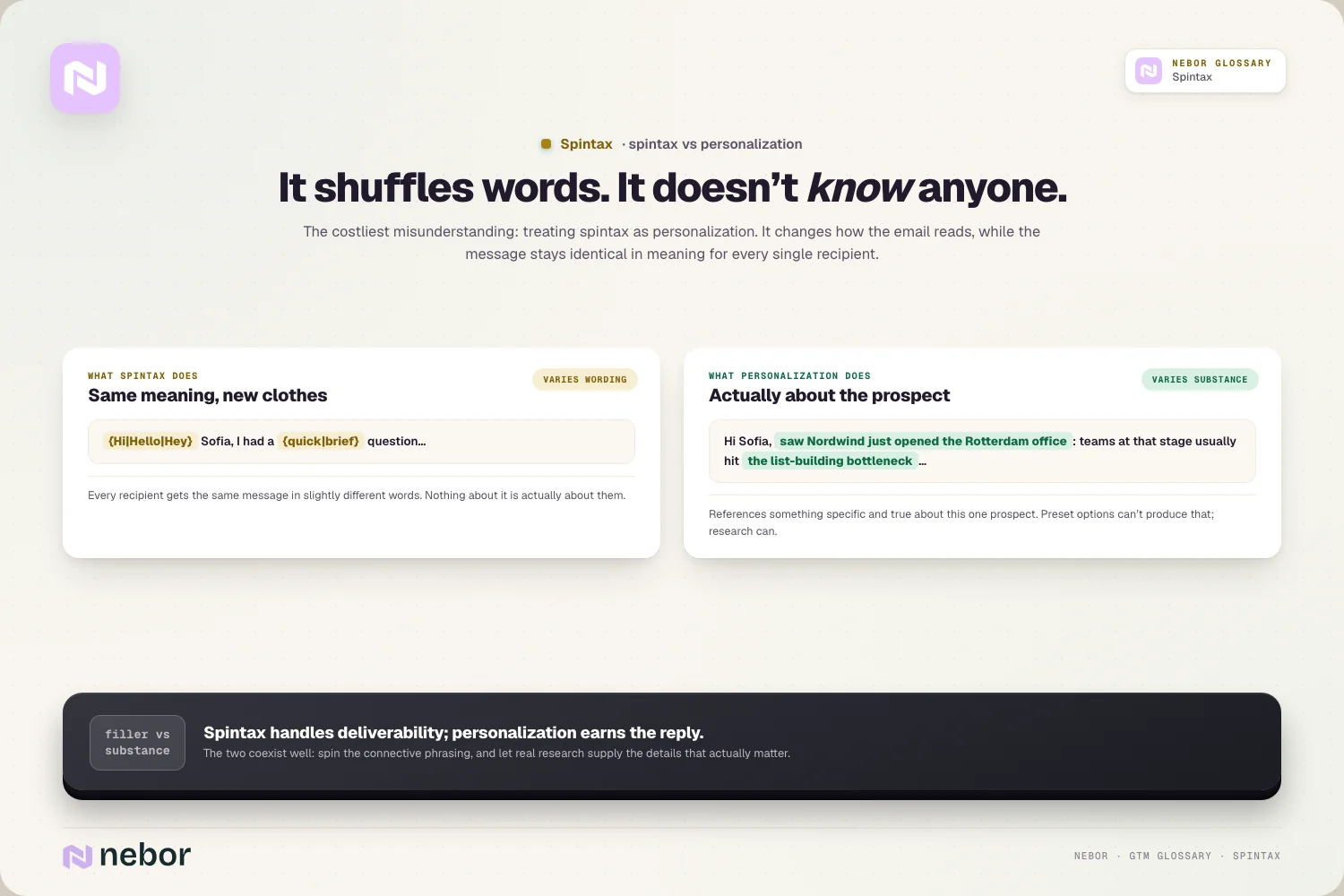
The two techniques solve entirely different problems for a sender. Spintax addresses deliverability by reducing sameness, while personalization addresses relevance by making the message about the prospect specifically.
So spintax and personalization are not interchangeable. One helps you avoid looking templated, the other helps you earn a reply, and confusing them leads to relevant-sounding emails that say nothing specific.
The two can coexist in one email, though. You can spin the connective phrasing of an email while still inserting truly personalized details, so spintax handles the filler and real research handles the substance that carries the message.
How much spintax variation is sensible to use in a single email
More variation is not automatically better, and in our experience knowing the right amount keeps spintax useful. A moderate range of options serves your sequences best.
A few options per set is the sweet spot. Around two to four alternatives per bracketed group is usually right, because fewer defeats the purpose and more rarely adds real variation.
Quality beats quantity in the options you write. Every option should be one you'd happily send on its own, so a smaller set of strong alternatives beats a large set with weak ones mixed in.

Weak options do real damage to the message. Padding a group to hit a count risks shipping a phrasing that reads badly, which hurts the emails that happen to draw it.
So the goal is a handful of genuinely good options instead of the maximum. A few strong alternatives per group gives real variation without diluting quality, which is where spintax pays off.
It also helps to spin whole phrases instead of single words. Swapping a full sentence opener for another natural one reads better than replacing individual words, which tends to produce the awkward, robotic combinations that undercut the whole point.
Why overusing spintax can backfire and start hurting your results
Spintax has a real failure mode, and it comes from using too much of it. Heavy spinning creates its own detectable pattern.
Over-spinning becomes a signal in its own right. Spinning nearly every word produces text that modern filters can recognize as mass-generated, so extreme spintax trades one pattern for another.
It can read awkwardly to the prospect. Forcing variation into every phrase often produces clumsy combinations, which can make the email feel oddly worded to a human reader.
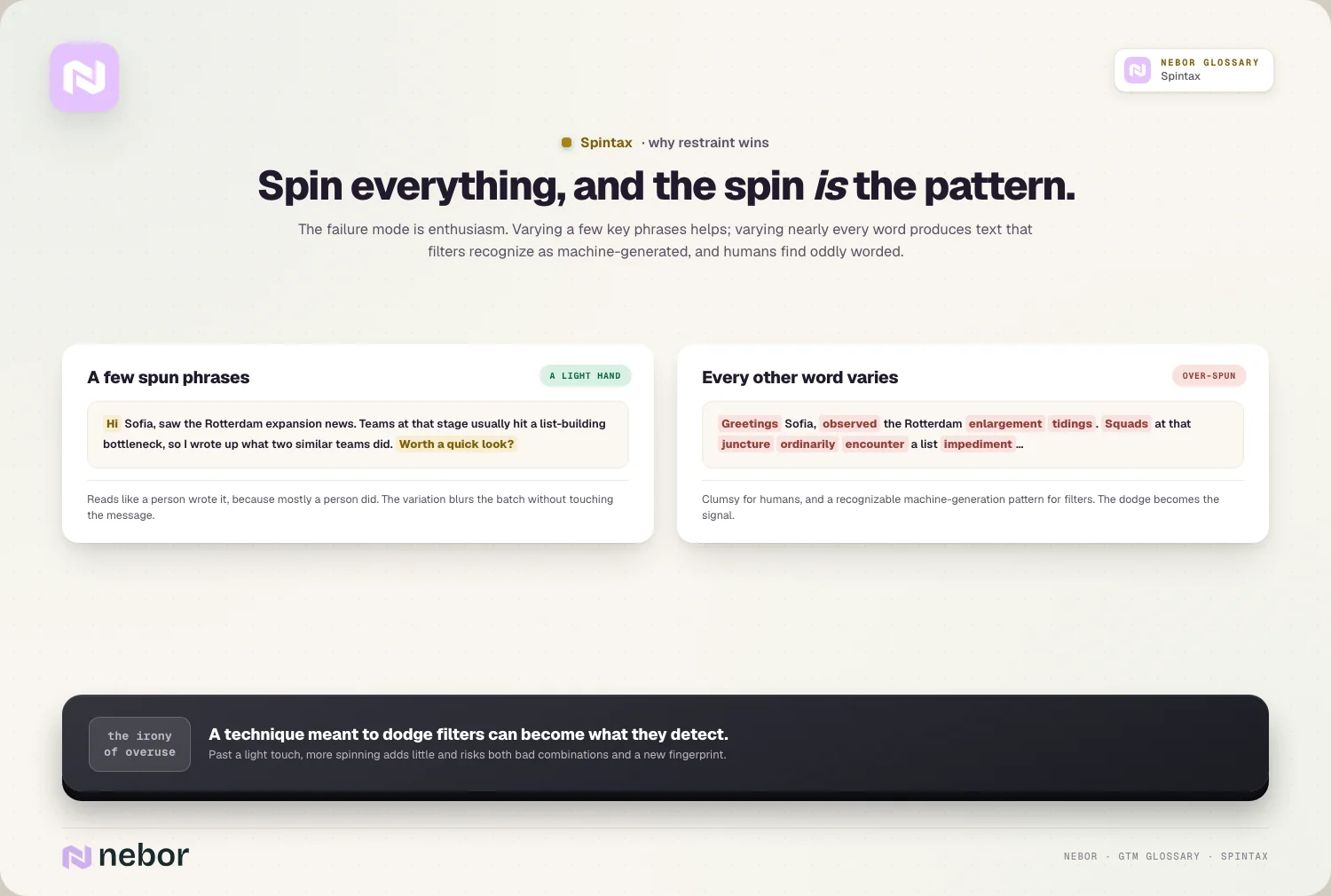
It gives diminishing returns past a point. Past a light touch, more spinning adds little deliverability benefit while raising the odds of a bad combination or a detectable pattern.
So spintax rewards restraint far more than it rewards cleverness. A light hand that varies a few key phrases helps, while spinning everything backfires, which is why less is usually more with this particular technique.
There's a real irony buried in that failure mode. A technique meant to help you dodge spam filters can, when overdone, become the very signal those filters are looking for, which flips its purpose on its head.
What happens when your spintax syntax breaks in a live email
A specific and embarrassing risk deserves its own attention, because it burns senders regularly. Broken syntax leaks the raw code to your prospect.
A small error in the braces breaks it. Forgetting a pipe or a bracket can stop the syntax from resolving, so the platform fails to pick an option cleanly.
The raw code can ship straight to a prospect. When that happens, the unprocessed spintax, brackets and all, can appear directly in the email your prospect receives, which looks obviously automated.
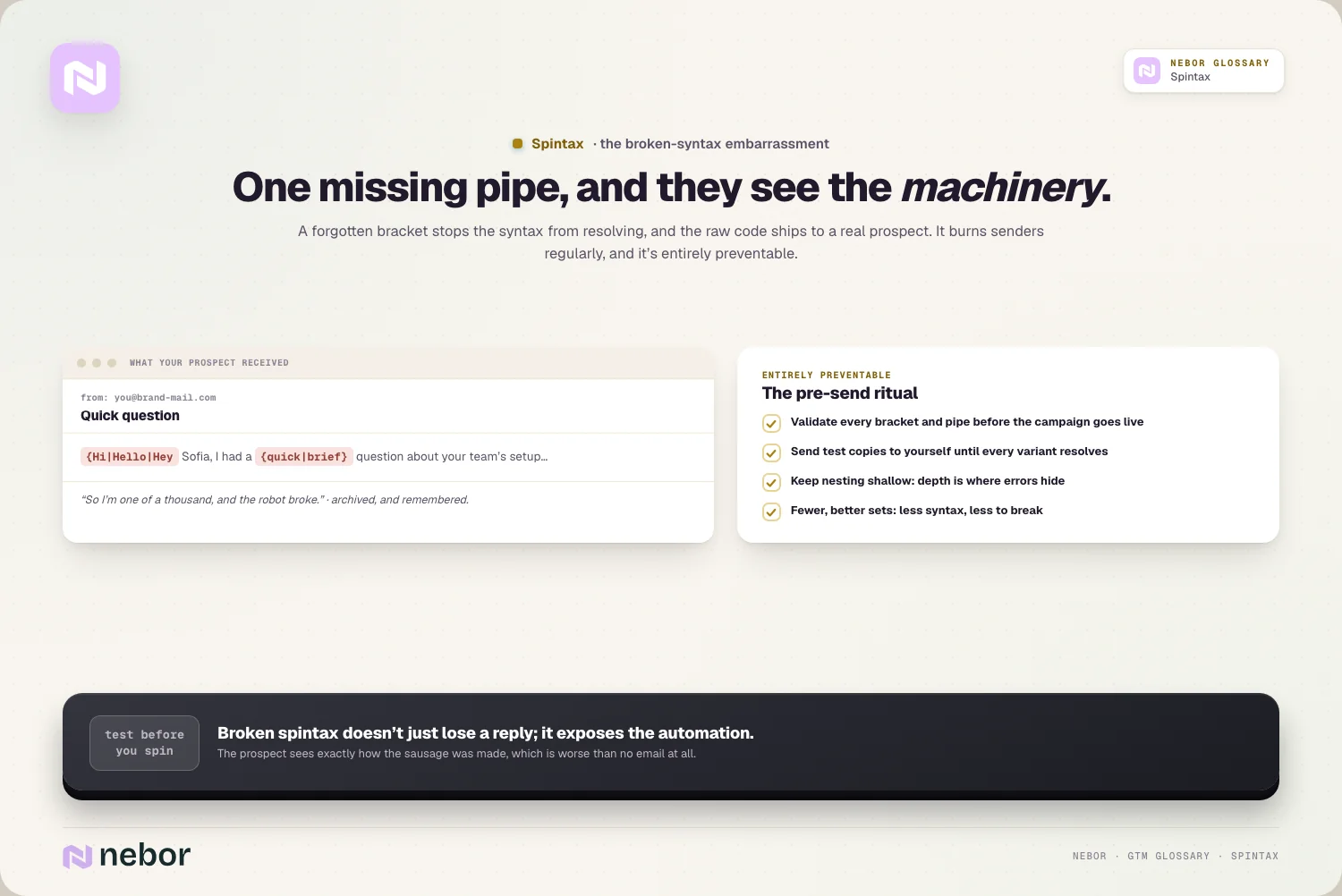
It instantly kills your credibility with the reader. A prospect who sees raw spintax code knows immediately the email was mass-generated, which undoes any effort to seem personal.
So testing every variant is non-negotiable with spintax. Sending a few test emails to confirm the syntax resolves cleanly is what prevents the raw code from reaching a real prospect.
The risk grows with every layer of complexity. A simple spun greeting is hard to break, but a heavily nested template with many groups has far more places for a missing bracket to hide, which is another reason to keep spintax light.
How spintax fits into your wider email deliverability picture
Spintax is a minor tool within a much larger deliverability picture, and we tell clients to keep it in proportion. It supports, but can't replace, the fundamentals.
It's one small factor among many larger ones. Spintax helps at the margin with content patterns, but it matters far less than authentication, warmup, and list quality in importance.
It can't fix a foundation that's already broken. No amount of word variation saves email sent from poor sending infrastructure or a bad list, because those problems dwarf content sameness.
It pairs naturally with the volume controls you already use. Spintax works alongside practices like mailbox rotation, which spread sending so no single account looks like a mass sender.
So spintax is a supporting player and never the star of the show. It's a small content-level tactic that helps only when the real deliverability fundamentals are already in place.
Skipping it entirely is often a fine choice, and plenty of the strong senders we work with don't use spintax at all, relying on genuine personalization and clean sending instead, which does far more to keep them in the inbox.
How spintax relates to testing and optimizing your sequences
Spintax and sequence improvement can work together, though the relationship has a catch. Variation and testing pull in slightly different directions.
Spintax adds variation you can't control or attribute. Because it picks options at random, you don't cleanly know which phrasing performed, so it muddies the signal that testing relies on.
Optimization needs tests where you control every variable. Real sequence optimization through disciplined A/B testing compares one deliberate variant against another, which is the opposite of spintax's random mixing.
The two practices serve entirely different goals for your sequences. Spintax exists for deliverability through variation, while testing exists to find what works for your audience, so you don't confuse one for the other.
So use spintax for variation and testing for learning. Keeping them separate means you get the deliverability benefit without letting random spinning pollute the tests that tell you what to improve next.
If you must do both, spin only the parts you're not testing. That way the element under test stays fixed while the surrounding wording varies, so your results stay clean.
How spintax relates to your reputation and reaching the inbox
Spintax touches deliverability, so it connects to the reputation signals providers watch. That connection is worth keeping in perspective.
It nudges the content signals a little. Reducing repetitive content is one small input into how providers judge your mail, so spintax plays a minor part in protecting your sender reputation.
It can't offset bad sending behavior in any meaningful way. If you're hitting a spam trap or drawing complaints, no amount of word-spinning saves you, because those signals outweigh content variation by far.
It works with the metrics that matter. Landing in the inbox is what protects your reply rate, and spintax contributes to that only at the margins, well behind list quality and authentication.
So spintax touches your reputation lightly instead of decisively. It helps a fraction with content patterns, while the heavy factors that truly decide your reputation lie almost entirely elsewhere.
The common mistakes teams make when they lean too hard on spintax
Spintax goes wrong in a few recognizable ways, and we keep seeing the same ones when teams show us their sequences. Avoiding them keeps it helpful instead of harmful.
The biggest is treating it as personalization. Relying on spintax to make emails feel personal produces relevant-sounding messages that say nothing specific to the prospect.
Another is over-spinning the message until it degrades. Spinning every word creates awkward text and a detectable pattern, which trades the problem you're solving for a new one.
A third is skipping the testing step. Failing to test the syntax risks shipping raw code to prospects, which is the most embarrassing spintax failure of all.
The last is padding with weak options. Adding mediocre alternatives just to hit a count means some recipients get your worst phrasing, so every single option has to be strong.
Why spintax is a minor tactic that deserves only a modest role
The honest way to hold spintax is as a small, situational tool instead of a core strategy. It helps a little, in a specific way, when used with care.
Its benefit is narrow by the nature of what it does. Spintax reduces content sameness, which is one modest factor in deliverability, so it earns a small place instead of a central one.
Its risks are real when it's overdone. Over-spinning and broken syntax can hurt more than the variation helps, which means casual use without care can backfire.
Its ceiling is low no matter the effort. Even done perfectly, spintax can't make a weak email good or a bad list deliverable, so it's simply never where the real gains are found.
A sender who understands spintax uses it lightly and moves on to the things that carry more weight, which is the right instinct in a modern go-to-market system. Real deliverability and real relevance are what carry the outreach you automate sales prospecting around, with spintax playing only a small supporting part.
Share this post
Outbound
Personalization
Glossary
Related glossary items
Understanding the core GTM concepts




Ready to build your pipeline











