

In this post:
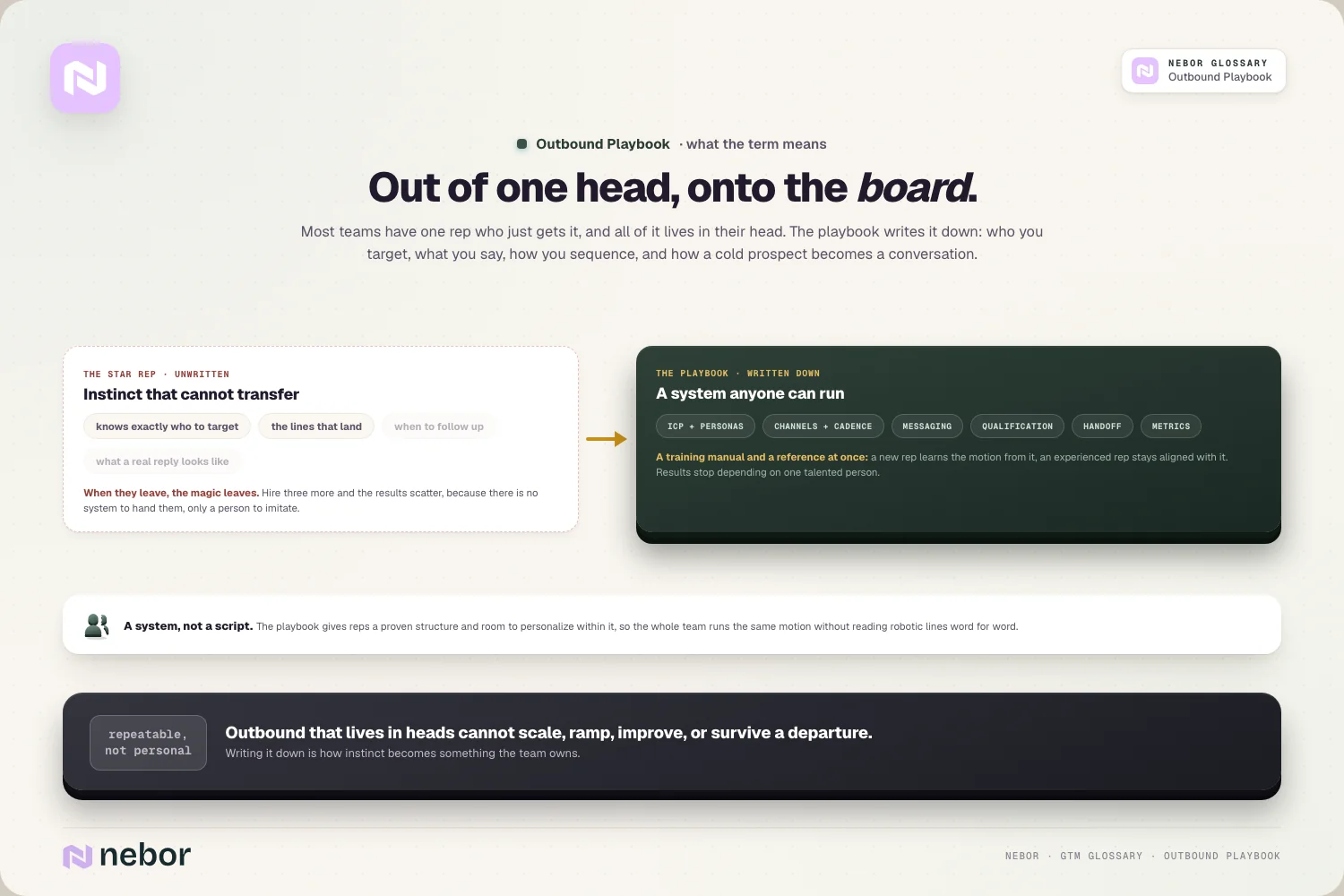
Most outbound teams have one rep who just gets it. They know exactly who to target, what to say, and when to follow up, and their numbers prove it.
The problem is that all of it lives in their head. When they leave, or when you try to hire three more like them, the magic doesn't transfer, and the team's results scatter.
An outbound playbook is the written system that captures all of that. It's a documented guide to who you target, what you say, how you sequence your touches, and how you move a cold prospect toward a conversation.
The point is to make outbound repeatable instead of personal. A good playbook turns your best practices into a system anyone on the team can follow, so results stop depending on one talented person.
TL;DR
An outbound playbook is a written, structured system that defines your outbound motion, who to target, what to say, which channels to use, how many touches to send, and how to qualify and hand off the conversations it creates.
Outbound that lives in people's heads can't scale or improve. A playbook makes the motion consistent, lets new reps ramp fast, and turns guesswork into something you can measure and refine.
The core pieces are your ideal customer profile, buyer personas, channel and sequence structure, messaging, qualification rules, and the metrics you track.
The standing requirement is that a playbook is never finished. Your market, your buyers, and your data keep shifting, so the best playbooks get reviewed and updated on a regular cadence rather than written once and shelved.
Understanding what an outbound playbook is and what it holds
An outbound playbook is a single, structured document that spells out how your team does outbound. It takes the scattered knowledge about what works and writes it down in one place.
Think of it as both a training manual and a reference. A new rep reads it to learn the motion, and an experienced rep checks it to stay aligned with how the team operates.
It answers the practical questions a rep faces every day. Who do I reach out to, what do I say, how often, on which channels, and what counts as a qualified reply worth passing on.
The result is consistency across the team. Instead of every rep inventing their own approach, the whole team works from the same proven motion, and that shared motion is what makes outbound something you can scale and improve.
The key thing is that it's a system rather than a script. A playbook gives reps a proven structure and the room to personalize within it, without robotic lines to read word for word.
Why does outbound fall apart without a playbook holding it up?
It helps to see what goes wrong when there's no playbook, because we see the same failure constantly. Outbound without a written system has a few predictable problems.
The first is that it can't scale. If your motion lives in one rep's instincts, hiring more people doesn't multiply results, it just adds confused beginners with no system to follow.
Slow ramp is the second, because new hires take months to get productive because they're reverse-engineering the motion from scratch, instead of learning a documented one.
The third is that you can't improve what you can't see. When everyone does outbound differently, you can't tell what's working, so you can't test anything properly or fix weak spots.
And the fourth is fragility, because knowledge that lives in heads walks out the door when people leave, and a single departure can gut your pipeline overnight. A playbook is how you keep that knowledge.
What goes into an outbound playbook, moving section by section?
A complete playbook has a handful of core sections, and each answers a specific question. Skipping any of them leaves a gap reps will fill with guesswork.
It starts with targeting, moves through messaging and sequencing, and ends with qualification and measurement. The rest of this entry walks each piece in turn.
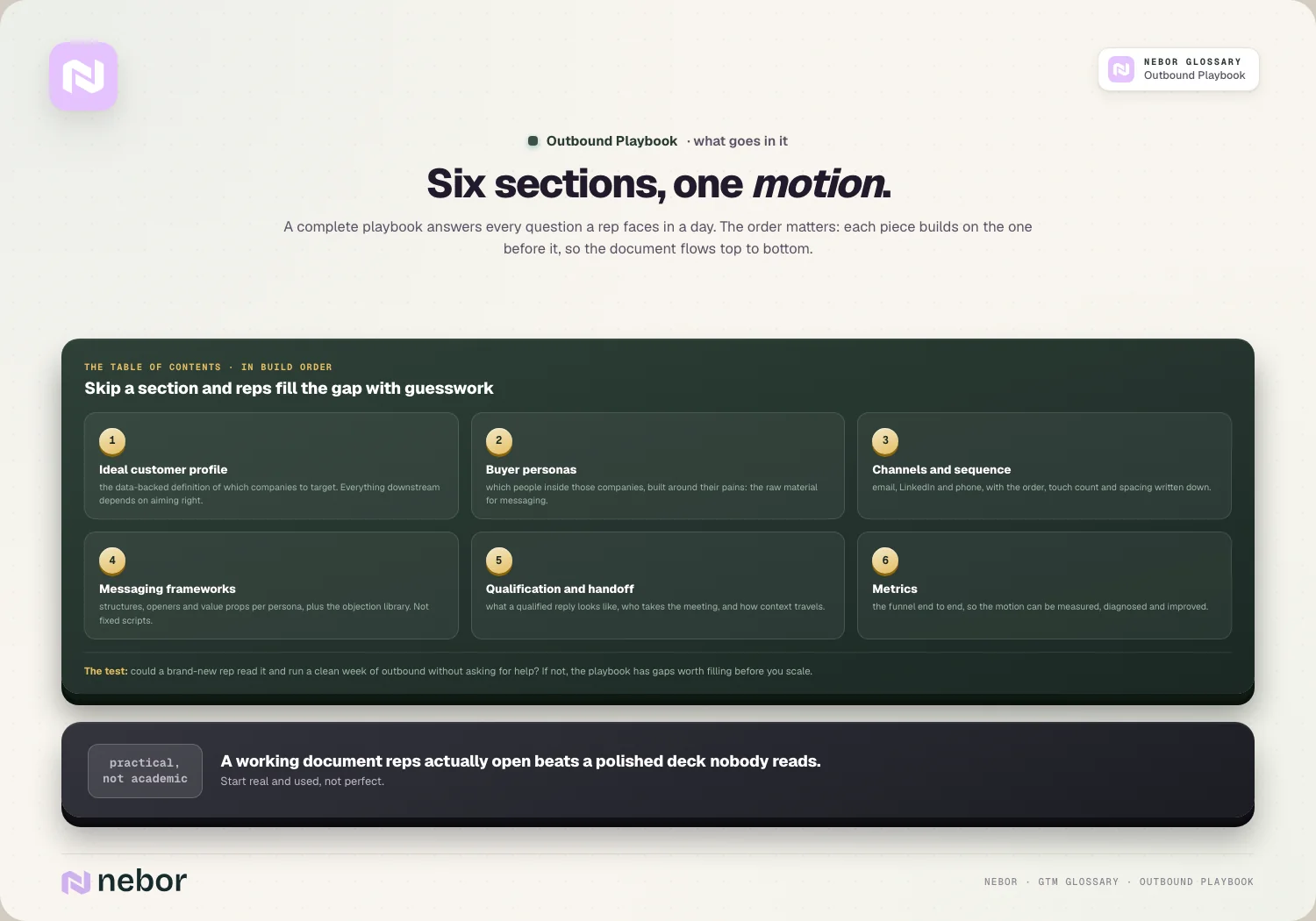
The order matters because the pieces build on each other. You can't write good messaging without knowing your buyer, and you can't sequence well without knowing your channels, so the playbook flows top to bottom.
The tone should stay practical instead of academic. The best playbooks are usable working documents reps open weekly, instead of polished decks that get written once and never touched again.
A simple test is whether a brand-new rep could read it and deliver a clean week of outbound without asking for help. If they can't, the playbook has gaps worth filling before you scale.
Why does every playbook start with your ICP and your personas?
Every effective outbound playbook begins with targeting, because everything downstream depends on it. If you aim at the wrong people, no amount of clever messaging saves you.
The foundation is your ideal customer profile. This is the precise, data-backed definition of which companies are most likely to buy, by size, industry, technology, and other firmographic traits.
On top of the ICP come your buyer personas. The ICP tells you which companies to target, and personas tell you which people inside them to reach and what each one cares about.
A useful way to build personas is around problems. For each role, write down their main pain points and the impact of those pains, because those become the raw material for your messaging.
This targeting layer is also what keeps your list building sharp. A clear ICP turns list building from a volume exercise into a precision one, which protects everything downstream.
How should the playbook handle your channels and sequencing?
Once you know who you're targeting, the playbook defines how you reach them. This is where channels and cadence get specified so reps aren't guessing.
Modern outbound is rarely a single channel. The playbook should lay out a multi-channel outreach motion combining email, LinkedIn, and phone, with a clear logic for which comes when.
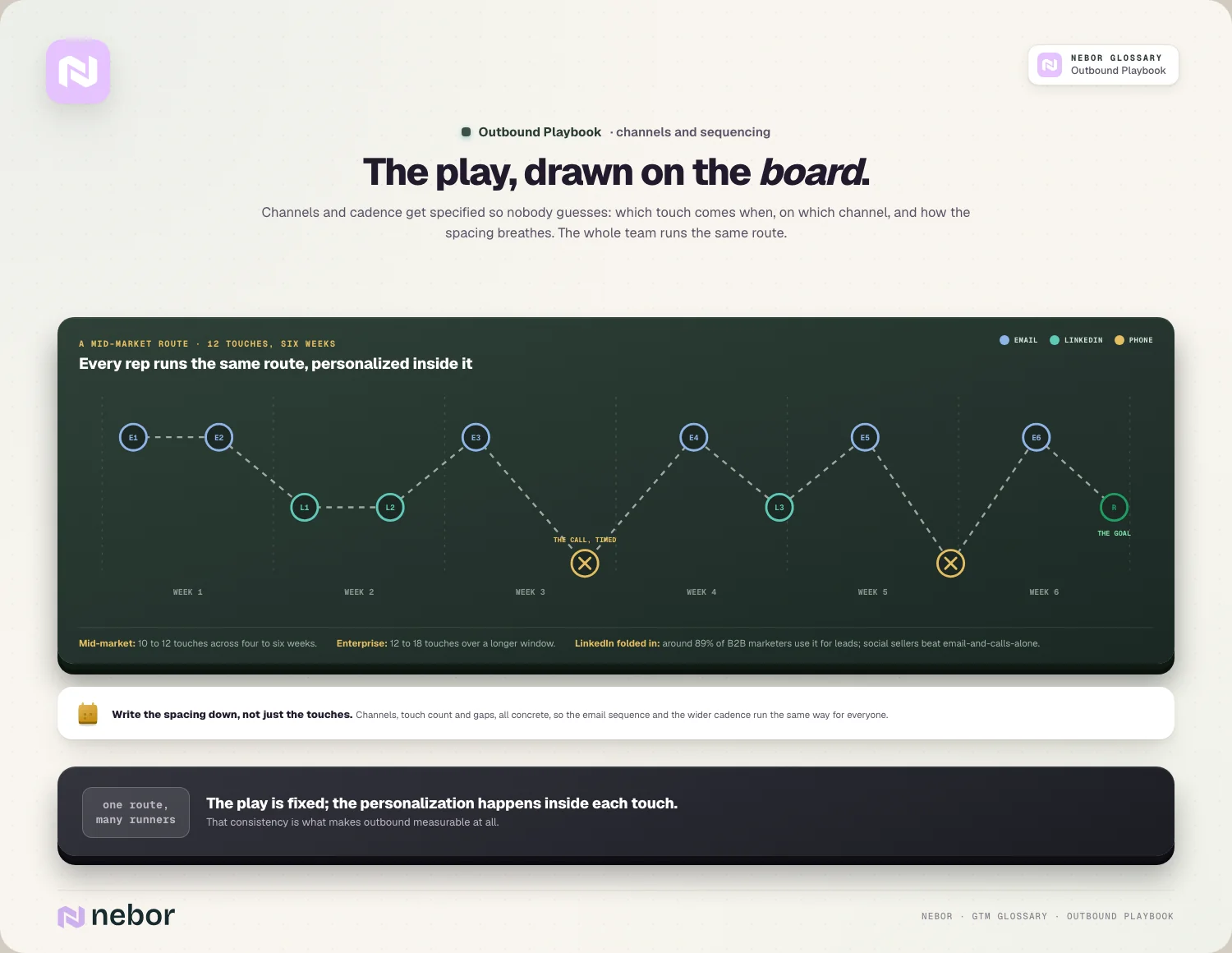
It should also specify the shape of the sequence. A common structure for mid-market targets is 10 to 12 touches across four to six weeks, with enterprise targets often needing 12 to 18 touches over a longer window.
LinkedIn deserves its own attention here, since around 89% of B2B marketers use it to generate leads. Reps who fold social selling into the motion tend to beat those leaning on email and calls alone.
The playbook should write all of this down concretely, the channels, the number of touches, and the spacing, so your email sequence and overall cadence are handled the same way by everyone.
What does the messaging section need to cover for your reps?
Messaging is the part reps reach for most, and in our experience the playbook has to make it genuinely useful. That means giving structure and angles instead of a single rigid script.
The best messaging is built from the problems you mapped in your personas. Each pain point becomes the seed of an email angle or a cold email opener that speaks to something the buyer actually feels.
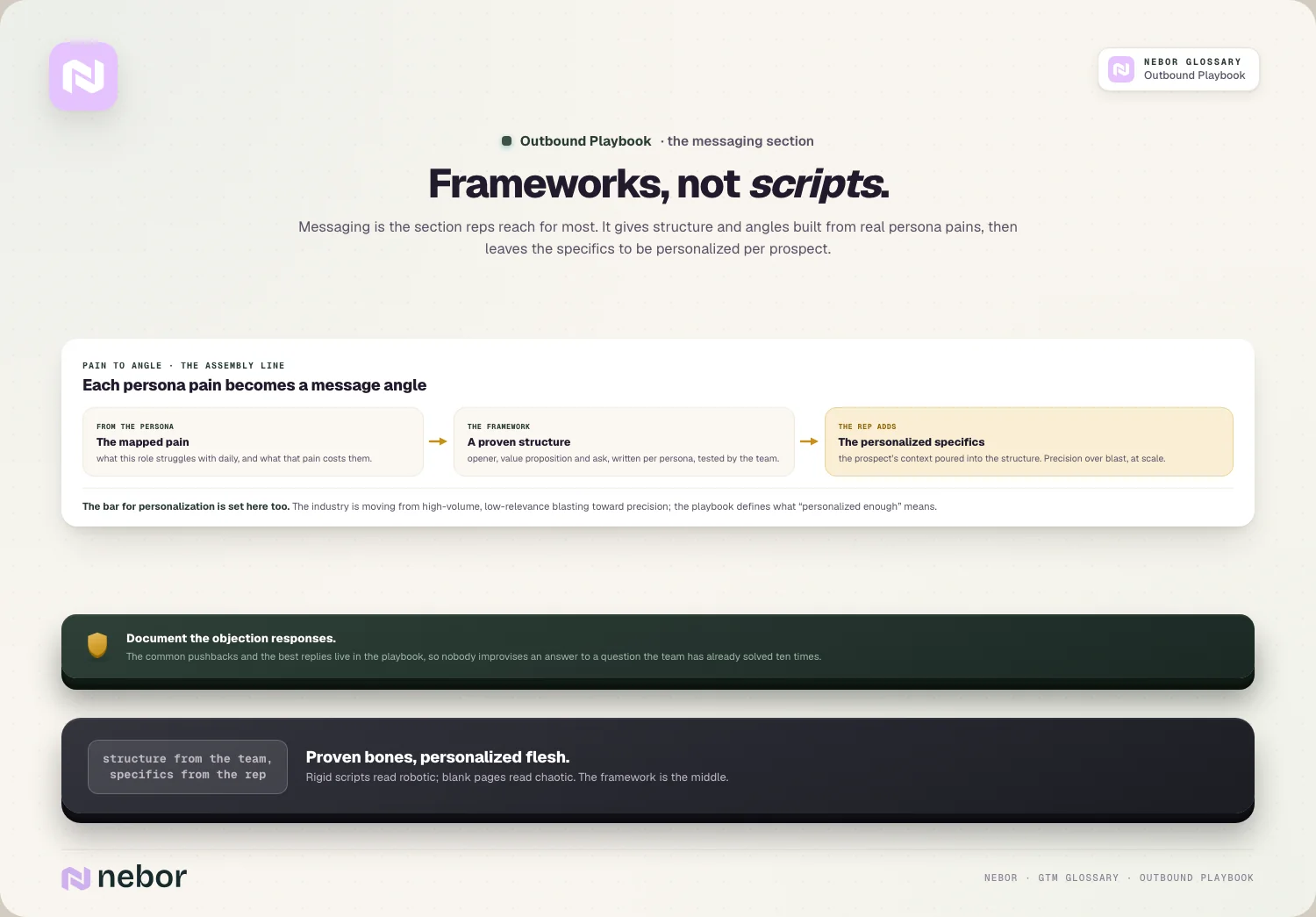
The playbook should provide frameworks instead of fixed copy, handing reps proven structures, strong openers, and value propositions per persona, then letting them personalize the specifics for each prospect.
This is also where you set the bar for personalization. The whole industry is moving away from high-volume, low-relevance blasting toward precision, which is the practical side of hyper-personalization done at scale.
Objection responses belong in this section too. Documenting the common pushbacks reps hear and the best replies means nobody has to improvise an answer to a question the team has already solved ten times.
How does the playbook qualify and hand off the replies it creates?
A playbook doesn't end when someone replies. It has to define what happens next, or all those conversations get handled inconsistently and good leads slip.
Qualification comes first, because the playbook should spell out what a qualified reply looks like, so reps can tell a real opportunity from a polite brush-off and spend their time accordingly.
This is where lead scoring and clear criteria help. Defining the signals that mark a prospect as worth pursuing keeps the team focused on the conversations most likely to become pipeline.
The playbook should also map the handoff. When a prospect is qualified, what happens, who takes the meeting, how it's logged, and how the context travels, so nothing is lost between outreach and the first real call.
When this part is done well, outbound turns from a lead generator into a pipeline system. The conversations it creates flow cleanly into the rest of your go-to-market system instead of piling up unmanaged.
What metrics should live inside the playbook from the first day?
A playbook without numbers is just opinion written down. The measurement section is what lets you tell whether the motion works and where it's breaking.
The funnel deserves tracking end to end, meaning contacts reached, reply rates, positive reply rates, meetings booked, and ultimately pipeline created, so you can see exactly where prospects drop off.
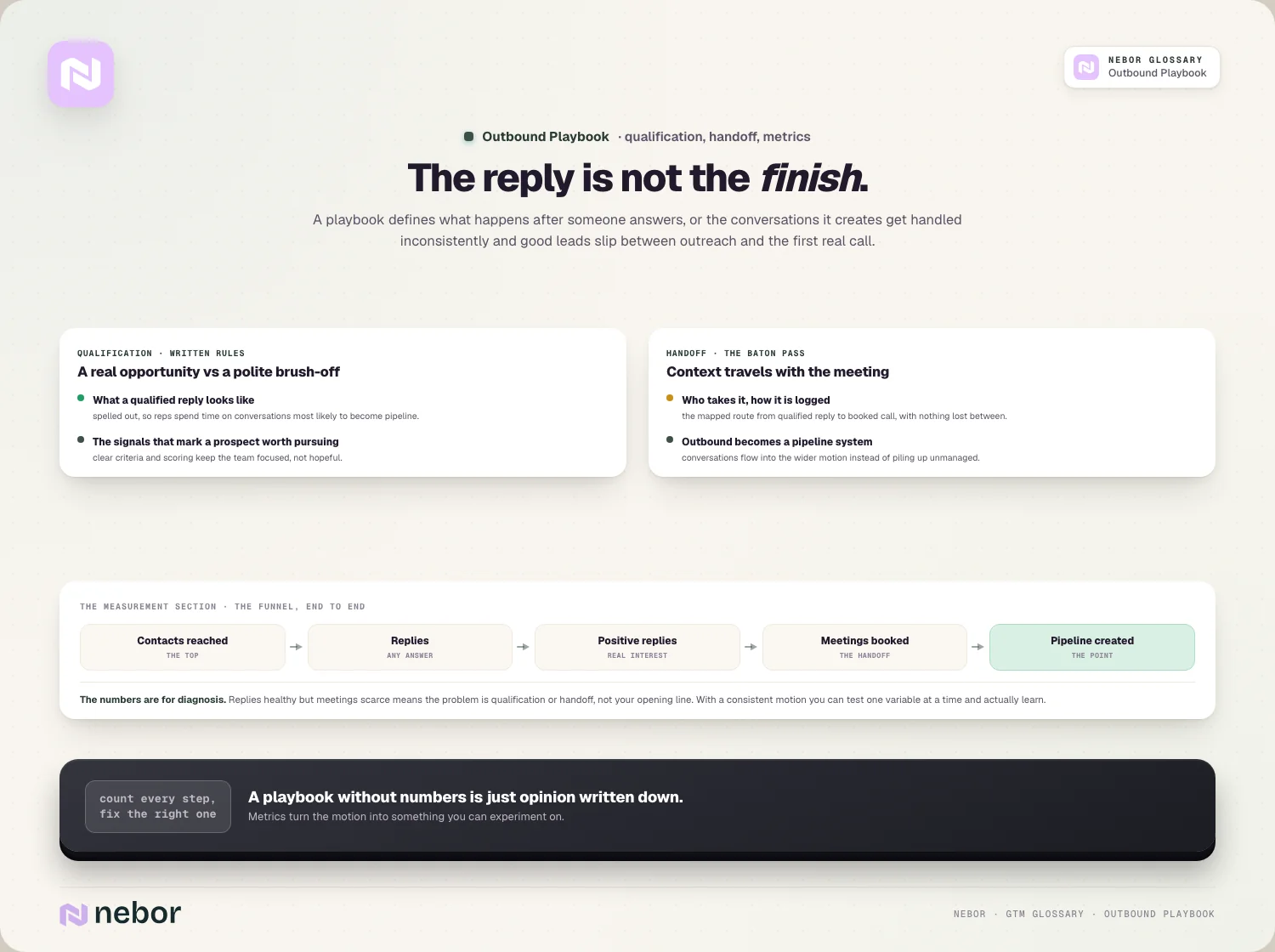
The point of these numbers is diagnosis. If replies are healthy but meetings are scarce, the problem is in qualification or handoff instead of your opening line, and the metrics point you to the real issue.
They enable real experiments too, because with a consistent motion and clear metrics, you can test one variable at a time and learn from it, which is impossible when everyone does outbound differently.
This is also where outbound connects back to demand. Watching which buying signals precede your best conversations helps you target sharper, the same instinct behind any signal-driven motion.
Does a playbook only matter for cold outbound, or for warm too?
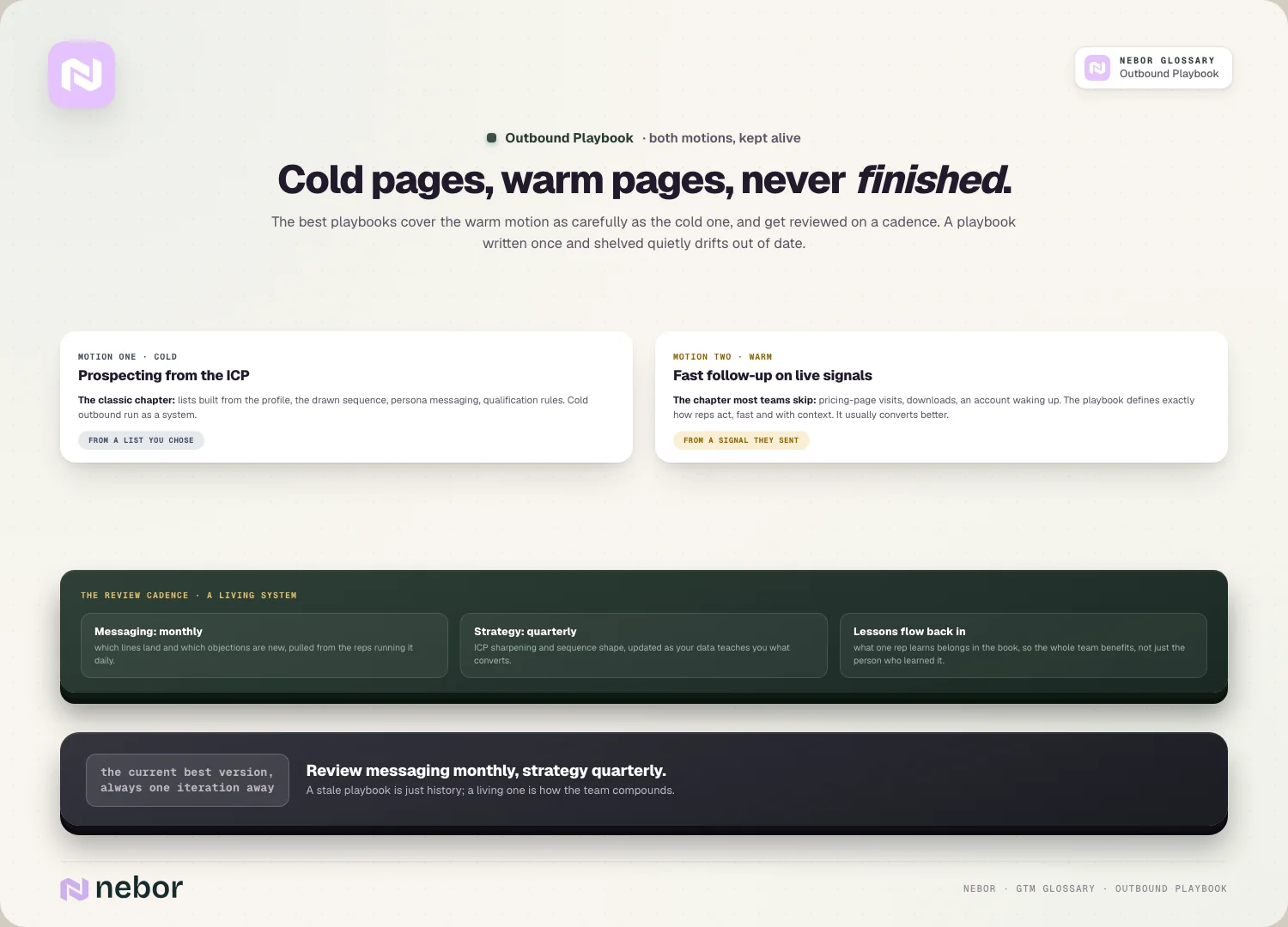
People think of a playbook as a cold-outreach manual, but the best ones cover warm motions just as carefully. A lot of your highest-value outreach starts from a signal instead of a cold list.
When a prospect visits your pricing page, downloads something, or a known account starts engaging, that's a warm trigger. The playbook should define exactly how reps act on it, fast and with the right context.
This is the heart of an inbound-led outbound motion, where marketing signals tell reps who to reach. Without a playbook, those warm signals get handled inconsistently or missed entirely.
So a complete playbook has both motions written down. One section for cold prospecting from your ICP, and another for warm follow-up triggered by intent, each with its own cadence and messaging.
The warm section often converts better, so leaving it out is a costly gap. Treating warm signals with the same rigor as cold lists is one of the clearest upgrades a playbook can make.
How does a playbook help you ramp and scale an entire sales team?
The clearest payoff of a playbook shows up when you grow. It's the difference between hiring being a gamble and hiring being a repeatable step.
Without one, every new rep is a slow, uncertain experiment. They spend months piecing together the motion, and some never get there, because there's nothing concrete to learn from.
With a playbook, ramp gets faster and more predictable. A new hire studies the ICP, the sequences, and the messaging, then steps into a proven motion on day one instead of inventing their own.
It makes performance comparable too, because when everyone uses the same system, you can see who needs coaching and on what, instead of guessing why one rep outperforms another.
This is what lets you confidently automate sales prospecting and add headcount at the same time. The playbook is the shared standard that both new people and new tooling plug into.
How do you keep a playbook from going stale on a shared drive?
The most common playbook mistake is treating it as a one-time project. A playbook written once and never revisited quietly drifts out of date as your market moves.
The fix is a standing review cadence, and a practical rhythm is messaging monthly and strategy quarterly, so the document keeps pace with what's actually working in the field.
Your reps are the best source of updates, and we tell clients to mine them monthly. The people in the motion every day know which lines are landing and which objections are new, so the playbook should pull from their experience constantly.
It should also evolve with your data. As your ICP sharpens and your results teach you what converts, those lessons belong back in the playbook so the whole team benefits alongside the rep who learned them.
The mindset is that a playbook is a living system. It's the current best version of how you approach outbound, always one iteration away from better, and that openness is exactly what keeps it useful.
Why writing the motion down is what makes success transferable
The real value of an outbound playbook is that it makes success transferable. It takes what works, whether that's in your best rep's head or buried in your data, and turns it into a system the whole team can use.
That shift changes what your team is capable of. Outbound stops being a collection of individual hustle and becomes a machine you can staff, measure, and steadily improve.
It future-proofs you as well, because when a great rep leaves, the motion stays, and when you hire, new people inherit a proven system instead of starting from zero.
So if outbound feels like it only works when your best people are on their game, the missing piece is usually the playbook. Writing it down is how you turn a few people's instinct into something the whole team owns.
It's also how outbound sales becomes predictable instead of heroic. The teams that scale outbound cleanly are simply the ones who wrote their system down and kept refining it.
None of this requires a hundred-page document. A sharp, honest playbook your reps open beats a polished one nobody reads, so the pieces above are the place to start, improving as you learn. The first version just has to be real and used, and perfection can come later.
Share this post
Outbound
Guide
Glossary
Related glossary items
Understanding the core GTM concepts




Ready to build your pipeline











