
In this post:
Most reps send one email, maybe a follow-up, and move on when they hear nothing back. They assume silence means no interest, so they quit and start over with a fresh batch of names.
That instinct throws away most of their pipeline without anyone noticing. The replies and meetings they wanted were usually a few touches further down the road, on a touch they never sent.
A sales cadence is a planned, repeatable sequence of touchpoints across channels, like email, phone, and LinkedIn, spread over a set timeframe to engage a prospect and earn a response. It's the structure that keeps you reaching out long enough to connect.
The whole point is to remove the guesswork and the early quitting. Instead of improvising whether to follow up, a cadence tells you exactly when and how to reach out next, so persistence becomes a system instead of a mood.
TL;DR
A sales cadence is a structured schedule of outreach touches across channels over a defined period, designed to engage a prospect through consistent, well-timed follow-up.
Persistence wins and most reps lack it, because around 80% of B2B sales happen between the 4th and 11th follow-up, yet most reps give up after one or two touches.
A good cadence usually spans 8 to 12 touches across multiple channels over two to three weeks, with deliberate timing instead of random follow-up.
One distinction keeps it honest, because a cadence is structure and never a script. It tells you when to reach out, but the touches still have to be relevant and personalized, or consistent outreach just becomes consistent spam.
So what is a sales cadence, exactly, and what does it lay out for you?
A sales cadence is the predefined rhythm of how you reach out to a prospect over time. It specifies the channels, the number of touches, the order, and the spacing between them.
Think of it as a schedule for persistence. Rather than deciding each follow-up on the fly, the cadence lays out the whole sequence in advance, so every prospect gets a consistent, deliberate approach.
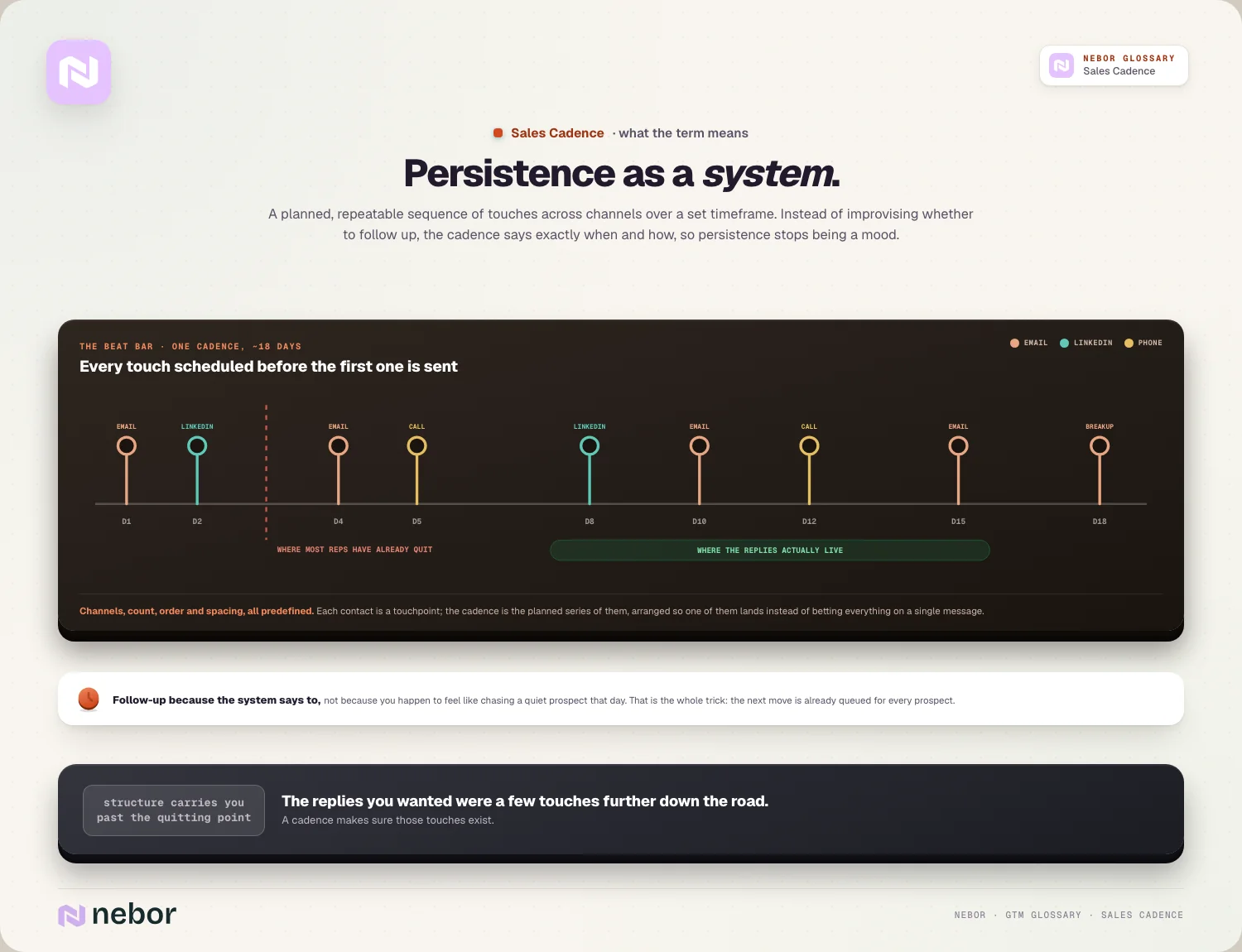
It's inherently a multi-channel idea rather than an email trick. A real cadence blends email, phone, LinkedIn, and sometimes other touches, because reaching someone across channels works far better than hammering one.
Each individual contact in the cadence is a single touchpoint. The cadence is simply the planned series of those touchpoints, arranged to maximize the odds that one of them lands, instead of betting everything on a single message.
So a cadence turns follow-up from a vague intention into a defined process. You know the next move for every prospect on your list, and that certainty is what makes consistent outreach possible at scale.
How is a cadence different from the email sequence inside it?
People often use cadence and sequence interchangeably, but they overlap without being quite the same, and the difference changes how you plan.
An email sequence is a series of emails sent to a prospect over time. It's channel-specific, focused entirely on the email side of your outreach.
A sales cadence covers more ground than that. It includes the emails but also the calls, the LinkedIn touches, and any other channel, coordinated into one schedule across all of them.
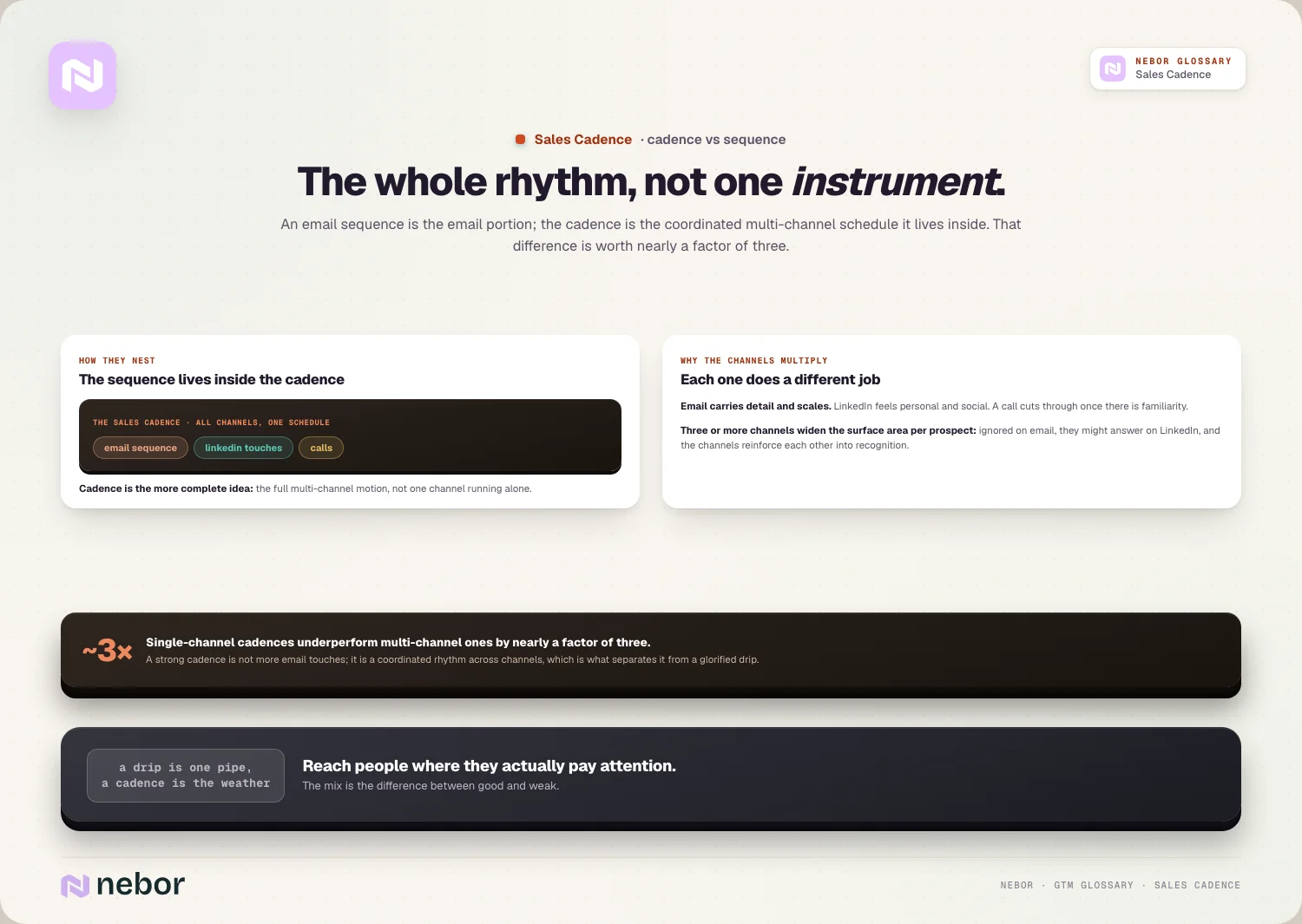
So an email sequence usually lives inside a cadence. The cadence is the whole multi-channel plan, and the email sequence is the email portion of it.
This is why cadence is the more complete idea. It captures the full multi-channel outreach motion instead of one channel working on its own.
Why do most reps give up on their prospects far earlier than they should?
This is the heart of why cadences exist, and the gap between how long reps persist and how long deals take is enormous.
The persistence data makes for uncomfortable reading. Around 44% of reps quit after a single follow-up, but most positive replies come between the fifth and eighth touch.
Meanwhile the deals land further out than reps assume. Roughly 80% of sales require five or more follow-up attempts, and most close between the fourth and eleventh.
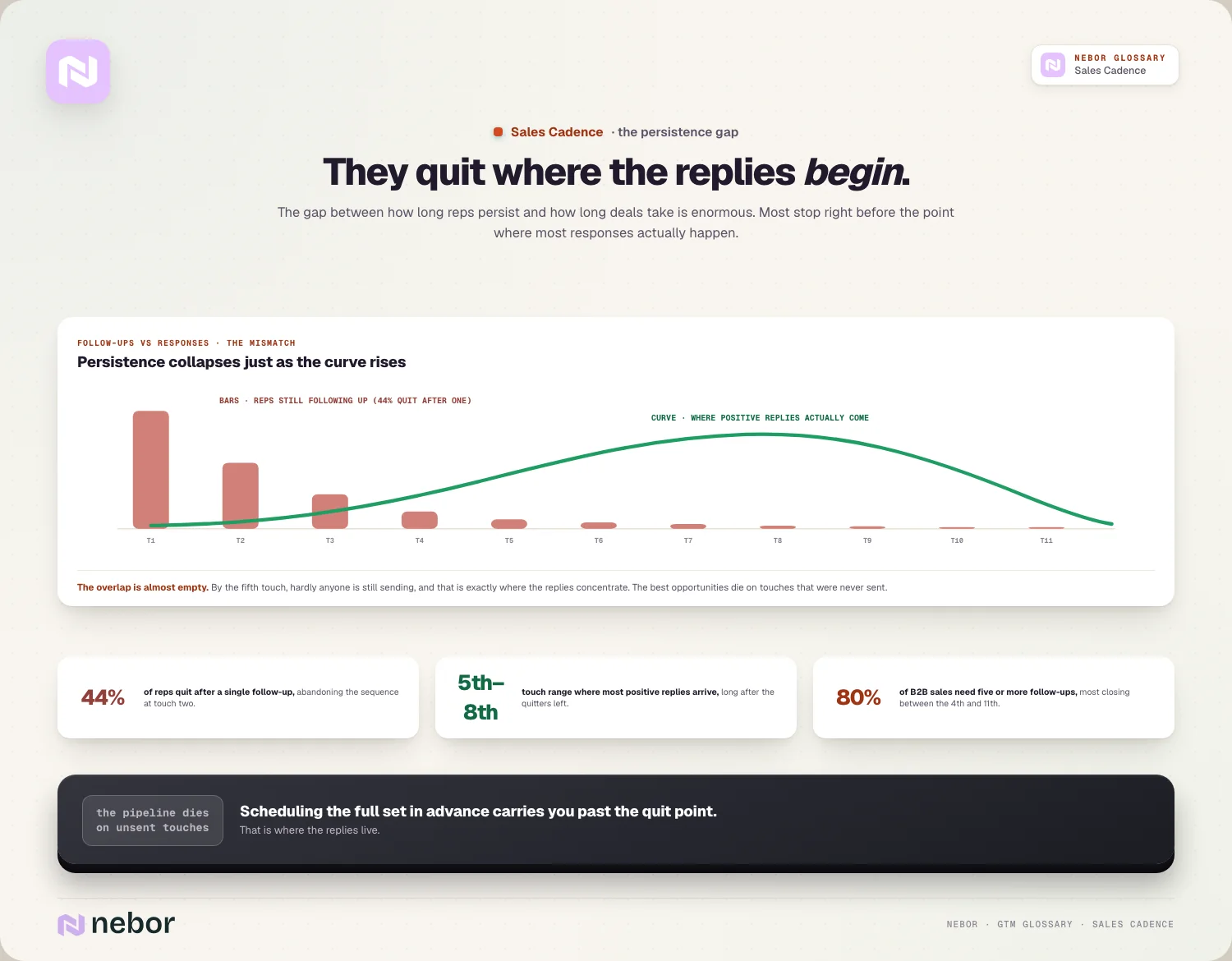
Put those together and the problem is obvious. The majority of reps stop reaching out right before the point where most responses arrive, leaving their best opportunities on the table.
A cadence fixes this at the structural level. By scheduling the full set of touches in advance, it carries you past the point where you'd otherwise quit, which is exactly where the replies live.
The reason this works is that persistence stops depending on motivation. When the next touch is already planned and queued, you follow up because the system says to, whether or not you feel like chasing a quiet prospect that day.
How many touches should a sales cadence have before you call it done?
There's no single perfect number, but the research clusters tightly enough to give clear guidance. Most effective cadences land in a similar range.
The common baseline is 8 to 12 touches. Most high-performing cadences land between 8 and 12 touches spread across roughly 14 to 21 days, which is enough to persist without becoming harassment.
The exact count depends on your context. Bigger, more complex deals often justify more touches over a longer window, while simpler or warmer ones can convert on fewer.
The mistake in both directions is real. Too few touches and you quit before the responses come, while too many crammed too close feels like an ambush and burns the prospect.
So aim for persistent but respectful, meaning enough touches to get past the early silence, spaced enough that each one feels like a reasonable follow-up instead of pressure.
How should you time the touches inside a cadence for the best results?
Timing matters as much as the number of touches. The same touches in a different rhythm produce very different results.
A sensible pattern starts fast and then eases off. The first few touches should land within the first three to four days to build momentum while the prospect is freshest.
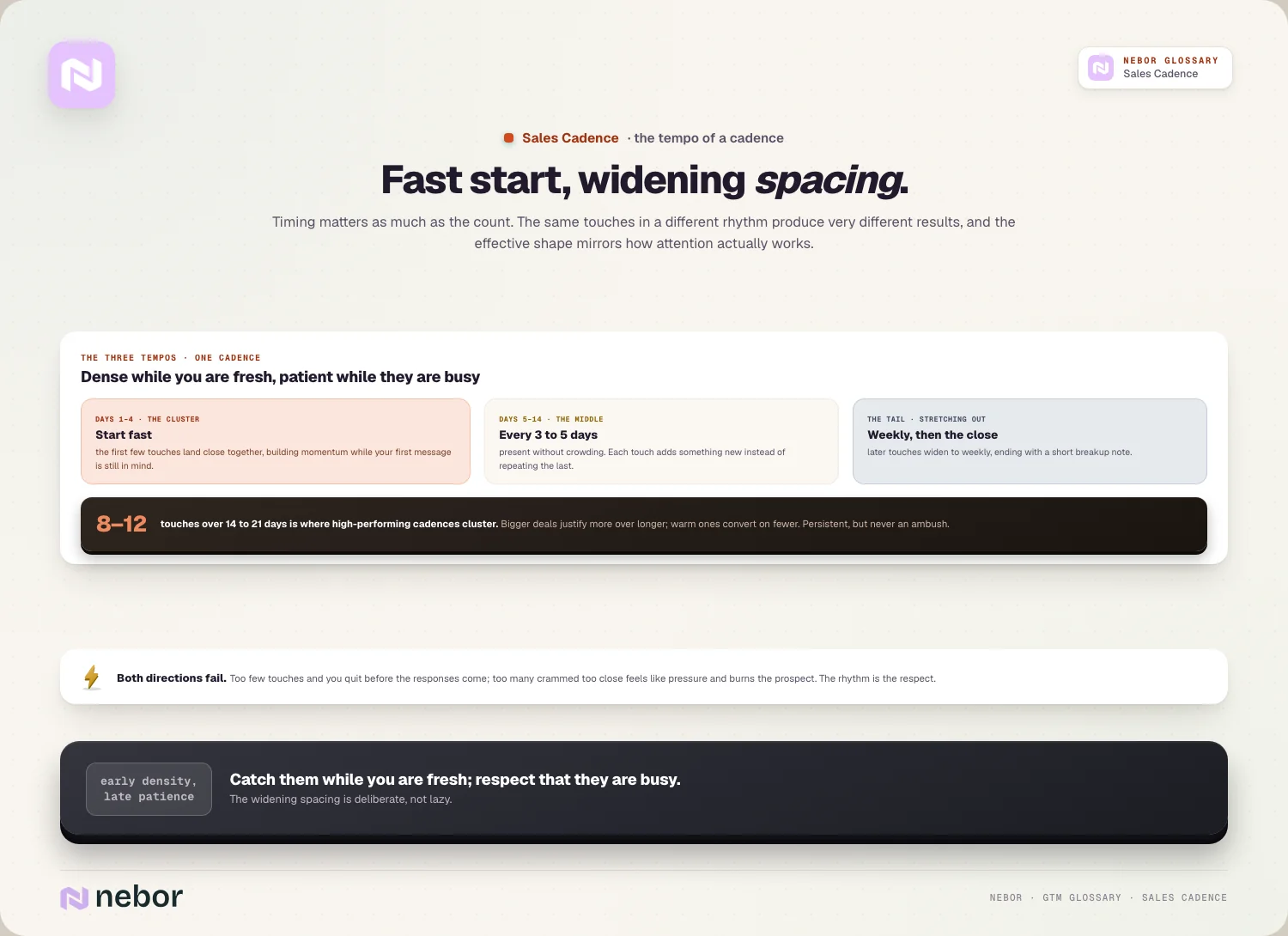
Then the spacing widens as you go. After the early cluster, touches every three to five days keep you present without crowding, and later touches can stretch to weekly.
This shape mirrors how human attention works. Early density catches people while your first touch is still in mind, and the widening spacing respects that they're busy without letting you disappear.
The follow-up structure inside this is its own craft, and a deliberate follow-up sequence is where it shows. Each later touch should add something new instead of repeating the last.
Why is multi-channel the difference between a good and a weak cadence?
The single biggest upgrade to most cadences is using more than one channel. A single-channel cadence leaves most of its potential unused.
The numbers leave little room for debate. Email-only or phone-only cadences underperform multi-channel ones by nearly a factor of three, because you reach people where they genuinely pay attention.
Each channel does a different job in the mix. A cold email carries detail and scales, LinkedIn outreach feels personal and social, and a call cuts through once there's some familiarity.
Combining at least three channels widens your surface area per prospect. If someone ignores email, they might answer on LinkedIn, and the channels reinforce each other into recognition.
So a strong cadence is a coordinated rhythm across channels instead of a taller stack of emails, and that coordination is what separates a real cadence from a glorified email drip.
What makes a cadence persuasive to prospects instead of annoying?
Persistence without relevance is just spam at a schedule, so this distinction decides whether a cadence works. The structure gets you in front of people, but the content earns the reply.
Each touch has to add value, because a follow-up that just says bumping this earns nothing, while one that brings a new angle, a useful idea, or a reason to care gives the prospect something to respond to.
Personalization holds even inside structure, because a cadence that pushes identical generic messages at everyone gets ignored, and that's exactly where personalization at scale matters even in a scheduled sequence.
Respecting the no protects your reputation, because when someone clearly isn't interested, the cadence should stop, and pushing past a real no damages you more than it helps.
And varying the message keeps you human, because repeating the same pitch in slightly different words feels robotic, while different angles across touches feel like a person honestly trying to help.
How does a cadence connect to the wider outbound system around it?
A sales cadence works as one component of a larger outbound motion, and the pieces around it decide how much it delivers.
It lives inside your outbound playbook as the scheduling layer. The playbook defines who you target and what you say, and the cadence is the schedule that delivers those messages consistently.
Its success is measured by the reply rate on your sequence. A cadence exists to earn responses, so reply rate, especially positive reply rate, is how you tell whether it's doing its job.
It also gets sharper with warm signals. Triggering a cadence off real buying signals means you reach people when they're receptive, which lifts response far above purely cold timing.
And it scales through the automation around it. Keeping consistent cadences across hundreds of prospects is exactly the kind of work that lets you automate sales prospecting instead of tracking follow-ups by hand.
What does a real sales cadence look like when you lay it all out?
It helps to see a cadence laid out, because the abstract version hides how simple the structure really is. Here's a typical multi-channel shape over about two weeks.
It might open with a personalized email on day one, followed by a LinkedIn profile view and connection request on day two. The early touches cluster to build momentum.
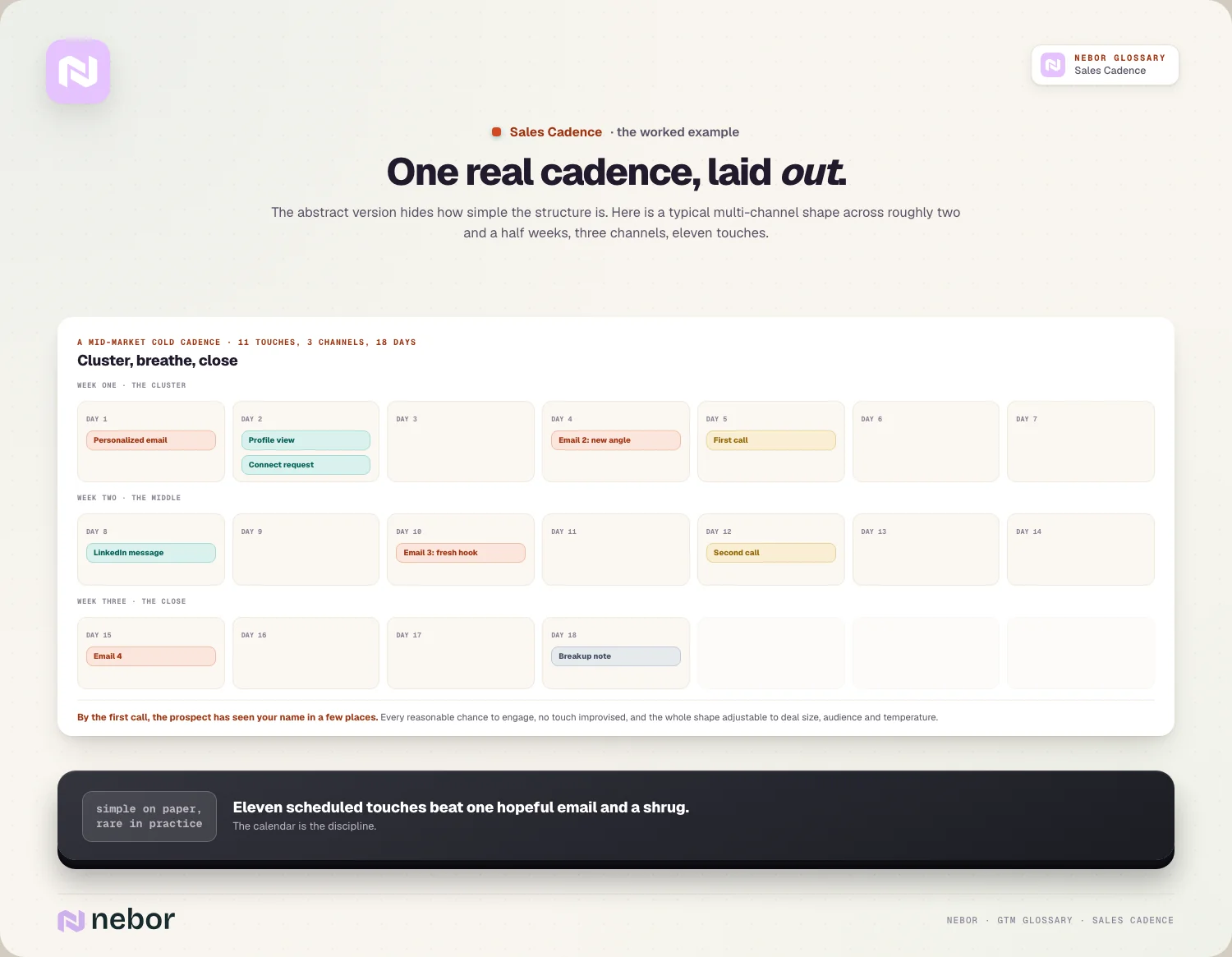
Around day four, a second email adds a new angle, and a day or two later comes the first call attempt. By now the prospect has seen your name in a few places.
The middle of the cadence stretches out. A LinkedIn message, another email with a fresh hook, and a second call spread across the next week, each spaced a few days apart.
It closes with a final email near the end, often a short breakup note. Across roughly 8 to 12 touches and three channels, you've given the prospect every reasonable chance to engage.
How do you build a cadence that fits your specific deal and audience?
There's no universal cadence, so the real skill is matching the structure to your situation, and in our experience a few factors shape what yours should look like.
Deal size shapes it more than anything. Larger, complex deals justify more touches over a longer window, while smaller or transactional ones can convert on a shorter, lighter cadence.
Your audience matters nearly as much as the deal. Senior buyers may respond better to fewer, sharper touches, while some roles are far easier to reach by phone or LinkedIn than by email.
The temperature of the lead changes everything. A cold prospect needs a full, patient cadence, while a warm one who just showed interest needs a faster, lighter touch.
So the 8-to-12-touch baseline works as a starting point and never a rule. You adjust the count, channels, and spacing to fit the deal in front of you, then refine it as results come in.
Does a cadence apply to warm and inbound leads just as much as cold?
Cadences are usually discussed for cold outbound, but warm and inbound leads need them just as much, with a structure that simply looks different.
When a lead comes in warm, speed matters more than persistence. The cadence should start fast, because reaching an interested prospect quickly is the heart of speed to lead.
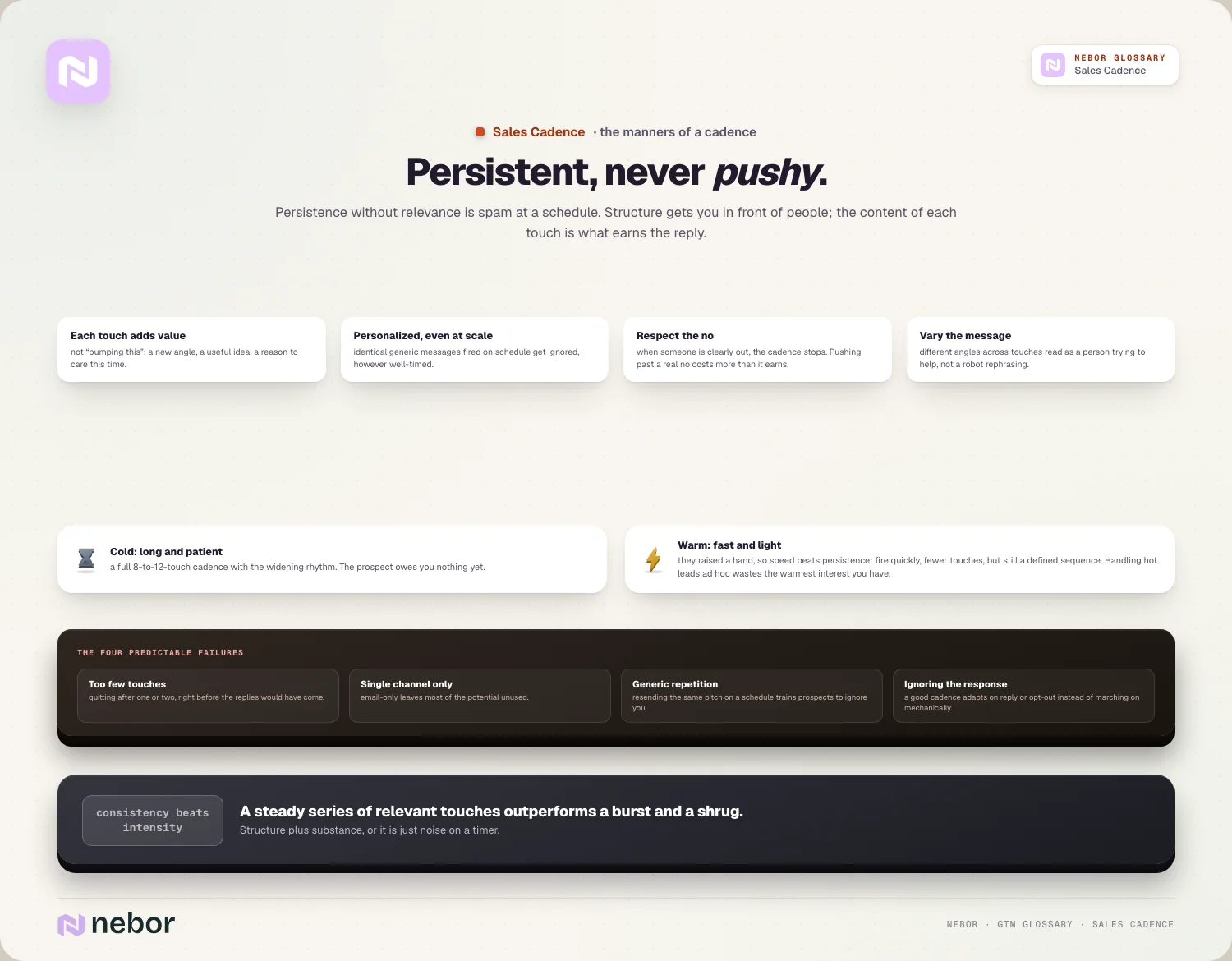
Warm cadences are usually shorter and lighter. The person already raised their hand, so you need fewer touches to connect, but you still need a structure so the follow-up reliably happens.
The mistake we keep seeing is teams handling warm leads ad hoc. They build careful cold cadences, then follow up on hot inbound interest once and let it drop, which wastes the warmest leads they have.
So cadence thinking applies across your whole pipeline. Cold leads need a long, persistent cadence, and warm leads need a fast, light one, but both need a defined sequence instead of improvised follow-up.
What are the common mistakes reps and teams make with cadences?
Cadences fail in a few predictable ways, and we keep seeing the same ones in the sequences clients bring us. They usually come from treating structure as a substitute for substance.
Too few touches is the one this whole entry argues against, because quitting after one or two follow-ups, as most reps do, means stopping right before the responses would have come.
Single-channel-only comes next, because an email-only cadence leaves most of its potential unused when multi-channel outperforms it by a wide margin.
Generic, repetitive messaging is the self-inflicted one, because a cadence that just resends the same pitch on a schedule trains prospects to ignore you, no matter how well-timed.
And ignoring the response defeats the purpose, because a good cadence adapts when someone replies or clearly opts out, rather than mechanically marching through every scheduled touch regardless.
Why structured persistence wins the deals that early quitting leaves behind
A sales cadence matters because persistence is the single most underused advantage in outbound. Most reps quit right before the replies come, and a cadence is what carries you past that point on purpose.
The deeper idea is that consistency beats intensity. A steady, well-timed series of relevant touches across channels outperforms a burst of effort followed by giving up, every time.
The honest caveat is that structure alone isn't enough. A cadence gets you in front of people repeatedly, but the touches still have to be relevant and varied, or persistence just becomes noise.
So if your outreach fizzles after a touch or two, the fix usually isn't a better first email. It's a real cadence that follows up long enough, across enough channels, with enough relevance, to reach people right when they're ready to answer.
The teams that win at outbound simply persist in a structured way most others never do. That discipline is why a cadence is at the core of any working go-to-market system, turning follow-up from a matter of willpower into a matter of process.
Share this post
Sequences
Outbound
Glossary
Related glossary items
Understanding the core GTM concepts


Ready to build your pipeline











