

In this post:
Personalization and scale sound like natural opposites. Personalization means treating each prospect as an individual, and scale means reaching thousands of them, so doing both at once feels like a contradiction.
For years it mostly was a real contradiction. You could send a few deeply researched emails or a flood of generic ones, but not both, and most teams quietly gave up on personalization once volume mattered.
Personalization at scale is the practice of making outreach feel individually relevant to each prospect while still reaching a large number of them, using data and automation to do the work. It's how you keep relevance without losing reach.
The key word in all of it is relevant. Personalization at scale isn't about inserting a first name into a template, it's about each message speaking to something true about that specific prospect, produced in a way that doesn't take an hour each.
TL;DR
Personalization at scale means sending outreach that feels genuinely tailored to each prospect, across many prospects at once, by using data and automation instead of manual research per person.
Relevance drives results and generic outreach has stopped working. Personalized messages get far higher reply rates, but doing it by hand doesn't scale, so the entire game is getting relevance and volume together.
The way it works is to do the thinking once, then let data and tools express it per prospect. You define the angles, enrich each contact, and generate messages that fit, instead of writing each from scratch.
The hard rule is that fake personalization is worse than none. Buyers instantly spot a hollow merge tag, so the bar is real relevance, which depends entirely on good data underneath.
So what does personalization at scale actually mean in practice?
Personalization at scale describes outreach that is both tailored and high-volume. Each prospect gets a message relevant to them, and you're sending to hundreds or thousands of prospects instead of a handful.
The old trade-off was brutal, because deep personalization meant slow, manual research per person, while scale meant generic templates, and you picked one based on whether you cared more about quality or quantity.
What changed is that data and automation now bridge the gap. You can pull specific details about each prospect automatically and use them to shape a message, so relevance no longer requires an hour of manual digging.
So personalization at scale isn't a single tactic, it's an approach. It's the combination of good data, clear messaging frameworks, and automation that together let you be relevant and broad at the same time.
The result, when you do it properly, is outreach that reads like you researched each person, because in a sense you did, just through a system rather than by hand.
That system is the entire idea behind the term. It moves the human effort from writing every message to designing how messages get built, and that shift is what finally makes relevance and volume coexist.
How is this different from the hyper-personalization next door?
People use these terms loosely, so let's draw the line between them. Personalization at scale and hyper-personalization are related but emphasize different things.
Hyper-personalization is about depth, going beyond basic details to weave in deep, specific, often real-time context about a prospect, so the message feels uniquely written for them.
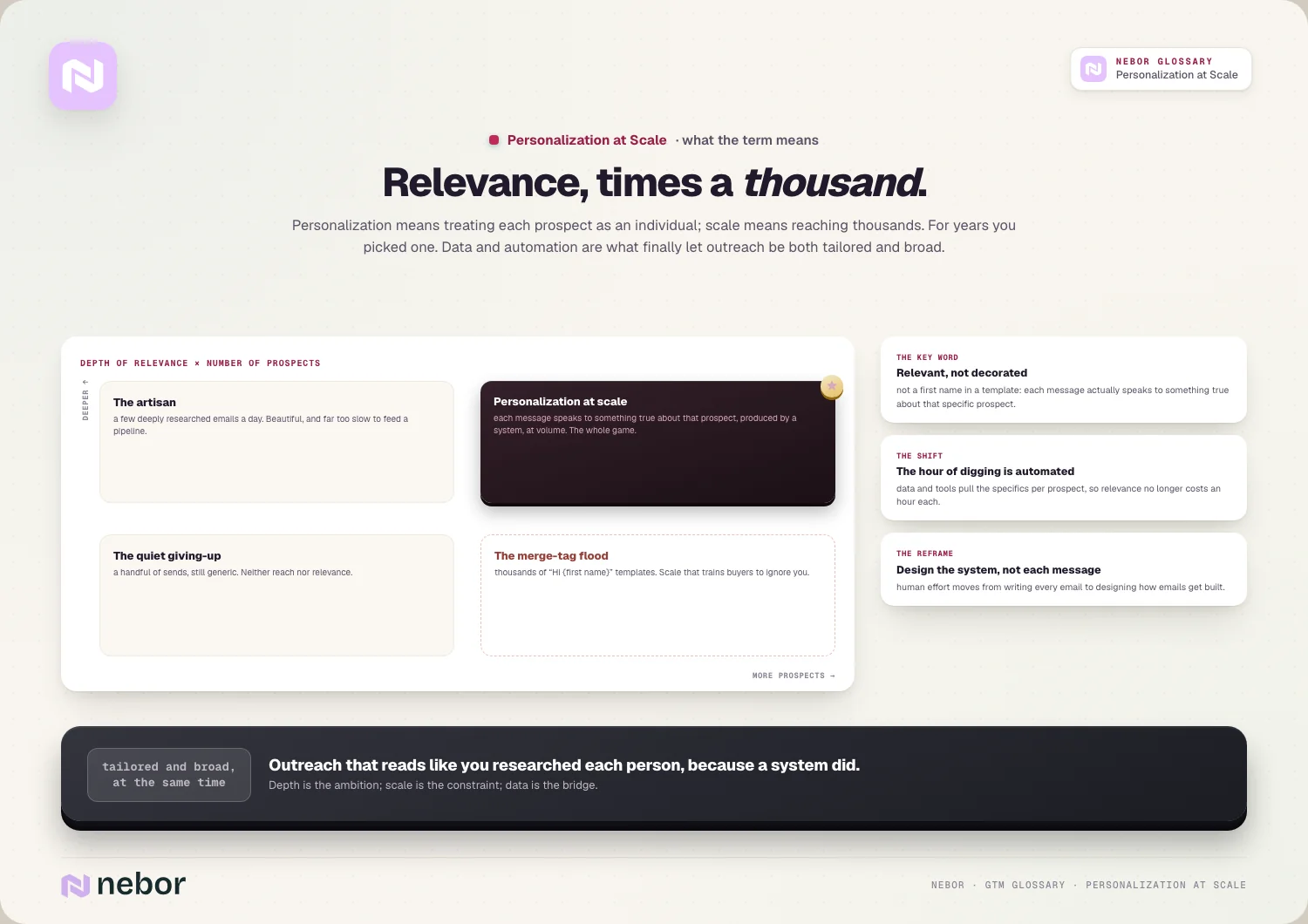
Personalization at scale is about reach instead, with its defining challenge being to personalize across a large volume of prospects, keeping each one relevant without the effort collapsing under its own weight.
In practice the two overlap heavily, because the goal of modern outbound is usually hyper-personalization delivered at scale, deep relevance produced efficiently across many prospects at once.
So think of scale as the constraint and depth as the ambition. The art is pushing relevance as deep as you can while still reaching the volume your pipeline needs.
Why has personalization at scale become non-negotiable lately?
Generic outreach has simply stopped performing, and the numbers make the shift impossible to ignore.
Cold email reply rates have fallen hard, dropping from around 8.5% to roughly 4% since 2019 as inboxes filled with lookalike templates. Buyers learned to tune generic outreach out entirely.
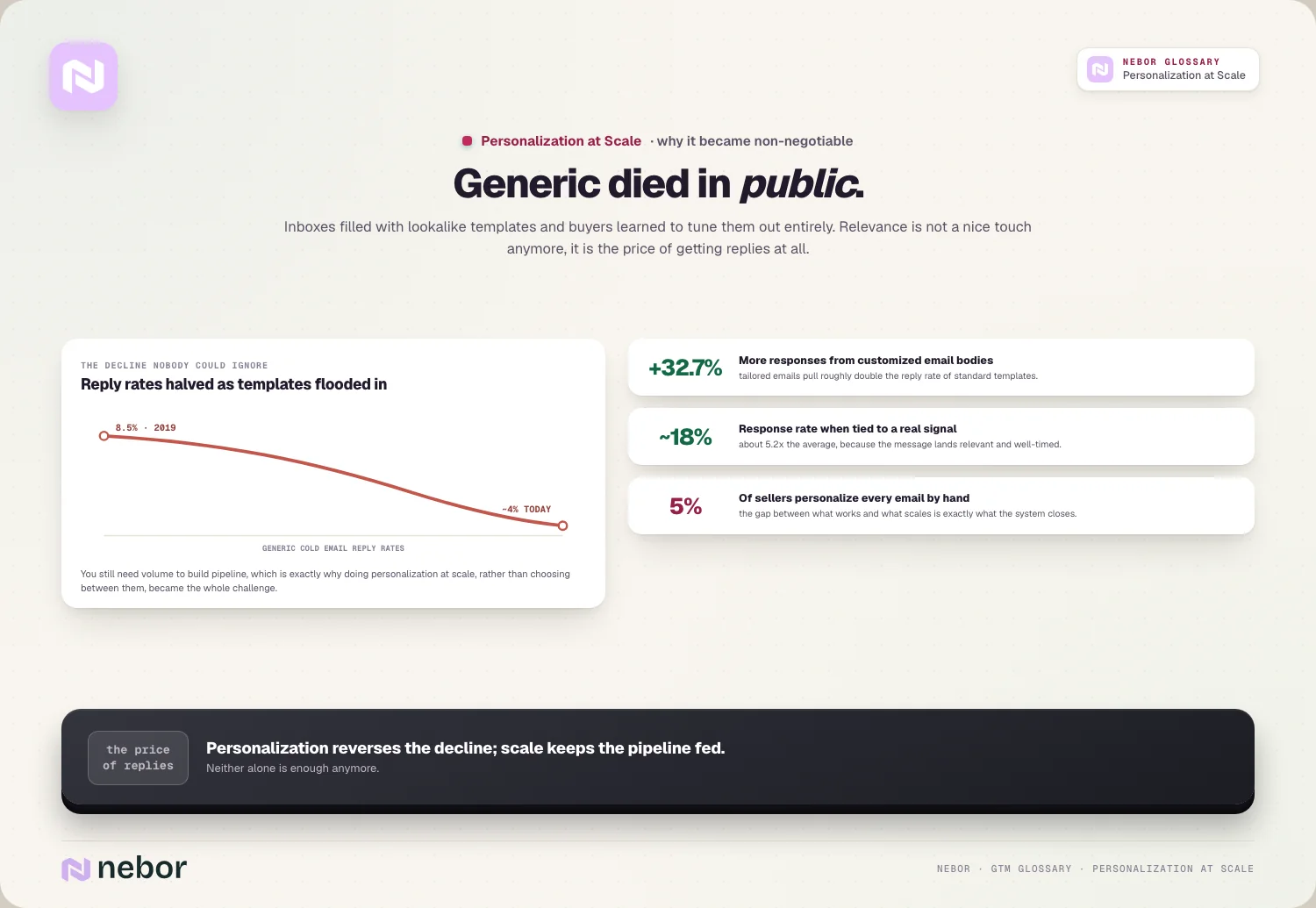
Personalization reverses that decline sharply, with customized email bodies seeing around a 32.7% increase in responses, and tailored emails get roughly double the reply rate of standard templates.
When personalization is tied to a real signal, the effect is dramatic. Signal-personalized outreach can hit around 18% response rates, about 5.2x the average, because it lands relevant and well-timed.
So personalization has moved from nice touch to the price of getting replies. The pressure is that you still need volume to build pipeline, and that's exactly why doing it at scale is the whole challenge.
Why is good data the real foundation of personalization at scale?
Here's the truth most tool pitches skip, and the one we tell every client first. Personalization at scale is a data problem first and a writing problem second, because you can't tailor a message to facts you don't have.
Every personalized message needs raw material, the specific details about each prospect that make relevance possible. Without that, automation just produces generic messages faster, which helps no one.
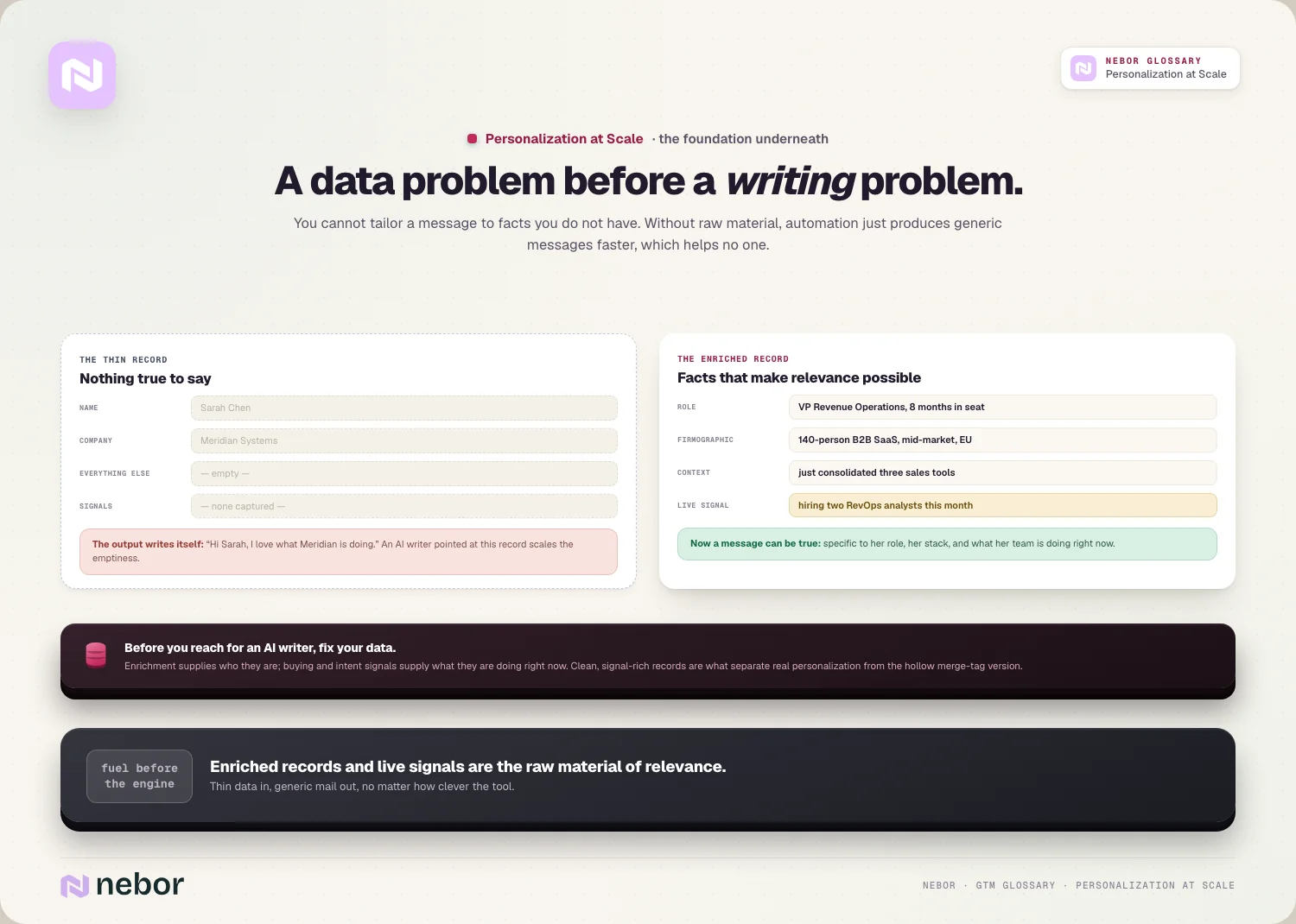
This is where data enrichment does the heavy lifting. Enriching each contact with firmographic details, role information, and context gives your system the facts it needs to say something true about that person.
The richest fuel of all is signals. Buying signals and intent signals tell you not just who a prospect is but what they're doing right now, and that timing is what makes a message feel timely instead of just informed.
So before you reach for an AI writer, fix your data. Clean, enriched, signal-rich records are what separate real personalization at scale from the hollow merge-tag version that buyers ignore.
How do you produce personalized messages at scale in practice?
With good data in place, the production side becomes manageable, and in our experience the trick is to separate the thinking from the typing, letting a system handle the repetitive part.
The strategy gets done once, up front. You define your personas, their pain points, and the angles that resonate, so you're not reinventing the message for every prospect, just adapting a known one.
Then let enrichment and logic fill in the specifics. For each prospect, the system pulls relevant details and selects the right angle, so the personalization is driven by data instead of a human staring at a LinkedIn profile.
AI writing tools layer on top of this. Given good inputs, they can draft a relevant message per prospect, which is the practical engine behind an AI personalization engine that produces tailored copy at volume.
The output then flows into your channels. A personalized cold email and a fitting LinkedIn note can be generated per prospect and sent through a coordinated motion, which is where scale finally meets relevance.
Why does personalization at scale belong in a multi-channel motion?
Personalization at scale isn't only an email tactic. Its real power shows up when it carries across every channel you use to reach a prospect.
A single channel limits both reach and relevance. Spreading personalized touches across email, LinkedIn, and phone, through multi-channel outreach, meets each prospect where they engage.
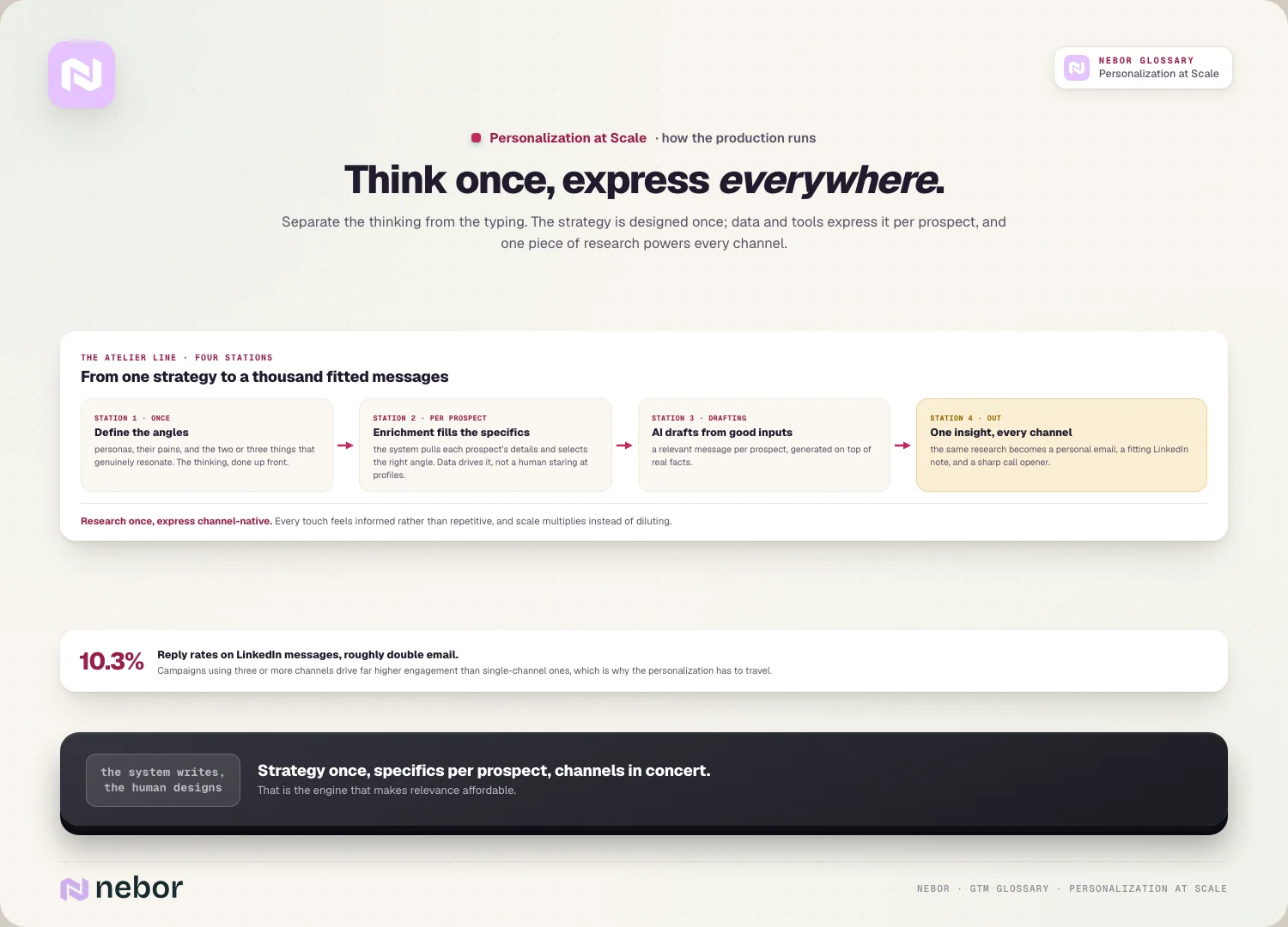
The numbers reward spreading the effort out. LinkedIn messages alone see around 10.3% reply rates, roughly double email, and multichannel campaigns using three or more channels drive far higher engagement than single-channel ones.
The trick is sharing the personalization across channels. You research the prospect once, then express that same insight in the right format for each channel, so every touch feels informed instead of repetitive.
If you do it this way, scale multiplies instead of diluting. One piece of research powers a relevant email, a fitting LinkedIn message, and a sharp call opener, all for the same prospect.
What separates real personalization from the fake merge-tag kind?
This is the line that decides whether personalization at scale works or backfires. Buyers can tell the difference instantly, so precision here pays.
Fake personalization stays on the surface, meaning a first name in the greeting, a company name dropped in, or a generic line about admiring their work, none of which proves you know anything about them.
Real personalization references something specific and true. It connects to their role, a recent move their company made, a signal they gave off, or a problem people in their exact position really have.
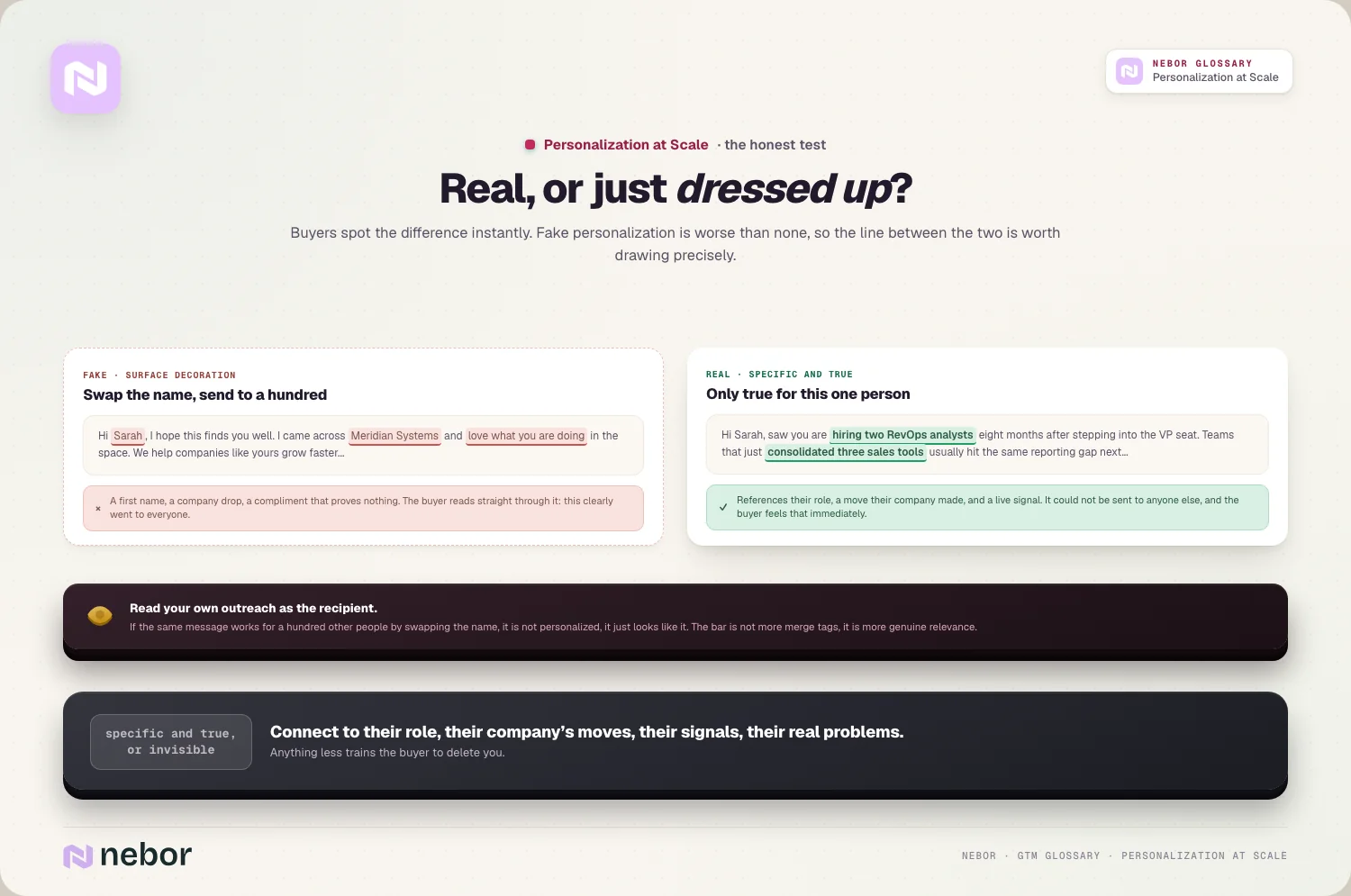
The test takes about one second. If the same message could be sent to a hundred other people by swapping the name, then it only looks personalized, and buyers read straight through it.
A good habit is to read your own outreach as the recipient. If the opening line makes you think this clearly went to everyone, your prospect thinks the same thing, and the message is already losing before it makes its point.
This is why doing it at scale is hard without being impossible. The bar is genuine relevance instead of more merge tags, and that's exactly what good data and clear angles let you produce repeatedly.
What are the common personalization at scale mistakes to avoid?
Even teams that buy into the idea trip over the same problems we keep seeing. Knowing them upfront saves a lot of wasted sends.
Automating before fixing the data tops the list, because pointing an AI writer at thin records just scales generic output, so the personalization is fake and the volume makes it worse.
Shallow merge-tag personalization comes next, because inserting a name and a company feels personalized to the sender, but it's transparent to the buyer and does almost nothing for replies.
Over-relying on AI without a human eye is the newer one, because around only 5% of sellers personalize every email individually and tools help close that gap, but unreviewed AI copy can read oddly or get facts wrong.
And there's mistaking the tool for the strategy, because a common reason Clay implementations fail is teams expecting the platform to supply relevance they never defined, when the thinking still has to come first.
How do you keep the quality high as the volume climbs upward?
The fear with scaling personalization is that quality slides as volume climbs, a little at a time. Managing that trade-off is its own discipline.
Human review belongs at the right points, because you don't need to read every email, but spot-checking samples catches the awkward AI phrasing and factual slips before they go out at volume.
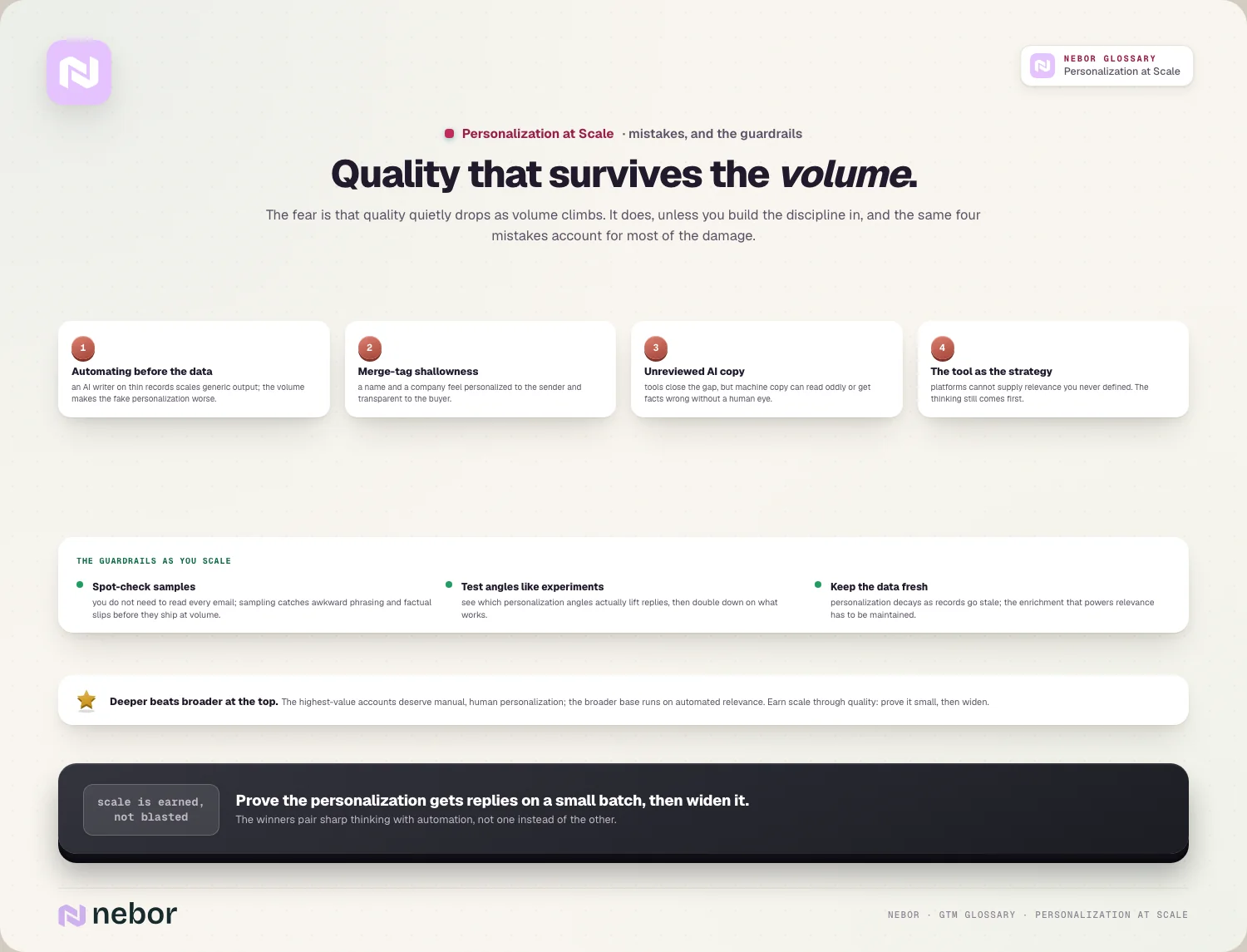
Your angles deserve testing like experiments, because with a consistent motion you can see which ones lift replies, then double down on the winners, the same instinct behind any list building and targeting refinement.
The data has to stay fresh too, because personalization decays as records go stale, so the same enrichment that powers relevance has to be maintained instead of set up once and forgotten.
And it pays to know when deeper beats broader, because the highest-value accounts often deserve manual, human personalization, while the broader base leans on automated relevance, which is a sensible way to spend your effort.
Does personalization at scale matter for inbound and warm leads?
It's easy to frame personalization at scale as a cold-outbound tool, but it matters just as much for warm and inbound contacts. Arguably it pays off even faster there.
When someone shows interest, by visiting your site, downloading something, or engaging with your brand, you already know a lot about them. That context is exactly what personalization feeds on, so warm outreach can be more relevant with less digging.
The same system that personalizes cold outreach can personalize inbound follow-up. You enrich the inbound contact, read the signal that brought them in, and respond with a message shaped by what they actually did.
This is where targeting still anchors everything. A clear ideal customer profile tells you which inbound leads deserve deep, personal follow-up and which fit a lighter automated touch.
So personalization at scale spans both motions. It makes cold outreach relevant enough to get noticed, and it makes warm follow-up sharp enough to convert the interest you already earned.
How do you get started with personalization at scale sensibly?
The idea can feel overwhelming, like it requires a giant tech stack before you send a single email. It doesn't, and starting small beats waiting for perfect.
You begin with your data instead of your tools, picking your target segment, enriching those contacts well, and making sure you have specific, true details to personalize around before automating anything.
From there you define a few strong angles, writing down the two or three things that truly matter to each persona, so your personalization has real substance instead of relying on surface merge tags.
From there you layer in automation gradually, because generating relevant messages from good inputs is the practical core of any effort to automate sales prospecting, and you can expand the volume as your quality holds.
The mindset is to earn scale through quality. Prove your personalization gets replies on a small batch, then widen it, instead of blasting thousands of half-personalized messages on day one.
Why the future of this belongs to relevance instead of volume
The direction of travel here is unmistakable. As AI tools spread, with around 95% of businesses using or planning to adopt AI in sales, generic outreach will only get more worthless and real relevance more valuable.
That creates a strange pressure, because the same tools that make personalization at scale possible also flood inboxes with mediocre AI copy, so the bar for what counts as relevant keeps rising.
The teams that win won't be the ones who automate the most. They'll be the ones who pair good data and sharp thinking with automation, so their scale produces relevance instead of noise.
So the future of personalization at scale isn't more volume or more merge tags. It's deeper relevance produced efficiently, and that's exactly what a well-built go-to-market system is designed to deliver, and what separates outreach worth reading from outreach worth deleting.
Share this post
Personalization
Outbound
AI
Glossary
Related glossary items
Understanding the core GTM concepts




Ready to build your pipeline











