
In this post:
A content engineer is someone who builds systems that produce and distribute content, instead of writing each piece by hand. They think like an engineer about content, designing repeatable workflows, usually powered by AI and data, that turn out a lot of good content reliably.
The job is where content creation meets technical and systems skills. A content engineer isn't only a writer, and isn't only an operator. They build the machine that makes your content, then keep it working well.
It's one of the newer roles in go-to-market, and it exists because the way content gets made has changed completely.
TL;DR
A content engineer builds the system that makes your content, rather than producing every piece themselves. They wire together AI, data, and workflows so your team can publish more, faster, without dropping quality.
The role appeared because AI made the actual writing cheap. Once a model can draft a decent article in seconds, the hard part is no longer the words, it's the system around them, the briefs, the quality control, the distribution, and the link to your GTM.
So a content engineer is less a writer and more a builder. If you've ever wished your content team could move ten times faster without the quality turning to mush, this is the role that makes that possible.
So what does a content engineer actually spend their day doing?
A content engineer builds and maintains the systems that create content at scale. Day to day, that means designing workflows where AI drafts, data informs, and a human checks, so the team can produce far more than it could by hand.
The work covers the whole pipeline from end to end. They set up the templates and briefs that keep quality consistent, wire in the tools that draft and repurpose content, connect it to your CRM and channels, and watch the results to keep improving the system.
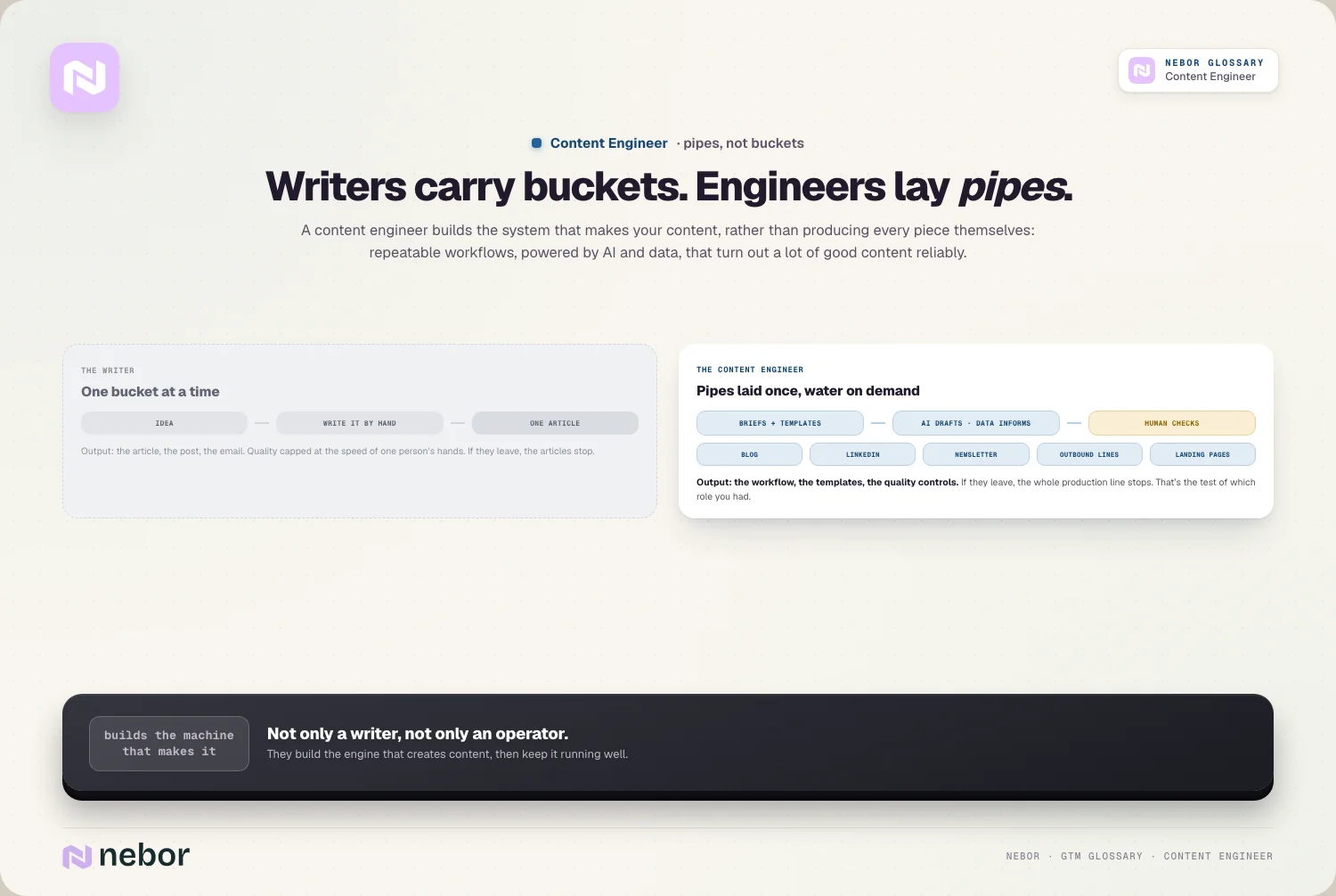
What they're really doing is replacing manual effort with infrastructure. Instead of a person writing one article at a time, a content engineer builds a process that can turn out many, with the human focused on judgment rather than typing.
A content engineer is a plumber for your content, in a sense. They don't carry every bucket of water across the house, they lay the pipes once, then make sure water flows on demand to every tap that needs it.
Why didn't the content engineer role exist just a few years ago?
This job is brand new, and it appeared for a clear reason. Around 2024 and 2025, AI models got good enough to draft content that was usable for search and brand instead of just rough notes.
Once a machine could produce a decent first draft in seconds, the bottleneck moved. The hard part stopped being the writing and became the system around it, who designs the briefs, who keeps the quality high, who handles distribution, and who ties it all to revenue.
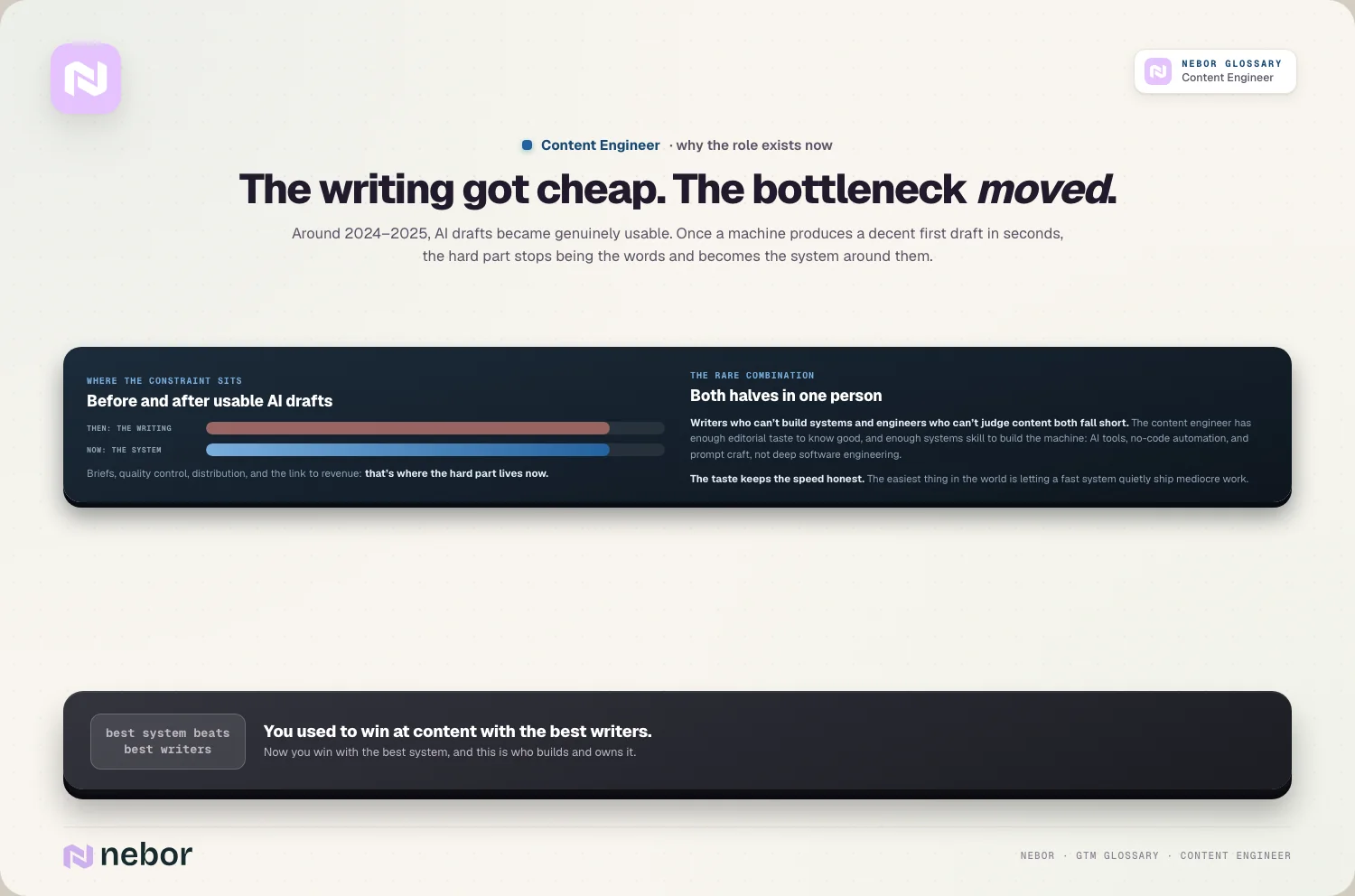
That shift created demand for someone with both halves of the skill set. Writers who couldn't build systems and engineers who couldn't judge content both fell short. The content engineer is the person who can do both.
There's a wider trend underneath this too. Across go-to-market, more and more work that used to be manual is getting rebuilt as systems, and the people who build those systems are turning into the most leveraged hires on the team.
How is a content engineer different from a writer or a strategist?
It's easy to confuse the two, so let's draw the line clearly. A writer produces individual pieces of content. A content engineer builds the system that produces them.
A writer's output is the article, the post, the email. A content engineer's output is the workflow, the templates, and the quality controls that let a lot of articles, posts, and emails get made well. One creates content, the other creates the engine that creates content.
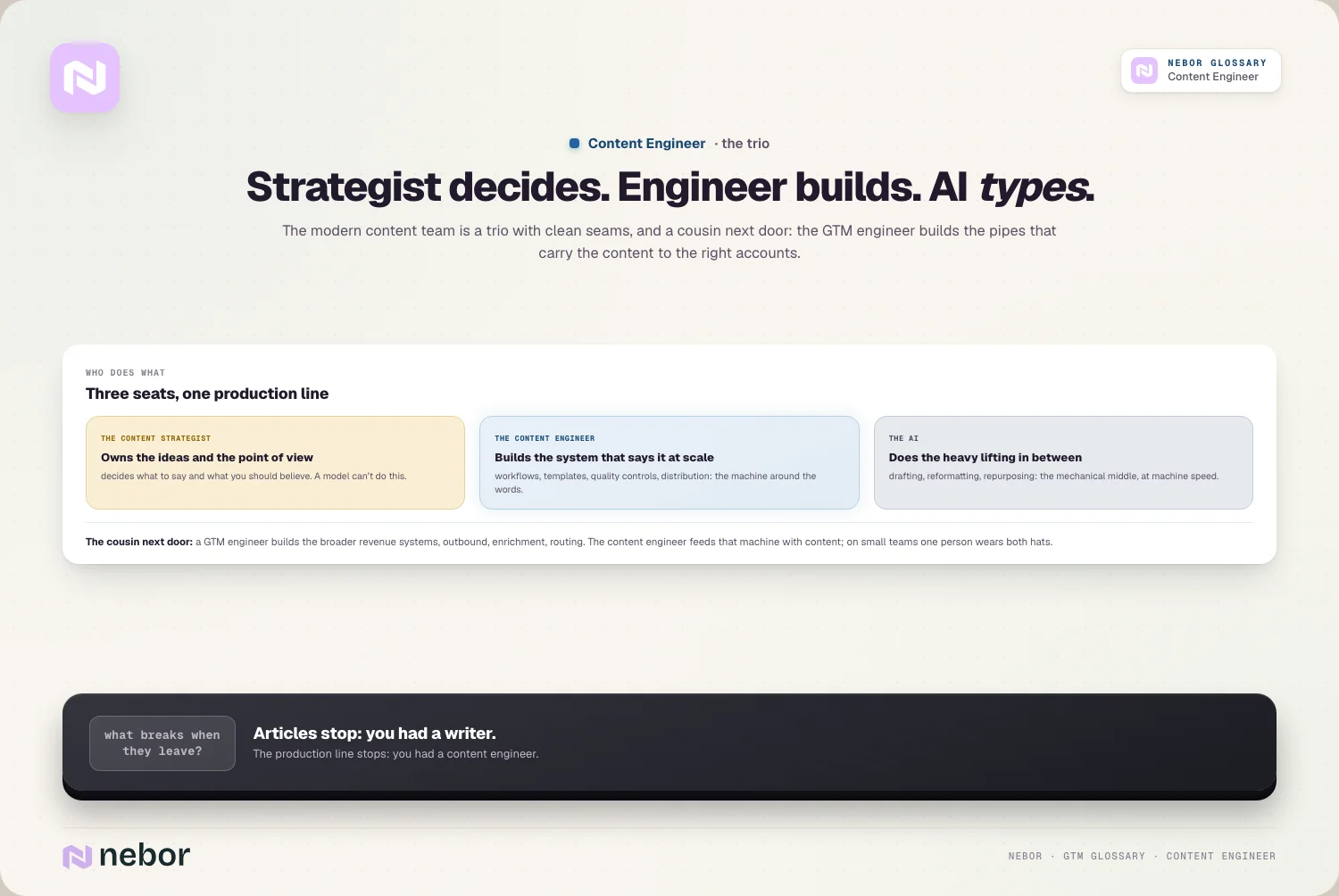
There's also a sibling role worth naming, the content strategist, who owns the original ideas and the point of view. In a modern team, the strategist decides what to say, the content engineer builds the system that says it at scale, and AI does the heavy lifting in between.
A good way to test which role you're looking at is to ask what breaks when that person leaves. If the articles stop, you had a writer. If the whole production line stops, you had a content engineer.
What does a content engineer look like next to a GTM engineer?
If this sounds a lot like GTM engineering, that's because it's a close cousin. Both roles are about building systems instead of doing the work by hand, and both blend technical skill with go-to-market judgment.
The two differ mainly in focus, because a GTM engineer builds the broader revenue systems, the outbound, the enrichment, the routing, the whole GTM stack. A content engineer builds the content side of that picture, the systems that produce and distribute the content the GTM motion depends on.
In practice the two overlap and often work together. The content engineer feeds the machine with content, and the GTM engineer makes sure that content reaches the right people through the rest of the system.
On a small team, one person sometimes wears both hats. On a larger team, you'll see them split, with the content engineer owning the words and the GTM engineer owning the pipes that carry them to the right accounts.
What skills do you need to do the content engineer job really well?
The role needs an unusual mix, which is part of why it's valuable. You need enough writing judgment to know what good content looks like, and enough technical skill to build the systems that produce it.
On the content side, that means understanding briefs, structure, SEO, and the kind of quality that ranks and gets read. On the technical side, it means being comfortable with AI tools, automation, AI workflows, and the prompt engineering that gets a model to produce useful drafts.
You don't have to be a deep software engineer for this. Most of the work happens in AI tools and no-code automation, with AI copywriting doing the drafting. The rare part is having both the editorial taste and the systems mindset in one person.
There's a softer skill that matters just as much. In our experience, a content engineer has to be ruthless about quality, because the easiest thing in the world is to let a fast system drift into shipping mediocre work. The taste is what keeps the speed honest.
How does a content engineer power both your inbound and your outbound?
A content engineer's work shows up on both sides of the funnel, which is what makes the role so useful. On the inbound side, they build the systems that produce SEO content, thought leadership, and the steady stream of useful material that pulls buyers in, which feeds your demand generation.
On the outbound side, the same systems power content-led outbound and personalization at scale. The content engineer builds the workflows that turn research and data into relevant, personalized outreach, rather than generic templates.
Because the role touches both motions, it works best inside a wider GTM system. The content isn't an end in itself, it's fuel for the whole go-to-market engine, and the content engineer keeps that fuel flowing.
The best content engineers also build the bridge between the two. A single piece of research becomes a blog post that ranks, a LinkedIn post that warms a feed, and a personalized line in an outbound sequence, all from the same source. That reuse is where the leverage multiplies.
What kinds of systems does a content engineer end up building?
Let's get concrete about the actual machines, because "system" can sound vague. The content engineers we work with end up owning a handful of distinct workflows that each solve a different problem.
There's the production workflow, which turns a brief into a finished, checked, on-brand draft, and the repurposing workflow, which takes one long piece and spins it into posts, snippets, and emails.
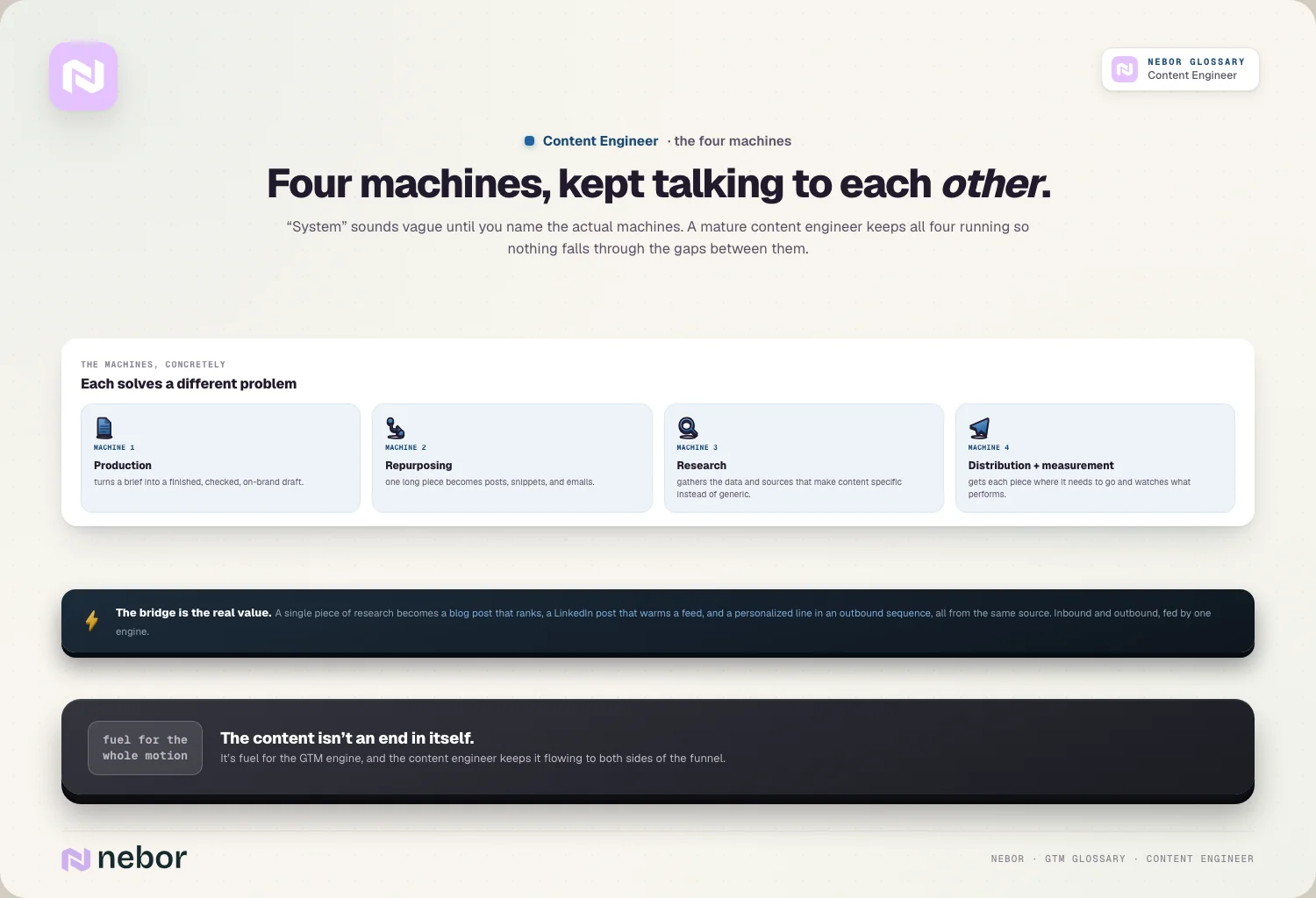
There's also the research workflow, which gathers the data and source material that make the content specific instead of generic.
Then there's the distribution and measurement layer, which gets each piece to where it needs to go and watches what performs. A mature content engineer keeps all four working and talking to each other, so nothing falls through the gaps between them.
How do you measure whether the content system is truly working?
A content engineer lives or dies by whether the output earns its keep, so they watch the numbers closely. Volume alone proves nothing, and the question is whether the content moves something real.
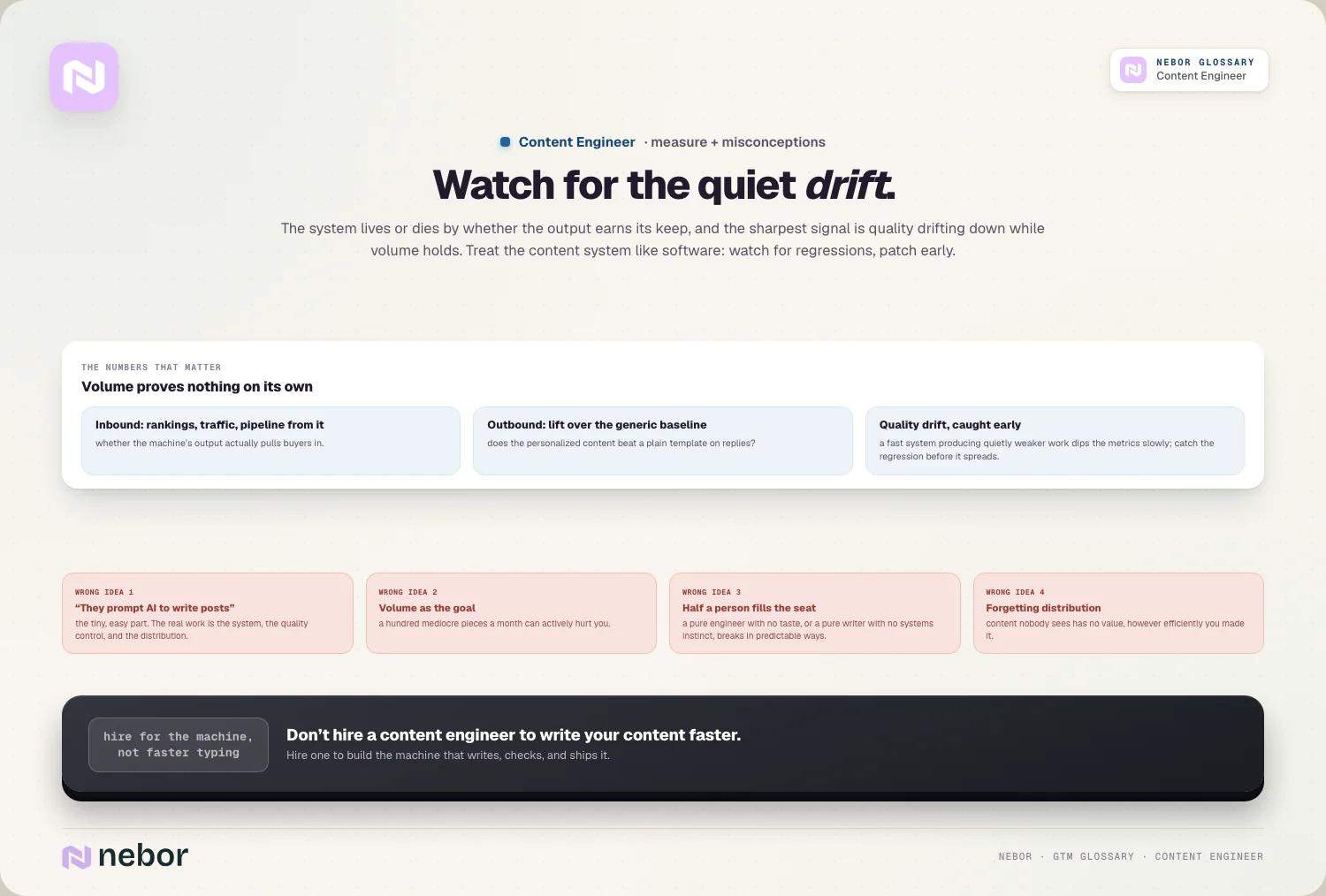
On the inbound side, they track things like rankings, organic traffic, and how much of that traffic turns into pipeline. On the outbound side, they watch reply rates and whether the personalized content lifts results over a generic baseline.
The sharpest signal to watch is quality drift. If a fast system starts producing weaker work over time, the metrics dip before anyone notices, and a good content engineer catches that early. They treat the system like software, watching for regressions and patching them before they spread.
Where exactly does the human stay in the loop of a content system?
A common fear is that a content engineer just points a model at the calendar and lets it rip, when a good system does the opposite. The human is deliberately placed where their judgment matters most, and pulled out of the places where they were only adding speed bumps.
The human sets the strategy and the point of view, because a model can't decide what you should believe. They write the brief, or at least approve it, since the brief is where most of the quality is decided. And they hold the final approval gate, where taste catches the things metrics never will.
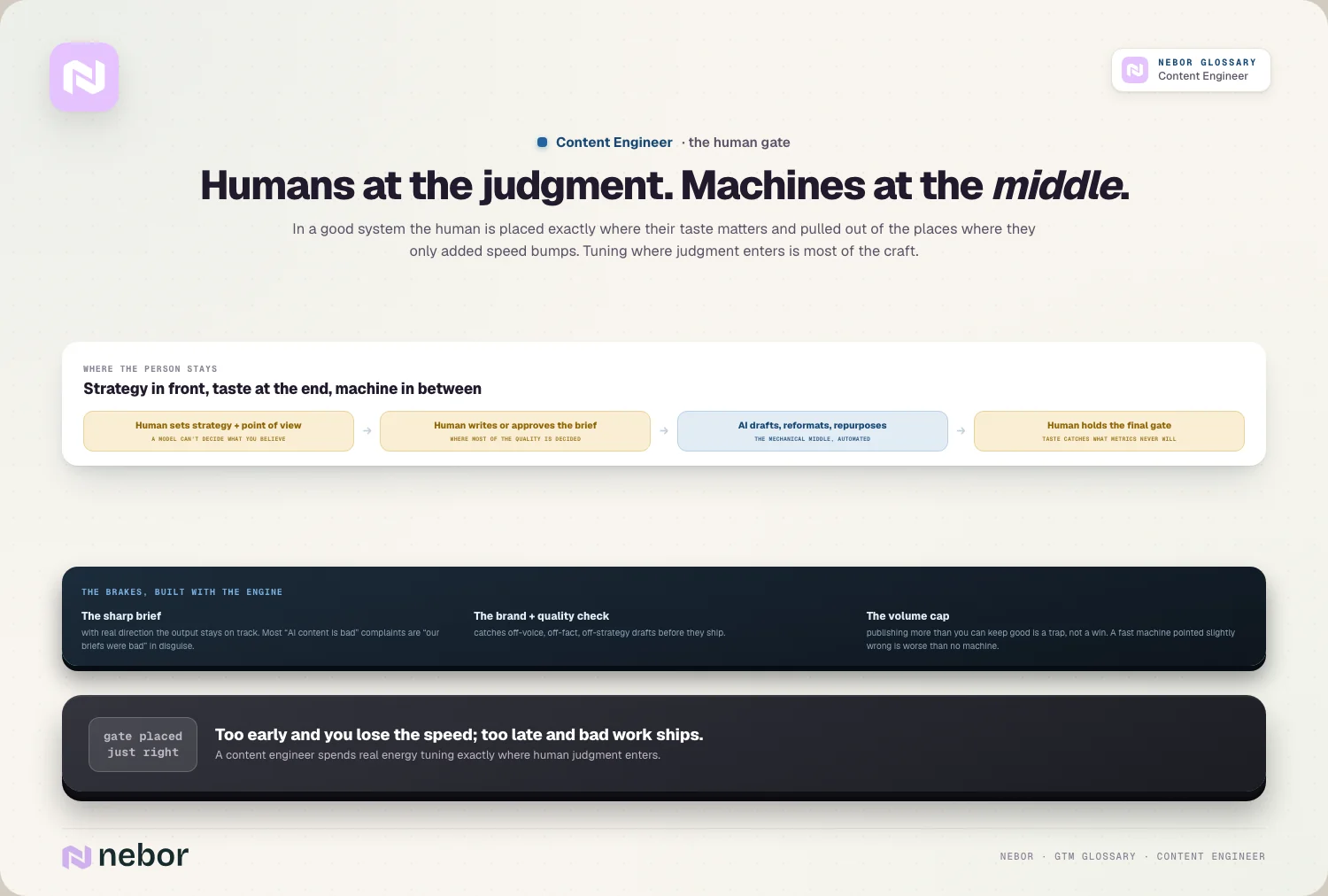
What the human stops doing is the mechanical middle, the first draft, the reformatting, the turning of one piece into five. That's the part a content engineer automates, so the person's time goes to the decisions only a person can make.
The skill is knowing where to put that gate. If it comes too early, you lose the speed that justifies the whole system, and if it comes too late, bad work slips out the door. A content engineer spends a lot of energy tuning exactly where human judgment enters.
How do you build a content engine without it going off the rails?
Speed is the whole promise of the role, but speed without guardrails is how you end up flooding your own site with generic junk. So we tell every content engineer to build the brakes at the same time as the engine.
The first guardrail is the brief itself. If the brief is sharp and specific, the output stays on track, because the model has real direction instead of a vague prompt. A lot of "AI content is bad" complaints are really "our briefs were bad" in disguise.
The second guardrail is the brand and quality check, a step that catches off-voice, off-fact, or off-strategy drafts before they ship. The third is a deliberate cap on volume, since publishing more than you can keep good is a trap dressed as a win.
If you build those three in early, the engine speeds you up without embarrassing you. If you skip them, you get a fast machine pointed in a slightly wrong direction, which is worse than no machine at all.
What do people most often get wrong about the content engineer role?
The biggest misunderstanding is thinking a content engineer just prompts AI to write blog posts. That's a tiny part of the job, and the easy part. The real work is the system, the quality control, and the distribution around the writing.
Another mistake is chasing volume for its own sake. Producing a hundred mediocre pieces a month isn't the goal, and it can actively hurt you. A good content engineer cares about output that's genuinely useful and on-brand, and plentiful comes second.
A third mistake is hiring a pure engineer with no editorial taste, or a pure writer with no systems instinct, and expecting either to fill the seat. The role needs both, and a person missing one half tends to break in predictable ways.
The last mistake is forgetting distribution entirely. Content that nobody sees has no value, no matter how efficiently you made it. A real content engineer builds the path to the audience as carefully as the path to the draft.
Why the content engineer is quickly becoming a seat you can't skip
The trend is hard to miss once you zoom out. As AI makes drafting nearly free, the advantage stops coming from who can write and starts coming from who can build the system around the writing.
That's the shift the content engineer rides. They turn a content team from a group of people typing into a machine that produces, checks, distributes, and learns, with humans pointed at judgment instead of grunt work.
If you're building a modern go-to-market team, this is the seat that quietly decides whether your content compounds or stays stuck at the speed of one person's hands. The companies that figure that out first tend to pull away from the ones still writing everything by hand.
The honest way to think about it is this. You used to win at content by having the best writers. Now you win by having the best system, and the content engineer is the person who builds and owns that system. That's a real shift, and it's only going to get more obvious as the writing itself keeps getting cheaper.
One hiring note is worth ending on. Don't hire a content engineer to write your content faster, hire one to build the machine that writes, checks, and ships it, so your best people spend their time on judgment instead of typing.
That's where the real value lives, and it's why the role keeps climbing up the list of seats a serious team can't afford to skip.
Share this post
Content
Marketing
Glossary
Related glossary items
Understanding the core GTM concepts




Ready to build your pipeline











