

In this post:
Two go-to-market teams can use the exact same AI model and get wildly different results. One gets sharp, personalized research at scale, and the other gets generic slop that prospects ignore.
The difference is in the instructions instead of the model. The team getting value has learned how to tell the AI exactly what to do, and the other is typing vague requests and hoping.
Prompt engineering for GTM is the practice of writing clear, structured instructions that get AI models to do go-to-market work well, like research, personalization, qualification, and copywriting. It's how you turn a general AI into a reliable part of your revenue motion.
That skill has quietly become a real edge. Since everyone has access to the same models, the teams that win with AI in go-to-market are the ones who know how to prompt them instead of the ones who simply have them.
TL;DR
Prompt engineering for GTM means crafting the instructions that get AI to perform go-to-market tasks reliably, from researching accounts to writing personalized outreach to qualifying leads.
The same model produces great or useless output depending on the prompt, and as AI spreads, prompting well is what separates teams getting real value from teams getting generic noise.
The core skills are specificity, structure, giving the model good context and examples, and breaking complex jobs into steps. A vague prompt yields vague output, while a precise one yields usable work.
One limit frames all of it, because prompting only produces good GTM results when it rests on good data and clear thinking. Even a perfect prompt can't personalize from facts it was never given.
What is prompt engineering for GTM, and what does the craft involve?
Prompt engineering is the craft of writing the instructions you give an AI model to get the output you want. For GTM, it means applying that craft to revenue work specifically.
A prompt is just the input you give the model. It can be a question, a command, or a detailed set of instructions, and the quality of that input largely determines the quality of what comes back.
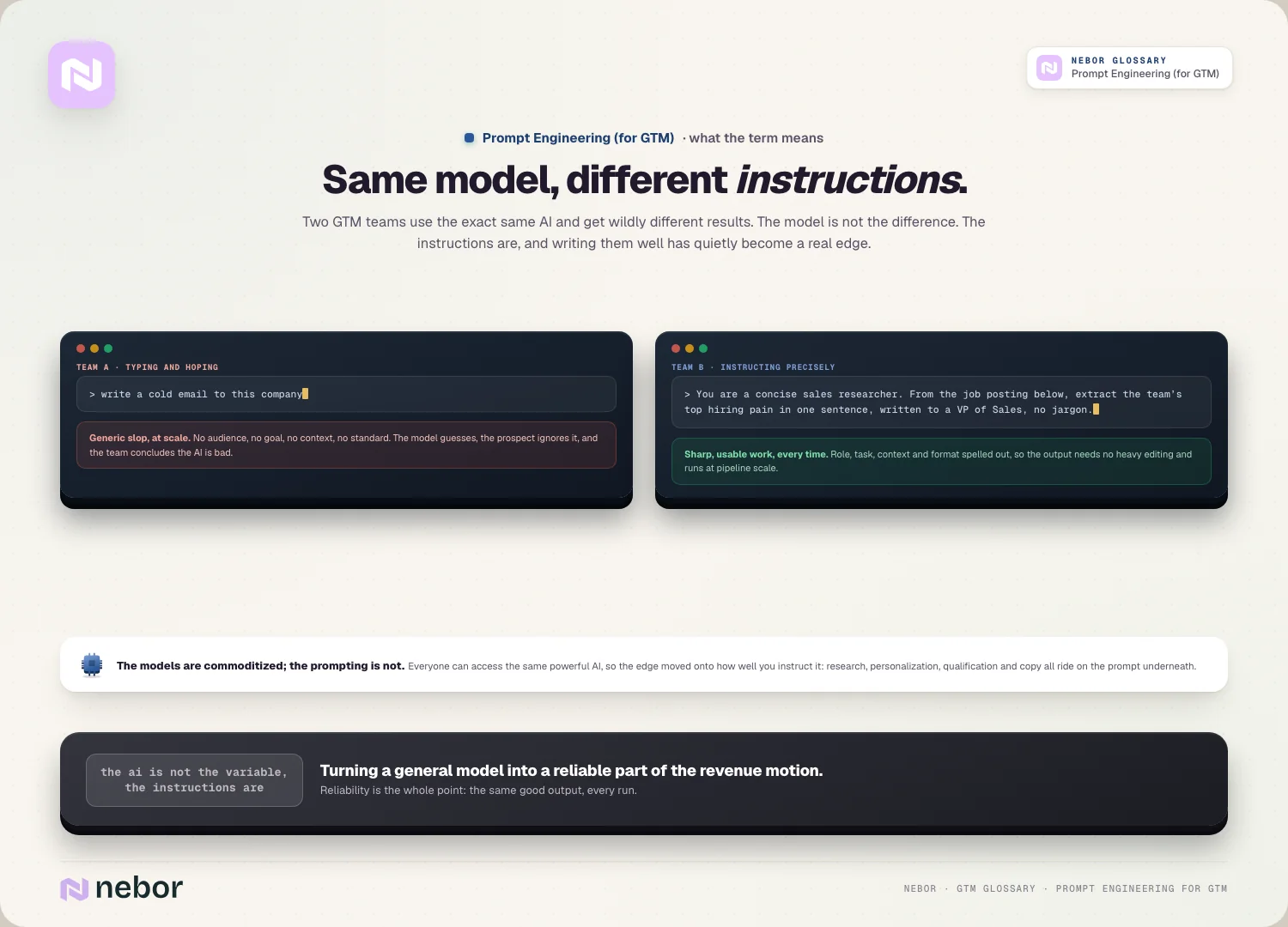
In a go-to-market context, the tasks are concrete. You might prompt a model to summarize a company's recent news, draft a personalized opener, classify a lead, or pull a pain point from a job posting.
Doing those well takes more than a one-line request. It takes prompts that spell out the role, the context, the format, and the standard you expect, so the output is usable without heavy editing.
So prompt engineering for GTM is really about reliability. It's how you get an AI to do a revenue task the same good way every time, at the scale your pipeline needs.
Why has prompting turned into a real go-to-market skill lately?
The timing deserves explaining, because a few years ago none of this mattered much. The shift came with AI moving into the core of go-to-market work.
AI now touches the whole go-to-market motion. Research, list building, enrichment, personalization, and qualification can all be done or assisted by models, which means prompts now underpin a huge share of GTM tasks.
And the models themselves have become a commodity. Everyone can access the same powerful AI, so the model itself is no longer an advantage, which pushes the edge onto how well you use it.
That's exactly where prompting enters the picture. A team that writes precise, well-structured prompts gets relevant, accurate output, while a team typing lazy requests gets generic results that hurt more than help.
So prompt engineering has moved from a curiosity to a genuine competitive skill. Mastering how you instruct AI has become close to a requirement for any team serious about modern go-to-market.
What separates a good GTM prompt from one that wastes your time?
The gap between a useless prompt and a great one comes down to a handful of principles. Each one pushes the output from generic toward genuinely usable.
Specificity carries the most weight, because a vague request like write a cold email gets a vague result, while a detailed one with audience, goal, and angle produces something far better, as most prompt engineering best practices stress.
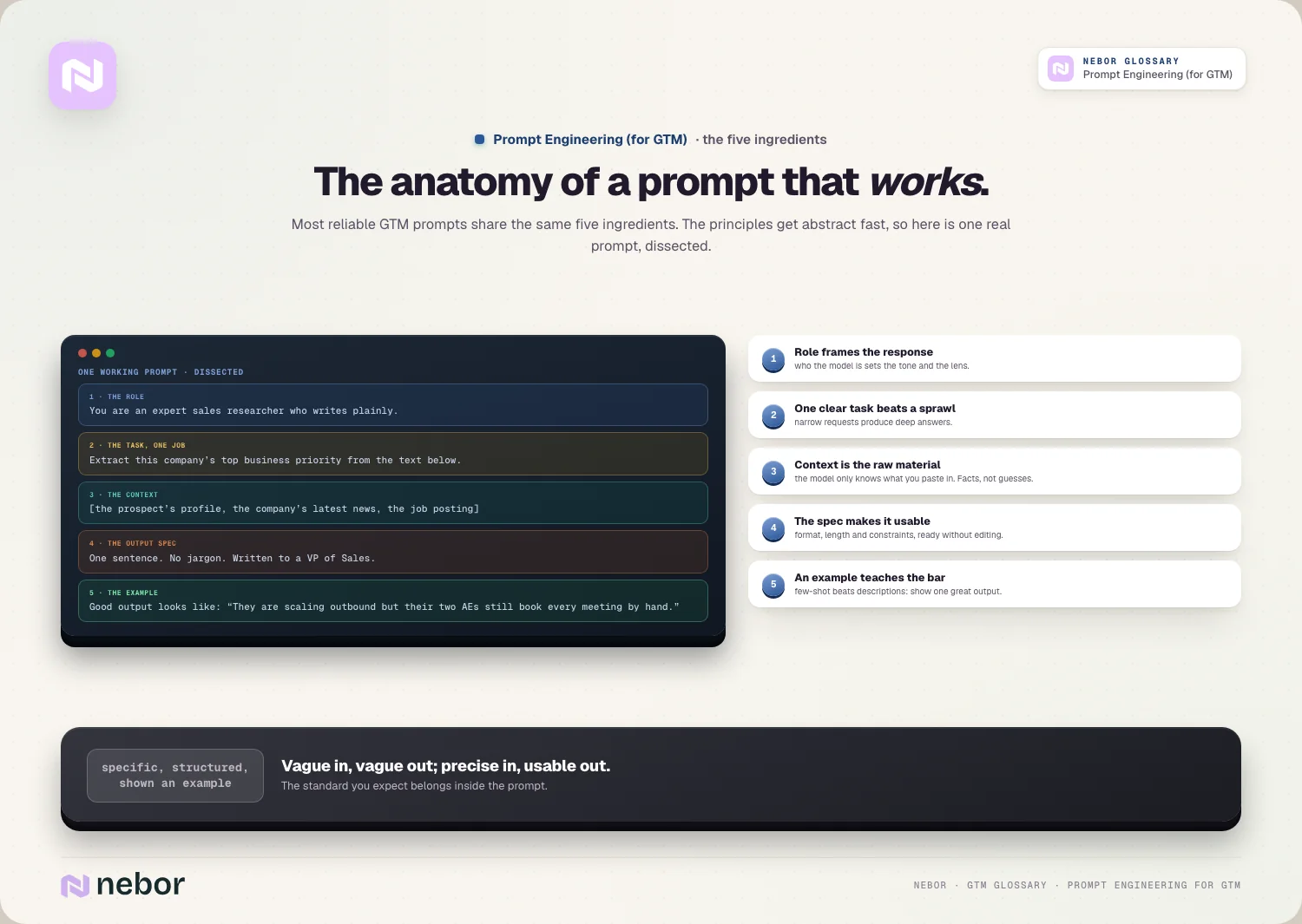
Context comes right behind it, because the model only knows what you tell it, so feeding it the prospect's role, company, and situation is what lets it write something relevant instead of generic.
Structure keeps the output usable, because telling the model what format you want, the length, the tone, and the shape of the result keeps it consistent and ready to use.
And examples teach faster than descriptions, because showing the model one or two samples of the output you want, often called few-shot prompting, conveys your standard far better than explaining it in words.
Why does breaking a big task into steps work so much better for AI?
One of the most useful techniques in GTM prompting is refusing to ask for everything at once. Complex tasks fall apart when crammed into a single prompt.
The instinct is to write one giant prompt that does the whole job. Research the company, find the pain, write the email, and personalize it, all in one go, which tends to produce shallow output on every part.
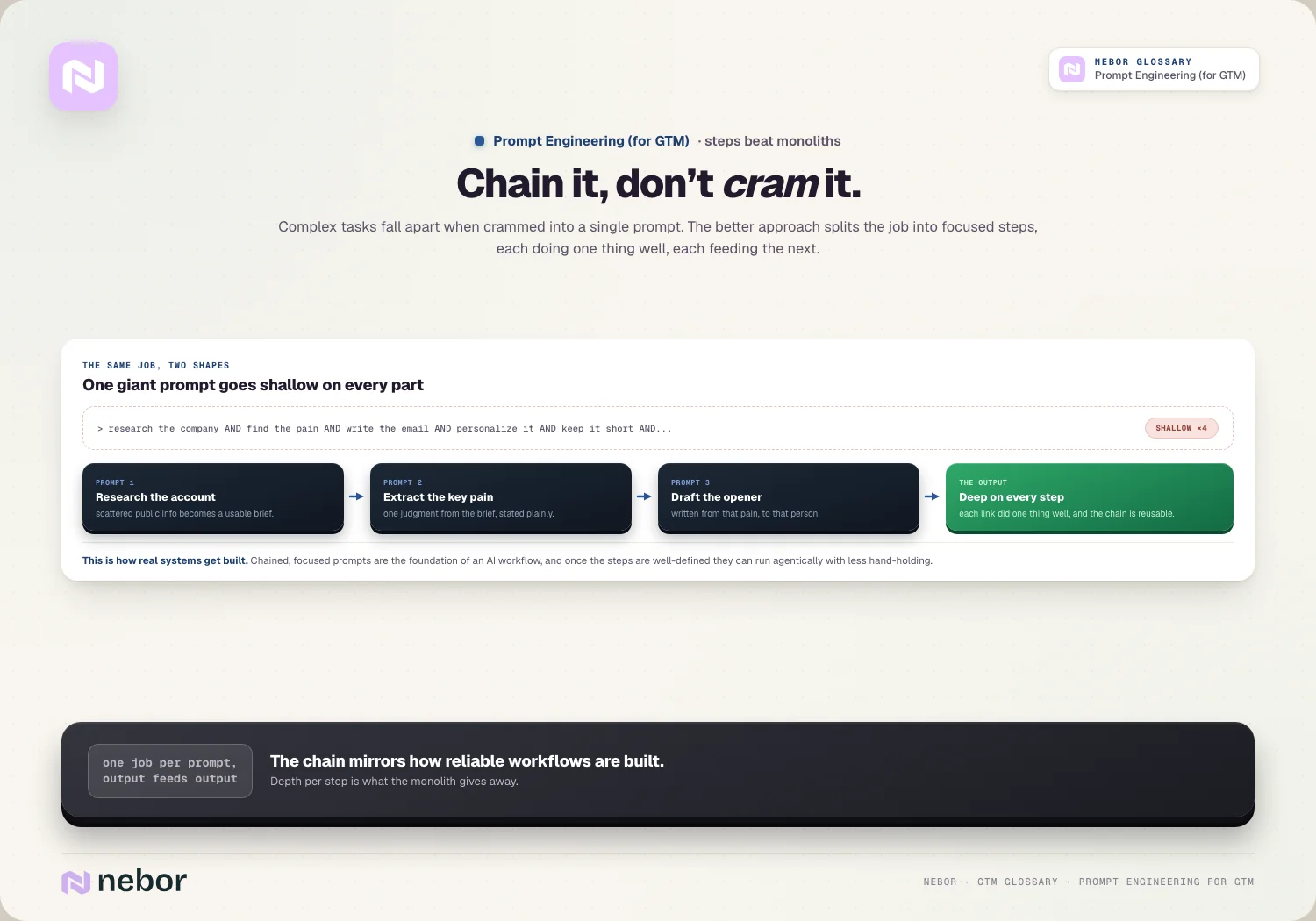
The better approach is to split it into steps. First prompt the model to research the account, then to extract the key pain, then to draft the opener using that pain, so each step does one thing well.
This mirrors how real workflows are built. Chaining focused prompts together is the foundation of an AI workflow, where each step's output feeds the next in a reliable sequence.
It sets up more autonomy down the road. Once steps are well-defined, they can work as an agentic workflow, where an AI agent executes the chain with less hand-holding.
What does prompt engineering handle across a real go-to-market motion?
It helps to make this concrete, because prompting touches more of the motion than people expect. The same skill shows up in several different jobs.
In research, prompts pull and summarize what matters about an account, turning scattered public information into a usable brief a rep or system can act on.
In data work, prompts help interpret and structure information, which supports data enrichment by extracting signals and details that raw fields don't capture cleanly.
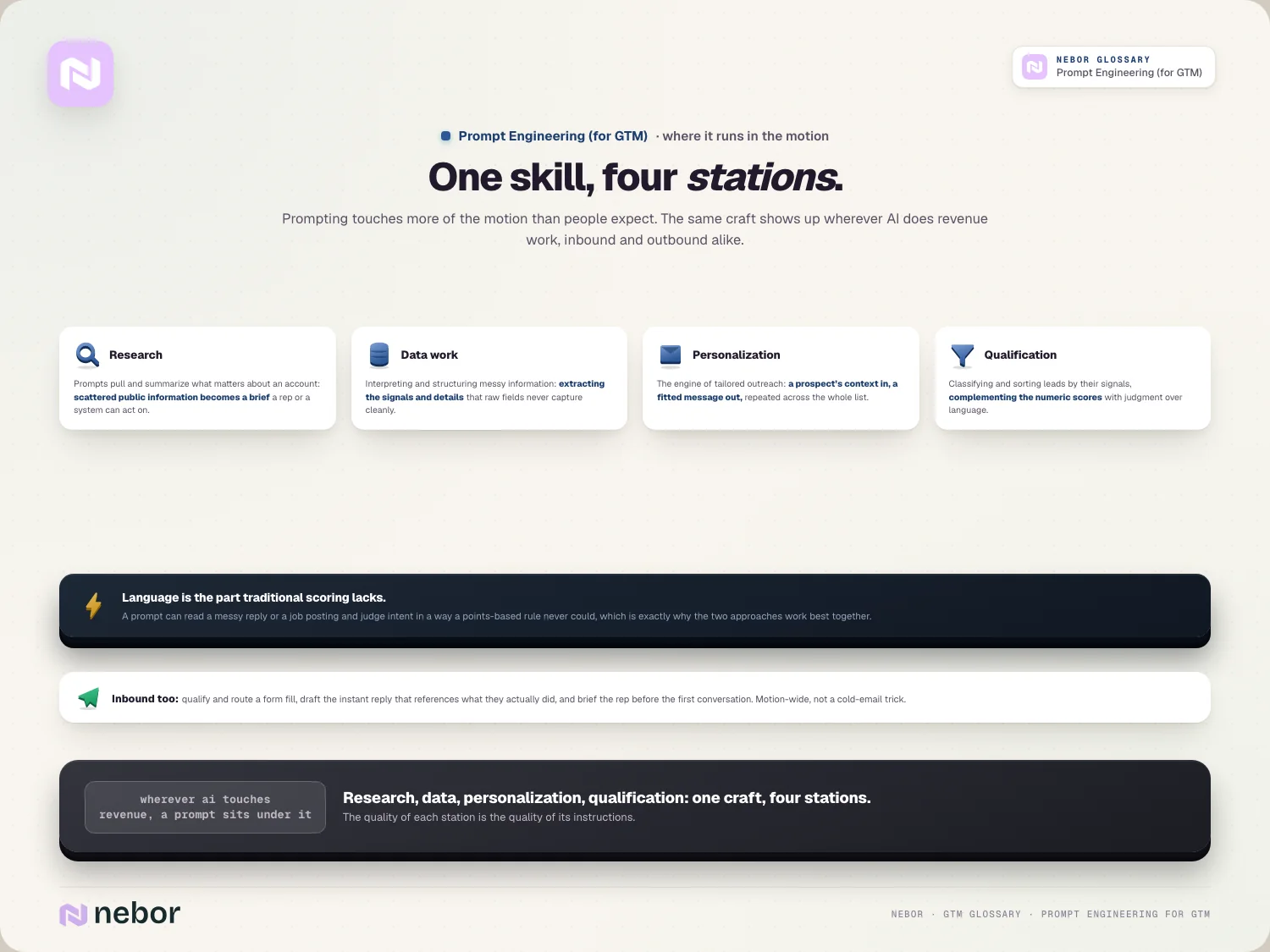
In personalization, prompts do the heaviest lifting. They take a prospect's context and produce a tailored message, which is the practical core of personalization at scale.
In qualification, prompts can classify and score. A well-built prompt can read a lead's signals and sort them, complementing numeric scoring models with a model that understands language and context.
That language understanding is the part traditional scoring lacks. A prompt can read a messy reply or a job posting and judge intent in a way a points-based rule never could, so the two approaches work well together.
Why is good data still the hard limit on what prompting can deliver?
Here's the hard truth that separates prompting hype from prompting value. A perfect prompt can't personalize from information it doesn't have.
Prompts can only work on the inputs they receive. If you ask a model to write a personalized email but give it nothing specific about the prospect, it can only produce something generic, no matter how clever the instruction.
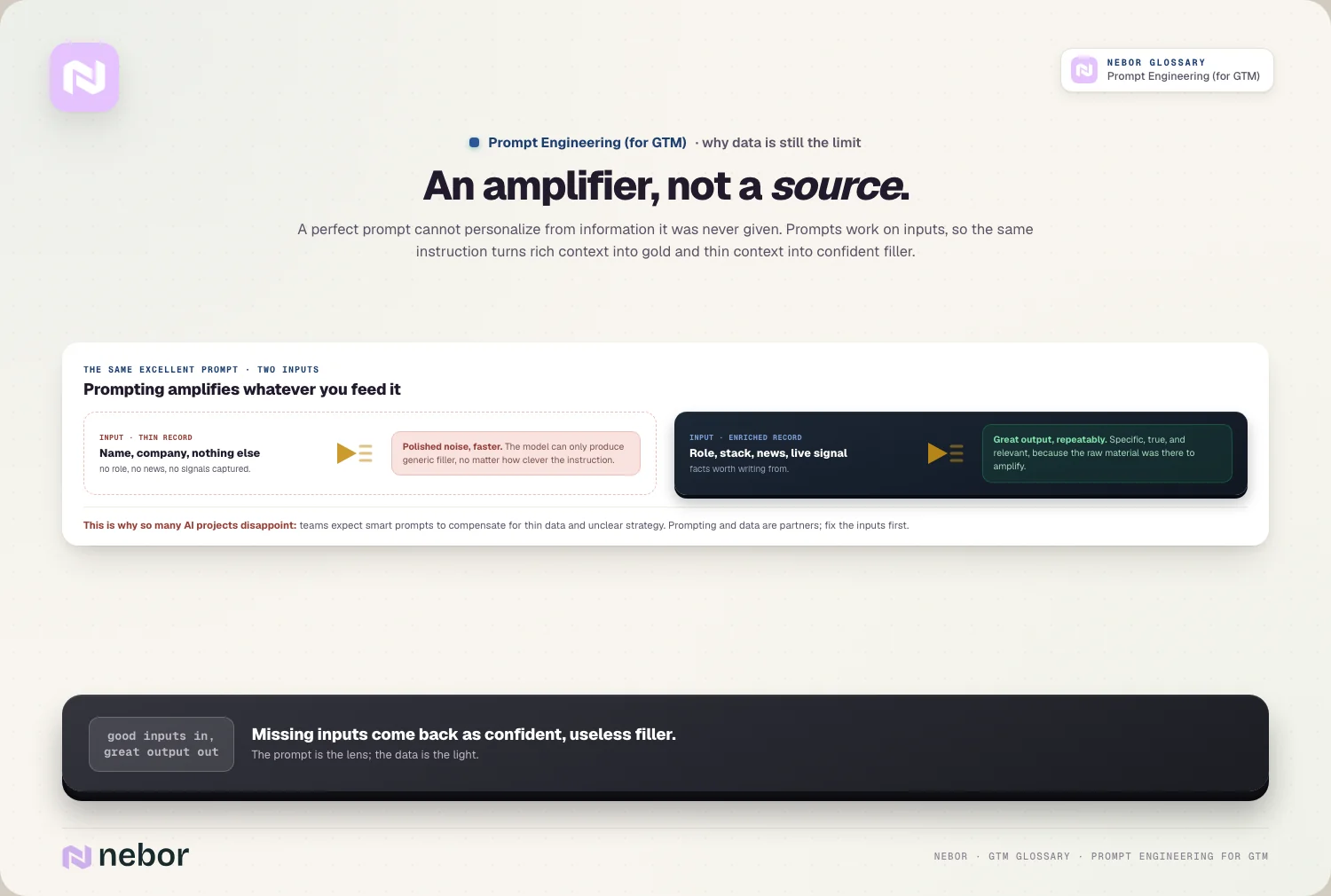
So prompting and data operate as partners. The richest prompts are the ones fed with enriched, accurate context, and that's the reason a solid data foundation matters as much as the wording of the prompt itself.
This is also why so many AI projects disappoint. A common reason Clay and similar implementations fail is teams expecting smart prompts to compensate for thin data and unclear strategy.
The takeaway is that prompting amplifies what you give it. Good inputs and clear thinking turn into great output, and missing inputs turn into confident, useless filler.
How does prompt engineering fit with AI agents and automation?
Prompting doesn't live in a chat window forever. Its real power in GTM shows up when prompts are wired into systems that work on their own.
Inside automation, prompts become reusable building blocks. A prompt that writes a good opener can be embedded in a workflow that applies it across thousands of prospects, and that embedding is how you automate sales prospecting at scale.
This is where prompting underpins AI sales roles. The behavior of an AI SDR is shaped largely by the prompts that tell it how to research, write, and respond.
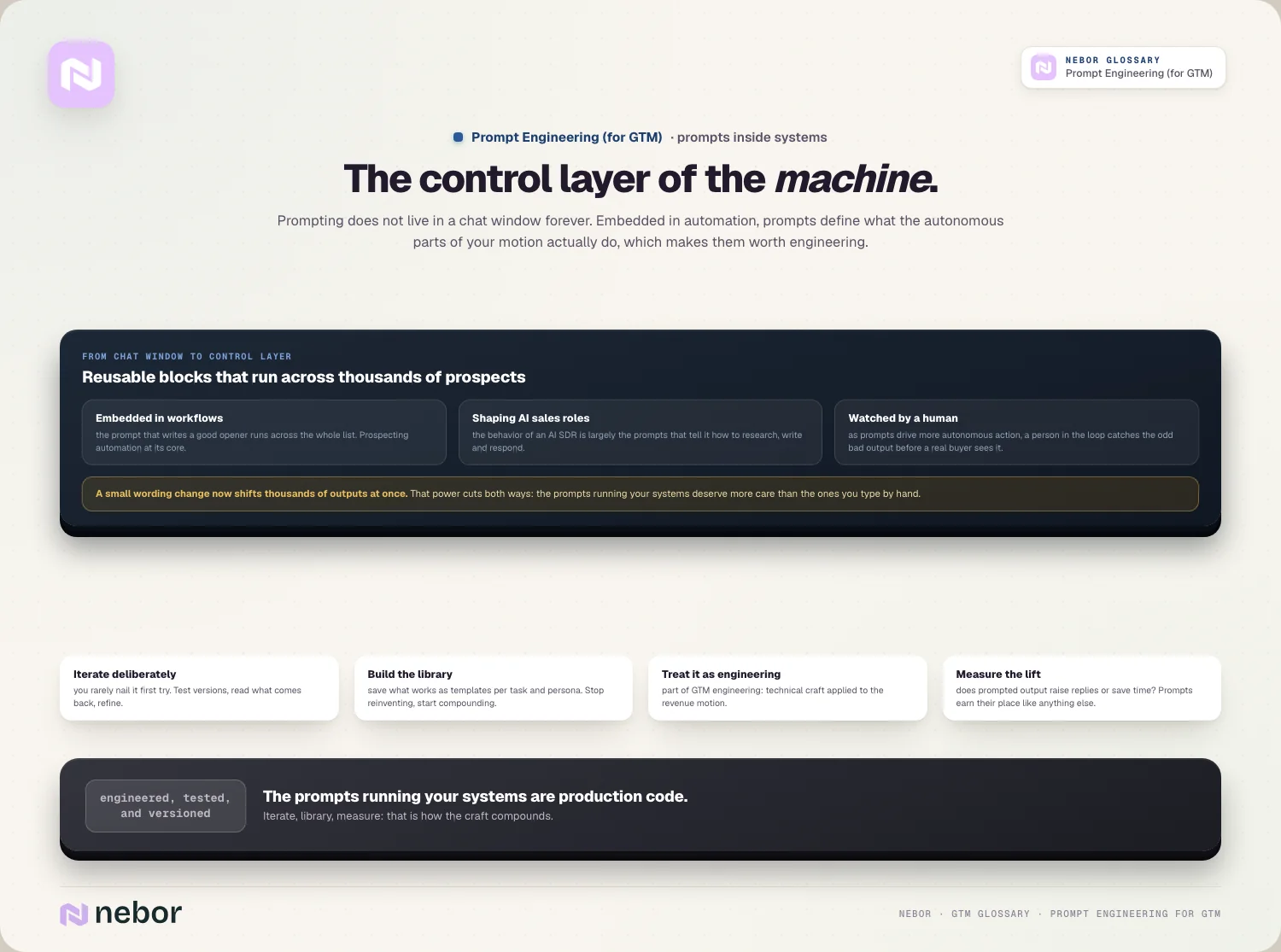
It also raises the stakes for keeping a person involved. As prompts drive more autonomous action, a human in the loop is what catches the odd bad output before it reaches a real prospect.
So prompt engineering is really the control layer for AI in GTM. The prompts define what the automated parts of your motion do all day, which makes them worth getting right.
When a prompt is buried inside an automation, a small wording change can shift thousands of outputs at once. That power cuts both ways, so the prompts driving your systems deserve more care than the ones you type by hand.
What are the common mistakes teams make when prompting for GTM?
Teams trip over the same prompting problems, and we keep seeing the same short list in the builds we do. Most come from treating AI as magic instead of a tool.
Being too vague tops the list, because a lazy prompt produces lazy output, and then people conclude the AI is bad when the instruction was the real problem.
Overloading one prompt follows close behind, because asking for a whole complex task at once gives shallow results, when splitting it into steps would have produced strong ones.
Skipping context and examples is the subtler slip, because without the specifics and a sample of what good looks like, the model defaults to generic, guessing at your standard.
And trusting output blindly is the costly one, because AI can be confidently wrong or write something off-key, so unreviewed prompts at scale can send bad messages to real buyers.
What does a strong GTM prompt contain when you look inside one?
It helps to see the anatomy of a good prompt, because the principles get abstract fast. Most reliable GTM prompts share the same few ingredients.
A role opens the prompt, because telling the model who it is, like an expert sales researcher or a concise copywriter, frames the whole response and sets the tone you want.
Then comes the task, stated plainly and narrowly. One clear job per prompt, such as extract this company's top business priority from the text below, beats a sprawling multi-part request.
The context supplies the raw material to work from. You paste in what the model needs, like the prospect's profile, the company's news, or a job posting, so it works from facts rather than guesses.
An output spec keeps the result usable. You define the format, length, and constraints, such as one sentence, no jargon, written to a VP of Sales, so what comes back is ready to use.
And an example seals it where one helps, because showing a single sample of a great output teaches the model your bar faster than any description, and that's the reason few-shot prompts tend to outperform.
Does prompt engineering matter for inbound as well as outbound?
Prompting often gets framed around cold outbound copy, but it's just as useful across inbound work. The same skill applies wherever AI touches the motion.
On the inbound side, prompts can qualify and route incoming interest. A model can read a form submission or a chat and summarize the need, so the right follow-up happens faster.
They power instant, relevant responses as well. When someone shows interest, a well-prompted model can draft a reply that references what they just did, which sharpens any autonomous outbound triggered by that signal.
Prompts help with inbound research just as directly. They can enrich and summarize an inbound lead's company in seconds, so a rep walks into the conversation already informed.
So treat prompting as a motion-wide skill. Whether the contact came from a cold list or raised their hand, good prompts turn raw context into the relevant action the moment calls for.
How do you get better at GTM prompting as the months of practice add up?
Prompting is a skill, which means it improves with deliberate practice, and in our experience a few habits speed that up considerably.
Iteration does the most for you, because you rarely nail a prompt on the first try, so testing versions, seeing what comes back, and refining the wording is how prompts get sharp.
Building a library helps just as much. Saving the prompts that work as reusable templates, per task and per persona, means your team stops reinventing them and starts compounding.
Treating it as part of GTM engineering matters as well. Prompting belongs inside the broader discipline of GTM engineering, where technical craft is applied to the revenue motion.
And measuring closes the loop, because watching whether prompted output lifts replies or saves time tells you which prompts deserve to stay, the same way you'd judge any part of your motion.
Why the instructions you write decide what AI is worth to your motion
Prompt engineering for GTM matters because the instructions have become the variable rather than the AI. Everyone has the same models, so the value lives in how well you tell them what to do.
When the craft is applied well, prompting turns a general AI into a reliable teammate for research, personalization, and qualification, working across your whole motion at a scale no human could match.
The honest limit is that prompting amplifies your inputs rather than replacing them. Without good data and clear thinking underneath, even a brilliant prompt just produces polished noise faster.
So as AI keeps spreading through go-to-market, the edge won't belong to whoever has the fanciest tool.
It will belong to the teams who learned to instruct it precisely, which is exactly what prompt engineering for GTM is about, and why it belongs at the center of a modern go-to-market system.
Share this post
AI
Guide
Glossary
Related glossary items
Understanding the core GTM concepts




Ready to build your pipeline











