
In this post:
AI can write a thousand cold emails in a minute. The problem is that most of them sound like a thousand AI cold emails, and buyers have learned to delete them on sight.
That tension is at the heart of AI copywriting. The technology makes it trivial to produce huge volumes of outreach, and that ease is exactly why so much AI-written copy is generic, forgettable, and ignored.
AI copywriting is the use of artificial intelligence, usually large language models, to generate marketing and sales copy like cold emails, subject lines, and outreach messages. It produces written content from a prompt and some context about the prospect.
When you use it well, AI copywriting lets you write relevant, personalized copy at a scale no human could match. When you use it badly, it just floods inboxes with polished-sounding spam faster than ever.
TL;DR
AI copywriting uses large language models to generate sales and marketing copy, from cold emails to subject lines, based on a prompt and context about the prospect.
Its promise is making personalized writing scalable. Good AI copy lets you tailor outreach to each prospect's role and situation across thousands of contacts, which a human couldn't do by hand.
The danger is that scale without judgment produces noise. AI can write fast, but without good inputs and human oversight, it generates generic copy that buyers ignore or resent.
The winning approach treats AI as a junior copywriter. It handles first drafts, research, and variations, while humans own the strategy, the judgment, and the quality control.
What is AI copywriting, and what does the model actually do?
AI copywriting is generating written sales and marketing content using AI models. You give the model a prompt and some context, and it produces copy like an email, an opener, or a subject line.
It is built on large language models, which are trained on huge amounts of text, so they can produce fluent, reasonably polished writing from an instruction, and that fluency is what makes them useful for outreach.
The output depends heavily on the input. A vague prompt with no context produces generic copy, while a detailed prompt with real information about the prospect produces something relevant.
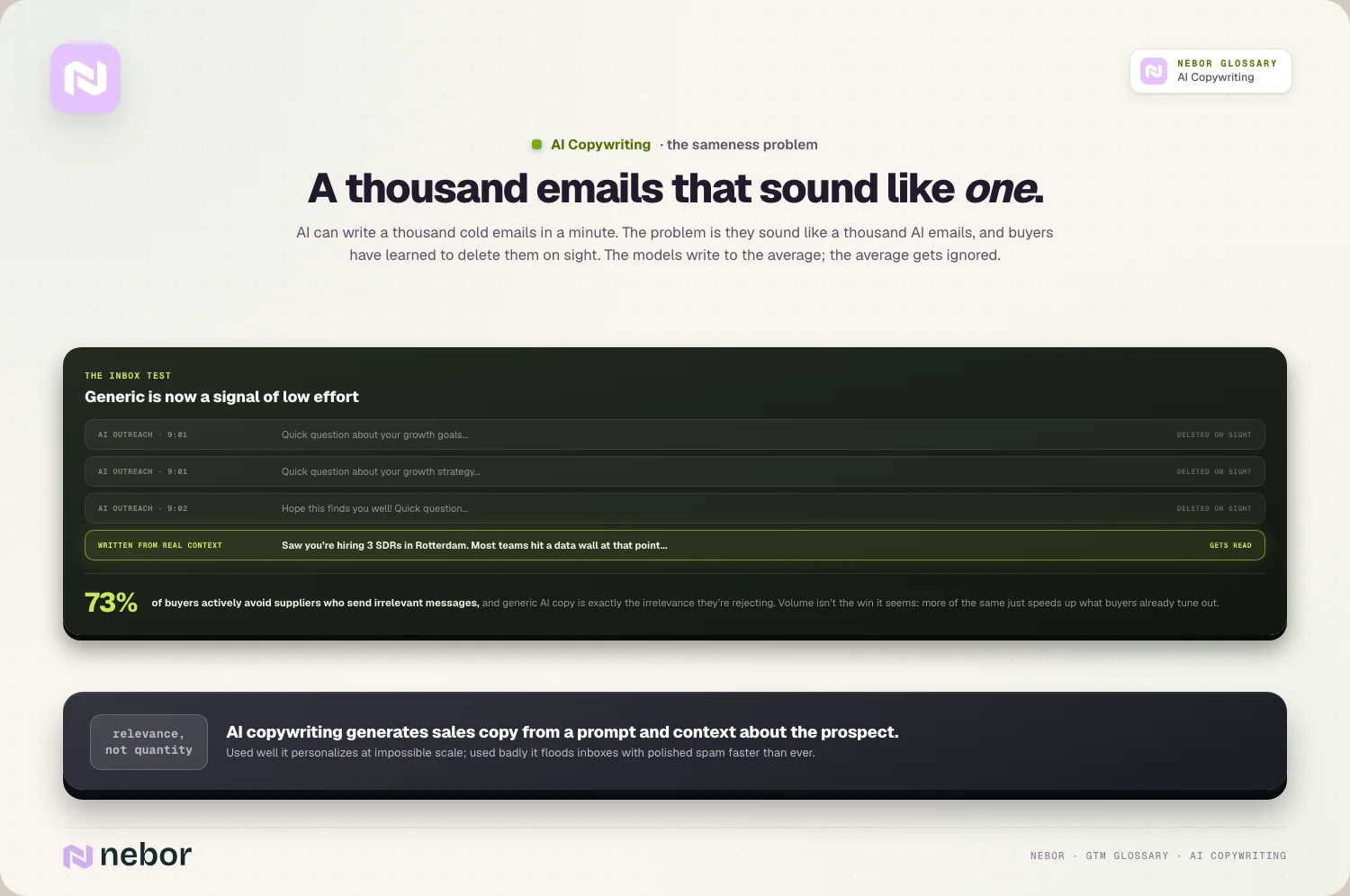
It spans the whole range of outreach writing. Your subject lines, cold email bodies, follow-ups, LinkedIn messages, and call scripts can all be drafted or assisted by AI.
So AI copywriting is really about turning context into copy at scale. It takes what you know about a prospect and writes a message around it for your team, which is powerful when the context is good.
The thing to hold onto is that the model is only the writer and never the strategist. It can phrase an idea well, but it can't decide what idea is worth sending, which is still your job.
Why does AI copywriting have such a stubborn sameness problem?
The biggest weakness of AI copywriting deserves facing directly, because it explains most of the failures. AI tends to produce copy that all sounds the same.
The models write to the average, because their training on vast amounts of text makes them default to the most common phrasings, and that's where the same polished, slightly hollow tone comes from.
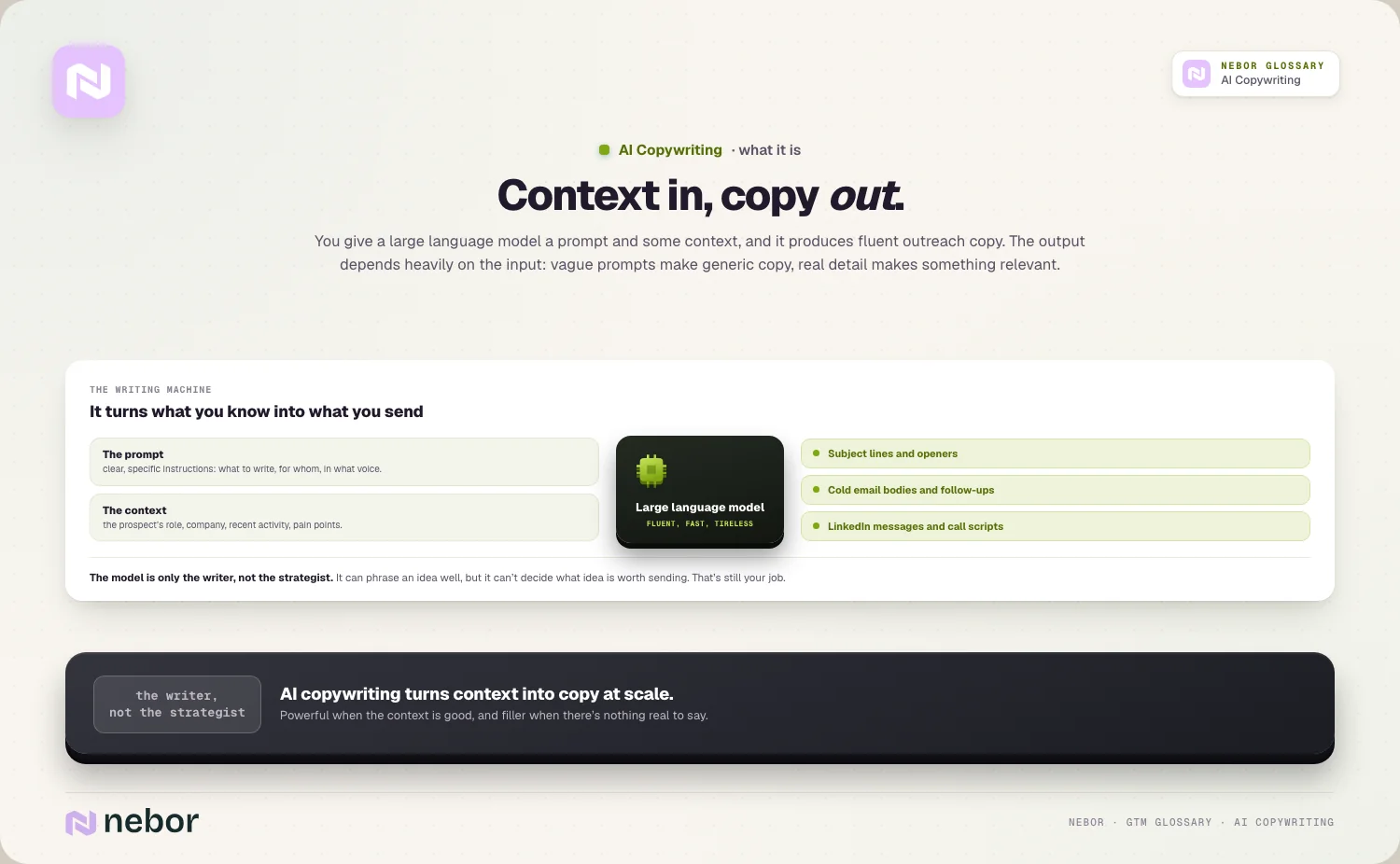
Buyers have caught on to the pattern. They've seen so much AI-written outreach that the generic version now actively signals low effort, which makes it easier to ignore than ever.
The numbers confirm the backlash, with around 73% of buyers actively avoiding suppliers who send irrelevant messages, and generic AI copy is exactly the kind of irrelevance they're rejecting.
So volume isn't the win it seems. Producing more AI copy that all sounds alike just speeds up the thing buyers already tune out, so relevance beats quantity as the real goal.
How do you make AI copy relevant instead of interchangeable?
The fix for sameness is relevance, and in our experience it comes down almost entirely to inputs. AI copy is only as good as the information you give it.
The key is feeding the model real context. Details about your prospect's role, company, recent activity, and pain points let the AI write something specific instead of generic.
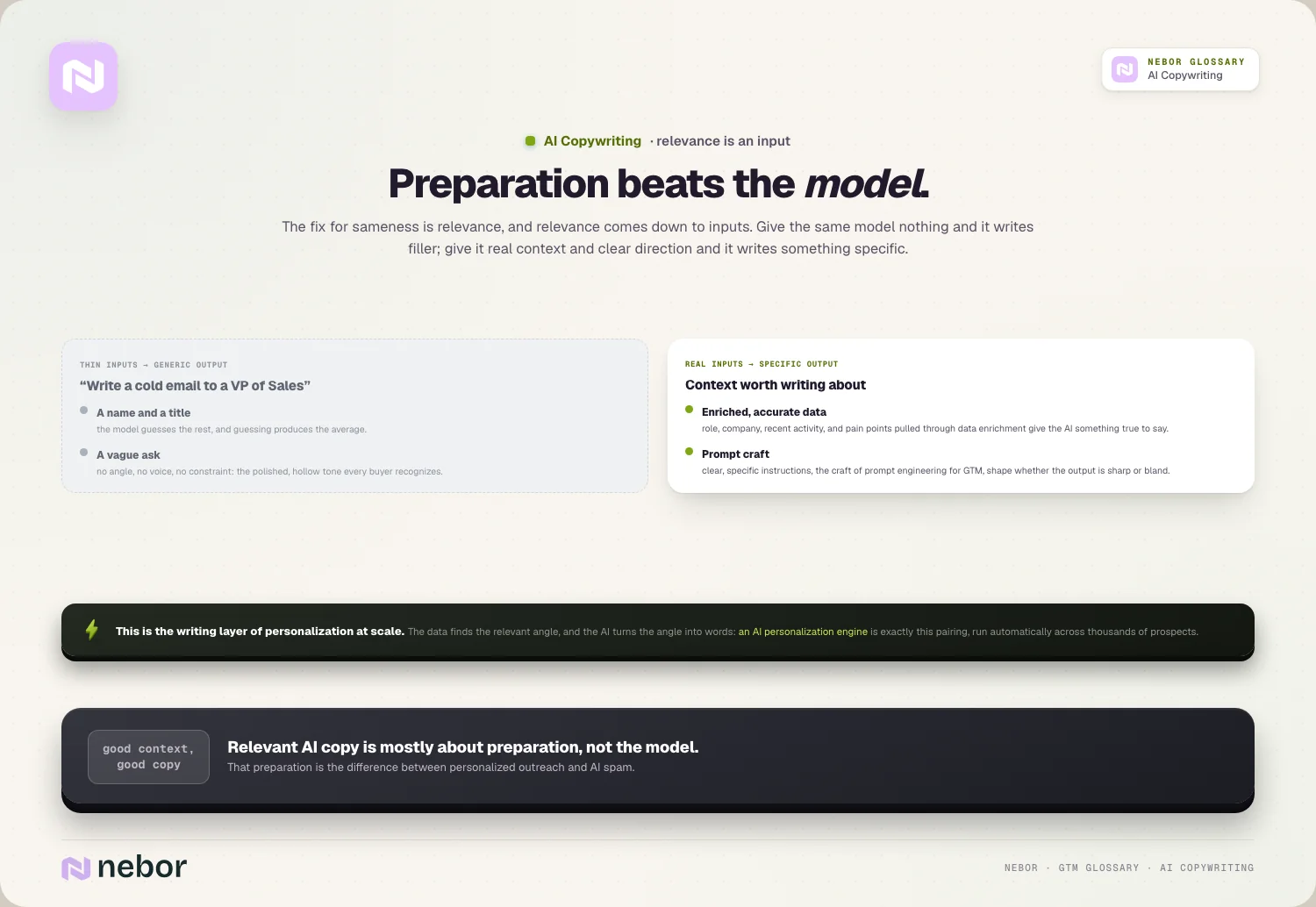
That in turn depends on good data, because pulling accurate context through data enrichment is what gives the AI something true to write about, rather than guessing from a name and a title.
It also depends on how you ask. Clear, specific instructions, the craft of prompt engineering for GTM, shape whether the output is sharp or bland.
So relevant AI copy is mostly about the preparation instead of the model. With good context and clear direction it writes well, and that's the difference between personalized outreach and AI spam.
How does AI copywriting relate to personalizing at real scale?
AI copywriting and personalization are deeply linked, because one is the engine for the other.
The goal of personalization at scale is relevant outreach across many prospects at once. AI copywriting is what makes producing that volume of tailored copy possible.
The deepest version is hyper-personalization, weaving specific, real-time context into each message. AI is what writes those individualized messages without a human drafting each one.
This is often packaged as an AI personalization engine, a system that combines data and AI copywriting to generate tailored messages automatically.
So AI copywriting is the writing layer of personalized outbound. The data finds the relevant angle, and the AI turns that angle into the actual words, at a scale no team could match by hand.
Why does AI copywriting still need a human in the driver's seat?
The most important principle in AI copywriting is that it doesn't replace the writer, it assists them. Removing the human entirely is where it goes wrong.
AI handles the heavy lifting, since it can draft, research, and produce variations fast, which removes the grunt work of writing the first version of every message.
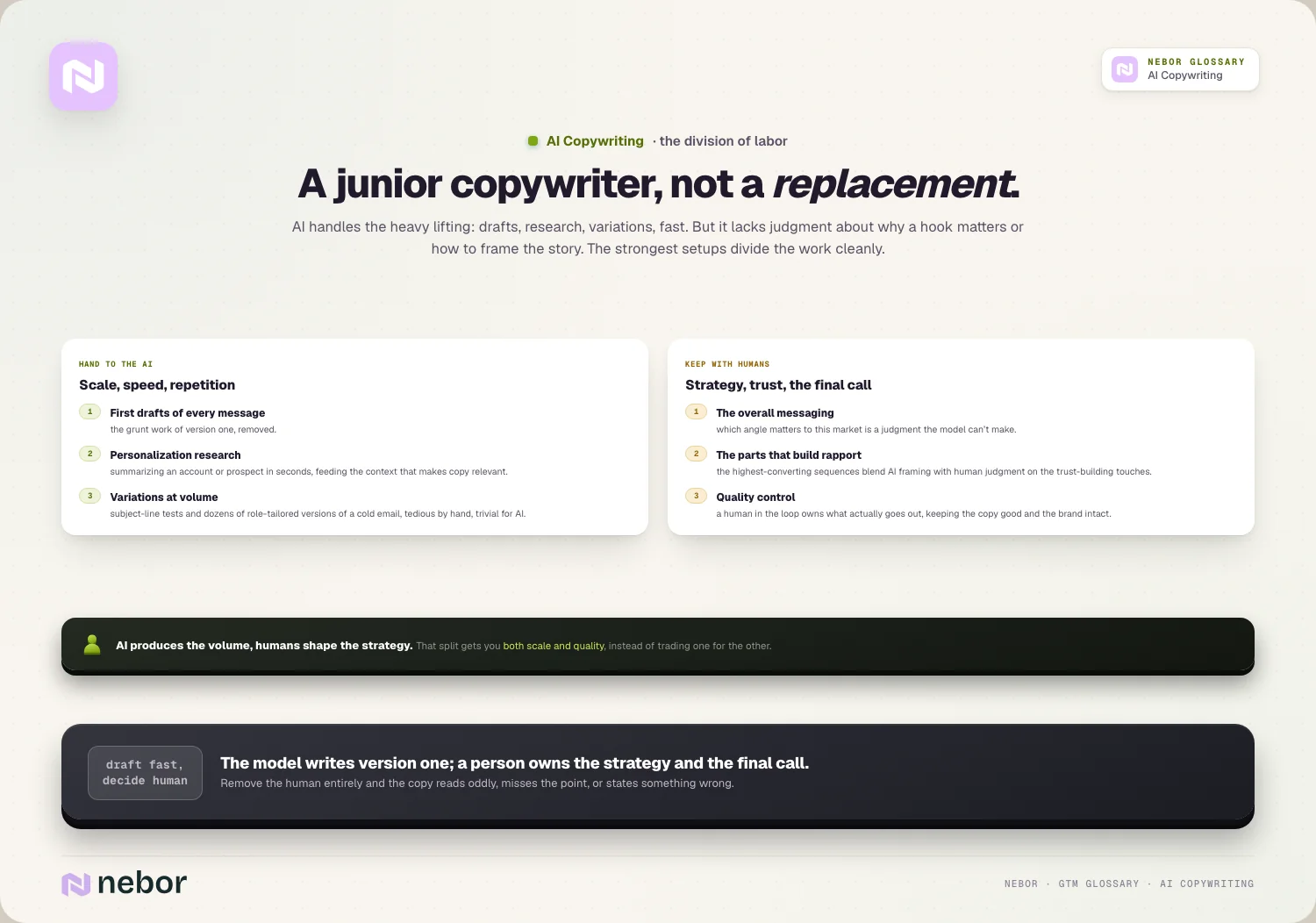
What it lacks is judgment about the buyer. AI can surface a relevant hook, but it can't always tell why that hook matters to the prospect or how to frame the narrative around it, which is where humans add value.
This is why a human in the loop matters so much. The highest-converting sequences we build blend AI-generated framing with human judgment, especially on the parts that build trust.
So the model works as a junior copywriter instead of a replacement. It writes the first draft and the variations, while a person owns the strategy, the quality, and the final call, and that split keeps the copy good and the brand intact.
What should you use AI copywriting for, and what should you keep human?
Knowing where to use AI and where to keep humans is the practical heart of getting this right. The split follows what each is good at.
AI takes the scale-and-speed work, because first drafts, personalization research, subject-line variations, and adapting a message across many prospects are exactly where it shines.
The repetitive parts belong to it too, like generating dozens of versions of a cold email tailored to different roles, which is tedious by hand and trivial for AI.
Humans keep the strategy and the trust, because the overall messaging, the angle that matters, and the parts of a sequence that build real rapport are where human judgment outperforms.
So the strongest setup divides the work cleanly. AI produces the volume and the variations, and humans shape the strategy and review the output, which gets you both scale and quality.
How does AI copywriting fit into your wider outbound system?
AI copywriting isn't a standalone tool, it's one layer in a larger outbound motion. It works best wired into everything around it.
It feeds your sequences first, as AI-drafted messages flow into your email sequence and your cadence, so the copy across many touches gets produced and tailored at scale.
It also powers the AI sales roles, because the writing an AI SDR produces is AI copywriting in action, generating the outreach that role sends.
And it connects to automation, where AI copy is most useful as part of a system that can automate sales prospecting end to end, rather than a chatbot you copy and paste from.
So AI copywriting is the writing component of automated outbound. It produces the words, while the rest of the system handles the data, the sending, and the follow-up around them.
Does AI copywriting actually improve results, or is it just hype?
It's fair to ask whether AI copywriting pays for itself, and the evidence is encouraging when the tool is used well, because relevance is what drives the gains.
Personalization is where the lift comes from. Personalized emails can drive around 20% higher open rates and a large lift in click rates, and AI is what makes that personalization scalable.
Teams using AI for sales report real efficiency gains. Many see 10 to 15% higher efficiency and meaningfully more leads from applying AI across their motion.
The key qualifier is that the gains come from relevance instead of volume. AI copy lifts results when it's targeted, and it hurts when it's just high-volume generic outreach.
So AI copywriting improves results as a relevance tool instead of a volume tool. The teams that win use it to be more personal at scale, which is where its real value lies and where the numbers move.
What makes AI copy sound human instead of obviously generated?
The difference between AI copy that lands and AI copy that flops is often tone. A few habits make the output feel like a person wrote it.
The first is feeding it your voice. Giving the model examples of how you really write, rather than letting it default to its generic style, shifts the output toward something recognizably yours.
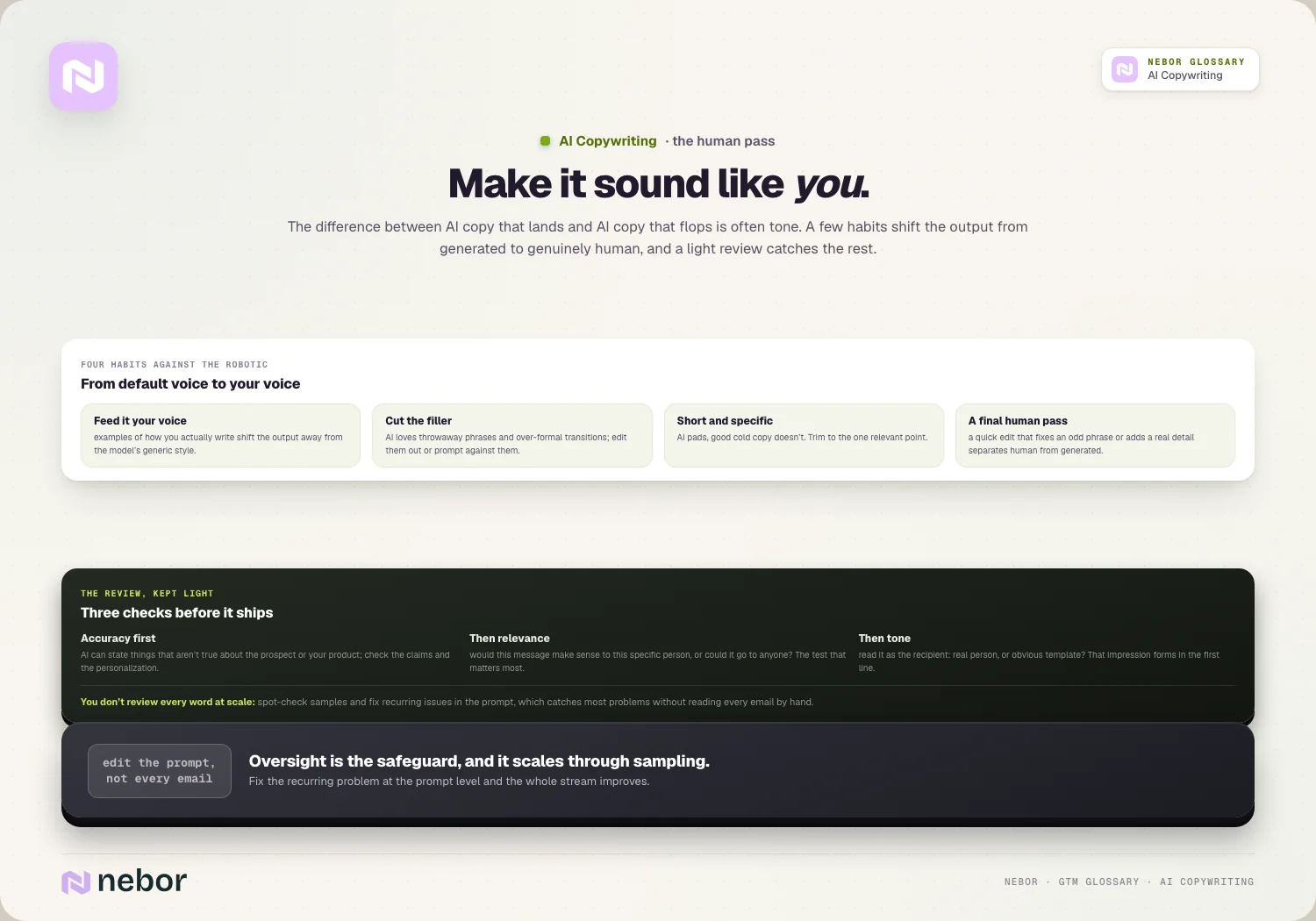
The second is cutting the filler out of the drafts. AI loves throwaway phrases and over-formal transitions, so editing those out, or prompting against them, makes the copy tighter and more natural.
The third is keeping it short and specific. AI tends to pad, while good cold copy is brief and concrete, so trimming to the one relevant point usually improves it.
The fourth is a final human pass. Even a quick edit to fix an odd phrase or add a real detail is often what separates copy that reads as human from copy that reads as generated.
How should you review AI-written outreach without slowing down?
Since human oversight is the safeguard, it helps to know what to check. A light but consistent review catches most problems.
Accuracy comes first, because AI can state things that aren't true about a prospect or your product, so the first check is whether the claims and personalization are correct.
Relevance comes right behind accuracy in the checklist. The question is whether the message would make sense to this specific person, or whether it's generic enough that it could go to anyone, which is the test that matters most.
Tone is the last thing to check. You read it as the recipient and ask whether it sounds like a real person or an obvious template, because that impression forms in the first line.
You don't have to review every word at scale. We tell clients to spot-check samples and fix recurring issues in the prompt, which catches most problems without reading every email by hand.
Does AI copywriting work beyond cold email and outbound work?
AI copywriting is often associated with cold outreach, but it applies across far more of your writing. The same tool helps wherever you produce copy.
It drafts your inbound and nurture content, because follow-ups to leads, nurture emails, and replies can all be drafted by AI and then tailored, which speeds up your warm motion too.
It supports your marketing copy as well, with landing pages, ad variations, and social posts all being places AI can produce first drafts and alternatives for a human to refine.
And it assists with research and summaries, because beyond writing outreach, AI can summarize an account or a prospect in seconds, which feeds the context that makes the actual copy relevant.
So AI copywriting works as a broad writing assistant instead of just a cold email tool. Anywhere you write to prospects or customers, it can handle drafts and variations while a human keeps it sharp.
What are the common AI copywriting mistakes that get you deleted?
AI copywriting fails in a few predictable ways. Most come from trusting the machine too much.
The first is using it to blast generic copy, because producing more bland AI outreach just speeds up the thing buyers ignore, which is the opposite of the goal.
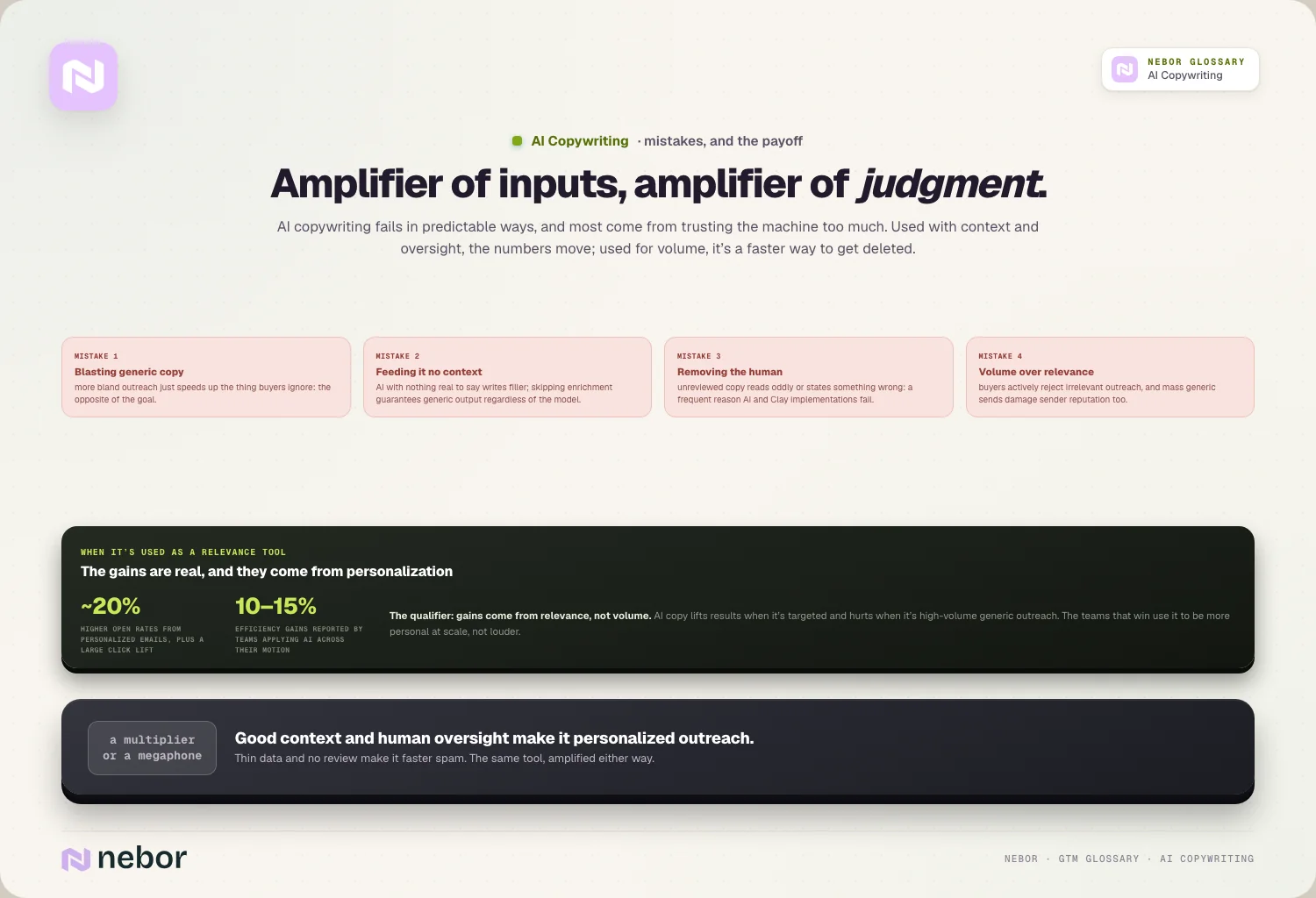
The second is feeding it no context, because AI with nothing real to say writes filler, so skipping enrichment guarantees generic output no matter how good the model is.
The third is removing the human entirely, where unreviewed AI copy can read oddly, miss the point, or state something wrong, which is a frequent reason AI and Clay implementations fail.
The fourth is chasing volume over relevance. With buyers actively rejecting irrelevant outreach, sending more generic messages digs the hole deeper, and it can damage your sender reputation too.
Why AI copywriting multiplies whatever judgment you bring to it
AI copywriting changed the math by making relevant, personalized writing possible at a scale no team could reach by hand. The trouble is that the same power makes generic spam just as easy to produce.
The deeper truth is that AI copywriting multiplies whatever you feed it. Good context and human oversight turn it into personalized outreach, while thin data and no review turn it into faster spam.
The honest framing is that it works as an assistant instead of a replacement. The best results come from letting AI draft, research, and vary the copy while humans own the strategy and the quality.
So if your AI-written outreach is getting ignored, the answer usually isn't more volume or a better model. It's better context and a human shaping the message.
That combination is what turns AI copywriting from inbox noise into outreach worth reading. When you do it right, it's a genuine multiplier inside a modern go-to-market system, and when you do it wrong, it's just a faster way to get deleted.
Share this post
Personalization
AI
Content
Glossary
Related glossary items
Understanding the core GTM concepts


Ready to build your pipeline











