
In this post:
Every year someone declares outbound sales dead. Inboxes are crowded, cold calls get ignored, and spray-and-pray clearly doesn't work anymore, so the conclusion seems obvious.
The conclusion is wrong every single time. What died is bad outbound, the high-volume, low-relevance version, while targeted, disciplined outbound is still one of the most reliable ways to build pipeline.
Outbound sales is the practice of proactively reaching out to prospects who haven't expressed interest yet, to start sales conversations and create opportunities. You go to the buyer rather than waiting for the buyer to come to you.
That's the core difference from inbound, where prospects find you first. Outbound puts you in control of who you target and when, and that control is exactly why it stays valuable even as the tactics keep changing.
TL;DR
Outbound sales means proactively contacting prospects who haven't raised their hand, through channels like email, LinkedIn, and phone, to start conversations and generate pipeline.
Control is the draw, because inbound depends on people finding you, while outbound lets you choose your targets and create demand on purpose, so most B2B teams use both.
The version that works today is precise instead of loud. It's built on a sharp target list, real personalization, and a multi-channel motion, instead of blasting thousands of generic emails.
The warning is that outbound is easy to do badly and unforgiving when you do. Poor targeting, weak infrastructure, or generic messaging will sink it, so the fundamentals underneath matter as much as the outreach itself.
So what is outbound sales exactly, and what makes it outbound?
Outbound sales is any motion where you make the first move. You identify companies and people who fit your market, build them into your pipeline plan, and reach out to start a conversation before they've shown any interest in you.
That's the defining trait, the proactive first contact. Nobody filled out a form or downloaded anything, you decided they were a good fit and went after them deliberately.
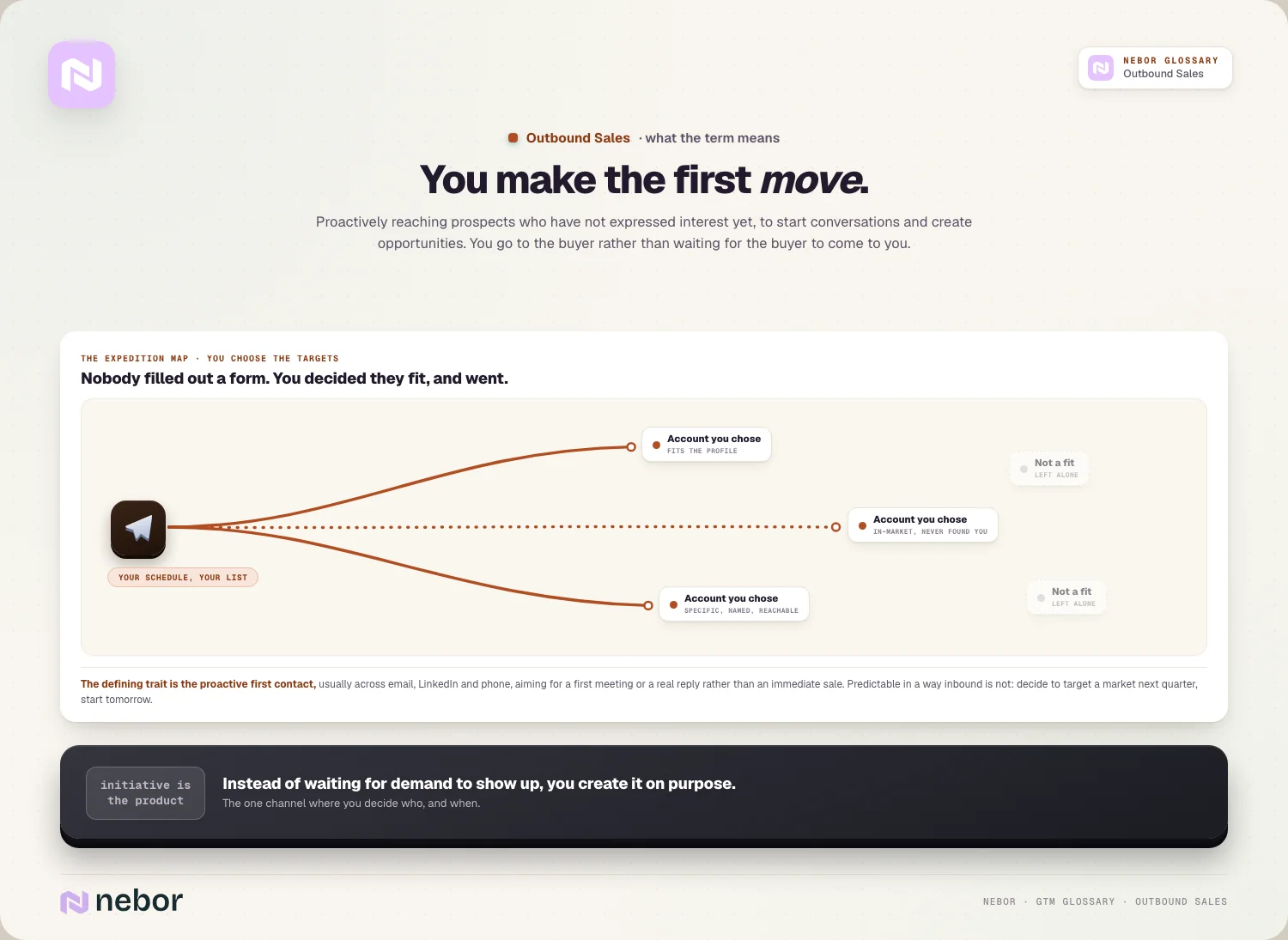
It usually works across a few channels. Email, LinkedIn, and phone are the core of most sequences, often combined, with the goal of landing a first meeting or a real reply instead of an immediate sale.
The whole point is initiative, because instead of waiting for demand to show up, you create it by putting your offer in front of the right people at the right time, on your schedule.
This makes outbound predictable in a way inbound isn't. You can decide to target a specific market next quarter and start tomorrow, instead of hoping the right people happen to find your content.
How is outbound sales different from the inbound beside it?
The cleanest way to understand outbound is to set it next to inbound. They solve the same problem, pipeline, from opposite directions.
Inbound waits for the interest to arrive. You publish content, buy ads, and build presence, so prospects discover you and reach out when they're ready, which means you're capturing demand that already exists.
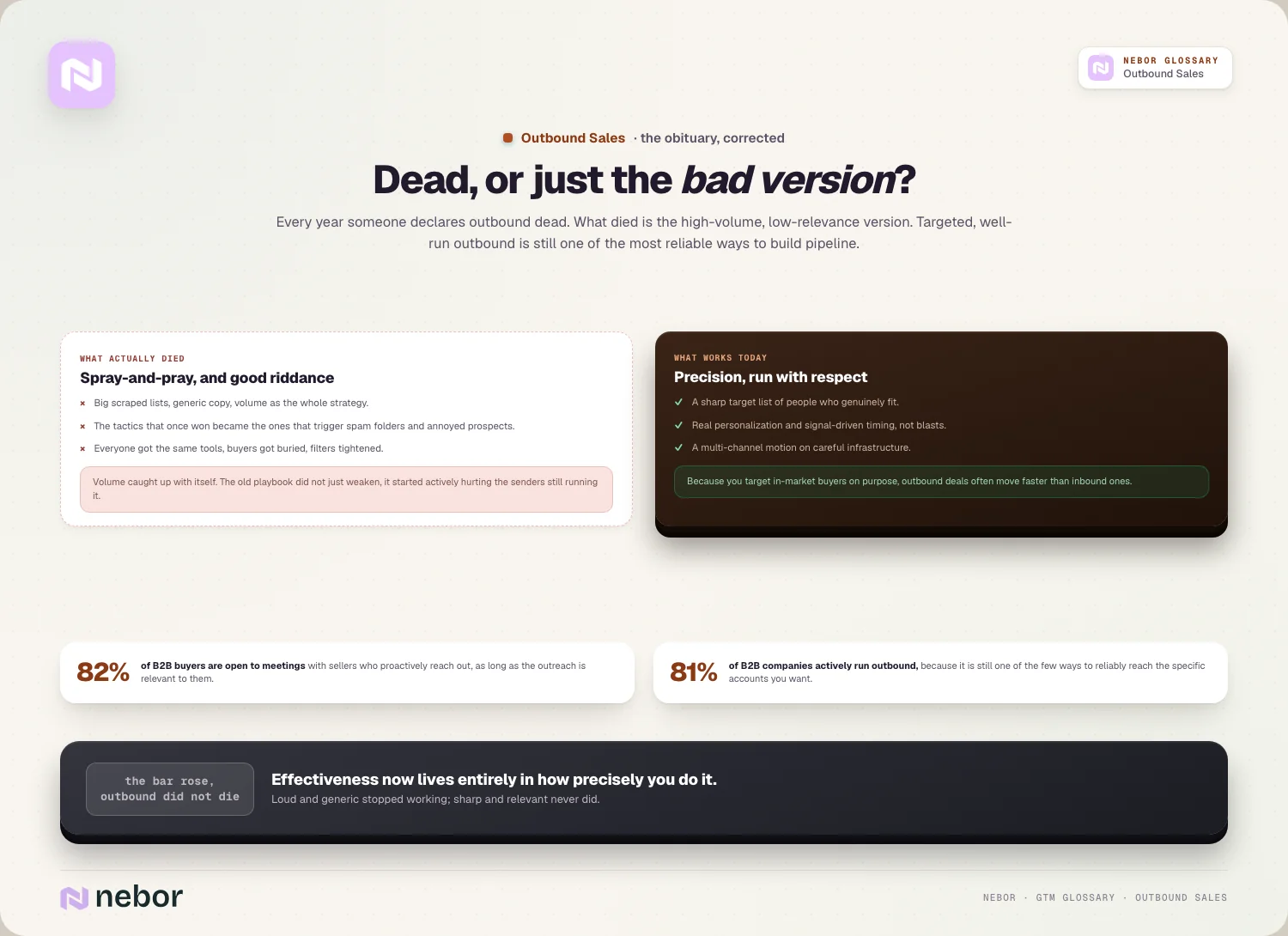
Outbound goes out and creates the interest itself. You pick your targets and start the conversation, which means you can reach in-market buyers who would never have found you on their own, on a timeline you control.
Each carries real trade-offs, because inbound leads are often warmer and cheaper at scale, while outbound gives you control, speed, and access to specific accounts you'd otherwise miss entirely.
The numbers cut both ways, which is the point. Inbound tactics can generate around 54% more leads than traditional outbound, yet outbound remains the best-performing source for smaller companies, with roughly 3x greater average deal values than inbound in that segment.
Is outbound sales still effective, or did the critics finally win?
This is the question clients ask us most, so let's answer it directly with evidence. The short version is yes, when it's done with precision.
Buyers are more open to outreach than the doom takes suggest. Around 82% of B2B buyers are open to meetings with sellers who proactively reach out, as long as the outreach is relevant to them.
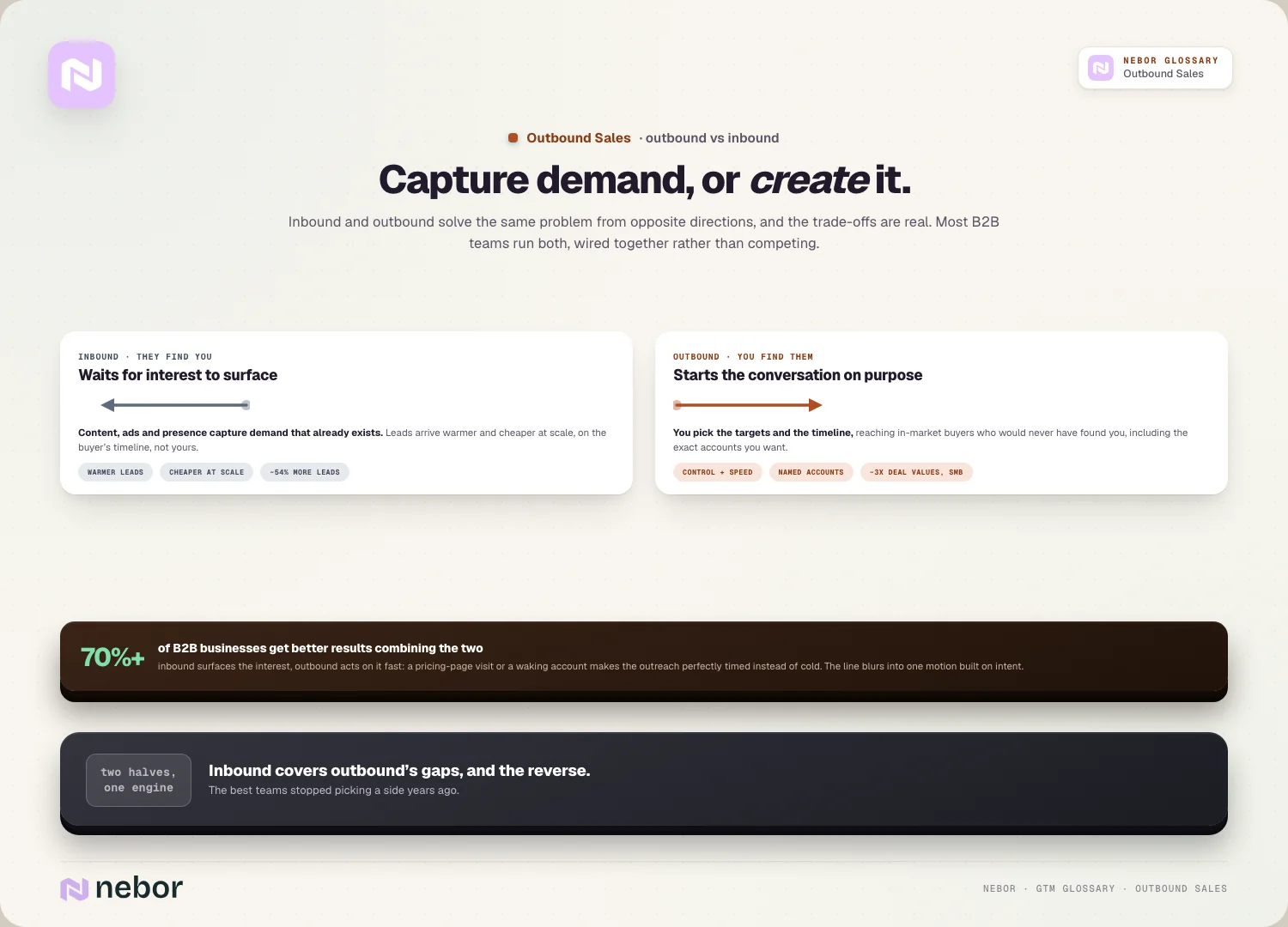
Outbound closes differently too, because targeting in-market buyers on purpose means outbound deals often move faster than inbound, since you're not waiting for someone to slowly self-educate and convert.
And adoption is high for a reason. Around 81% of B2B companies actively do outbound lead generation, because it's still one of the few ways to reliably reach specific accounts you've decided you want.
What's true is that the bar has risen. Generic, high-volume outbound really has stopped working, so the effectiveness now lives entirely in how precisely and respectfully you do it.
Why does great outbound begin with who you choose to target?
The biggest mistake we watch teams make in outbound is starting with the email. Targeting comes first, because reaching the wrong people perfectly is still a waste.
It all begins with your ideal customer profile. A sharp ICP defines exactly which companies are worth your time, by size, industry, and the traits that signal they'll actually buy.
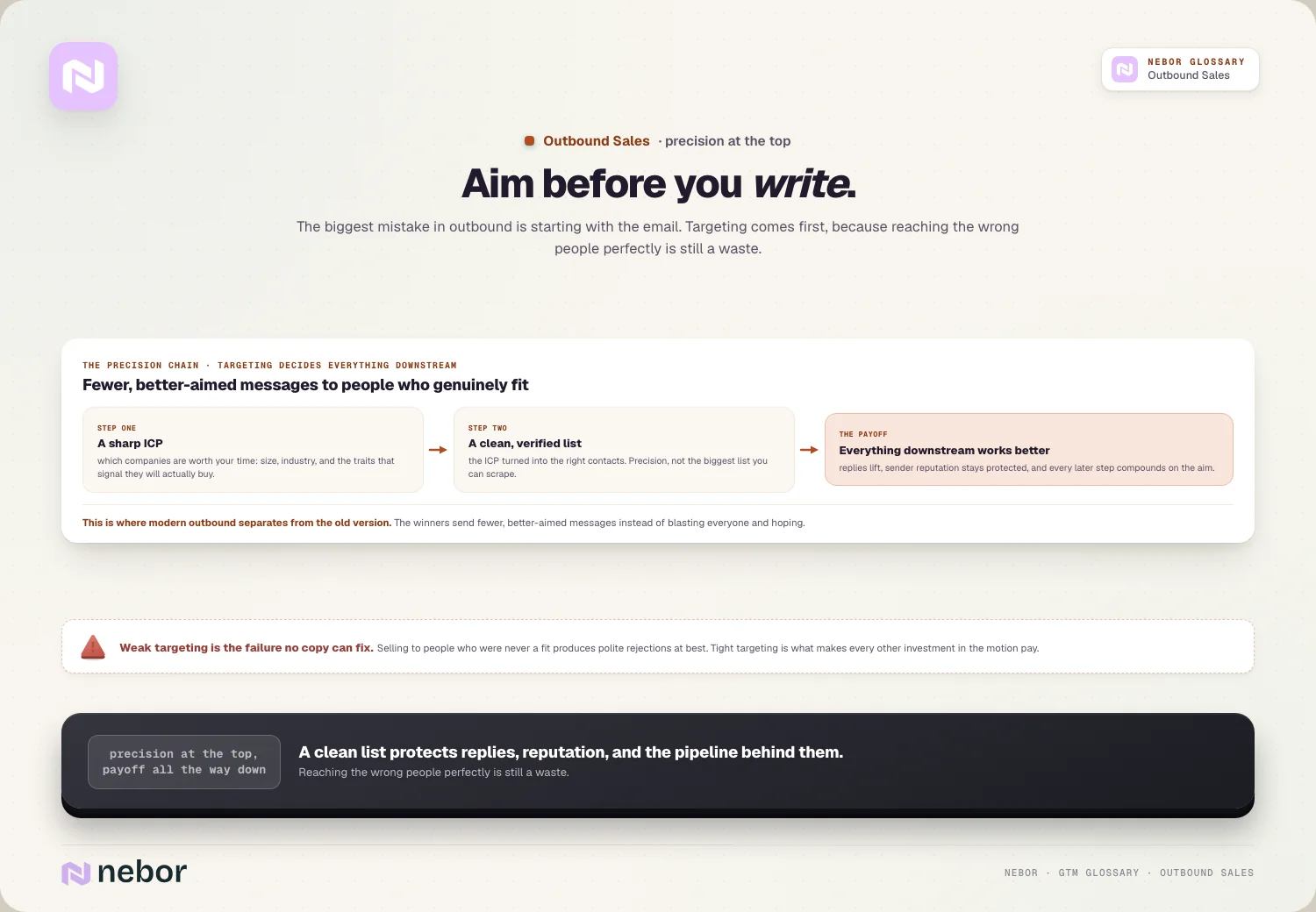
From there, targeting becomes a precision exercise. Good list building turns your ICP into a clean, verified set of the right contacts, instead of the biggest list you can scrape.
This is where modern outbound really separates from the old version. The winners send fewer, better-aimed messages to people who genuinely fit, instead of blasting everyone and hoping.
The payoff compounds all the way down the funnel, because tight targeting lifts your reply rates, protects your sender reputation, and makes every later step work better, and that's the reason precision at the top decides everything downstream.
What does the outbound motion look like once it's live?
Once you know who to reach, outbound becomes a coordinated sequence of touches. It's rarely one email, it's a planned series across channels.
The modern standard is a multi-channel outreach motion. You combine email, LinkedIn, and phone in a deliberate order, so you reach each prospect where they actually pay attention.
Cold email is usually the backbone, carrying the most detail and scaling the best. It's a structured sequence rather than a single send, with follow-ups that add something each time.
LinkedIn outreach adds a softer, relationship-led touch, and a well-timed call cuts through when the other channels have built some familiarity, so together they form one patient motion.
Writing this down so the whole team follows it the same way is the job of an outbound playbook. The playbook turns the motion from one rep's instinct into a repeatable system.
Why does infrastructure decide whether outbound works at all?
Here's the part beginners skip and regret. You can have perfect targeting and great messaging, and still fail if your technical foundation is broken.
The foundation is your cold email infrastructure. This is the domains, mailboxes, authentication, and warmup that decide whether your emails reach the inbox or vanish into spam.
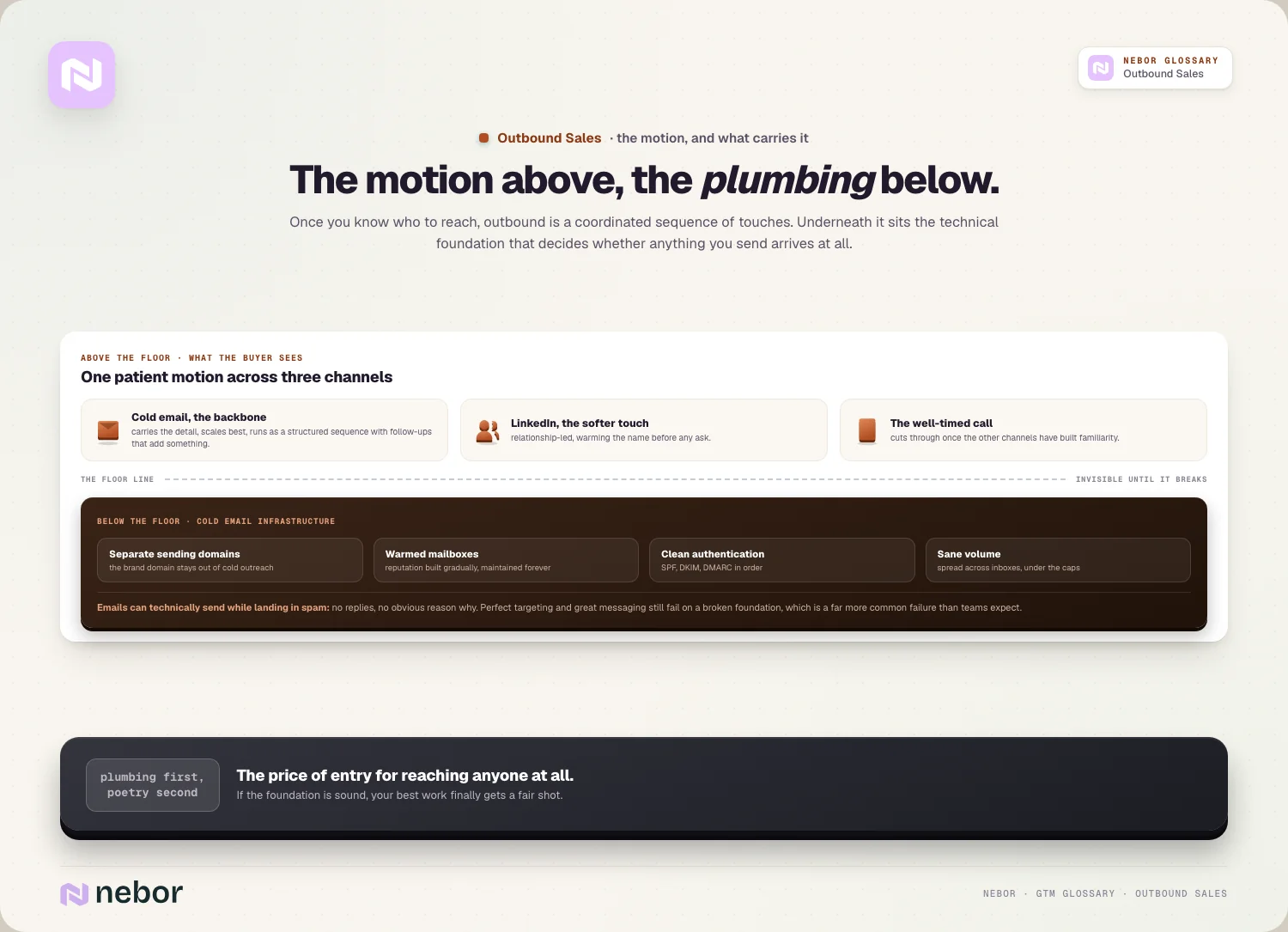
Deliverability is invisible until it breaks, and that invisibility is the danger. Your emails can technically send while landing in spam, so you get no replies and no obvious reason why, which kills the whole motion in silence.
This is why serious outbound treats infrastructure as a first-class concern instead of an afterthought. Separate sending domains, warmed mailboxes, and clean authentication are the price of entry for reaching anyone at all.
If the plumbing is sound, everything above it finally gets a fair shot. If it's broken, even your best targeting and copy never arrive, which is a far more common failure than teams expect.
How does outbound connect to inbound instead of competing with it?
The framing of outbound versus inbound is mostly a false choice. The best teams don't pick one, they wire the two together.
The data is blunt on this question. More than 70% of B2B businesses say combining inbound with proactive outreach produces better results than either alone, because the two cover each other's gaps.
The most powerful version is inbound-led outbound. Instead of cold-targeting from scratch, you use signals from your own channels to decide who to reach, which makes outbound far warmer.
This is where buying signals change the game. When someone visits your pricing page or a target account starts engaging, outbound to that person isn't cold anymore, it's perfectly timed.
So treat outbound and inbound as two halves of one engine. Inbound surfaces interest and outbound acts on it, and the line between them blurs into a single motion built around real intent.
What are the most common ways outbound goes wrong for teams?
Outbound fails in predictable ways, and in our experience almost all of them are avoidable. Knowing the usual traps is half the battle.
The first is chasing volume over relevance. Blasting huge generic lists feels productive, but it tanks reply rates, burns your domain, and trains buyers to ignore you.
Skipping infrastructure is the second, because teams launch big campaigns on a cold primary domain with no warmup, then wonder why nothing lands, when the answer is deliverability.
Weak targeting is the third, because selling to people who were never a fit produces polite rejections at best, and it's a problem no clever copy can fix.
The fourth is treating outreach as a one-shot. Most replies come from follow-up, so your reps who send once and give up leave most of their pipeline on the table.
How do you measure whether your outbound is really working or not?
Outbound is one of the most measurable motions in sales, which is both its gift and its pressure. You can see exactly where it breaks if you track the right things.
The top of the funnel comes first, where you watch how many contacts you reach, your reply rate, and your positive reply rate, because those tell you whether your targeting and messaging are landing.
From there you follow it down, because meetings booked, opportunities created, and pipeline value show whether those replies turn into business, or whether you're generating noise that never converts.
The real use of these numbers is diagnosis. If replies are strong but meetings are weak, the problem is in qualification or handoff instead of your opener, and the metrics point you straight to it.
Cost matters too, because tracking what it costs to book a meeting or create an opportunity keeps outbound honest, given that a motion booking meetings nobody can close isn't working.
The discipline of measuring is what lets outbound improve. With clean numbers and a consistent motion, you can test one thing at a time and learn, instead of guessing what changed.
Why did outbound have to change so much over the last decade?
It helps to understand why the old playbook stopped working, because it explains what good outbound looks like now. The shift came down to volume catching up with itself.
A decade ago, sending a lot of decent emails worked. Inboxes were less crowded, tools made mass sending easy, and the sheer numbers produced replies even with weak personalization.
Then everyone got the same tools at once, buyers were buried in generic outreach, providers tightened their spam filters, and the high-volume approach started hurting more than it helped.
That saturation is what killed spray-and-pray, while outbound itself survived. The exact tactics that once won, big lists and generic copy, became the ones that now trigger spam folders and annoyed prospects.
So outbound adapted toward precision, with better data, real personalization, signal-driven timing, and careful infrastructure replacing raw volume, and that's the reason modern outbound looks so different from its older self.
Who should own your outbound, in-house, outsourced, or a system?
A fair question once you commit to outbound is who does the work. The honest answer has shifted a lot in the last few years.
The classic options are an in-house team or an outsourced one. Each has trade-offs, and the real question underneath that debate is who owns the system you build.
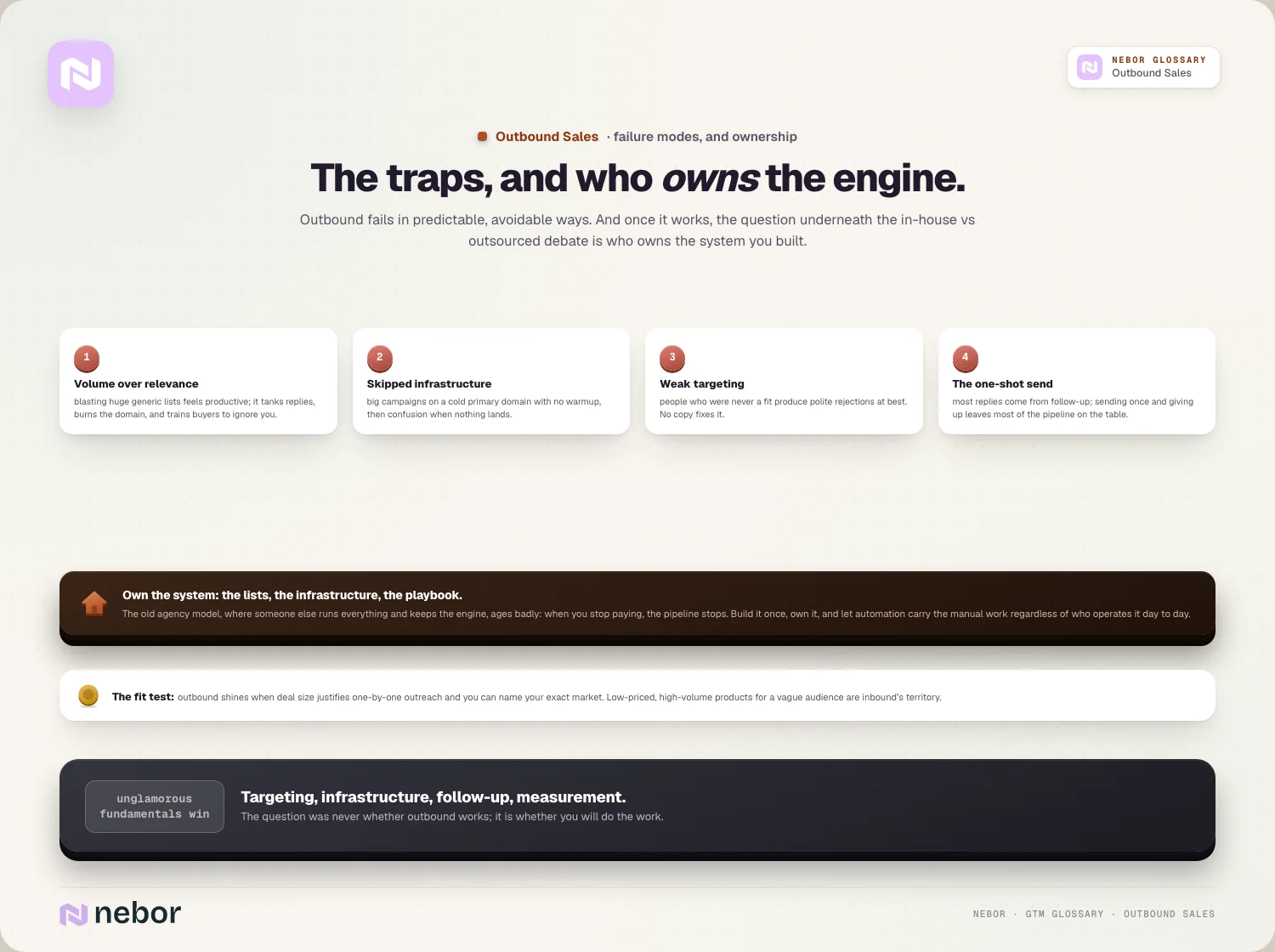
The older outsourced model, where an agency handles everything and keeps the engine, is exactly the part that has aged badly. When you stop paying, the pipeline stops, which is the core flaw in classic SDR as a service.
The modern answer leans on systems and automation. A lot of the manual prospecting work can now be built once and repeat on its own, which is what it means to automate sales prospecting instead of throwing bodies at it.
Whatever you choose, one principle holds either way. The value lives in owning your outbound system, the lists, the infrastructure, and the playbook, so the pipeline keeps going regardless of who operates it day to day.
Does outbound make sense for every business and every deal size?
Outbound is powerful, but it isn't equally right for everyone. It pays to know whether your business is a natural fit before you pour resources into it.
Outbound shines when your deals are worth enough to justify the effort of reaching people one by one. Higher-value B2B deals can absorb the cost of targeted outreach, and that's the reason outbound often produces larger deals than inbound.
It also fits when you have a clear, definable target market. If you can name the exact companies and roles you want, outbound lets you go straight at them instead of waiting to be found.
Where outbound struggles is with very low-priced, high-volume products sold to a huge, vague audience. There, the cost of personal outreach rarely pays back, and inbound or self-serve usually wins.
So the question isn't whether outbound works in general. It's whether your deal size and target market make proactive outreach worth it, which for most B2B companies, it clearly is.
Why outbound is the channel where you get to decide who's next
Outbound sales isn't dead, and the people who keep saying so are usually describing the version that deserved to die. Loud, generic, untargeted outbound stopped working, and good riddance.
What's left is sharper and more effective than ever. Precise targeting, real personalization, solid infrastructure, and a multi-channel motion that respects the buyer's attention still build pipeline reliably.
The deeper truth is that outbound is the one channel where you decide. Instead of waiting for the right buyers to find you, you go and start the conversation, on your terms and your timeline.
So the question was never whether outbound works. It's whether you're willing to do the unglamorous fundamentals that make it work, which is exactly where it fits inside a complete go-to-market system built to generate pipeline on purpose.
Share this post
Outbound
Glossary
Related glossary items
Understanding the core GTM concepts




Ready to build your pipeline











