

In this post:
Most companies obsess over closing the first deal and then move on to the next one. But in any business with recurring or repeat revenue, the first sale is rarely where the money is. The real value of a customer accumulates long after they sign.
That accumulated value is what customer lifetime value measures, and ignoring it leads teams to badly misjudge what a customer is worth and how much they can spend to win one. A customer who looks small at signing can be worth a fortune over years.
Customer lifetime value, written as CLV or LTV, is the total revenue or profit a customer generates over their entire relationship with you. It captures the full worth of a customer instead of just the first transaction.
Nearly every growth decision depends on it. How much you can spend to acquire customers, which of your prospects to pursue, and whether your business is healthy all hinge on what a customer is actually worth over time.
TL;DR
Customer lifetime value is the total revenue or profit a customer generates across their whole relationship with you instead of just their first purchase.
It defines what a customer is worth, which determines how much you can spend to acquire them and whether your growth is profitable.
You estimate it from average revenue, gross margin, and churn, because how long a customer stays and how much they spend over time drive the number.
The caution is that LTV is an estimate built on assumptions, especially about churn. It's most useful read against acquisition cost, where the LTV to CAC ratio reveals whether your unit economics work.
What is customer lifetime value, and what does it really total up?
Customer lifetime value is the total worth of a customer over the entire time they do business with you. Instead of looking at one purchase, it captures the full revenue or profit across the relationship.
It answers a simple question about every account. How much is a customer worth to you in total, from the day they sign to the day they leave?
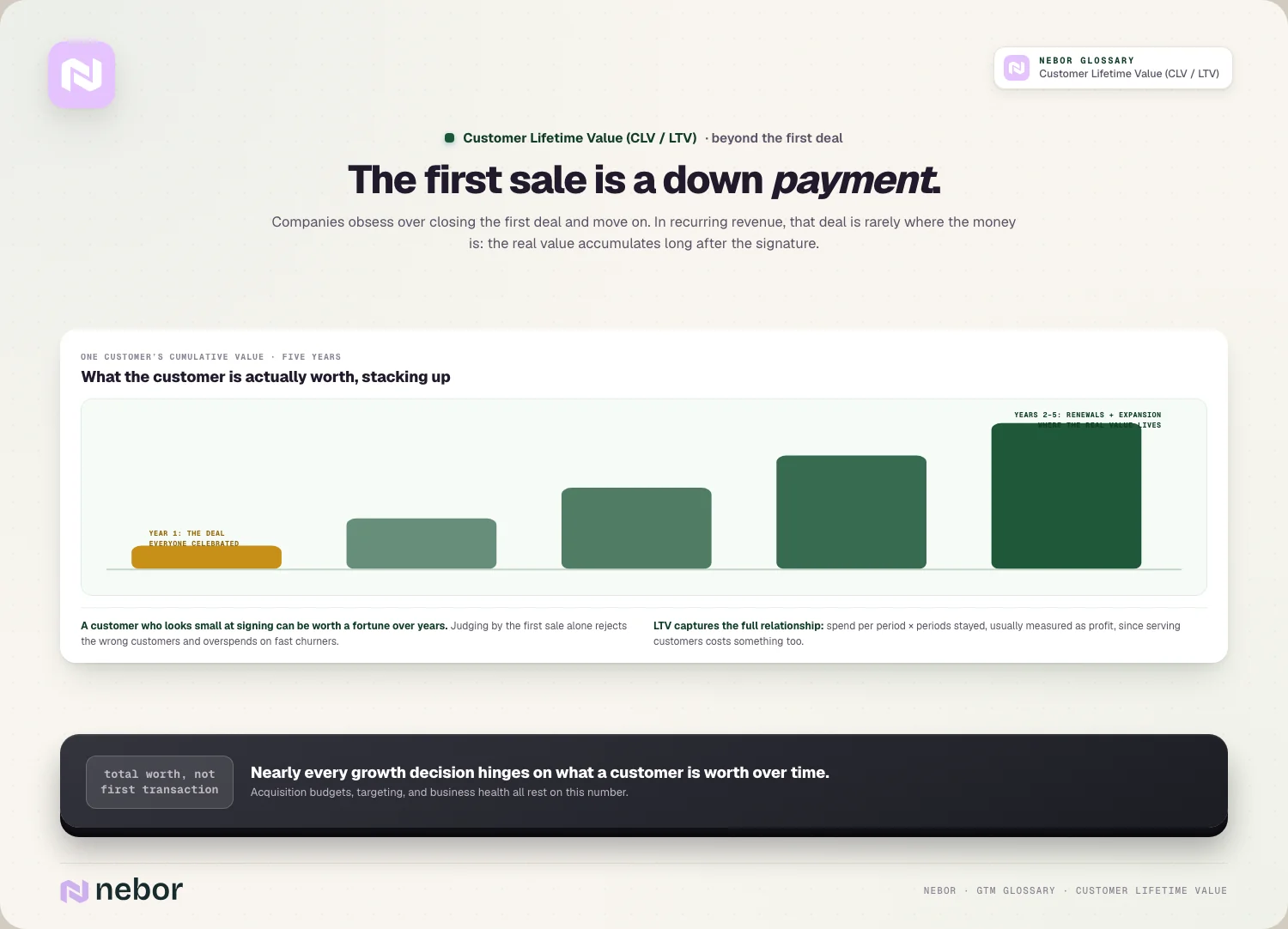
The value comes from two things working together, meaning how much a customer spends per period and how many periods they stay, which together determine their total contribution.
It's usually measured as profit rather than raw revenue, because a true LTV accounts for the gross margin on what a customer pays, and the cost of serving them matters to their real worth.
So LTV is really a measure of a customer's full economic value. It tells you what each customer is worth over their entire lifetime, which is the number most acquisition and retention decisions should rest on.
How do you calculate LTV, and which inputs move the number most?
The LTV formula is simpler than it looks, and in our experience a few inputs do most of the work.
The common approach multiplies and divides three things. You take the average revenue per customer, multiply by gross margin, and divide by the churn rate, which gives the lifetime value.
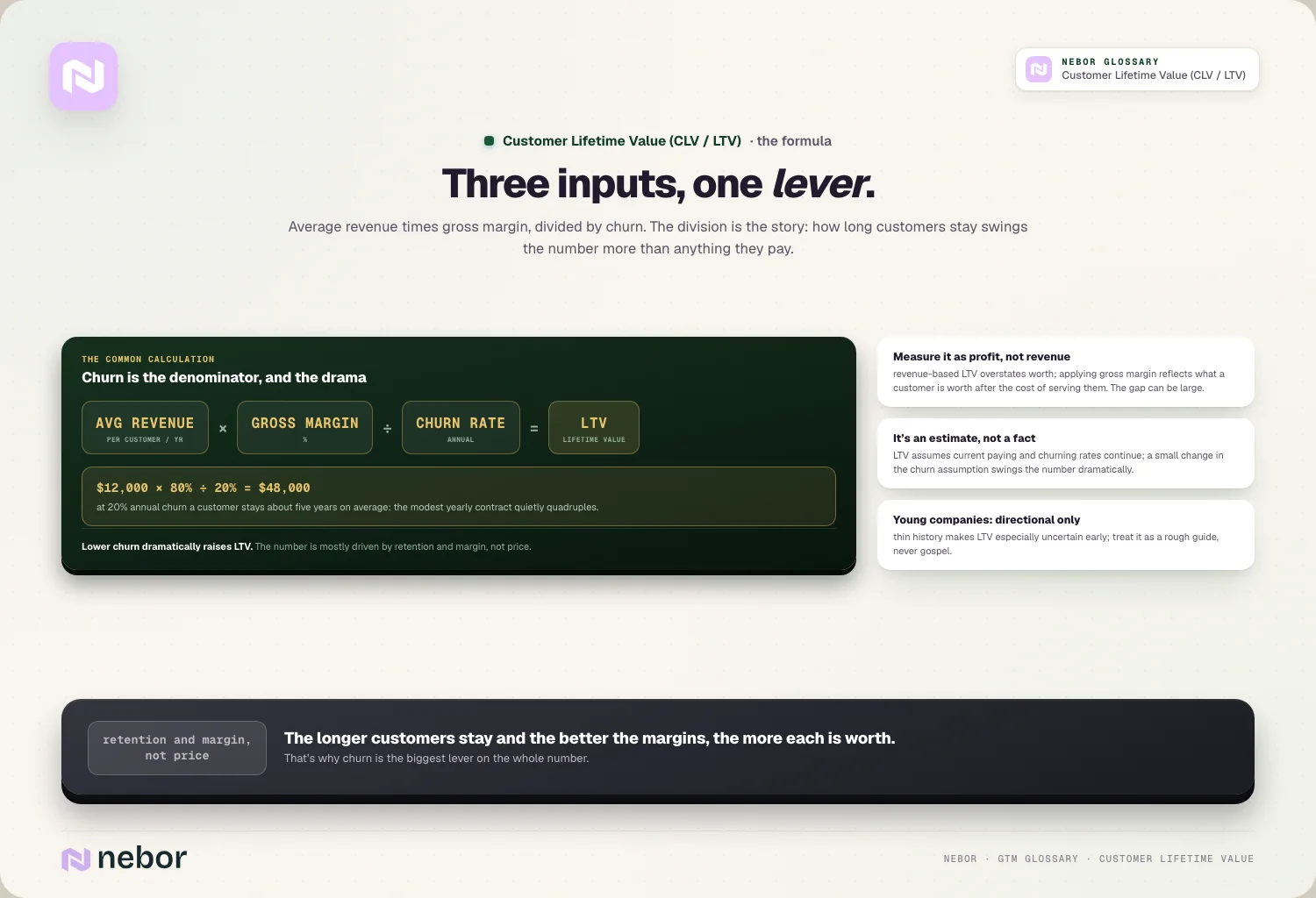
Churn is the lever that moves it most, because dividing by churn captures how long a customer stays, and a customer lifetime value formula based on revenue, margin, and churn shows that lower churn dramatically raises LTV.
A quick example makes the math concrete. If a customer pays $12,000 a year at 80% gross margin and your annual churn is 20%, their LTV is roughly $48,000, because they stay about five years on average.
So LTV is mostly driven by retention and margin instead of price alone. The longer customers stay and the better your margins, the more each customer is worth, and that's exactly why churn matters so much to it.
Why does the first sale understate what a customer is worth to you?
The first sale misleads in ways that shape real decisions, because the initial purchase is just a fraction of the real value.
In recurring models, value compounds over time. A customer who pays a modest amount each month becomes worth far more across years than that first payment suggests.
Expansion adds even more on top, because customers who grow their usage and buy more over time generate expansion revenue that can dwarf their initial spend, pushing LTV well above the first deal.
Judging a customer by the first sale alone causes mistakes. You might reject a customer who looks small at signing but would have been worth a fortune, or overspend on one who churns fast.
So the first sale works like a down payment on the full value. LTV captures what the relationship is worth over time, which is the number that should guide how you treat and pursue customers.
Why does LTV only matter when you read it right next to your CAC?
LTV on its own is interesting, but it becomes powerful when compared to what a customer costs. That comparison is the heart of unit economics.
The pairing is with customer acquisition cost. LTV tells you what a customer is worth, CAC tells you what they cost, and the relationship between them tells you whether acquisition is profitable.
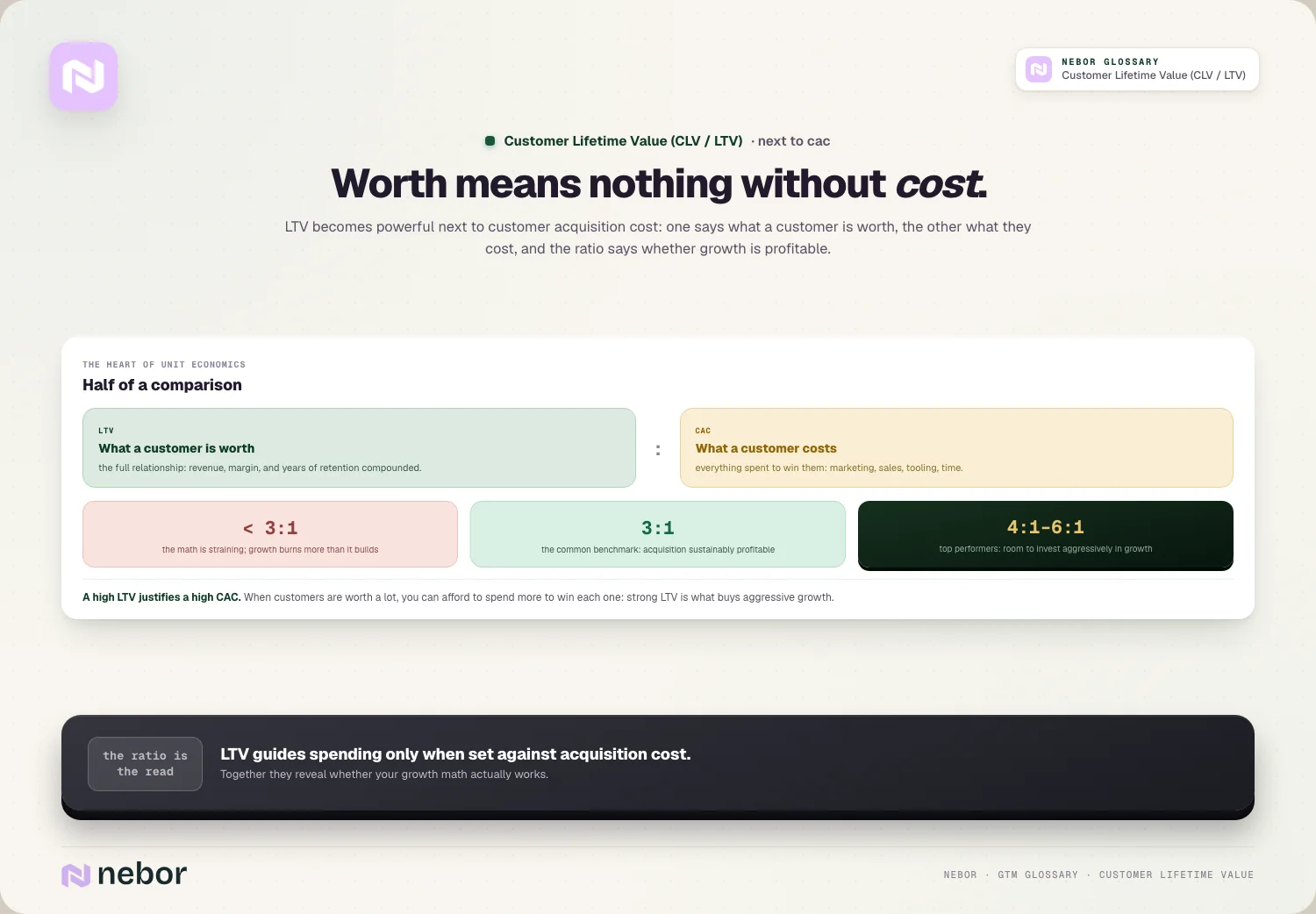
The ratio is where the reading happens. The LTV to CAC ratio compares the two, and the common benchmark is an LTV at least three times CAC, with top performers reaching four to six times.
A high LTV justifies a high CAC. If customers are worth a lot, you can afford to spend more to win them, and that's the reason a strong LTV gives you room to invest aggressively in growth.
So LTV is half of a comparison. The number guides spending only when set against acquisition cost, which together reveal whether your growth math holds up.
How does retention drive LTV more than any other single lever?
Since churn is the biggest lever in the LTV formula, retention deserves a closer look. Keeping customers longer is often the highest-impact way to raise LTV.
Lower churn extends the relationship directly, because every reduction in churn means customers stay longer, which multiplies their lifetime value, often more than raising prices would.
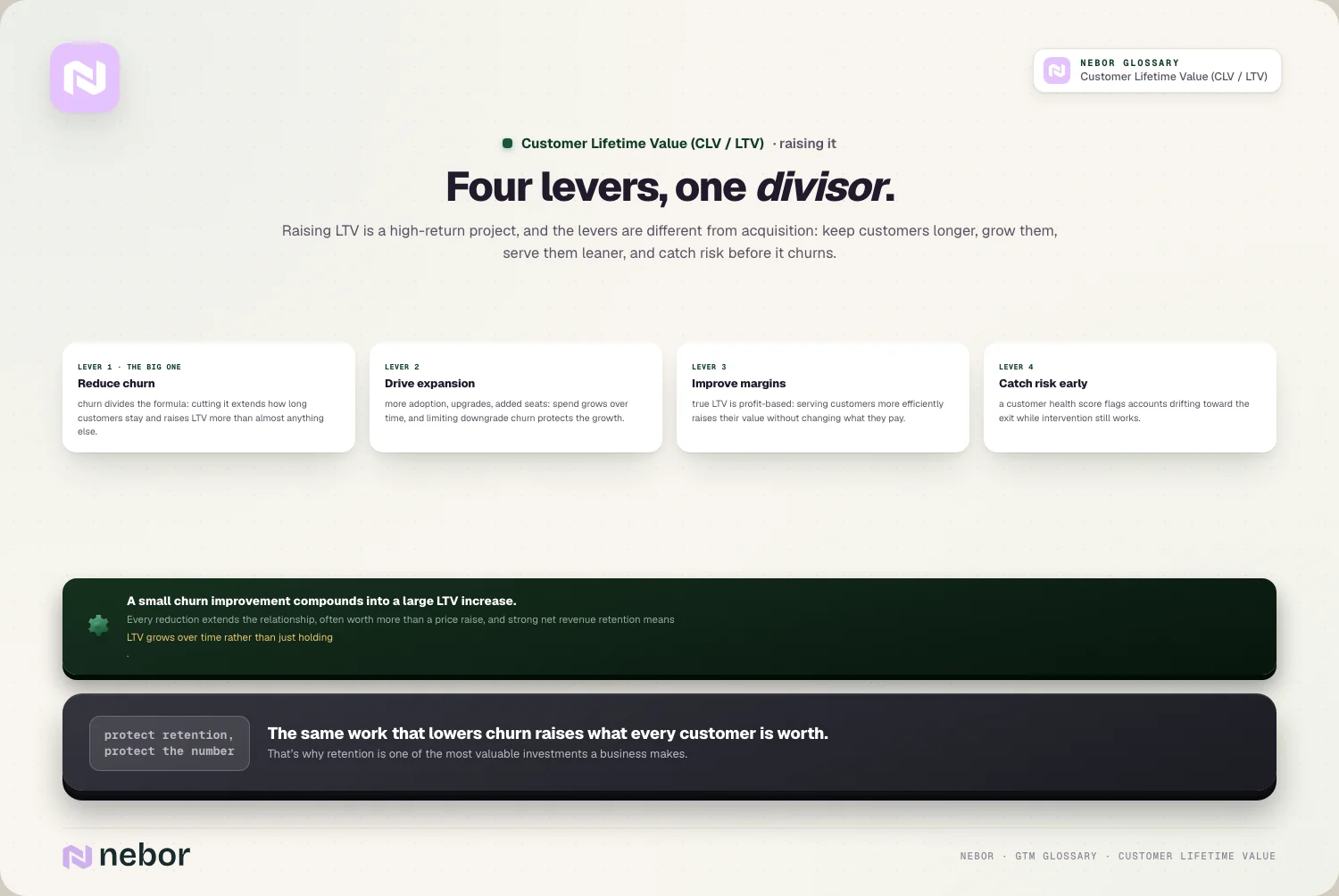
This is why customer churn rate is so tightly linked to LTV. A small improvement in churn compounds into a large increase in what each customer is worth.
Net retention pushes it higher still, because when existing customers expand, strong net revenue retention means LTV grows over time instead of just holding, which is the best case.
So protecting LTV is largely about protecting retention. The same work that lowers churn raises LTV, which makes retention one of the most valuable investments a business can make.
How does LTV shape who you should be targeting in the first place?
LTV isn't only a finance metric, it should guide your go-to-market targeting. Not all customers are worth the same, and LTV tells you which are worth most.
Different segments carry very different LTVs, because some types of customers stay longer, expand more, and churn less, which makes them far more valuable to your pipeline than others over time.
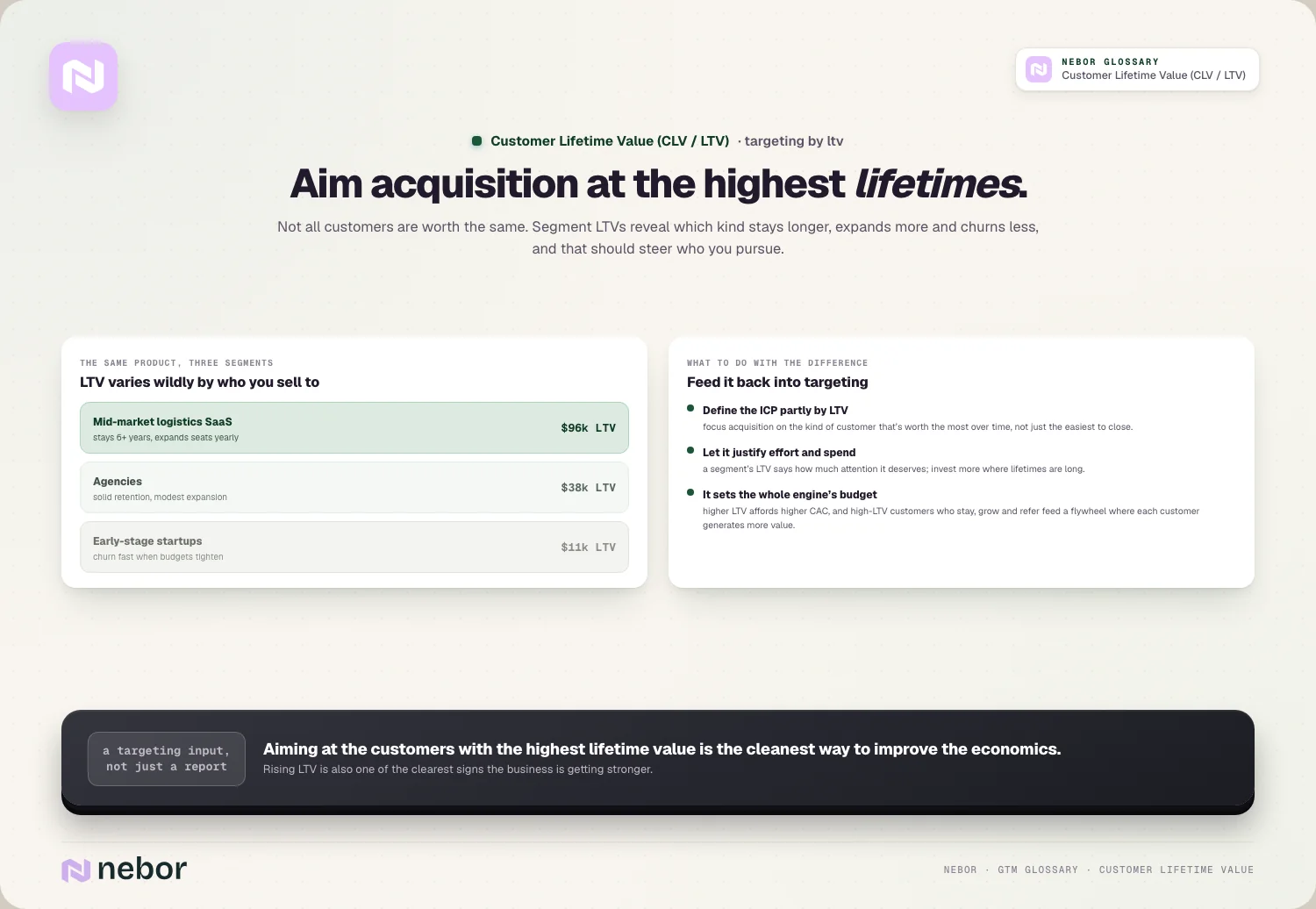
This connects to your ideal customer profile. Defining your ICP partly by which customers have the highest LTV focuses acquisition on the most valuable kind of customer.
It justifies effort too, because knowing a segment's LTV tells you how much attention and spend it deserves, so you can invest more in pursuing high-value customers.
So LTV should feed your targeting as much as your reporting. Aiming your acquisition at the customers with the highest lifetime value is one of the clearest ways to improve your overall economics.
How does LTV fit into the rest of your growth engine's math?
LTV is a foundational input into how your whole business grows, so it connects to everything around it. It sets the economics the rest of the motion depends on.
It defines your acquisition budget first, because a higher LTV means your team can afford a higher CAC, so LTV directly determines how aggressively your revenue engine can spend to grow.
It compounds through referrals and expansion too, because high-LTV customers who stay, grow, and refer others feed a GTM flywheel where each customer generates more value over time.
And it signals health, because a rising LTV means customers are staying longer and spending more, which is one of the clearest signs your business is getting stronger.
So LTV is a hinge for growth strategy. It links retention to acquisition spend and to the long-term value of the business, and that's the reason it is the center of unit economics.
Why is LTV an estimate instead of a hard fact you can bank on?
A common mistake we see is treating LTV as a precise number, when it's really a forecast built on assumptions. Understanding its limits keeps you from misusing it.
It depends on predicting the future, because LTV assumes customers will keep paying and churning at current rates, but those rates change, so the number is an estimate instead of a guarantee.
Churn assumptions dominate the whole thing, because a small change in your churn assumption swings LTV dramatically, which makes the number sensitive to how you model it.
New companies have thin data to model on, so without much history, LTV is especially uncertain early on, and young businesses should treat theirs as a rough directional figure.
So LTV deserves reading as a guide instead of gospel. It's a useful estimate of what customers are worth, but treating it as precise, or building rigid plans on a shaky number, leads to overconfidence.
How do you increase LTV once you know what actually drives it?
Since LTV drives so much, raising it is a high-return project, and we point clients at a few levers that are different from acquisition.
Reducing churn is the biggest, because churn divides the LTV formula, so cutting it extends how long customers stay, which raises lifetime value more than almost anything else you can do.
Driving expansion comes next, where getting customers to adopt more, upgrade, or add seats increases their spend over time, and limiting revenue churn from downgrades protects that growth.
Improving margins works quietly, because true LTV is profit-based, so serving customers more efficiently raises their value without changing what they pay.
And catching risk early protects it all, with a customer health score letting you intervene before customers leave, defending the longevity that LTV depends on.
How does LTV differ across the different ways businesses earn?
LTV behaves very differently depending on how you make money, and the metric matters most in some models.
In subscription businesses, LTV is the center, because recurring revenue means most of a customer's value comes after the first sale, which makes it the defining metric of the model.
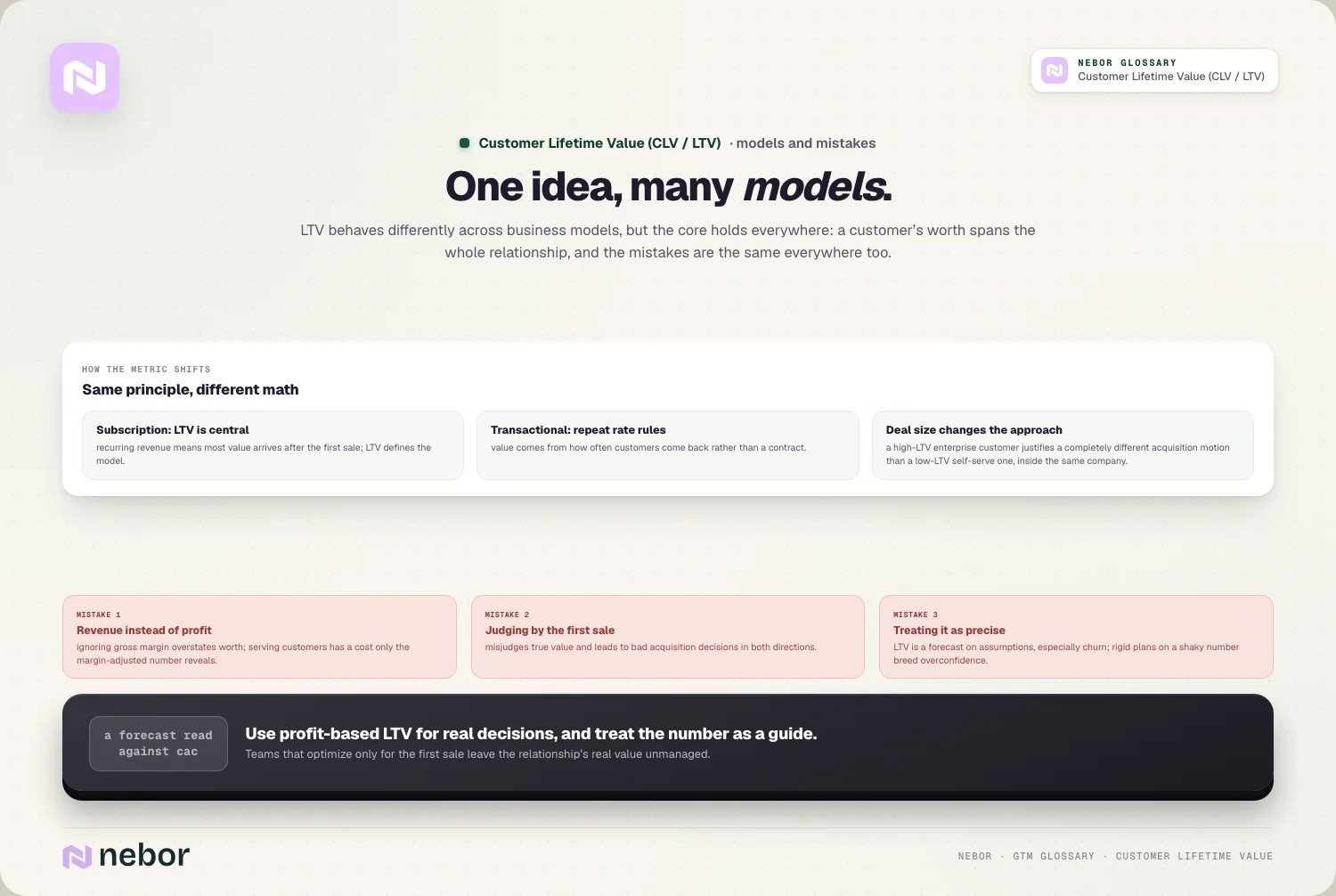
In transactional or one-time businesses, it's subtler. A customer's value comes from repeat purchases over time, so LTV depends on how often they come back rather than a contract.
Deal size changes the math too, because a high-LTV enterprise customer justifies a very different acquisition approach than a low-LTV self-serve one, even within the same company.
So LTV never comes in one universal size. The way you calculate and use it shifts with your model, but the core idea, that a customer's worth spans the whole relationship, holds everywhere.
What are the common LTV mistakes that distort good decisions?
LTV gets misused in a few predictable ways. Avoiding them keeps it a useful metric instead of a misleading one.
Using revenue instead of profit tops the list, because an LTV that ignores gross margin overstates a customer's real worth, given that serving them has a cost.
Ignoring it in favor of the first sale comes next, where judging customers only by their initial purchase misjudges their true value and leads to bad acquisition decisions.
Treating it as precise is the sneaky one, because LTV is an estimate built on churn assumptions, so false precision and rigid plans built on it invite trouble.
And there's reading it without CAC, because LTV alone says nothing about whether growth is profitable, so it belongs next to acquisition cost every time.
Should you measure LTV in revenue or in profit after margins?
A practical question is whether to base LTV on revenue or profit, and the choice changes the number a lot, though each version has a use.
Revenue-based LTV is the simpler one, using what a customer pays without subtracting costs, which is quick to calculate but overstates their true worth to the business.
Profit-based LTV is more honest, because applying gross margin reflects what a customer is worth after the cost of serving them, which is the version that matters for unit economics.
The gap between them can be large. A customer paying a lot but expensive to serve has a much lower profit LTV than revenue LTV, which only the margin-adjusted number reveals.
So real decisions deserve the profit-based version. Revenue LTV is fine for a rough sense of scale, but acquisition and investment decisions should rest on what a customer is genuinely worth after costs.
Why the first sale is only the opening line of a customer's value
Customer lifetime value cuts through because it reveals what a customer is worth over time, which is almost always far more than the first sale suggests. In any recurring or repeat-revenue business, the real value accumulates over the whole relationship.
The deeper point is that LTV is driven by retention and margin more than price. The longer customers stay and the better your margins, the more each one is worth, and that's the reason churn is the biggest lever on the number.
The honest qualifier is that LTV is an estimate read best against acquisition cost. The number only guides decisions well when set against CAC and treated as a forecast instead of a fact.
So if your team optimizes only for closing the first deal, it's missing where the real value lives. Understanding and growing lifetime value, by targeting the right customers and keeping them longer, is what turns a stream of one-time sales into a compounding business.
That compounding is exactly the economics a modern go-to-market system is built to maximize. It pays off most as you automate sales prospecting toward the highest-value customers rather than chasing whoever is easiest to close.
Share this post
RevOps
Glossary
Related glossary items
Understanding the core GTM concepts




Ready to build your pipeline











