
In this post:
Email deliverability is whether your emails actually reach the inbox instead of getting filtered to spam or blocked entirely. It's the difference between a message that lands in front of a person and one that quietly disappears.
It's also the most underrated part of any email program. Teams obsess over their copy and their lists, then wonder why nobody replies, when the real problem is that a big share of their mail never reached a human in the first place.
For cold outreach especially, deliverability is the silent tax on everything you do. You can have the perfect message for the perfect prospect, but if it lands in spam, none of that effort counts.
TL;DR
Email deliverability is the ability of your email to reach the inbox. It's not one setting, it's the combined result of your authentication, your reputation, your list quality, and how people engage with what you send.
Most teams confuse being delivered with reaching the inbox. An email can be accepted by the server and still land in spam, so the number that matters is inbox placement rather than raw delivery.
The fix is to treat deliverability as a system. When your authentication, domains, warmup, and list hygiene are right, your complaints stay low, your engagement stays real, and your mail reaches people. When any one of them slips, the whole thing slips with it.
So what is email deliverability, and why is it different from just being delivered?
Email deliverability is the question of whether your mail reaches the place you intended, the primary inbox. It sounds simple, but it hides a distinction that trips up most teams.
There's a difference between delivery and deliverability. Delivery just means the receiving server accepted your email and didn't bounce it. Deliverability, or more precisely inbox placement, means the email made it into the inbox instead of the spam or promotions folder.
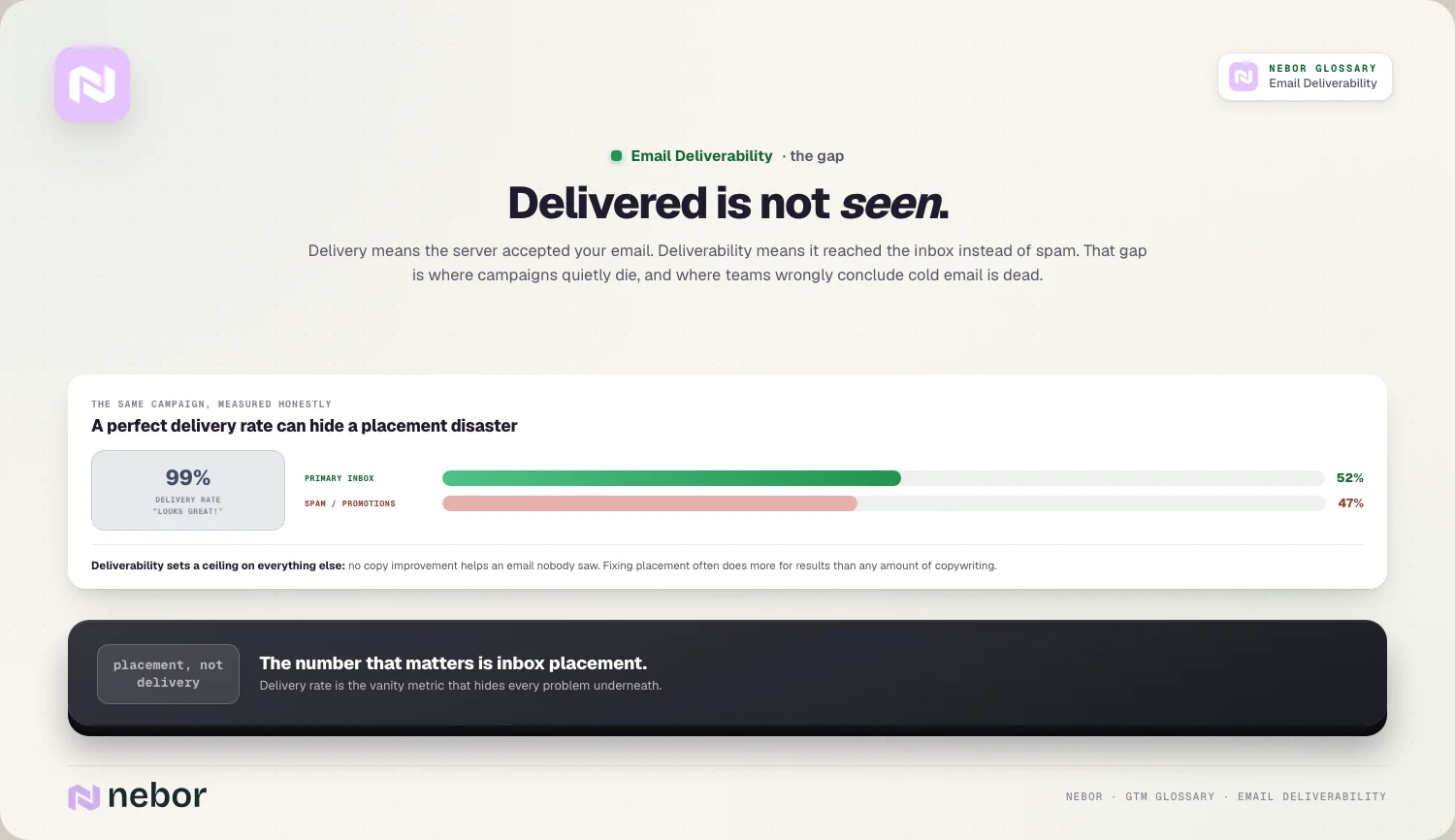
That gap is where campaigns go to die. Your delivery rate can look great, with almost nothing bouncing, while half your mail piles up in spam folders nobody opens. So when people talk about deliverability, they really mean placement, the share of your mail that lands somewhere a person will see it.
Why does email deliverability matter so much for your outbound?
Deliverability matters because it sets a ceiling on everything else you do in email. No improvement to your targeting or your copy can help an email that never reached a human.
The math we walk clients through makes it concrete. If a large share of your emails land in spam, then doubling your reply rate on the ones that land still leaves you reaching a fraction of your list.
Fixing deliverability so most of your mail reaches the inbox often does more for results than any amount of copywriting.
This is also why so many teams wrongly conclude that cold email is dead. They sent reasonable mail on a broken setup, got silence, and blamed the channel. The channel was usually fine, and the deliverability underneath it was the problem.
What decides whether your email reaches the inbox or the spam folder?
Deliverability isn't one thing you switch on, it's the sum of several factors the mailbox providers weigh together. Understanding the main ones tells you where to look when mail stops landing.
The big factors are your authentication, your reputation, your list quality, and your engagement.
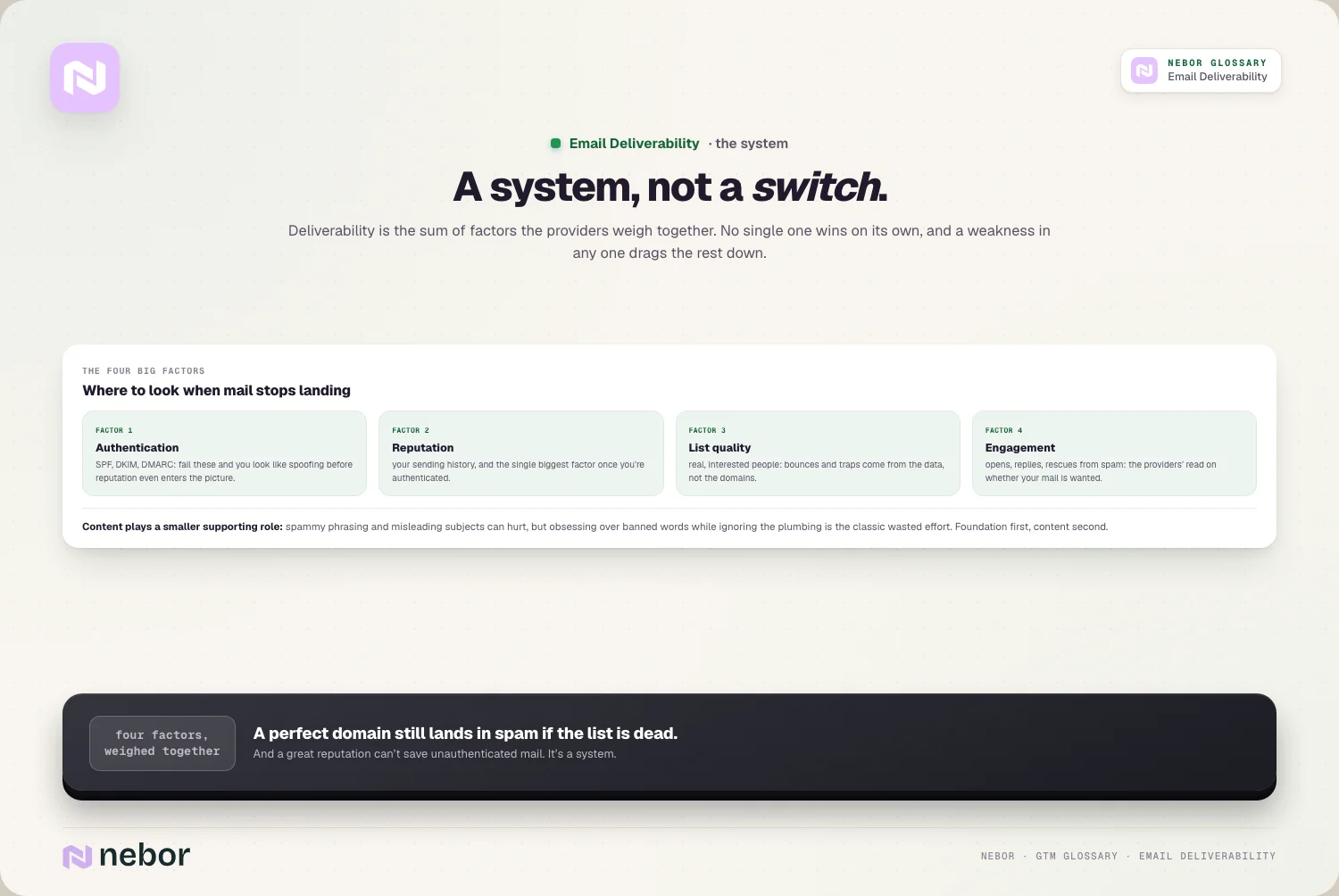
Authentication proves your mail is really yours, reputation reflects your sending history, list quality keeps you sending to real and interested people, and engagement tells the providers your mail is wanted. Content and sending volume play smaller supporting roles.
No single factor wins on its own, and a weakness in any one drags the rest down. A perfectly authenticated domain still lands in spam if its reputation is poor, and a great reputation can't save mail sent to a dead list. They work together, which is why deliverability is a system rather than a checkbox.
How does authentication form the foundation of your deliverability?
The first thing a receiving server checks is whether your mail is authenticated, so this is the foundation everything else stands on. Without it, you fail before your reputation even enters the picture.
Authentication means your DNS authentication records, the SPF, DKIM, and DMARC that prove an email genuinely came from you and wasn't forged. Mail that fails these checks looks exactly like spoofing to a provider, so it gets filtered or rejected regardless of how good the rest of your setup is.
The major providers require all three for bulk senders, so authentication has gone from an advantage to a baseline. You set it up once, keep it aligned, and it clears the first gate on the way to the inbox from then on.
Skipping it means failing the very first test the providers apply, before your reputation or your copy get any say.
Why is your sending reputation the single biggest factor of them all?
Once your mail is authenticated, reputation does most of the work, and it's the factor teams underestimate most. The providers keep a live score of how trustworthy your sending looks, and they lean on it heavily.
This score comes in two related forms that travel together. Your domain reputation follows your sending domain, and your sender reputation is the broader trust the providers place in you. Both are built slowly through clean, consistent sending and damaged quickly by complaints, bounces, and spam traps.
Reputation is why warmup matters so much. A new domain has no track record, so you build one gradually through warmup before sending real volume. Every email either helps or hurts this score, which means deliverability work is largely reputation work in disguise.
How does the quality of your list make or break your deliverability?
You can do everything else right and still wreck your deliverability with a bad list, because who you send to is itself a signal. The providers watch what happens when your mail arrives.
A clean list keeps your bounces and complaints low, which protects your reputation, so list hygiene is deliverability work. That means passing addresses through email validation before you send, removing dead and risky contacts, and never blasting scraped or stale data.
A high bounce rate tells the providers you don't keep your data clean, and hitting a spam trap is worse still.
Tight beats big here every time we've tested it. A small list of real, relevant people who might want your mail will protect your deliverability far better than a huge list of randoms, which only generates the bounces and complaints that get you filtered.
Why does recipient engagement end up deciding where your mail lands?
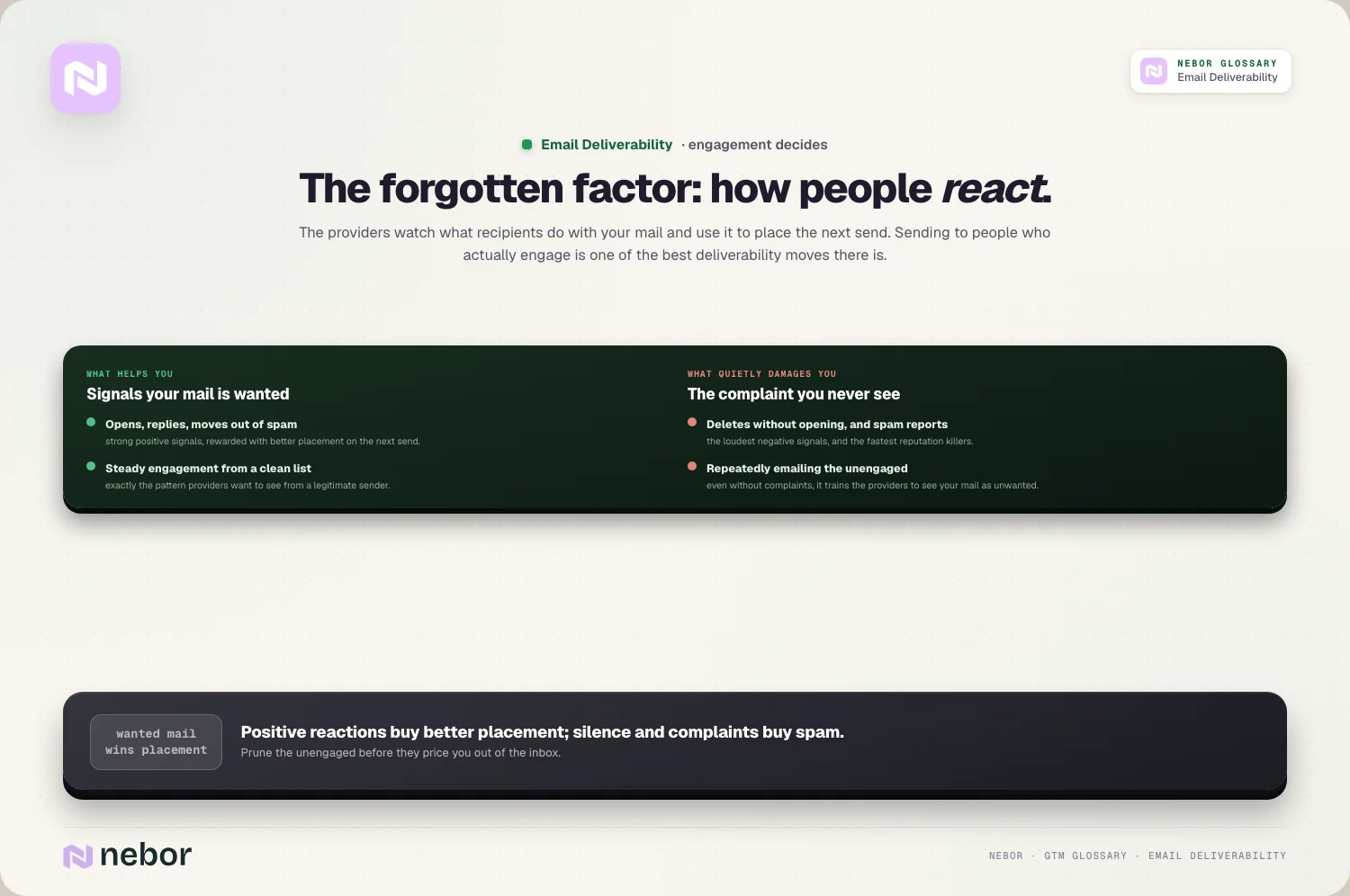
This is the factor people forget, and it's becoming one of the most important. The providers watch how recipients react to your mail, and they use that to decide where future mail goes.
Positive engagement works in your favor from the first open. When people open your emails, reply to them, or move them out of spam, the providers read that as a strong signal your mail is wanted, and they reward it with better placement.
Negative engagement hurts you, since deletes without opening, and especially spam complaints, tell them the opposite.
This is why sending to unengaged contacts does so much silent damage. Even without a complaint, repeatedly emailing people who never open trains the providers to see your mail as unwanted. Sending to people who actually engage is one of the best things you can do for deliverability.
What role do your content and spam trigger words really play in this?
People often start with their copy when they worry about deliverability, but content is a smaller factor than the rest. It matters less than the myths suggest, and we spend a surprising amount of time talking clients out of word-level superstition.
Certain things in a message can raise suspicion, like spammy phrasing, too many links, heavy images with little text, or misleading subject lines. An email that reads like a billboard can hurt you, so you write like a normal human being.
But tweaking words won't save mail that's failing on authentication or reputation.
The honest order is foundation first, content second. Once your authentication, reputation, and list are right, you write clean, relevant emails on top. Obsessing over banned words while ignoring the plumbing is the most common way teams waste effort on deliverability.
How do you measure your email deliverability without fooling yourself?
You can't fix what you don't measure, and deliverability is easy to measure badly. The trick is to watch placement and complaints alongside plain delivery.
The number that matters is your inbox placement rate, the share of your mail that reaches the primary inbox, which you can estimate with seed tests that send to a spread of test accounts.
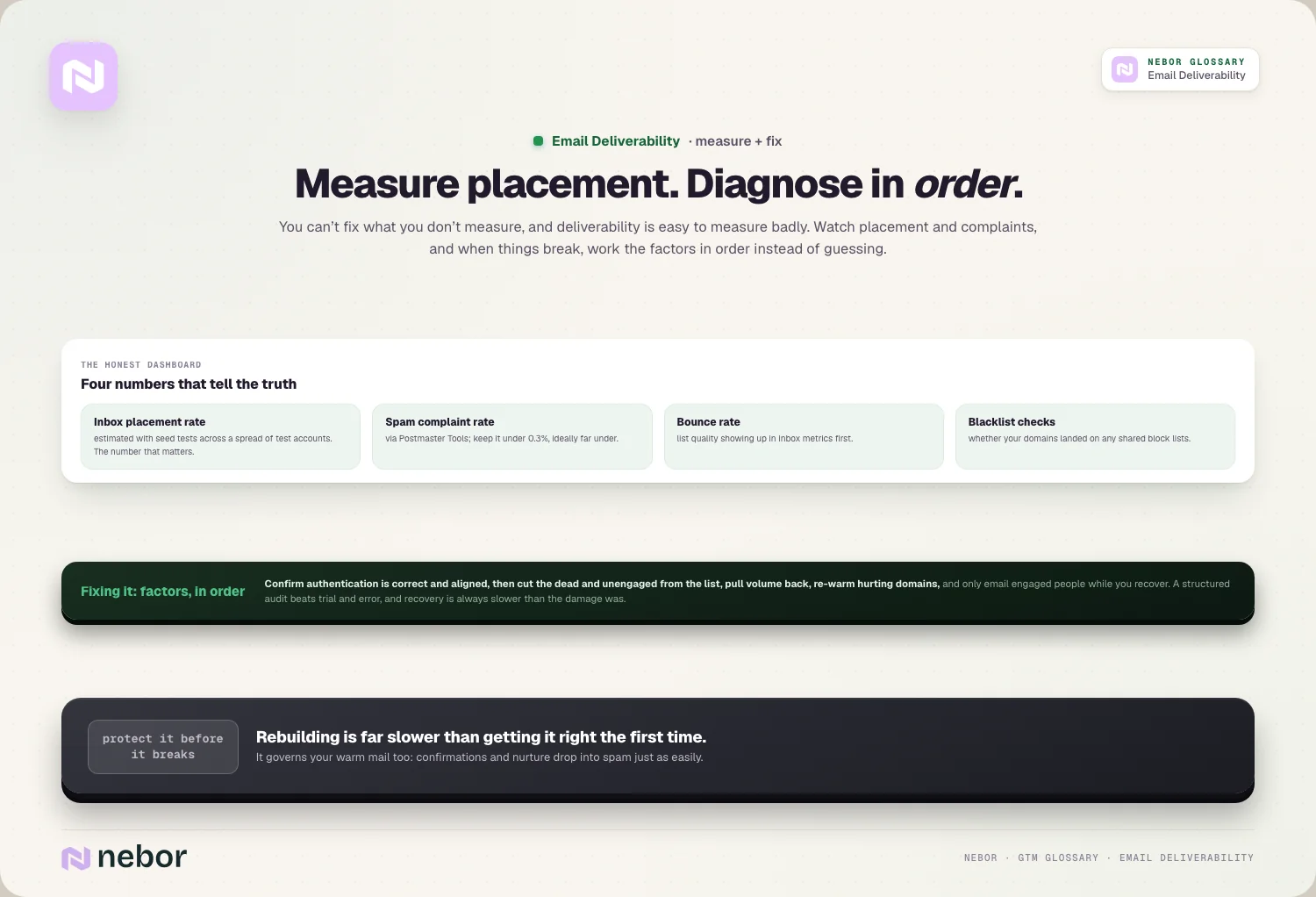
Google's Postmaster Tools shows your authentication results and your all-important spam complaint rate, which you need to keep under 0.3%. You also want to watch your bounce rate and check whether your domains have hit any blacklists.
Delivery rate, by contrast, is the vanity metric that hides every problem. It can look near perfect while your mail piles up in spam folders, so the moment you start measuring placement and complaints instead, you finally see what's been happening all along.
How do you fix your deliverability once your mail is already in spam?
If your mail has started landing in spam, the fix is to work through the factors in order, because the cause is almost always one of them. Guessing at the cause wastes weeks, so you diagnose it factor by factor.
You start by confirming your authentication is correct and aligned, since a broken SPF or DKIM is the culprit we find most often. Then you look at your list, cutting dead and unengaged addresses to bring down bounces and complaints.
From there you pull your volume back, re-warm your domains if their reputation is hurting, and only email engaged people while you recover.
A structured deliverability audit walks through all of this and catches the issue faster than trial and error. Recovery is usually slower than the damage was, so the real lesson is to protect deliverability before it breaks instead of scrambling to rebuild it after.
Why does deliverability matter for inbound just as much as cold email?
It's tempting to think of deliverability as a cold outreach concern, but it governs every email you send. The same factors that decide whether your cold email lands also decide whether your warm and inbound mail does.
The inbound version of the failure hurts more. A prospect requests a demo, your confirmation lands in spam, and the meeting never happens, with nobody on your side ever learning why. That silent failure costs you buyers who had already decided to talk to you.
So deliverability underpins every email relationship your company has. Whether the message is a first cold touch or a reply to your warmest inbound lead, it has to clear the same filters, and that shared gate makes deliverability a foundation for both motions at once.
How long does it take to build deliverability you can count on?
Good deliverability isn't instant, because the biggest factor underneath it, reputation, is built over time. A brand-new domain has to earn trust before it can send real volume.
In practice, warming a new domain takes a few weeks before it's ready, and a strong reputation builds over months of clean, consistent sending. Nobody has found a shortcut around this, because the whole scoring system was designed to reward a long track record.
The flip side is that deliverability can drop in days when you send badly, and rebuilding is always slower than the damage was. A patient early ramp costs you a few weeks, while a burned domain can cost you a quarter.
Does using a big-name email tool guarantee good deliverability?
A common assumption is that picking a reputable email platform takes care of deliverability for you. It helps, but it doesn't do the job on its own.
The tool can handle some of the technical plumbing, but it can't fix a bad list, a cold domain, weak authentication, or low engagement. Two companies on the exact same platform can have wildly different deliverability, because the difference is in their setup and their sending habits instead of the logo on the tool.
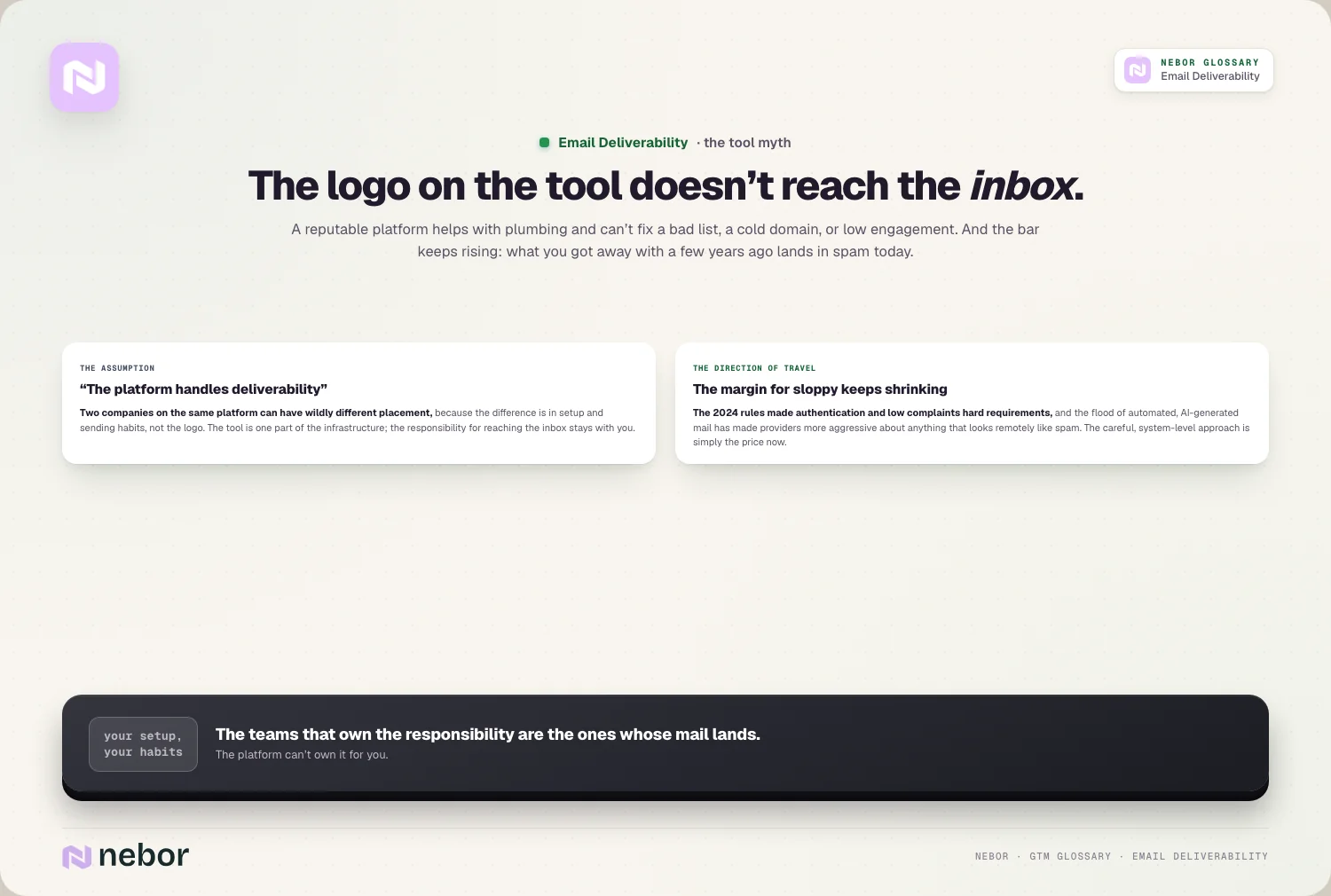
So the platform counts as one piece of your cold email infrastructure and never as a guarantee. The responsibility for reaching the inbox stays with you, and the teams that own that responsibility are the ones whose mail consistently lands.
Why is email deliverability getting harder with every passing year?
Deliverability has become more demanding over the last few years, and the trend is only going one way. The mailbox providers keep raising the bar.
The 2024 rules from Google and Yahoo are part of this, turning authentication and a low complaint rate from best practice into hard requirements. At the same time, the sheer volume of automated and AI-generated email has made the providers more aggressive about filtering anything that looks remotely like spam.
So the margin for sloppy sending keeps shrinking. What you could get away with a few years ago will land you in spam today, which means the careful, system-level approach to deliverability isn't optional anymore. It's simply the price of reaching people by email.
Why email deliverability is the invisible tax you pay on every send
Every email program pays a deliverability tax, and the only question is the rate. When the foundation is healthy, the tax is small, and nearly everything you write reaches a human. When it's broken, the tax swallows half the campaign before a single prospect gets the chance to say no.
We've audited setups where the team was convinced their offer was the problem, and the offer was fine. Their mail was simply never seen, and once the foundation was repaired, the same sequences that had produced silence started producing replies.
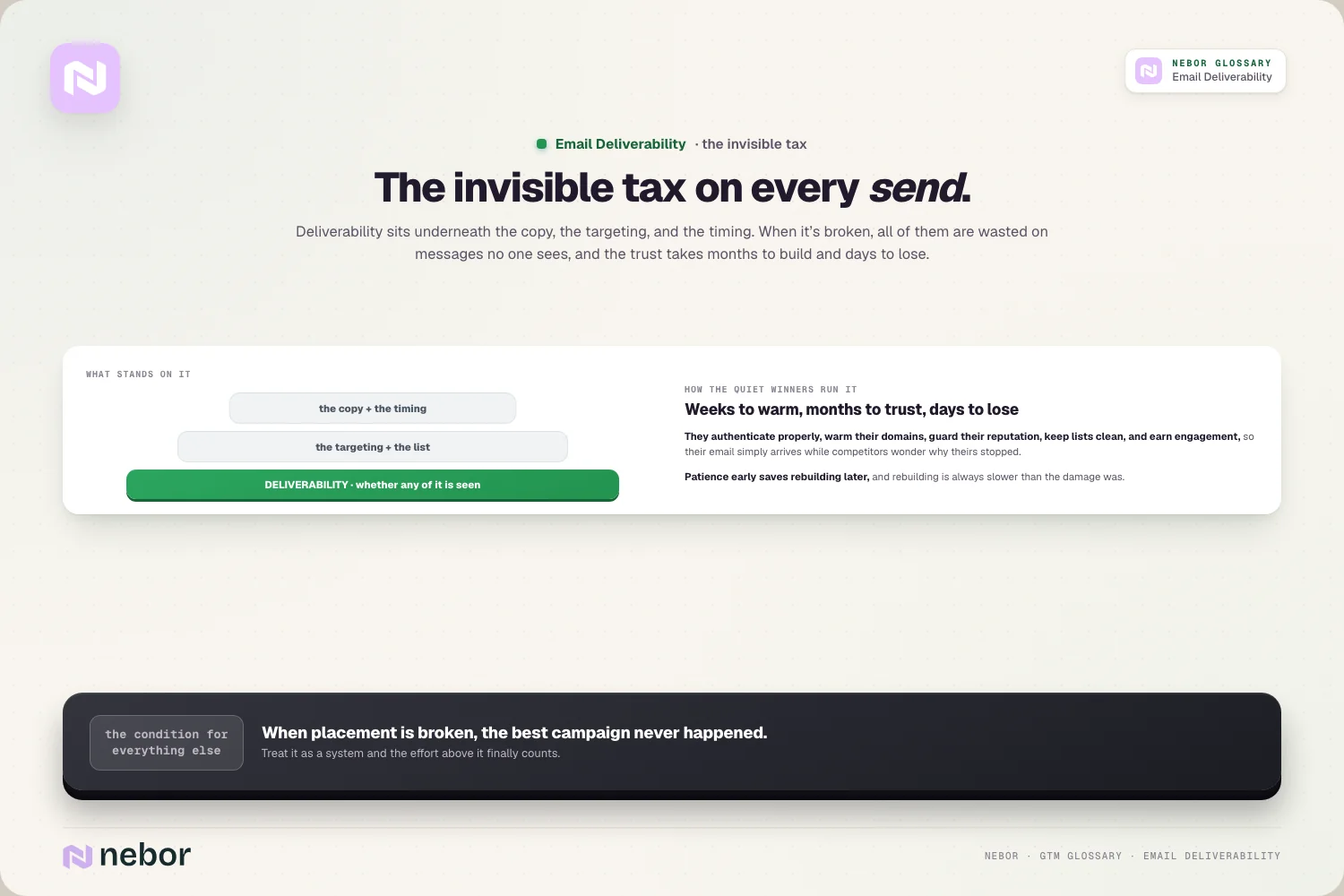
The mindset that works is to treat deliverability as an ongoing system rather than a one-time fix, because the most brilliant email in the world is worthless in a folder nobody checks. The teams that keep watching their placement and their complaint rate get to keep the channel for years.
Share this post
Deliverability
Glossary
Related glossary items
Understanding the core GTM concepts




Ready to build your pipeline











