

In this post:
Email warmup is the process of gradually building a new sending domain's reputation, by slowly increasing how much you send and generating positive engagement, until the mailbox providers trust it enough to deliver your mail. It's how you take a brand-new domain from suspicious stranger to trusted sender.
A fresh domain has no sending history, so the providers treat it with caution. If you start blasting campaigns from it on day one, most of that mail lands in spam, and you can burn the domain before it ever had a chance.
Warmup is the unglamorous step that makes cold outreach possible. If you skip it, even a perfect setup struggles to reach the inbox, because the providers simply don't trust a domain that appeared yesterday and started sending hundreds of emails.
TL;DR
Email warmup means ramping a new domain's sending slowly over a few weeks, while generating real-looking engagement, so the mailbox providers learn to trust it before you send real campaigns.
A new domain has zero reputation, and reputation is built through steady, normal behavior. Warmup manufactures that early track record on purpose, so you don't get filtered the moment you start sending volume.
It takes a few weeks to get going and never fully stops, because domains need ongoing activity to stay trusted. When you do it properly, it becomes the foundation that lets the rest of your deliverability work, and skipping it undermines everything else.
So what is email warmup, and why does every new domain need to go through it?
Email warmup is the deliberate practice of building up a domain's sending reputation before you use it for real outreach. You ease the domain into sending, rather than throwing it straight into the deep end.
The reason a new domain needs this comes down to trust. Mailbox providers decide where to put your mail based largely on your reputation, and a fresh domain has none.
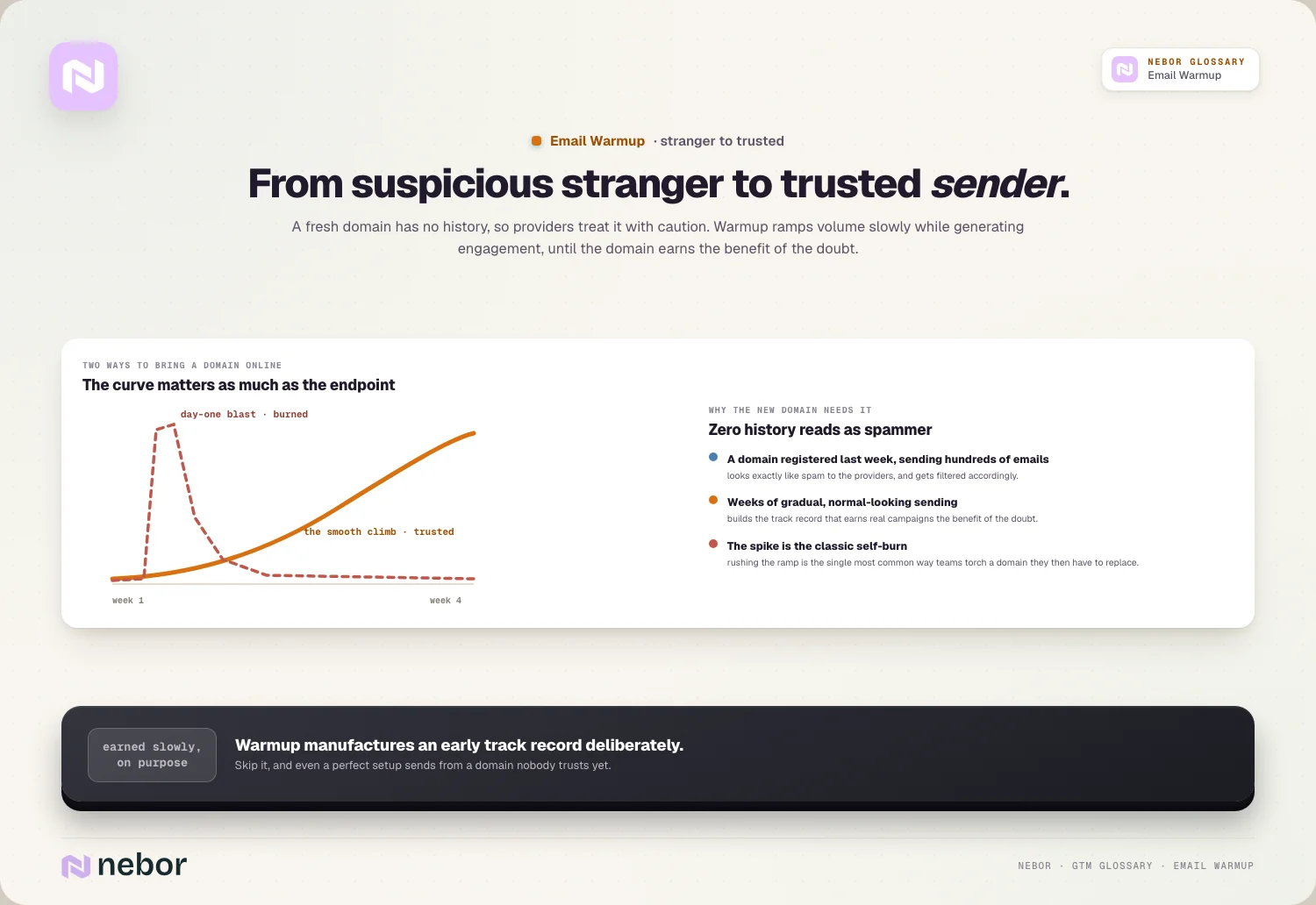
To the providers, a domain that registered last week and immediately started sending hundreds of cold emails looks exactly like a spammer, so they filter it.
Warmup solves that by giving the domain a track record. Over a few weeks of gradual, normal-looking sending, the providers come to see it as a real sender of wanted mail, which earns it the benefit of the doubt when you start sending campaigns.
How does email warmup actually work once the ramp gets going?
The mechanics are simpler than they sound. Warmup combines two things, a slow ramp in volume and a stream of positive engagement, to mimic the behavior of an established, trusted sender.
The volume side means starting with just a handful of emails a day and increasing the number gradually over weeks, instead of jumping to full volume immediately.
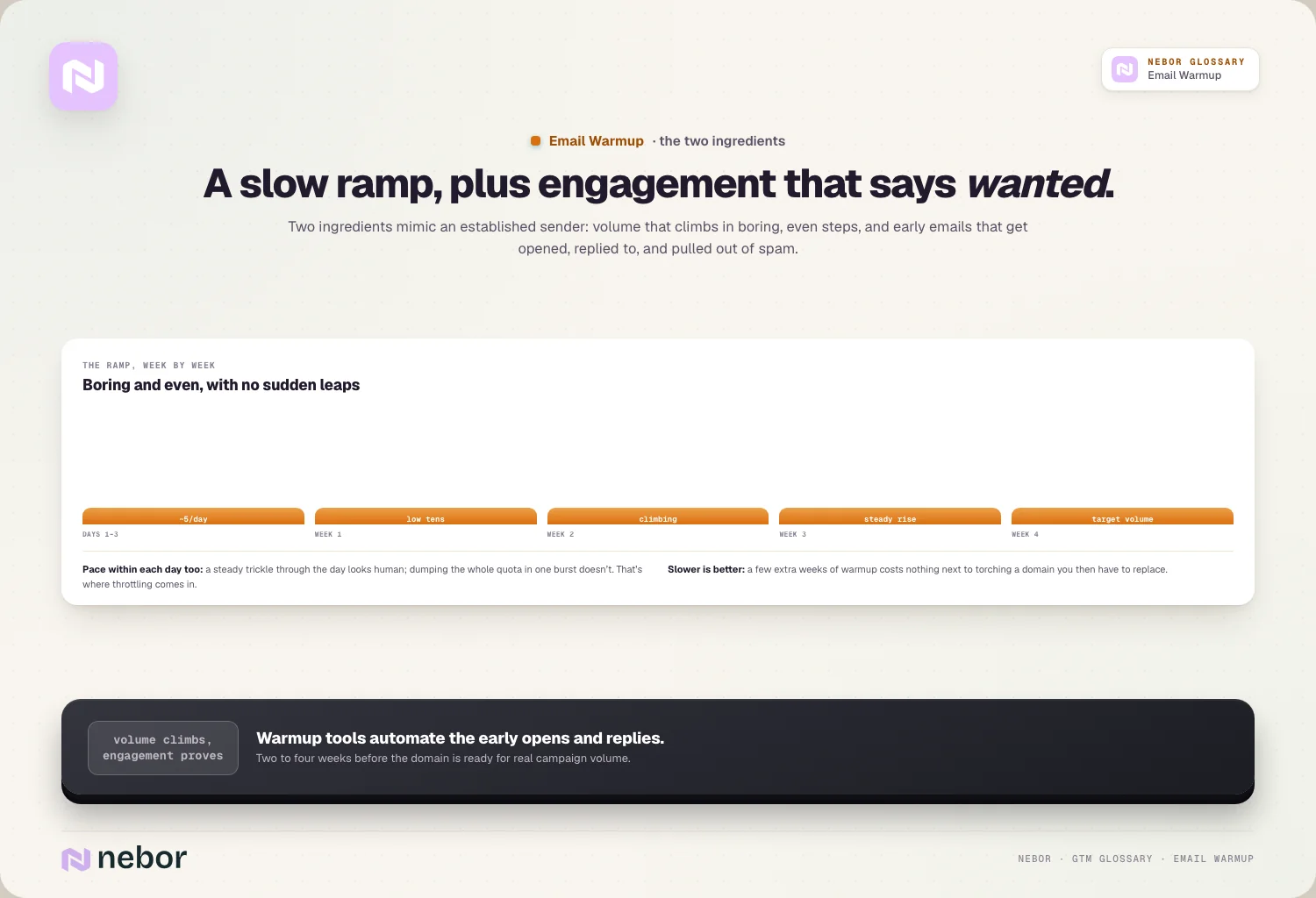
The engagement side means those early emails get opened, replied to, and moved out of spam, which tells the providers the domain sends mail people want.
Most teams handle this with warmup tools that automate the process. These tools connect your domain to a pool of other inboxes, then quietly send, open, and reply to messages between them, generating the early engagement that builds reputation without you having to do it by hand.
How long does email warmup take before you can send for real?
Patience is the whole point of warmup, so it isn't a quick job. For most domains, a careful warmup takes a few weeks before the domain is ready for real campaign volume.
A typical ramp starts very small, with a handful of emails a day, and increases steadily over two to four weeks until the domain can handle a normal sending volume. Rushing this is the single most common way teams burn a domain, because a sudden spike looks suspicious no matter how good everything else is.
The exact timeline depends on how much you eventually want to send and how cautious you want to be. The rule we tell clients is that slower is better, since the cost of a few extra weeks of warmup is tiny compared to the cost of torching a domain you then have to replace.
What's a warmup pool, and can you still safely rely on one today?
Warmup tools rely on something called a warmup pool, and you should understand both how it works and why it's become controversial. A pool is a large network of inboxes that automatically exchange and engage with each other's mail.
The appeal of the pool is easy to see. It generates the opens, replies, and positive signals that build reputation, automatically and at scale, without real people involved. For a long time this was the standard way to warm a domain quickly.
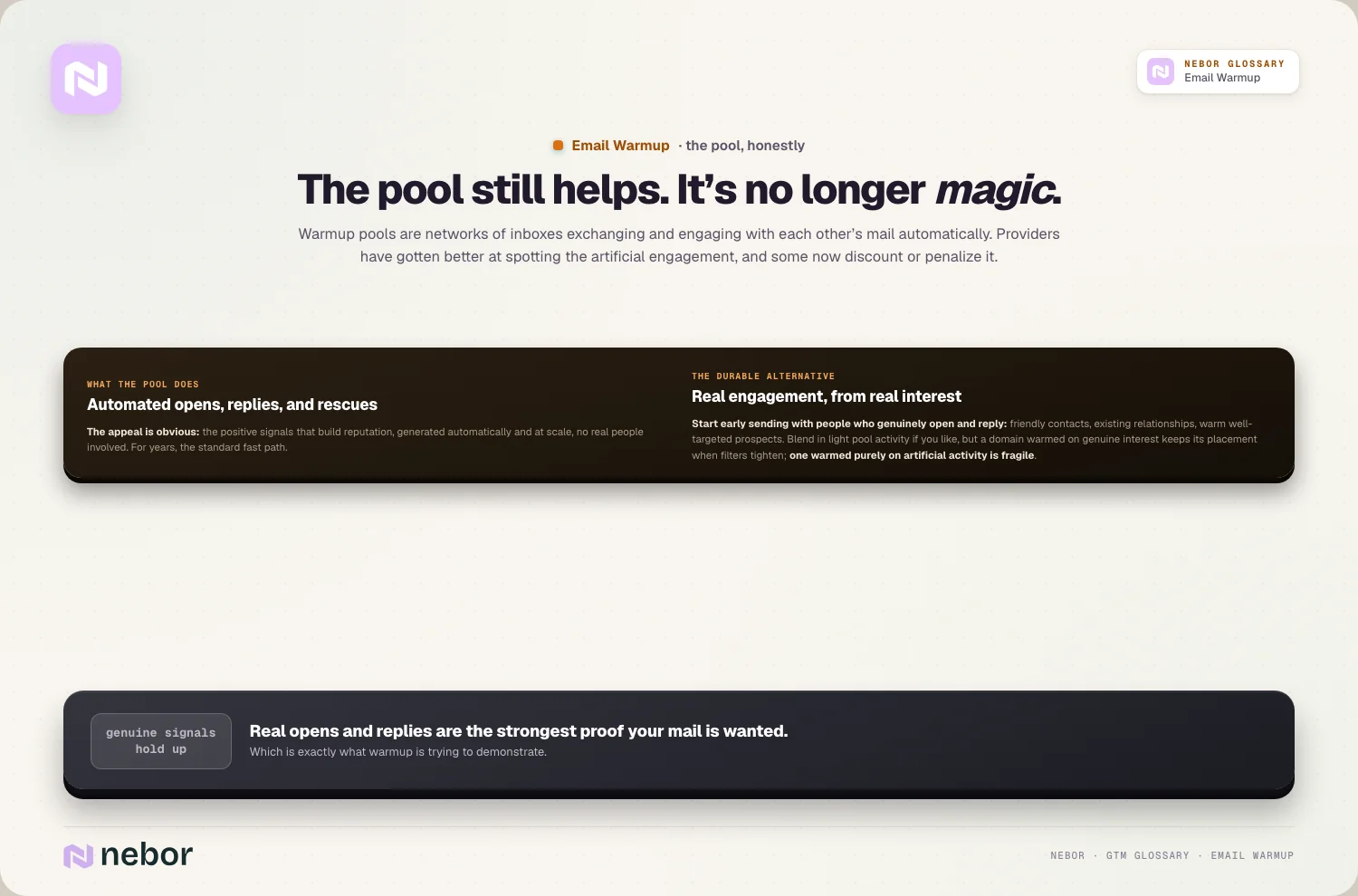
The problem is that the mailbox providers have gotten better at spotting this artificial engagement, and some have started discounting or even penalizing it.
So the honest answer is that warmup pools still help, but they're less of a magic fix than they used to be. The most durable warmup increasingly comes from real engagement, like sending mail people want, to contacts who really open and reply.
What does a sensible warmup ramp look like from day one to full volume?
It helps to picture the shape of a good ramp, because the curve matters as much as the endpoint. You want a smooth, gradual climb that never jumps.
In our experience a good ramp starts at just a few emails a day in the first few days, rise into the low tens over the first week, and keep climbing steadily across the following weeks until they reach your target volume.
The increases should feel boring and even, with no sudden leaps that would stand out to a provider watching your pattern.
You also pace your sending within each day, instead of sending everything at once, which is where email throttling comes in. A domain that sends a steady trickle through the day looks far more human than one that dumps its whole quota in a single burst.
Why isn't email warmup a one-time task you finish and walk away from?
People treat warmup as a setup task you complete and forget, but that's not quite right. Domains need ongoing activity to keep their reputation warm, so warmup is more of a habit than a one-off.
The reason is that reputation can fade. A domain that warms up, sends hard for a while, then goes quiet can lose some of the standing it built, and a domain that suddenly spikes after a lull looks suspicious again. Keeping a steady baseline of sending and engagement maintains the trust you worked to build.
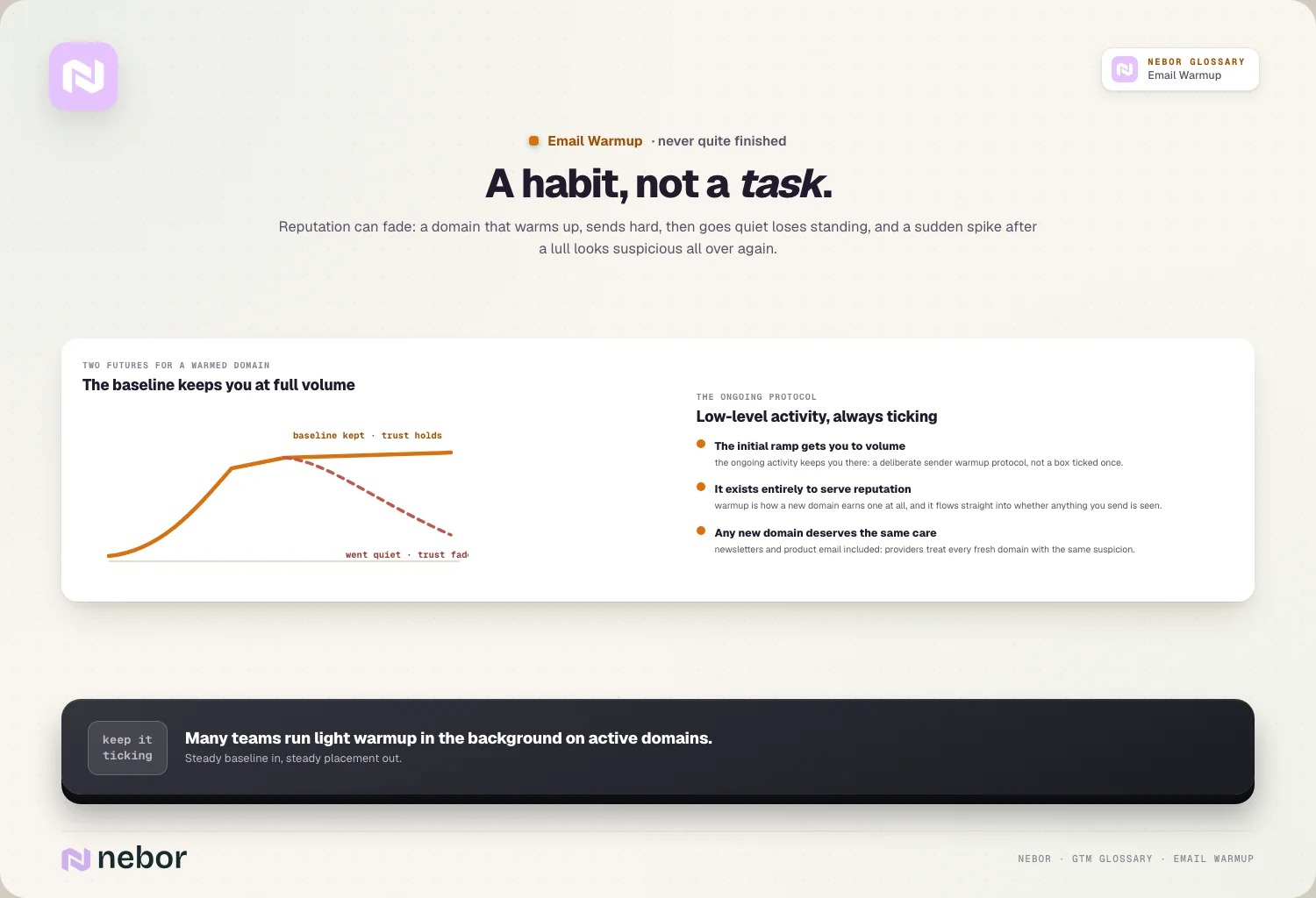
This is why we keep a low level of warmup going in the background on our clients' domains, even the active ones. The initial ramp gets you to full volume, and the ongoing activity keeps you there, which is part of a deliberate sender warmup protocol rather than a box you tick once.
How does warmup connect to your domain reputation and deliverability?
Warmup doesn't stand alone, it exists entirely to serve your reputation and your deliverability. It's the on-ramp that the rest of your sending depends on.
The direct link is to domain reputation. Warmup is how a new domain earns a reputation in the first place, by building the track record of clean, wanted sending that the providers reward. Without warmup, a domain has nothing for its reputation to be built on.
From there it flows into your email deliverability as a whole. A properly warmed domain reaches the inbox, while a cold one lands in spam, so warmup sets the ceiling on everything else.
It works alongside clean lists, proper authentication, and sensible volume, and it can't replace any of them, but none of them work without it.
Why does cold outreach depend on warmup more than any other channel?
For cold email, warmup isn't optional, it's foundational, because cold senders rely on fresh secondary domains that start with zero trust. Those domains exist precisely so you don't risk your main domain, but that means each one needs warming from scratch.
This is why warmup is a core part of any real cold email infrastructure. Every separate sending domain you set up for outreach has to be warmed before it sends a single campaign, and the time that takes is part of the cost of doing cold outreach properly.
The teams that skip this are usually the ones who arrive at our door saying cold email doesn't work. They bought domains, started blasting, and watched everything land in spam, when the domains were never warmed and the channel never had a chance.
What are the common email warmup mistakes that waste the effort?
Warmup is simple in principle, but there are a few reliable ways to get it wrong. Each one wastes the time you put in.
The most common is impatience, ramping too fast and spiking the volume before the domain is ready, which looks exactly like the spam behavior you were trying to avoid. Another is skipping warmup entirely on a new domain and going straight to campaigns, which burns the domain almost immediately.
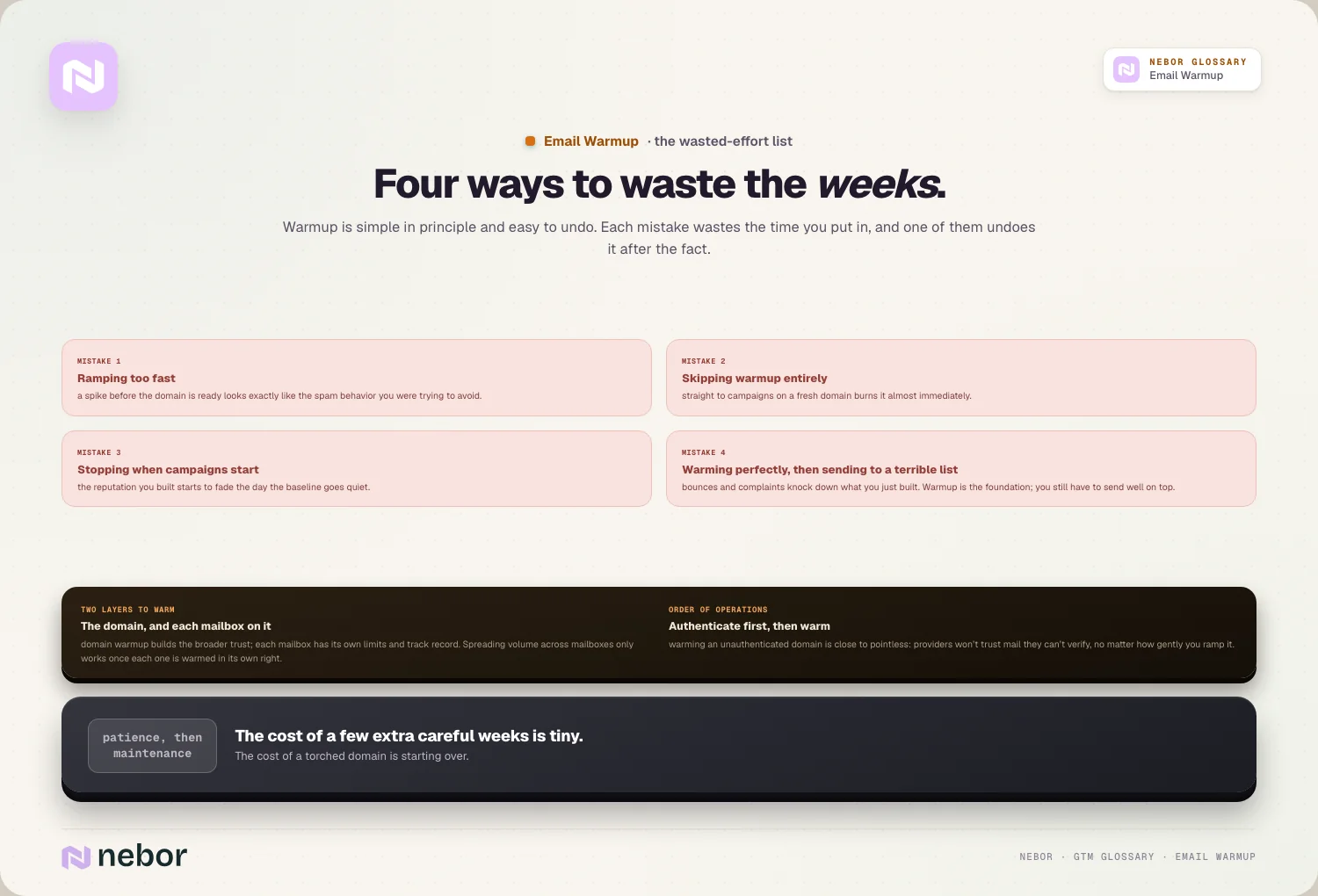
A third is stopping all warmup activity the moment campaigns start, so the reputation you built starts to fade.
There's also the mistake of warming a domain perfectly and then sending to a terrible list, which undoes the good work through bounces and complaints. Warmup builds the foundation, but you still have to send well on top of it, or you knock down what you just built.
Does email warmup matter for your main domain and inbound email too?
Warmup is usually discussed in a cold outreach context, but the principle applies whenever you bring a new sending domain online. Any fresh domain, including one for marketing or transactional email, benefits from a gradual ramp.
If you launch a new domain for your newsletters or your product emails, sending to your whole list on day one risks the same cold-domain problem, with mail landing in spam and a reputation that starts in a hole. A measured ramp protects those inbound and lifecycle emails just as it protects cold outreach.
So warmup is less a cold email trick and more a basic rule of bringing any domain online. Whenever you start sending from something new, you ease it in, because the mailbox providers treat every new domain with the same initial suspicion regardless of what you plan to send.
How does warmup fit with the rest of your sending infrastructure?
Warmup is one piece of a larger setup, and it only works when the other pieces are in place. Pointing warmup at a domain with broken records just builds trust on a cracked foundation.
Before you warm a domain, it needs proper DNS authentication, the SPF, DKIM, and DMARC that prove your mail is really yours. Warming an unauthenticated domain is close to pointless, because the providers won't trust mail they can't verify no matter how gradually you ramp.
From there, warmup feeds your sender reputation and slots into your wider sending infrastructure, alongside clean lists, healthy domains, and sensible volume.
Each part supports the others, and warmup is the one that gets a new domain off the ground so the rest has something to work with.
What's the difference between warming a domain and warming a mailbox?
People use warmup loosely, but there are really two layers to it, the domain and the individual mailbox. Both need warming, and they're not quite the same.
Domain warmup builds the reputation of the sending domain itself, which is the broader trust that follows you everywhere. Mailbox warmup builds the standing of a specific email address on that domain, since each mailbox also has its own limits and its own track record with the providers.
In practice you warm both together, because a cold outreach setup usually spans several mailboxes across several domains. The domain ramp alone doesn't cover them, because each new mailbox needs its own gentle climb, which is why spreading volume across mailboxes only works once each one has been warmed in its own right.
How do you warm a domain with real engagement instead of a pool?
Since warmup pools are losing their edge, let's cover how to warm a domain the more durable way, with genuine engagement. It's slower, but it builds reputation the providers actually trust.
The idea is to start your early sending with people who will genuinely open and reply, like friendly contacts, existing relationships, or warm and well-targeted prospects, rather than a cold blast.
Real opens and replies from real people are the strongest possible signal that your mail is wanted, and that's precisely the case warmup is trying to make.
You can blend this with light pool activity, but the more of your early reputation comes from real engagement, the better it holds up.
A domain warmed on genuine interest tends to keep its strong inbox placement, while one warmed purely on artificial activity is more fragile when the providers tighten their filters.
Why warmup is the patient first step that earns a new domain its trust
At the bottom of all the tooling, warmup is about earning trust the slow, honest way. A new domain has no reputation, and reputation can't be bought or rushed, so warmup is the deliberate work of building it one steady day at a time.
We've never seen a shortcut survive contact with the providers, and every year they get better at spotting the fakes. The senders who respect the ramp keep their domains healthy for years, while the impatient ones cycle through burned domains and wonder why the channel feels broken.
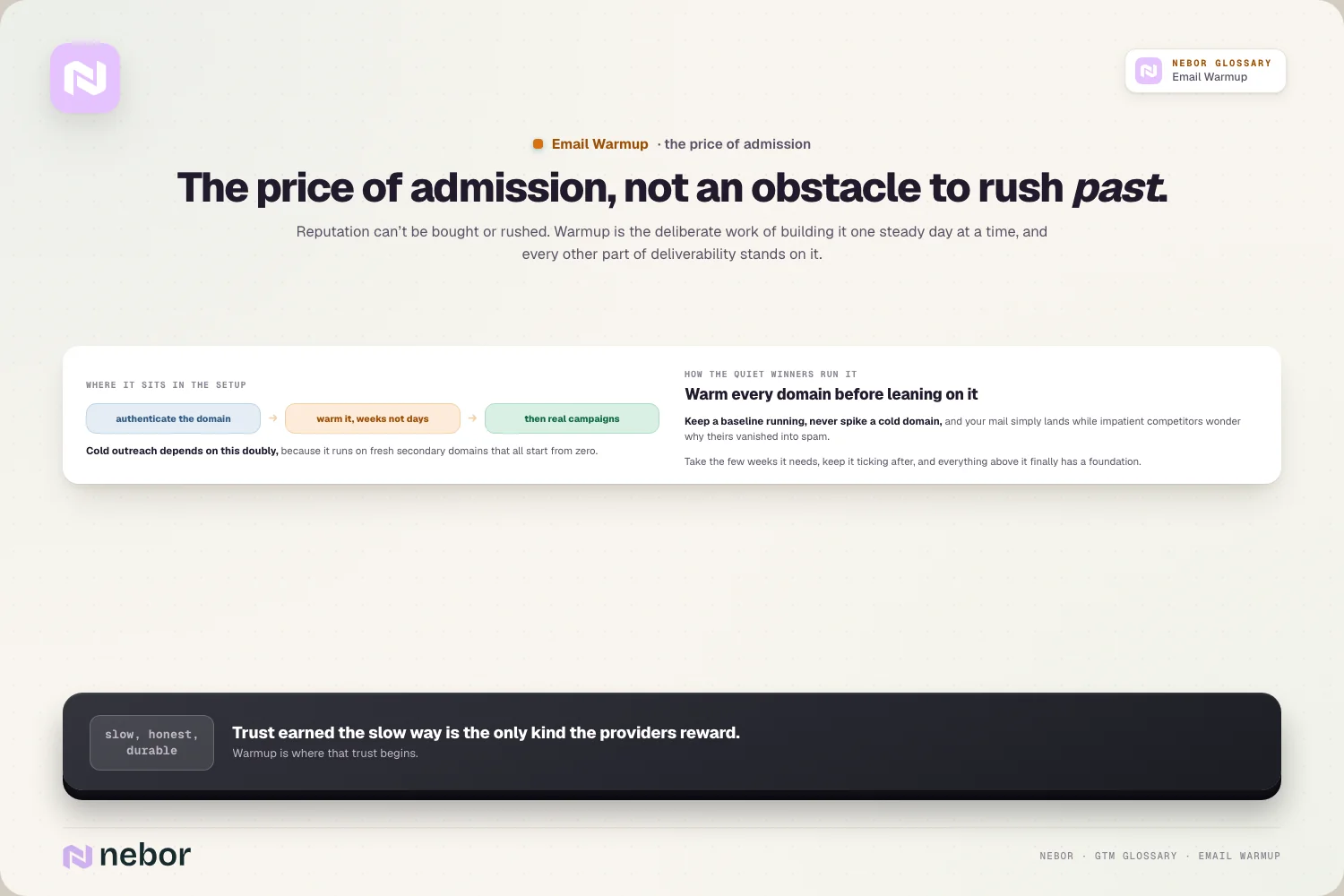
The mindset that works is to treat the wait as part of the build instead of an obstacle to rush past. Once you've taken the few weeks it needs and kept it ticking over afterward, every other part of your deliverability has a foundation to stand on.
If you skip it, even the most careful campaign in the world is sending from a domain nobody trusts yet.
Share this post
Deliverability
Infrastructure
Glossary
Related glossary items
Understanding the core GTM concepts




Ready to build your pipeline











