

In this post:
Cold email infrastructure is the technical setup that gets your cold email reliably into the inbox. It's the domains, mailboxes, authentication, warmup, and reputation management underneath your campaigns, doing the unglamorous work of landing your mail.
It's the half of cold email almost nobody talks about, because it isn't fun. There's no clever subject line here, just plumbing. But this plumbing decides whether your emails reach a human at all.
If your setup is solid, even average copy has a fair chance of being read, because it reaches people at scale. If your setup is weak, even your best message can end up in a spam folder that nobody ever checks.
TL;DR
Cold email infrastructure is everything that carries your message to the inbox, the domains, the mailboxes, the DNS authentication, the warmup, and the reputation behind it all.
Most teams pour their energy into copy and ignore this layer, then wonder why nobody replies. The awkward reality is that your infrastructure decides more about your results than your words do. A great email that lands in spam may as well not exist.
If you build it properly, on separate domains, with full authentication, careful warmup, and sensible volume, you protect both your reach and your main domain. If you skip this work, you'll damage your sending reputation, and no amount of good copy will undo that.
What cold email infrastructure actually means when you break it down
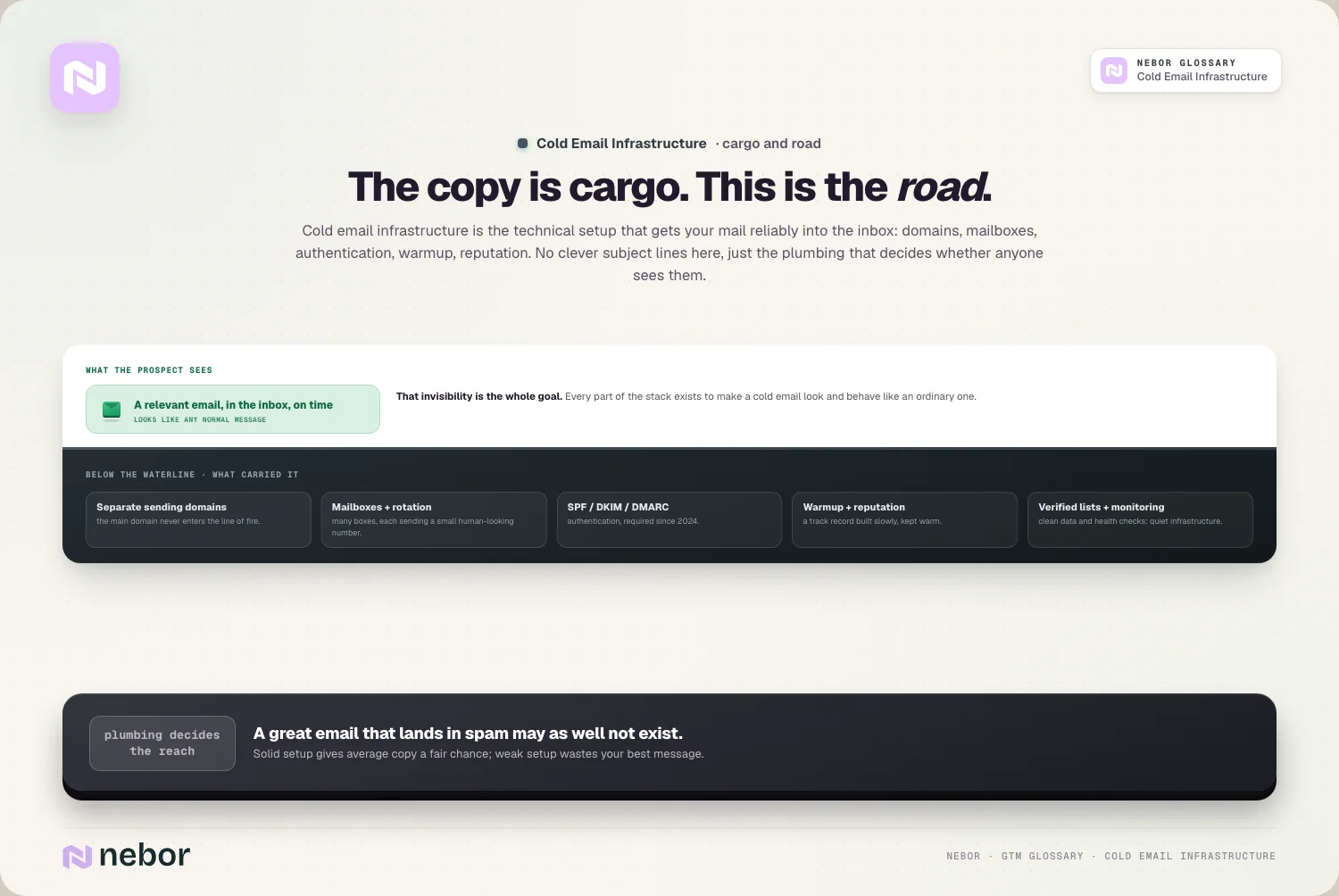
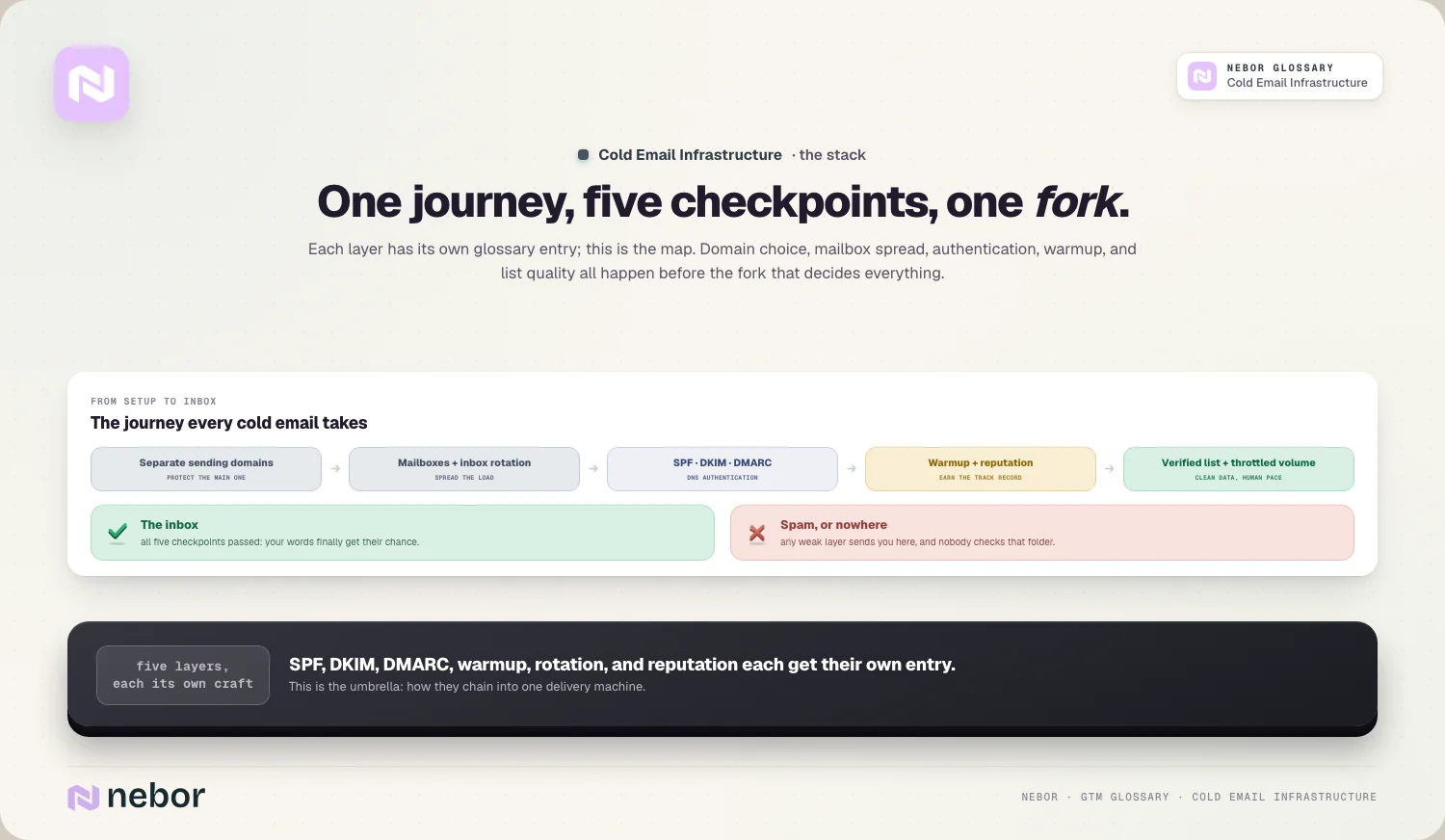
Cold email infrastructure is the full technical stack that moves a cold email from your tool to a prospect's inbox. It covers the domains you send from, the mailboxes on them, the DNS records that authenticate them, the warmup that builds their reputation, and the monitoring that keeps them healthy.
None of that touches what the email says. It's purely about delivery, the question of whether the message arrives in the inbox, the spam folder, or nowhere. The copy is the cargo, and the infrastructure is the road, the truck, and the license plates.
When people say a cold email campaign failed, they usually mean one of two things, the message was wrong or it never arrived. We've audited enough broken campaigns to say it's usually the second one, and that's an infrastructure problem.
Why your infrastructure matters more than your copy ever will
This is the claim that surprises people, so let's be blunt about it. Your deliverability ceiling is set by your infrastructure, and no amount of copywriting raises it.
If half your emails land in spam, doubling your reply rate on the half that land still leaves you reaching a fraction of your list. Once the infrastructure is fixed and most emails reach the inbox, the same copy suddenly performs. The biggest gains are in the layer nobody enjoys working on.
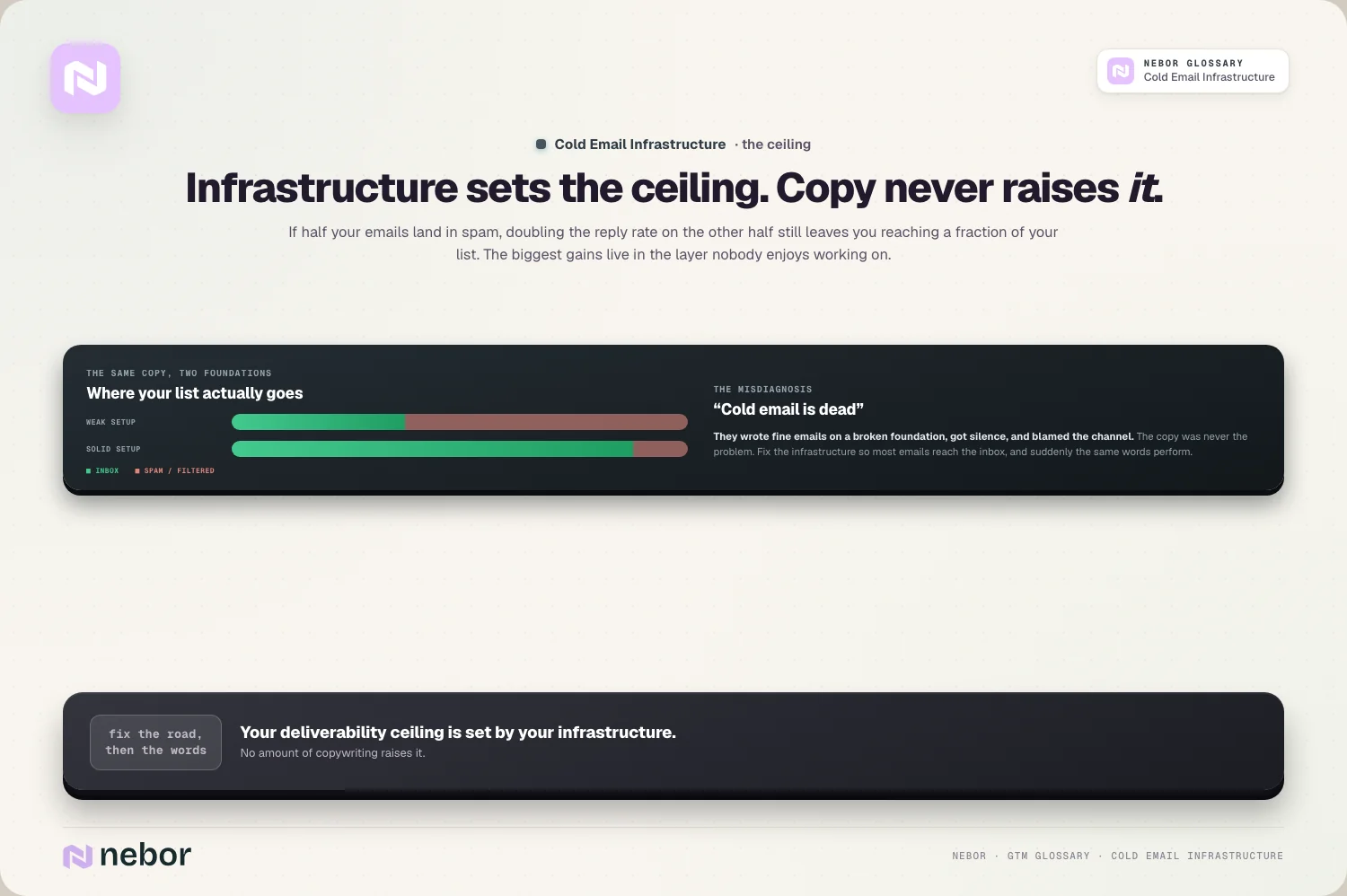
This is also why so many teams conclude cold email is dead. They wrote fine emails on a broken foundation, got silence, and blamed the channel. The copy was never the problem, the foundation underneath it was.
Why you should never send cold email from your company's main domain
The first rule of infrastructure is to protect your primary domain at all costs. The domain carrying your company's real email and website is too valuable to risk on cold outreach.
Cold email carries reputation risk by nature, because bounces, spam complaints, and the occasional misfire all chip away at the sending domain's standing. If that's your main domain, a bad campaign can hurt your normal business email too, and that damage is slow and painful to undo.
So serious senders buy separate sending domains, often close variations of the main one, and send all cold outreach from those. If a secondary domain gets burned, you retire it and protect everything that matters. Your real domain stays well clear of it.
How your mailboxes and inbox rotation spread the sending load safely
On top of those domains come mailboxes, and how you use them matters as much as the domains themselves. Each mailbox can only send so much per day before it starts to look suspicious to the mailbox providers.
The fix is to spread volume across many mailboxes instead of piling it onto a few. A campaign of a few hundred sends a day might spread across a dozen mailboxes on several domains, each sending a small, human-looking number. That's inbox rotation, and it keeps any single mailbox from tripping limits.
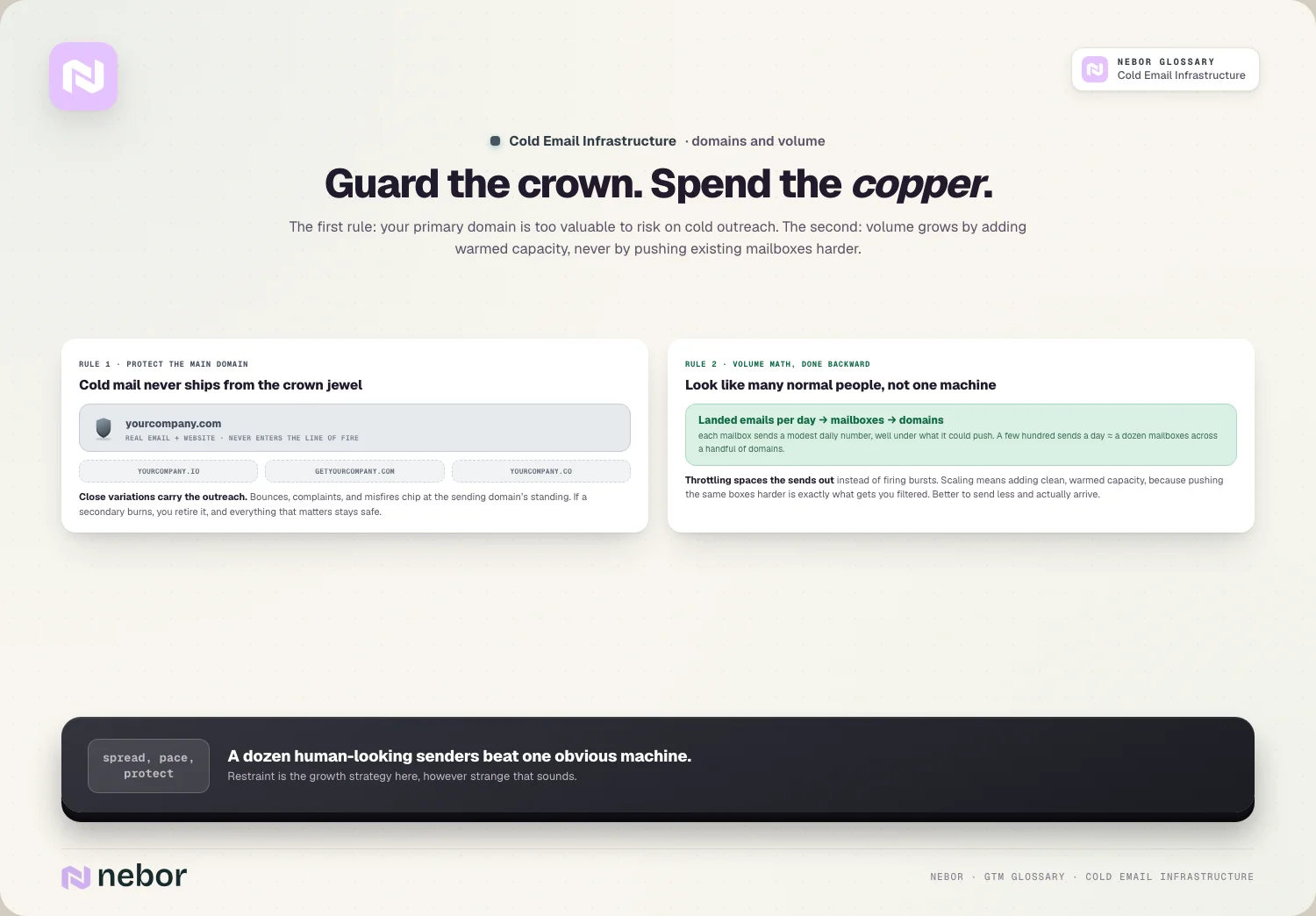
The principle is to look like a lot of normal people sending modest amounts instead of one machine pushing thousands. Spread keeps you under the thresholds that flag bulk senders, and it limits the damage if one mailbox hits trouble.
The DNS authentication you have to get right before you send a single email
Authentication is how the receiving server checks that your mail is really from you, and it's non-negotiable now. Three records matter, and you need all of them through proper DNS authentication.
SPF says which servers are allowed to send for your domain. DKIM adds a cryptographic signature that proves the message wasn't tampered with. DMARC ties the two together, tells receivers what to do if a message fails, and gives you reporting on what's being sent in your name.
All of this stopped being optional in 2024. Google and Yahoo now require bulk senders to use SPF, DKIM, and DMARC, to offer one-click unsubscribe, and to keep their spam complaint rate below 0.3%. If you miss the authentication, you're filtered before a human ever sees the subject line.
The mistake here is treating authentication as a one-time checkbox. Records drift when you add a new sending tool, change providers, or spin up fresh domains, and a record that was correct last year can quietly break today.
A misconfigured SPF or a DMARC policy that's still set to do nothing is one of the most common reasons good infrastructure leaks deliverability without anyone noticing.
So you set all three up correctly on every sending domain, then you keep checking them instead of assuming they hold. DMARC reporting is the part that gets ignored, and it's the part that tells you when something is sending in your name or failing checks.
If you read those reports, you catch problems early instead of finding out from a dead campaign.
Why you have to warm up every new domain before you send anything real
A brand-new domain has no sending reputation, and mailbox providers treat strangers with suspicion. A fresh domain that starts sending at volume lands in spam almost immediately.
Warmup solves this by ramping a domain's volume slowly over weeks, often with tools that send and engage with mail in a controlled pool, so the domain builds a track record of normal, wanted email. Only once it's warmed do you point real campaigns at it.
Warmup never really finishes once it starts, either. Domains need ongoing low-level activity to keep their reputation warm, and pushing a cold domain straight to full volume is one of the fastest ways to burn it. Patience here saves you from rebuilding later.
How your domain and sender reputation get made or broken over time
Underneath all of this is reputation, the score mailbox providers keep on whether your mail is wanted. It comes in two flavors, domain reputation and sender reputation, and both decide where your email lands.
Reputation is earned slowly and lost quickly. Consistent volume, low bounces, low complaints, and real engagement build it up. A spike in bounces, a wave of spam reports, or hitting a spam trap tears it down fast, sometimes overnight.
The practical takeaway is that every send either helps or hurts this score. Infrastructure work is really reputation management, protecting a number you can't see directly but that governs everything. Rebuilding reputation costs far more than protecting it, so treat it as the asset it is.
What decides whether you land in the inbox or the spam folder
All of this exists to win one thing, inbox placement. Getting delivered is only half of it, because the email has to reach the inbox instead of the spam or promotions folder.
Deliverability is the broad health of your sending, and inbox placement rate is the sharper number, the share of your emails that truly reach the primary inbox. A campaign can show high delivery and still fail, because most of it sat in spam unseen.
This is why open and reply rates can mislead you. If placement is poor, your real audience is a fraction of your list, and no clever copy reaches the people in spam. Measuring placement on top of delivery tells you whether your infrastructure is doing its job.
Why your sending volume and throttling need to stay on a tight leash
Volume is where good infrastructure gets undone by impatience. Sending too much, too fast, from too few mailboxes is a reliable way to get filtered.
Each mailbox should send a modest daily number, and new domains should ramp up gradually instead of jumping to full volume. Throttling spaces sends out over time instead of pushing them out in one burst, which looks far more human to the receiving servers.
The mindset we push clients toward is restraint. It's tempting to raise volume to hit a pipeline target, but a smaller, well-paced send that lands in the inbox does far more for you than a huge one that gets filtered into spam.
The spam traps, blacklists, and complaint rates that can sink you
A few specific things can wreck your infrastructure quickly, and each one deserves to be known by name. The first is the spam trap, an address that exists only to catch senders using bad lists, and hitting one tells providers you don't keep your data clean.
The second is the blacklist, a shared list of known-bad senders. If you land on one, your mail gets blocked across many providers at once, which is why protecting reputation matters so much. The third is your complaint rate, the share of recipients who mark you as spam.
Keep that complaint rate low, ideally under the 0.3% line Google draws, by emailing the right people with relevant messages and honoring unsubscribes fast. These three, traps, blacklists, and complaints, are how a careless campaign turns into months of recovery.
Why your list quality is really part of your infrastructure too
Most people think of infrastructure as domains and DNS, but your list is part of it, because the cleanest setup in the world can't survive a dirty list. Who you email shapes your reputation as much as how you send.
Every bounce, every spam complaint, and every spam trap you hit comes from your data long before it comes from your domains. If you send to old, scraped, or unverified addresses, you'll rack up bounces and complaints that tear down the reputation your warmup spent weeks building.
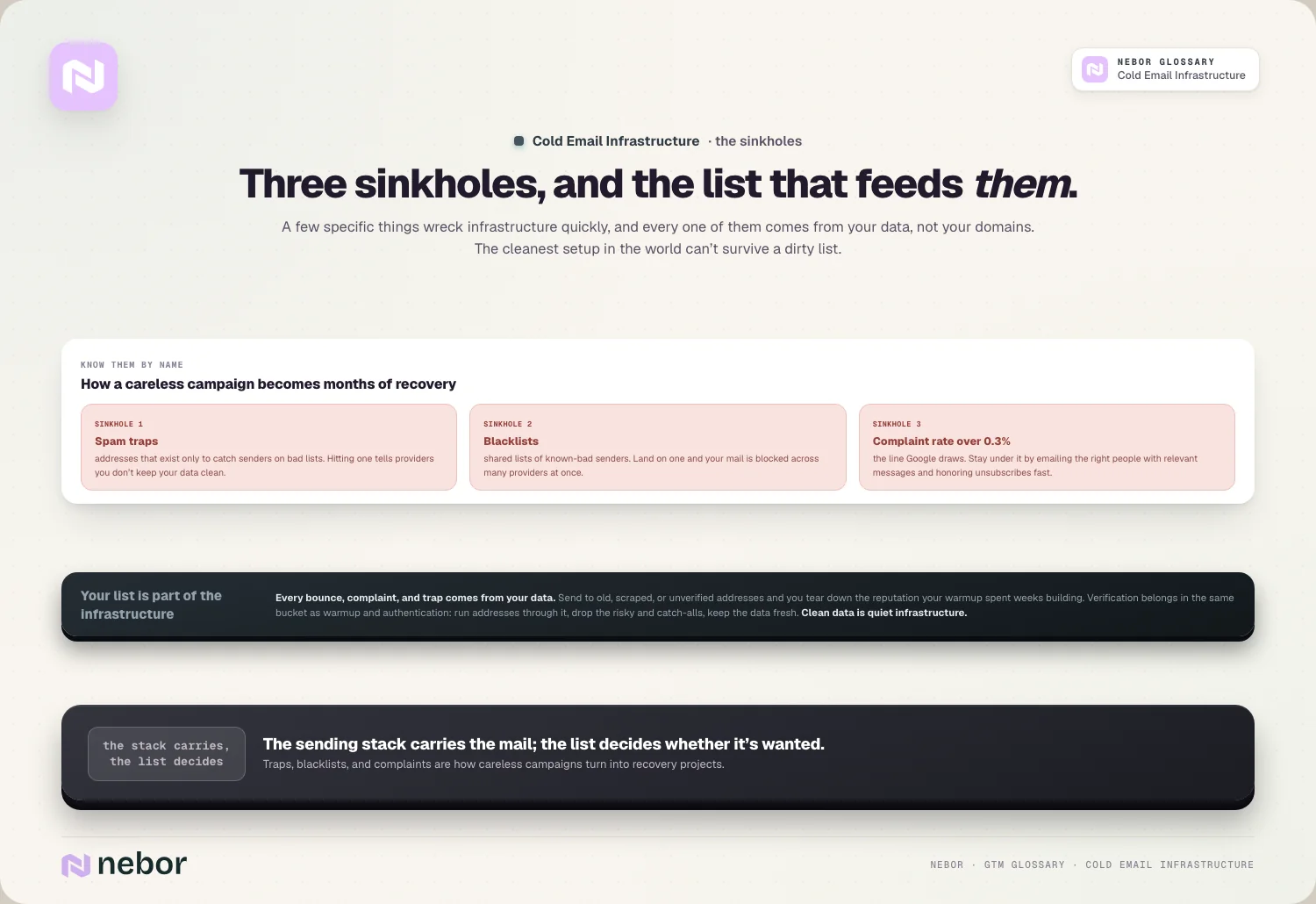
The sending stack carries the mail, but the list decides whether that mail is wanted.
So list verification belongs in the same bucket as warmup and authentication. You pass addresses through a verification tool before you send, you drop the risky and catch-all ones, and you keep your data fresh so it doesn't decay into a bounce machine.
Clean data is quiet infrastructure, the kind that protects your reputation without ever showing up in a dashboard.
How much sending infrastructure you really need at different volumes
The right amount of infrastructure depends on how much you send, and a lot of teams overbuild or underbuild because they never do the math. The starting point is a simple calculation. Decide how many emails you want to land per day, then work backward to the mailboxes and domains.
The safe rule we build around is to keep each mailbox to a small daily number, well under what it could technically push, so nothing looks like a machine. If you treat that as your unit, the math falls out cleanly.
A few hundred sends a day might need a dozen or so mailboxes spread across a handful of domains, and scaling up means adding more of both while the per-mailbox volume never rises.
This is why inbox rotation and volume planning go together. You don't grow a cold email program by sending more from the same boxes, because that's exactly what gets you filtered. You grow it by adding clean, warmed capacity, so your per-mailbox volume stays human-looking no matter how big the program gets.
How your inbox infrastructure shapes replies and the handoff to warmer motions
Infrastructure isn't only about getting mail out, it's also about what happens when someone writes back. A reply is the whole point, and a broken inbox setup can fumble it right when it matters.
If you send across many mailboxes, replies land across many inboxes too, so you need a way to catch and route them before they scatter and go cold. Slow or missed replies waste the deliverability you worked so hard to protect, because the prospect raised their hand and nobody answered in time.
This is where infrastructure connects to speed to lead, since a fast, organized reply beats a perfect send that goes unread.
The same setup feeds your warmer motions too. A cold email that lands and earns a reply is the first step in turning a stranger into a known, interested prospect, which is the start of a cold-to-warm pipeline.
Good infrastructure doesn't just deliver mail, it keeps the conversation alive long enough to become real pipeline.
How to keep your cold email infrastructure healthy over time
Infrastructure never turns into something you can set and forget, because reputation drifts and providers change the rules, as 2024 showed when Google and Yahoo tightened theirs.
Verify your lists before you send, so dead addresses and traps don't bounce and burn you. Monitor your deliverability with seed tests and blacklist checks, do a regular deliverability audit to catch problems early, and keep warmup ticking over on the domains you rely on.

The goal is to catch decay before it costs you a campaign. Teams that treat infrastructure as a living system rather than a one-time setup are the ones whose cold email keeps working while everyone else wonders why theirs stopped.
Why the best cold email infrastructure is the kind nobody ever notices
The strange thing about infrastructure is that when it works, no one can tell it's there. The prospect just sees a relevant email arrive in their inbox, on time, like any normal message, and never thinks about the domains, warmup, and reputation that carried it.
That invisibility is exactly what you're building toward. Every part of the stack, the separate domains, the full authentication, the patient warmup, the spread across mailboxes, and the verified lists, exists to make a cold email look and behave like an ordinary one.
None of it shows up in your copy, and none of it shows up to the reader.
So if you take one thing away from this entry, let it be the order of operations. Treat your infrastructure as the real product behind your cold email instead of an afterthought you bolt on once the copy is written.
If you build the foundation first and protect it, your words finally get the chance to do their job, because they reach a human. If you neglect it, you'll keep blaming the channel for a problem that was never about the words.
Share this post
Infrastructure
Deliverability
Glossary
Related glossary items
Understanding the core GTM concepts




Ready to build your pipeline











