

In this post:
Domain reputation is the score that mailbox providers like Gmail and Outlook quietly assign to your sending domain, based on how you've sent email in the past. It decides whether your messages land in the inbox, the spam folder, or nowhere anyone will ever look.
You never see this score directly, but it governs everything about your email. A domain with a strong reputation gets the benefit of the doubt, while a domain with a weak one struggles to reach anyone, no matter how good the message is.
For anyone doing cold outreach, domain reputation is the invisible foundation the whole channel rests on. If you ignore it, your best campaigns get filtered away before a single prospect knows they exist.
TL;DR
Domain reputation is how much the mailbox providers trust your sending domain, built up over time from your sending behavior. It's one of the biggest factors in whether your email reaches the inbox.
It's earned slowly through clean sending, low complaints, real engagement, and proper authentication, and it's lost quickly through spam complaints, bad lists, and sudden volume spikes. Once a domain is burned, recovery is slow and painful.
The practical takeaway is to protect it like the asset it is. Send from separate domains, warm them up, keep your lists clean, and keep your spam complaints far below the line the providers draw.
So what is domain reputation, and why does it decide if your email lands?
Domain reputation is a rating of how trustworthy your sending domain looks to the mailbox providers. They watch how you send, who engages, and who complains, then use that history to decide where your future mail goes.
It matters this much for a simple reason. Inbox providers are trying to protect their users from spam, so they lean heavily on reputation to sort wanted mail from unwanted. A trusted domain reaches the inbox, and an untrusted one gets filtered, throttled, or blocked.
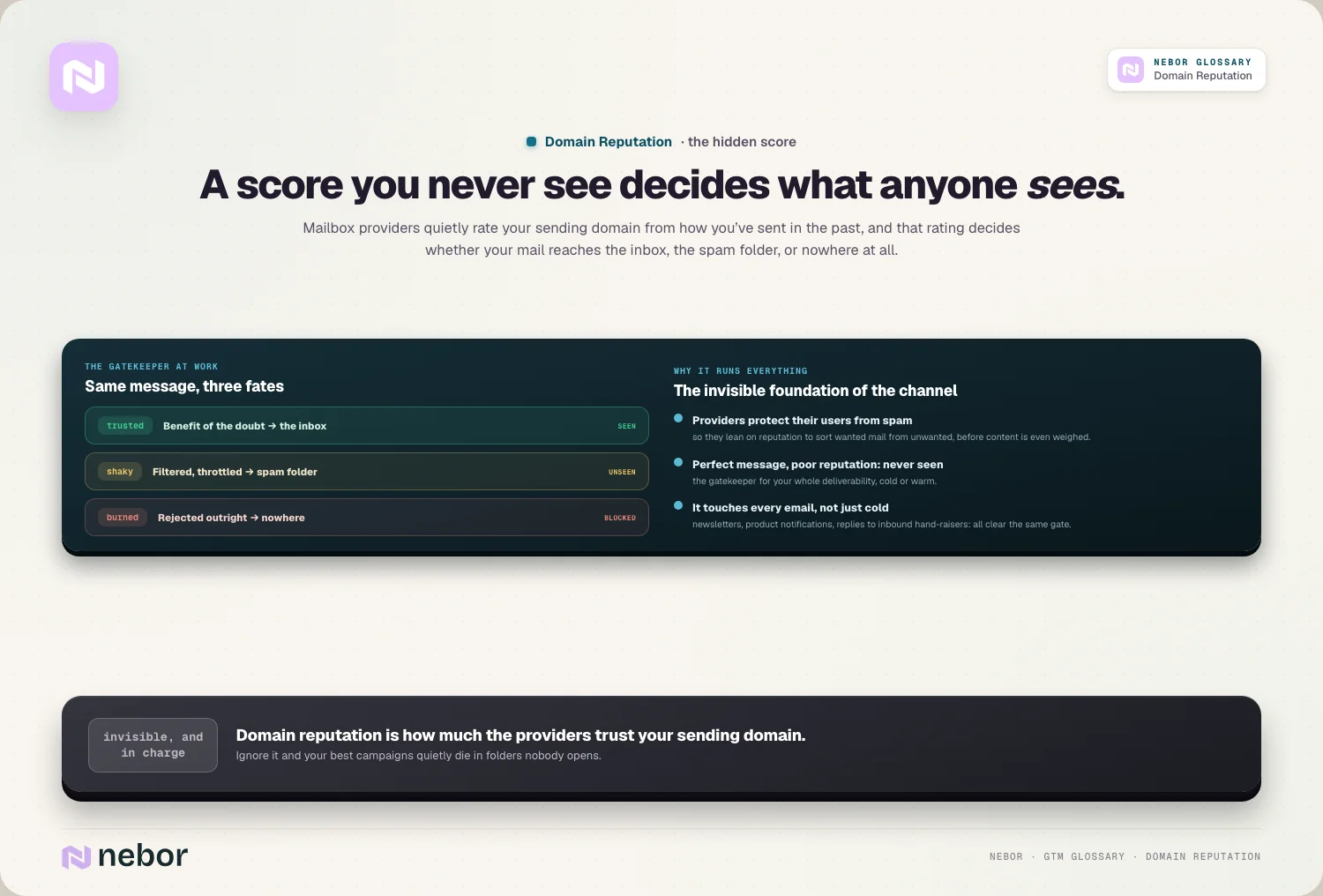
This makes domain reputation the gatekeeper for your whole email deliverability. You can write the perfect message to the perfect list, but if your domain's reputation is poor, most of it never gets seen.
How is domain reputation different from IP and sender reputation?
These three terms get used interchangeably, and they're related, but they aren't the same thing. They deserve a clean separation, because each one behaves differently.
IP reputation is tied to the server address your mail is sent from, and it can be shared across many senders if you're on a shared IP. Domain reputation is tied to your specific sending domain, so it follows you even if you change servers. That makes domain reputation harder to escape and more personal to you.
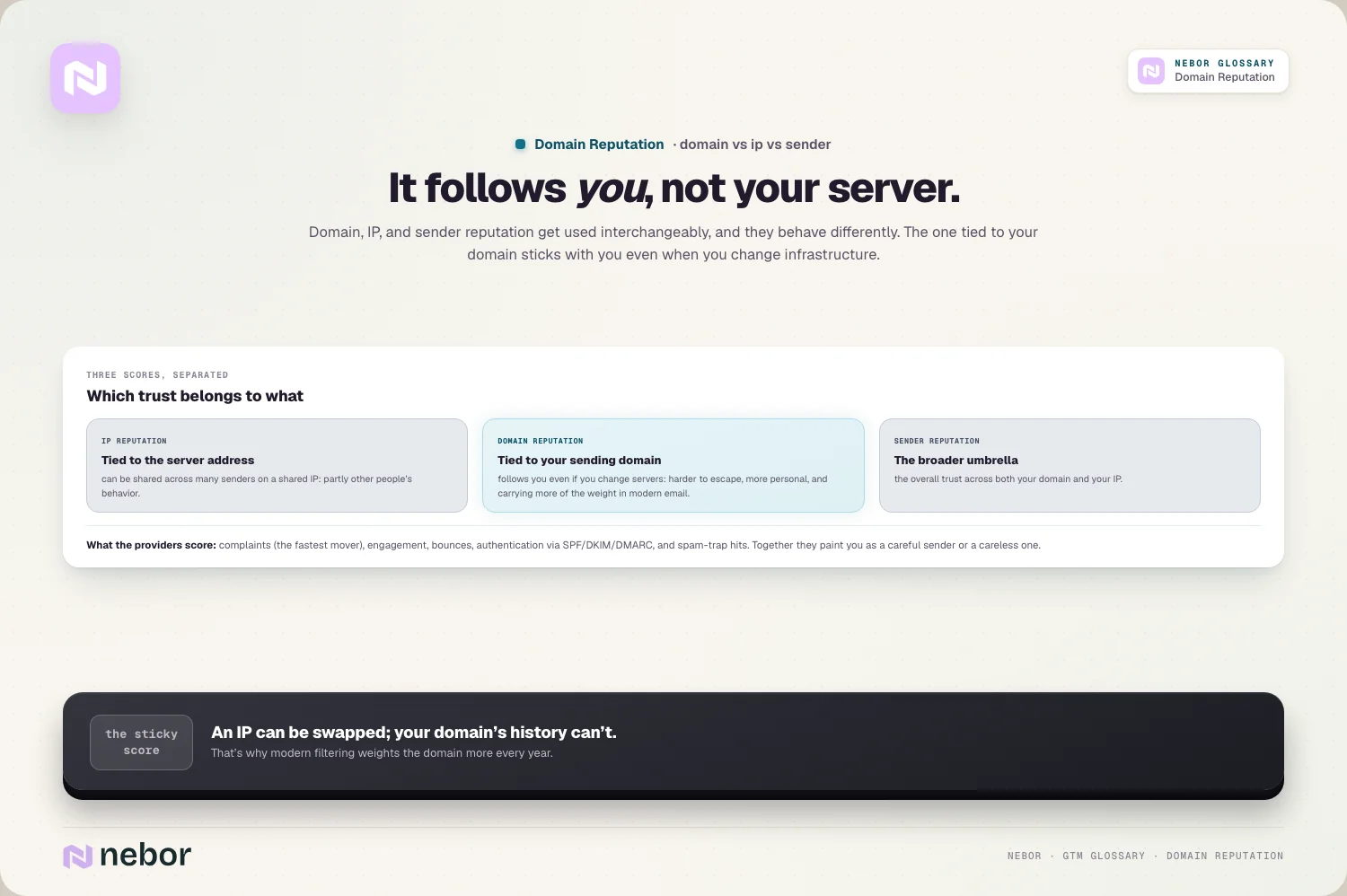
Sender reputation is the broader umbrella, the overall trust the providers place in you across both your domain and your IP. In modern email, domain reputation carries more and more of the weight, because it sticks to you in a way an IP address doesn't.
How do the mailbox providers put a score on your sending domain?
You can't see the exact formula, but you can see the inputs, because the providers have been clear about what they watch. A handful of signals do most of the work.
The biggest input is complaints, because when people mark your mail as spam, your reputation drops faster than anything else can rebuild it.
Engagement matters too, since opens, replies, and people moving you out of spam all tell the providers your mail is wanted. Bounces work the other way, because sending to dead addresses signals a dirty list.
They also check your authentication, the SPF, DKIM, and DMARC records set up through proper DNS authentication, and they punish you hard if you hit a spam trap.
Put together, these signals build a picture of whether you're a careful sender or a careless one.
What builds a strong domain reputation over time when you do it right?
A strong domain reputation isn't bought, it's earned through consistent, careful sending. The good news is that the habits that build it are the same ones that make outbound work in general.
It starts with warmup, slowly ramping a new domain's volume so the providers see a normal, gradual pattern rather than a sudden blast. From there it's about steady volume, real engagement from the people you email, and keeping complaints and bounces low.
Authentication and list quality do the rest. A fully authenticated domain that only emails people likely to care, and gets replies and opens in return, builds trust month after month. None of this is flashy, but month after month it's the difference between a domain the providers trust and one they keep at arm's length.
What are the mistakes that can destroy a domain reputation in days?
Reputation is earned slowly and lost quickly, and a few mistakes can undo months of careful sending in a week. Knowing them by name helps you avoid them.
The fastest killer is spam complaints, and that's the reason blasting people who never wanted your mail is so dangerous. Close behind is a bad list, because sending to stale or scraped addresses drives up your bounce rate and signals carelessness.
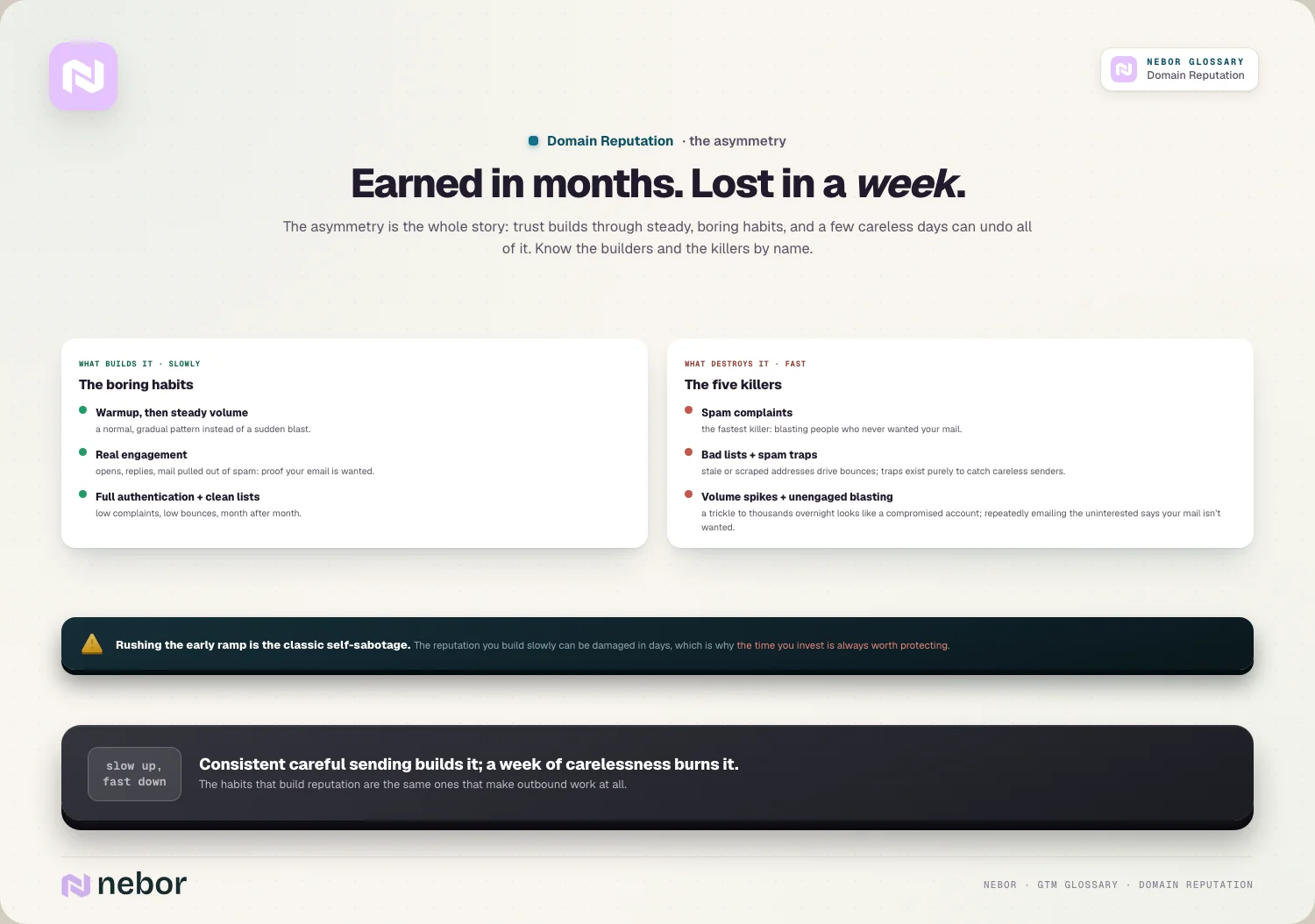
Hitting a spam trap is worse still, since those addresses exist purely to catch senders using bad data.
Sudden volume spikes hurt too, because going from a trickle to thousands overnight looks exactly like a compromised account. So does repeatedly emailing unengaged contacts, which tells the providers your mail isn't wanted even when nobody actively complained.
Why you should never burn your main company domain on cold outreach
Here's the rule that protects everything else. Your primary company domain, the one your real email and website depend on, is far too valuable to risk on cold outreach.
Cold email carries reputation risk by its nature, with bounces, complaints, and the occasional misfire. We've watched one bad campaign push a company's everyday business email into spam for weeks, and that kind of damage is slow and expensive to undo.
So serious senders send cold outreach from separate sending domains, kept well away from the main one, as part of a deliberate cold email infrastructure. If a secondary domain gets burned, you retire it and protect everything that matters, while your real domain stays well clear of it.
What changed with Google's 2025 rules, and why it matters now
Domain reputation used to be a fuzzy score you could only guess at, but that's changed, and the change matters. In 2025, Google retired the old domain and IP reputation dashboards in Postmaster Tools and replaced the guesswork with a hard number.
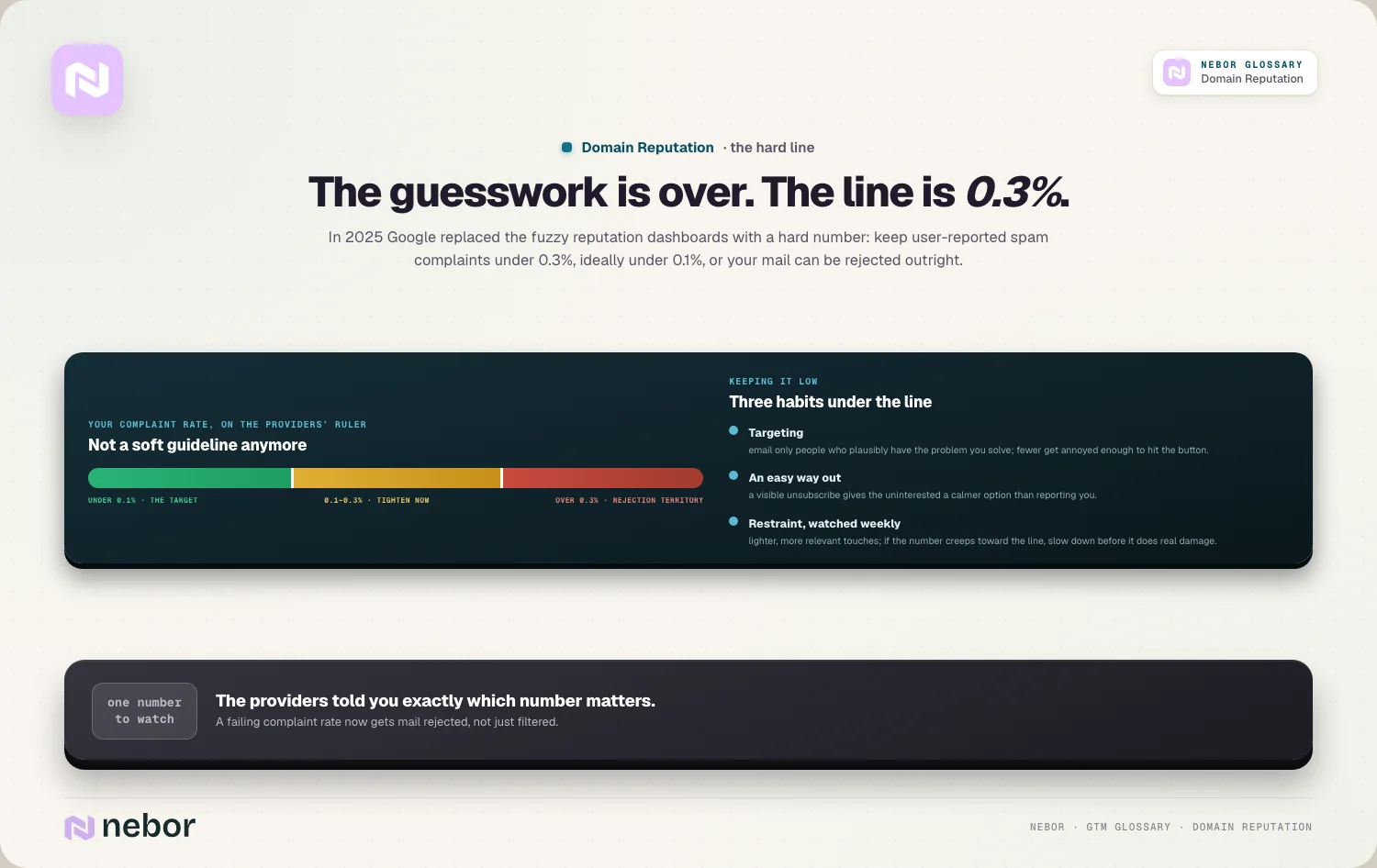
The rule the providers landed on is blunt. You need to keep your user-reported spam complaint rate below 0.3%, and ideally under 0.1%, or you're in trouble.
This isn't a soft guideline anymore, because a failing complaint rate can now get your mail rejected outright instead of just filtered to spam.
That shift makes reputation management less mysterious and more measurable. The providers have told you exactly which number to watch, so the job is to keep complaints low through good targeting, real consent where it applies, and easy opt-outs, rather than hoping a hidden score stays green.
How do you check and monitor your domain reputation in practice?
Since reputation governs so much, you want to watch it instead of finding out the hard way. There are a few practical ways to keep an eye on it.
Google's Postmaster Tools still shows you your spam complaint rate, your authentication results, and delivery errors, which together tell you most of what you need.
You can also try seed tests, sending to a set of test inboxes to see where your mail really lands, and check whether your domain has hit any blacklists.
The most reliable approach is to make this a standing habit instead of a panic response. A regular deliverability audit catches a slipping reputation while it's still fixable, and the audits we do for clients almost always spot the slide long before anyone noticed replies drying up.
How do you recover a domain reputation once the damage is done?
If your reputation is already hurting, the honest news is that recovery is slow, but it's usually possible. The providers want to see a sustained pattern of good behavior before they let you back in.
The first job is stopping the bleeding. You pull back your volume, cut the unengaged and risky addresses from your list, and only email people who are likely to want it. Then you effectively re-warm the domain, rebuilding a track record of clean, wanted sending over weeks.
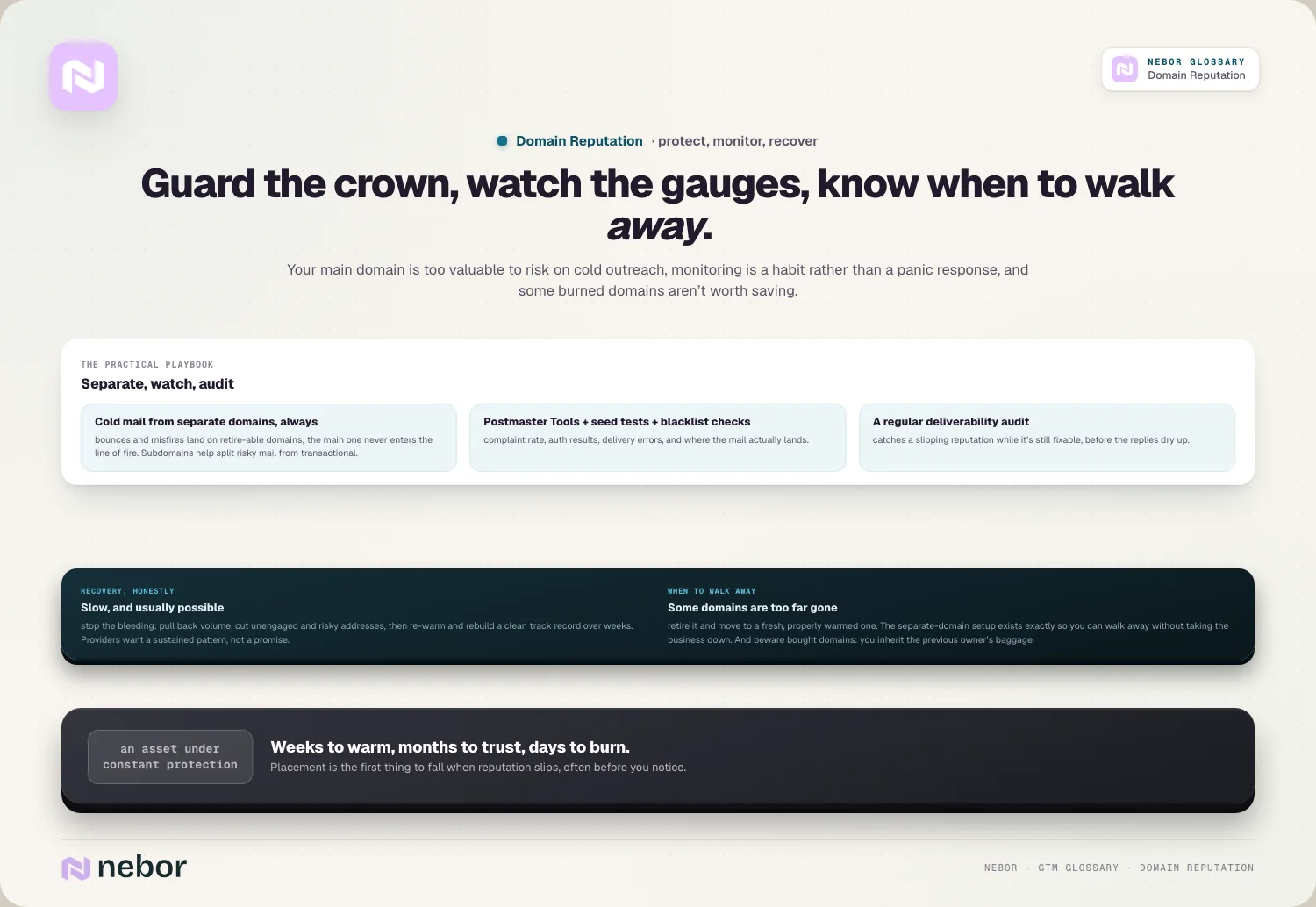
Sometimes a domain is too far gone to save, and we've told clients exactly that, because the faster path is to retire it and move to a fresh, properly warmed one.
That's another reason the separate-domain setup matters, because it gives you room to walk away from a burned domain without taking your whole business down with it.
Does your domain reputation matter for more than just cold email?
It's easy to think of domain reputation as a cold outreach problem, but it touches every email you send. The same score that decides whether your cold email lands also decides whether your newsletters, your product notifications, and your sales follow-ups reach people.
The inbound side takes the same hit. A weak reputation can push your meeting confirmations and follow-ups into spam, so the prospect who raised their hand yesterday never sees the reply they were waiting for. Losing a stranger costs you little, while losing a warm hand-raiser costs you a deal.
So reputation is really about protecting your ability to reach anyone by email at all. Whether the message is a cold first touch or a warm reply to an inbound lead, it has to clear the same gatekeeper, and that gatekeeper is your domain's standing.
How long does it take to build a domain reputation you can rely on?
Patience is part of the job, because reputation is built on a track record, and a track record takes time. A brand-new domain starts with no history, so the providers treat it cautiously until it proves itself.
A careful warmup usually takes a few weeks before a domain is ready for real volume, and a genuinely strong reputation builds over months of consistent, clean sending. There's no shortcut that skips this, because the providers are specifically watching for steady, normal behavior over time.
The reputation you build slowly can be damaged in days, and that lopsided math is the strongest argument for patience. Rushing the early ramp is one of the most common ways teams sabotage a domain before it ever gets going.
How do domain age and sending history shape the trust you start with?
Not every domain starts from the same place, and its past matters. An established domain that's been sending clean email for years carries a trust a fresh one simply doesn't have yet.
This is why buying old domains can backfire. A domain with a shady sending history comes with baggage, and you inherit whatever reputation the previous owner left behind, good or bad. A freshly registered domain has no baggage, but it also has no trust, so it needs full warmup before you lean on it.
Subdomains add one more wrinkle to the picture. A subdomain can carry some signal from its root domain, and that's the reason teams often send different kinds of mail from different subdomains, keeping risky cold outreach away from the domain their important transactional email depends on.
How does domain reputation connect to the rest of your sending setup?
Domain reputation doesn't stand on its own, it's one piece of a wider sending infrastructure that all has to work together. The other pieces either protect it or put it at risk.
Clean lists protect it, because passing email validation before you send keeps dead addresses from driving up bounces and dragging your reputation down. Authentication protects it, warmup protects it, and sensible volume protects it. Every part of a good setup exists partly to keep your reputation healthy.
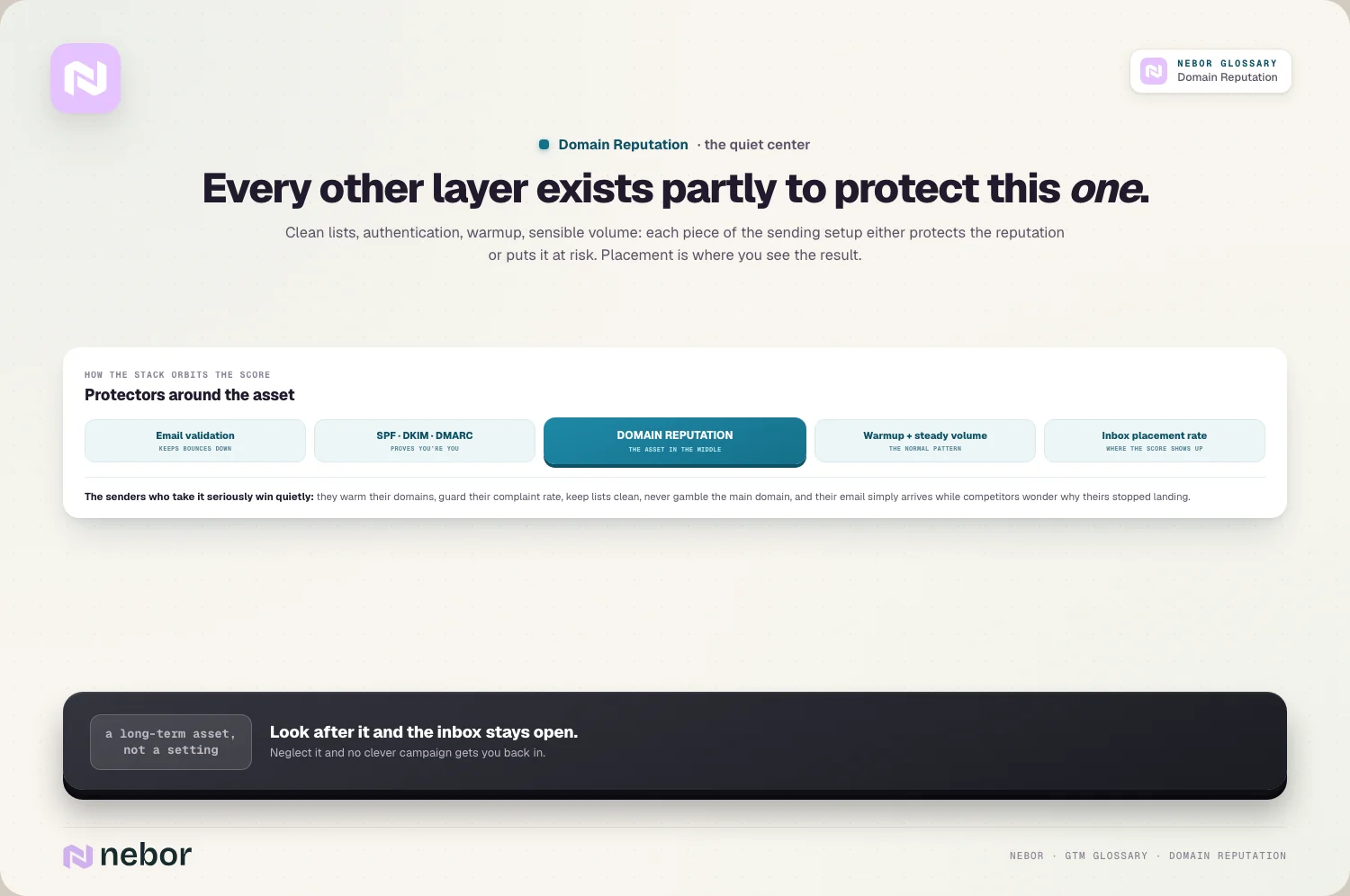
The clearest way to see reputation's effect is your inbox placement rate, the share of your mail that makes it into the primary inbox.
When your reputation is strong, that number stays high, and when it slips, placement is usually the first thing to fall, often before you notice your replies drying up.
How do you keep your spam complaints low enough to stay in the clear?
Since the spam complaint rate is now the number that matters most, let's get practical about how to keep it down. In our experience staying under that line comes down to a few habits.
The first habit is targeting people honestly in the first place. If you only email people who plausibly have the problem you solve, far fewer of them get annoyed enough to hit the spam button.
The second is an easy, obvious way out, because a visible unsubscribe or a simple opt-out gives an uninterested person a calmer option than reporting you.
The third habit is restraint in how hard you push. Over-emailing, sending too often, or pushing the same tired pitch all drive complaints up, so a lighter and more relevant touch protects you.
Watch the number weekly, and if it starts creeping toward the line, slow down and tighten your targeting before it does any real damage.
Why domain reputation is the quiet score behind your whole outbound
At the end of every campaign you'll ever send is the same checkpoint, because domain reputation is the thing standing between your message and your prospect's inbox. It's invisible, it's slow to build, and it decides far more than most teams realize.
That's why the senders who take it seriously keep winning without any visible flash. They warm their domains, guard their complaint rate, keep their lists clean, and never gamble their main domain, so their email simply arrives while their competitors wonder why theirs stopped landing.
The mindset that works is to treat your domain reputation as a long-term asset you keep protecting rather than a setting you configure once. As long as you look after it, the inbox stays open, and once you neglect it, no clever campaign will get you back in.
Share this post
Deliverability
Glossary
Related glossary items
Understanding the core GTM concepts




Ready to build your pipeline











