
In this post:
Inbox rotation is the practice of moving your cold email volume through batches of sending accounts in turns, so the accounts working this month go quiet next month while a different batch carries the load.
Holding twenty accounts doesn't mean twenty accounts sending every day. You might work the first batch through one month, switch to the second batch for the next, then bring the first batch back once it has had time to recover.
It exists because of a hard limit nobody can wish away. A single account can only send a tiny number of cold emails per day before mailbox providers start treating it as spam, and sending from the same accounts month after month wears down even that modest allowance.
If you're doing cold outbound at any scale, inbox rotation stops being optional, because it's the foundation that keeps your email landing in inboxes instead of spam folders. Understanding it is understanding why serious cold email looks the way it does behind the scenes.
TL;DR
Inbox rotation means moving your cold email volume through batches of sending accounts in turns, so each account sends a small number of emails while it's active and then goes quiet while another batch takes over.
The reason it exists is that a single account can only send a handful of cold emails a day before providers flag it, and working the same accounts continuously grinds down their reputation even at safe daily volumes.
A rule of thumb once put the ceiling near 40 cold emails a day per account, and that figure is well out of date now, because the realistic limit has dropped to somewhere around 10 to 20.
Rotation lets you scale outreach safely, though it only works on top of proper authentication, warmup, and a clean list. Volume without that foundation just burns accounts faster.
So what is inbox rotation exactly, and how does the cycling work?
Inbox rotation is a method for sending cold email at volume without wearing out any single account. You split your sending accounts into batches, work one batch for a stretch of weeks or months, then hand the work to the next batch while the first one rests.
The mechanics are easiest to see with real numbers. Holding twenty accounts, you might work them as two batches of ten, with the first batch carrying your campaigns through one month and the second picking up the next, so no account sends continuously.
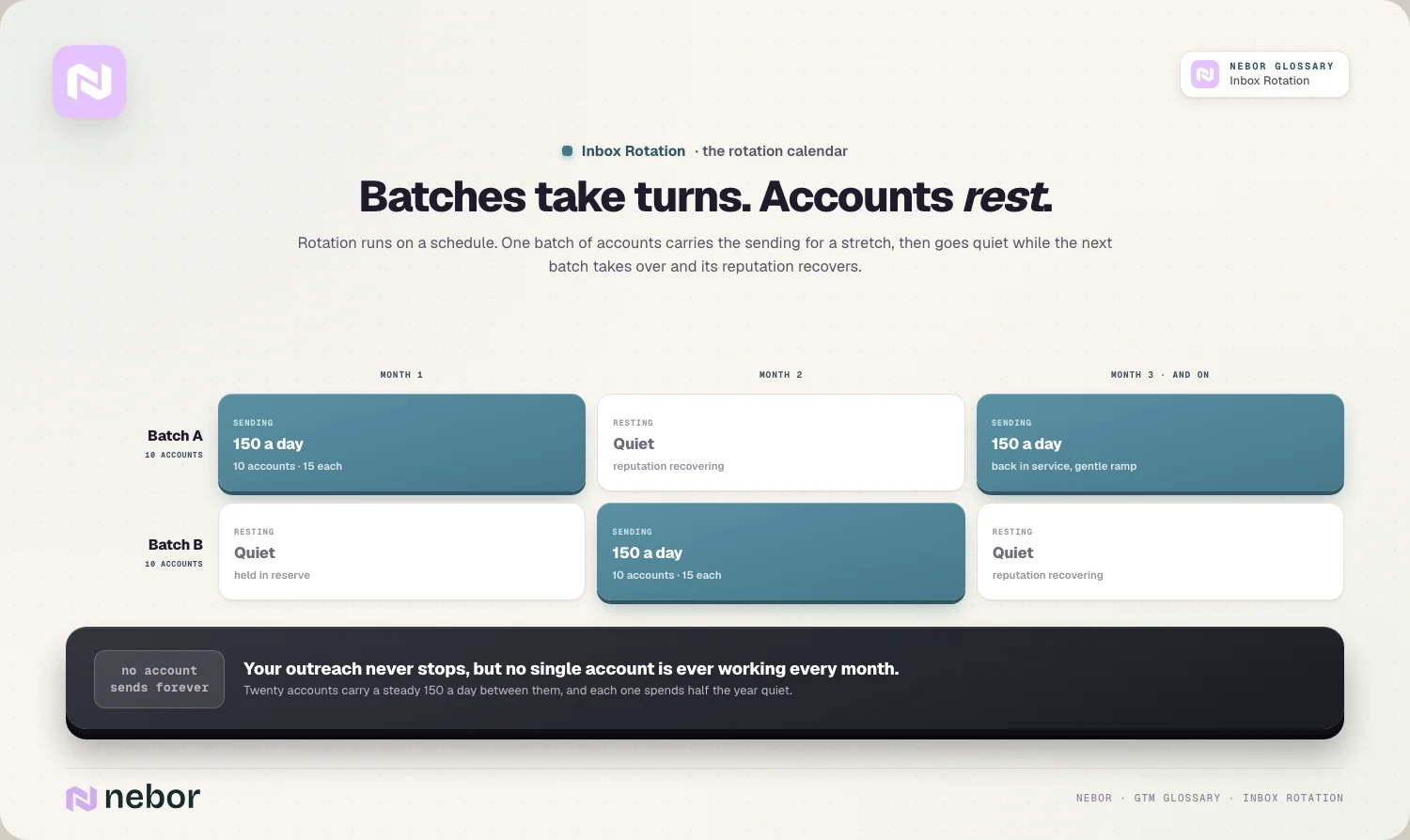
Each account ends up with a working life made of short active stints and long quiet gaps, which is far closer to how a real person's mailbox behaves than an account blasting cold email every weekday of the year.
A single account trying to send hundreds of cold emails a day looks obviously abnormal to mailbox providers, and an account that never once pauses looks strange in its own way, so batching answers both problems together.
Rotation turns a volume that would destroy a handful of accounts into one a larger, rested pool can carry for years.
Why can't you just send everything from one inbox and be done?
The whole reason inbox rotation exists is a limit that catches a lot of people by surprise. A single inbox simply can't send much cold email before it gets punished.
Mailbox providers like Google and Microsoft watch sending behavior closely, and an account that suddenly sends a large volume of cold email to people who didn't ask for it looks exactly like spam.
The safe daily volume of cold email per account is smaller than most people expect, somewhere around 10 to 20 messages, and pushing past it risks landing in spam folders, damaging your reputation, or getting the account suspended outright.
The rule of thumb we used to hear was 40 a day per account, and we tell clients to forget that number, because providers have tightened enough that anything above 20 starts drawing attention. One account hits that ceiling almost immediately.
So the constraint is what a single account can do before providers turn on it, however willing you are to send more.
This is why you can't scale cold email by simply sending more from one address, because the more you push a single inbox, the faster you destroy it. Rotation answers a limit that's baked into how email works, and there's nothing clever or hacky about it.
How does inbox rotation work in practice once a campaign is live?
In the setups we build, inbox rotation is a schedule as much as a setting. You decide which accounts make up each batch, how long a batch stays active, and how long it rests before coming back into service.
You connect the active batch, often spread across several domains, to your sequence, and your sending tool shares that batch's daily volume among its accounts.
When the stint ends, the accounts in that batch stop sending cold email for a while, and the next batch takes over the campaigns without any gap in your outreach.
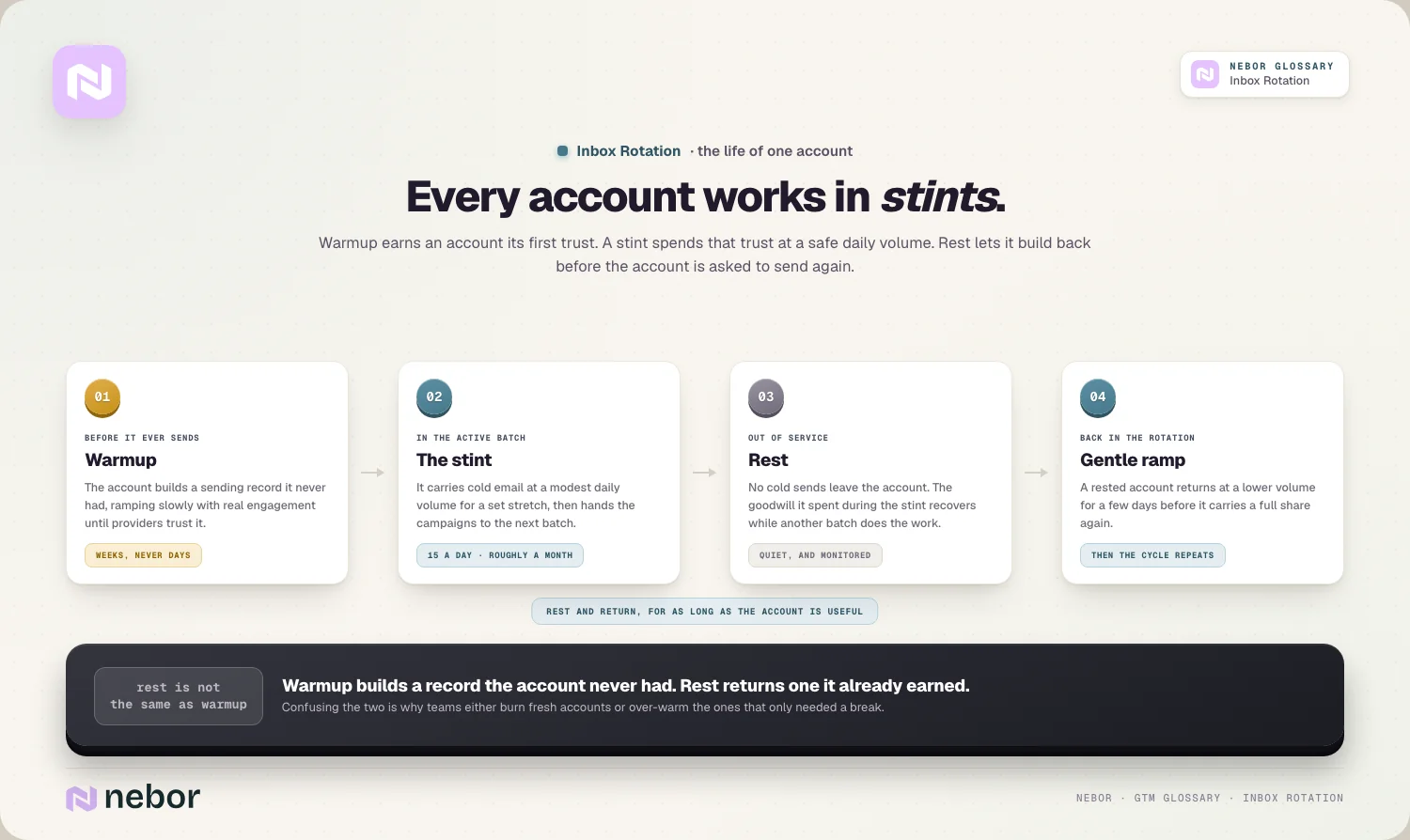
Some teams switch every month and others keep longer stints, and the right rhythm depends on how hard the accounts were worked and how quickly their engagement recovers.
For most of our clients, two or three batches give enough breathing room, with the number of accounts inside each batch set by the daily volume you need.
The key is that no account sends continuously and none of them pass their daily ceiling while active. Rotation is less about any single setting and more about the discipline of resting accounts before they show signs of strain.
How does inbox rotation fit into your cold email infrastructure?
Inbox rotation never stands alone, because it's one piece of a larger setup that makes cold email deliverable. Seeing where it fits keeps you from treating it as a magic fix.
It's part of your cold email infrastructure, the whole foundation of domains, inboxes, authentication, and warmup that outbound depends on.
Rotation handles the distribution of volume, but it stands alongside other essentials, like properly authenticated domains and warmed-up accounts, that all have to be in place for the email to land.
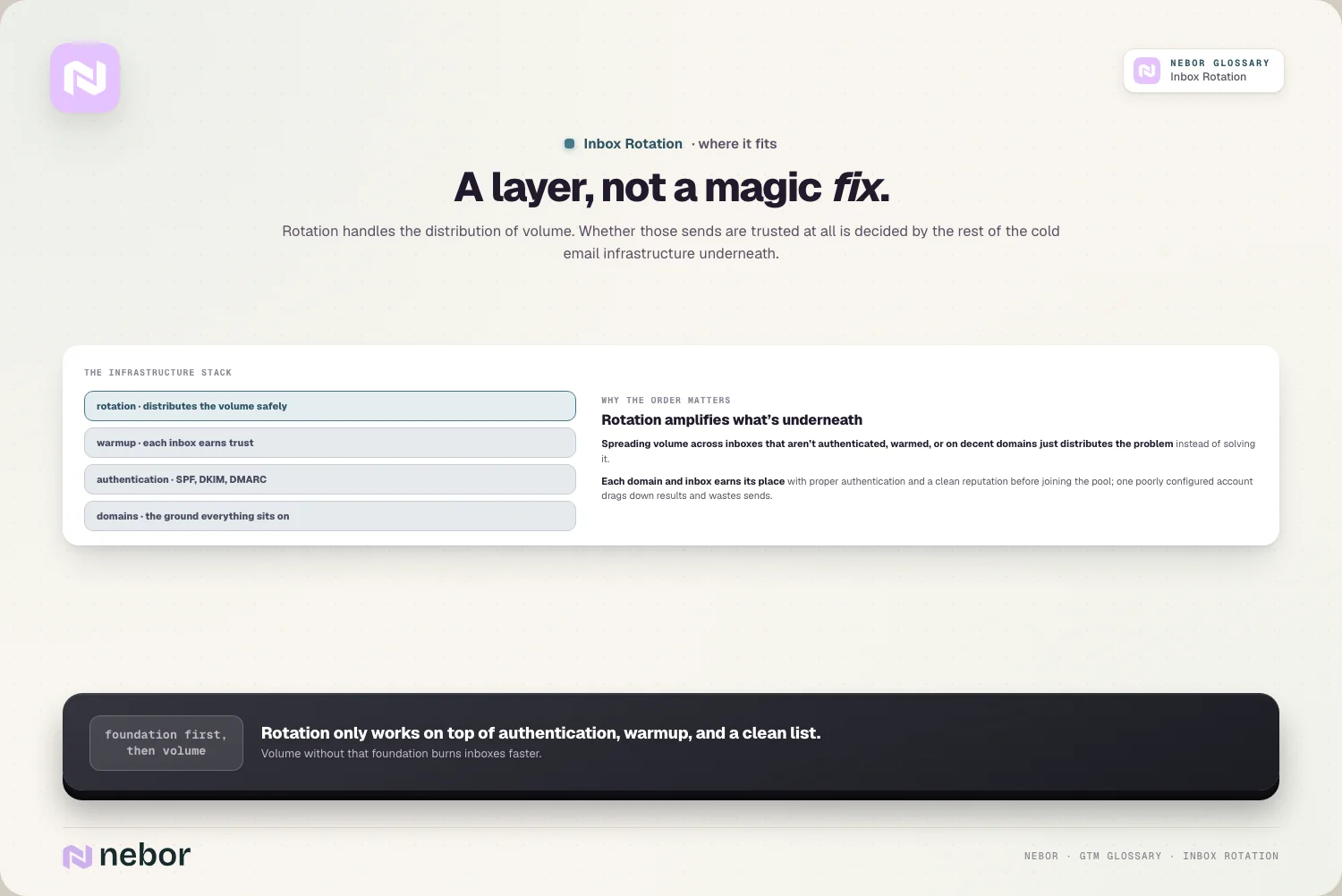
It also manages how much each inbox sends, while the rest of the infrastructure determines whether those sends are trusted in the first place.
This is why rotation alone can't save bad infrastructure. Spreading volume across many inboxes that aren't authenticated, aren't warmed up, or live on a poor domain just distributes the problem instead of solving it.
That means inbox rotation is a critical layer, but it works only on top of a sound foundation, and that's exactly the reason cold email infrastructure gets treated as a system instead of a single trick.
How does inbox rotation protect the deliverability underneath you?
The real job of inbox rotation is protecting your deliverability, which is whether your email actually reaches the inbox. It does that by keeping each account's behavior normal.
Email deliverability depends heavily on how mailbox providers judge each sending account, and an account that sends too much cold email too fast gets judged harshly.
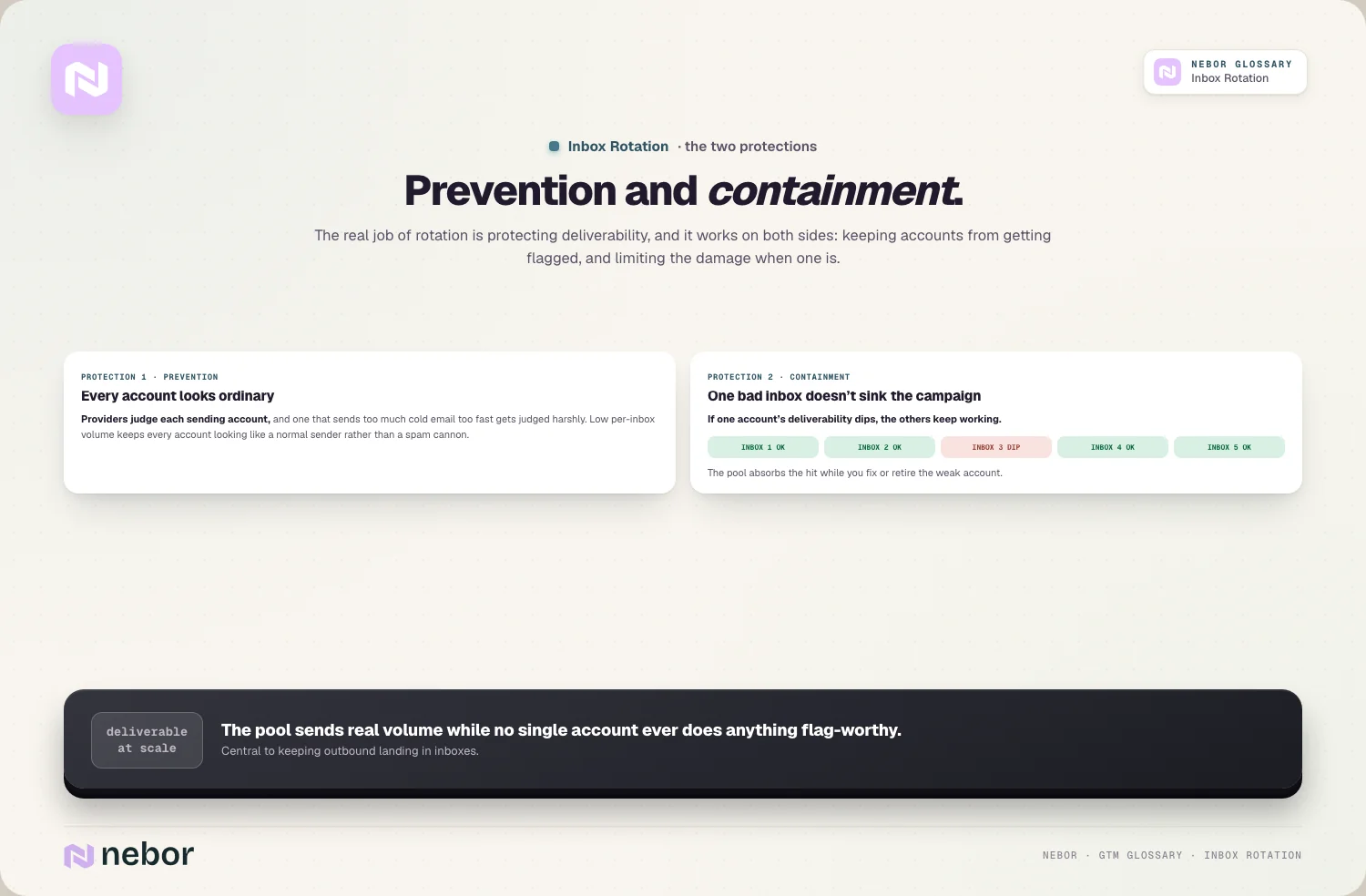
By keeping each account's volume low and its stints short, rotation makes every one of them look like an ordinary sender, which keeps providers trusting it. The pool carries real volume while no single account does anything that would get it flagged.
Containment comes along as a second, quieter benefit. If one inbox in the pool hits trouble and its deliverability dips, the others keep working, so a single bad account doesn't take down your whole campaign.
Inbox rotation both prevents problems, by keeping volumes safe, and limits the damage when one does occur, which is why it's central to keeping outbound deliverable at scale.
Why does inbox rotation depend on domain reputation and authentication?
Inbox rotation only helps if the inboxes you're rotating through are trustworthy to begin with, which comes down to reputation and authentication. Rotating bad inboxes just spreads the badness.
Each sending account carries a domain reputation, a track record that providers use to decide whether to trust it, and rotation across many domains means you're relying on all of their reputations.
If those domains aren't properly set up with DNS authentication like SPF, DKIM, and DMARC, providers can't verify the mail is really from you, and no amount of rotation will make unauthenticated email land.
The accounts in your rotation have to be legitimate and verified, or the rotation is just distributing untrusted mail.
This is why setting up a rotation pool is more involved than connecting a bunch of random inboxes.
Each domain and inbox needs proper authentication and a clean reputation before it joins the rotation, because a single poorly configured account can drag down results and waste sends.
Rotation amplifies whatever reputation your inboxes have, so the foundation under each one has to be solid.
Why do new inboxes need warmup before they can join the rotation?
You can't just spin up a batch of fresh inboxes and immediately blast cold email through them, even with rotation. New accounts need to be warmed up first, or they'll get flagged fast.
A brand-new inbox with no sending history looks suspicious to the providers the moment your team points cold email through it, because providers have no track record to trust.
Email warmup is the process of gradually building that history, by slowly ramping up sending and generating positive engagement so the account looks established before it carries real outbound.
Skipping warmup means dropping cold, untrusted inboxes straight into your rotation, which undermines the whole point.
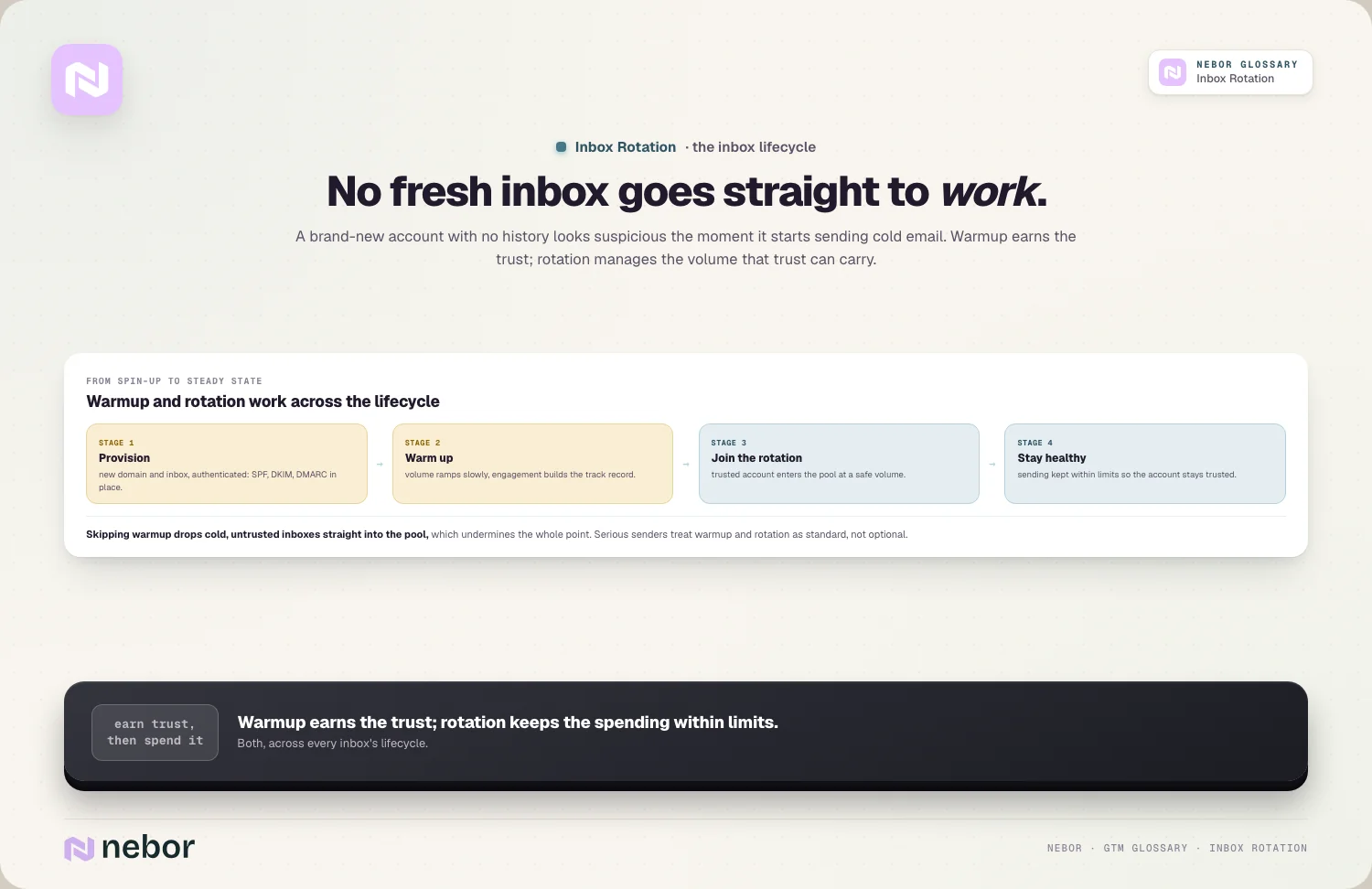
So warmup and rotation work together across the lifecycle of an account. You warm one up until it's trusted, add it to a batch at a safe volume, then let it rest when its stint ends.
Warmup and rest are doing two different jobs here. Warmup builds a track record an account never had, while a rest period lets an established account recover the goodwill it spent, so a batch returning to service usually needs a gentle ramp instead of a full warmup from scratch.
Rotation manages the ongoing volume, and warmup earns the trust that makes that volume safe, and that's the reason serious senders treat both as standard instead of optional.
How does inbox rotation relate to your sequences and sending volume?
Inbox rotation shapes how your actual outreach campaigns are built, because the volume you can send is bounded by the size of your pool. The two have to be planned together.
When you send an email sequence across a list, your daily ceiling is whatever the active batch can safely send, so reaching more prospects per day means widening each batch instead of pushing its accounts harder.
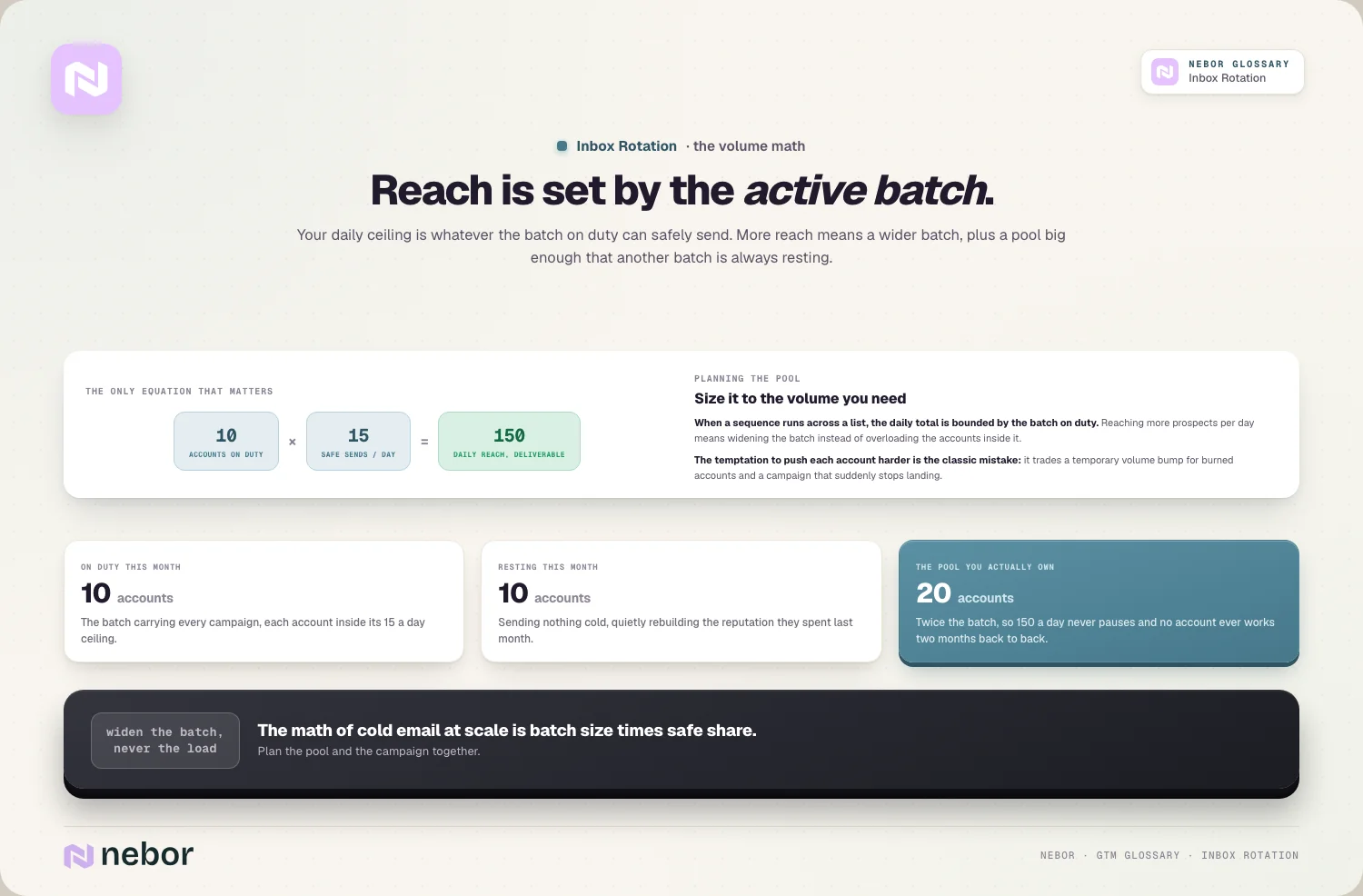
This is the math of cold email at scale, where your reach is a function of how many healthy accounts are in the active batch, each contributing its small safe share. You size the batches to the volume you need, and size the pool so a rested batch is always waiting.
This also shapes how you think about list building and pacing. A large list isn't something you can blast in a day, it's something you work through at the safe pace your rotation allows, which keeps the whole operation healthy.
The rotation schedule and the campaign volume are two sides of the same plan, and treating them separately is how accounts get burned.
Is inbox rotation just a trick for getting past the spam filters?
The suspicion deserves a direct answer, because spreading email across many accounts can sound like a dodge. When you do it properly, there's no deception involved, only alignment with how email is meant to work.
The honest framing is that rotation makes your sending look natural because, at the per-inbox level, it is natural, with each account sending a modest, human volume.
Nothing gets disguised along the way, because what you're avoiding is the abnormal behavior, like one account blasting out hundreds of cold emails, that providers rightly treat as abuse.
Mailbox providers care about whether recipients want your email, and rotation is about sending within healthy limits, with nothing to hide.
That said, rotation can be abused, because someone sending unwanted junk across many inboxes is still spamming, just in a distributed way. The line is the quality and relevance of what you send.
When it carries relevant outreach at sane volumes, rotation is simply good infrastructure, and when it scales junk, the junk stays junk. The email you put through it is what matters in the end.
What are the common inbox rotation mistakes that burn accounts?
A few mistakes show up repeatedly with inbox rotation, and we've watched most of them burn real accounts. They come from treating it as a shortcut instead of one layer of a system. Naming them helps you avoid burning your inboxes.
The biggest is overloading the accounts anyway, cramming too much volume through too few of them to hit a number, which defeats the purpose and gets them flagged.
Close behind is working every account you own at the same time, which leaves nothing in reserve and ages the whole pool at one rate, so the accounts all start struggling in the same month.
Another is rotating accounts that were never properly set up, with weak authentication or no warmup, so you're spreading untrusted mail.
Then there's ignoring the health of individual accounts, leaving a struggling one in the active batch where it drags down results instead of pulling it out to recover.
There's also the deeper mistake of leaning on rotation to compensate for bad outreach, assuming more inboxes will fix a message that gets marked as spam, when the real problem is the email itself.
A single checklist covers every one of them. You set up and warm every account properly, keep daily volume low, give each batch real rest, watch account health, and remember that rotation protects good outreach while never rescuing bad outreach.
How does inbox rotation fit into automated and AI-driven outbound?
Inbox rotation has become even more important as outbound gets more automated, because automation makes it easy to send at volumes that would instantly burn a single inbox. The two have to be designed together.
In an autonomous outbound setup, where systems handle much of the sending, rotation is what keeps that automated volume from overwhelming any one account.
The automation can prepare and send a lot of email, so the rotation layer underneath has to distribute it across enough healthy inboxes to stay safe.
Without rotation, automated outbound would simply hit the single-inbox ceiling faster and louder, getting accounts suspended at scale.
This is why modern outbound treats rotation as part of the plumbing rather than an afterthought.
The more you automate and scale, the more your results depend on a well-managed pool of authenticated, warmed-up inboxes sending within safe limits.
Rotation is what lets automation translate into real, deliverable volume instead of a pile of burned accounts, and that's the reason it is at the core of serious outbound infrastructure.
Why inbox rotation is really about respecting how email works
Inbox rotation is an honest response to a simple reality, that each email account can only send so much cold email before providers stop trusting it, and that no account can keep sending forever without a break.
Moving volume through batches that take turns is how you send at scale while keeping every account inside the limits that keep email deliverable.
The teams that do it well treat rotation as one layer of a real system, built on authenticated domains, warmed-up inboxes, and clean lists, with per-inbox volume kept honestly low.
They monitor the health of each account, pull the struggling ones out early, and size their pool so a rested batch is always ready to take over.
The mindset that works treats your accounts as a resource you spend down and then let recover, sized so the next batch is always ready before you need it.
When you respect the per-inbox limits, set up every account properly, and let rotation protect good outreach instead of excusing bad outreach, you get the scale you want without the burned inboxes and spam folders that come from fighting how email works.
Share this post
Deliverability
Infrastructure
Glossary
Related glossary items
Understanding the core GTM concepts


Ready to build your pipeline