

In this post:
Say the words revenue operations to ten companies and you'll get ten different pictures. At one it's a single analyst cleaning up the CRM, at another it's a strategic team steering the whole go-to-market with predictive models, and both call the function RevOps even though they're worlds apart in capability.
A RevOps maturity model exists to put that spectrum on a map. Instead of arguing about whether your RevOps is good, it gives you defined stages so you can see exactly where you are today, what the next level looks like in practice, and which gaps to close to get there.
A RevOps maturity model is a diagnostic framework that grades how advanced an organization's revenue operations are across dimensions like process, data, technology, and cross-functional alignment. It places you on a stage from basic to optimized and lays out a path for moving up.
The value is that it turns a vague ambition into a concrete roadmap. Rather than trying to improve everything at once, you diagnose your current stage honestly, identify the specific weaknesses holding you back, and prioritize the handful of changes that would move you to the next level.
TL;DR
A RevOps maturity model is a framework that scores how sophisticated your revenue operations are and maps a path from a basic, reactive function to an advanced, strategic one.
Most models grade you across four dimensions, usually process standardization, data unification, technology integration, and cross-functional alignment, because maturity means progress on all of them together.
Stages go from early levels where RevOps just connects tools and cleans data, through middle levels where systems and forecasts truly integrate, to advanced levels driven by predictive and prescriptive analytics.
Advancing is worth the effort, because companies with advanced-maturity RevOps are meaningfully more likely to beat their revenue and profit goals than those still stuck at lower stages.
What a RevOps maturity model measures across your whole revenue org
A maturity model measures how far your revenue operations have progressed from reactive firefighting to a strategic, well-built system. Rather than judging a single metric, it assesses the whole operating capability, from how consistent your processes are to how much your teams work off the same data.
The point of measuring this is to make an abstract quality concrete. Everyone senses their RevOps could be better, but a maturity model breaks that feeling into specific, observable levels, so you can say precisely which capabilities are strong and which are holding the function back.
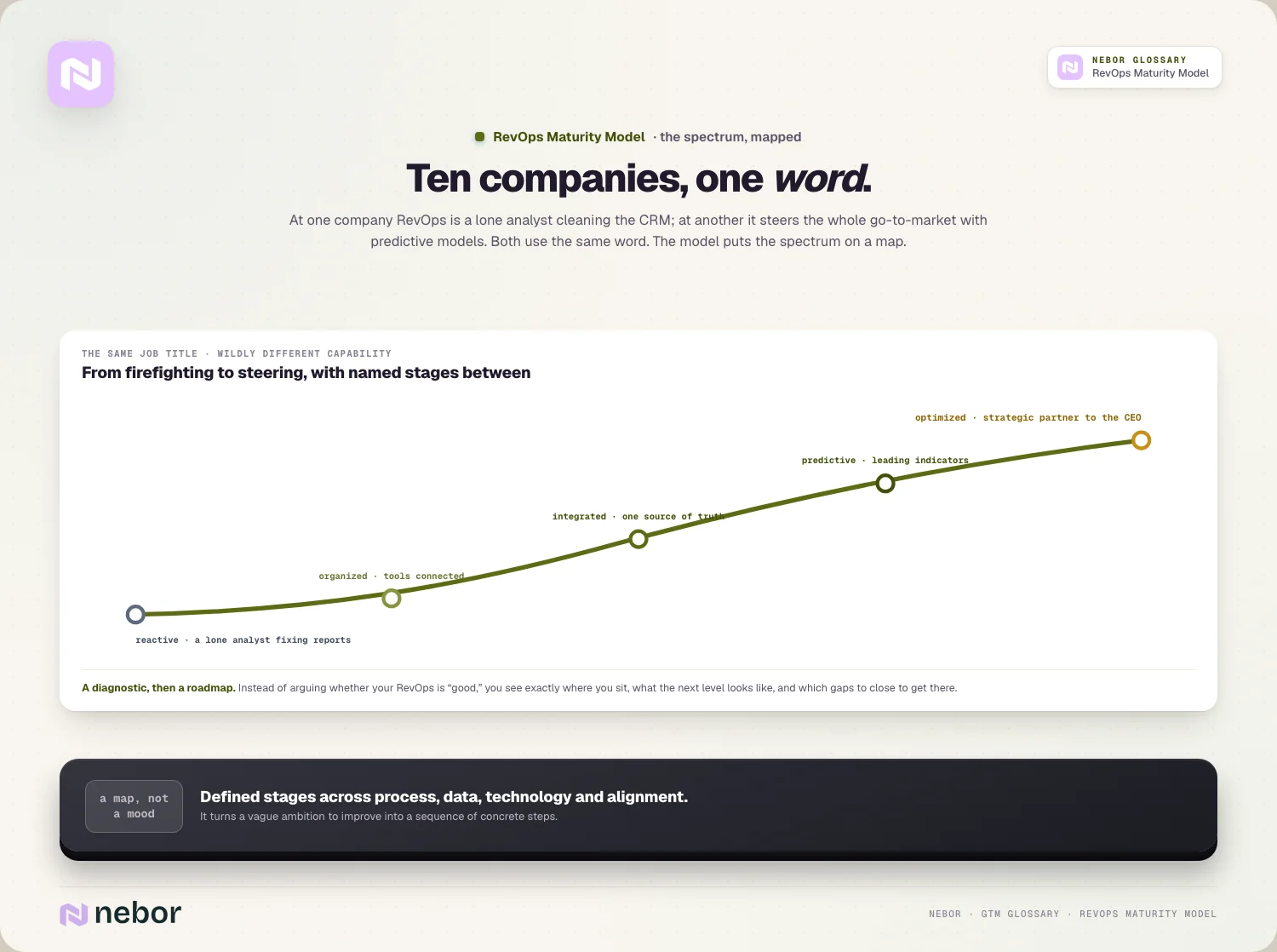
Because it defines an endpoint as well as a start, the model works as a roadmap instead of just a report card. Seeing what a more advanced stage looks like tells you what to build next, which turns a general desire to improve into a sequence of concrete steps you can take this quarter.
The four dimensions almost every maturity model grades you on
Most models assess maturity across four connected dimensions instead of one score. Process standardization looks at whether your processes are defined and repeatable or improvised deal by deal, and data unification looks at whether teams work from one shared source of truth or conflicting systems.
The other two dimensions cover the tools and the people. Technology integration measures whether your stack is connected into one flow or a pile of disconnected apps, and cross-functional alignment measures how well marketing, sales, and success operate as one motion instead of separate silos.
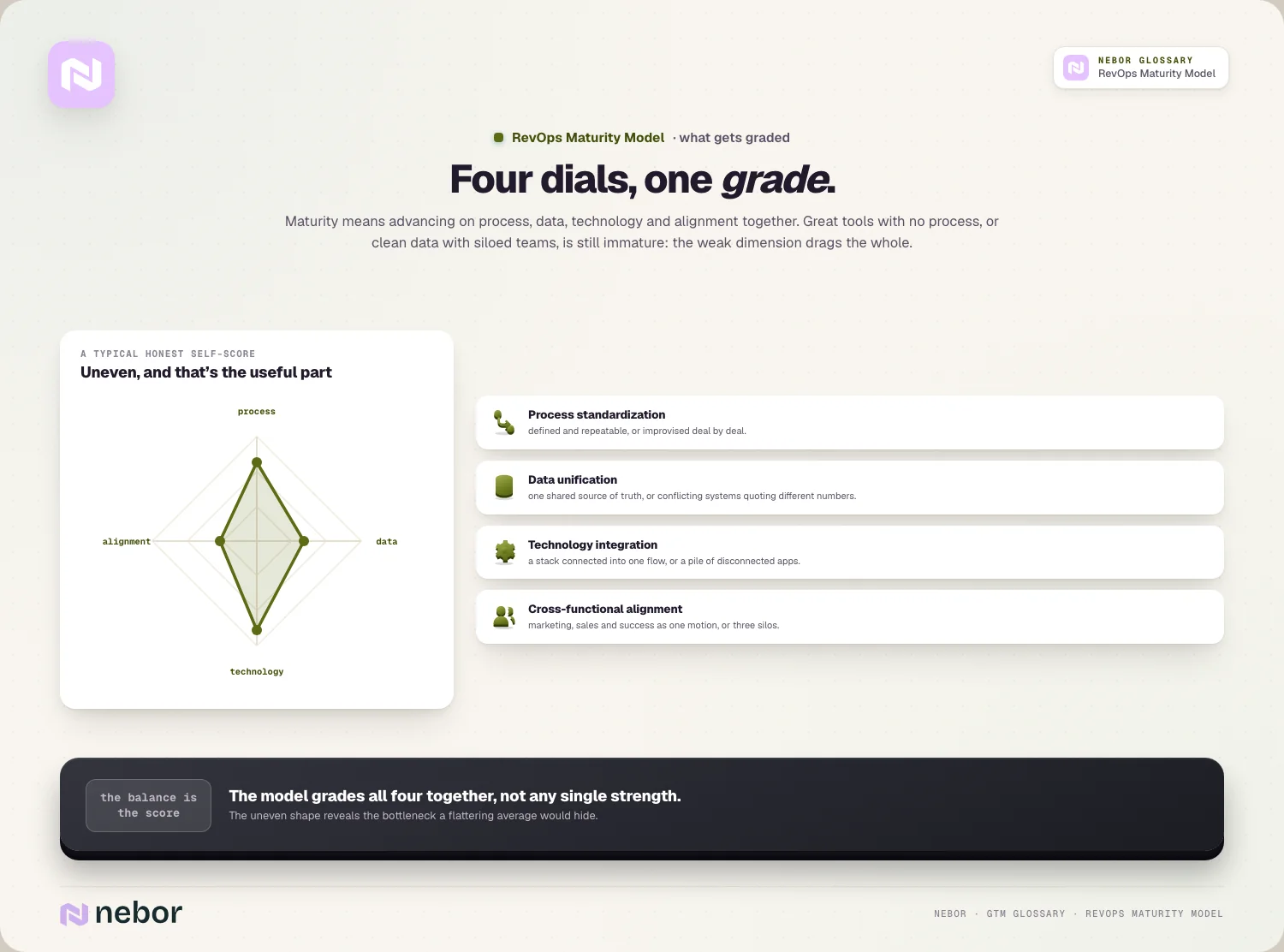
These dimensions matter together because maturity means advancing on all of them at once. A team with great tools but no process, or clean data but siloed teams, is still immature overall, because a weak dimension drags down the whole, which is why the model grades the balance instead of any single strength.
Why some maturity models use three stages and others use five
You'll notice maturity models don't agree on how many stages there are, and that's fine because they describe the same journey at different resolutions. Gartner uses a three-stage version, from developing to intermediate to advanced, while other models break the same path into five levels from organized to optimized.
The number of stages matters less than the direction they describe. Whether it's three steps or five, every credible model moves from reactive and manual at the bottom to predictive and strategic at the top, so the labels differ but the underlying progression is consistent across frameworks.
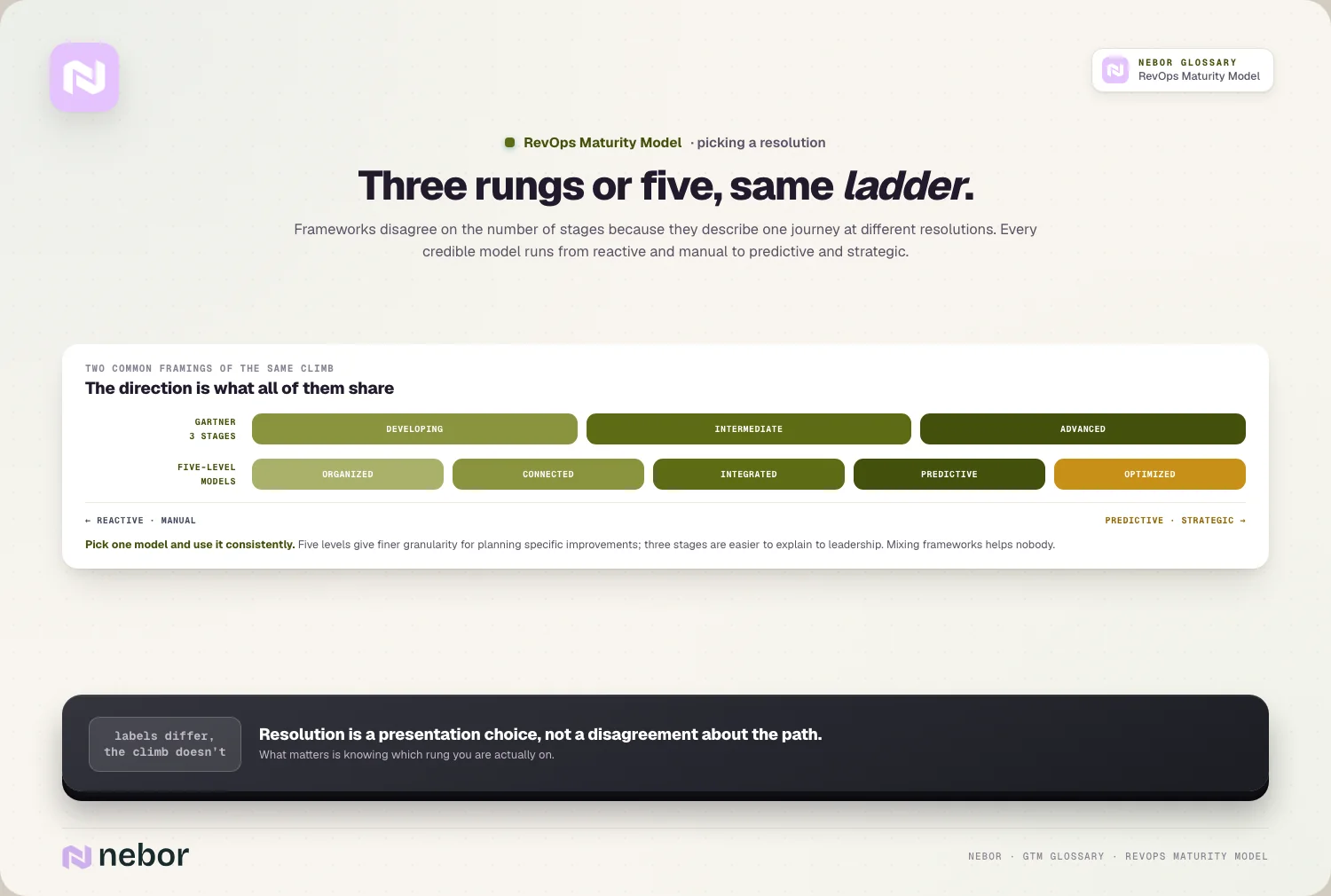
What helps in practice is picking one model and using it consistently instead of mixing several. A five-stage model gives finer granularity for planning specific improvements like quota capacity planning or tightening pipeline velocity, while a three-stage model is easier to explain to leadership.
What the early stages look like when RevOps is still just cleaning up tools
At the earliest stages, RevOps barely exists as a function and mostly reacts to whatever breaks. Processes are inconsistent, data lives in scattered spreadsheets, and whoever holds the title spends their days fixing broken reports and answering one-off requests instead of building anything durable.
The defining trait of this stage is that everything is manual and reactive. There's no shared source of truth, so different teams quote different numbers, and basic CRM hygiene is a constant struggle because nobody owns the data discipline that would keep the records clean in the first place.
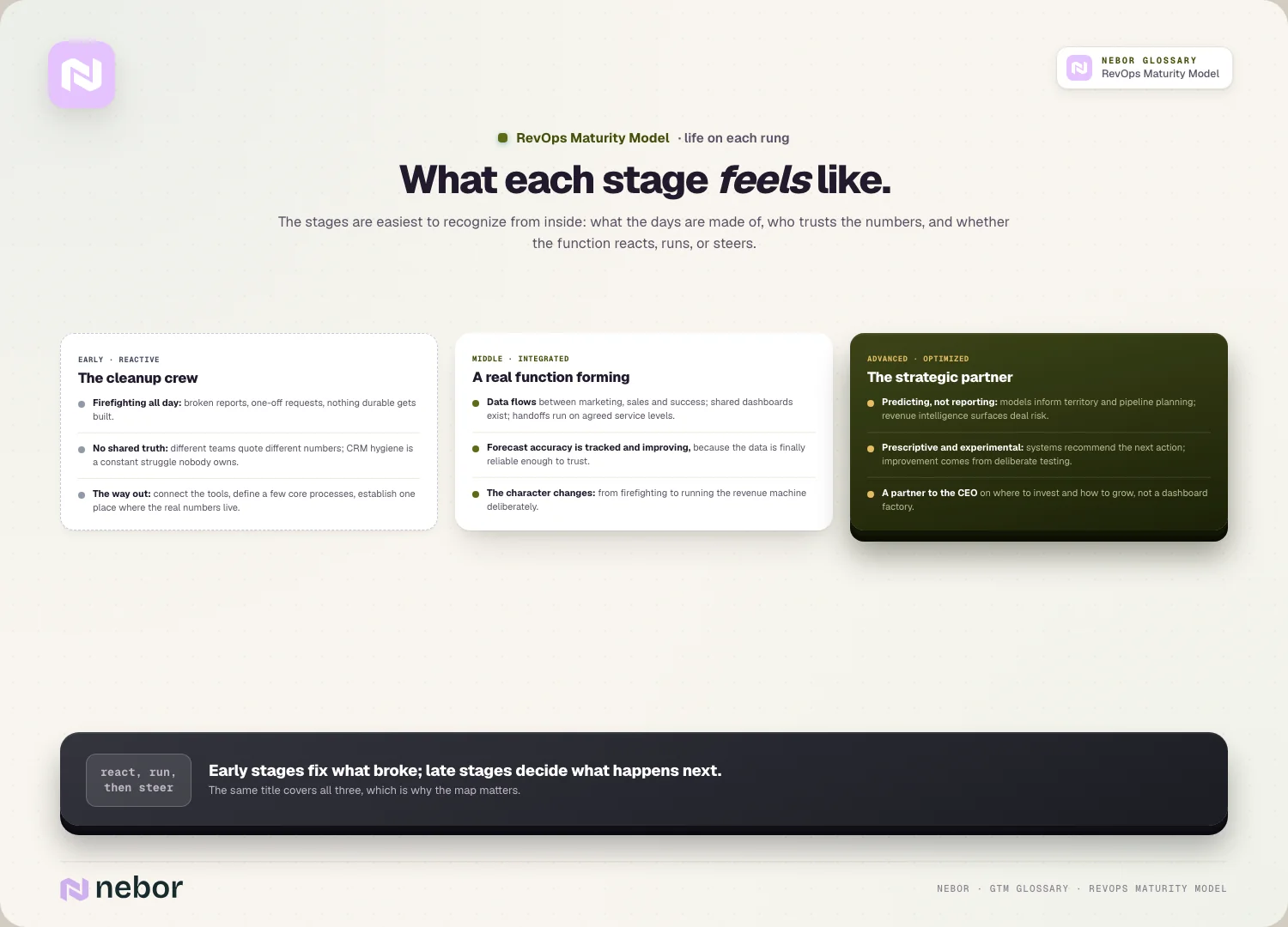
Moving out of this stage starts with connecting the basics. Getting tools talking to each other, defining a few core processes, and establishing one place where the real numbers live are the first steps, and they're what separate a company that merely has a RevOps title from one with a real function forming.
What the middle stages look like once data and process finally connect
In the middle stages, RevOps becomes a genuine function with defined processes and integrated systems. Data flows between marketing, sales, and success, shared dashboards exist, and handoffs follow agreed service levels instead of hoping someone picks up the lead, which steadies the whole motion.
Forecasting is where the shift becomes visible. At this level, forecast accuracy is tracked and improving because the underlying data is reliable enough to trust, so the team moves from guessing at the number to measuring how close its predictions come and tightening them over time.
The character of the work changes here too. Instead of firefighting, RevOps starts steering the revenue machine deliberately, standardizing how deals move and how teams coordinate, which is the point where the function begins to look like real revenue operations instead of a cleanup crew.
What advanced and optimized maturity looks like once a team gets there
At advanced maturity, RevOps shifts from reporting on the past to predicting the future.
Predictive models inform territory planning and pipeline forecasting, revenue intelligence tools surface deal-level risk, and systematic win-loss analysis lifts the win rate, so the engine is guided by leading indicators instead of only lagging metrics.
The most advanced stage, often called optimized, adds continuous experimentation and prescriptive guidance. The systems don't just predict what will happen, they recommend the next action, and the whole engine is instrumented tightly enough that improvement comes from deliberate testing instead of occasional heroics.
At this level RevOps stops being a support function and becomes a strategic partner. The team advises leadership on where to invest and how to grow, operating as a genuine partner to the CEO on revenue strategy instead of a group that produces dashboards other people use to make the real decisions.
Why climbing the maturity model is worth the real effort it takes
The case for advancing isn't abstract, because higher maturity correlates strongly with hitting the number.
Companies with advanced-maturity RevOps are about twice as likely to exceed revenue goals and 2.3 times as likely to exceed profit goals as those stuck at developing or intermediate stages, which is a large gap for an operational capability.
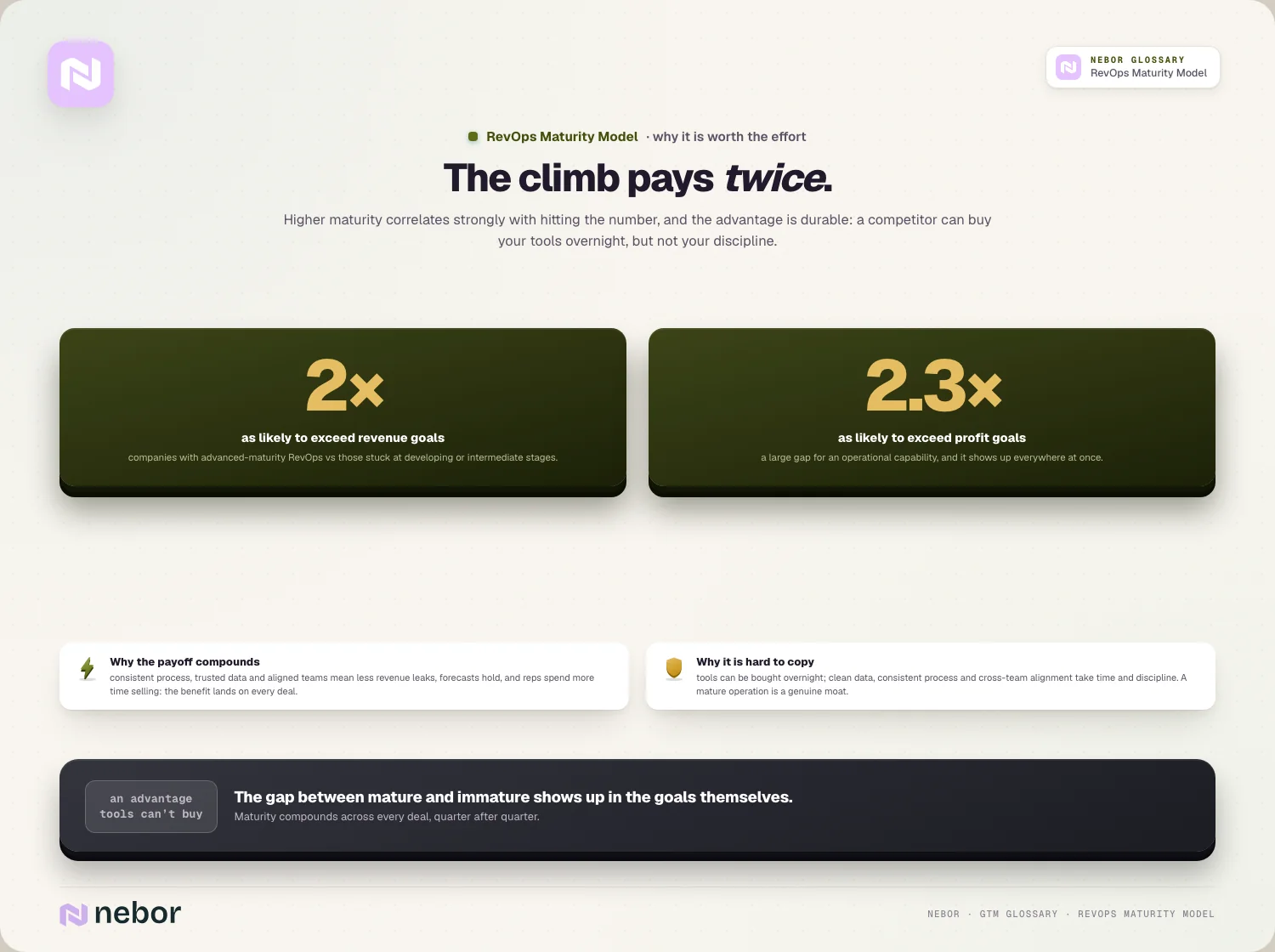
The reason the payoff is so big is that mature RevOps compounds across every deal. When processes are consistent, data is trusted, and teams are aligned, less revenue leaks, forecasts hold, and reps spend more time selling, so the benefits show up everywhere at once instead of in a single metric.
That compounding is also why maturity is hard to copy. A competitor can buy the same tools overnight, but building the clean data, consistent process, and cross-team alignment that define an advanced stage takes real time and discipline, which makes a mature revenue operation a genuine and durable advantage.
How to figure out which stage your revenue operation is at today
Placing yourself honestly starts with looking at the four dimensions separately instead of on a gut feeling, and we advise scoring them with real examples in hand.
Ask whether your processes are documented and followed, whether teams share one source of truth, whether your stack is connected, and whether the teams operate as one, then score each on its own.
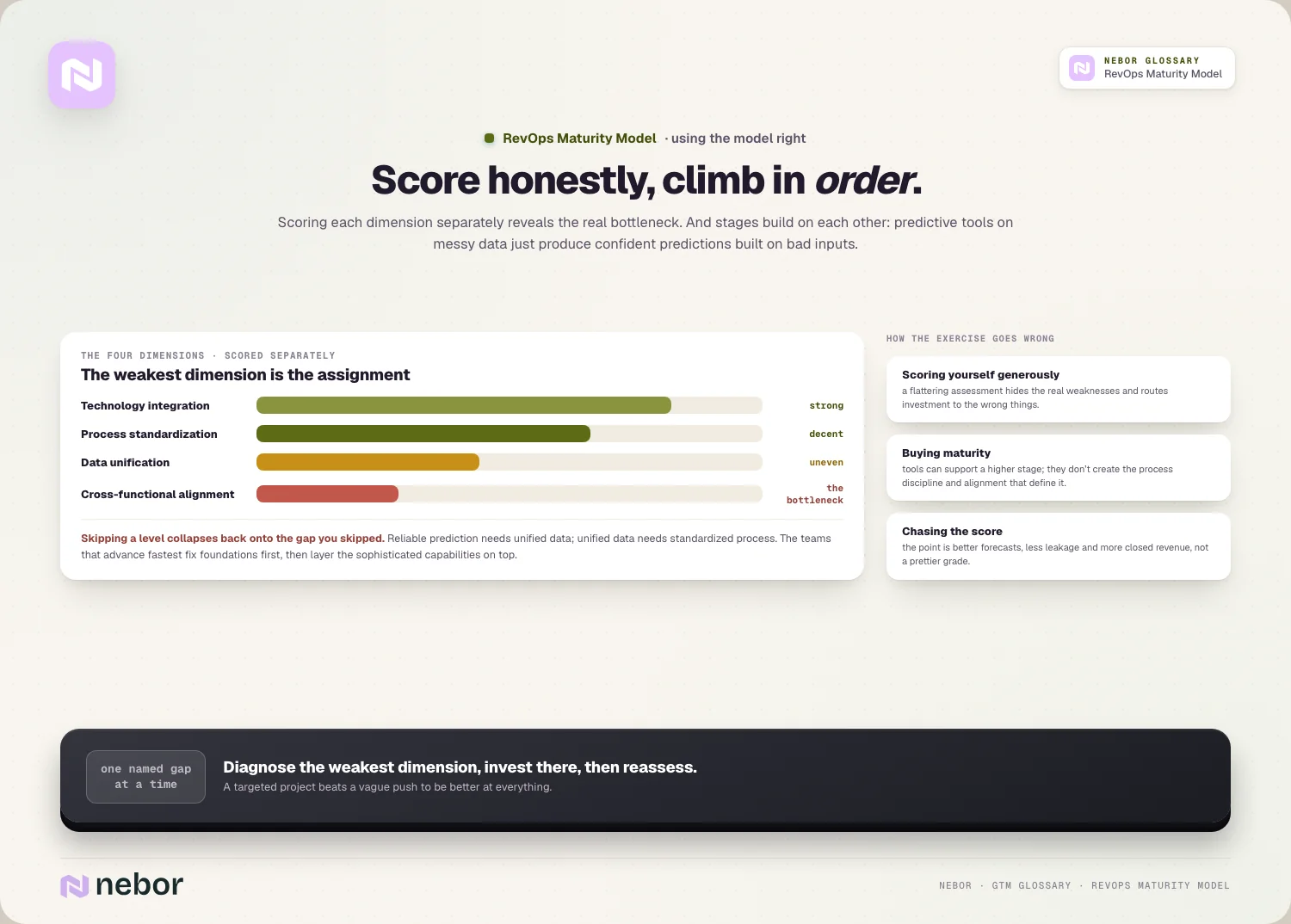
The honest answer is usually uneven, and that unevenness is the useful part. Most companies are advanced on one dimension and weak on another, so the exercise reveals the specific bottleneck holding your overall maturity down instead of flattering you with a single average score that hides the real gap.
That diagnosis is what makes the model actionable instead of academic. Once you know your weakest dimension, you know where the next investment should go, so improving RevOps becomes a targeted project against a named gap instead of a vague push to be better at everything simultaneously.
Why jumping stages rarely works and progress has to be sequential
A tempting mistake is trying to leap straight to advanced capabilities without the foundation underneath. Buying predictive forecasting tools while your data is still a mess just produces confident predictions built on bad inputs, because the sophisticated layer depends on the clean data a lower stage establishes.
Maturity builds in order because each stage is the platform for the next. You can't build reliable predictive models without unified data, and you can't unify data without first standardizing the processes that generate it, so skipping a level tends to collapse back onto the gap you skipped.
This is why the sequence matters as much as the destination. The teams that advance fastest fix their foundations first, getting workflow orchestration and clean data in place, and only then layer on the predictive and prescriptive capabilities that would have been worthless on top of a broken base.
The common mistakes teams make when they use a RevOps maturity model
The most common mistake, and we see it every time a team self-assesses, is using the model to feel good instead of to find problems.
Scoring yourself generously defeats the purpose, because the value comes entirely from an honest diagnosis, and a flattering assessment that hides your real weaknesses leaves you investing in the wrong things.
Another is treating maturity as a tooling problem you can buy your way out of. New software can support a higher stage, but maturity is mostly about process discipline and alignment, so a team that keeps buying tools without fixing how it works stays immature no matter how expensive its stack becomes.
The subtler mistake, in our experience, is chasing maturity as a goal in itself instead of a means to results.
The point of advancing isn't a higher score, it's a revenue engine that grows more efficiently, so a maturity effort that doesn't translate into better forecasts, less leakage, and more closed revenue has missed what it was for.
Why a RevOps maturity model is really a map for building a durable revenue engine
The deepest way to see a maturity model is as a shared map for a journey every revenue org is on whether or not they've named it. Companies drift from chaotic early operations toward more sophisticated ones, and the model makes that path explicit so you can walk it deliberately instead of stumbling.
Its real usefulness is turning improvement into a sequence instead of a scramble. By showing what each stage requires and what comes next, it lets a team focus on the one or two changes that move it forward, which is far more effective than trying to fix everything and burning out on the effort.
A go-to-market system that keeps advancing up this map compounds its own strengths over time, because each stage makes the next easier to reach.
When your operations mature alongside the volume you automate sales prospecting to create, growth stops straining the system and starts being something it can handle with room to spare.
Share this post
RevOps
Glossary
Related glossary items
Understanding the core GTM concepts




Ready to build your pipeline