
In this post:
An AI SDR is a set of AI agents that does the sales development rep's job, qualifying inbound leads and handling outbound prospecting. It catches interest, checks fit and intent, follows up fast, and books meetings for the human reps who close.
The role is broader than an AI BDR, which leans purely outbound. An AI SDR works both sides, the inbound leads coming to you and the outbound motion you push out.
TL;DR
Most "AI SDR" tools are pitched as a full replacement for your SDR team. That's the wrong frame, and it sets teams up to be disappointed.
What an AI SDR really does is take the repetitive parts off a human's plate, instant inbound qualification, fast follow-up, prospecting, enrichment, and first-draft outreach. The person still owns the real conversation.
Its biggest and most underrated win is speed. An AI SDR can answer an inbound lead in seconds, at any hour, which is where a lot of pipeline gets quietly won or lost.
So what does an AI SDR actually do across both inbound and outbound?
An AI SDR covers both sides of the full sales development job. On inbound, it catches a new lead, checks fit and intent, answers the basic questions, and books a meeting when the lead is real.
On outbound, it finds target accounts, enriches the contacts, writes personalized first touches, and follows up until someone replies. Across both, it handles the repetitive work so a person can spend their time on actual conversations.
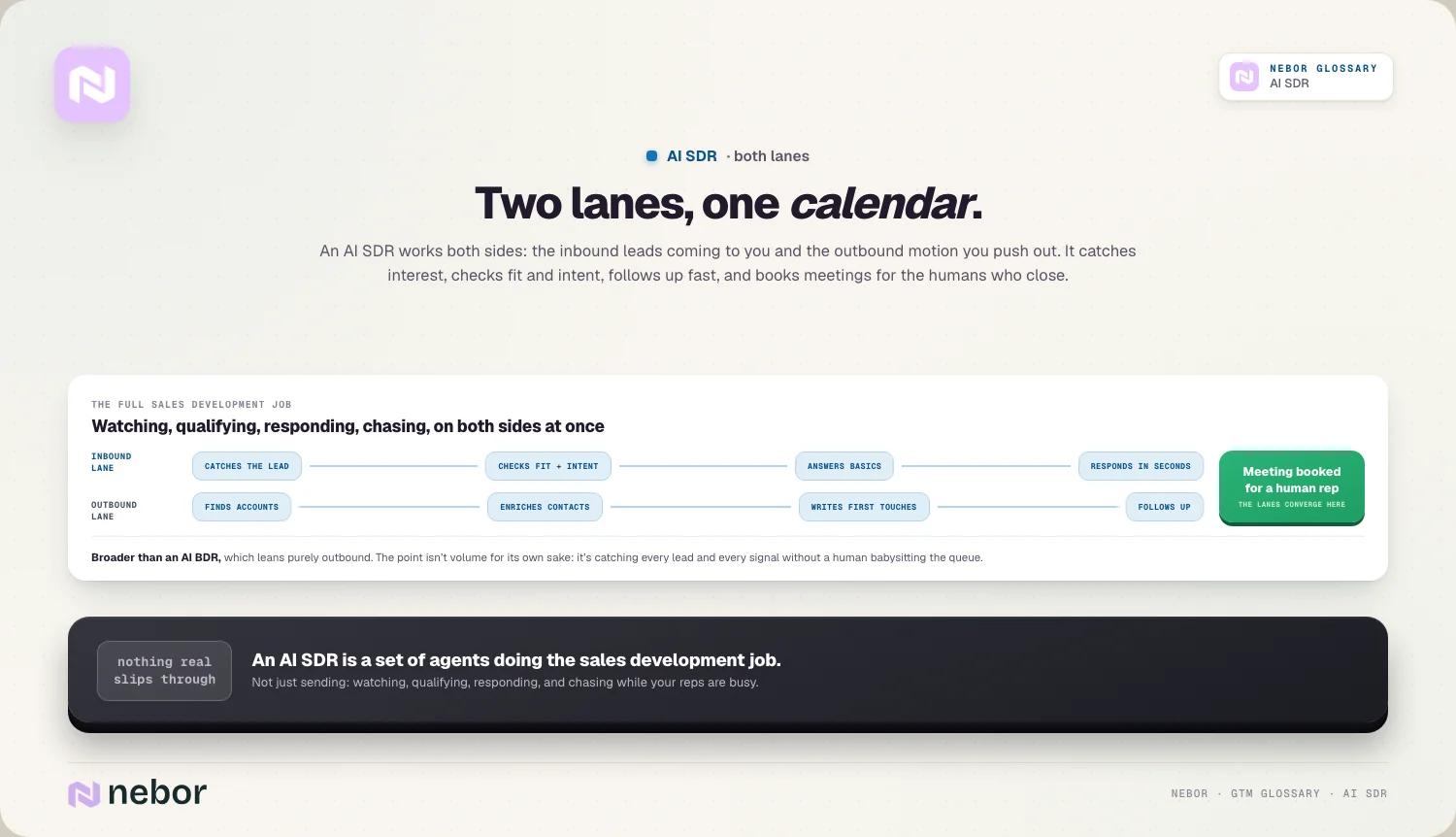
The point isn't volume for its own sake. It's catching every lead and every signal without a human having to babysit the queue.
That coverage across both motions is what sets it apart from a plain cold email tool. It's not just sending, it's watching, qualifying, responding, and chasing, so nothing real slips through while your reps are busy.
Why speed to lead is where an AI SDR really shines on inbound
The most underrated win here is plain speed. Inbound interest goes cold fast, and a human can't watch the inbox at 2am.
Speed to lead is the metric here, and it's brutal. Reaching an inbound lead within five minutes makes you far more likely to qualify them than waiting even half an hour, yet most teams still take hours. An AI SDR replies in seconds, any hour, every day.
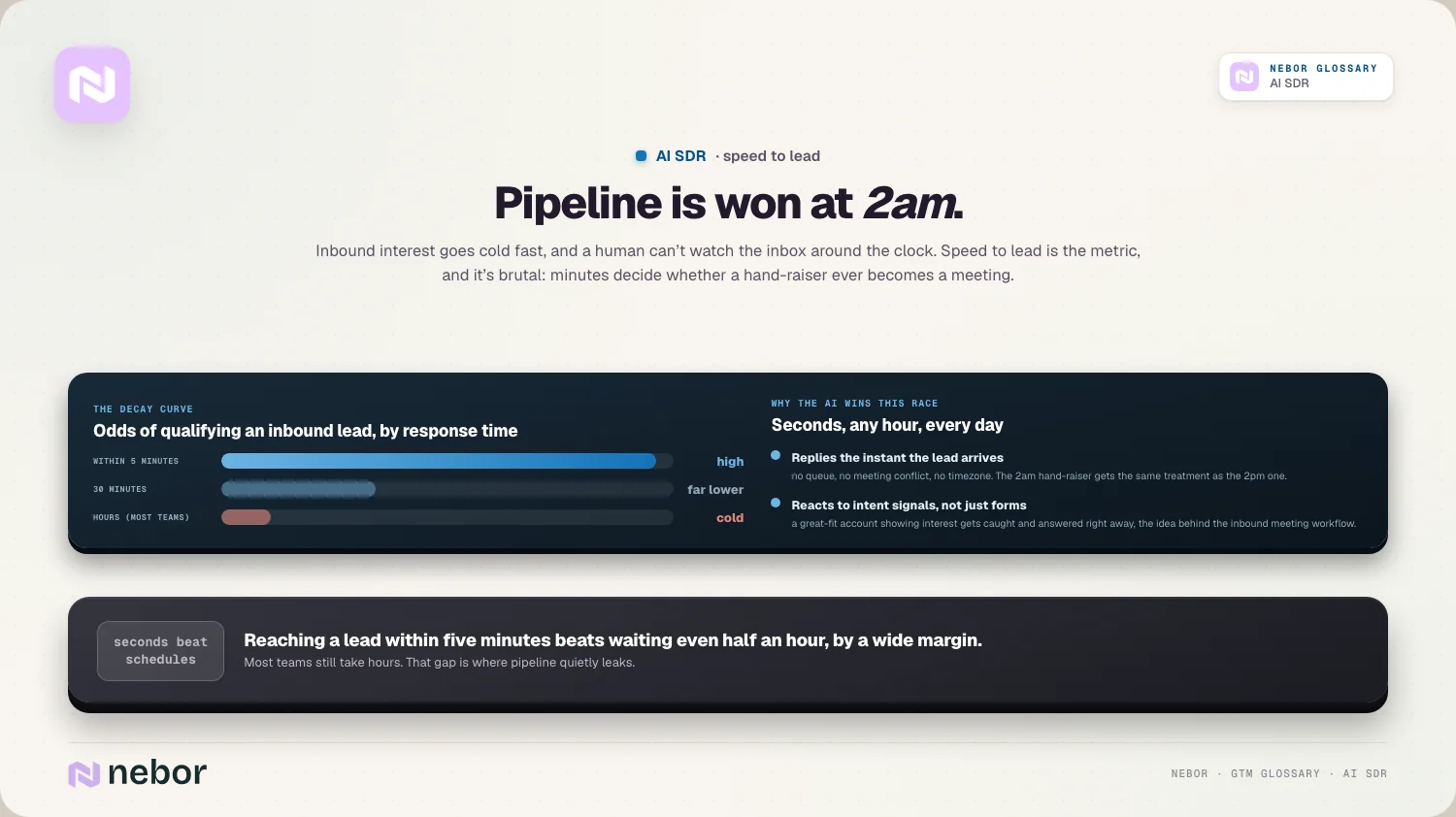
It also reacts to intent signals beyond plain form fills. When a great-fit account shows interest, the AI SDR can catch it and respond right away, the same idea behind our inbound meeting workflow.
What an AI SDR takes on for you across the outbound side of the funnel
On the outbound side, an AI SDR does the prospecting grind. It builds and enriches lists, writes outreach tied to a real reason, and chases follow-ups across channels.
This overlaps heavily with an AI BDR, so the deeper outbound mechanics live in that entry. The short version is the same, agents handle the prep and the sending, and the value depends on good targeting and a real signal behind each message.
What it shouldn't be is autonomous outbound blasting strangers with no oversight. We've written about which prospecting jobs you can safely hand to a machine, and which still need a person.
The strongest outbound an AI SDR sends isn't cold at all. It's warm outbound off an inbound signal, where the agent reaches out because an account just showed real interest. That's where the prospecting work and the inbound work meet, and it's the part of the motion that pays off fastest.
Should you replace your SDRs with one, or use it to augment them?
Here's the honest answer to that question. An AI SDR doesn't replace your sales team, it removes the busywork that was burning them out.
A hybrid split works best in every setup we've built. AI handles the scale and the speed, and people handle the judgment and the relationships. Keep a human in the loop on anything a buyer reads, and let the AI own the repetitive prep and the instant first response.
That also reframes the old hiring question. Instead of hiring a stack of SDRs or renting a black-box tool, the durable move is to build the motion as sales automation you own.
Why most AI SDR tools underdeliver once you get them out of the demo
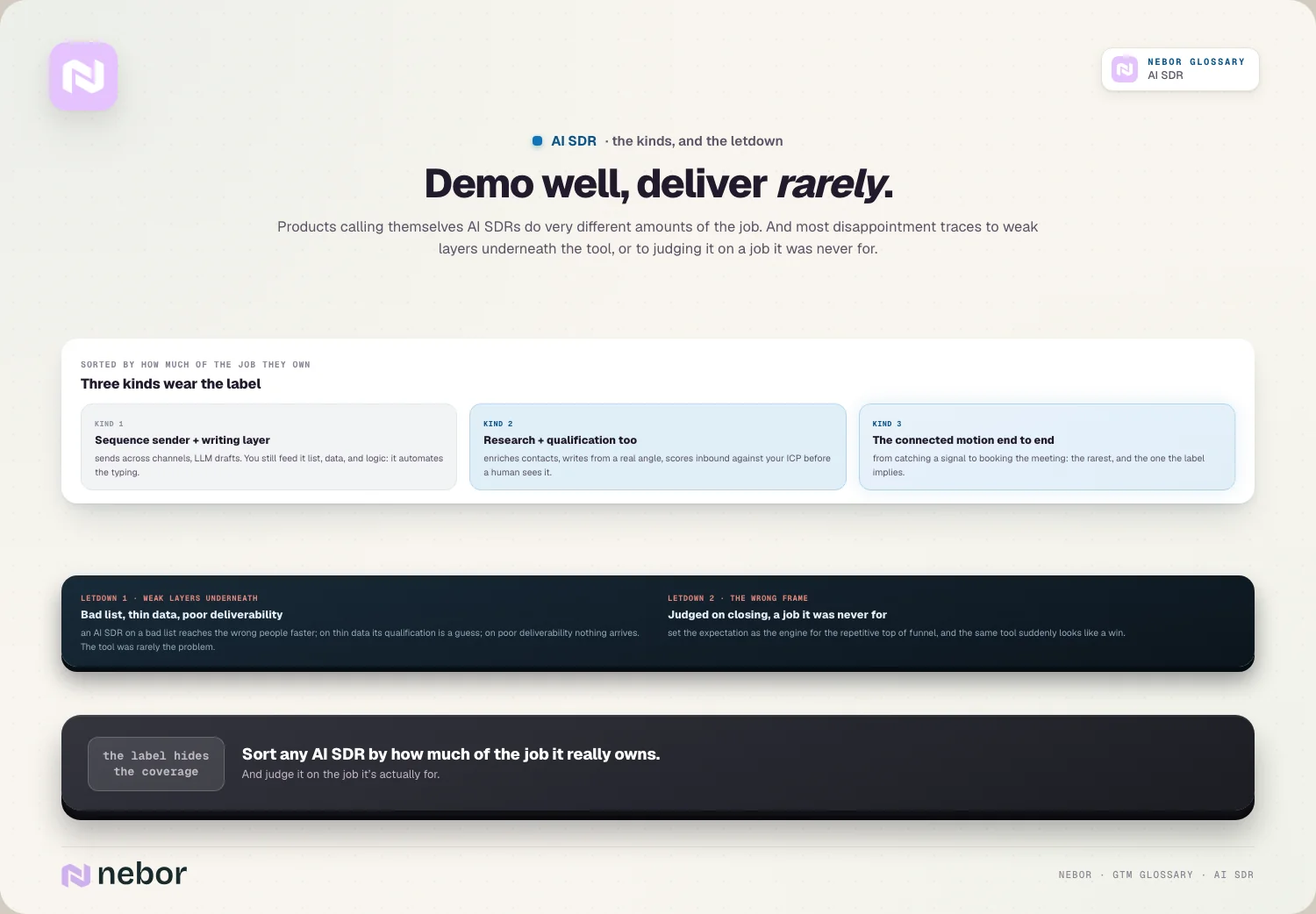
Most of the disappointment traces back to the same place. The tool is a sequence sender with an LLM bolted on, and everything underneath it is weak.
An AI SDR on a bad list just reaches the wrong people faster. On thin data, its qualification and personalization are guesses. On poor deliverability, even good outbound never reaches the inbox.
We see the same thing in broken Clay builds, where the tool rarely turns out to be the problem and the data and thinking under it usually do.
There's a second reason for the disappointment, and it's the framing. Teams buy an AI SDR expecting it to replace a person, then judge it on whether it closed deals, and when it doesn't, they call it a failure.
That was never the right job for it. With the expectation set correctly, as the engine for the repetitive top of funnel, the same tool suddenly looks like a win.
Let's compare the kinds of AI SDR you'll meet when you go shopping for one
Products calling themselves AI SDRs cover a huge range of depth, and sorting them by how much of the job they really own saves you from a bad buy.
The most common kind is a sequence sender with a writing layer. It sends across email and LinkedIn and uses an LLM to draft copy, but you still feed it the list, the data, and the logic. It automates the typing and leaves the thinking to you, so it disappoints whenever the inputs are weak.
A deeper kind handles research and qualification too. It enriches the contacts, writes from a real angle, and scores inbound leads against your ICP before a human ever sees them.
The deepest kind owns the connected motion end to end, from catching a signal to booking the meeting, and only stops at the live conversation. Knowing which one you're looking at tells you how much you'll still have to build yourself.
Let's get specific about the tasks an AI SDR can take off your plate
The pitch for these tools is usually vague, so here are the concrete jobs. The work splits into a handful of them, and they're all the repetitive ones.
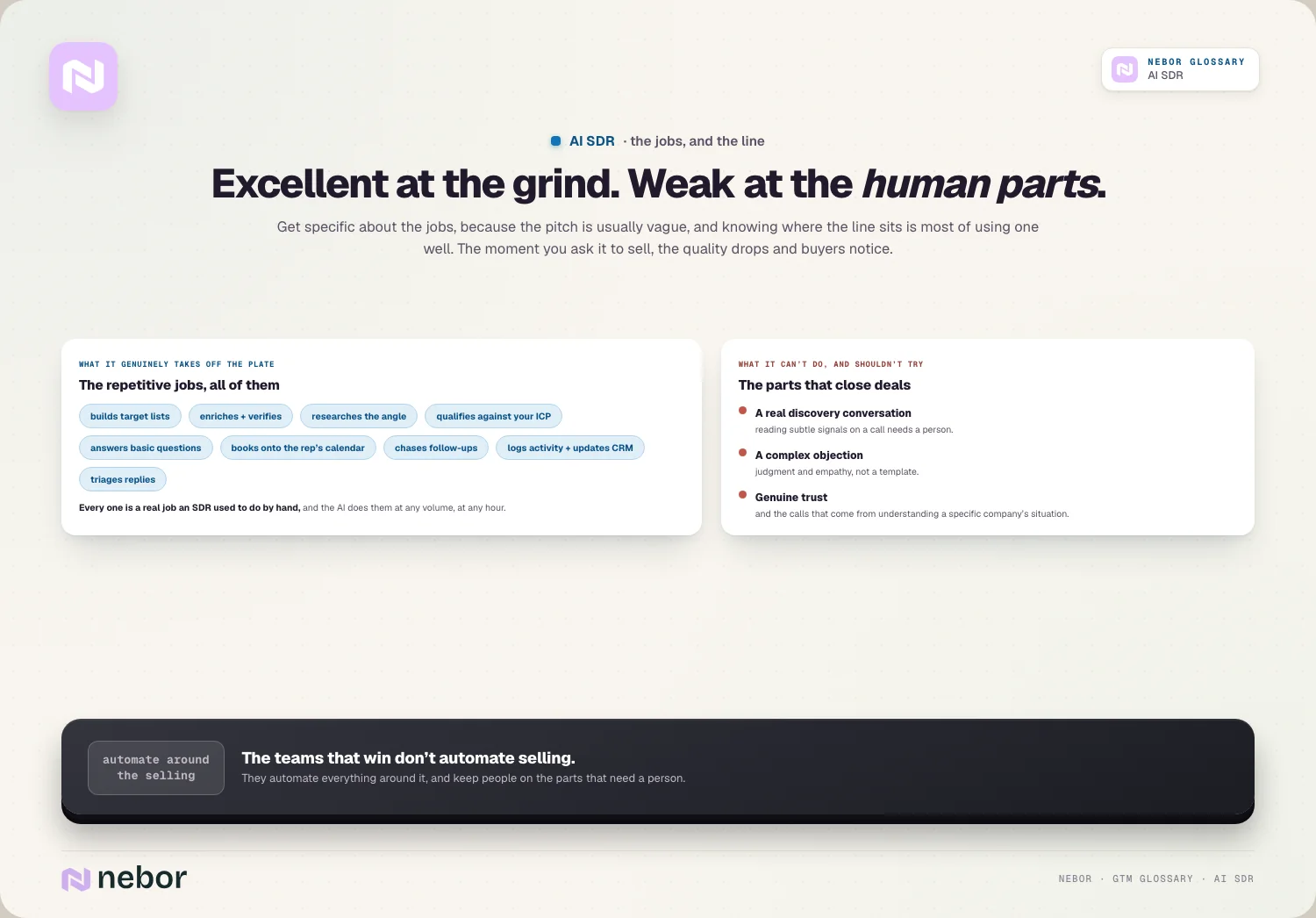
On the prep side, it builds target lists, enriches and verifies the contacts, and researches each account for a relevant angle. On the inbound side, it watches for new leads and signals, qualifies them against your ICP, answers basic questions, and books meetings straight onto a rep's calendar.
It also handles the chasing nobody likes, the follow-ups across email and LinkedIn, and the admin, like logging activity and updating the CRM. It can even triage replies, sorting interested from not-now so a human only sees the ones worth their time. Every one of these is a real job an SDR used to do by hand.
What an AI SDR still can't do for you, and really shouldn't try to
For all that, an AI SDR has clear limits, and pretending otherwise is how teams get burned. The things it can't do well are the things that actually close deals.
It can't lead a real discovery conversation, read the subtle signals on a call, or handle a complex objection that needs judgment and empathy. It can't build genuine trust with a buyer, and it can't make the calls that come from understanding a specific company's situation.
The honest framing, then, is a narrow one. An AI SDR is excellent at the repetitive top-of-funnel work and weak at the human parts of selling. The moment you ask it to do the second thing, the quality drops and buyers notice. Knowing where that line falls is most of using one well.
How you should split the work between an AI SDR and your human reps
In the setups we build, an AI SDR earns its place by drawing a clean line with your reps. The AI takes the volume and the speed, and the humans take the conversations and the judgment.
In practice that means the AI handles everything up to the point of real engagement. It finds and qualifies, it responds instantly, it preps the account and drafts the outreach, and then it hands a warm, well-researched lead to a person.
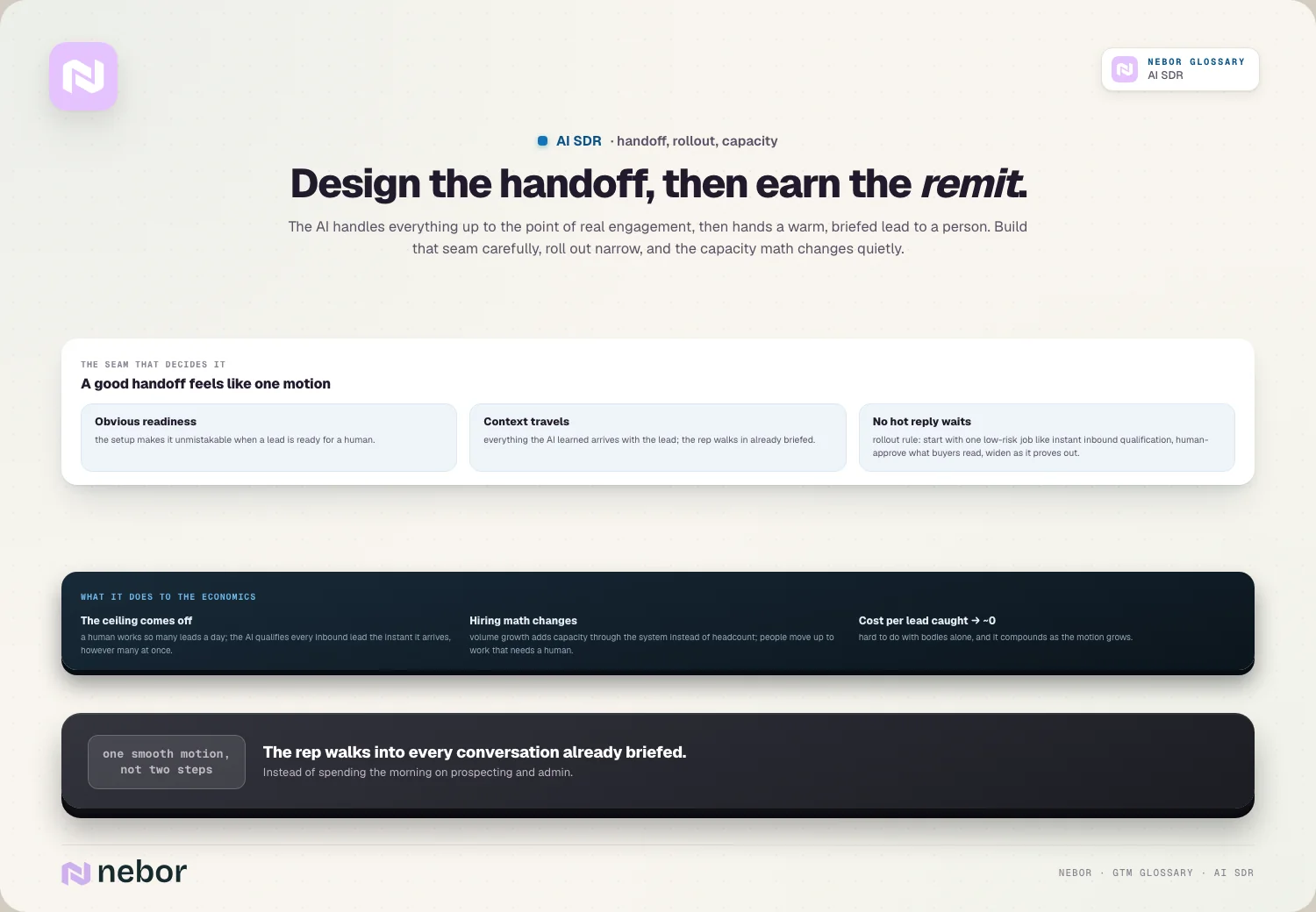
The rep walks into every conversation already briefed, instead of spending their morning on prospecting and admin.
The handoff is the part to design carefully. A good setup makes it obvious when a lead is ready for a human, passes along everything the AI learned, and never lets a hot reply go unanswered. When the handoff is built well, the AI and the rep feel like one smooth motion rather than two disconnected steps.
Which metrics tell you the truth about whether your AI SDR is working?
An AI SDR is easy to misjudge, because the wrong metrics make it look busy and productive when it isn't, and activity numbers flatter every tool ever built.
On inbound, the numbers that matter are speed to lead and the share of fit leads that get a fast, relevant response. On outbound, it's reply rate and positive replies, then meetings booked, and never mind how many messages went out. Sheer volume is the vanity metric that hides every underlying problem.
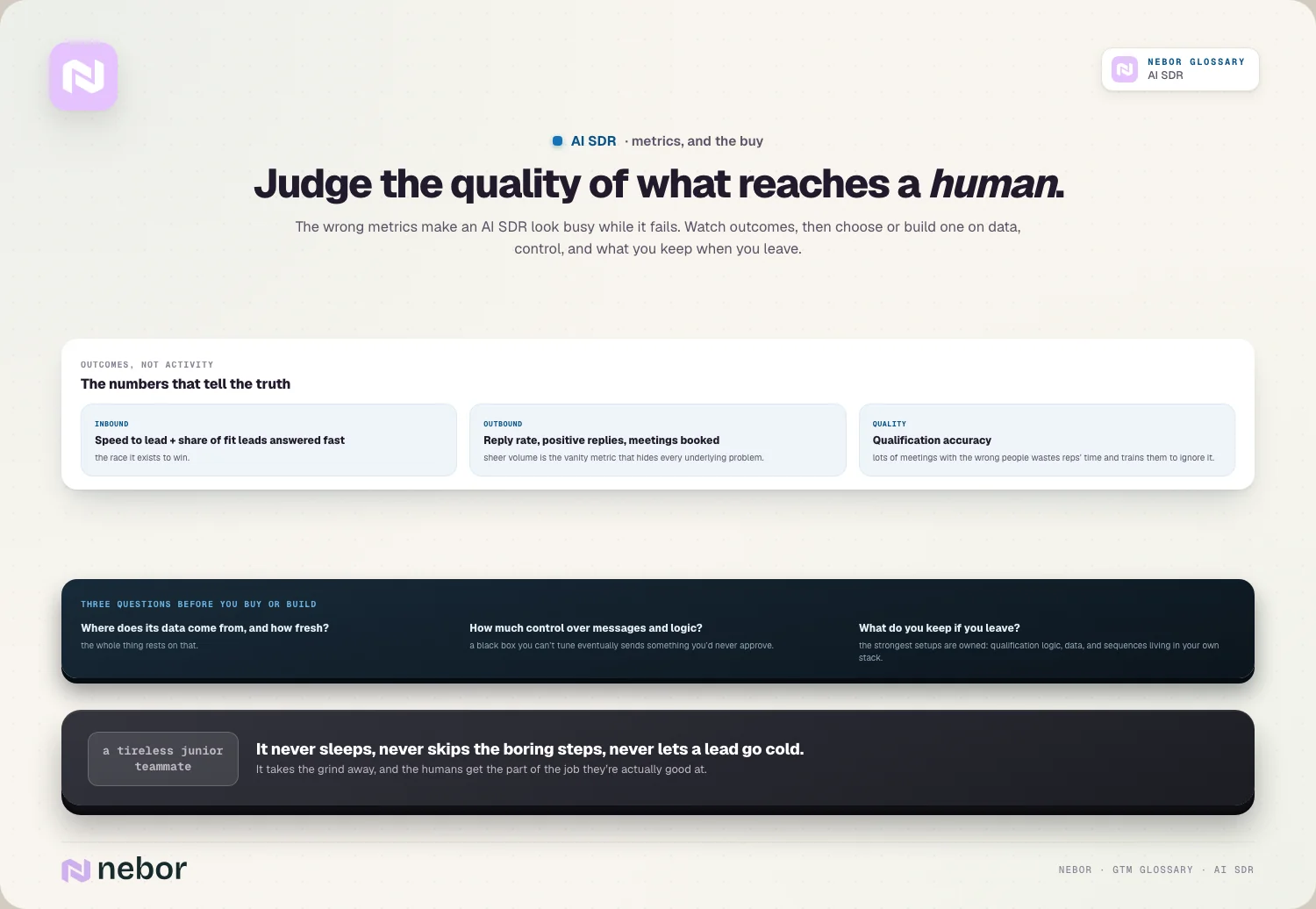
Qualification accuracy deserves its own line on the scoreboard. An AI SDR that books lots of meetings with the wrong people is worse than one that books fewer good ones, because it wastes your reps' time and trains them to ignore it.
The quality of what reaches a human is the score that counts, and the quantity barely matters.
How to roll out an AI SDR without watching it backfire on you
Rolling out an AI SDR works best when you start narrow and earn trust, rather than handing it the whole motion on day one. The teams that rush it usually end up switching it off.
Begin with one job, like instant inbound qualification, where the value is obvious and the risk is low. Keep a human approving anything a buyer reads at first, and make sure the data underneath is clean before you scale, because an AI SDR on bad data scales its errors along with everything else.
Then widen its remit as it proves itself, watching the quality of its output the whole way. The same lesson applies as with any automation, because when you introduce it gradually, with oversight and clean data underneath, it becomes something your team relies on instead of something they have to firefight.
How an AI SDR changes your team's capacity and your hiring economics
The reason teams adopt an AI SDR usually comes down to capacity. A human SDR can only work so many leads and send so many quality touches in a day, and they hit a hard ceiling.
An AI SDR removes that ceiling on the repetitive work. It can qualify every inbound lead the instant it arrives, no matter how many come in at once, and it can research and draft outbound at a volume a person couldn't sustain. The same small team suddenly covers far more ground without working longer hours.
This is also why it changes the hiring math. Instead of adding headcount every time volume grows, you add capacity through the system, and your people move up to the work that truly needs a human. The cost of catching one more lead drops toward zero, which is hard to do with bodies alone.
What you should look for when you choose or build an AI SDR of your own
If you're weighing up an AI SDR, the features matter less than what lies underneath. Most tools demo well, so the real questions are about data, control, and ownership.
Ask where its data comes from and how it's kept fresh, because the whole thing rests on that. Ask how much control you have over the messages and the logic, since a black box you can't tune will eventually send something you'd never approve.
And ask what you keep if you leave, because a tool that owns your lists, your data, and your workflows leaves you with nothing the day you stop paying.
The strongest setups are the ones you own, where the qualification logic, the data, and the sequences live in your own stack. That's the difference between renting a result and building a capability your team keeps.
Why your AI SDR works best when you treat it as a teammate for your reps
The clearest way to think about an AI SDR is as the tireless junior teammate your reps always wished they had. It never sleeps, it never skips the boring steps, and it never lets a fresh lead go cold while someone's stuck in a meeting.
But it's a teammate with a narrow job. It does the prospecting, the qualifying, the instant follow-up, and the prep, and then it gets out of the way so a person can sell. The teams that win with it aren't the ones who try to automate selling, they're the ones who automate everything around it.
There's a quieter benefit too, in what it does for the humans on the team. When reps stop spending their days on list building, data entry, and chasing cold leads, they get back to talking to people and closing, the part of the job they enjoy.
Burnout on a sales team usually comes from the grind more than the selling, and an AI SDR takes the grind away.
So a good one doesn't just lift your numbers, it makes the sales seat a better one to hold. That shows up later as reps who stay longer and perform better, which is worth as much as the speed and the coverage.
If you treat an AI SDR this way, as support for your people, it steadily becomes one of the most useful parts of the team.
Share this post
AI SDR
AI
Outbound
Glossary
Related glossary items
Understanding the core GTM concepts
Ready to build your pipeline











