
In this post:
Human-in-the-loop is a design where a person reviews, approves, or corrects an AI system's output at key points, instead of letting it work completely on its own. It's the deliberate decision to keep a human in control of the moments that matter.
We build and advocate for automation all day, so this is a question we owe our clients an honest answer on.
As AI takes over more of the work, the question stops being whether the machine can do something and becomes whether it should do it unsupervised.
Human-in-the-loop is the answer for everything where a mistake is costly, a judgment call is needed, or a buyer is on the other end.
It's one of the most important ideas in using AI well, especially in go-to-market. The teams that get value from AI aren't the ones who hand it the keys and walk away, they're the ones who automate the work but keep a person on the decisions that count.
TL;DR
Human-in-the-loop means keeping a person in control of an AI system's important decisions, by having them review, approve, or correct the output instead of letting it act fully autonomously.
AI makes confident mistakes, and some of those mistakes are expensive, especially anything a customer sees. A human checkpoint catches errors, adds judgment, and builds the trust that lets you safely automate more over time.
The skill is placing the human where it counts, on the risky, customer-facing, and irreversible steps, while letting the machine take the safe, repetitive ones. When you do that, you get the speed of automation without handing over the decisions that can hurt you.
So what does human-in-the-loop actually mean in an AI system?
Human-in-the-loop describes any setup where a person is part of an AI system's decision-making, instead of the AI acting entirely alone. The human stands at a checkpoint, reviewing or approving what the machine produced before it goes any further.
The phrase comes from systems design, and it captures a spectrum rather than a single setting.
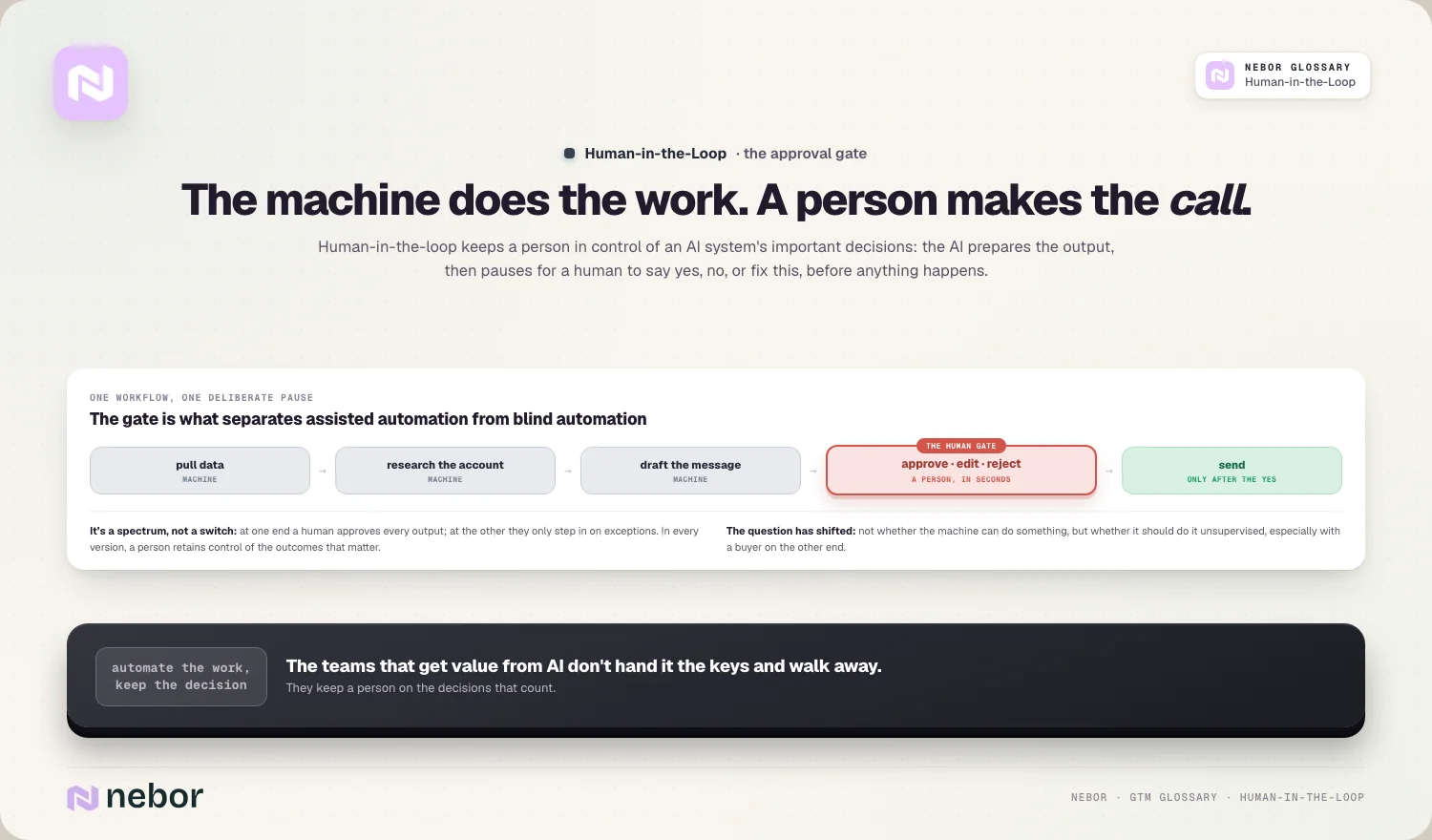
At one extreme, a human approves every single output, and at the other, the human only steps in on exceptions, but in all of these the key point is that a person retains control of the outcomes that matter.
An approval gate is the cleanest picture of it. The AI does the work, prepares the output, and then pauses for a human to say yes, no, or fix this, before anything happens. That gate is what separates assisted automation from blind automation.
Why does AI need a human in the loop at all, given its talents?
It's a fair question, since the whole appeal of AI is doing work without people. The answer is that AI is powerful but unreliable in specific ways, and a human covers exactly those gaps.
AI makes confident mistakes, producing output that looks right but is wrong, and it has no real judgment about context, tone, or consequences.
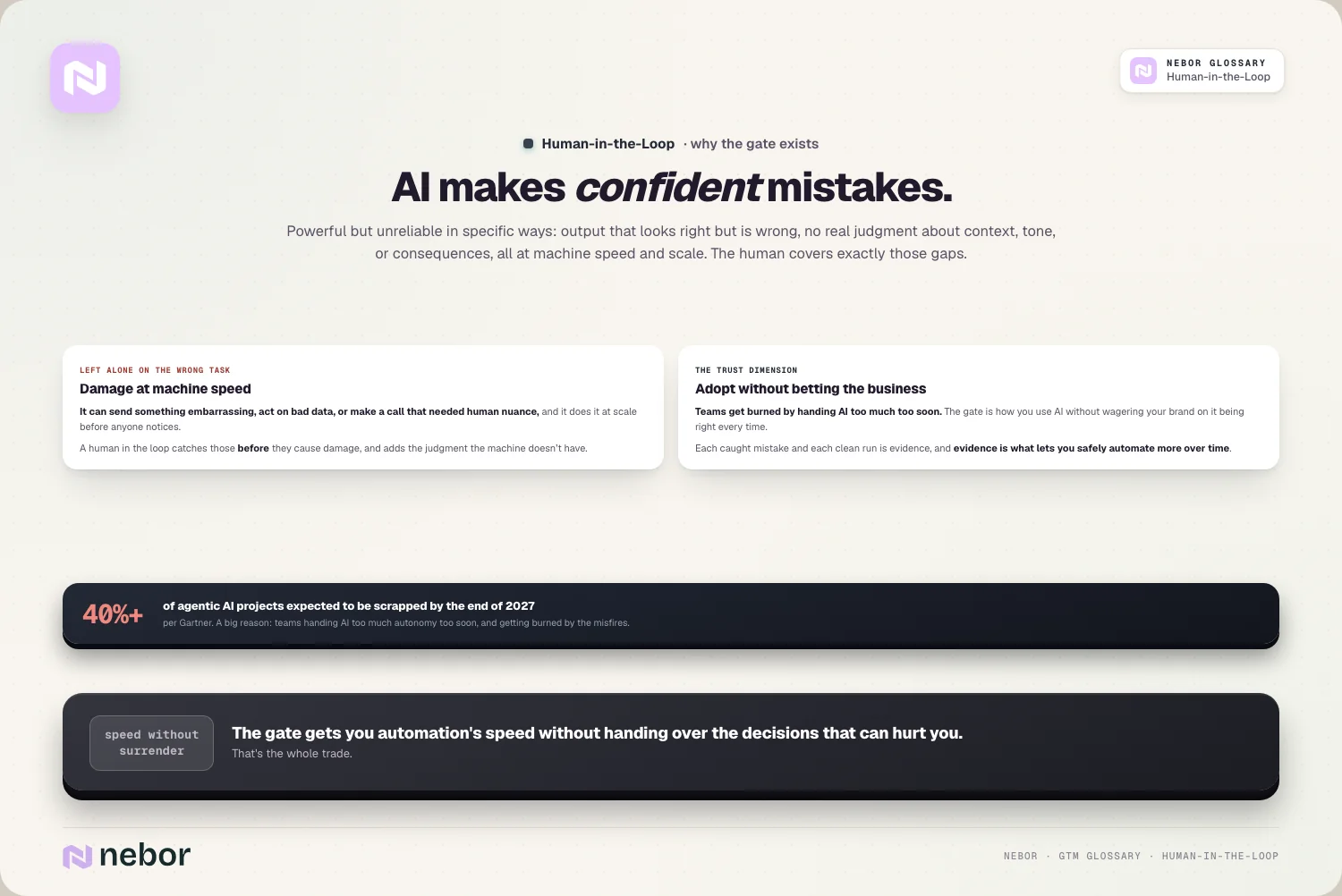
Left alone on the wrong task, it can send something embarrassing, act on bad data, or make a call that needed human nuance, all at machine speed and scale. A human in the loop catches those before they cause damage.
Trust plays its own part in the answer. Gartner expects companies to scrap more than 40% of agentic AI projects by the end of 2027, and a big reason is teams handing AI too much too soon and getting burned, a pattern we've watched up close.
A human in the loop is how you adopt AI without betting the business on it being right every time.
Where should you put the human in the loop for the most benefit?
You don't need a human on everything, since that would defeat the point of automation. The skill is putting the human exactly where the risk is, and nowhere else.
A few kinds of step almost always deserve a human. Anything customer-facing, like an email or message a buyer will read, needs a person, because a bad one damages your brand.
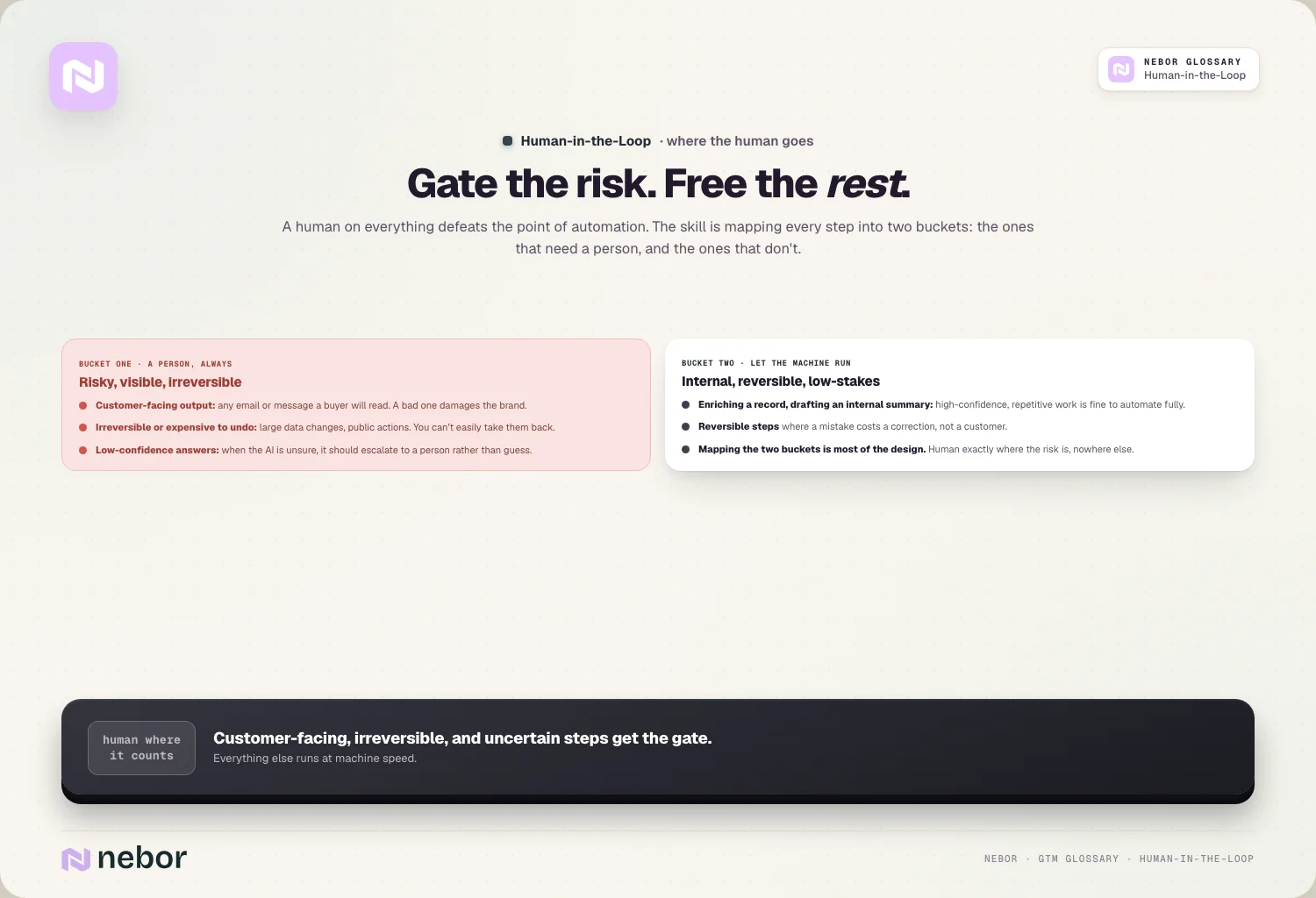
Anything irreversible or expensive to undo, like a large data change or a public action, needs a check, because you can't easily take it back. And anything where the AI is uncertain, returning a low-confidence answer, should fall to a human instead of guessing.
Everything else can usually go without a human. Internal, reversible, low-stakes, high-confidence work, like enriching a record or drafting an internal summary, is fine to automate fully.
Mapping your steps into these two buckets, the ones that need a human and the ones that don't, is most of designing a good loop.
What does a human-in-the-loop checkpoint look like in practice?
In practice, a human-in-the-loop checkpoint is a pause in the workflow where the AI hands its output to a person and waits. How that's built shapes whether it helps or slows you down.
A common pattern in the go-to-market systems we build is the approval queue. An AI agent researches an account and drafts a personalized message, then posts it somewhere like Slack or a review screen, where a rep approves, edits, or rejects it before it sends.
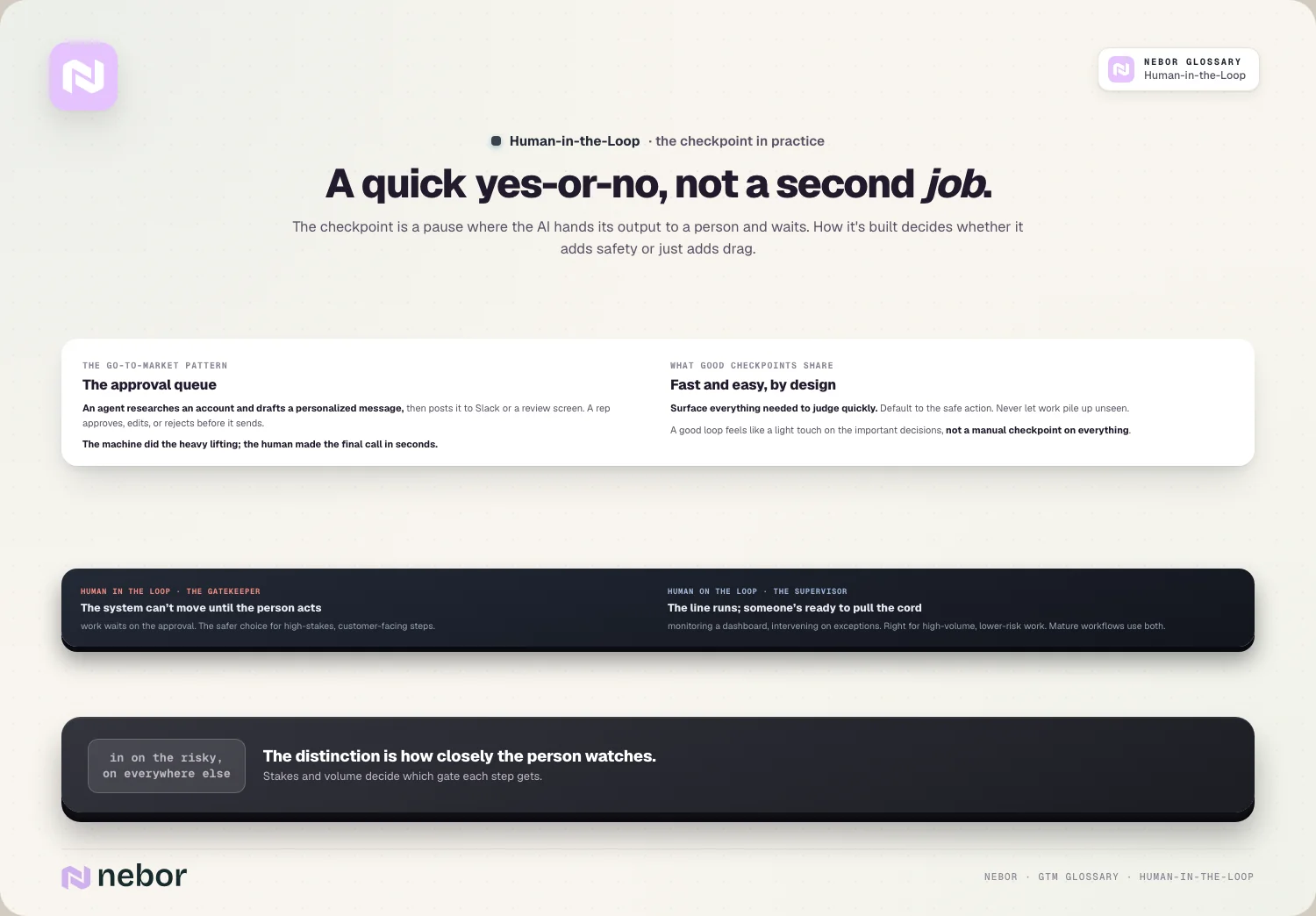
The machine did the heavy lifting, and the human made the final call in seconds. This is exactly how our website visitor workflow keeps a person in control of what actually reaches a buyer.
The best checkpoints make the human's job fast and easy. They surface everything your rep needs to judge the output quickly, default to the safe action, and never let work pile up unseen. A good loop feels like a quick yes-or-no instead of a second full-time job.
What's the difference between a human in the loop and a human on the loop?
People use these two phrases, and the distinction is small but useful. It captures how closely the person is watching, which changes the design.
A human in the loop is inside the process, so the system can't move forward until the person acts, like an approval that the work waits on.
A human on the loop is above the process, letting it move on its own while the person monitors and can step in if something looks wrong, more like a supervisor watching a dashboard than a gatekeeper signing off each item.
The first stops the line for a decision, and the second lets the line keep moving with someone ready to pull the cord.
Which one you want depends on the stakes and the volume. For high-stakes, customer-facing steps, a human in the loop, who has to approve before anything happens, is the safer choice.
For high-volume, lower-risk work where stopping for every item would be silly, a human on the loop, watching and intervening on exceptions, keeps things moving while still catching the bad cases.
Most mature AI workflows end up using both, in the loop on the risky steps and on the loop everywhere else.
How is human-in-the-loop different from turning AI fully loose?
Human-in-the-loop is one point on a wider range, so it helps to place it against full autonomy. The range stretches from a human doing everything to a machine doing everything, and human-in-the-loop lands in the productive middle.
At the co-pilot end, the AI suggests and a human approves everything, which is the same idea as the co-pilot versus autopilot distinction.
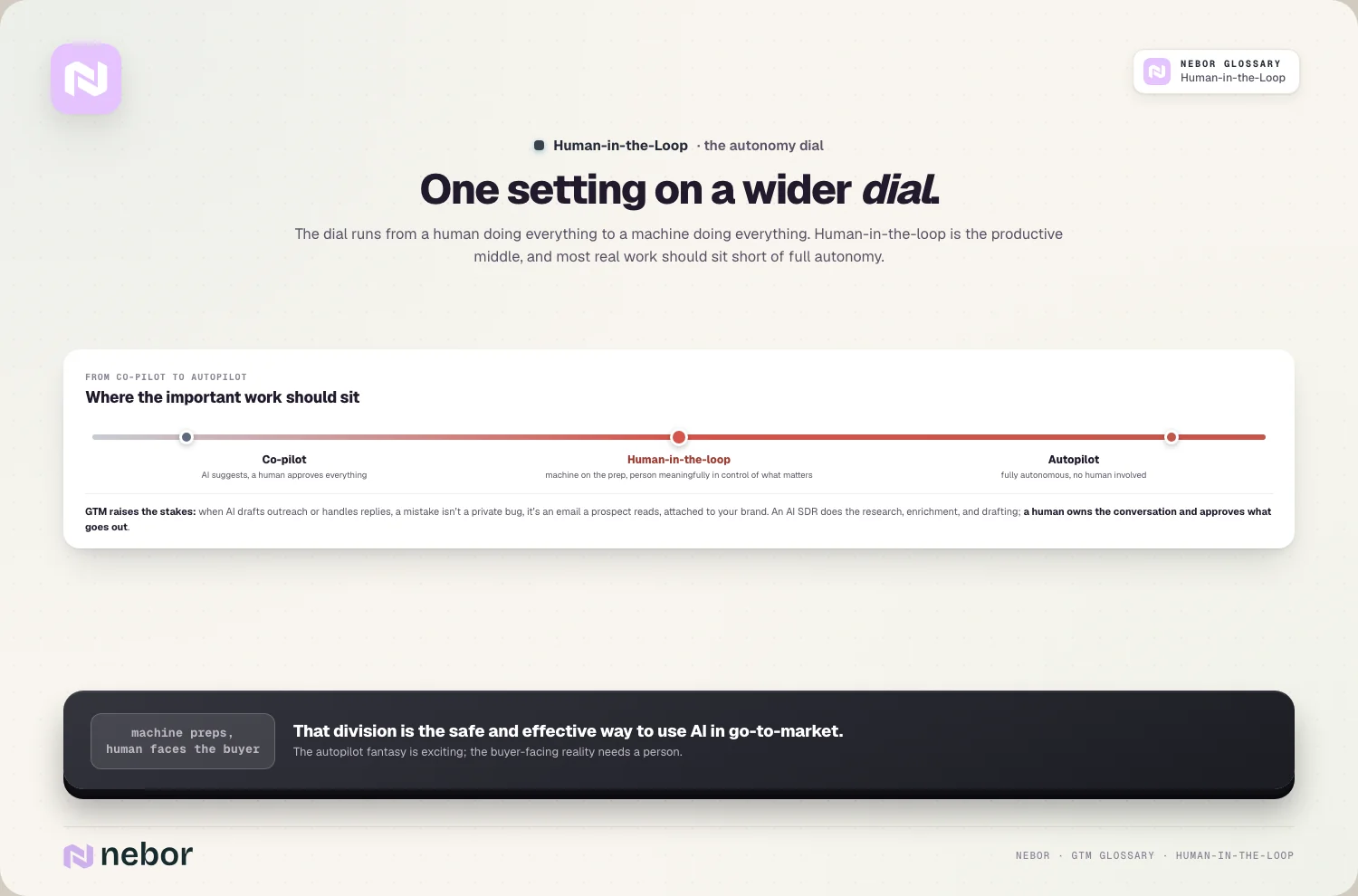
At the autopilot end, the machine acts with no human involved, and that end is what fully autonomous outbound means. Human-in-the-loop is anywhere a person stays meaningfully in control of the important decisions, usually toward the supervised end of that range.
Most real work should stop short of full autonomy, and that's the point of naming the range. The fantasy of agentic AI operating entirely alone is exciting, but for anything customer-facing or high-stakes, keeping a human in the loop is what makes the automation safe to use at all.
Why is human-in-the-loop especially important in go-to-market?
Go-to-market is a domain where the human-in-the-loop principle matters more than almost anywhere, because the output goes straight to your buyers. The stakes reach well outside your own building.
When AI drafts your outreach, qualifies your leads, or handles replies, a mistake isn't a private bug, it's an email a prospect reads, a wrong answer a buyer sees, or a tone-deaf message attached to your brand.
The cost of a fully autonomous misfire in GTM is real damage to relationships and reputation, which is exactly why a human should stay on anything a customer experiences.
This is the heart of how AI sales roles really work. An AI SDR or AI workflow does the research, the enrichment, and the drafting, and a human owns the conversation and approves what goes out.
That division, machine on the prep, human on the buyer-facing decisions, is the safe and effective way to use AI in go-to-market.
How do you keep the human-in-the-loop from becoming a bottleneck?
The obvious worry is that putting humans in the loop slows everything down, turning your fast AI into a queue waiting for approvals. Good design avoids that, so the human adds safety without becoming a drag.
The main move is to gate only what needs gating. If you make a person approve every internal, low-stakes step, you've created a bottleneck for no benefit, but if you reserve human review for the genuinely risky moments, the volume stays manageable.
You can also use confidence thresholds, so the AI only escalates the cases it's unsure about and handles the clear ones itself, and batch approvals so a person reviews many items at once instead of one at a time.
The goal is a loop that's tight where it matters and loose where it doesn't.
A well-designed human-in-the-loop setup feels like a light touch on the important decisions instead of a manual checkpoint on everything, and that placement is the difference between AI that's safe and AI that's slow.
How does human-in-the-loop change as the system earns your trust?
The right amount of human involvement isn't fixed, because it should shift as the system proves itself. You start cautious and loosen the leash as trust grows.
When you first deploy an AI step, you keep a human on a tight rein, reviewing most of what it produces, because you don't yet know how reliable it is.
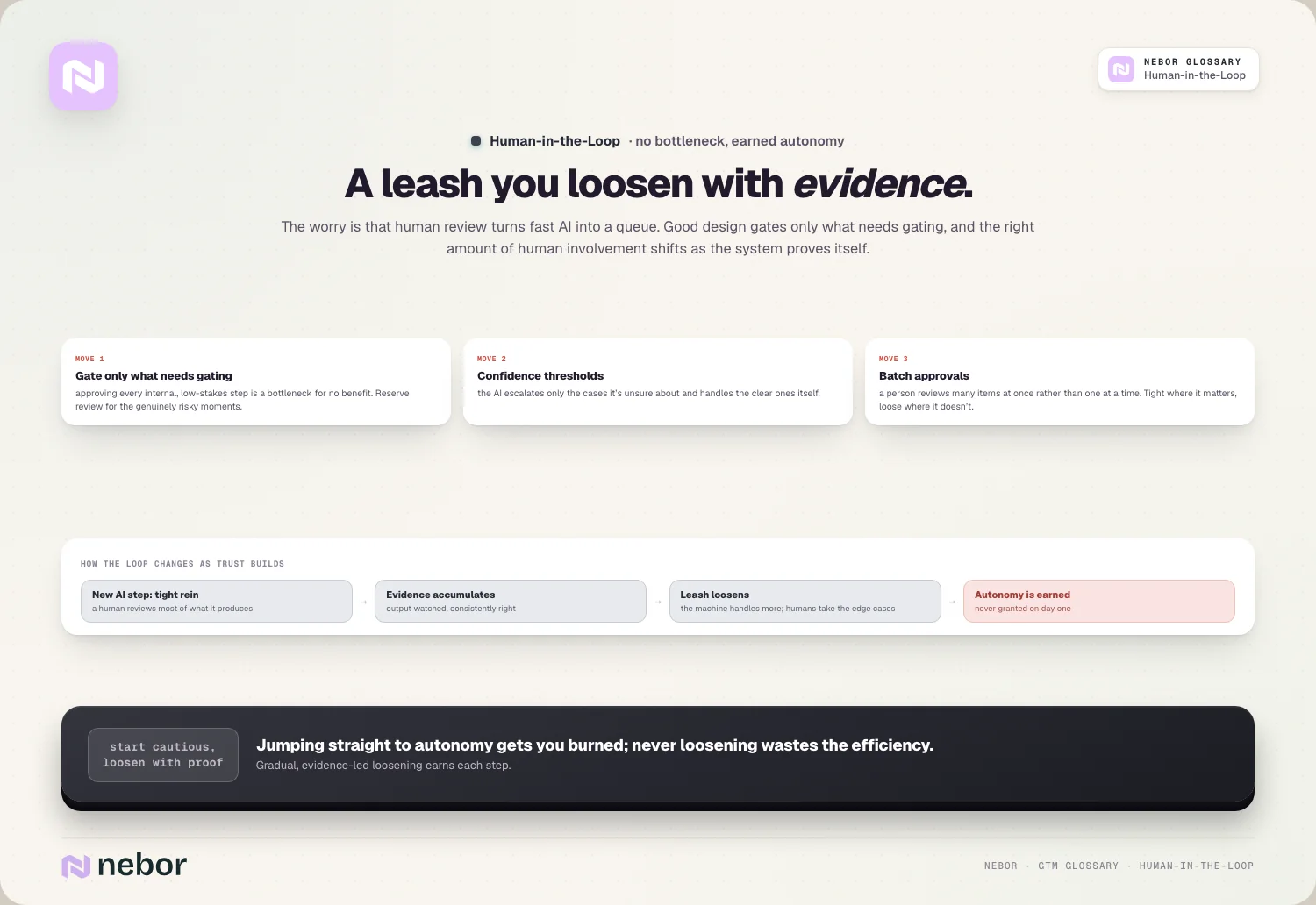
As you watch its output and it consistently gets things right, you can pull back, letting it handle more on its own and reserving human review for the edge cases. The loop gets looser as the evidence accumulates.
This is the sensible way to adopt AI, and it's the opposite of the two common failures.
Jumping straight to full autonomy gets you burned, and never relaxing the review means you never capture the efficiency, so the right path is a gradual, evidence-led loosening that earns each step of autonomy.
How does human-in-the-loop work inside an AI agent or workflow?
It helps to see where the human checkpoint belongs when you're building with AI agents and automated systems. The loop lives as a step you design into the flow instead of as a separate tool.
In a typical agentic workflow, the agent moves through several steps on its own, like pulling data, researching an account, and drafting a message, and then hits a deliberate pause where it hands the result to a person.
The person approves, edits, or rejects, and only then does the workflow continue to the action, like sending the email or updating the record. The human step is a node in the flow, placed right before anything with consequences.
The art is choosing where in the chain that node goes. Put it too early and the human is reviewing rough work that isn't ready, and put it too late and the system has already acted before anyone could catch a problem.
The right spot is usually just before the irreversible step, so the agent does all the prep on its own and the person only weighs in at the moment that carries the consequences.
This is how thoughtful sales automation stays safe, by letting the machine do everything up to the buyer-facing action and keeping a person on that final gate.
What's the relationship between human-in-the-loop and AI quality?
A human in the loop catches mistakes and also makes the AI better over time, which is an underrated benefit. The loop is also a feedback mechanism.
Every time a person edits or rejects an AI output, that's a signal about what good looks like, and a well-built system feeds that back to improve future output.
The corrections become training, the rejections reveal weak spots, and the human's judgment slowly gets encoded into better prompts, better data, and better rules. The loop is how the system learns your standards.
This is also why removing the human too early caps your quality. Without the feedback a human provides, the AI keeps making the same mistakes, while a system with a person in the loop keeps getting sharper.
The human works as more than a safety net, because they're part of how the automation improves, which is part of why personalization at scale needs human judgment to stay good rather than drifting into generic.
What are the common human-in-the-loop mistakes teams keep making?
Even teams that adopt the principle get the details wrong in predictable ways. Knowing the common mistakes helps you build a loop that holds up.
The biggest is putting humans everywhere, gating even trivial internal steps until the approvals become a bottleneck and people start rubber-stamping without really checking.
The opposite mistake is putting humans nowhere on the things that matter, letting AI loose unsupervised on customer-facing work to save time, until a bad output causes real damage. Both miss the point of placing the human precisely where the risk is.
There's also rubber-stamping, where approvals exist on paper but the human clicks yes without truly reviewing, which is worse than no gate because it creates false confidence.
And there's the static loop that never loosens even as trust builds, so you never capture the efficiency. All of them come back to placement and honesty. You gate the right steps, make review fast and real, and adjust the loop as the system proves itself.
For us, a human in the loop is how you use AI without getting burned
Human-in-the-loop answers a simple problem, that AI is capable enough to do a lot and unreliable enough that you can't fully trust it yet. Keeping a person on the decisions that matter lets you have the speed of automation without the risk of blind automation.
The teams that win with AI treat the human in the loop as a feature instead of a limitation. They automate aggressively on the safe, internal, repetitive work, and they keep a person firmly on anything a buyer sees or anything hard to undo, handing over more only as the system earns it.
That balance is what separates AI that helps you from AI that embarrasses you in front of buyers.
The mindset that works is to ask, of every AI step, what happens if it gets this wrong.
Where the answer is harmless, the machine is free to act, and where the answer is costly, a person stays on the gate. When you get that placement right, AI becomes a tireless assistant instead of a liability, which is exactly the relationship you want with it.
Share this post
AI
Automation
Glossary
Related glossary items
Understanding the core GTM concepts


Ready to build your pipeline











