

In this post:
Most people assume that if they want to send more cold email, they just turn up the volume in their tool. Then their reply rates collapse, their domain gets flagged, and they learn the hard way that volume has a ceiling.
That ceiling is set by your sending infrastructure. You can only safely send a certain amount per mailbox, which means real volume comes from having more mailboxes and domains instead of cranking one inbox harder.
Sending infrastructure is the underlying technical setup that lets you send email at scale. It includes your domains, mailboxes, authentication, and the platform that sends and routes your messages.
It's the machinery that determines how much outbound you can send and whether any of it reaches the inbox.
The word infrastructure is the point of the term. This is a system of moving parts instead of a single setting, and how well you build it decides both your capacity and your deliverability.
TL;DR
Sending infrastructure is the technical foundation for sending email at scale, made up of domains, mailboxes, authentication records, and the sending platform that delivers your messages.
Volume is capped per mailbox, and safe sending limits mean real scale comes from adding mailboxes and domains, so your infrastructure literally determines how much you can send.
A solid setup means separate sending domains, multiple authenticated mailboxes, proper authentication, warmup, and rotation, all working together to protect deliverability.
The awkward part is that infrastructure stays invisible until it fails. A weak setup caps your volume and tanks your placement without announcing itself, so building it deliberately is the price of doing outbound at any real scale.
So what is sending infrastructure, exactly, and what goes into it?
Sending infrastructure is the full set of technical components that make email sending possible at scale. It's everything between your campaign tool and the recipient's inbox.
It has several parts working together as one system. The domains you send from, the mailboxes on those domains, the authentication that proves you're legitimate, and the platform that actually sends the mail.
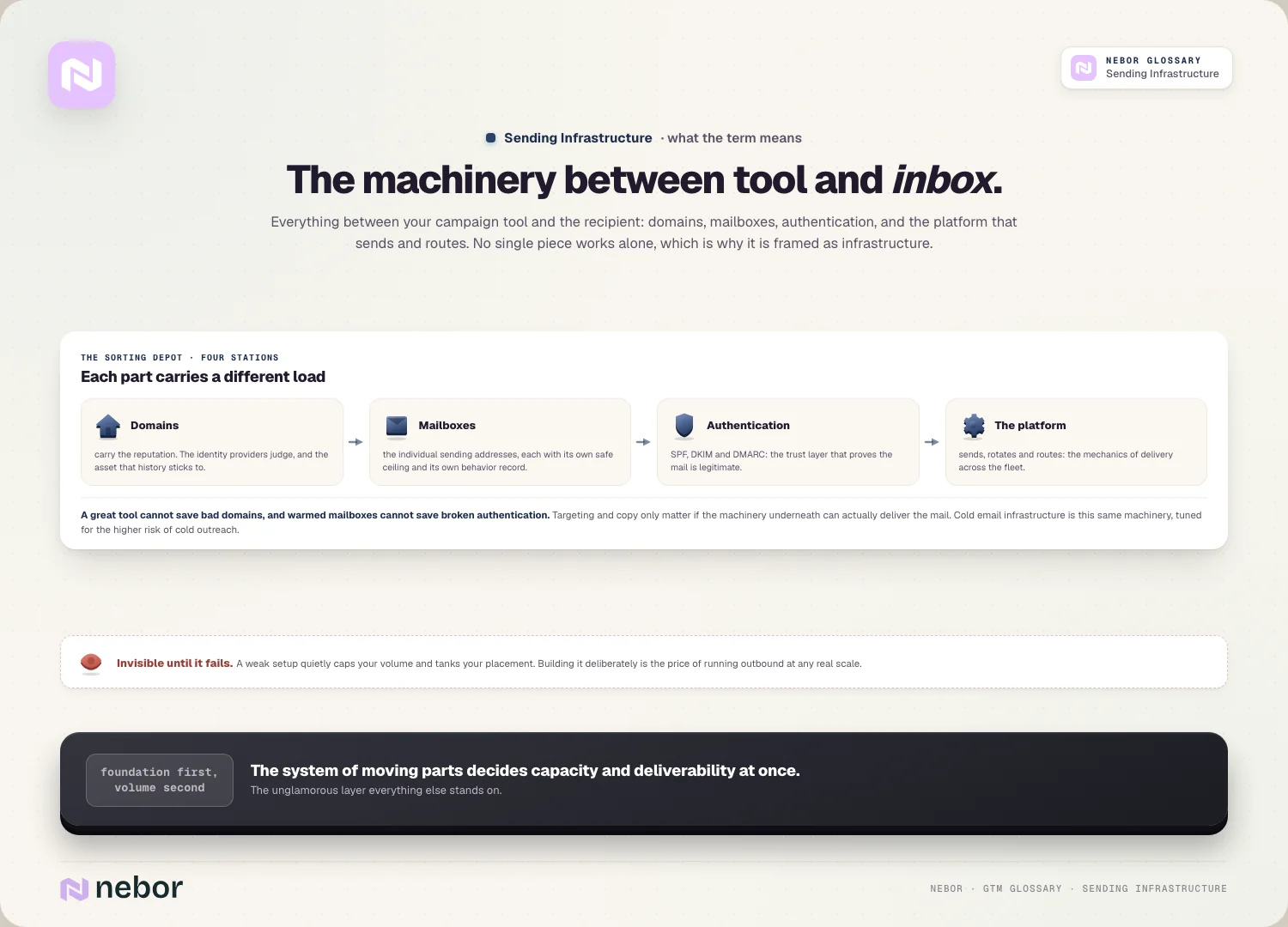
Each part plays a distinct role in the whole. Domains carry your reputation, mailboxes are the individual sending addresses, authentication builds trust, and the sending platform handles the mechanics of delivery and routing.
The reason it's framed as infrastructure is that no single piece works alone. A great tool can't save bad domains, and warmed mailboxes can't save broken authentication, so the whole system has to be sound.
So sending infrastructure is the foundation everything else is built on. Your targeting and copy only matter if the infrastructure underneath them can actually deliver the mail.
How does sending infrastructure relate to cold email infrastructure?
These two terms overlap heavily, so it helps to place them side by side. They describe the same machinery from slightly different angles.
Sending infrastructure is the general concept, the technical setup for sending email at scale, which applies to any high-volume sending, including newsletters and transactional mail.
Cold email infrastructure is that same machinery applied specifically to cold outreach. It carries the same parts but with choices tuned for cold sending, like separate domains and tight per-mailbox limits.
So you can think of cold email infrastructure as a specialized version of sending infrastructure. The components are identical, but the configuration reflects the higher risk of cold outreach.
The practical takeaway is that both names point at the same foundation. Whatever you call it, the domains, mailboxes, authentication, and platform are what determine your reach and your deliverability.
Why does your sending infrastructure cap how much you can send?
The most counterintuitive thing about infrastructure is that it limits how much you can send. Understanding why is the key to building it right.
Each mailbox has a safe ceiling on volume. Sending too much from one inbox looks like spam, so experienced teams keep cold sends to roughly 10 to 20 emails per inbox per day on Google and Microsoft.
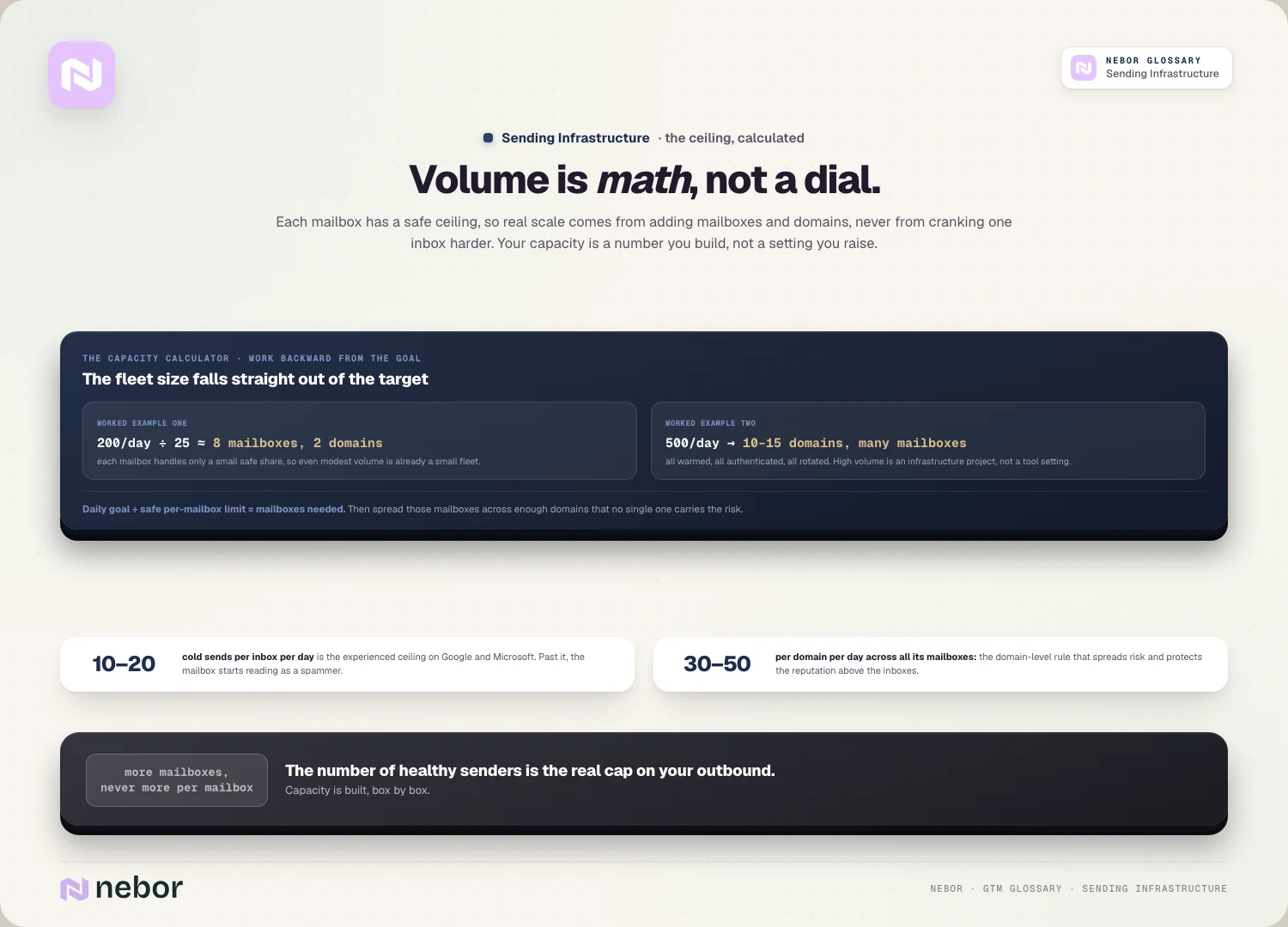
That ceiling applies per mailbox instead of per company. So the only safe way to send more is to add more mailboxes, each staying within its own limit, instead of pushing any single one harder.
The same logic applies at the domain level. A sensible rule is 30 to 50 cold emails per domain per day across all its mailboxes, which spreads risk and protects reputation.
So your infrastructure is what sets your capacity. The number of healthy mailboxes and domains you have is the real cap on how much outbound you can send safely.
How do you calculate how many mailboxes and domains you need?
This is where infrastructure becomes simple math, which is helpful for planning, and we do this exact calculation with clients before any domains get bought. You work backward from your target volume.
Start with your daily volume goal and work down. Divide it by the safe per-mailbox limit, and you get the number of mailboxes you need to send that much without overloading any of them.
The numbers add up faster than most teams expect. Sending 200 emails a day takes at least 8 mailboxes across 2 domains, because each mailbox handles only a small safe share.
Scaling further multiplies the requirement even more quickly. To send 500 cold emails a day, you need roughly 10 to 15 domains with many mailboxes spread across them, all warmed and authenticated.
So high volume is an infrastructure project before it is anything else. The capacity you want directly dictates how many domains and mailboxes you have to build and maintain.
Why should your cold email always go out from separate sending domains?
One of the most important infrastructure choices is where your cold email comes from. The answer is almost never your main domain.
Sending cold outreach from your primary domain is risky. One round of spam complaints can damage the reputation your real business mail depends on, including invoices and replies to customers.
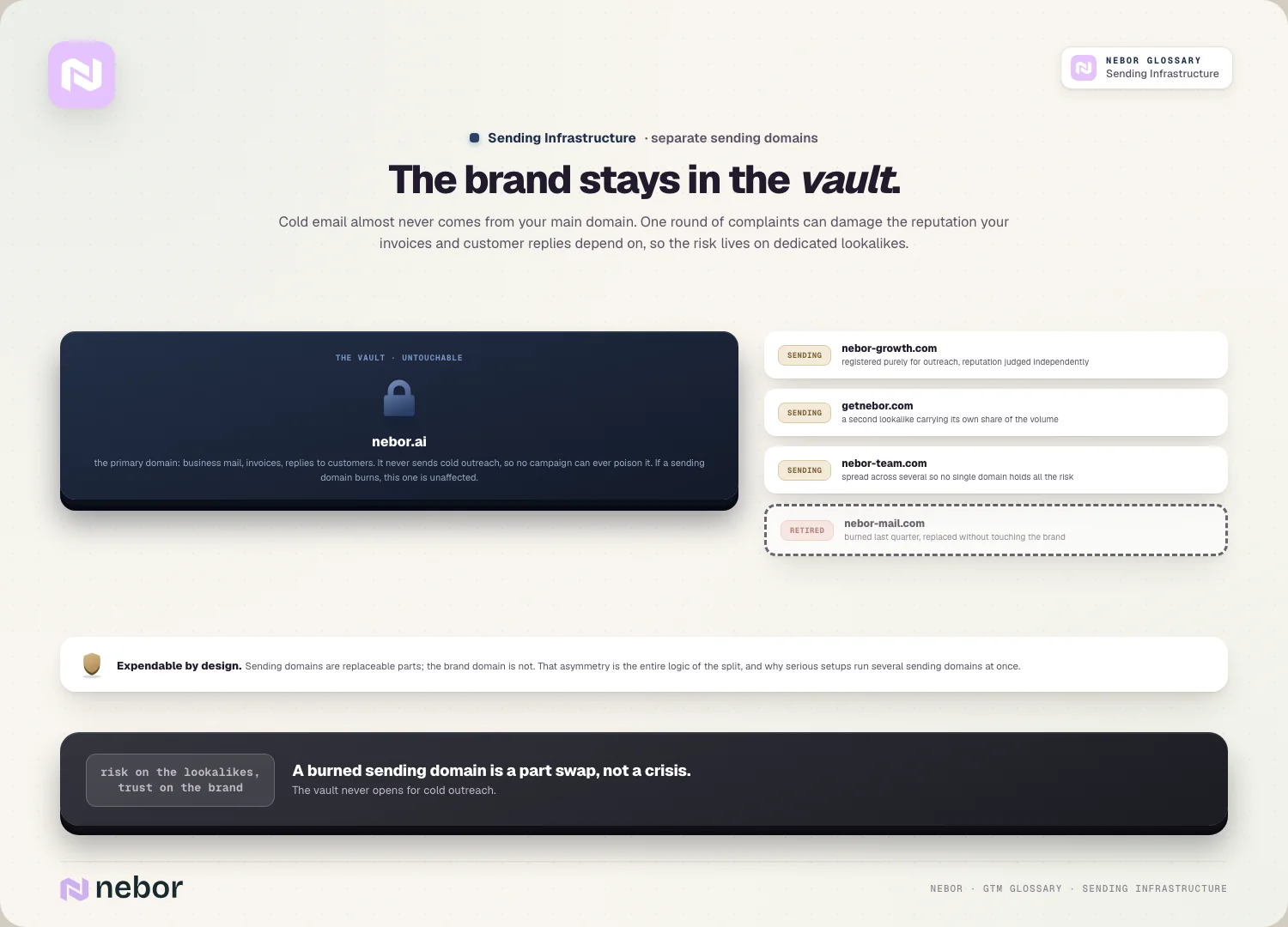
The fix is a set of dedicated sending domains. You register separate domains, often lookalikes of your main one, purely for cold outreach, so their reputation is judged independently from your brand.
This insulates your core domain from the risk entirely. If a sending domain gets burned, your business mail is unaffected, and you can replace the sending domain without touching your main one.
It lets you spread risk around as well. Spreading across multiple sending domains means no single one carries all your volume, which is part of why serious setups use several at once.
What role does authentication play inside your sending infrastructure?
Authentication is the part of infrastructure that proves you're a legitimate sender. Without it, even a well-structured setup gets filtered.
The core records are SPF, DKIM, and DMARC. Setting up SPF and DMARC correctly, as part of your overall DNS authentication, tells providers your mail is genuine.
These records have moved from best practice to requirement. Major providers increasingly demand proper authentication, so a domain without it gets treated as suspicious no matter how carefully you send.
You set this up before sending anything. Authentication is a prerequisite, configured on every sending domain at setup, well before any problems could appear.
So authentication is the trust layer of your infrastructure. It's what lets the rest of your careful setup translate into inbox placement.
How do warmup and rotation keep the infrastructure usable day to day?
Building domains and mailboxes is only the start. Two ongoing practices keep that infrastructure healthy enough to use.
Warmup handles the trust side of the job. Every new mailbox has to ramp gradually following a sender warmup protocol, because a fresh inbox blasting volume looks like spam and gets filtered immediately.
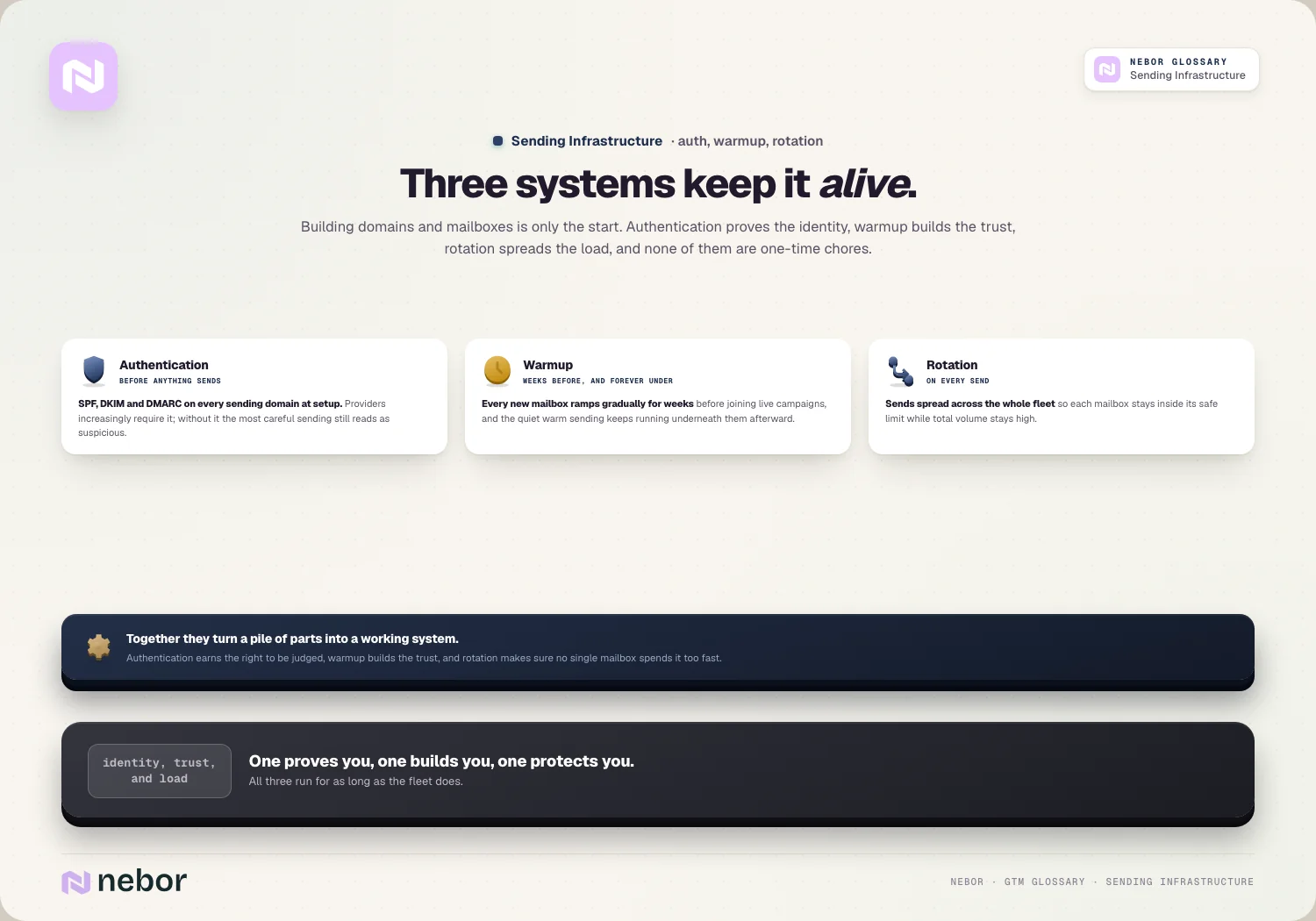
This is the practical side of email warmup. New mailboxes typically warm for a few weeks, starting at a handful of sends a day, before they're ready for real campaigns.
Rotation handles the load side of the same job. Spreading sends across many mailboxes through inbox rotation keeps each one within its safe limit while letting your total volume stay high.
Together, warmup and rotation turn a pile of domains and mailboxes into a working system. One builds the trust, and the other distributes the load so no single mailbox gets overloaded.
How does infrastructure connect to your deliverability and reputation?
Sending infrastructure exists to serve one goal, which is reaching the inbox. It connects directly to your reputation and deliverability.
It's the foundation of your sender reputation. Clean domains, proper authentication, and disciplined sending build the trust that becomes your reputation over time.
That reputation then drives your email deliverability every day. Good infrastructure produces good placement, while a weak or overloaded setup pushes your mail into spam regardless of content.
When something breaks, infrastructure is the first place to look. An outbound deliverability audit usually traces problems back to domains, authentication, or sending behavior.
So infrastructure is upstream of deliverability as its cause. The state of your domains and mailboxes is what determines whether your mail arrives at all.
Should you build your sending infrastructure yourself or buy it ready?
A practical decision every team faces is whether to set up infrastructure themselves or use a provider that supplies it ready-made, and we meet clients on both paths.
Building it yourself means registering domains, creating mailboxes, configuring authentication, and managing warmup and rotation by hand. It gives full control but takes real time and technical know-how.
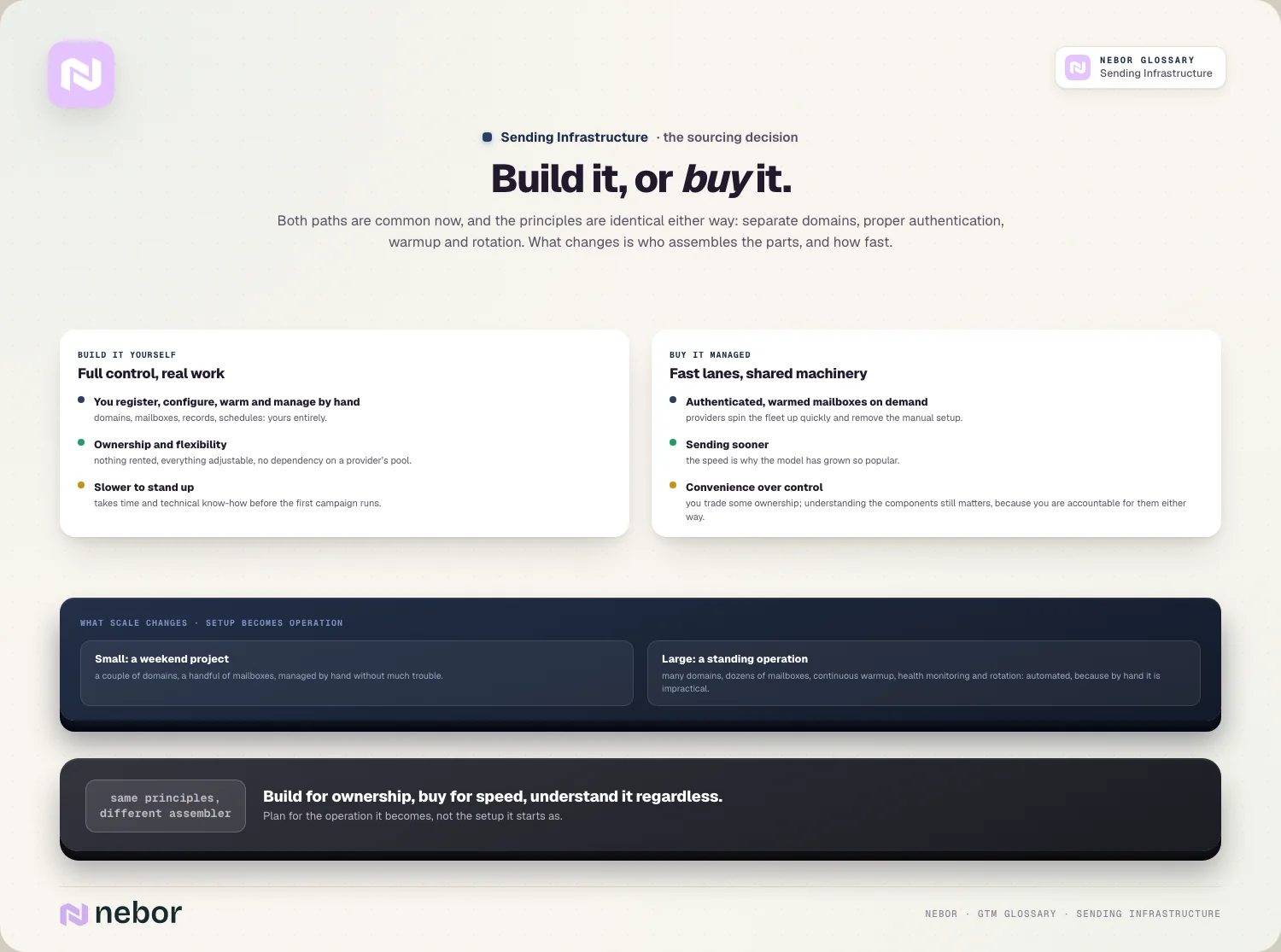
Buying it means using infrastructure providers that spin up authenticated, warmed mailboxes quickly. This is far faster and removes a lot of the manual setup, which is why it's grown popular.
The tradeoff comes down to control versus convenience. Managed providers get you sending sooner, while a self-built setup gives you ownership and flexibility that you fully control.
Either way, the principles are the same. Whether you build or buy, you still need separate domains, proper authentication, warmup, and rotation, so understanding the components matters regardless of who assembles them.
How does sending infrastructure change as your volume keeps climbing?
Infrastructure that works for a small operation looks very different at high volume. As you grow, it shifts from a one-time setup into an ongoing operation.
At low volume, a couple of domains and a handful of mailboxes may be plenty. The setup is simple and you can manage it manually without much trouble.
At high volume, you're managing many domains and dozens of mailboxes. Warmup becomes continuous, rotation gets more complex, and monitoring each mailbox's health turns into a real job.
This is the point where automation becomes essential. Coordinating warmup, rotation, and health checks across a large fleet of mailboxes is impractical by hand, so teams build systems to manage it.
So infrastructure never stays static for long. It grows from a quick setup into a maintained operation, and planning for that growth early saves painful rebuilds later when your volume climbs.
What are the common mistakes teams make with sending infrastructure?
Sending infrastructure goes wrong in a handful of predictable ways, and we keep seeing the same ones when clients bring us a burned setup. Avoiding them is most of what keeps outbound healthy.
Overloading mailboxes does the quickest damage, because pushing volume past the safe per-inbox limit to send more from fewer accounts is the fastest route to spam folders.
Sending cold from the primary domain risks the most, because it puts your real business mail on the line when separate sending domains would protect it entirely.
Skipping authentication or warmup wastes everything upstream, because mail from unauthenticated or cold mailboxes gets filtered immediately, undoing all your targeting work.
And set-and-forget lets it all rot, because infrastructure needs monitoring, and domains can degrade and mailboxes can get flagged, so a setup left unwatched slowly decays.
What does a basic sending infrastructure look like when laid out plainly?
It helps to see a simple setup laid out, because the parts are easier to grasp as a whole. Here's what a modest cold email infrastructure might involve.
You start with a few secondary domains, separate from your main brand domain, registered purely for outreach. Spreading across two or three from the start distributes your reputation risk.
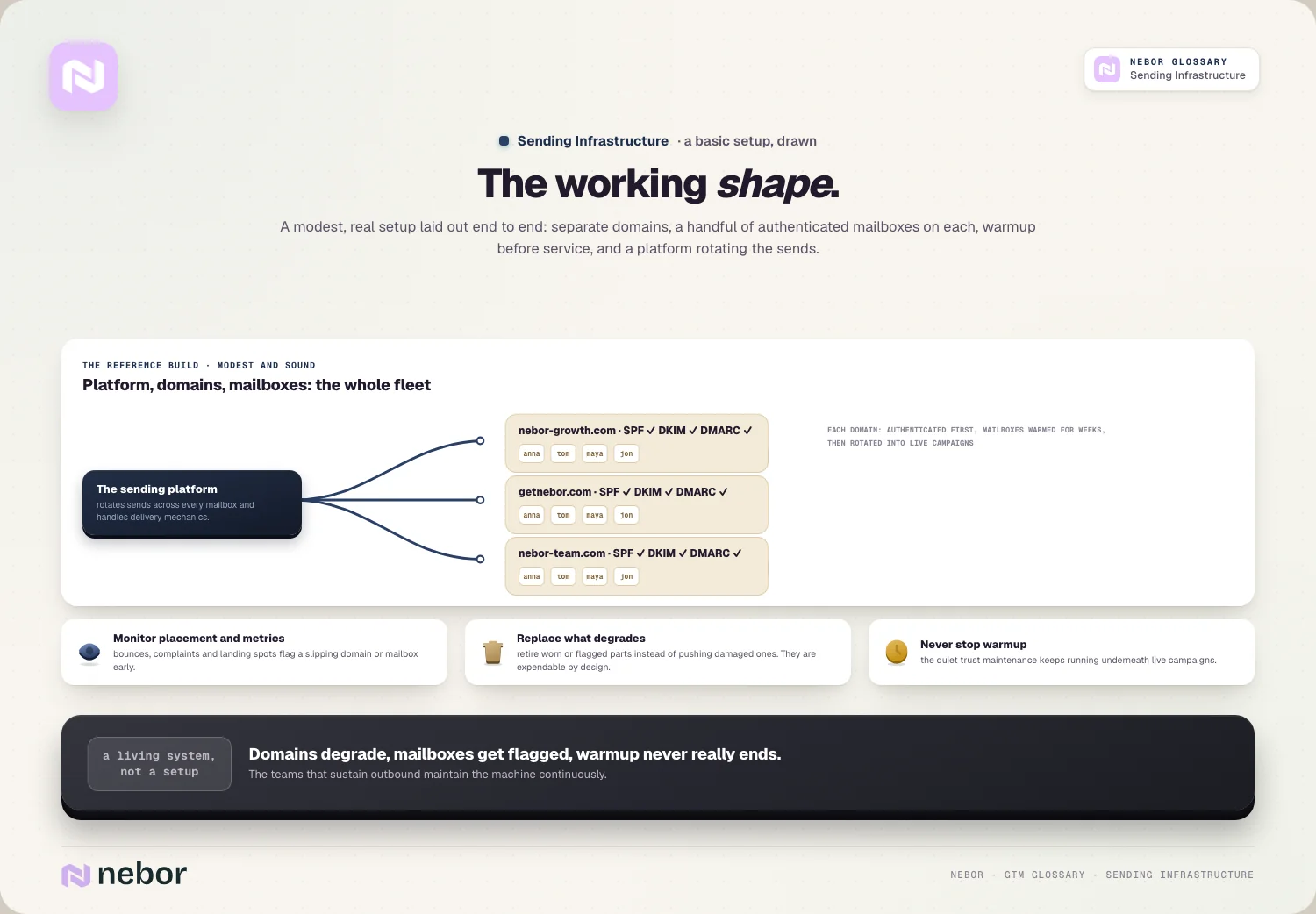
On each domain you create a handful of mailboxes, each a real sending address. With safe limits per mailbox, a few mailboxes per domain gives you reasonable capacity without overloading any one.
Every domain gets authenticated with SPF, DKIM, and DMARC before sending, and every new mailbox goes through warmup for a few weeks. Only then do they join live campaigns.
Finally, a sending platform ties it together, rotating sends across the mailboxes and handling delivery. That combination, separate domains, warmed and authenticated mailboxes, and rotation, is the working shape of real sending infrastructure.
How do you keep your sending infrastructure healthy month after month?
Infrastructure isn't something you build once and forget. Like any system, it degrades without attention, so keeping it healthy is an ongoing job.
Monitoring placement and metrics comes first, because watching bounce rates, complaint rates, and where your mail lands tells you when a domain or mailbox is starting to slip.
Replacing what degrades keeps the fleet honest, because domains and mailboxes can wear out or get flagged, so healthy operations retire and replace them rather than pushing damaged ones.
And never stopping warmup underpins the rest, because keeping warmup going underneath live sending maintains the trust that keeps your mailboxes in good standing as they work.
So infrastructure deserves treating as a living system. In our experience, the teams that sustain outbound long-term are the ones who maintain their infrastructure continuously, rather than building it once and watching it slowly decay.
Why the machinery underneath your outbound decides how far it can go
Sending infrastructure matters because it's the hard ceiling on your outbound. You can't simply decide to send more, your domains and mailboxes determine how much you can safely send and whether it lands.
The deeper point is that volume is an infrastructure problem long before it's a tool setting. Real scale comes from building more healthy mailboxes and domains, each kept within its limits, rather than overworking the ones you have.
The honest reality is that this is unglamorous, ongoing work. Building, authenticating, warming, and monitoring a fleet of domains and mailboxes is exactly the kind of foundation teams skip and regret.
So if your outbound keeps hitting a wall or sliding into spam, the problem is usually below your message, in the infrastructure underneath it.
Building that properly is what lets you scale outreach without burning it. It's why teams increasingly automate sales prospecting on top of solid infrastructure, and a core layer of any go-to-market system built on email.
Share this post
Infrastructure
Deliverability
Glossary
Related glossary items
Understanding the core GTM concepts




Ready to build your pipeline











