
In this post:
An agentic workflow is a multi-step process where an AI agent decides what to do next as it goes, instead of following a script you wrote in advance. You give it a goal, and it figures out the steps at runtime, uses tools, and checks its own work along the way.
It's one layer above a single AI agent, because one agent handles one task while a workflow strings several steps together, and sometimes several agents, into a process that reaches a bigger goal. It's how agentic AI gets put to work.
TL;DR
Most things sold as agentic workflows aren't. They're ordinary linear automations with one AI step bolted in, and the path never changes from one pass to the next.
A real agentic workflow has decision points, where the agent picks the next step based on what it just found. That flexibility is the whole reason to use one, and it's also what makes it slower, pricier, and harder to predict.
So don't make a workflow agentic just because you can. Use plain automation for the steps that never change, and bring in an agent only where the path really varies and you couldn't have scripted it ahead of time.
So what actually makes a workflow agentic instead of just automated
The difference comes down to one question. Who decides the next step, you or the system?
In a normal automation, you decide everything in advance. Every step and every branch is written into the workflow, and it behaves the same way every time. A Zapier zap or an n8n flow that always does A, then B, then C is automation with no agent anywhere in it.
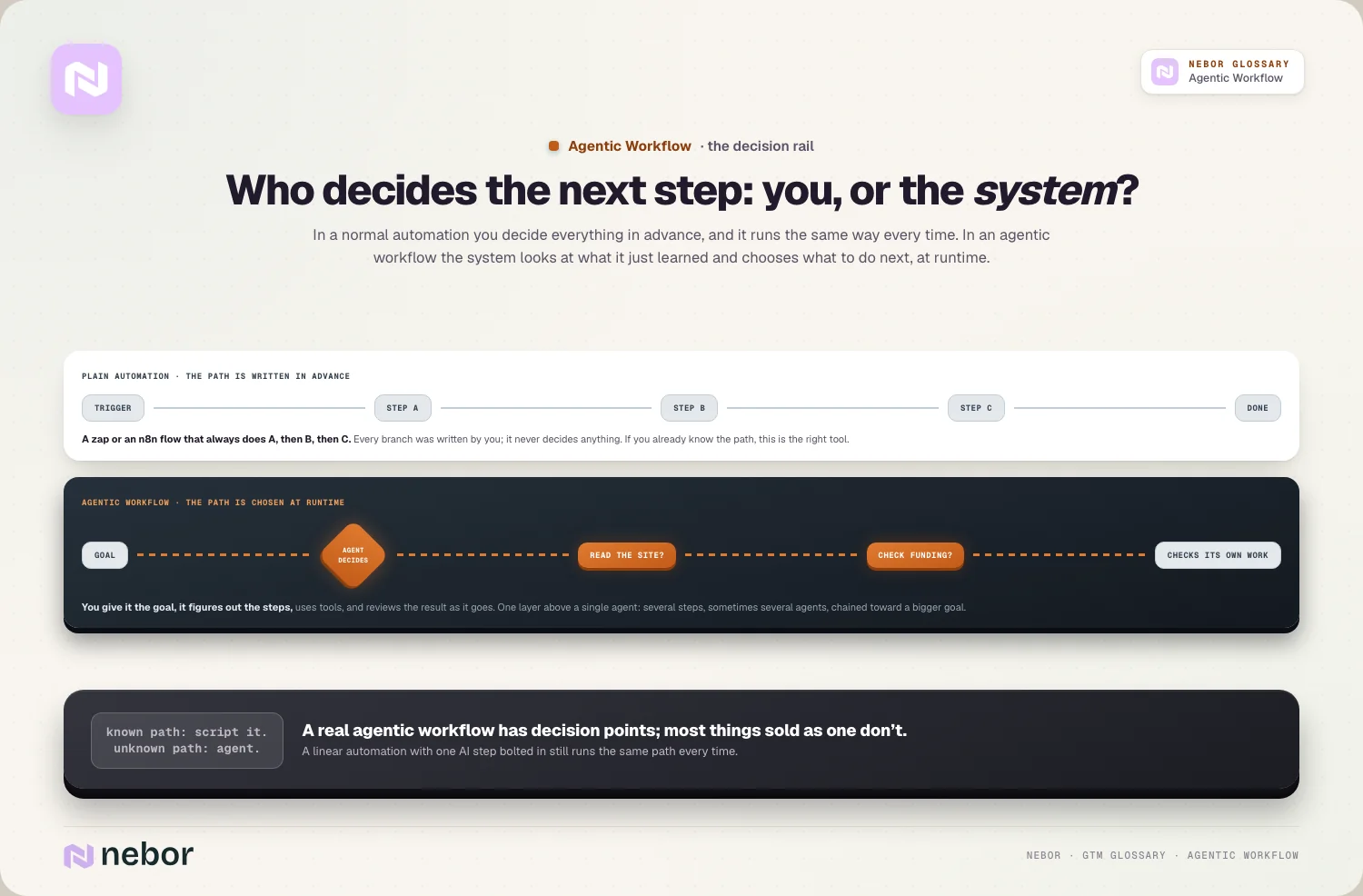
In an agentic workflow, the system decides at runtime. It looks at the goal and at what it just learned, then chooses what to do next.
One simple rule settles most of the borderline cases. If you already know the path, use a deterministic workflow, and if the goal is clear but the path isn't, an agentic workflow earns its place.
The four building blocks you'll find inside almost every agentic workflow
Andrew Ng laid out four patterns that show up in almost every agentic workflow. Most real systems use two or three of them together.
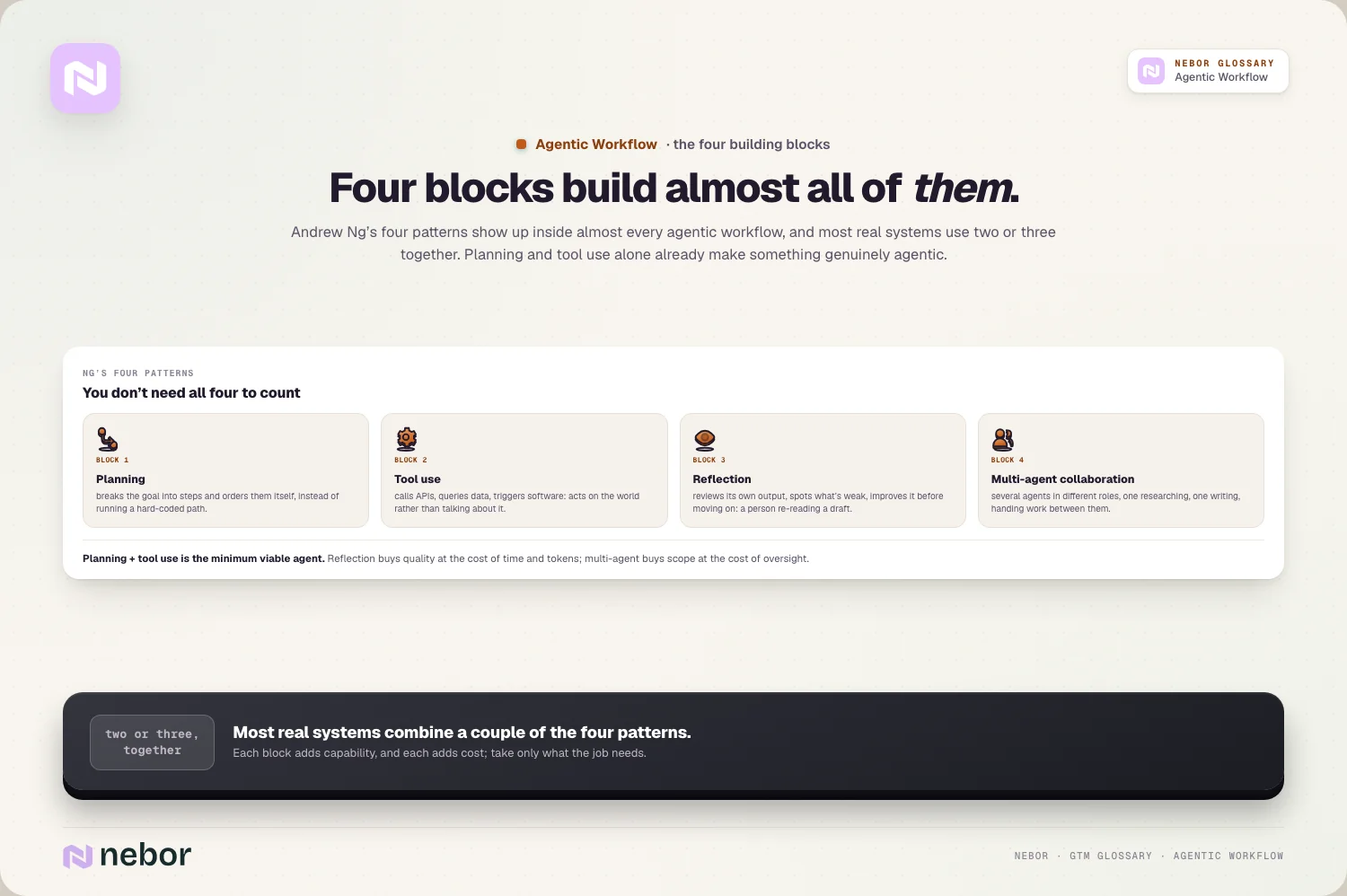
Planning. The agent breaks a big goal into smaller steps and decides their order on its own, instead of following a path you hard-coded.
Tool use. The agent calls APIs, queries data, and triggers other software, so it can act on the world rather than just talk about it.
Reflection. The agent reviews its own output, spots what's weak, and improves it before moving on, the way a person re-reads a draft.
Multi-agent collaboration. Several agents take on different roles, like one researching and one writing, and hand work between them.
You don't need all four for a workflow to count. Planning and tool use on their own already make something properly agentic.
How you can spot the different shapes an agentic workflow usually takes
Once you start looking, agentic workflows come in a few recognizable shapes, and knowing them helps you pick the right one.
The simplest is a single agent in a loop. It plans, acts, checks, and repeats until the job is done, all on its own. This is enough for most bounded research and drafting tasks.
A step up is the orchestrator-worker shape. One agent acts as a manager, breaks the goal into pieces, and hands each piece to a worker agent. It's powerful for big jobs, but the manager's first decision shapes everything after it, so a bad split early on poisons the whole job.
Then there's the reviewer pattern, where one agent produces and a second critiques and sends it back for another pass. It catches a lot of weak output, but it also burns more time and tokens, so you save it for work where quality really matters.
Why agentic isn't automatically better than the plain automated version
Here's the part the hype skips, which is that agency is a cost you pay rather than a free upgrade.
Every time you let an agent decide, you add a little latency, you add token cost, and you add a chance it picks wrong. A deterministic step behaves the same way every time, and you can debug it in seconds. An agentic step can surprise you, and working out why is much harder.
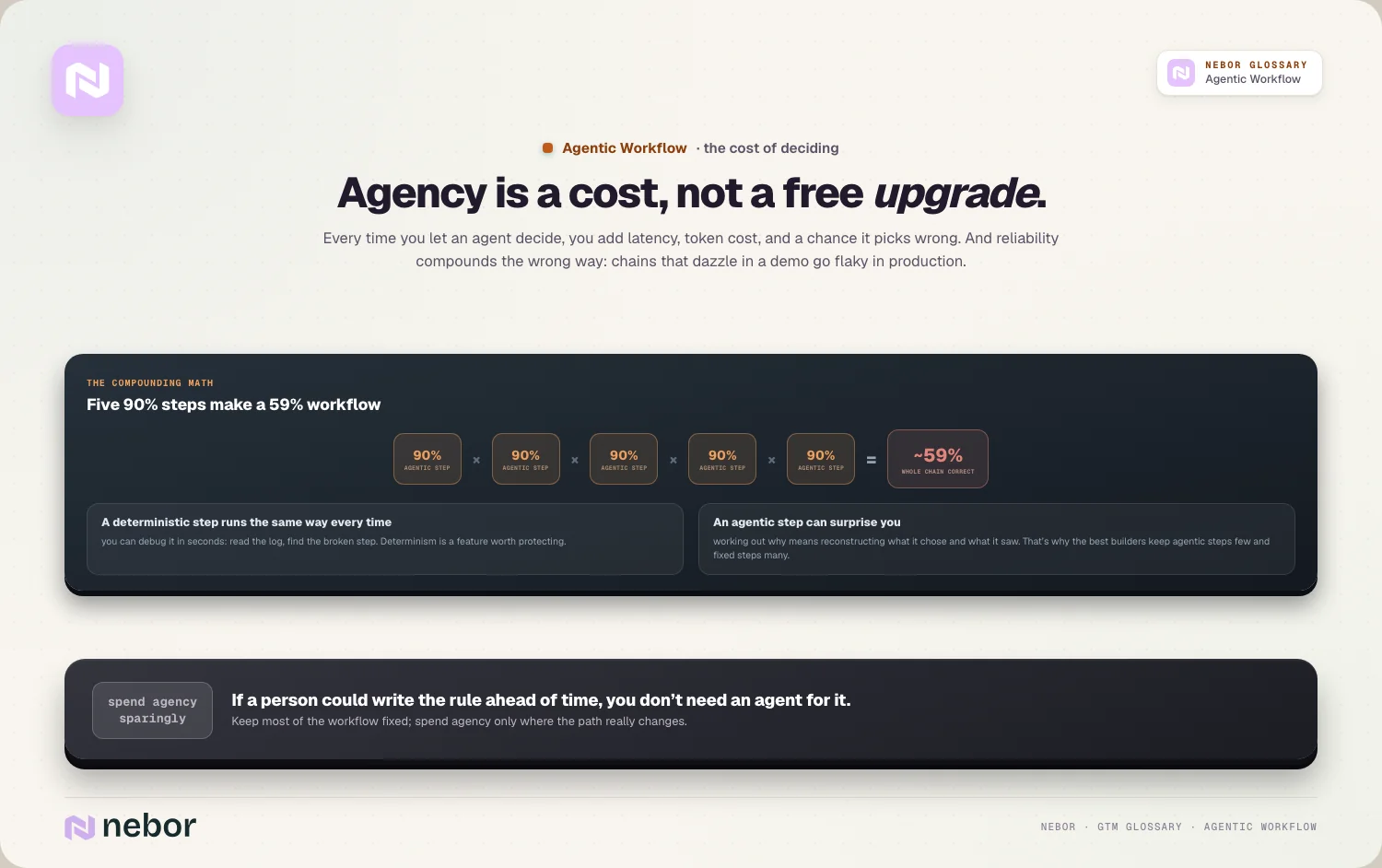
So determinism is a feature worth protecting. The best builders keep most of the workflow fixed and predictable, and they spend agency only on the few steps where the path really does change. If a person could write the rule ahead of time, you don't need an agent for it.
Where agentic workflows fit in GTM, and where plain automation still wins
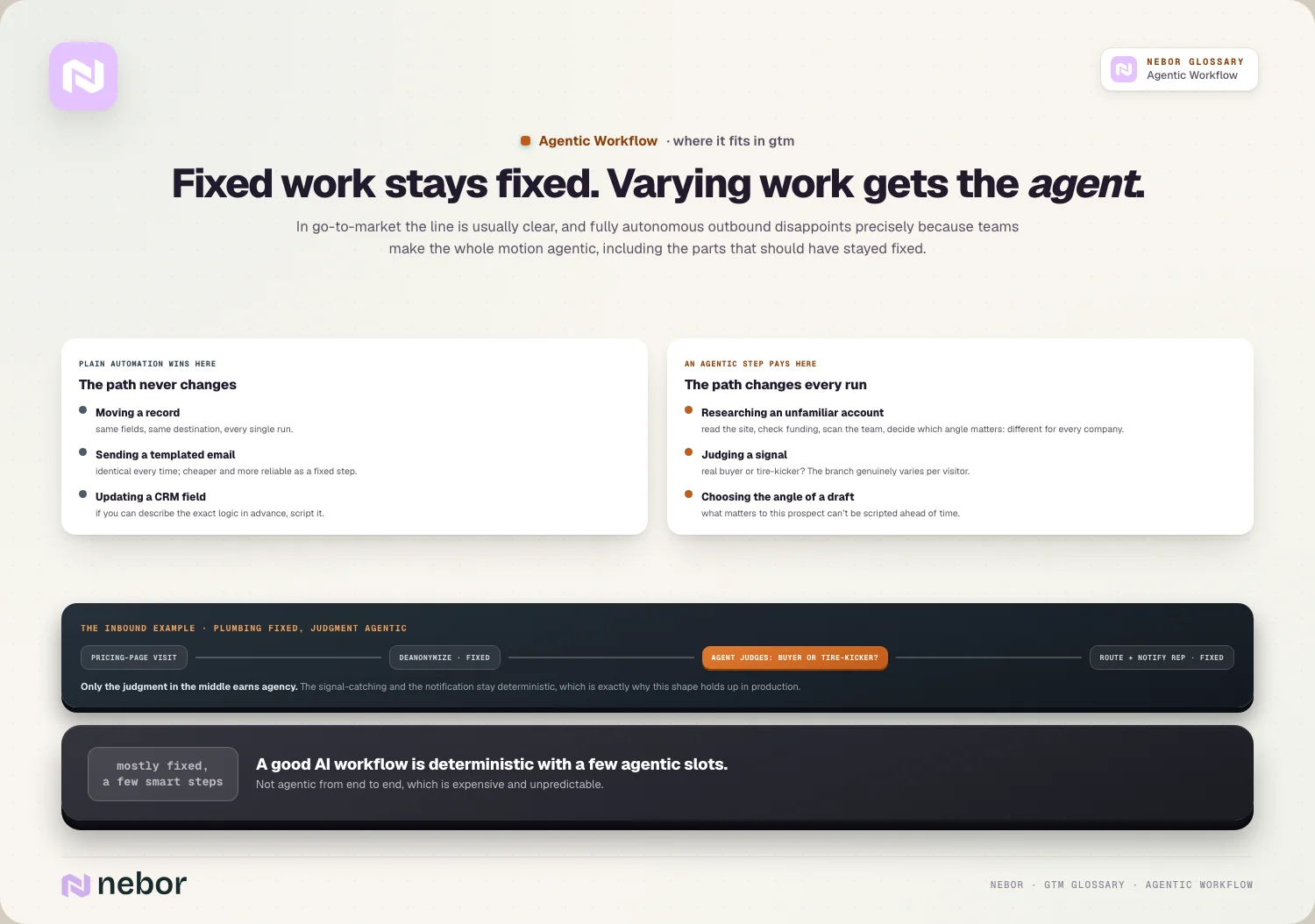
In go-to-market, the line is usually clear. Moving a record, sending a templated email, or updating a field in your CRM is fixed work, so plain sales automation handles it better and cheaper.
Researching an unfamiliar account is a different story. The agent might need to read the site, check funding news, scan the team, and decide which angle matters, and that path changes for every company, which is where an agentic step pays off.
We've written about which prospecting jobs you can hand to a machine and which still need a person.
This is also why fully autonomous outbound so often disappoints. Teams make the whole motion agentic, including the parts that should have stayed fixed, and the result is expensive and unpredictable. A good AI workflow stays mostly deterministic with a few smart steps, and it never needs to be agentic from end to end.
How agentic workflows earn their place on the inbound side too
Outbound gets most of the attention, but inbound is where the agentic decision points often pay off fastest, because the intent is already there and you're racing the clock.
Take a known company landing on your pricing page. A workflow can deanonymize the visit, then an agent decides whether this looks like a real buyer or a tire-kicker, and routes accordingly. That branch truly varies per visitor, so it's a fair place to spend agency.
Our own website visitor workflows work this way. The plumbing that catches the signal and the notification that goes to the rep stay fixed, and only the judgment in the middle, the part that asks "is this worth a tailored touch and what angle fits," gets handled by an agent.
How an agentic workflow differs from a single agent and from plain automation
These three words get used as if they mean the same thing, and they don't. Keeping them straight saves you from building the wrong thing.
A single AI agent is one unit doing one task on its own. It plans, acts, and checks, but it's still pointed at a single job, like building a research brief.
An agentic workflow is the layer above that. It chains several steps, and sometimes several agents, into a longer process with decision points along the way. The agent in the middle isn't just doing one task, it's choosing which task comes next.
Plain automation is the layer below both. It follows a fixed path you wrote in advance, with no decisions of its own. Most real GTM systems are a blend, mostly automation for the predictable steps with a few agentic decision points dropped in exactly where the path varies.
How to decide which steps in your workflow deserve their own decisions
The hardest part of building one of these isn't the wiring. It's deciding which steps get to make their own decisions and which stay fixed. A few questions make that call easier.
Ask whether you could write the rule ahead of time. If you can describe the exact logic in advance, like "if the lead is from this industry, send it to this queue," that's a fixed step and it should stay deterministic.
Ask whether the path changes from one case to the next. Researching a company is a fair candidate, because the right sources and angles differ for every account. Sending a templated confirmation email is not, because it's identical every time.
Ask what it costs if the step gets it wrong. A wrong research note that a human reviews is cheap. A wrong email that goes straight to a buyer costs far more, so even when the drafting is agentic, the sending should stay fixed behind an approval gate.
How to build an agentic workflow your team can trust from day one
Start from a deterministic skeleton when you build. Lay out the fixed steps first, then mark the one or two places where the path truly varies, and make only those agentic.
Put a human in the loop on anything a buyer will see, so a person approves before it ships. One of our own website visitor workflows does exactly this, with an approval gate built into the flow. Feed the whole thing clean data, because an agent reasoning over bad data just makes bad calls faster.
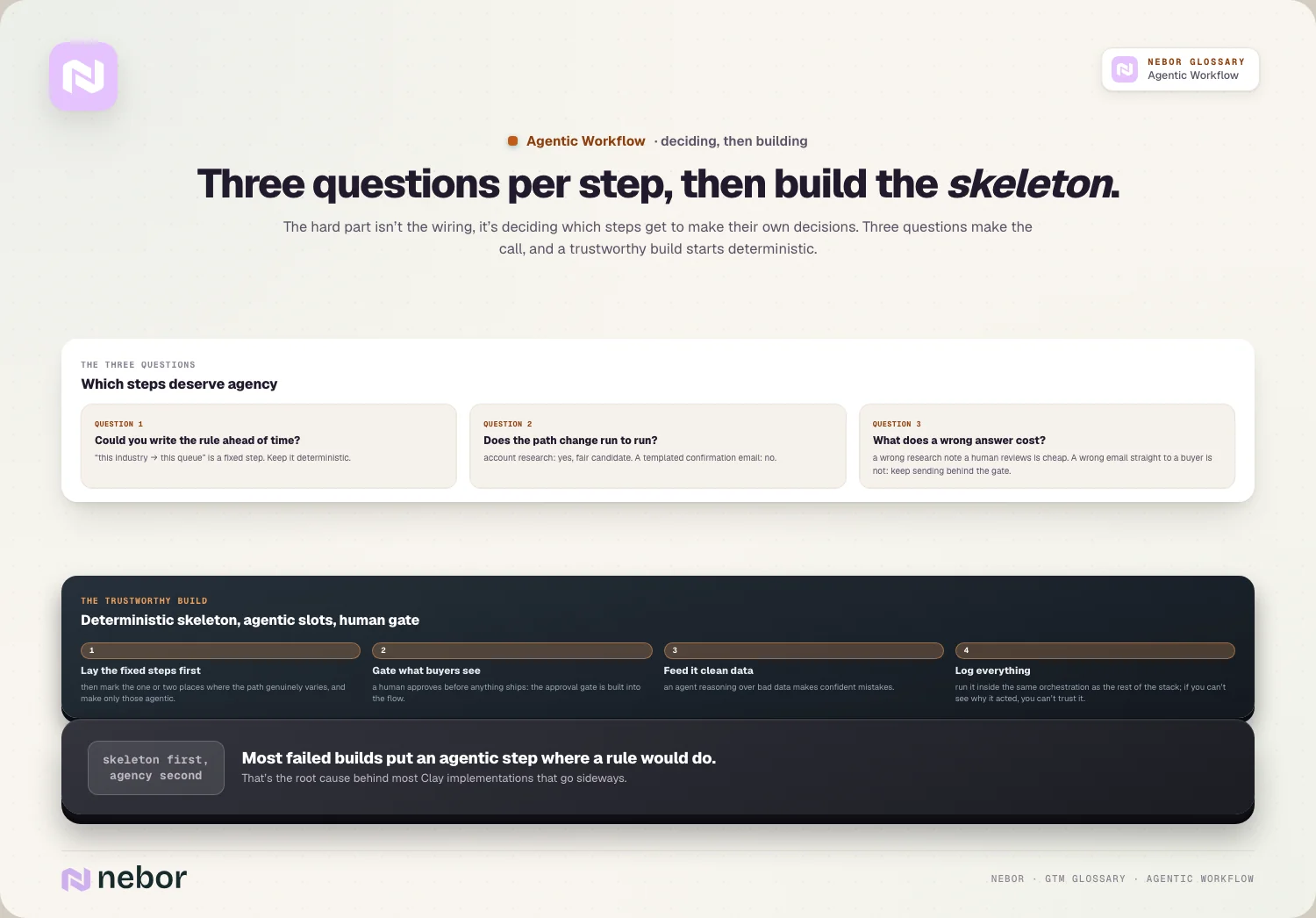
Then log everything and keep it inside the same workflow orchestration as the rest of your stack, as one part of a wider GTM system you own. If you can't see what the agent did and why, you can't trust it yet.
Tools like Clay tend to be where these workflows get assembled, because they live between the data and the action. That's also why so many of them go sideways.
We've written about why most Clay implementations fail, and the root cause is almost always the same, an agentic step where a deterministic one would have done the job more cheaply and reliably.
How a few agents working together turn a workflow into a system
A single agent in a workflow is useful. The shape gets far more powerful, and far harder to manage, once several agents share the work and hand results between each other.
The classic split is a researcher, a writer, and a reviewer. One agent gathers the facts about an account, a second turns them into a tailored draft, and a third checks the draft against the brief and sends it back if it's weak.
Each agent stays narrow, which keeps it reliable, while the team of them covers a bigger job than any one could alone.
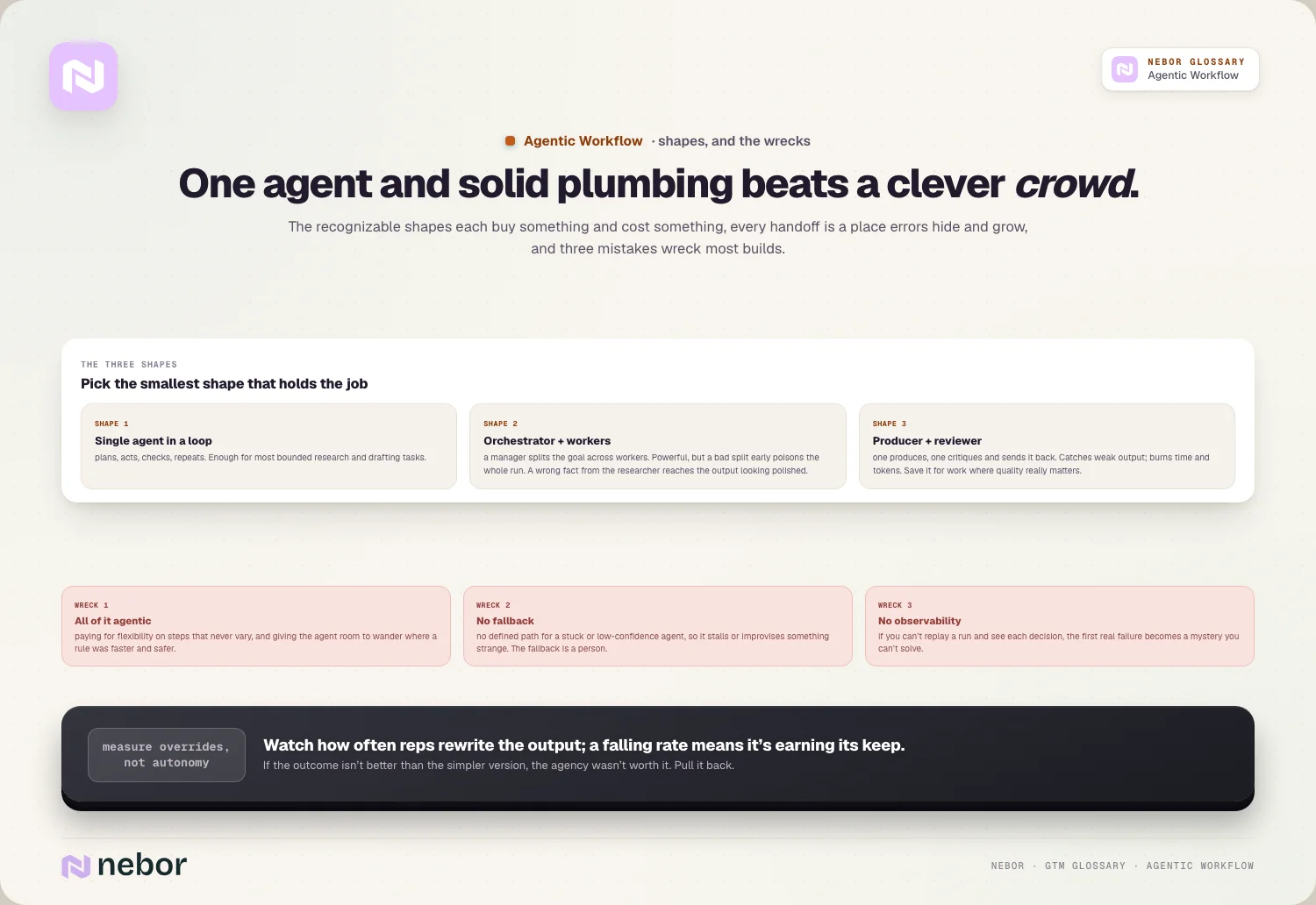
Every handoff, though, is a place errors can hide and grow. If the researcher pulls a wrong fact, the writer builds on it and the reviewer may not catch it, so the mistake reaches the output looking polished.
That's why multi-agent workflows need even tighter logging and a clear human gate, because a sophisticated look earns the system no relief on oversight.
So treat extra agents the way you treat extra agency, as a cost you take on only when one agent really can't hold the whole job. Most GTM workflows are better served by one well-scoped agent and a lot of solid deterministic plumbing around it.
The mistakes that drain agentic workflows without ever throwing an error
The biggest one is making the whole thing agentic when only a slice of it needed to be. You pay for flexibility on steps that never vary, and you give the agent room to wander where a fixed rule would have been faster and safer.
The second mistake is having no fallback path. A good workflow has a defined route for when the agent gets stuck or low on confidence, usually handing off to a person. Without that, a confused agent either stalls or improvises something strange.
The third mistake is skipping observability from the start. If you can't replay a past execution and see each decision and what the agent was looking at, you're flying blind, and your first real failure becomes a mystery you can't solve.
What's still genuinely hard about agentic workflows at scale
The hype tends to skip the parts that nobody has solved yet, so here they are. A few real problems show up the moment you move past a single tidy demo.
Reliability compounds against you as the chain gets longer. If each agentic step is right ninety percent of the time, a chain of five of them is right only about sixty percent of the time.
That math is why long, fully agentic chains feel impressive in a demo and flaky in production, and why the best builders keep the agentic steps few and the fixed steps many.
Debugging gets harder as the workflow gets cleverer. When a deterministic flow breaks, you read the logs and find the broken step. When an agentic one goes sideways, you have to reconstruct why the agent chose what it chose, which means you need rich logging from day one or you're stuck guessing.
Cost creeps up on you as well. Every agentic decision spends tokens and time, and a workflow that quietly got more agentic over time can end up slower and pricier than the boring automation it replaced, without anyone noticing until the bill arrives.
How you'll know whether your agentic workflow is really paying off
Don't measure an agentic workflow by how autonomous it feels. Measure it by how often a person has to step in and how good the output is when they don't.
Watch the rate at which your reps override or rewrite the agent's output. A high rate early is normal, and a falling rate over a few weeks tells you the workflow is earning its keep.
Watch end-to-end time and cost too, because a workflow that's clever but slow and expensive may lose to the boring automation it replaced.
Most of all, watch the downstream result, the reply rate, the meeting rate, the clean records that came out the other end. A workflow exists to produce an outcome, and looking sophisticated counts for nothing on its own.
If the outcome isn't better than the simpler version, the agency wasn't worth the price, and the honest move is to pull it back to where the path really does change.
Share this post
AI
Automation
Workflows
Glossary
Related glossary items
Understanding the core GTM concepts



Ready to build your pipeline











