

In this post:
Right now, while nobody's touching it, your contact database is getting less accurate. People are changing jobs, companies are moving, and email addresses are going dead one by one, and that's data decay at work.
Data decay is the natural way B2B data loses accuracy over time, as the real world changes and your records don't. Industry estimates put it at roughly 30% a year, so a big slice of your CRM is wrong within twelve months of being right.
It isn't a one-off problem you clean up and forget. It's a constant force working against every list, every campaign, and every automation you build.
TL;DR
Data decay is the steady way your B2B data goes out of date, as people switch jobs, companies change, and emails die. If nobody touches it, roughly a third of your database goes wrong every year.
Most teams treat their data like something they build once and own forever, when it's closer to fresh produce, accurate today and a little less so tomorrow, whether you touch it or not.
If you ignore it, decay slowly wrecks your deliverability, your targeting, and your reps' time. The fix isn't a one-time cleanup, it's treating data hygiene as something you do continuously.
So what is data decay actually, and why does it never stop happening?
Data decay is the gradual loss of accuracy in your data as the world changes and your records don't. Every contact and account you store is a snapshot of a moment, and the moment keeps moving.
It's sometimes called data rot or data degradation, and it's completely normal. No database stays accurate on its own, because the people and companies in it keep changing in ways your CRM has no way of knowing about.
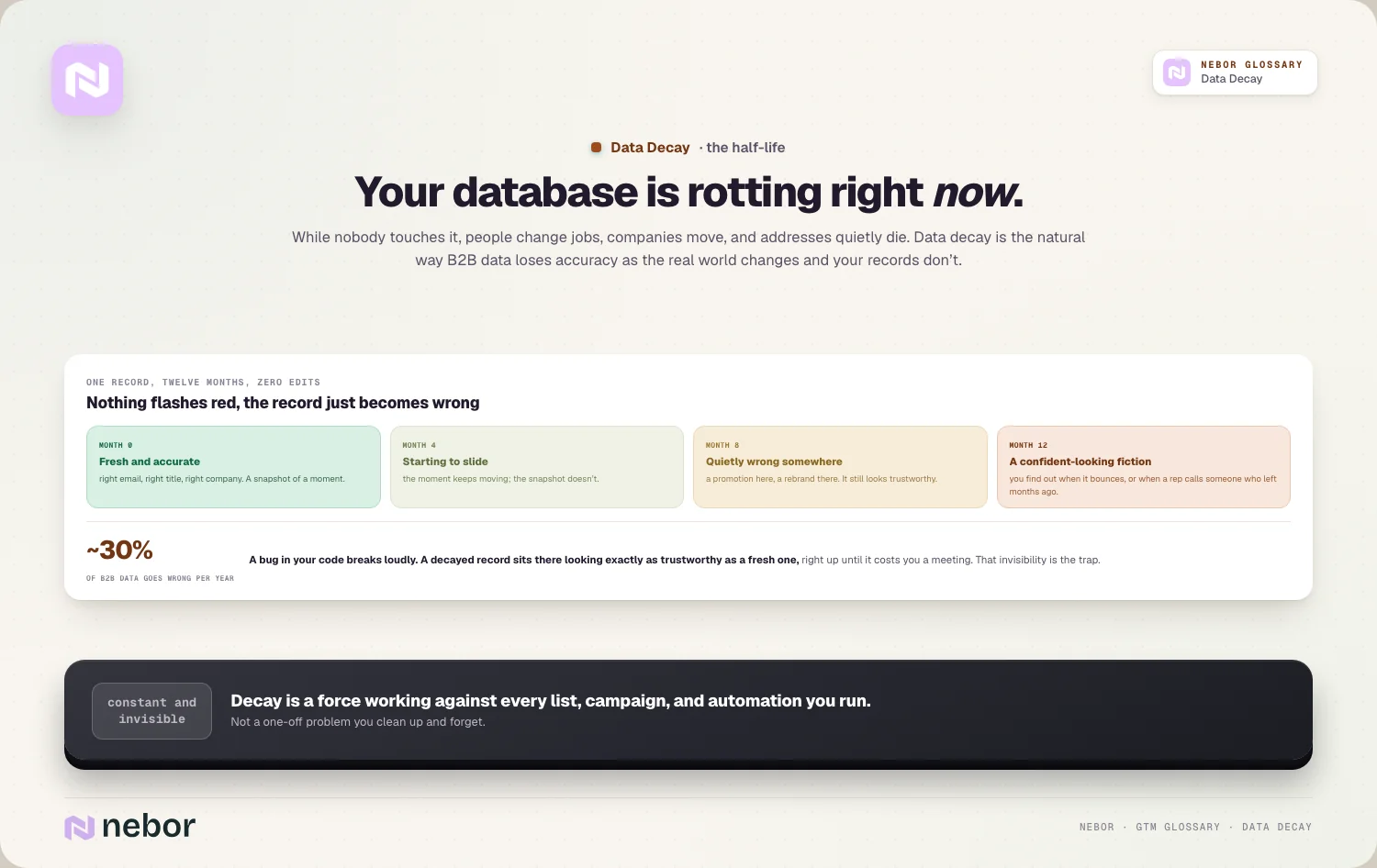
The key thing to understand is that decay is constant and invisible. Nothing flashes red when a contact changes jobs. The record just silently becomes wrong, and you only find out when an email bounces or a rep calls someone who left months ago.
That invisibility is the trap in all of this. A bug in your code breaks loudly, while a decayed record just looks exactly as trustworthy as a fresh one, right up until it costs you a meeting.
Why does your data go stale so much faster than you would expect?
The main driver is that people change jobs, a lot. A meaningful share of professionals switch companies every year, and each move breaks their email, their title, their employer, and often their phone number all at once.
Companies change just as much as the people do. They rebrand, get acquired, move offices, change domains, and restructure, and every one of those events invalidates records without warning. Email addresses also just die over time as old accounts get shut off.
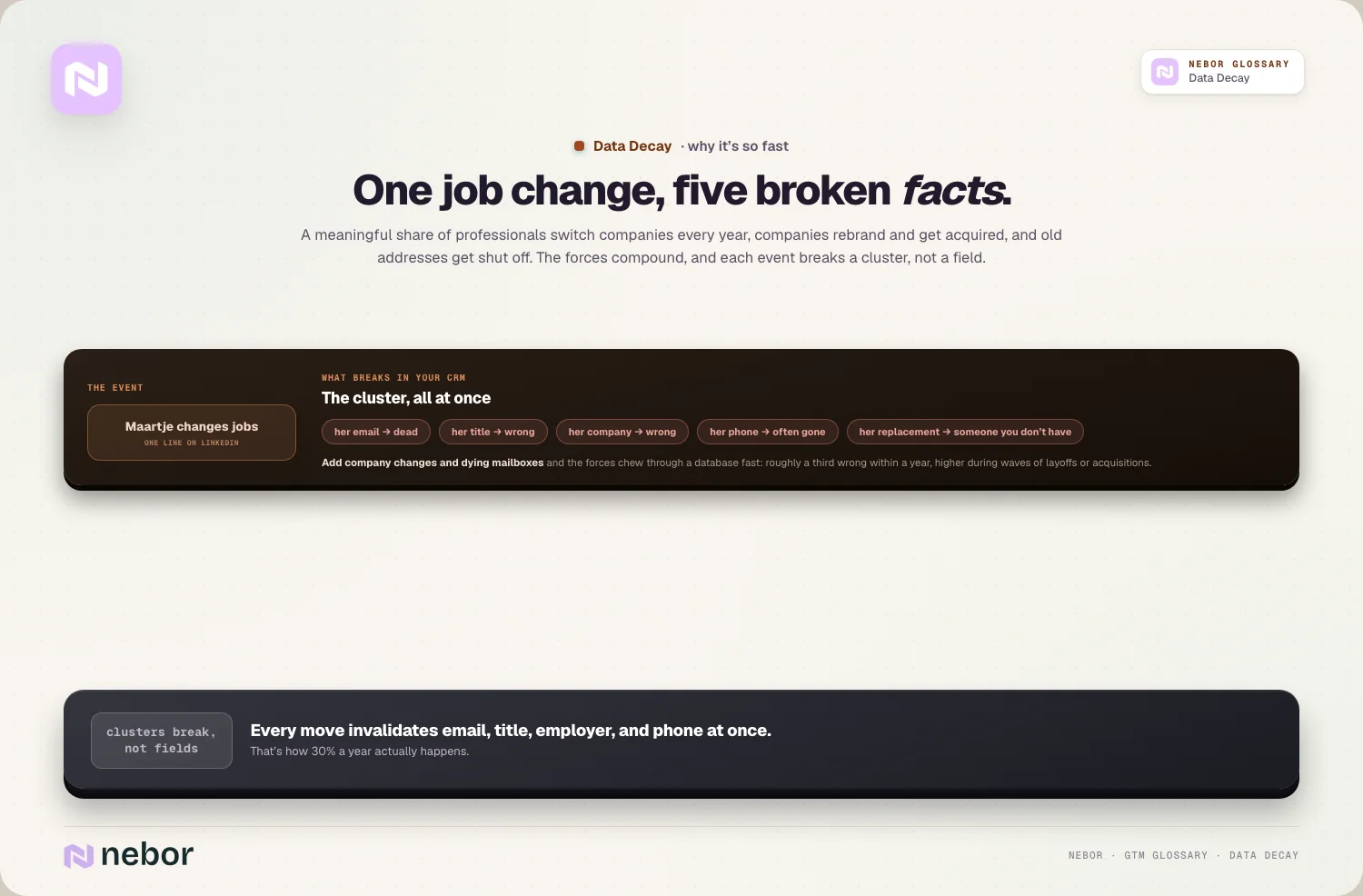
Those forces together chew through a database fast. In our experience that's how you get to roughly a third of your data being wrong within a year, and why the figure climbs even higher during waves of layoffs or acquisitions.
There's a compounding effect on top of that. A single job change doesn't break one field, it breaks a cluster. The person's email stops working, their title is now wrong, their company might be wrong, and the new person in their old seat is someone you don't even have. One event breaks four or five facts at once.
Let's break down the different kinds of decay you're actually fighting
We push clients to stop treating decay as one blob and see the distinct flavors of it, because each one needs a slightly different fix. Bounced emails get all the attention, and the rest goes unnoticed.
There's contact-level decay, which is the classic one. The person is real, but the details you have for them are now wrong, like a dead email or an old title after a promotion.
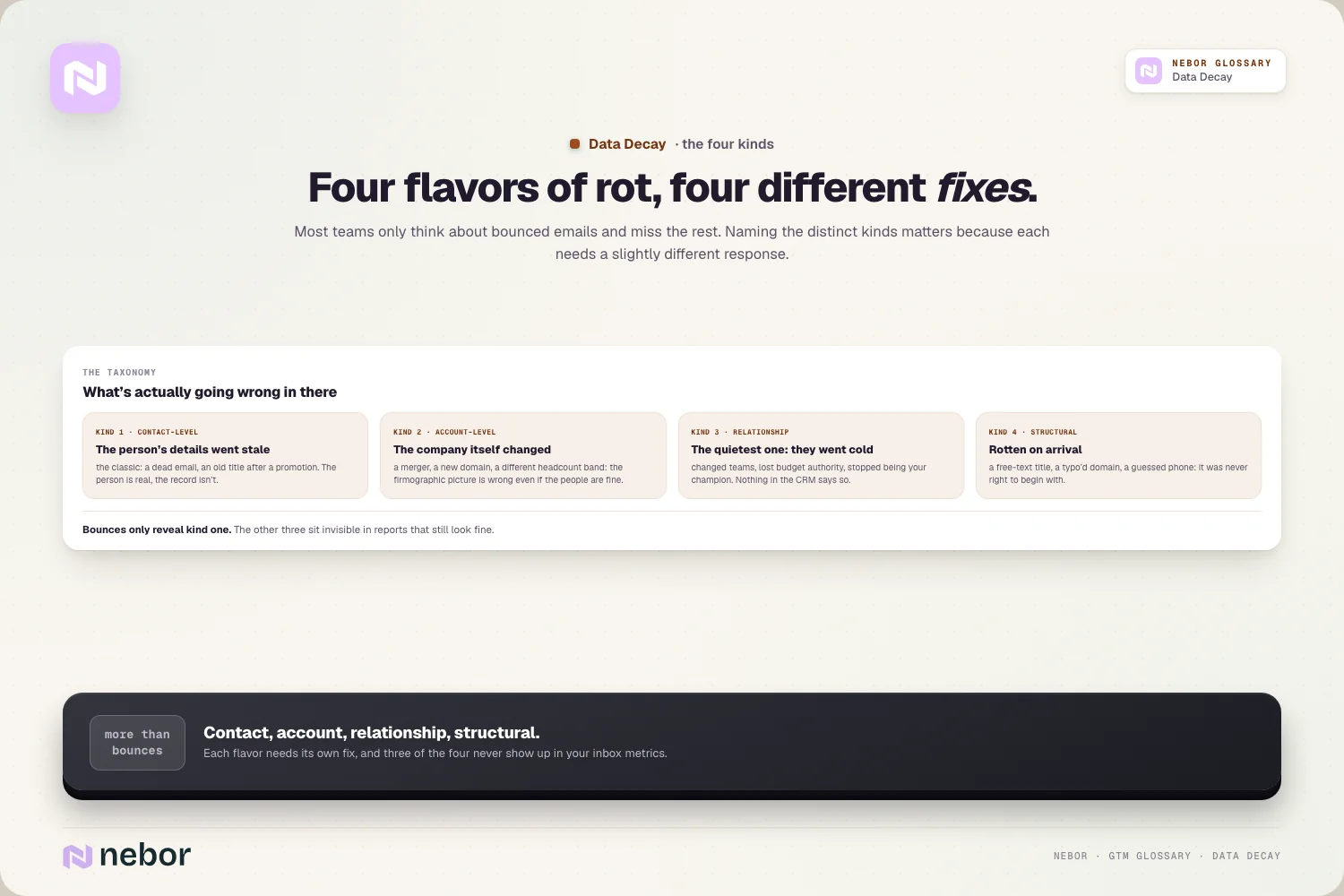
There's account-level decay, where the company itself changes. A merger, a new domain, a different headcount band, or a relocation all make your firmographic picture wrong even though the people might be fine.
Then there's relationship decay, the quietest one. The contact is still accurate, but they've gone cold. They changed teams internally, lost budget authority, or simply stopped being your champion, and nothing in your CRM tells you that.
And there's structural decay, where a field was filled badly in the first place. A free-text job title, a typo'd domain, or a guessed phone number was never right, so it doesn't decay so much as it was rotten on arrival.
What is decaying data quietly costing you across the whole funnel?
The damage is bigger than a few bounced emails, though that's where it starts. When you send to dead addresses, your bounce rate climbs, and a high bounce rate hurts your deliverability and your sender reputation, which drags down even your good emails.
It also wastes your team's time and aim. Reps chase people who left, personalization gets built on outdated facts, and your targeting drifts as the firmographic data underneath it ages. Decisions made on a decayed database are really decisions made on fiction, which is part of why so many Clay builds fail on bad data.
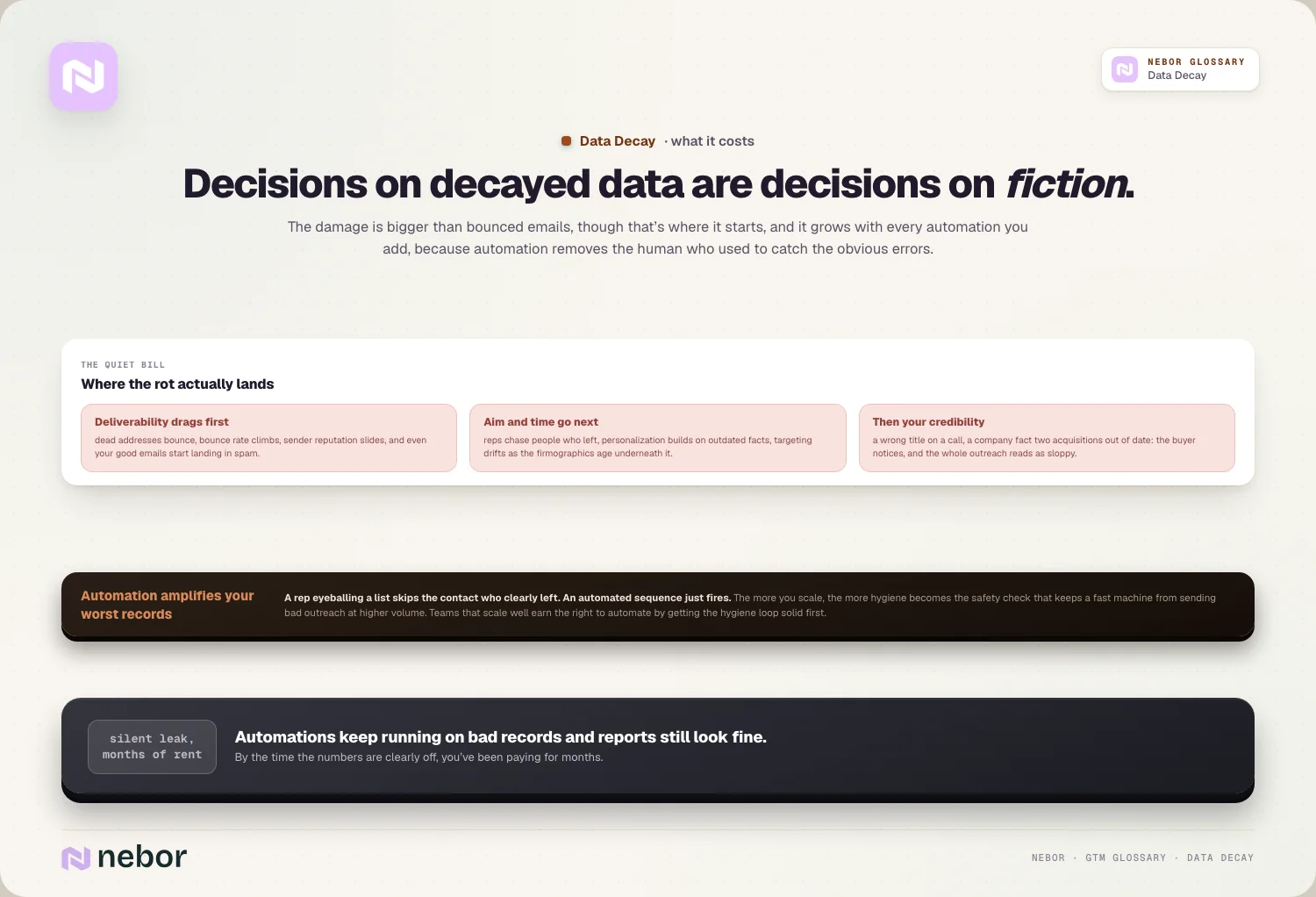
The worst part is how silently it breaks. Automations keep working from bad records, reports still look fine, and nobody notices the slow leak until the numbers are clearly off. By then you've been paying for it for months.
There's a credibility cost in the mix as well. If a rep opens a call with a wrong title or a company fact that's two acquisitions out of date, the buyer notices, and your whole outreach reads as sloppy. Bad data doesn't just miss, it actively makes you look careless.
Here's why a one-time cleanup never truly fixes the decay problem
The instinct is to do a big cleanup, scrub the database once, and move on. It feels productive, and it does help for a while, but it never solves the underlying problem.
The reason is that decay never stops. The day after your perfect cleanup, people start changing jobs again, and the rot resumes immediately. A one-time clean is like mowing a lawn and expecting it to stay short forever.
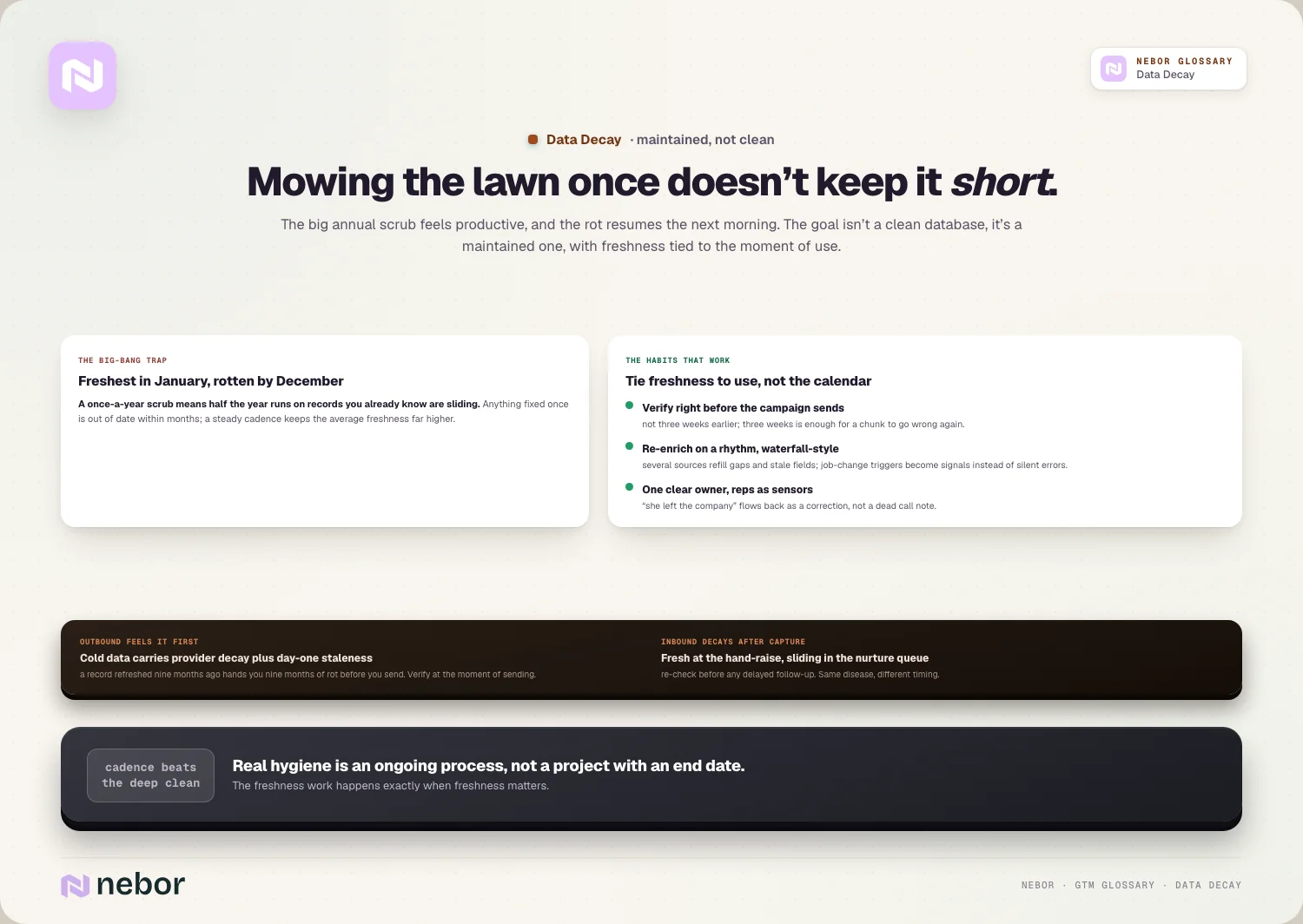
So the goal shifts from a clean database to a maintained one. Anything you fix once will be out of date within months, which is why real data hygiene is an ongoing process instead of a project with an end date.
There's also a hidden cost to the big-bang approach. A once-a-year scrub means your data is freshest in January and most rotten in December, so you spend half the year acting on records you already know are sliding. A steady cadence keeps the average freshness much higher.
So how do you keep your data fresh as an ongoing habit instead?
Keeping data fresh means building maintenance into how you work, rather than bolting it on once a year. A few habits do most of the work.
Verify contacts before you use them, through contact verification, so dead addresses don't bounce and burn your reputation. Re-enrich your records regularly, ideally with waterfall enrichment that checks several sources, so gaps and stale fields get refilled.
It also pays to watch for the events that cause decay in the first place. If you monitor for triggers like job changes, a contact moving becomes a signal you act on instead of a silent error buried in your CRM.
Teams that do this treat it as a standing part of their CRM hygiene, with a clear owner and a regular cadence.
The trick is to tie freshness to use instead of just the calendar. Verify a record right before a campaign sends rather than three weeks earlier, because three weeks is enough time for a chunk of it to go wrong again.
Why does outbound feel the decay long before inbound ever does?
Outbound and inbound rot at different speeds, and knowing which one you rely on changes how aggressive you need to be about hygiene.
Outbound lives and dies on cold data you went out and bought or built, so it carries the full weight of provider decay plus whatever was stale on day one. If your data provider refreshed a record nine months ago, you're inheriting nine months of rot before you even send.
Inbound is a little luckier, because the person just raised their hand, so their core details are usually current at the moment of capture. The trouble is that inbound records still decay afterward, waiting in a nurture sequence for months while the contact changes jobs unannounced.
So outbound teams need verification at the moment of sending, and inbound teams need re-checks before any delayed follow-up. Same disease, different timing, and treating them identically leaves one of them exposed.
What are the most common mistakes teams make with data decay?
Knowing decay exists doesn't stop teams from getting burned, usually in the same few ways. The first is trusting a freshness date you never checked. A provider says a record was "verified," but verified can mean a year ago, and a year is plenty of time for it to go bad.
The second is enriching a record without verifying it. Filling an empty field feels like progress, but if you don't confirm the new value, you've just added a confident-looking guess that decays like everything else.
The third is going ahead with no clear owner. If nobody is responsible for data quality, the cadence slips, the cleanup never happens, and everyone assumes someone else is handling it, which is exactly the ambiguity decay thrives on.
The fourth is collecting more than you maintain. The more fields you store, the more surface area there is to rot, so a bloated record with thirty half-filled fields decays faster in practice than a lean one you keep maintained.
How do you know decay is hurting you, and what should you watch?
You don't need a fancy dashboard to catch decay, you need a few numbers you check on a regular cadence. The most obvious one is bounce rate, because a creeping bounce rate is decay showing up in your inbox metrics first.
Watch your match rate on enrichment too. If the share of records you can successfully enrich or re-verify is dropping, your existing data is drifting away from what providers can confirm.
Keep an eye on reply quality alongside reply volume. A rising number of "this person no longer works here" auto-replies is a direct, human-readable signal that a slice of your list has decayed.
And track how old your records are on average. If you can't answer "when was this last verified" for most of your database, that's the real problem, because you're flying without knowing how stale you are.
A manual spot-check now and then helps too, and we recommend it for every list you rely on. Pull a small random sample, look the people up, and see how many are wrong.
That tiny manual audit gives you a real decay rate for your own list, which beats trusting a generic industry figure.
How do you build a decay-resistant process without a huge team?
Staying ahead of decay takes a small set of habits on a cadence, and no data engineering function. The first move is to assign one clear owner, because a process with no owner simply stops happening.
Then set a refresh rhythm that matches how fast your slice of the market moves. Industries with heavy job churn or lots of acquisitions need a tighter loop, while slower sectors can stretch the cadence without much pain.
Wire verification into the moment of use instead of just the calendar. The cleanest setup re-checks a record automatically right before it enters a sequence, so the freshness work happens exactly when freshness matters and nowhere else.
And close the loop with your reps. When a rep hears "she left the company," that should flow back into the database as a correction instead of dying in a call note, because your team is a live decay sensor you already pay for.
Why does data decay matter even more when you're scaling outbound with automation?
The more you automate, the more decay hurts, because automation removes the human who used to catch the obvious errors. A rep eyeballing a list would skip the contact who clearly left, but an automated sequence just sends anyway.
That's the quiet danger in scaling sales prospecting with automation. You've built a machine that sends faster than any human, and if the data feeding it is rotten, you're now sending bad outreach at a much higher volume.
So as your automation grows, your hygiene has to grow with it. Verification and re-enrichment stop being nice-to-haves and become the safety check that keeps a fast machine from amplifying your worst records.
The teams that scale outbound well treat data freshness as a prerequisite rather than an afterthought. They earn the right to automate by getting their hygiene loop solid first, so the volume they add lands on accurate records instead of dead ones.
Why staying ahead of data decay is a job that never really ends
The real shift is in how you think about your database. Most people treat it as an asset, a big store of value they built once and now own. That assumption is exactly what gets them in trouble.
Your data isn't a warehouse, it's a river, and it only has value while it's moving and fresh. Accurate data is something you rent from a world that keeps changing, and the rent comes due every single day.
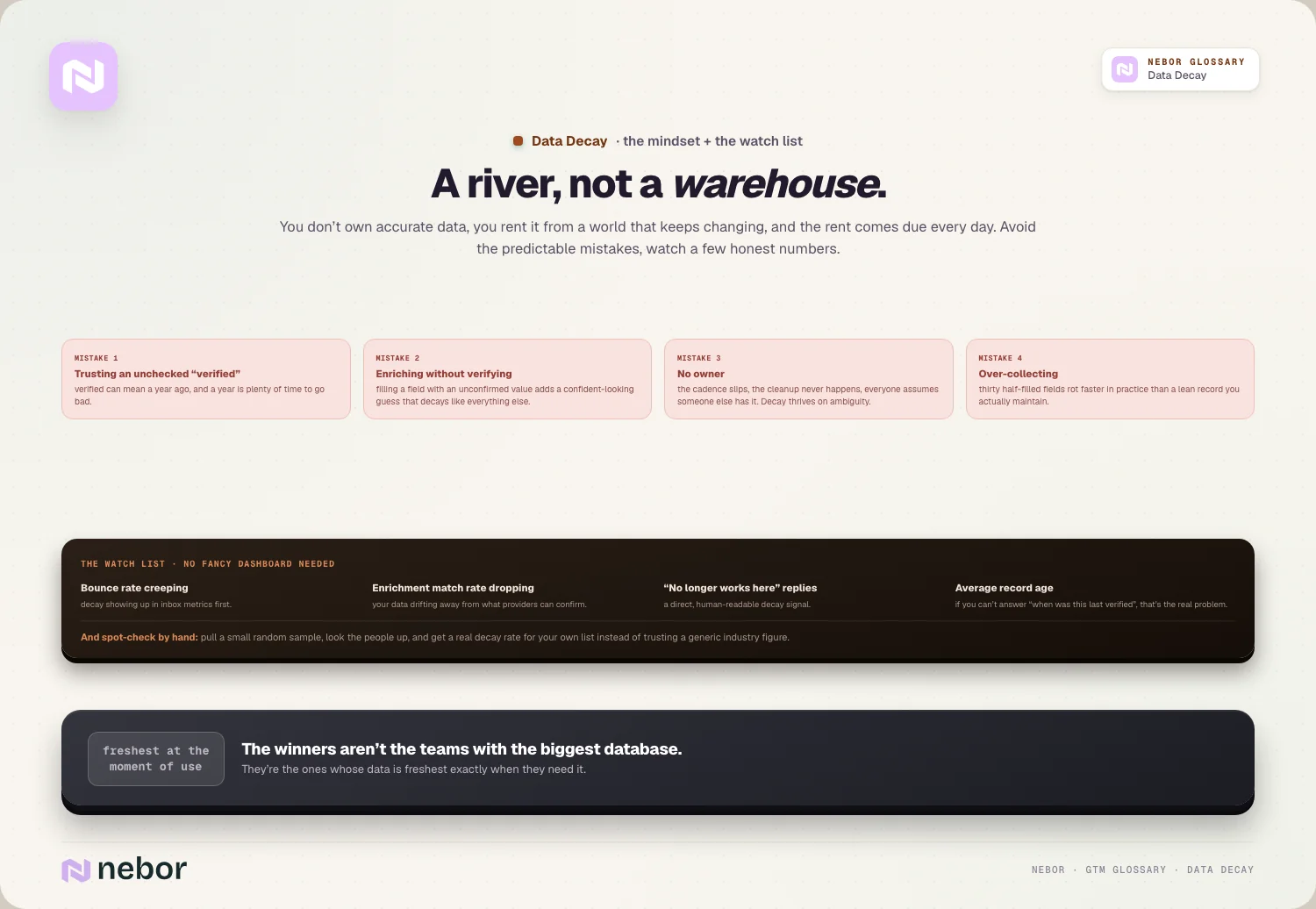
Once you see it that way, data decay stops being a nasty surprise and becomes a normal cost you plan for. The teams that win here aren't the ones with the biggest database. They're the ones whose data is freshest at the moment they need it.
Deel dit bericht
Data
CRM
Begrippenlijst
Gerelateerde begrippen
De basis GTM-concepten begrijpen




Klaar om je pipeline te bouwen