

In this post:
GTM engineering is the practice of building and automating your go-to-market motion with tools, data, and workflows, instead of doing it with manual effort and ever more headcount. A GTM engineer is the technical operator who builds that revenue infrastructure.
It's one of the fastest-growing roles in B2B, and it exists because the old answer to every growth problem, hire more people, stopped scaling. GTM engineering replaces a lot of that manual work with systems that work on their own.
The shift underneath it is structural, and it's the shift our own practice at Nebor is built on. Instead of adding another SDR every time you need more pipeline, you build a system that generates it, which is a fundamentally different and more durable way to grow.
TL;DR
GTM engineering is building your go-to-market motion as a system, using automation, data, and tools, rather than doing it manually with more and more people. The GTM engineer is the person who builds that system.
The role appeared because hiring stopped scaling and the tools got good enough to replace a lot of manual work. A GTM engineer wires together data, enrichment, outreach, and routing into infrastructure that keeps working without constant human effort.
The core idea is to replace headcount with infrastructure. Instead of hiring another rep for every bit of growth, you build a system that produces pipeline, which is cheaper, more consistent, and something you own.
So what is GTM engineering, and why did the role suddenly appear?
GTM engineering is the discipline of treating your go-to-market motion as something to be built and automated, instead of staffed and grinded out by hand. It applies an engineering mindset, systems, automation, and data, to the work of acquiring customers.
The role appeared for two reasons that arrived at once. First, hiring stopped scaling, since adding people to a manual motion gets expensive fast and the results don't keep up.
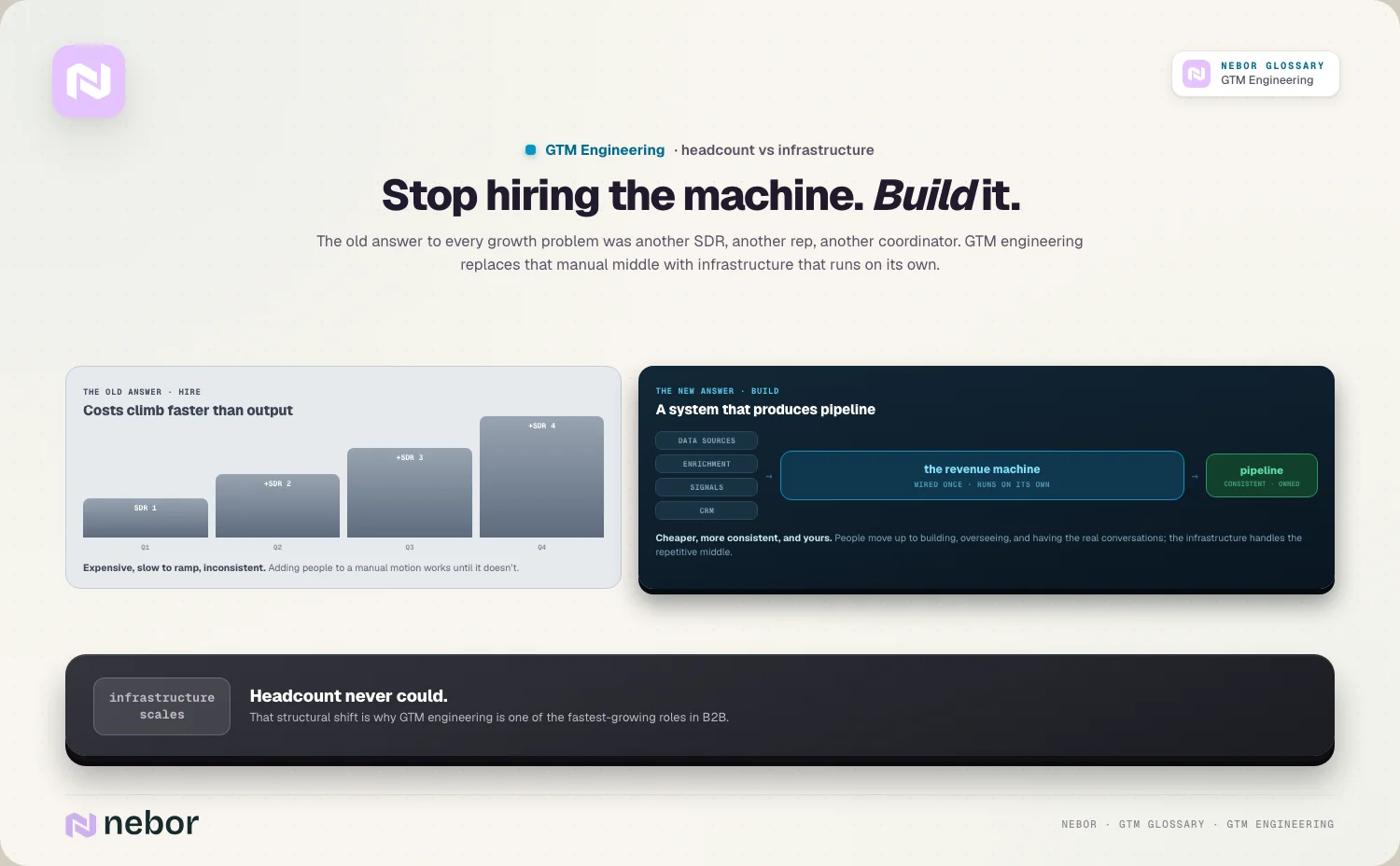
Second, the tools got good enough, with platforms like Clay, n8n, and a wave of AI making it possible to automate work that used to need a person.
With both in place, a new role made sense. Someone technical enough to build systems, but commercial enough to understand the go-to-market motion, could replace a stack of manual work with infrastructure. That person is a GTM engineer, and the practice is GTM engineering.
What does a GTM engineer really do all day, once you look closely?
A GTM engineer builds and maintains the systems that power the revenue motion, so their day is mostly about wiring things together and making them work. The output is infrastructure instead of a pile of finished tasks.
In practice, they build workflows that find and enrich your target accounts, score and route your inbox full of leads, trigger personalized outreach from signals, and keep your CRM clean.
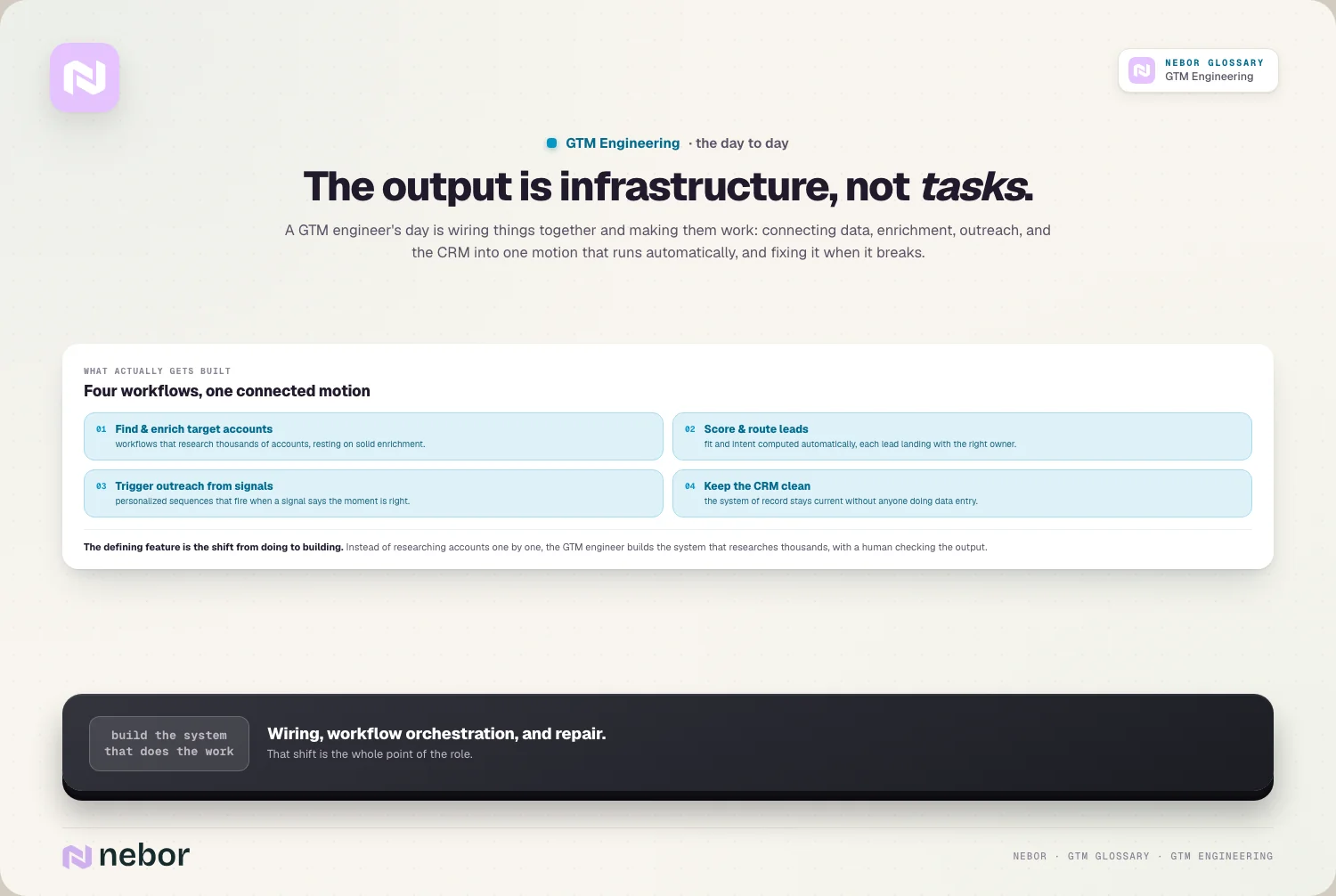
They connect the data sources, the enrichment, the outreach tools, and the CRM into one motion that works automatically, and they fix it when it breaks. A lot of this rests on solid data enrichment and workflow orchestration.
The defining feature is that they build the system rather than doing the task by hand. Instead of researching accounts one by one, a GTM engineer builds the system that researches thousands, with a human checking the output.
That shift from doing the work to building the system that does it is the whole point of the role.
How is a GTM engineer different from a RevOps or sales ops person?
These roles overlap, and the lines are genuinely blurry, but there's a real difference in emphasis. Let's draw the line, so you know what you're hiring for.
Traditional RevOps and sales ops tend to focus on the systems of record and the process, like keeping the CRM clean, building reports, managing the tech stack, and supporting the team.
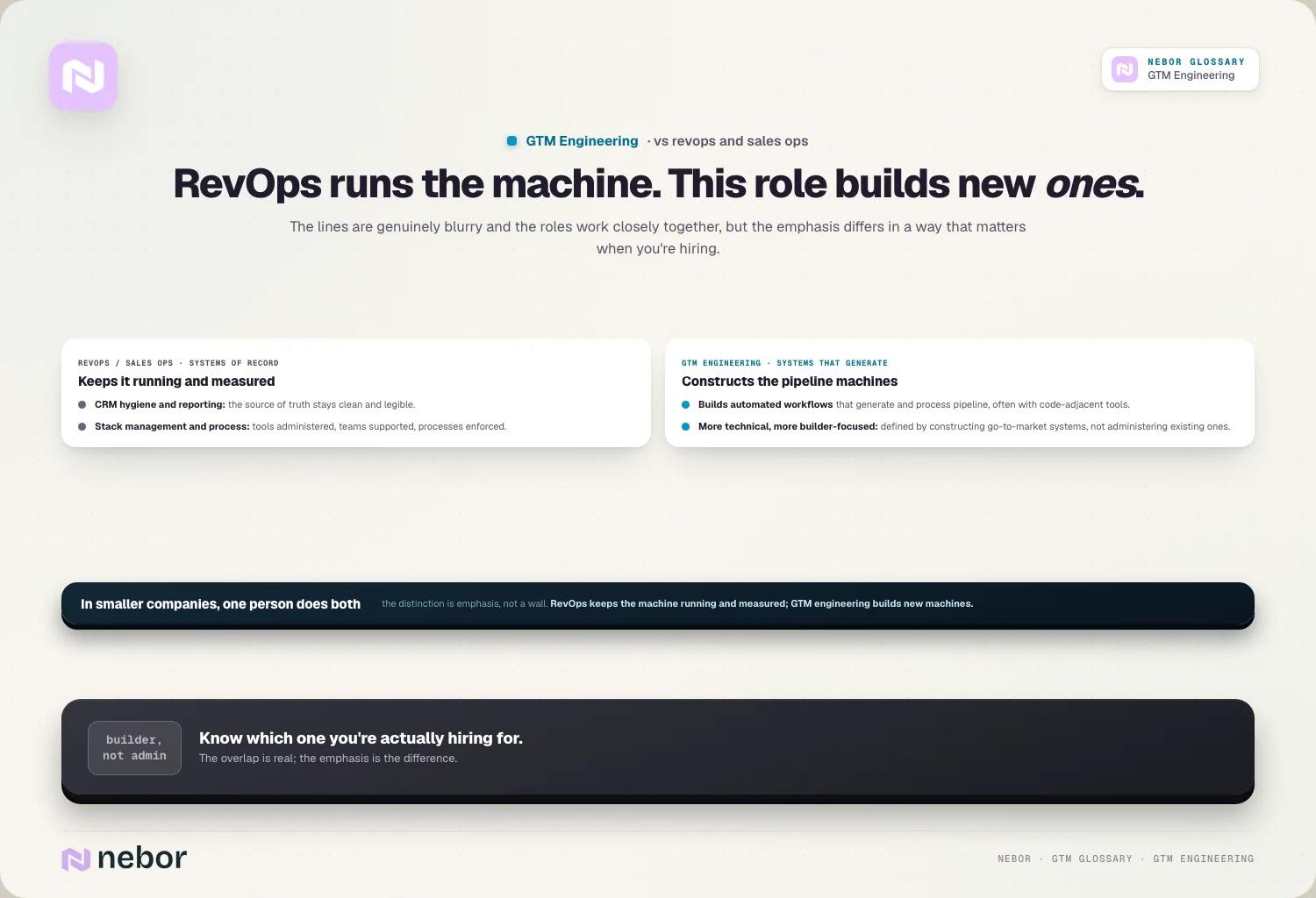
A GTM engineer leans more technical and more builder-focused, actively constructing automated workflows that generate and process pipeline, often with code-adjacent tools.
The simplest way to see it is that RevOps keeps the machine working and measured, while GTM engineering builds new machines.
The two work closely together, and in smaller companies one person often does both, but the GTM engineer is defined by building automated go-to-market systems instead of administering existing ones.
Why is GTM engineering really about replacing headcount with infrastructure?
GTM engineering is, more than anything, a different answer to the question of how you grow. The old answer was to hire, and the new answer is to build.
For years, the default response to needing more pipeline was to add another SDR, another rep, another coordinator. That works until it doesn't, because manual headcount is expensive, slow to ramp, and inconsistent, and the costs climb faster than the output.
GTM engineering offers a different path, building a system that produces the same pipeline without the linear headcount, which is the core idea behind automating your prospecting from scratch.
This is the real shift, from people doing the work to systems doing it. You still need people, but they move up to building and overseeing the systems and having the real conversations, while the infrastructure handles the repetitive middle.
It's why GTM engineering is reshaping how revenue teams are built, since infrastructure scales in a way that headcount never could.
What tools does a GTM engineer reach for when they build a system?
GTM engineering depends on a particular kind of tooling, and knowing the categories helps you see how the work comes together. The tools are what make building a system possible without writing much software.
The center of gravity for most GTM engineers is Clay, which connects data providers, enrichment, and logic into one place.
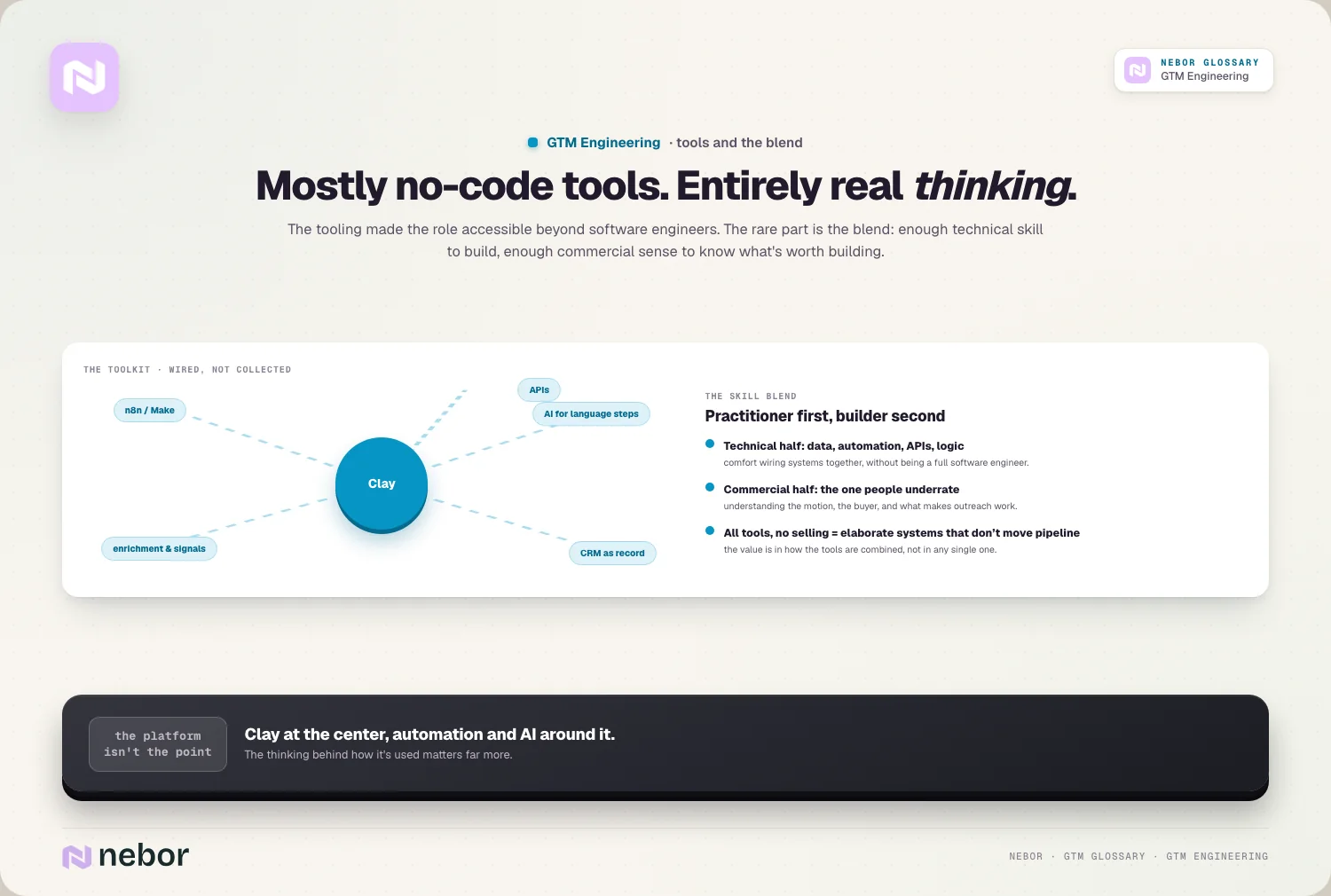
Around it are automation tools like n8n and Make, AI for the language-heavy steps, enrichment and signal sources, and the CRM as the system of record. Together these form the GTM stack the engineer builds in.
Most of this is no-code or low-code, which is what made the role accessible beyond software engineers.
A GTM engineer wires these tools into AI workflows and sales automation, so the value is in how well they're combined instead of in any single tool. The platform matters far less than the thinking behind how it's used.
What skills does GTM engineering demand from the person doing it?
The role needs an unusual blend, which is part of why good GTM engineers are in such demand. You need enough technical skill to build systems and enough commercial sense to know what's worth building.
On the technical side, that means comfort with data, automation tools, APIs, and the logic of wiring systems together, even without being a full software engineer.
On the commercial side, it means truly understanding the go-to-market motion, the buyer, and what makes outreach work, so you build systems that produce results instead of just impressive-looking automations.
The commercial half is the one people underrate. A GTM engineer who can build anything but doesn't understand selling tends to build elaborate systems that don't move pipeline.
The best ones are practitioners first and builders second, which is exactly the mix that lets them build infrastructure that really works.
Why do GTM engineering builds fail so often despite the good tools?
For all the hype, plenty of GTM engineering efforts disappoint, and the reasons are consistent. Knowing them is most of avoiding them.
The biggest one, and we build in Clay every week so we say this with love, is leading with the tool instead of the thinking. A team buys Clay, builds an elaborate workflow, and gets little out of it, because the strategy and the data underneath were never sorted out first.
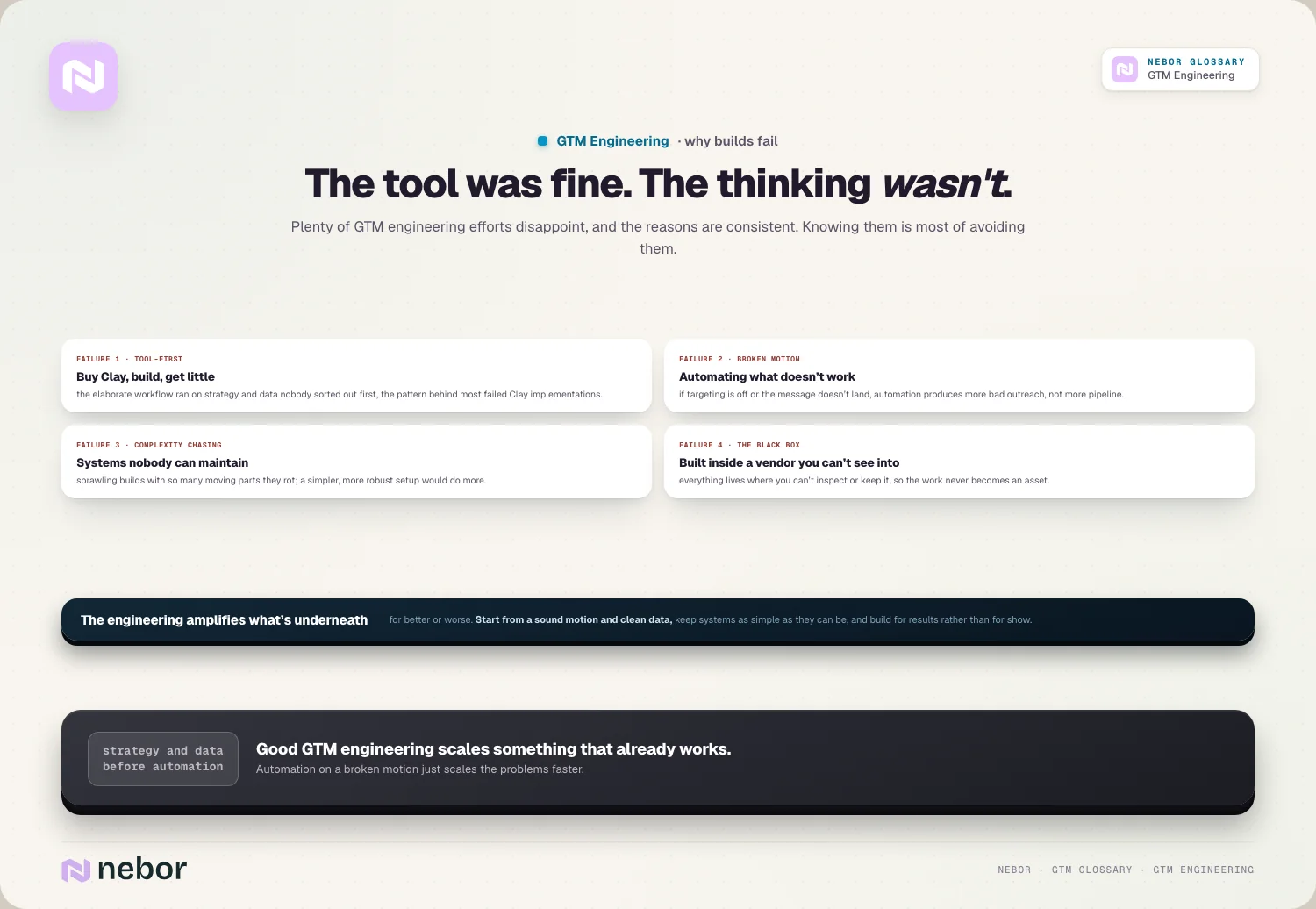
This is exactly the pattern behind most failed Clay implementations, where the tool was fine and the thinking wasn't.
The other common failure is building automation on a broken motion, which just scales the problems faster. If your targeting is off or your message doesn't land, automating it just produces more bad outreach for your pipeline to choke on.
Good GTM engineering starts from a sound motion and clean data, and only then builds the systems to scale it. The engineering amplifies whatever is underneath it, for better or worse.
How does GTM engineering connect to your strategy and your system?
GTM engineering doesn't exist in a vacuum, it's the execution layer beneath your strategy. The strategy decides what to do, and GTM engineering is how you build the machine that does it.
Your go-to-market strategy sets the targets, the message, and the motion, and GTM engineering turns those decisions into a working GTM system, the connected set of workflows that works day to day.
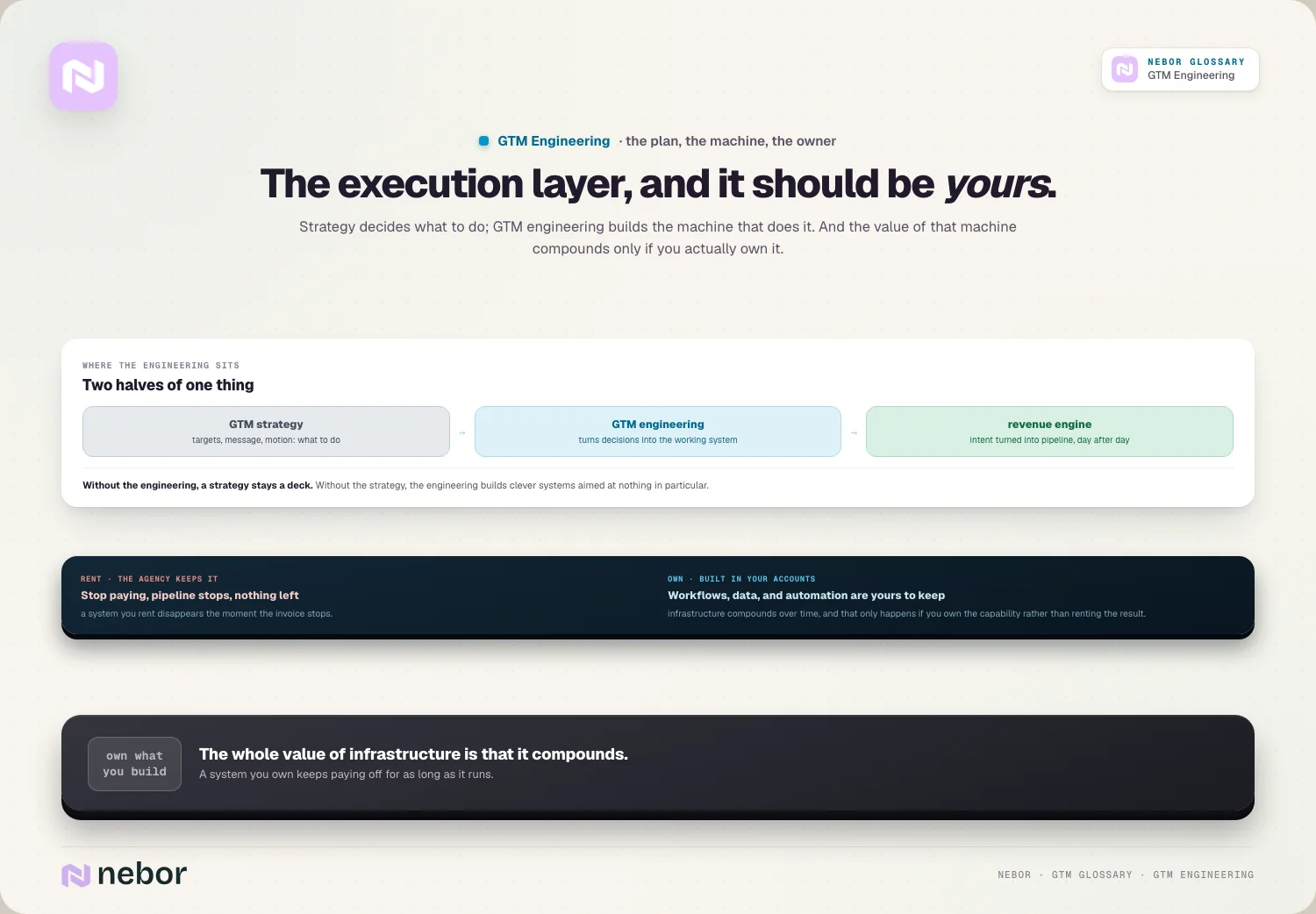
Without the engineering, a strategy stays a deck, and without the strategy, the engineering builds clever systems aimed at nothing in particular.
This is also where GTM engineering becomes a revenue engine, the infrastructure that reliably turns intent into pipeline.
The strategy and the engineering are two halves of one thing, the plan and the machine that carries it out, and the companies that win treat them as inseparable instead of handing the strategy to one team and hoping execution appears.
Why does GTM engineering work best when you own the systems?
There's a strategic choice hidden inside GTM engineering, which is whether the systems you build belong to you. The answer shapes how much lasting value you get from the work.
A lot of agencies will build a GTM motion for you and keep it, so when you stop paying, the pipeline stops and you're left with nothing.
The more durable approach is to build the systems inside your own accounts and stack, so the workflows, the data, and the automation are yours to keep. That's the gap between paying for an outcome and holding the capability yourself, the same distinction at the heart of why a GTM agency beats a lead-gen one.
This is why ownership matters so much in GTM engineering. The whole value of building infrastructure is that it compounds over time, and that only happens if you own it.
A system you rent disappears the moment the invoice stops, while one you own keeps paying off for as long as you keep it.
What are the common GTM engineering mistakes you should sidestep?
Beyond the big failure modes, a few recurring mistakes undermine GTM engineering efforts from the inside. Once you can name them, they're easier to sidestep.
The first is hiring or becoming a GTM engineer who's all tools and no commercial sense, building automations that look impressive on a screen-share but don't move pipeline. The second is automating before the underlying motion works, which scales the problems.
The third is chasing complexity, building sprawling systems with so many moving parts that nobody can maintain them, when a simpler, more robust setup would do more.
There's also the ownership question, because building everything inside a vendor's black box leaves you with systems you can't see into or keep.
The answers all rhyme with each other. You lead with strategy and clean data, keep the systems as simple as they can be, build for results instead of for show, and make sure you own what you build.
Does every company really need a GTM engineer on the payroll?
Not every company needs a dedicated GTM engineer, so let's be honest about when the role pays off. It comes down to volume, complexity, and stage.
If you're pushing real outbound volume, juggling multiple tools, and feeling the limits of manual work, a GTM engineer pays for themselves quickly by turning that grind into systems.
If you're very early, with a handful of customers and a founder doing sales by hand, you probably don't need the role yet, because there isn't enough volume to justify the infrastructure.
The middle ground is common, where a company needs the systems but isn't ready to hire a full-time engineer. That's where a partner who builds the infrastructure for you, ideally inside your own stack so you keep it, bridges the gap until the role makes sense to bring in-house.
How do you get started with GTM engineering without overreaching?
If GTM engineering sounds useful but daunting, we recommend starting small and specific instead of trying to automate everything at once, because one working system beats a grand plan.
You pick a single motion that's clearly worth automating, like enriching and routing inbound leads or building and personalizing an outbound list, and you build that one system end to end.
The data gets cleaned first, the workflow stays as simple as it can be, and a human check goes on anything a buyer sees. Once it reliably saves time and produces results, you build the next one.
The thing to avoid is trying to do everything in one quarter. Teams that engineer their entire go-to-market in one go usually end up with a tangle nobody can maintain, while teams that ship one solid system, then another, quietly build real infrastructure over time.
The pattern that works is narrow first, owned always, and compounding from there.
Why GTM engineering is the shift from hiring your way to growth to building it
GTM engineering, at the end of the day, is a bet that infrastructure beats headcount, that a well-built system can do what used to take a room full of people, more cheaply and more consistently. It's the engineering mindset applied to the messy, human work of going to market.
The teams that win with it treat it as a craft instead of a tool purchase. They start from a sound motion and clean data, build systems that produce real pipeline, keep those systems simple enough to maintain, and own them outright.
That way the infrastructure compounds rather than evaporating when a contract ends.
The mindset that works is to stop reaching for another hire every time you need growth and start asking what system would produce it instead.
When you build that system well, own it, and keep refining it, go-to-market turns from something you staff into something you engineer, and that engineering keeps paying your team back long after a hire would have churned.
Deel dit bericht
Automation
Workflows
Data
Begrippenlijst
Gerelateerde begrippen
De basis GTM-concepten begrijpen




Klaar om je pipeline te bouwen