
Top 6 OneAway.io Alternatives for B2B Companies That Want to Own Their Sales Systems

by
In this post:
You have probably seen us cover most of the other agencies in this space. Today we are looking at OneAway.io and the alternatives and competitors worth comparing them against before you sign anything.
OneAway.io is a B2B growth and marketing partner that specializes in automation and go-to-market work for SaaS companies.
They handle the full workflow, from building lead lists and enriching contact data to writing copy and delivering qualified meetings to your calendar.
The agency is a Clay Enterprise Partner that positions itself as a way to get SDR-level output without hiring an in-house team.
Their approach centers on multi-channel coordination, where ads, emails, and LinkedIn work together as one connected engine.
They use Clay for enrichment and workflow automation alongside tools like Instantly for sending.
OneAway works best for B2B SaaS companies that want to outsource their outbound operations entirely rather than build internal systems.
Their case studies feature startups that had previously struggled with agencies, or with DIY outbound built on basic tools like Apollo.
Their business model assumes a specific type of company. You need a SaaS business with an annual contract value of at least $10K to justify the cost per meeting, and a total addressable market of 50,000 accounts or more to sustain ongoing campaigns without burning through your list inside two quarters.
Your prospects also need to be findable through LinkedIn or Google Maps. If your buyers live in databases that require custom scraping, or your deal sizes are smaller, the unit economics may not work in your favor.
That is the gap that pushes some teams to look elsewhere. Either OneAway brought you here, or you are doing your due diligence before you sign up with any agency. Either way, this guide is built to make the next step clearer.
Let’s get started.
TL,DR
OneAway is good at what they do, and so are most of the agencies you’ll see on this list. But the question isn’t who sends a better cold-email campaign or who does more volume. It's what you own at the end of it.
Most agencies sell you the same thing: outbound at the top of the funnel, built on their tools, gone the day you stop paying. You get meetings while the invoices keep coming, and when they stop, your pipeline stops too. You're left with nothing to show for it.
We do it differently. For about what you'd pay for outbound alone, we build you the whole system. Think outbound, intent, inbound, and the operations layer that ties them together and we build it inside your own accounts.
Everything works together, so each part makes the others better. Your outreach learns from your closed deals. The warm traffic you already pay for stops slipping away. Your reps walk into calls knowing who they’re talking to, so they spend their time selling instead of fixing tools.
And because we document it and hand it over, it keeps going with or without us. You end up owning the system. That’s what we want you to take away: not a slightly better agency, but a pipeline that’s actually yours.
6 best OneAway.io alternatives and competitors to consider
There is no objectively best agency on this list. Anyone who tells you otherwise is either selling you something or has never worked with more than one partner.
The right fit depends on how you approach growth, what you want to own versus what you want to outsource, and where you are in your GTM motion.
A Series A SaaS company testing outbound for the first time has very different needs from an established mid-market team trying to replace a broken BDR function.
Some companies want a partner who builds systems they keep forever. Others want someone to deliver campaigns while they focus on closing. Both approaches are valid.
The mistake is picking an agency built for one model when you actually need the other. Below are the six agencies we think are worth comparing seriously, with what each one does well and where each one breaks down.
1. Nebor: You get a connected GTM flywheel that reaches from outbound through RevOps, built inside your own accounts so every workflow stays yours when our engagement ends
We are Andrew and Yannick, founders of Nebor. We build GTM systems that work on autopilot for B2B and SaaS companies, and we build them inside the accounts you already pay for so the work compounds with your team.
OneAway does excellent work with Clay. They are a certified Clay partner (so are we and the other agencies on this list) with deep expertise in cold email and multichannel outreach.
The difference that matters when you compare us is what we build around the outbound engine, and where the system lives once it is built.
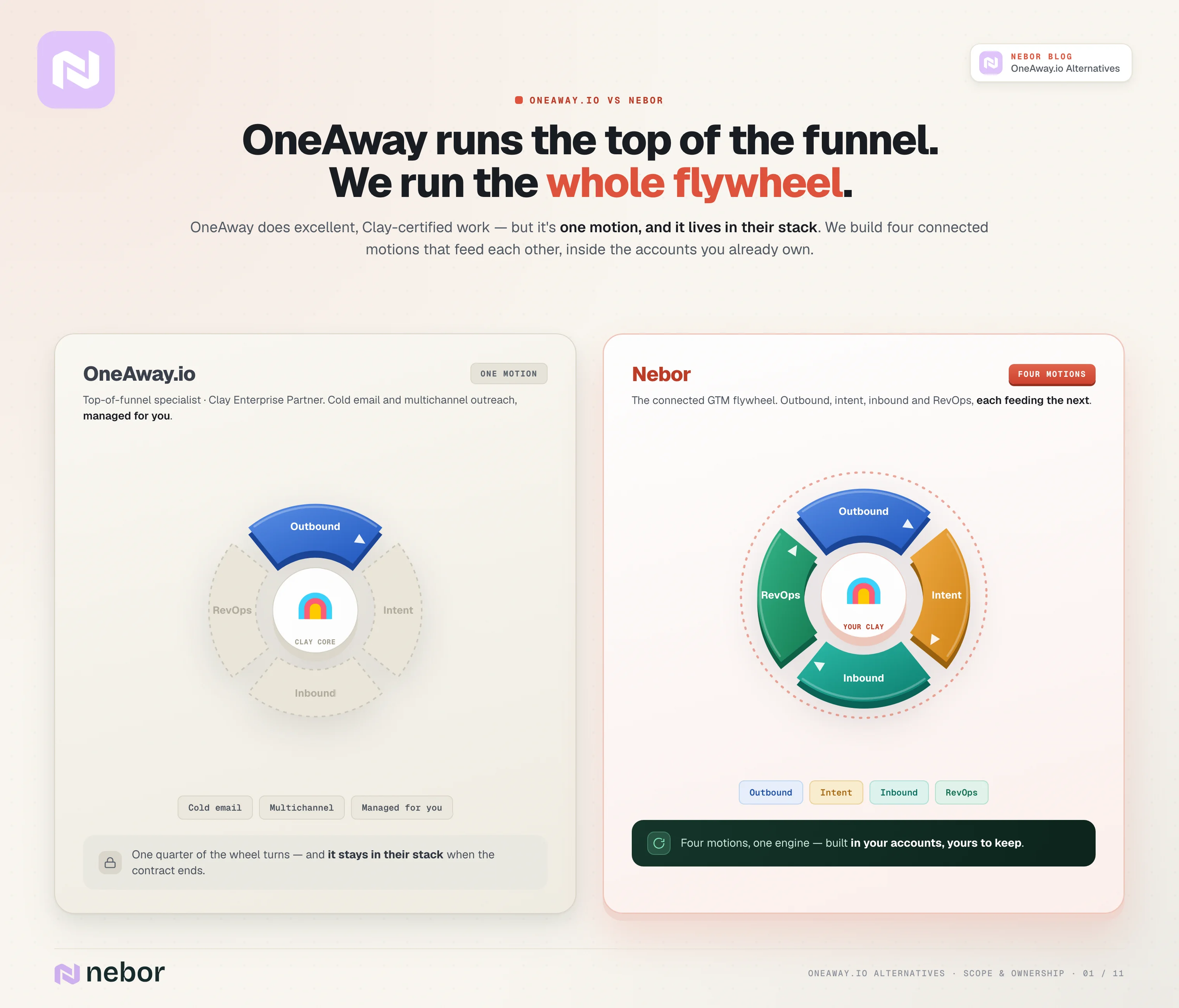
The other difference is scope. OneAway focuses on the top of the funnel. We build a connected flywheel that covers outbound, intent monitoring, inbound qualification, and the RevOps layer that closes the loop and feeds every motion above it.
Each motion produces signal the next motion uses. The whole thing lives in your CRM, your Clay workspace, your inboxes, and your LinkedIn accounts.
We were salespeople before we ever touched Clay, and the work shows it
Andrew and I (Yannick) each have a minimum of 10 years in corporate sales under our belts. Andrew spent years copying and pasting between systems, watching companies that should have known better burn hours on work that should have been automated.
I spent over a decade in corporate SaaS sales, building outbound systems for teams that needed pipeline tomorrow, and I saw firsthand how most agencies build campaigns that look impressive in a demo and break the moment a real prospect pushes back on a real conversation.
That background shapes every workflow we build. Every API call, filter, automation step, and webhook ties back to a conversion goal.
We do not build technically beautiful systems that fail to book meetings, and we do not build outreach our reps would have hated receiving.
When we design a workflow, we think about what happens when the lead replies. We think about how the SDR-to-AE handoff works inside the CRM.
We think about whether the rep opening their inbox tomorrow morning has enough context to actually take the call without a prep doc nobody filled out. That perspective comes from doing the work. You can’t get it from reading a Clay tutorial.
We are salespeople first, automation experts second. The order matters because it determines which choices we make when the workflow gets complicated.
Most agencies optimize for what is easiest to ship. We optimize for what your reps will trust six months from now.
We build a multi-channel outbound motion driven from a single Clay command center
We build a single automation that hits your prospects across email, LinkedIn, and phone, all coordinated from one Clay table. Each channel feeds the others, and the entire workflow works without manual intervention from your team.
Here is how we set it up.
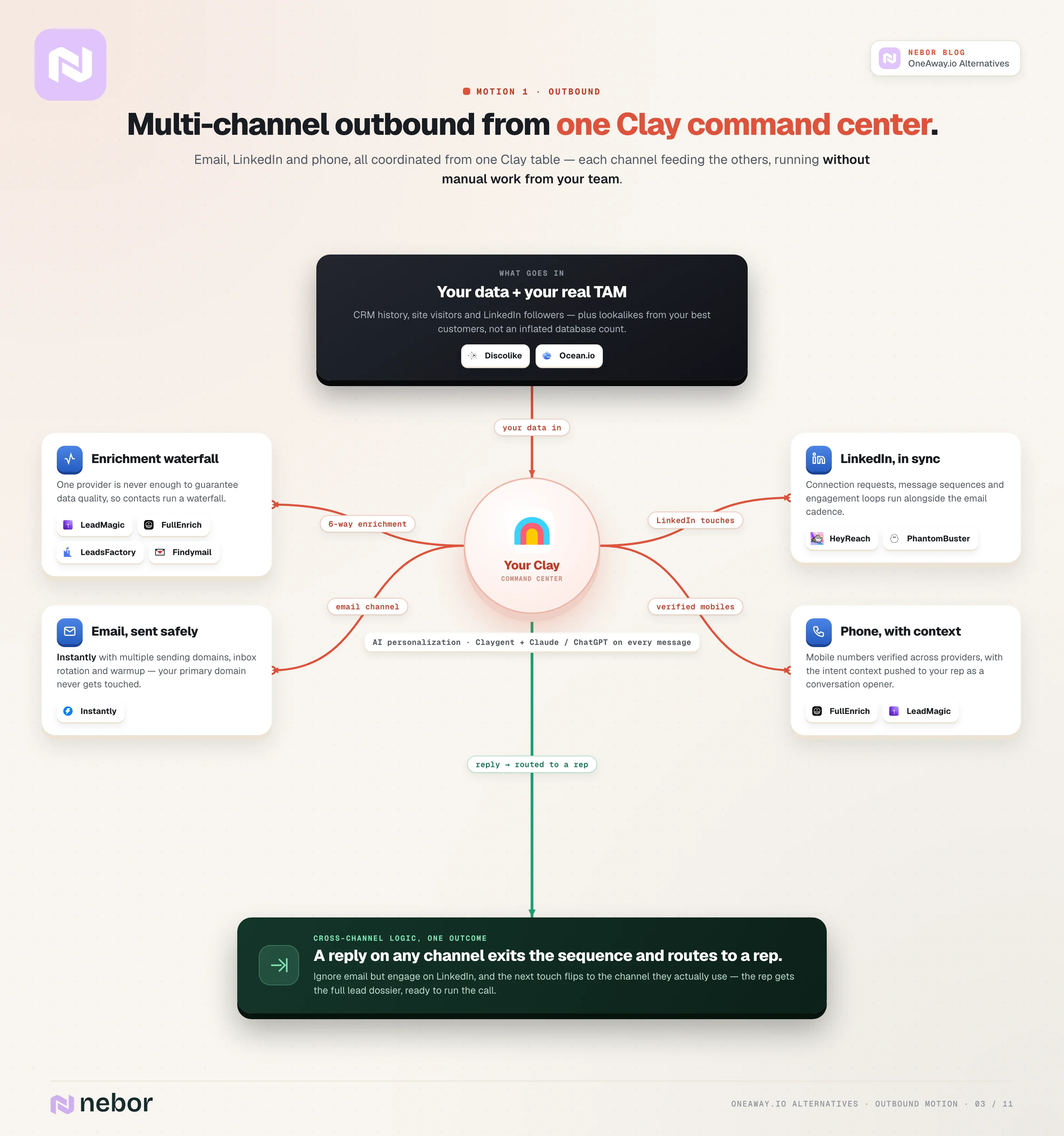
We start by building a centralized Clay workspace that becomes the command center for your outbound.
In Clay, we import and analyze the data you already have, including CRM history, website visitor logs, and LinkedIn followers, then layer enriched signals on top of it.
We use tools like Disolike and Ocean.io to find lookalikes from your best customers and define the actual TAM you should be working, not the inflated database count Apollo will tell you exists.
Most agencies pull from the same generic databases. We choose data sources based on your ICP and your industry.
Sometimes that means LinkedIn-first enrichment through PhantomBuster. Sometimes it means a custom scraping workflow built in Apify or RSS feed readers pulling contacts from a specific government registry, association directory, or trade publication that no enrichment tool covers.
We build the waterfall to fit your TAM, not for your TAM to fit the tool we want to sell you. That means strategy first, tooling second.
Once the data is enriched and verified, we connect Clay to your sending stack. For email, that usually means Instantly with multiple sending domains, inbox rotation, and warmup going in the background so your primary domain never gets touched.
For LinkedIn, HeyReach or PhantomBuster handles the connection requests, the messaging sequences, and the engagement loops.
For cold calling leads, FullEnrich and LeadMagic verify mobile numbers across providers before they ever land in front of a rep, and Clay pushes the intent context into Slack or your CRM as a conversation opener your AE can actually use.
The personalization layer passes through Claygent paired with Claude or ChatGPT. The AI has access to the enriched lead record, including company news, hiring signals, technology stack, recent social activity, and whatever else we have pulled in.
Each message references something real about the prospect's business. This is not merge-field personalization with a first name and a city stamped on top of a generic template. Every message reads like a person noticed something specific.
The four channels do not work in silos. We set up logic in Clay using Claygents so that signals on one channel update the sequence on another.
If a prospect ignores email but engages with your LinkedIn content, that signal flips their record and the next touch comes through the channel they actually use.
If a prospect replies on any channel, they exit the automated sequence and route to a rep with the full lead dossier.
We build a deliverability layer that protects your sender reputation, because most agencies treat it as somebody else's problem
Most agencies treat deliverability as a simple component in outbound implementation. OneAway does not mention it on their website at all.
The standard playbook is to spin up a few sending domains, warm them for a couple of weeks, and start blasting. When bounce rates climb and reply rates collapse, the agency blames your list, your offer, or the market.
We treat deliverability as a system.
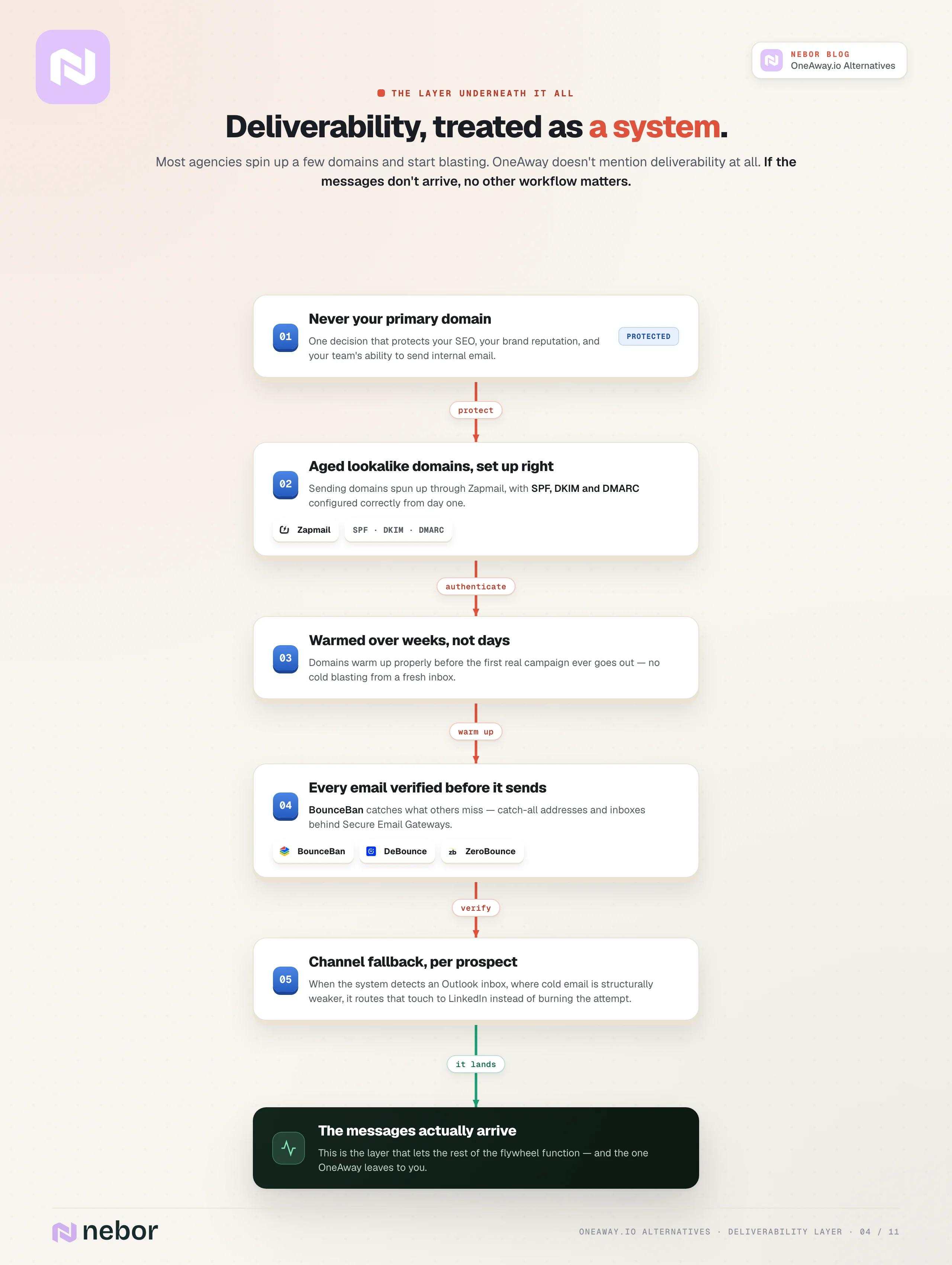
Every email passes through a verification stack of BounceBan, DeBounce, and ZeroBounce before it ever enters a sequence.
BounceBan matters specifically because it validates the email types that other verifiers miss, including catch-all addresses and inboxes protected by Secure Email Gateways.
We never use your primary domain for outbound. That single decision protects your SEO, your brand reputation, and your team's ability to send internal email without bouncing through Microsoft's spam folder.
We set up aged lookalike domains through tools like Zapmail, configure SPF, DKIM, and DMARC correctly, and warm the domains over weeks before the first real campaign goes out.
We also build channel optimization directly into Clay using Claygents. When the system detects a prospect on Outlook, where cold email deliverability is structurally lower, it routes the touch to LinkedIn instead of burning the email attempt.
The fallback logic applies on a per-prospect basis, not a per-campaign basis. Every campaign carries deliverability tracking and channel fallbacks built into the workflow rather than bolted on.
This is the layer that lets the rest of the flywheel function. If the messages do not arrive, no other workflow matters.
We build intent and signal monitoring that finds buyers in the buying window
Most agencies talk about intent data and mean basic IP tracking or article views from a Bombora feed. We define intent differently.
Intent is information that ties directly to a buying behavior or a business need that your offer addresses right now. Everything else is noise dressed up as a signal.
We build systems that combine Clay with PhantomBuster, Apify, and n8n to monitor and scrape the sources that produce real-time buying signals for your specific market. The sources are never predetermined.
They depend on what your buyer actually does six weeks before they realize they have a problem. Here is what that looks like in practice across three different motions we have shipped.
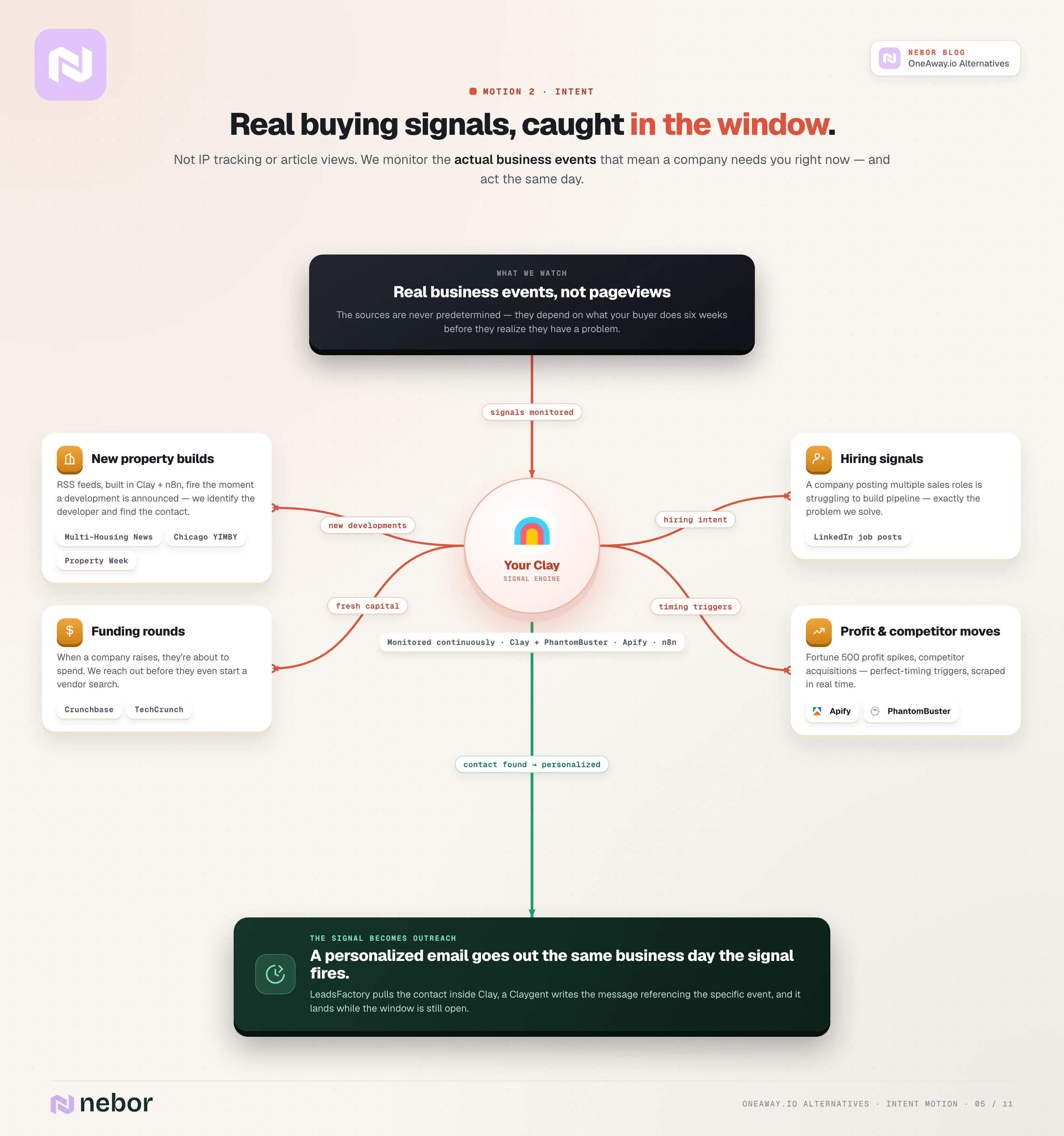
For a client offering AI-powered furnishing solutions to property developers, we built a workflow that monitors RSS feeds from Multi-Housing News, Chicago YIMBY, and Property Week.
Every time a new article publishes about a property development project, the workflow pushes the article into Clay, identifies the project name and the developer, finds the developer's website and contact person, and pulls the contact details through LeadsFactory in Clay.
We create Claygents that generate a personalized outreach email that references the specific project, and the email goes out within the same business day the article published.
The pattern across all businesses is the same. We build the monitoring once, the workflow keeps going continuously, and the moment a signal appears the prospect is already in motion through the outbound system above.
The intent layer is what makes the outbound layer feel like timing rather than guessing.
We build inbound qualification that catches every warm signal coming through your existing channels and routes it to your reps in real time
Inbound is where most companies lose deals they have already half-won. A prospect downloads a guide, fills out a form, signs up for a demo, or visits the pricing page three times in a week, and the team finds out about it the following Tuesday during pipeline review. By then the prospect is on a competitor's call.
Again, this is something OneAway.io doesn’t even mention as well.
Most agencies do not. We build it as a connected workflow because the same Clay enrichment infrastructure that powers the outbound and intent motions can be pointed at warm traffic with one configuration change.
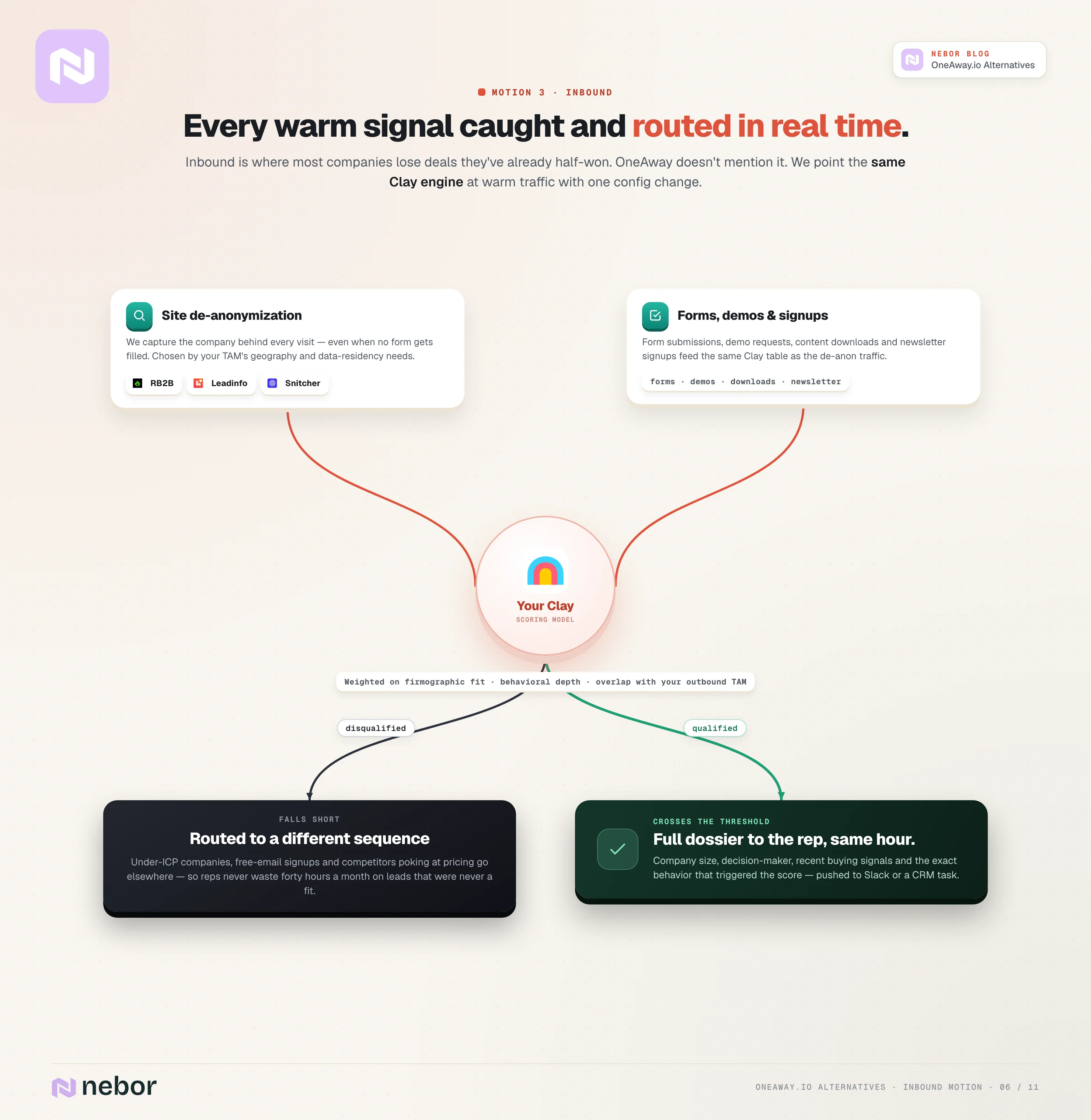
We start with site de-anonymization. RB2B, Leadinfo, or Snitcher (we choose based on the geography of your TAM and your data residency requirements) capture the company behind every visit, even when no form gets filled.
The capture pushes into Clay for enrichment with the same depth as our outbound motion. Company size, industry, hiring signals, technology stack, and recent funding all attach to the visit record.
Form submissions, demo requests, content downloads, and email newsletter signups feed into the same Clay table. Every inbound lead passes through a custom scoring model we build with you.
The model weights firmographic fit, behavioral depth (one pricing page visit versus three plus a demo request), and intent overlap with your outbound TAM, so warm leads that already match an account you are working get a higher score and a faster handoff.
We have written more about building this kind of inbound-led-outbound loop elsewhere on the blog.
When a lead crosses the qualification threshold, the workflow generates a full lead dossier inside the CRM.
The dossier includes the company size, the decision-maker contact info, recent buying signals like hiring or funding, the LinkedIn profile, and the specific behavior that triggered the score.
The rep gets a Slack notification or a CRM task with the dossier attached, and they act on it inside the same hour the prospect was on your site.
We also build the disqualification logic, because the alternative is a rep spending forty hours a month on inbound leads that were never a fit.
Companies under your ICP threshold, prospects with personal email addresses on a free plan signup, and competitors poking at your pricing page all route to a different sequence so they do not steal the rep's attention from the leads worth working.
We have a longer walk-through of this pattern in our inbound meeting workflow piece.
We build the RevOps layer that closes the loop and feeds every motion above it back into itself
This is where most outbound agencies stop and where most of the value of the system lives. The first three motions produce signal, conversations, and warm leads. The RevOps layer is what makes the system get smarter every week instead of decaying back into noise.
OneAway does not build this layer. SocialBloom does not build it. Most of the agencies on this list do not build it. The ones that do (The Kiln, SalesCaptain) tend to charge enterprise rates because the work is genuinely complex.
We build it because without it, the rest of the flywheel turns once and then stops.
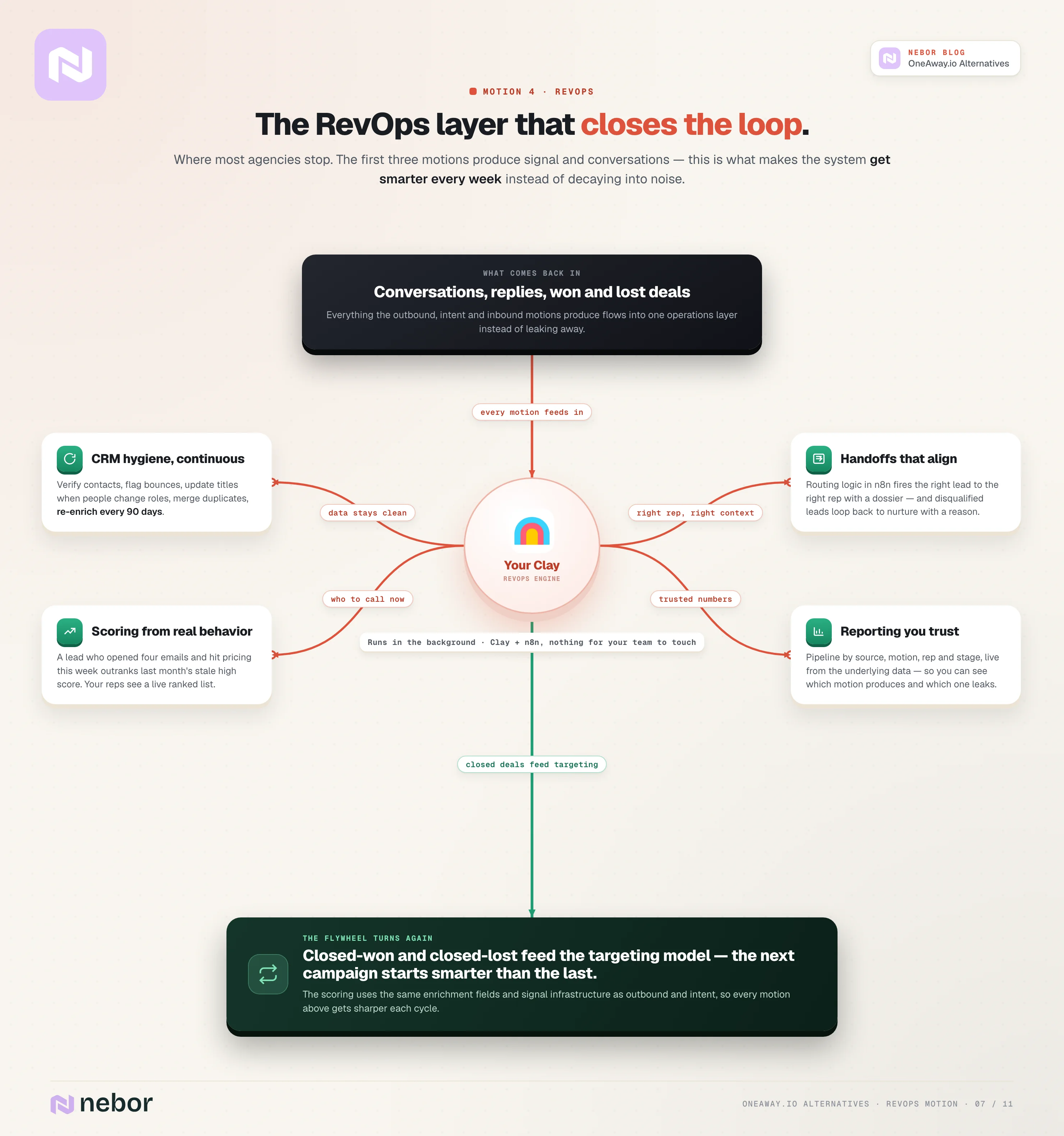
Here is what the RevOps layer covers when we ship it.
CRM hygiene as a continuous workflow
Most CRMs fail because the data inside them rots faster than the team can clean it.
We build automated workflows in Clay and n8n that continuously verify contact information, flag bounced emails, update job titles when prospects change roles, merge duplicate records, and re-enrich contacts every 90 days so your reps are never working off a record that was accurate two quarters ago.
The workflow works in the background and your team never has to think about it.
Lead scoring that updates from real behavior
You get dynamic scoring inside Clay and your CRM that updates the priority on every prospect based on the most recent signal.
A lead who opened four emails this week and visited the pricing page outranks a lead who got a higher score last month but has gone silent since.
Your reps see a ranked list of who to call first based on what is happening now. This connects directly back to the outbound and intent motions because the scoring model uses the same enrichment fields and the same signal infrastructure.
Sales-marketing handoff workflows that actually align
When a marketing-qualified lead crosses into sales-qualified, the handoff is a workflow, not a meeting.
We build the routing logic in n8n/Clay so the right rep gets the right lead with the right context the moment the threshold gets hit, with the lead dossier pre-populated and a Slack notification landing in the rep's account.
We also build the reverse loop, where leads the SDR disqualifies route back to marketing's nurture sequence with a tag that explains why they did not qualify, so marketing can re-engage them when the disqualification reason changes.
Pipeline reporting and forecast workflows that pull from the system
We build Clay views and CRM dashboards that show pipeline by source, by motion, by SDR, by AE, and by stage, all updated in real time from the underlying data.
The number you look at on Friday morning is the number from Friday morning, not the number from the spreadsheet someone built last week and forgot to update.
This matters specifically because it lets you see which motion in the flywheel is producing pipeline and which one is leaking. If outbound is producing meetings but the meetings are not converting, the data is right there.
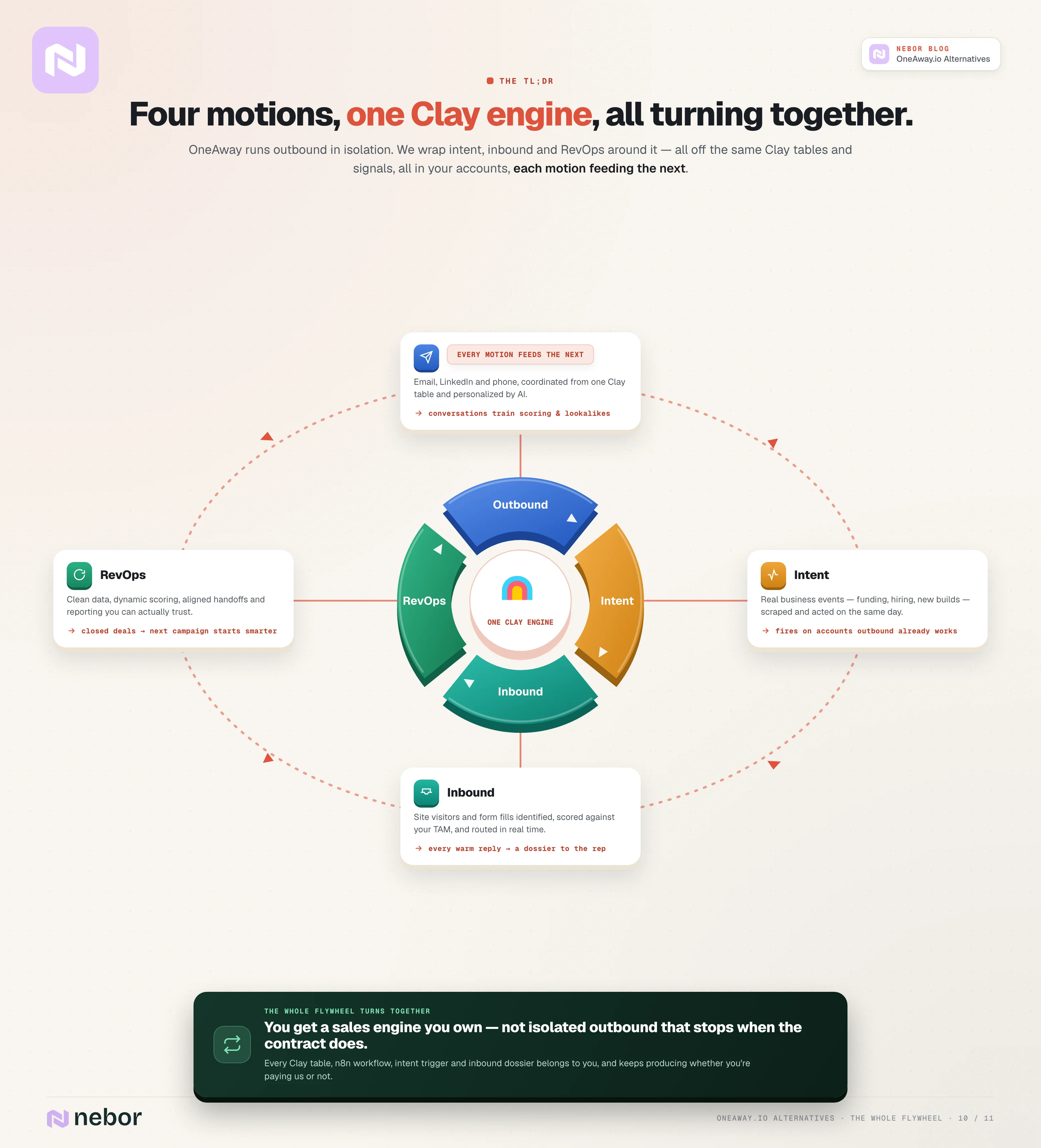
How the four motions work together as one flywheel
The four motions are not four separate workflows that we hand off as four separate deliverables. They feed each other.
Outbound produces conversations, which produce closed deals, which update the lookalike model and the lead scoring.
Intent monitoring triggers on accounts the outbound motion was already working, so the touch becomes a follow-up timed to a real signal instead of a cold pitch.
Inbound qualification catches every warm reply across every channel and routes it back to the rep with the dossier built from the same enrichment infrastructure that powered the outbound campaign.
RevOps cleans the data, scores the leads, triggers the handoffs, builds the reports, and pushes the closed-won and closed-lost signal back into the targeting model so the next campaign starts smarter than the last one.
2. ColdIQ: They combine managed campaigns with training so you can eventually do outbound yourself

ColdIQ's positioning centers on what they call the GTM Flywheel, which connects content, paid ads, and outbound into a single motion rather than treating them as separate channels.
Like us, ColdIQ works a hybrid model. You can pay them to manage campaigns the way a traditional agency would, or you can pay for coaching that teaches your team how the systems work so you are not permanently dependent on their bench.
Their flywheel concept solves a real problem. Most agencies treat outbound as isolated from marketing, which means the cold email goes out cold, with no awareness of what the prospect has read, watched, or skipped.
ColdIQ does outbound and publishes content alongside it, so the cold email lands on a buyer who has already encountered the brand somewhere else.
Where ColdIQ falls short
They are a systems-focused agency, which makes them a poor fit for teams that want pure appointment setting and have zero interest in how the underlying workflows are built.
We are in a similar place. OneAway lands closer to the appointment-setting end if that is what you actually want.
If you want to pay a fixed fee per meeting booked and never think about Clay tables or enrichment waterfalls, ColdIQ will feel like overkill.
3. The Kiln: They specialize in enterprise-grade GTM engineering for post-Series B companies with complex needs
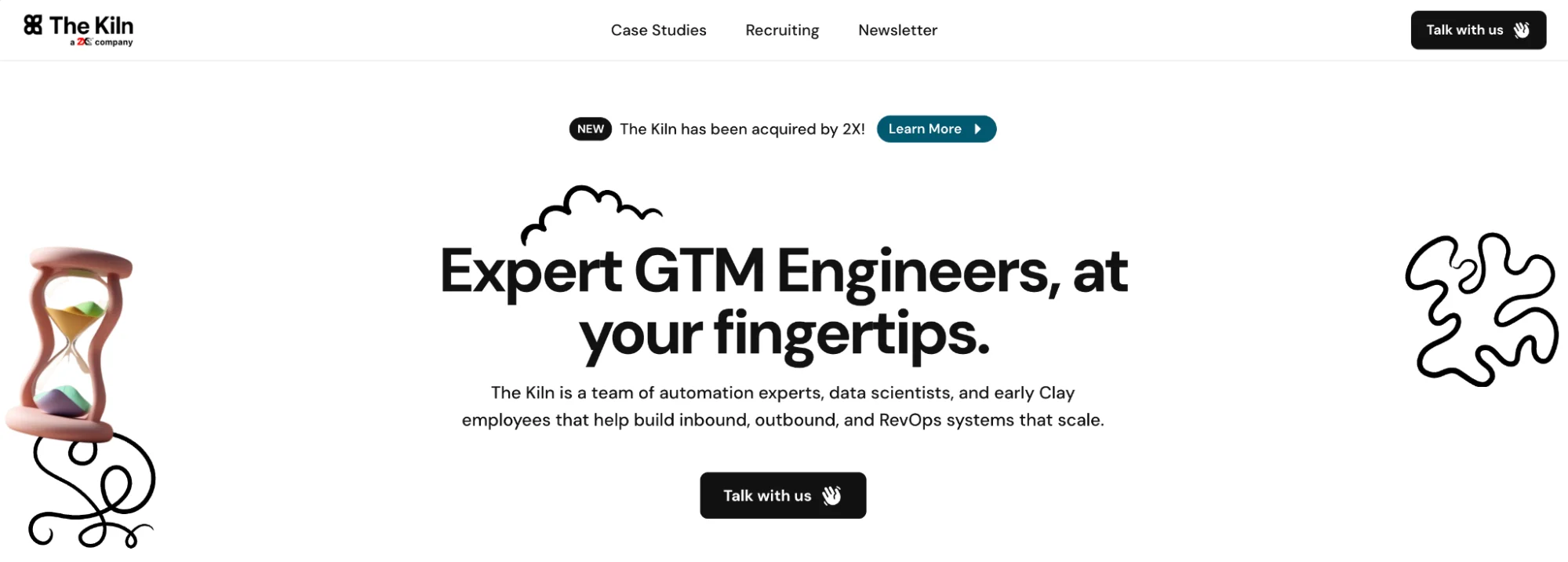
The Kiln is a GTM engineering agency that specializes in custom AI-powered inbound, outbound, marketing, and RevOps systems for post-Series B companies and enterprise teams.
In January 2026, The Kiln was acquired by 2X, a global marketing-as-a-service firm, which gave them enterprise-grade delivery infrastructure while keeping their specialized Clay expertise intact.
The founding team includes people who literally helped build Clay as a product. Patrick Spychalski was Clay's first marketing contractor and has created over 100 tutorial videos on their YouTube channel.
That insider knowledge translates into implementations that push the platform beyond what most agencies even know is possible.
If your CRM is full of outdated contacts, bounced emails, and duplicate records, every campaign you send is fighting against bad data.
The Kiln can build you Clay workflows that continuously validate and enrich your existing database so your sales team trusts what they see.
Why you might not enjoy working with The Kiln
Their model is not built for early-stage startups or for companies working on small budgets. Their sweet spot is post-Series B teams that have already hit product-market fit and need to scale revenue through better systems.
If you are still figuring out your ICP or testing whether outbound works for your business at all, their approach will feel over-engineered for your stage.
OneAway's more accessible service model makes more sense until you have enough volume and complexity to justify a GTM engineering investment.
4. Growth Engine X: They send millions of personalized emails monthly for companies with large addressable markets
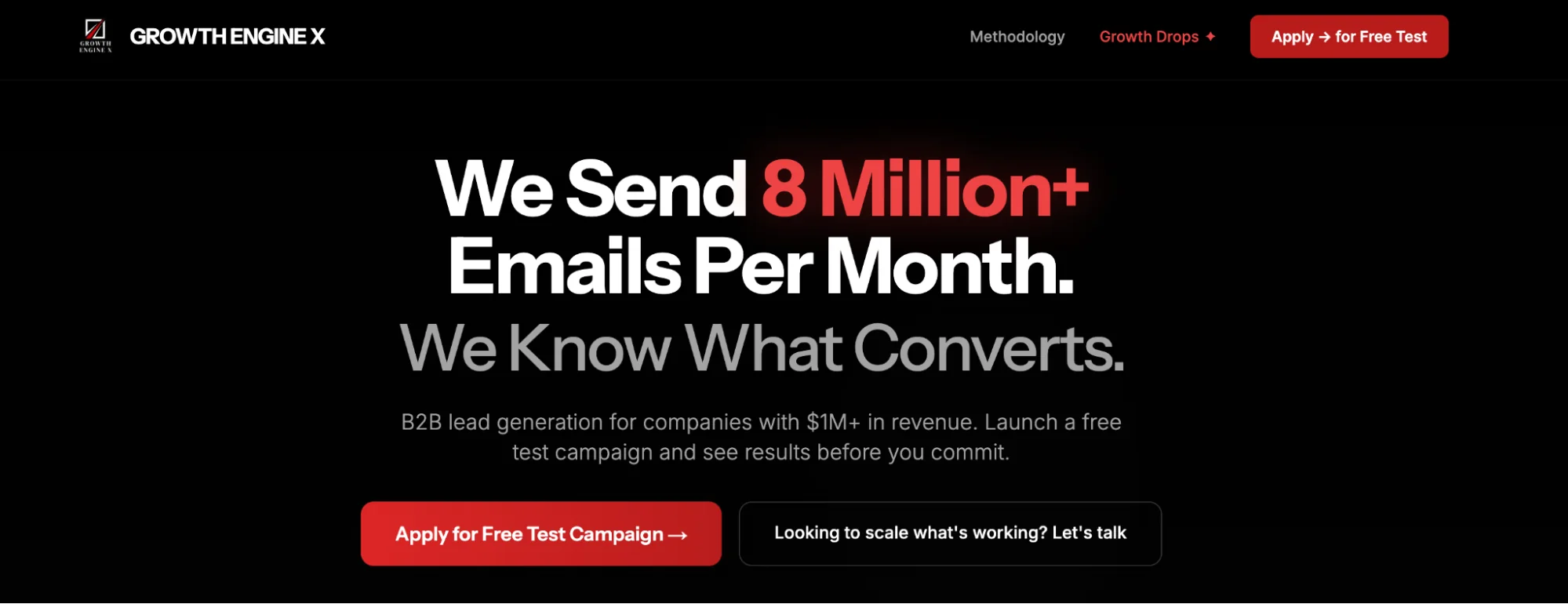
Growth Engine X is an outbound agency that specializes in high-volume cold email campaigns for B2B companies. We have a deeper writeup of their model and the alternatives worth comparing elsewhere on this blog, so this is the short version.
Their founder, Eric, came out of the Clay ecosystem early and helped build their YouTube and LinkedIn presence before launching the agency.
Growth Engine X is now one of Clay's largest users by enrichment volume and sends over four million emails monthly across more than 300 clients.
The stack is built on Clay for enrichment and list building, Smartlead for sending at scale, and direct CRM integrations for lead handoff.
They manage over 7,700 inboxes across their client base. That number is the actual cost of sending several million emails a month without destroying deliverability, and very few agencies are willing to make that infrastructure investment.
Where Growth Engine X falls short
They are built for volume, which makes them a poor fit if you need highly curated, enterprise-focused ABM campaigns targeting a small number of strategic accounts. Their strength is reaching thousands of prospects efficiently, not crafting bespoke outreach for 50 whales.
OneAway's smaller-team approach offers more customization for companies with narrow TAMs where every message needs to feel individually researched. We land closer to OneAway than to Growth Engine X on this dimension.
5. SocialBloom.io: They guarantee a specific number of qualified meetings each month with no long-term contracts
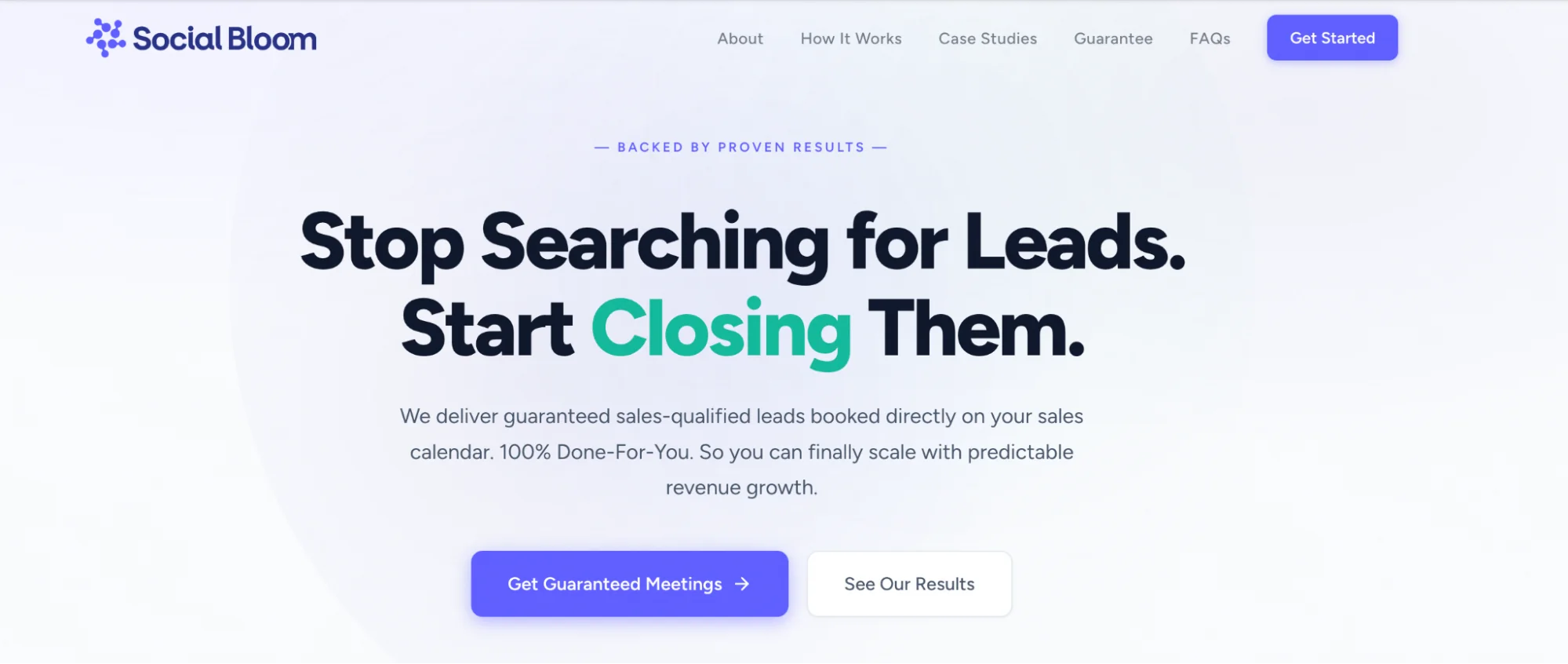
SocialBloom is a done-for-you lead generation agency that guarantees a specific number of qualified sales meetings every month.
They operate strictly month-to-month with no long-term contracts, and they offer free replacement for any meeting that turns out to be unqualified after your call.
The guarantee model changes the relationship dynamic. Most agencies charge a retainer that continues whether or not they actually book meetings. SocialBloom only gets paid when qualified opportunities show up on your calendar.
Why you might not enjoy working with them
SocialBloom might not be the right partner if you want to build internal outbound capabilities or own the systems generating your pipeline. They operate as a black box. You receive meetings without visibility into the workflows producing them.
When the engagement ends, you do not walk away with Clay tables, email sequences, or enrichment workflows your team can operate on its own.
The pipeline stops the day the contract stops. That is the structural trade-off of the guarantee model, and for some teams it is the right trade-off.
They also focus primarily on software and tech companies. Businesses in other industries may find their playbook less applicable to the specifics of their market.
6. SalesCaptain.io: They build broader RevOps systems that align inbound, outbound, and post-sale motions together
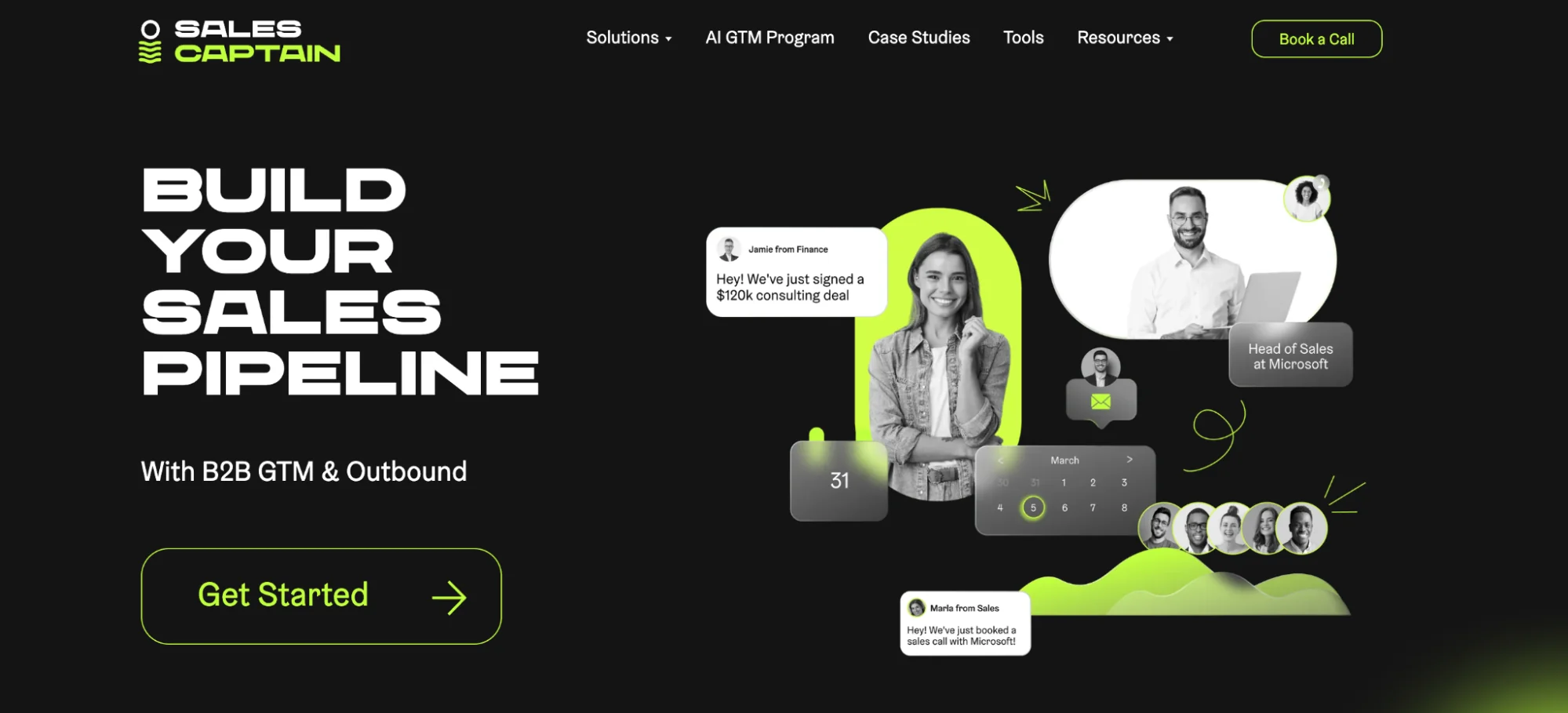
SalesCaptain is a B2B outbound and GTM agency led by Bill Stathopoulos, the Clay Chapter Lead for London. They hold Clay Enterprise partner status and send roughly 1.2 million emails monthly across their client base.
The RevOps orientation is what sets SalesCaptain apart from agencies that treat outbound as an isolated function. They think about the entire customer journey, which means their Clay workflows do not stop the moment a meeting books.
You get inbound lead qualification that sends personalized outreach when a website visitor or a content engager matches your ICP. You get automated CRM enrichment that keeps the data clean and the rep informed.
This is the closest model on the list to what we build, and we say that openly. The difference is in execution detail and team fit, not in category.
Where SalesCaptain falls short
Their sophistication comes with complexity. If you want simple, straightforward cold email campaigns with no RevOps integration, no CRM automation, and no inbound processing, their approach will feel over-engineered for your stage.
Their pricing also reflects their enterprise client base and broader service scope, so startups with limited budgets and simple outbound requirements often find better value with agencies that specialize in early-stage teams.
How to choose between OneAway and these alternatives, on four dimensions that actually matter
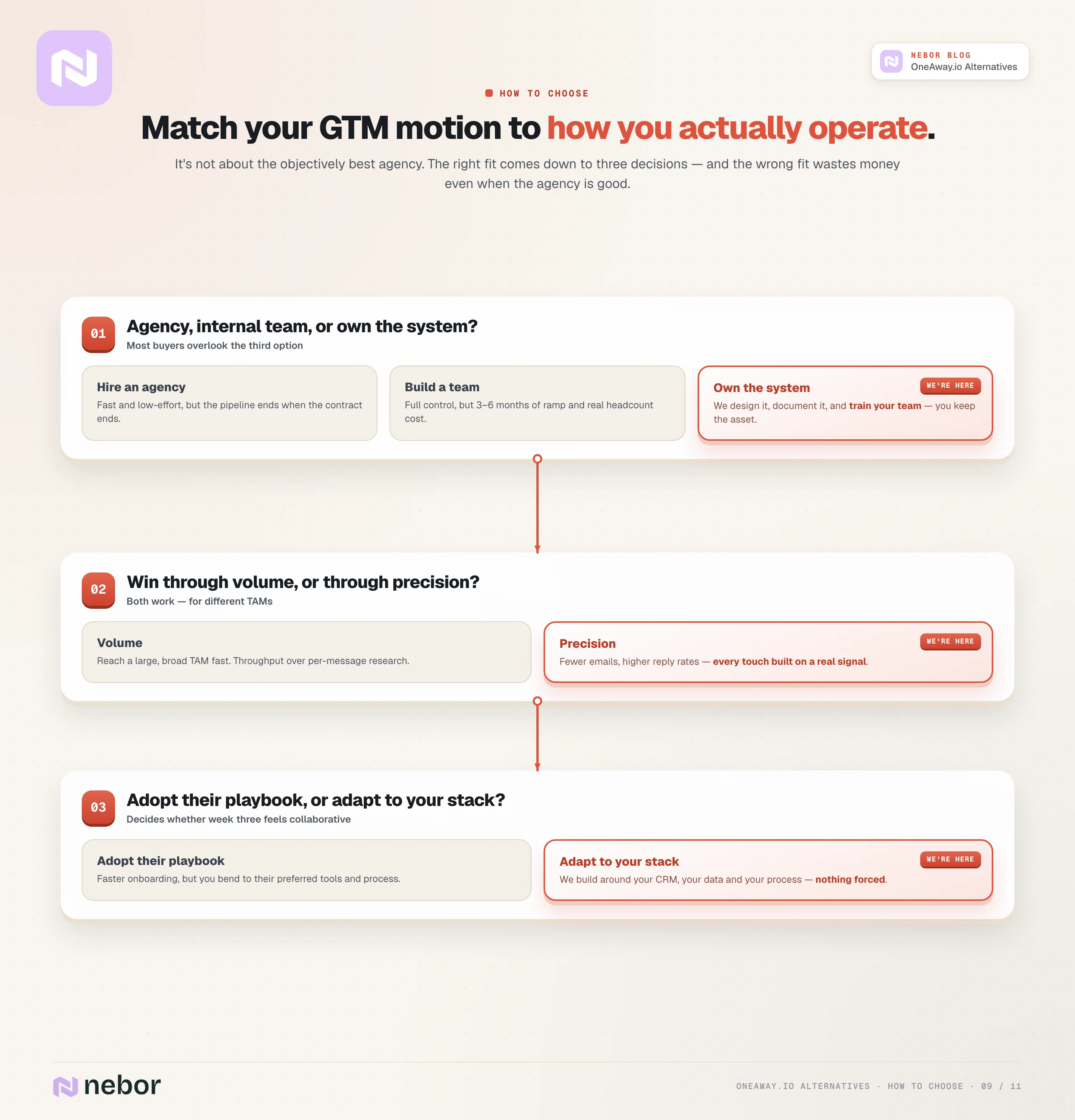
Choosing between OneAway and these alternatives is not about finding the objectively best agency. The decision is about matching your GTM motion to a partner built for how you actually operate.
The wrong fit wastes money and creates friction even when the agency is technically competent. The right fit feels like an extension of your team from week one. Below are the four dimensions we have seen actually drive that fit, from inside the work.
First, decide whether you should hire an agency at all or build an internal outbound team
Building an internal outbound team gives you full control and the institutional knowledge that compounds when people who understand your product do the work themselves.
The cost is real, though. You have to hire SDRs, train them, buy tools, manage the stack, and accept that the ramp time before anyone books a single meeting is usually three to six months.
If you have the budget, the patience, and the management capacity to build internally, that path often produces better long-term results than any agency relationship.
Agencies make sense when you need speed, lack internal expertise, or want to test outbound before committing to headcount. The trade-off is dependency. When the contract ends, the pipeline generation capability ends with it.
A third option exists that most buyers overlook. Agencies like Nebor, ColdIQ, The Kiln, and SalesCaptain build systems you own permanently. We work as implementation partners, not ongoing service providers.
You pay us to design and orchestrate the workflow, document everything, and train your team to operate it. Then you operate it yourself, or you hire someone junior to manage what they built. This model costs more upfront than pure managed services.
It also creates an asset you keep rather than results you rent month to month. We have written about this trade-off in more depth in sales systems versus headcount.
Decide whether you want to win through volume or through precision
Some companies succeed by going after everyone in their TAM quickly through volume and letting conversion rates shake out.
Others succeed by going after fewer prospects with messages so relevant that response rates far exceed industry benchmarks. Both strategies work, and neither is universally better.
Volume-oriented agencies like Growth Engine X optimize for throughput. They send hundreds of thousands or millions of emails monthly across their client base.
The system prioritizes deliverability at scale, automated personalization that feels individual without human review, and infrastructure that handles high sending volumes without tripping spam filters.
If your TAM is large and your offer appeals broadly, volume wins, because you reach more potential buyers faster than the competitors who are agonizing over every message.
Precision-oriented agencies like The Kiln and Nebor optimize for relevance. We build workflows that identify the specific signal indicating a prospect is ready to buy right now, then craft outreach that speaks directly to that current situation.
The approach sends fewer emails. It generates higher response rates and better-qualified conversations. If your TAM is limited, your buyers are educated, or your offer needs explanation before it resonates, precision wins.
You make every touch count rather than hoping volume compensates for weak targeting. We covered the signal-based version of this approach in more depth elsewhere.
Consider how much you want the agency to adapt to your stack versus adopt their standardized playbook
The final question is how much you want the agency to adapt to your existing processes, versus how much you are willing to adopt their way of doing things.
This matters more than most buyers realize because it determines whether the engagement feels collaborative or frustrating from week three onward.
Custom workflow agencies like Nebor, The Kiln, ColdIQ, and SalesCaptain start by understanding your current tech stack, your sales process, and your data sources.
We build Clay tables and automation sequences that integrate with what you already have rather than forcing you into our preferred tools.
If you have specific CRM requirements, existing enrichment subscriptions, or internal processes that cannot change, custom workflow agencies accommodate those constraints.
The trade-off is longer onboarding, higher costs, and more implementation decisions falling on your team during the build.
Hire Nebor to build your GTM flywheel and own the system that generates your pipeline
OneAway does excellent work for companies that want fully managed cold email, Clay expertise, and a high-touch agency relationship. The five other alternatives we covered each solve a different problem for a different kind of buyer.
If you want to build internal capabilities while getting help, ColdIQ and The Kiln offer hybrid models that train your team alongside the execution.
If you need high volume and your TAM is large, Growth Engine X has the infrastructure built for it.
If you want guaranteed meetings with minimal involvement, SocialBloom handles everything so you can focus on closing.
If you want broader RevOps coverage from a Clay-native team, SalesCaptain is in the same neighborhood we are, with a slightly different execution style.
If you want to own the system permanently rather than rent results month to month, that is where we come in.
At Nebor, we build the four motions inside your accounts. Outbound, intent monitoring, inbound qualification, and the RevOps layer that closes the loop and feeds the rest.
The Clay tables, the n8n workflows, the intent triggers, the inbound dossiers, and the multi-channel sequences all belong to you.
We document everything, train your team to operate it, and hand over a sales engine that keeps producing pipeline whether you continue working with us or not.


Related Articles


By clicking Sign Up you're confirming that you agree with our Terms and Conditions.