

In this post:
An AI personalization engine is a system that automatically tailors what each person sees or receives, based on their data, their behavior, and the signals they're giving off. Instead of one message for everyone, it decides what to say, to whom, and when, for each individual.
In outbound, that means cold emails and LinkedIn messages shaped around a specific prospect and a specific reason. On the inbound side, it means a site or landing page that adapts to the visitor or the account in front of it.
TL;DR
Most things sold as an AI personalization engine are mail merge with extra steps. Swapping in a first name or an industry line isn't personalization, it's a template with holes.
Real personalization decides what to say, to whom, and when, using individual-level data and live signals. The engine never invents relevance, it just acts on the data and signals you feed it.
So the quality of your personalization is the quality of your data and your triggers, and the cleverness of the model barely moves it. Good signal in means a relevant message out, and garbage in means confident spam out.
So what does an AI personalization engine actually do under the hood?
An AI personalization engine takes individual data and turns it into a tailored message or experience. It pulls what it knows about a person, their role, their company, their recent behavior, and the signals they're showing, then builds something specific to them.
The good ones work in real time. They react to what someone just did, like a page they viewed or an action they took, instead of replaying a fixed template set months ago.
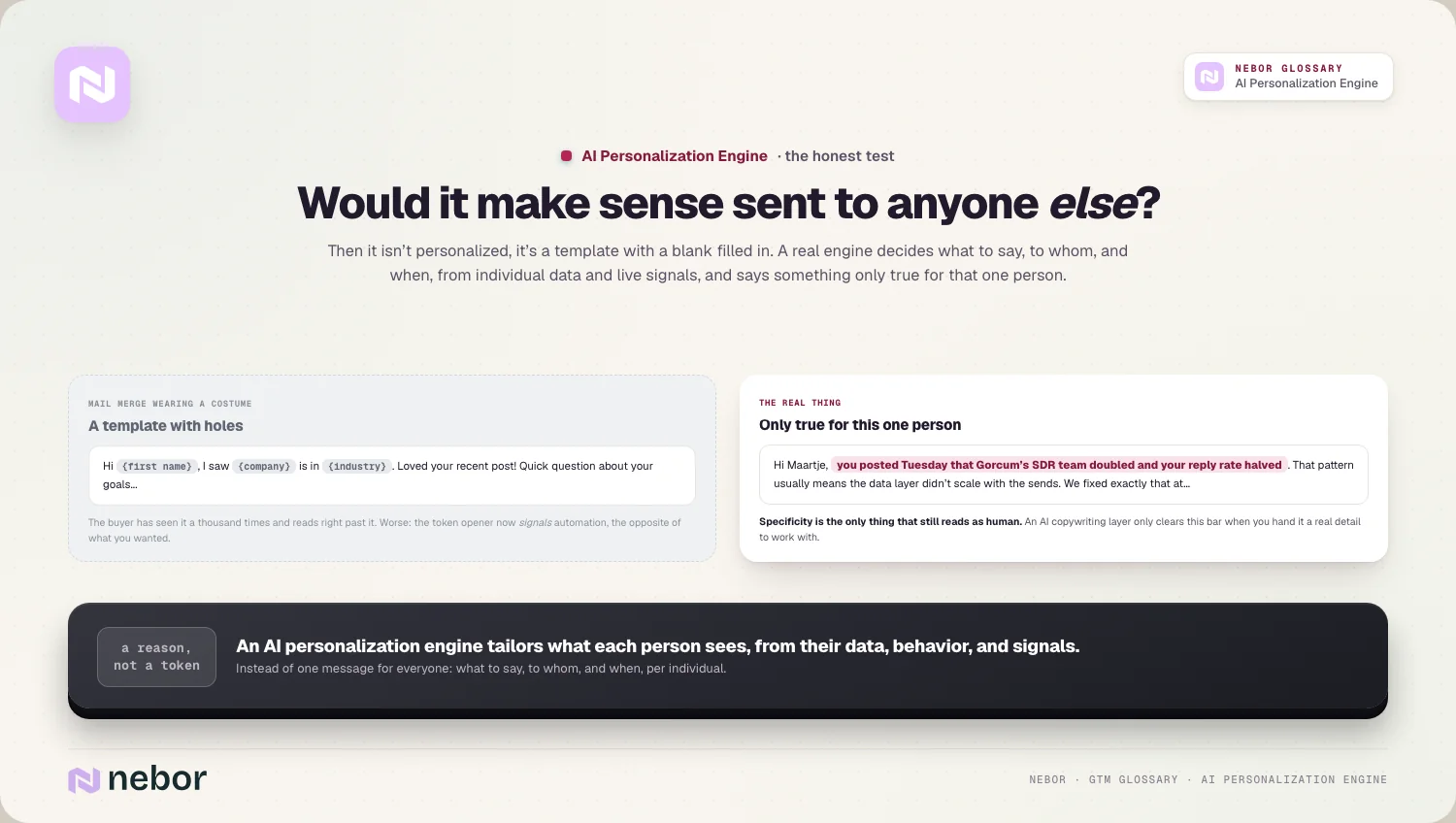
It works on two sides of the funnel, shaping the cold message on outbound and shaping what a visitor sees on inbound. Either way, the enriched data underneath is what makes the output specific instead of generic.
Stripped-down, the engine does three jobs, gathering what it knows about a person, deciding what's relevant to them right now, and assembling the message or experience that fits.
The model only handles the assembling, while the first two jobs depend entirely on the data and the triggers you give it.
Why most "personalization" is really just mail merge wearing a costume
Here's the honest test we apply to every message. If the line you wrote would make just as much sense sent to anyone else, it isn't personalized. It's a template with a blank filled in.
Swapping in a first name, dropping in an industry, or pasting a vague "loved your recent post" is still mail merge, whatever the label says. The buyer has seen it a thousand times and reads right past it.
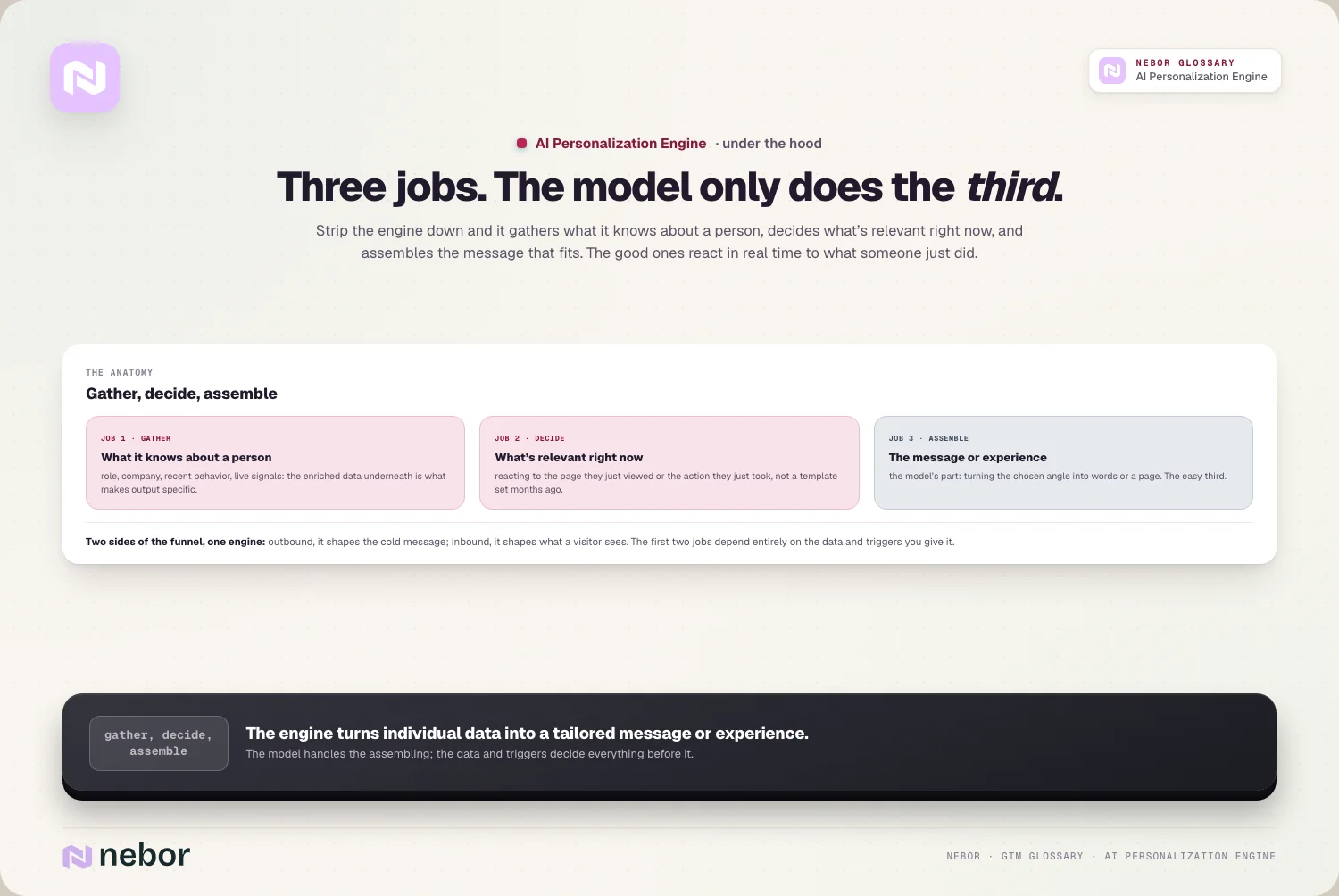
Real personalization says something that's only true for that one person. That's a higher bar, and an AI copywriting layer only clears it when you give it a real detail to work with.
All of this matters more now because buyers have calibrated to the fake version. A "{first name}, I saw {company} is in {industry}" opener openly signals automation, which is the opposite of what you wanted. Specificity is the only thing that still reads as a human bothered to look.
Let's break down the levels of personalization, from a name token to a real reason
Personalization works on a spectrum instead of being one thing, and knowing where your engine lands saves you from fooling yourself.
The shallowest level is plain field insertion, where you drop in a name, a company, or an industry, and the rest of the message is identical for everyone. This is mail merge, and it's what most "AI personalization" really is.
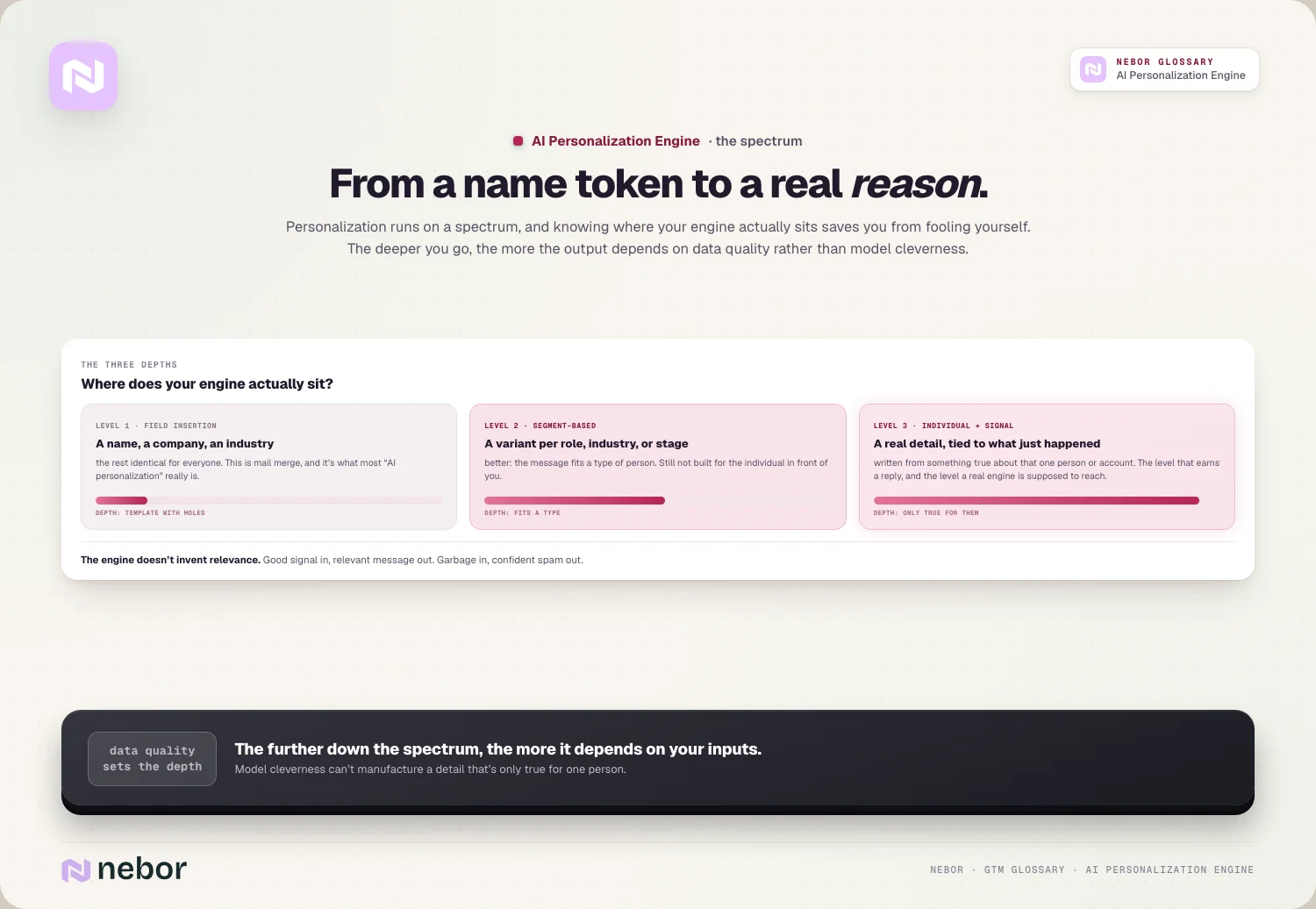
The middle level works by segment, where you group people by role, industry, or stage, and write a variant for each group. It's better, because the message at least fits a type of person, but it still isn't built for the individual in front of you.
The deepest level is individual and signal-driven. The engine writes from a real detail about that one person or account, often tied to something that just happened.
That's the level that earns a reply, and it's the level a real AI personalization engine is supposed to reach. The further down this spectrum you go, the more the output depends on data quality rather than model cleverness.
How an AI personalization engine works on the outbound side of the motion
In outbound, the engine writes the cold email or LinkedIn message around a specific prospect and a specific reason. The reason is the hard part, and the writing is the easy one.
The best outbound personalization starts from a trigger, like a job change, a funding round, or a product launch, and never from a model guessing what might flatter someone. When the engine gets a real event, it writes a line that lands, and when it gets nothing, it invents filler.
That's also the line between hyper-personalization and noise. We've written about which prospecting jobs you can hand to a machine, and writing from a real signal is one of them.
The mistake teams make is asking the engine to be clever instead of feeding it something true. A model with nothing to work from will write a smooth, confident, completely generic line, and that's worse than no personalization at all, because it reads as automated.
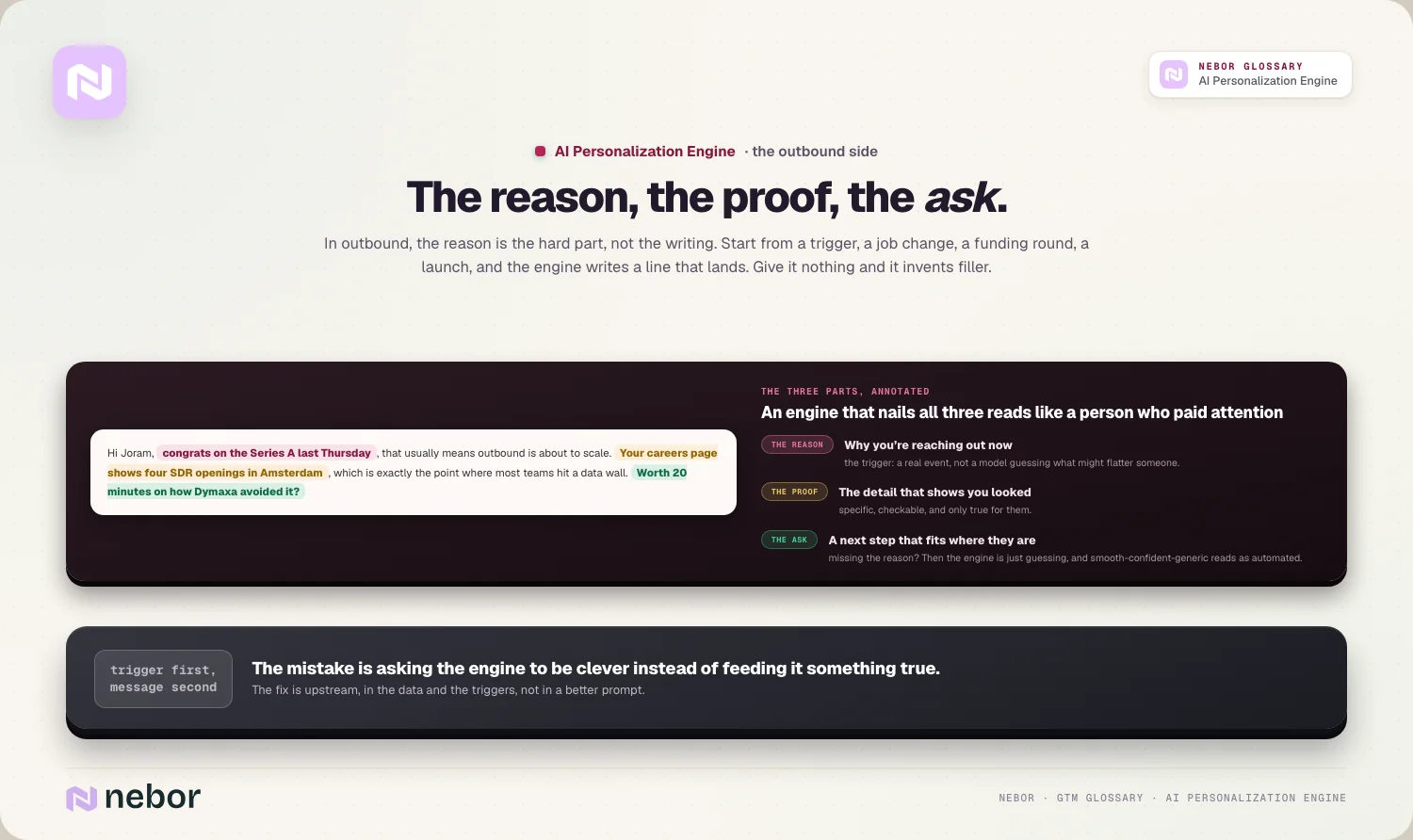
The fix is upstream, in the data and the triggers, and a better prompt won't reach it.
A useful frame for outbound is the reason, the proof, and the ask. The reason is the trigger that says why you're reaching out now, the proof is the specific detail that shows you looked, and the ask is the next step that fits where they are.
An engine that nails all three writes outbound that reads like a person who paid attention, and one that's missing the reason is just guessing.
How an AI personalization engine works on the inbound side of your funnel
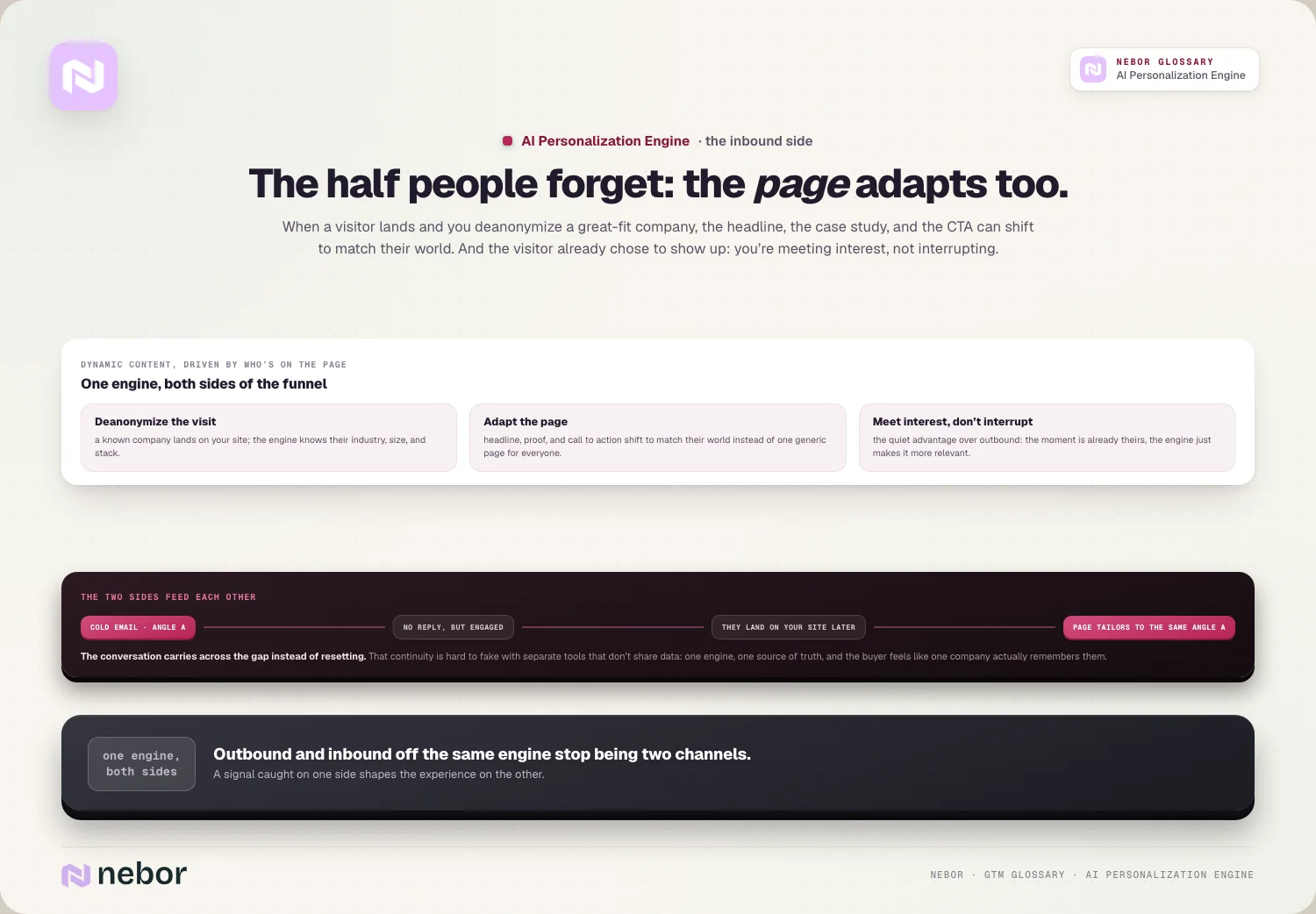
Inbound personalization is the half people forget. When a visitor lands on your site, an engine can adapt the page to who they are.
If you deanonymize the company and it's a great fit, the headline, the case study, and the call to action can shift to match their world. That's dynamic content, driven by who's on the page.
We build a lot of this, like the website visitor workflow that turns anonymous traffic into a named, relevant experience instead of one generic page for everyone.
The inbound side has a quiet advantage over outbound. The visitor already chose to show up, so you're not interrupting anyone, you're meeting an interest that already exists.
An engine that makes that moment more relevant, by showing the right proof to the right account, lifts conversion without spending a single cold touch.
Inbound personalization also doesn't have to be loud to work. It might just mean a case study from the visitor's own industry instead of a generic one, or routing a high-fit account straight to a senior rep instead of a form.
Small, accurate shifts beat a flashy page that guesses wrong, because a visitor who recognizes their own situation on the page is far more likely to keep going.
How the outbound and inbound sides of an AI personalization engine feed each other
The two sides were never really separate products. When they work off the same engine and the same data, they stop being two channels and start being one connected motion.
A signal you catch on one side can shape the other. If an account engages a cold email but doesn't reply, the engine can recognize them when they later land on your site and tailor the page to the same angle. The conversation carries across the gap instead of resetting every time.
That continuity is hard to fake with separate tools that don't share data. It's the difference between a buyer feeling chased by two disconnected systems and a buyer feeling like one company actually remembers them. The engine that pulls both sides from the same source of truth is the one that gets that right.
Why the engine is only ever as good as the data and the signals you feed it
No demo lingers on this part, but the engine doesn't create relevance on its own. It only acts on the data and the signals you give it.
Thin or stale data gets you personalization at scale that's really just scaled irrelevance, the same empty line sent to thousands of people fast. The model isn't the bottleneck here, the inputs are.
It's the same lesson behind most failed Clay builds, where the tool was fine and the data and thinking under it weren't.
There's a sharper version of this risk too, because bad data doesn't just produce a bland message, it produces a wrong one sent with total confidence.
An engine that thinks someone changed jobs when they didn't, or names the wrong company, lands worse than a plain template, because now you've shown the buyer your "personalization" is broken.
What common mistakes make AI personalization quietly fall apart
Most of the personalization failures we see aren't dramatic. They're quiet, and they hide behind activity, which is what makes them dangerous.
The first mistake is mistaking volume of personalized fields for real relevance. You can insert ten data points and still say nothing that's only true for that person.
The second is feeding the engine stale data, so it personalizes around a fact that's no longer true and embarrasses you in front of the exact buyer you wanted.
The third is letting the model invent detail to fill a gap. When the engine has nothing real to say, a loose prompt lets it hallucinate something plausible, and a hallucinated compliment is worse than silence.
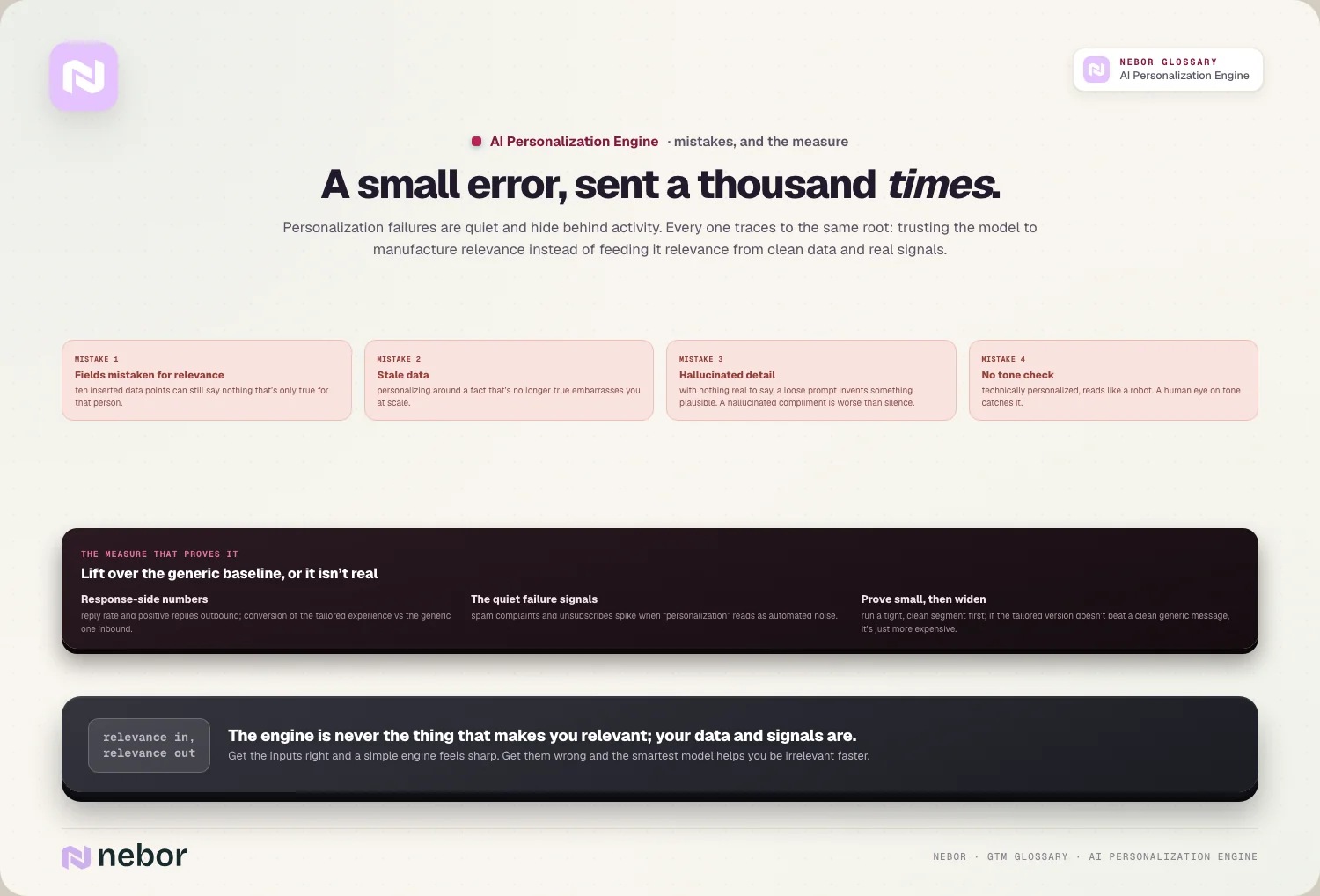
The fourth is skipping the human check on tone, so messages ship that are technically personalized but read like a robot wrote them.
Every one of these traces back to the same root. The team trusted the model to manufacture relevance instead of feeding it relevance from clean data and real signals.
There's a scale trap hiding in here too. Personalization that's slightly off feels harmless on one message, but an engine sends thousands, so a small error becomes a thousand small embarrassments.
The faster you scale a shaky setup, the faster you teach your whole market that your outreach is automated and not worth reading.
How to make AI personalization land instead of just scaling the noise
Start every build from a real reason. Before you scale anything, make sure each message or experience ties to a specific signal or detail about that person.
Keep the individual-level data clean, because wrong data makes personalization fail without any error message you'd notice. Let the AI assemble the message from real inputs rather than invent facts, and keep a human eye on tone so nothing reads like a robot wrote it.
Then measure the right thing, meaning replies, meetings, and engagement instead of how many personalized messages you managed to send.
One more habit separates the teams that get this right. They pick the trigger first and write the message after. If you can't name the specific reason this person should hear from you today, the honest move is to not send yet, rather than dress up a generic touch as a personalized one.
It also pays to start small and prove it before you scale. Try the engine on a tight, well-understood segment first, where you know the data is clean and the triggers are real, and check that the tailored version really lifts replies.
Once it works there, you widen it with confidence. Scaling a setup you haven't proven just turns a small problem into a large one across your whole market.
How you should measure whether your AI personalization really works
It's easy to grade personalization on the wrong scale, because the obvious number, how many tailored messages you sent, tells you nothing about whether any of them worked.
The numbers that matter are on the response side. On outbound, watch reply rate and positive reply rate, because those tell you whether the relevance registered at all. On inbound, watch conversion on the personalized experience against the generic one, so you know the dynamic content is earning its place.
Watch the quiet failure signals too, like spam complaints and unsubscribes on outbound, which spike when "personalization" reads as automated noise. The goal was never more personalized sends but more of the right people taking the next step, and the volume metric will happily hide whether that's happening.
A useful gut check is to compare your personalized motion against a plain one. If a tailored message doesn't beat a clean generic message on reply rate, your personalization isn't real, it's just more expensive. The lift over the generic baseline is the number that proves the engine is earning its place.
How an AI personalization engine fits into your wider go-to-market system
An AI personalization engine isn't a standalone trick you bolt onto one channel. It works best as a shared layer across your whole go-to-market system, pulling from one source of truth.
When your outbound and your inbound draw on the same enriched data and the same signals, the personalization stays consistent and a signal caught in one place can shape the experience in another. The same funding round that triggers a tailored cold email can also reshape that account's landing page when they visit.
That shared foundation is what turns personalization from a feature into a capability. A standalone tool personalizes one channel in isolation. A real engine wired into your data and your workflows makes every touch, inbound and outbound, more relevant from the same clean inputs.
In the end, the engine is never the thing that makes you relevant. Your data and your signals do that, and the engine just acts on them at scale. If those inputs are right, even a simple engine feels sharp. If they're wrong, the smartest model on the market will only help you be irrelevant faster.
Share this post
Personalization
AI
Glossary
Related glossary items
Understanding the core GTM concepts




Ready to build your pipeline











