

In this post:
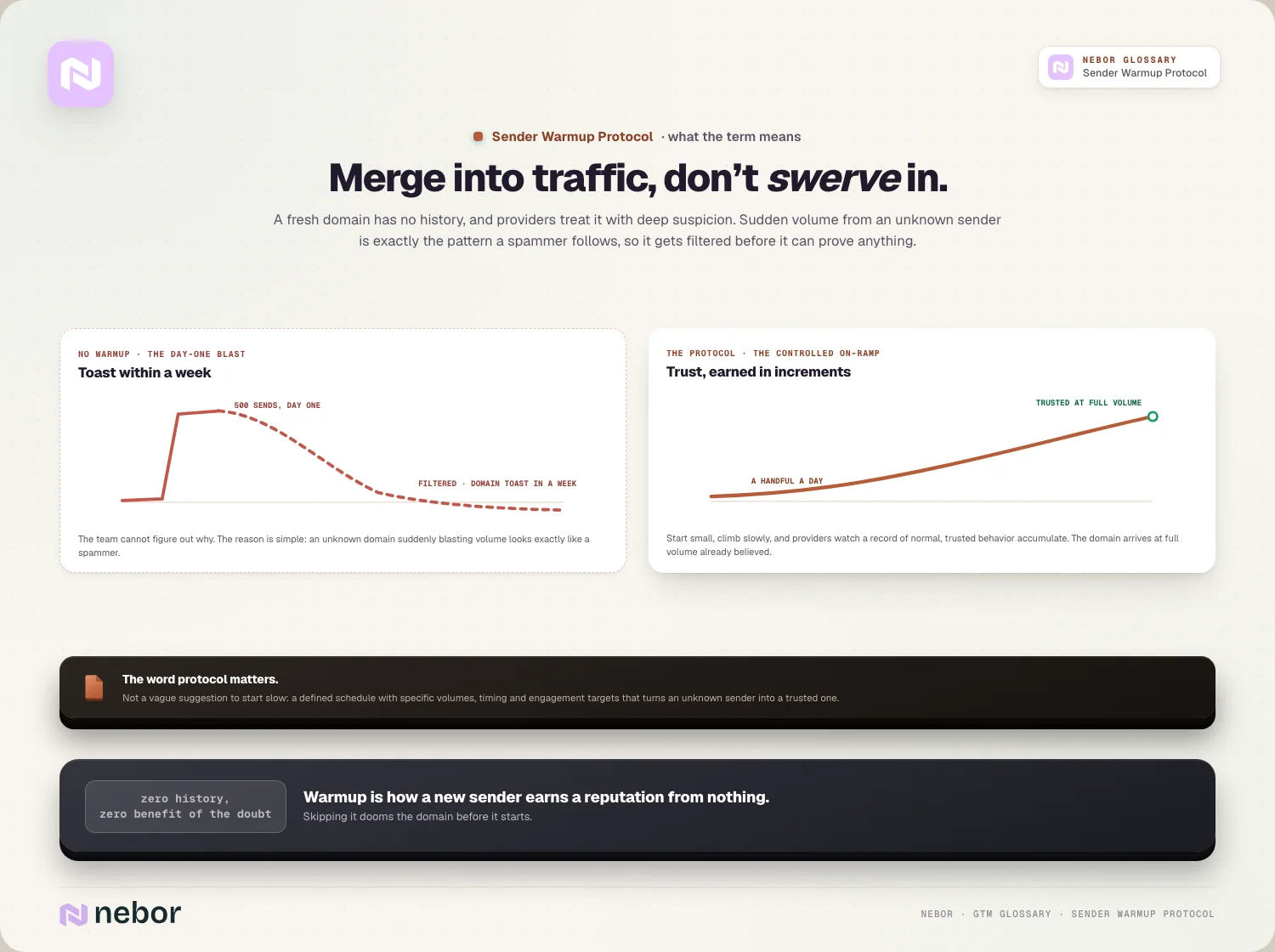
A team buys a fresh domain, sets up their mailboxes, and blasts five hundred cold emails on the first day. Within a week, their domain is toast, their messages land in spam, and they can't figure out why.
The reason is that mailbox providers treat a brand-new sender with deep suspicion. A domain with no history suddenly blasting volume looks exactly like a spammer, so it gets filtered before it ever has a chance.
A sender warmup protocol is the structured, step-by-step process of gradually increasing your sending from a new domain or mailbox, so mailbox providers learn to trust you before you send at full volume. It's the disciplined ramp that keeps a new sender alive.
The word protocol carries real weight here. This is a defined schedule instead of a vague suggestion to start slow, with specific volumes, timing, and engagement targets that turn an unknown sender into a trusted one.
TL;DR
A sender warmup protocol is the structured schedule for ramping up a new sending domain or mailbox gradually, building sender reputation so your emails reach the inbox instead of spam.
New domains have no trust at all, and sending too much too soon gets them filtered or blocked, so warmup is how you earn that trust before scaling.
A typical protocol spans two to four weeks, starting at a handful of emails a day and increasing slowly, with engagement mattering as much as volume.
One framing keeps you out of trouble, because warmup is a precondition and an ongoing practice instead of a one-time chore. If you skip it, you burn the domain, and if you stop it abruptly when real sending starts, you undo the trust you built.
So what is a sender warmup protocol, exactly, and what does it cover?
A sender warmup protocol is the deliberate plan for introducing a new domain or mailbox to mailbox providers. Instead of sending at full volume immediately, you ramp up over a set period following a defined schedule.
The goal is to build trust gradually. By starting small and increasing slowly, you show providers like Gmail and Outlook that you're a legitimate sender instead of a spammer who appeared overnight.
It's the practical, structured version of email warmup. Where warmup is the general idea of ramping up, a protocol is the specific schedule of volumes and steps you actually follow.
The protocol covers more than just numbers. It defines how much to send, who to send to, how to drive engagement, and how to monitor your metrics as you scale.
So it works like a controlled on-ramp. You merge into the flow of email traffic gradually instead of swerving in at full speed, and that gradual merge keeps your new domain from being rejected before it can prove itself.
Why do new domains need a warmup period before real sending starts?
To understand why warmup matters, you have to see things from the mailbox provider's side. They're constantly trying to separate legitimate senders from spammers.
A brand-new domain has no track record. Providers have never seen mail from it, so they have no reason to trust it and every reason to be cautious.
Now imagine that unknown domain suddenly sends hundreds of cold emails. From the provider's view, that's the exact pattern a spammer follows, so the natural response is to filter or block it.
Warmup solves this by building a history where none existed. Sending a little at first, then gradually more, creates a record of normal, trusted behavior that providers learn to recognize.
This is the foundation of your sender reputation. Warmup is literally how you earn a reputation from zero, so skipping it dooms a new domain before it starts.
What does a typical warmup schedule look like week over week?
The heart of a warmup protocol is the ramp schedule, and a concrete example makes it easy to picture. The exact numbers vary, but the shape is consistent.
A common approach goes week by week, starting your list with friendly, high-engagement contacts. Week one might be 10 to 20 emails a day, sent mostly to people likely to generate positive signals.
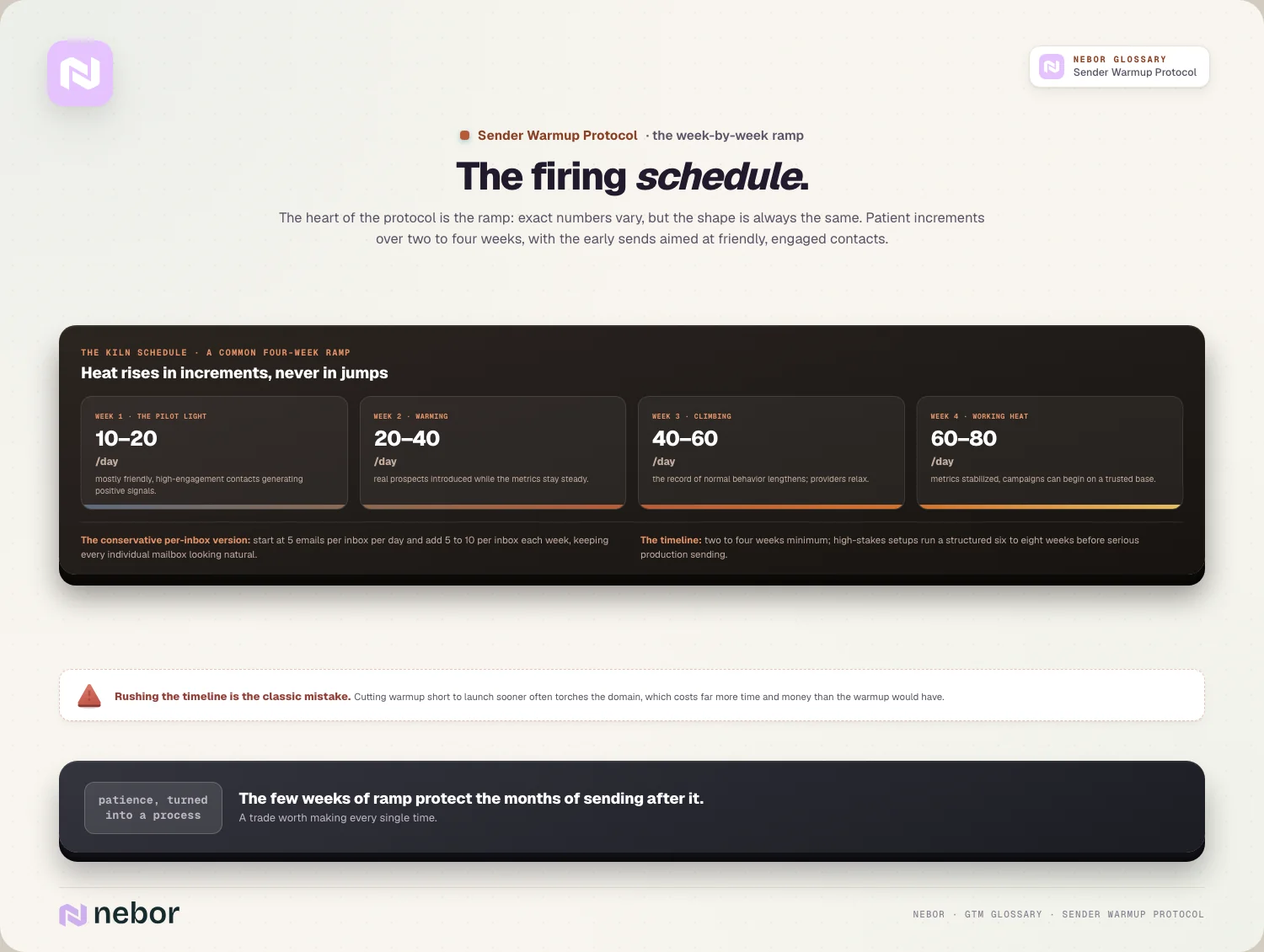
From there the numbers climb steadily each week. Week two moves to 20 to 40 a day while introducing real prospects, week three to 40 to 60, and week four to 60 to 80 as your metrics stabilize.
A per-inbox version is even more conservative. Some protocols start at 5 emails per inbox per day and add 5 to 10 per inbox each week, which keeps each individual mailbox looking natural.
The common thread across every version is patience. Whatever the exact numbers, you increase gradually over two to four weeks instead of jumping to full volume, and that restraint keeps providers comfortable.
How long should warmup take before you trust the domain with volume?
Timeline is one of the most common questions clients ask us, and the honest answer is that it depends on how aggressively you'll send later, though there's a sensible range.
For most new domains, warmup takes two to four weeks minimum. That's enough to establish a baseline of trusted behavior before real campaigns begin.
For higher-stakes setups, a longer runway is safer. Some teams follow a structured six to eight week process before any serious production sending, especially when reputation really matters.
Rushing the timeline is the classic mistake. Cutting warmup short to start campaigns sooner often torches the domain, which costs far more time and money than the warmup would have in the first place.
So the timeline deserves treating as non-negotiable. The few weeks you spend warming up your domain properly protect months of sending, which is a trade worth making every time.
What sending limits should you keep once the warmup period ends?
Warmup is also about learning what full volume safely means for you, because many senders overestimate how much they can push.
Even after warmup, staying conservative is smart. Many businesses see the best results holding around 20 emails per inbox per day, well below what's technically possible.
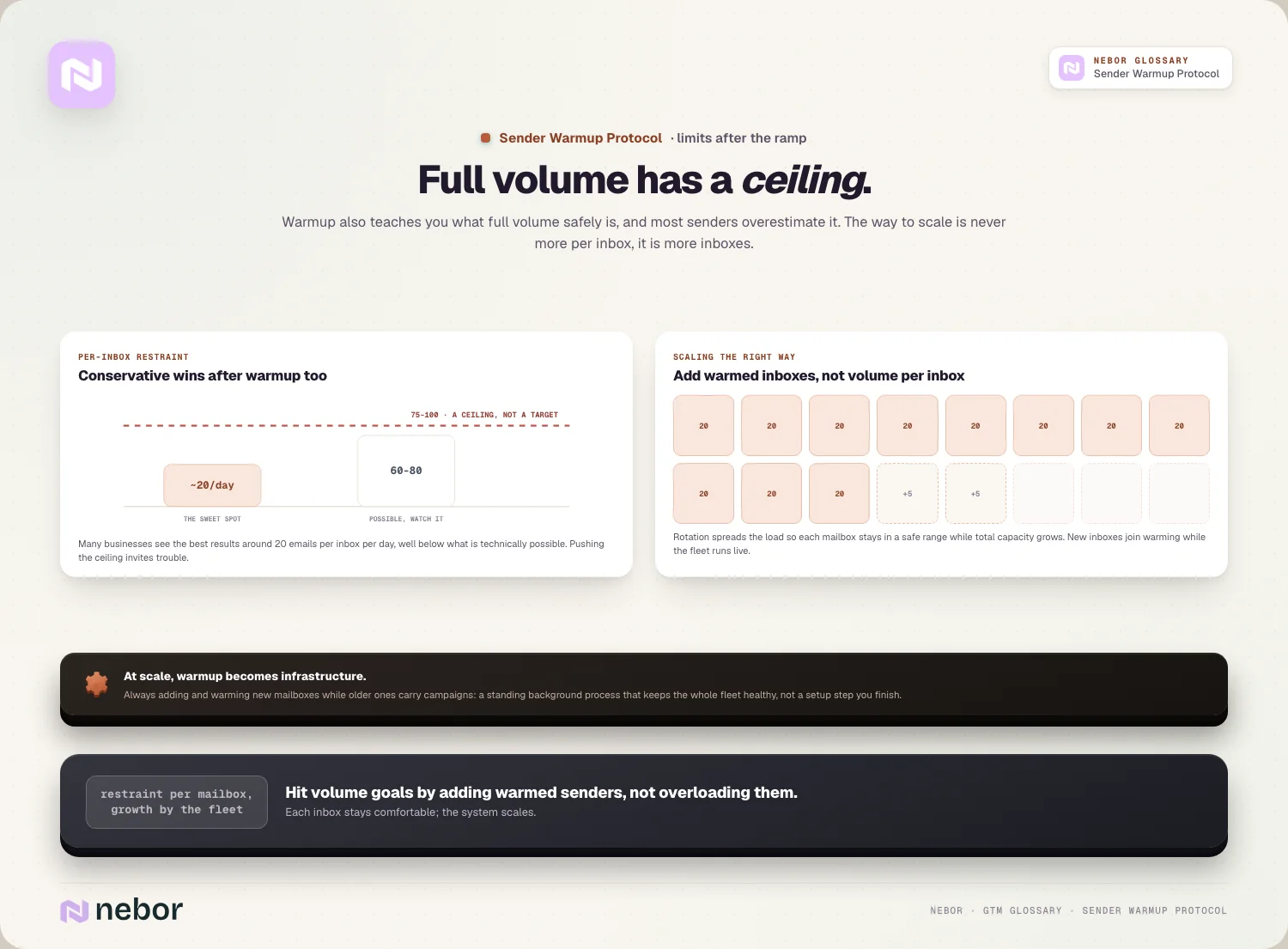
There's an upper bound that deserves respect. Most B2B senders should treat 75 to 100 emails per inbox per day as a ceiling instead of a target, because pushing higher invites trouble.
The way to scale is more inboxes instead of more per inbox. Spreading volume across many mailboxes through inbox rotation keeps each one in a safe range while growing total capacity.
So the rule is restraint per mailbox. You hit your volume goals by adding warmed mailboxes instead of overloading the ones you have, which protects the whole system.
Why is engagement the real point of warmup rather than raw volume?
A subtle but important truth is that volume is only half of warmup. The signals that build the most trust are about engagement.
Mailbox providers watch what recipients do with your mail. Opens, replies, and emails moved out of spam into the inbox are the strongest signals that your mail is wanted.
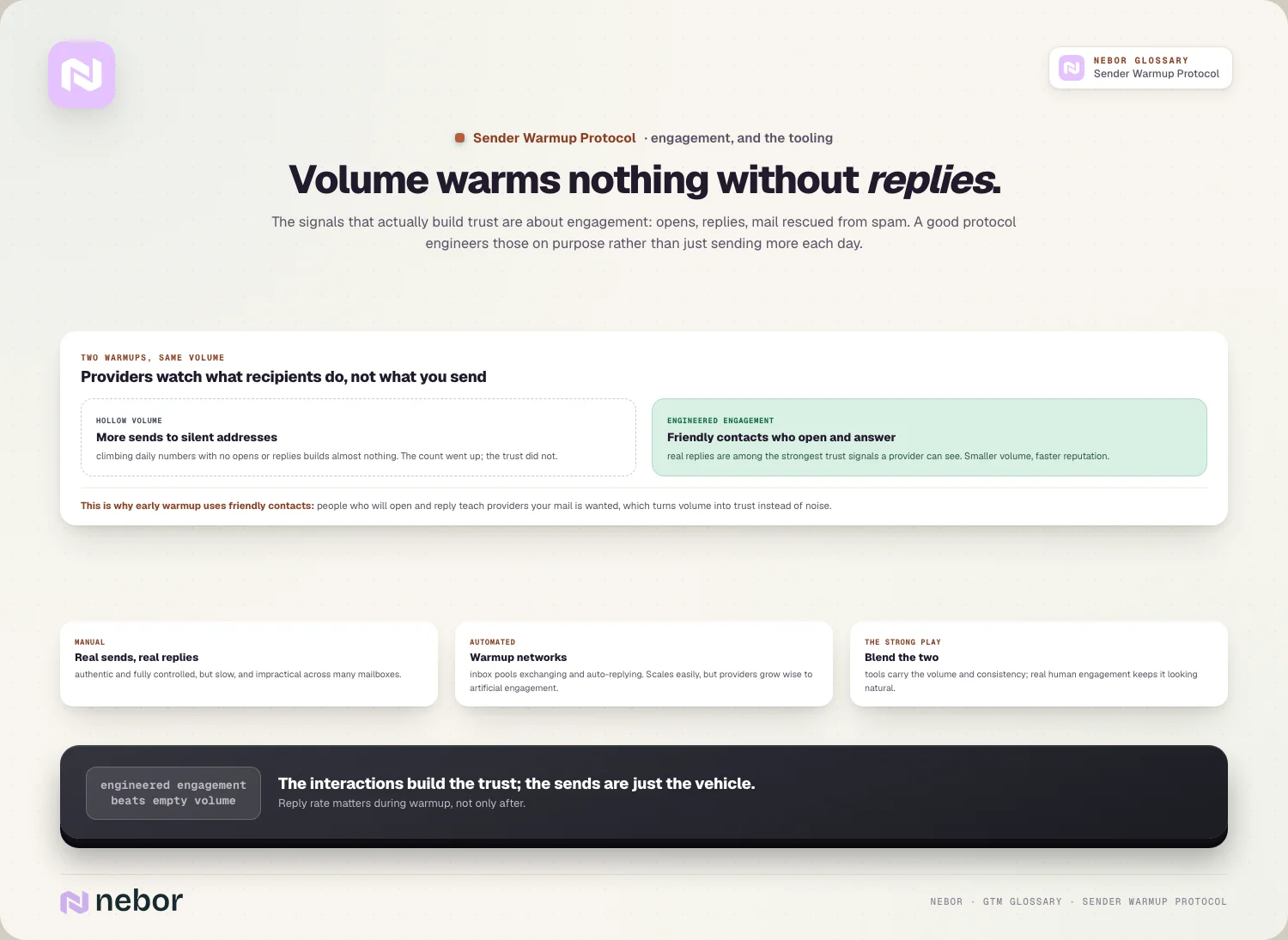
This is why early warmup uses friendly contacts. Sending to people who will open and reply generates the positive engagement that teaches providers your mail is legitimate.
It's also why reply rate matters during warmup as much as later. Real replies are powerful trust signals, so warmup that produces engagement builds reputation far faster than empty volume.
So a good protocol engineers engagement on purpose. Beyond sending more each day, it makes sure that mail gets the positive interaction that turns volume into trust.
What has to be in place on your domain before you start warming up?
Warmup doesn't happen in a vacuum, and starting it without the right foundation wastes the effort, because a few prerequisites are non-negotiable.
Authentication comes before anything leaves the domain. Your setup needs SPF, DKIM, and DMARC configured correctly before you send, because these prove your mail is legitimate and are required by major providers.
Proper infrastructure stands right next to it. Your domains and mailboxes should be set up cleanly as part of a deliberate cold email infrastructure, ideally separate from your main business domain.
And a plan for what you'll send completes the prerequisites. Warmup builds trust, but you need clean lists and relevant messages ready, so you don't waste your new reputation on bad sending the moment you scale.
So warmup is the ramp, but authentication and infrastructure are the road underneath it. Without them, even a perfect warmup schedule can't keep you in the inbox for long.
Getting these prerequisites in place first is what makes the warmup itself count, instead of wasting weeks of careful ramping on a setup that was never going to be trusted.
How does warmup connect to reputation and deliverability downstream?
Warmup works as one part of the larger system that keeps you reaching the inbox, feeding directly into your reputation and deliverability.
It's how you build domain reputation from scratch. The gradual ramp creates the trusted history that becomes your reputation, which then governs your placement.
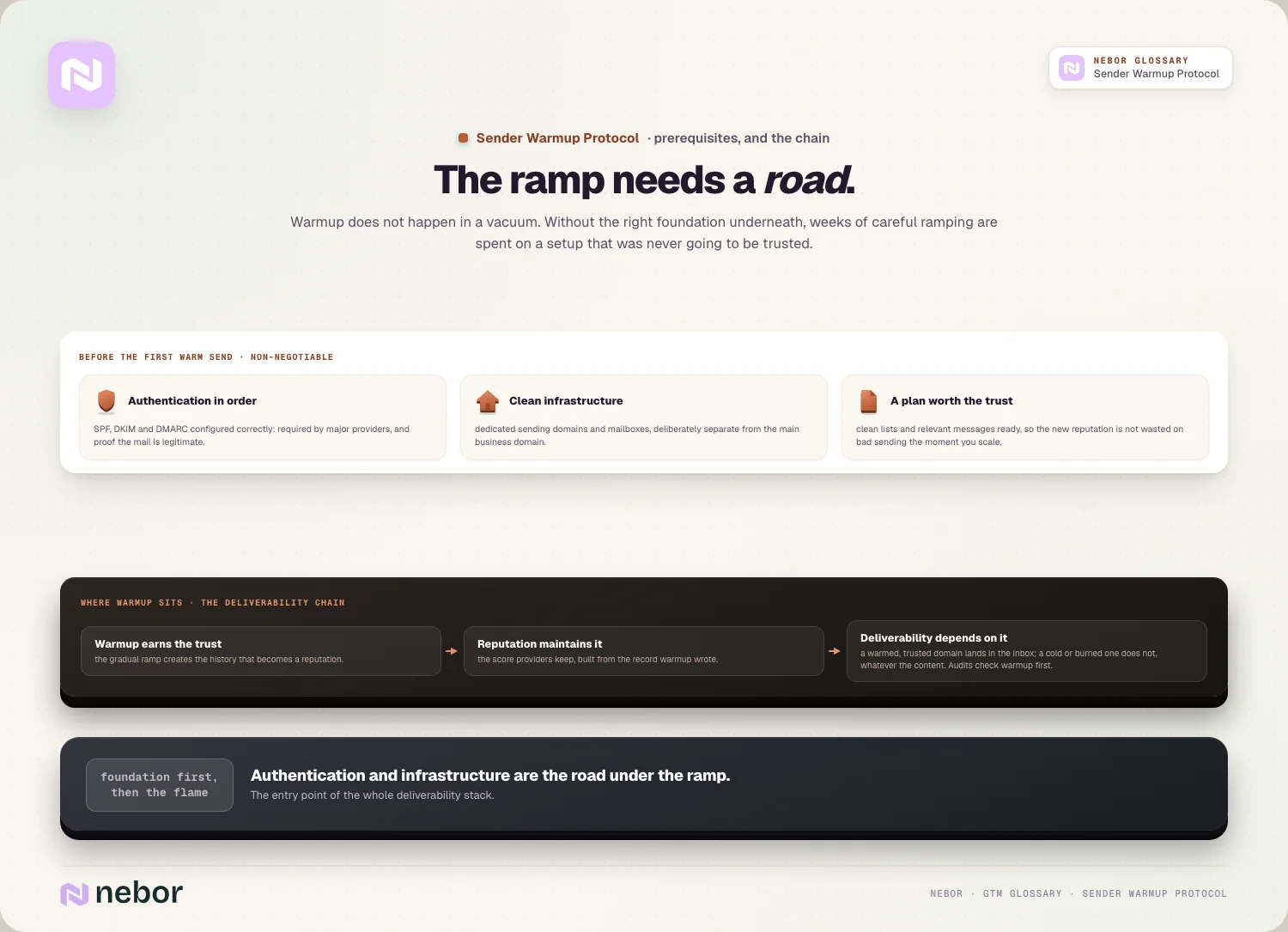
That reputation then drives your email deliverability day to day. A well-warmed domain with a strong reputation lands in the inbox, while a cold or burned one lands in spam no matter the content.
When things go wrong, warmup is one of the first things to check. An outbound deliverability audit often finds that a domain was scaled too fast or that warmup stopped when sending began.
So warmup is the entry point to the whole deliverability stack. It earns the trust that reputation maintains and deliverability depends on, which makes it foundational instead of optional.
Should you warm up manually or lean on one of the warmup tools?
A practical question is whether to do warmup by hand or use one of the many warmup tools. Both approaches exist, and they suit different situations.
Manual warmup means you personally send and reply to real contacts, slowly increasing volume. It's authentic and gives you full control, but it's slow and hard to do across many mailboxes.
Automated warmup tools simulate the engagement instead. They send emails between networks of inboxes and auto-reply to generate positive signals, which scales easily across many mailboxes at once.
The tools save enormous effort, but they have limits. Providers are increasingly wise to artificial warmup networks, so tool-generated engagement is weaker than genuine human interaction.
The strongest approach we've seen blends both. You use tools to handle the volume and consistency, while mixing in real engagement, so the warmup looks as natural as possible while still scaling.
How does warmup fit into a high-volume outbound operation at scale?
Warmup looks simple for one mailbox, but it becomes a real operation at scale. Sending outbound across dozens of domains and mailboxes changes the picture.
At volume, warmup turns into a continuous process. You're always adding new mailboxes and warming them while older ones carry live campaigns, so warmup becomes a standing process.
This is where it ties into spreading the load. Because each mailbox stays in a safe range, you scale by warming and adding more inboxes, which keeps total volume high without overloading any single sender.
Managing all of this by hand is impractical. Coordinating warmup, rotation, and sending across many mailboxes is exactly the kind of work teams build systems to automate sales prospecting end to end.
So at scale, warmup stops being a setup step and becomes infrastructure. It's a constant background process that keeps a fleet of mailboxes healthy enough to sustain real volume.
What are the common mistakes teams make with warmup protocols?
Warmup goes wrong in a handful of predictable ways, and we keep seeing the same ones in the audits we do. Avoiding them is most of what makes a protocol succeed.
Skipping it entirely is the most destructive, because sending real volume from a cold domain is the fastest way to burn it, and it's the single most common deliverability mistake.
Ramping too fast follows close behind, because jumping volume in big leaps, even after starting small, can spook providers and undo the trust you've been building.
Stopping warmup once campaigns start is the sneaky one, because warmup is ongoing maintenance, so cutting it the moment real sending begins removes the support your reputation still needs.
And warming volume without engagement wastes the effort, because sending more each day to addresses that never interact builds far less trust than a smaller volume that gets real replies.
Do you warm up the domain, the individual mailbox, or the IP address?
People often ask what exactly gets warmed up, because the term covers a few things. The answer is that reputation lives at multiple levels, and your protocol touches each.
The domain matters most of the three. Domain reputation follows you across tools and IPs, so warming the domain builds the trust that matters most and lasts longest.
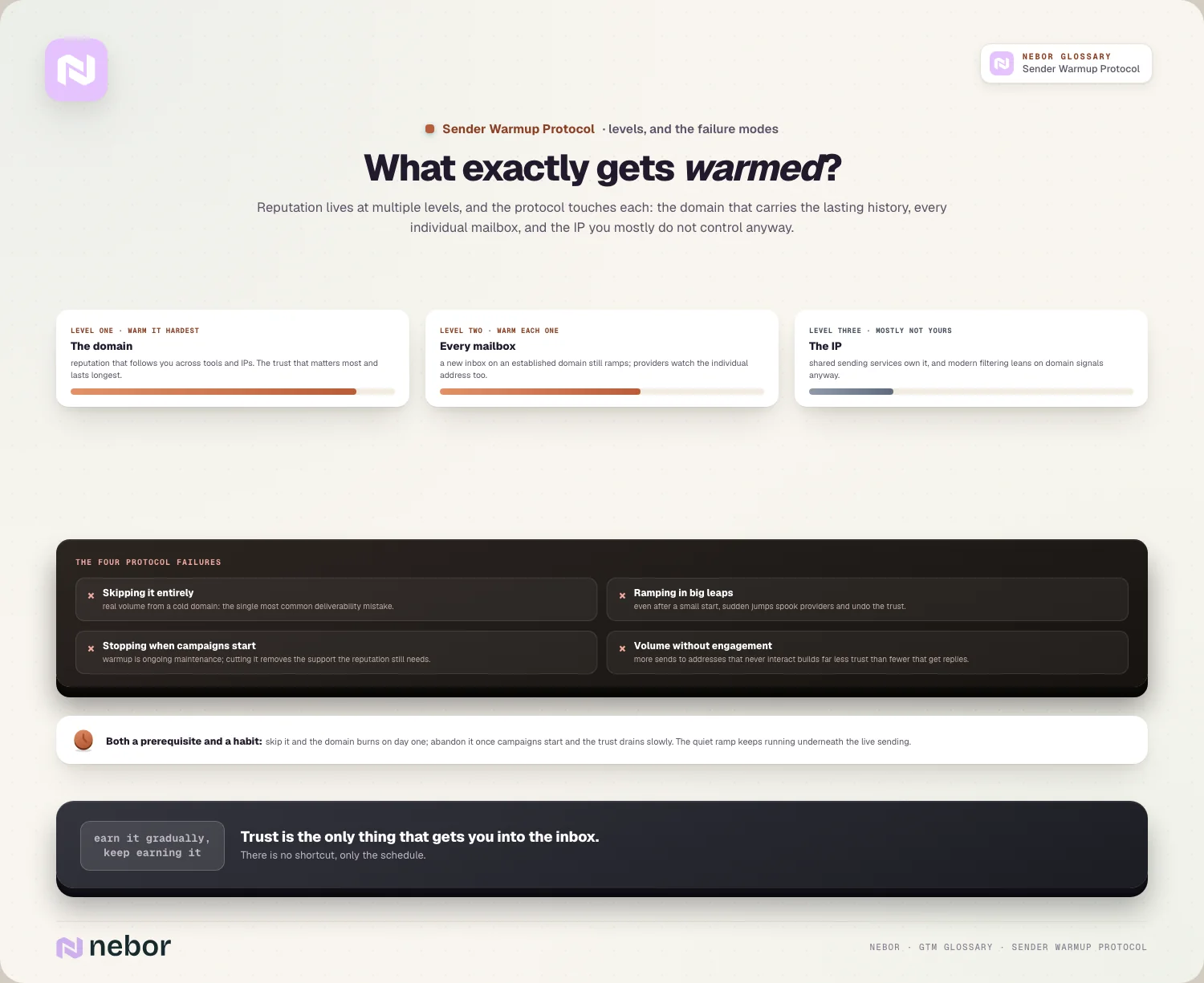
Each mailbox needs warming on top of that. A new inbox on an established domain still has to ramp, because providers also watch behavior at the individual sending-address level.
The IP matters less than it used to. With shared sending services, the provider's IP reputation is largely out of your hands, and modern filtering leans more on domain signals anyway.
So in practice you warm the domain and each mailbox together. The protocol ramps both, building trust at the levels you control rather than worrying about IPs you mostly don't.
Why the patient ramp is what keeps a new sending domain alive at all
A sender warmup protocol matters because a new domain starts with zero trust, and trust is the only thing that gets you into the inbox. It has to be earned gradually, and there's no faster route that survives.
The deeper point is that warmup is patience turned into a process. By ramping slowly and engineering real engagement, you convince mailbox providers you're legitimate before you ever send at scale.
The honest reality is that it's both a prerequisite and an ongoing habit. If you skip it, you burn the domain on day one, and if you abandon it once campaigns start, you slowly lose the trust you built.
So if you're standing up new domains for outbound, resist the urge to send fast. A few weeks of disciplined warmup is what keeps your messages reaching real people, and it's a foundational layer of any go-to-market system built on email, which is exactly why the top outbound experts never skip it.
Share this post
Deliverability
Infrastructure
Glossary
Related glossary items
Understanding the core GTM concepts




Ready to build your pipeline











