

In this post:
A prospect fills out your form at 2pm, genuinely interested, ready to talk. By the time your rep follows up two days later, that moment has passed, they've moved on, and they've probably already talked to a competitor who called back in minutes.
We see this constantly, and it kills more pipeline than bad targeting ever does. The interest was real, the lead was good, and the only thing that went wrong was the wait.
Speed to lead is how fast you make meaningful contact with a prospect after they show interest, like filling out a form or requesting a demo. It measures the gap between their intent and your response.
That gap decides so much because buying intent is perishable. A lead is hottest the moment they raise their hand, and every minute you wait, the odds of connecting and converting fall faster than most people believe.
TL;DR
Speed to lead is the time it takes to respond to a new lead after they show interest, and few numbers in sales move results as sharply, because intent fades fast.
Responding within five minutes makes you around 21 times more likely to qualify the lead than waiting just thirty. Meanwhile the average B2B response time stretches into the tens of hours, so fast responders win deals almost by default.
Real speed takes systems behind it, though, because nobody responds in minutes on willpower. The teams that do it consistently have automation, routing, and process watching every lead around the clock.
What speed to lead means and where the clock actually starts ticking
Speed to lead, sometimes called lead response time, is how long your team takes to make the first meaningful contact after a prospect shows interest. The clock starts when they raise their hand.
That moment of interest takes many forms. Filling out a form, requesting a demo, downloading content, or replying to your outreach all say someone is engaged and worth reaching.
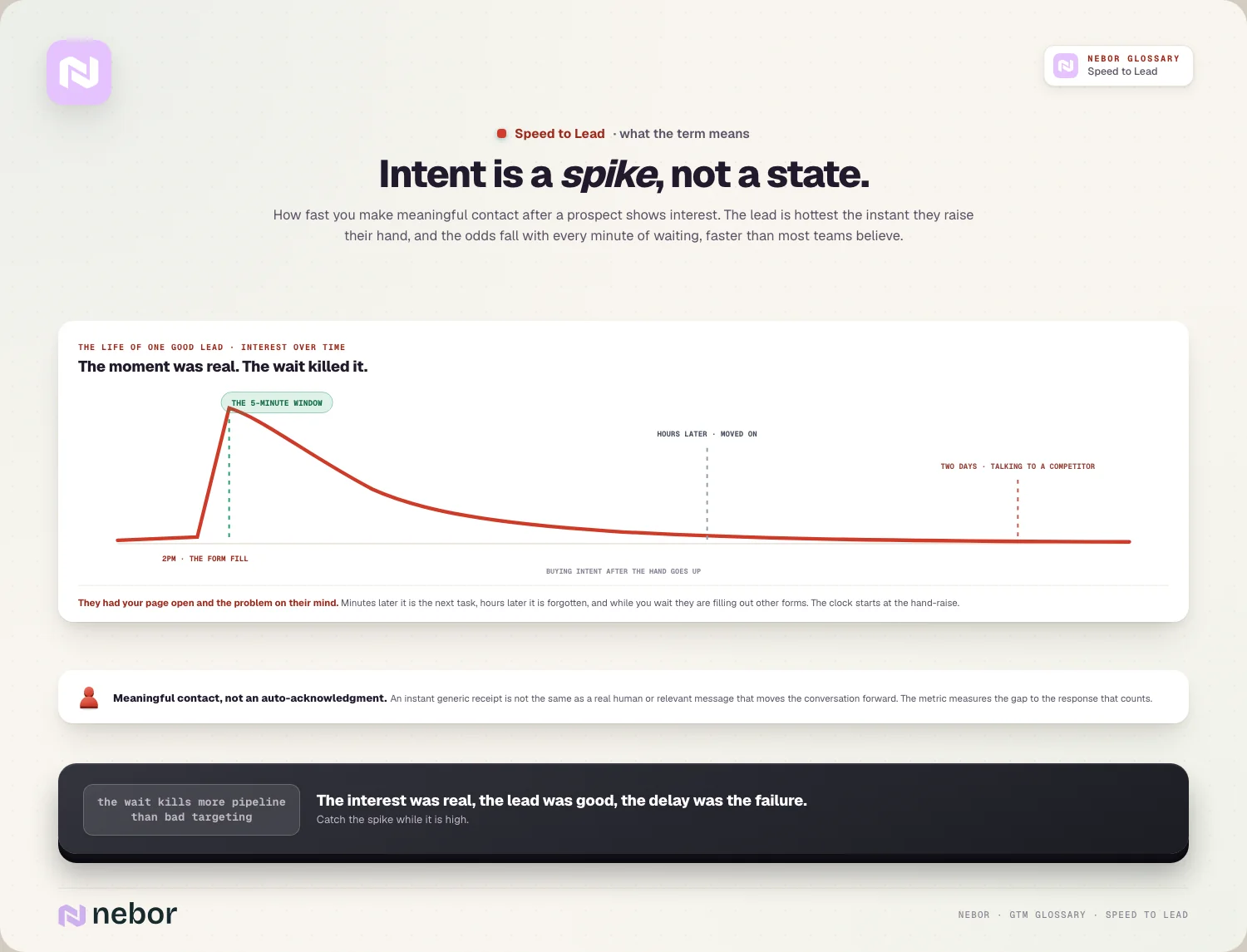
One thing we push clients on is that meaningful contact means a real human or a truly relevant message, and a hollow auto-acknowledgment counts for nothing. An instant "we got your request" email does nothing for that clock.
The prospect is waiting for a response that moves the conversation forward, and until they get one, your speed to lead clock is still ticking.
The numbers behind speed to lead are some of the wildest in sales
The numbers from the foundational research leave little room for argument. Responding within five minutes makes you around 100 times more likely to make contact and 21 times more likely to qualify a lead than waiting thirty minutes.
The effect is steepest at the very start. Responding within the first minute can drive a roughly 391% improvement in conversion, because you catch the prospect at peak interest.
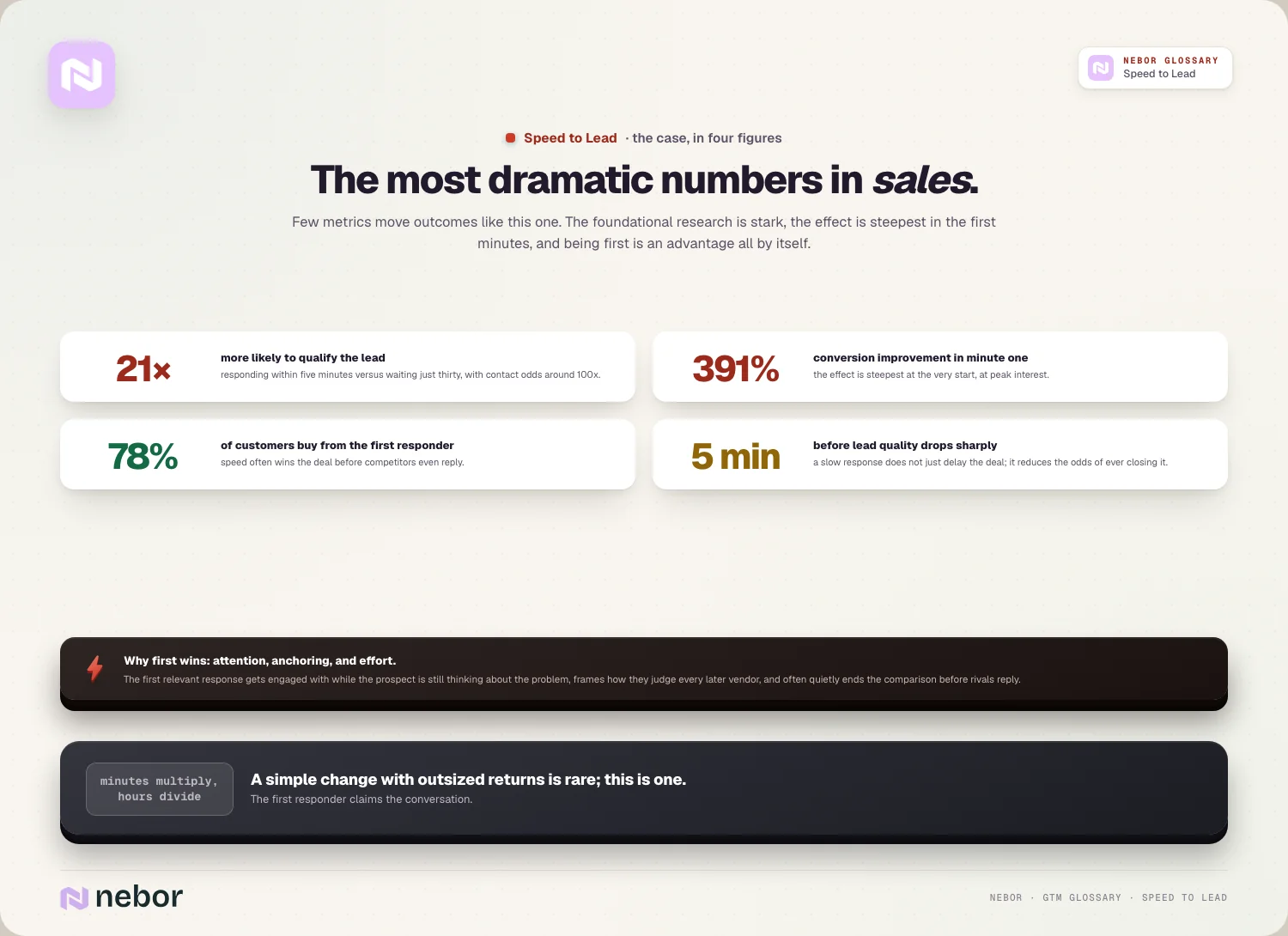
Being the first company to respond carries a prize of its own. Around 78% of customers buy from the first business that responds, so speed often settles the deal before your competitors even reply.
And after five minutes, lead quality drops sharply. A slow response does more than delay the deal. It shrinks your odds of ever closing it.
Why buying intent evaporates faster than your team thinks it does
When someone fills out a form, they're engaged right then. They have your page open, the problem is on their mind, and they're ready to talk in that specific window.
That window closes faster than most teams want to believe. Minutes later they've moved to the next task, hours later they've forgotten, and by the next day the urgency that drove them to act has faded.
They're also rarely talking only to you. While your lead waits in a queue, they're filling out other forms, and a competitor who responds first captures the attention you let cool.
Intent behaves like a spike that starts falling the moment it peaks. If you catch the spike while it's high, everything downstream gets easier, and if you miss it, you're doing outbound to someone who used to be inbound.
How slow the average company really is, and why that gap is your opening
B2B lead response time averages somewhere in the range of 40-plus hours, which puts the first response nearly two full days after the moment of peak interest.
Only about 23% of companies respond within five minutes. The overwhelming majority leave their best leads to go cold.
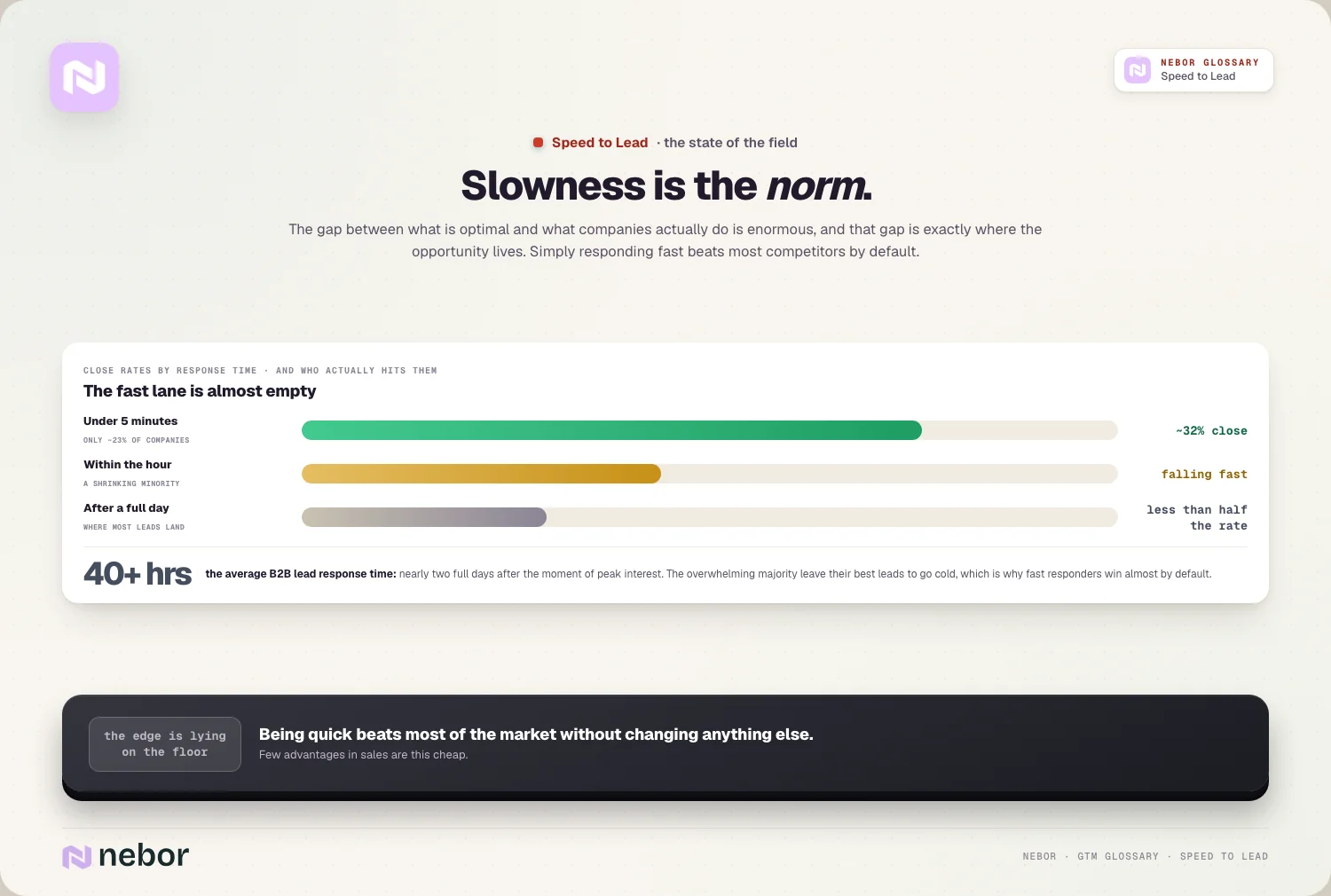
Leads contacted in under five minutes close at roughly 32%, more than double the rate of those contacted after a day.
When you read those three numbers together, the conclusion writes itself. Slowness is the norm, so simply responding fast puts you ahead of most of your competition without changing anything else about your motion.
Where speed to lead fits between your inbound and outbound motions
Every fast response is a small act of inbound-led outbound. A prospect shows inbound interest, and your quick, proactive reach is the outbound that capitalizes on it.
A form fill is only the most obvious version of the signal. A product qualified lead hitting a usage milestone, or a known account showing strong buying signals, deserves the same urgency.
You could call it the human half of signal-based selling. The signals tell you when a buyer is moving. Speed to lead is whether your team honors that timing or wastes it.
Why trying harder never fixes speed to lead, and what actually does
Plenty of teams hear these stats and resolve to just respond faster. In our experience that resolve survives about a week, because the problem is structural.
No human can keep an eye on every incoming lead. Your reps sleep, take meetings, and handle other work, so leads that arrive at the wrong moment go untouched until someone notices.
Manual routing adds a delay of its own. If a lead has to be seen, assigned, and picked up by hand, minutes or hours vanish in the handoffs before anyone reaches out.
The teams that respond in minutes have built systems for it, with automated lead routing that gets each lead to the right rep instantly and automation that handles the prospecting grunt work so a human only steps in where a human is needed.
The four components of a lead response system that answers in minutes
Building real speed to lead is a system design problem, and four components carry most of the weight.
The first component is instant routing, where a lead gets scored and sent to the right rep automatically the moment it arrives, so zero time is lost figuring out who owns it.
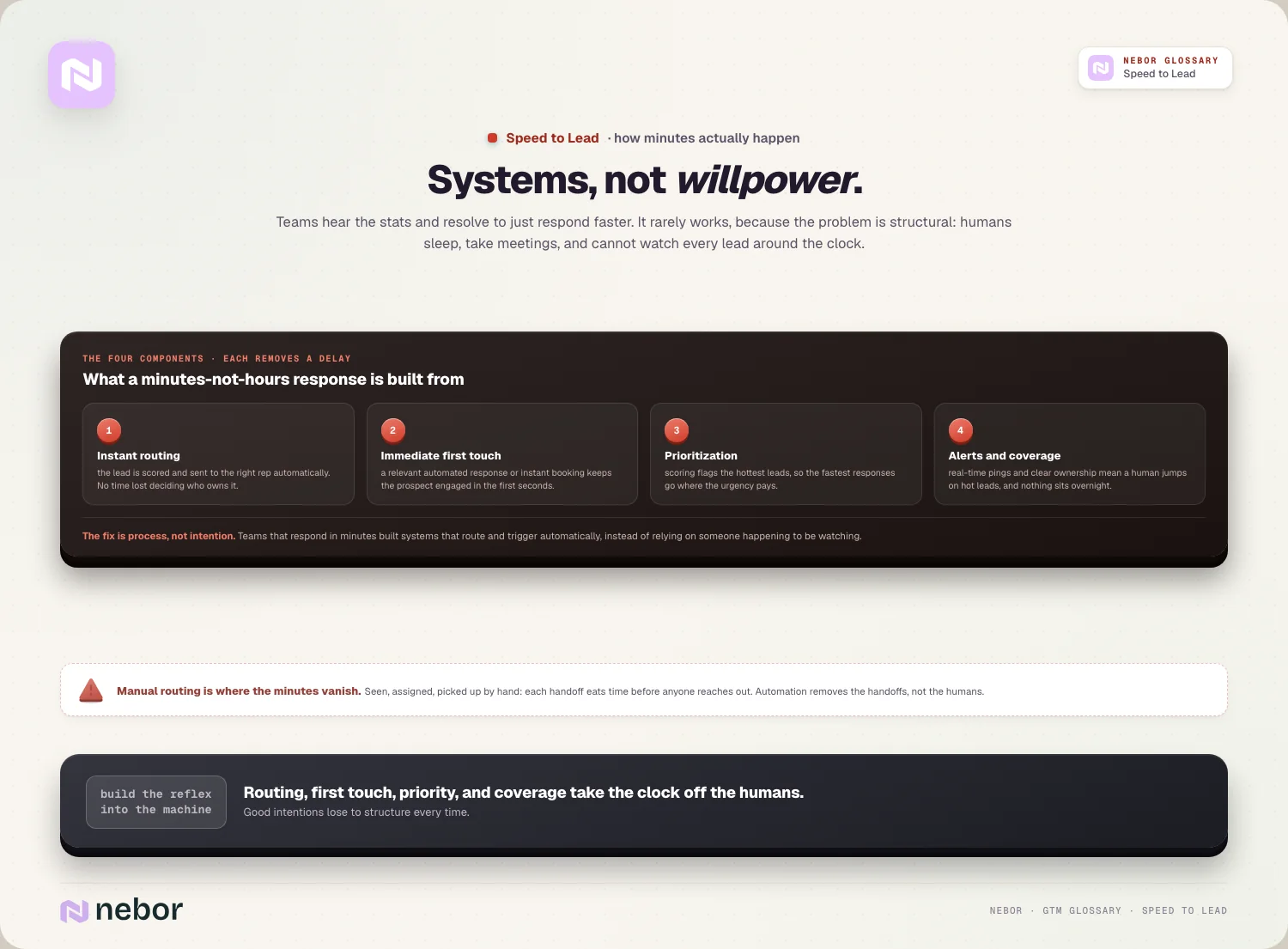
The second component is an immediate first touch. An automated but relevant first response, or an instant booking link, keeps the prospect engaged in the seconds after they act, before any rep is involved.
The third component is prioritization, where lead scoring flags the hottest leads so your fastest responses go to the prospects most worth the urgency.
The last component is alerting and coverage. Real-time alerts and clear ownership mean a human can jump on a hot lead fast, with coverage spread so nothing waits overnight.
How a fast first response ripples through the rest of your funnel
Speed to lead is an early lever, and early levers compound. Catching prospects at peak interest turns more leads into conversations, the first conversion in the whole pipeline.
That first conversion flows straight into your pipeline velocity, because more leads converting sooner shortens the cycle at its very start, where delays are cheapest to remove.
A fast first touch still needs a real motion behind it, because one quick reply rarely closes a deal alone. It has to hand off into a real multi-channel outreach cadence to go anywhere.
You'll see it in your reply rate too. People respond more when you contact them at the moment they wanted to hear from you.
Your outbound replies deserve the same urgency as your inbound forms
Speed to lead usually gets framed around inbound forms, but a warm reply to your outreach is just as perishable. When someone answers a cold email or accepts a LinkedIn message, they're engaged in that exact moment.
Waiting a day to respond lets that interest fade the same way a slow form follow-up does. And a positive reply is one of the warmest signals your team will ever get.
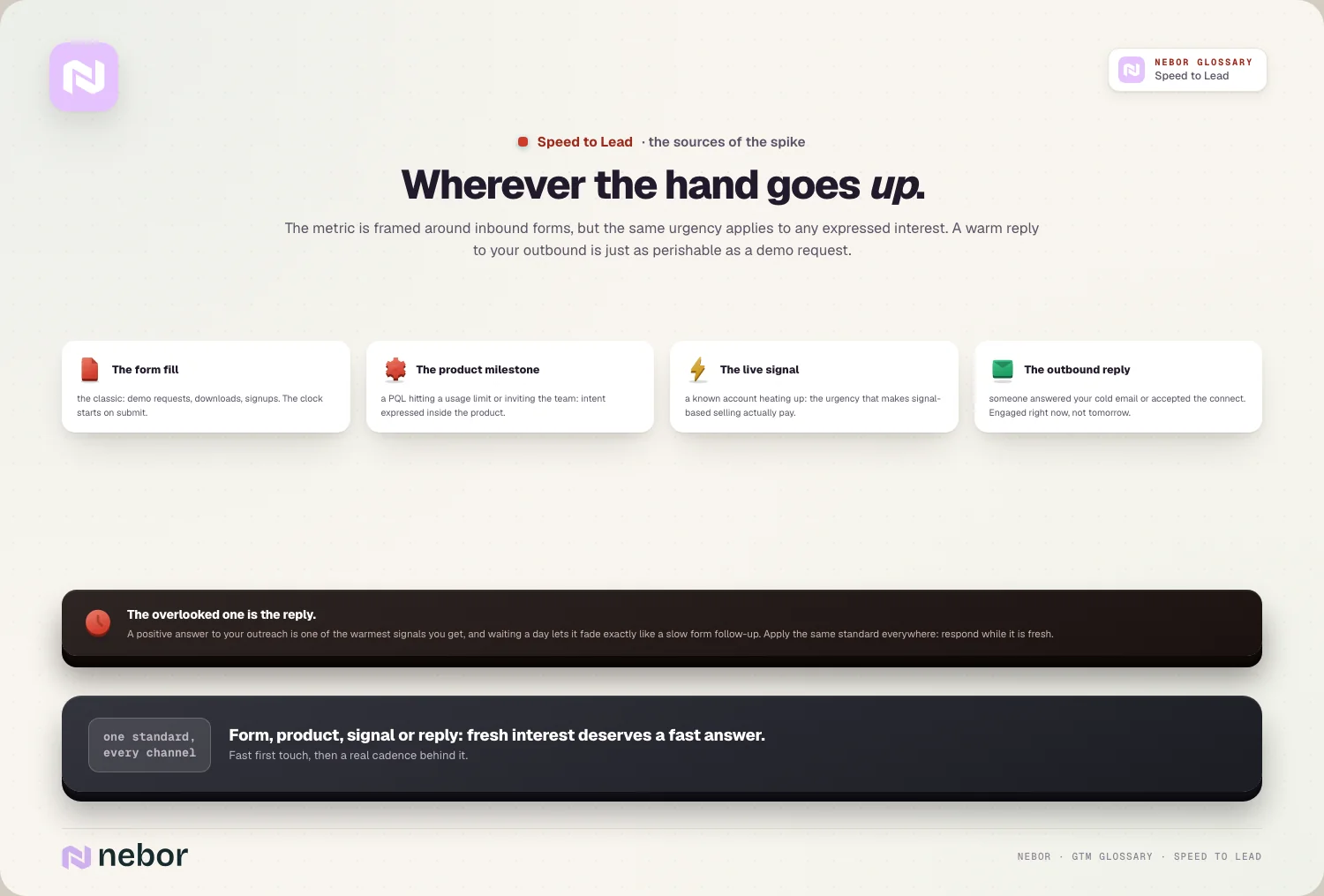
We think the framing should simply be expressed interest, wherever it shows up. A form fill, a product action, a reply to your sequence all deserve the same standard. Continue the conversation while it's fresh, because that's what turns a flicker of attention into a real one.
How to measure your real response time and where to attack the lag
Start by measuring your real number honestly. Teams routinely assume they're fast and then discover their average is hours, so the baseline usually stings, and that sting is useful.
Segment the measurement by lead type as well. Your speed on high-priority leads matters most, so track response time for hot leads separately and check your urgency is aimed where it pays.
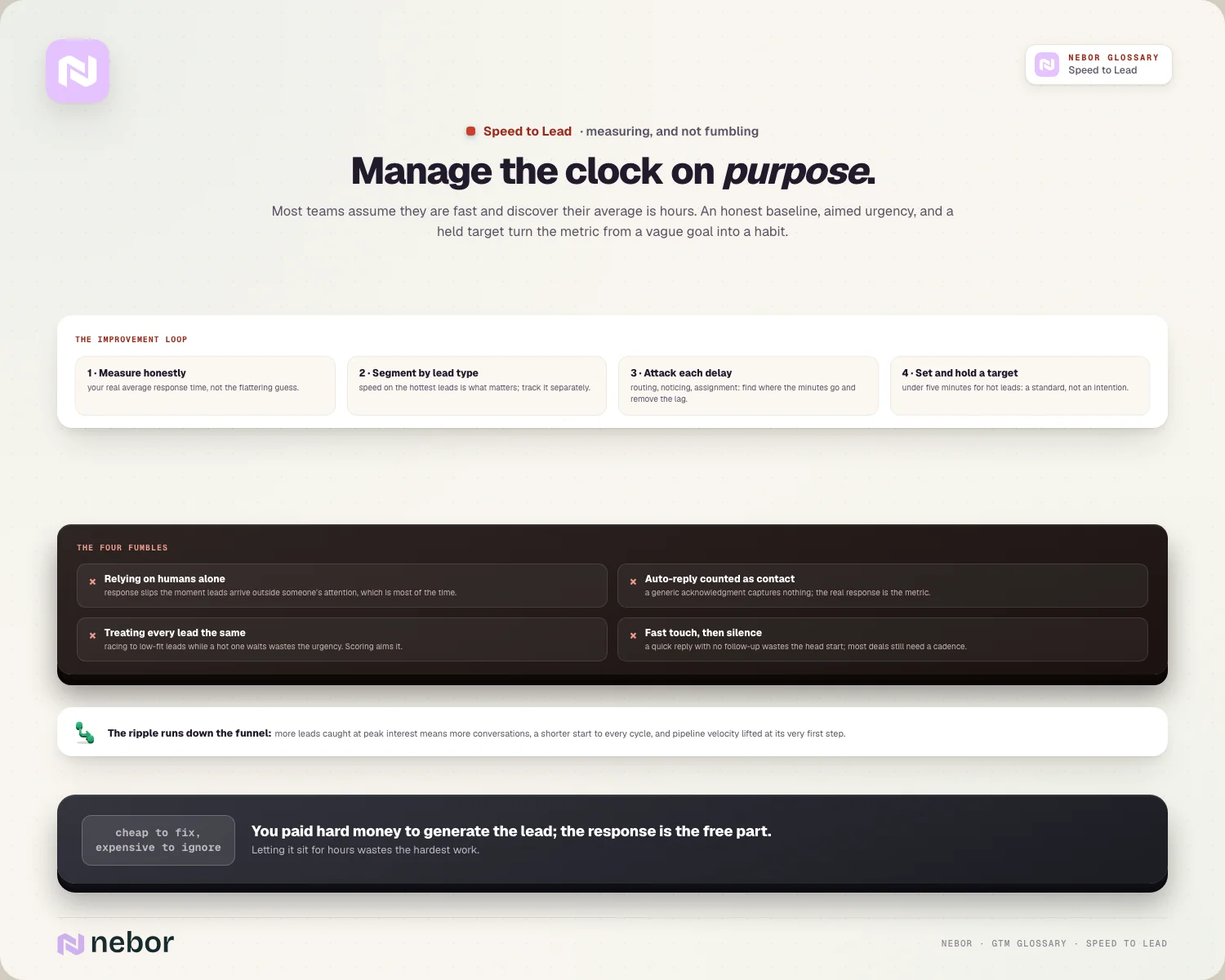
Then go after the delays one by one. Time gets lost in noticing the lead, in routing it, in assignment. Each source of lag has an automation or a clearer process that removes it.
Finally, set a target and hold it. A concrete window, say under five minutes for hot leads, beats a vague intention to be quick, because you can see when you missed it and ask why.
How fast is fast enough, and does replying in one minute look desperate
A question we get from clients is whether replying sixty seconds after a form fill makes you look like you were hovering over the inbox. In practice, buyers read it the opposite way. A fast, relevant response signals that this is what working with you feels like.
The worry only comes true when the fast response is empty. A templated "just checking in" sent within one minute feels robotic. A short note that references what they asked about, with a booking link, feels like service.
Fast enough also depends on the channel. Form fills and demo requests deserve minutes. A content download can warrant a softer touch later the same day, because the intent is real but weaker.
And if your buyers are in other time zones, a lead arriving at 11pm still needs an answer before morning. That's a coverage problem, and it's one more reason the fix is a system with automation in it instead of one more promise that someone will watch the inbox.
The mistakes that keep response times slow even on well-managed teams
Relying on humans alone tops the list. Without automation and routing, response times slip the moment leads arrive outside someone's attention, and that describes most of the day.
Confusing auto-replies with real contact comes next. An instant generic acknowledgment captures none of it, and the prospect who wrote to you is still waiting for a real answer.
Treating all leads the same wastes the urgency. Racing to respond to low-fit leads while a hot one waits means your speed is aimed at the wrong targets, and scoring exists to prevent exactly that.
And a fast first touch with no follow-up squanders the head start. Most deals still need a persistent cadence behind that quick opening move.
Why the first company to respond wins so much more than its share
Part of the first-responder effect is simple attention. When a prospect is actively thinking about the problem, the first relevant response gets engaged with, while later ones arrive after the moment has passed.
Another part of it is anchoring, because the first vendor to respond frames how the prospect thinks about the solution, so every later competitor gets measured against a standard you set.
And some of it comes down to plain effort, because a prospect who gets a fast, helpful answer has less reason to keep shopping, so being first can end the comparison before rivals even reply.
Responding fast does more than catch the intent while it's warm. It claims the conversation before anyone else gets the chance, and most buyers reward that with the deal.
What we'd tell you to do about your speed to lead this quarter
If you're spending real money to generate leads and then letting them go cold for hours, you're throwing away the hardest-won part of the work. Responding fast is one of the cheapest ways we know to win more deals.
Measure your true response time this week, automate the routing and the first touch, and give your hot leads a five-minute standard that the team holds.
None of that requires new headcount, which is why we bake this into every inbound meeting workflow we build. The whole design exists to engage interest the moment it appears, inside a wider go-to-market system, before it has any chance to cool.
Share this post
Inbound
Automation
Scheduling
Glossary
Related glossary items
Understanding the core GTM concepts




Ready to build your pipeline