

In this post:
Most lead scoring is built on hunches. Someone in marketing decides a job title is worth 10 points, a webinar signup is worth 5, and a pricing-page visit is worth 15, then those numbers get locked into the system.
The problem is that nobody really knows if those points are right. They're educated guesses about which signals predict a sale, and they rarely get checked against what closes.
Predictive lead scoring replaces the guessing with data. It uses machine learning to analyze your past deals and figure out which traits and behaviors truly predict conversion, then scores new leads on that basis.
So instead of you deciding what matters, the data tells you. Predictive lead scoring learns from your real history of wins and losses, which makes its scores far more accurate than a hand-built point system.
TL;DR
Predictive lead scoring uses AI and machine learning to score and rank leads by their likelihood to convert, based on patterns learned from your historical data rather than manually assigned points.
Traditional scoring is subjective and static, because people guess which signals predict a sale and the rules never adapt, so the scores drift out of sync with reality as buyer behavior changes.
Predictive models flip that dynamic around by studying your past wins and losses, finding the real predictors, and updating automatically as new data arrives, so teams using them report meaningfully higher conversion.
The one dependency to respect is that predictive scoring is only as good as your data. It needs enough clean historical deals to learn from, so it rewards teams with solid data and struggles for those without it.
What is predictive lead scoring, and where does the score come from?
Predictive lead scoring is a way of ranking leads by how likely they are to become customers, using a model trained on your own data. The output is a score, but the way it's produced is the whole story.
Instead of a person assigning points, a machine learning model studies your history. It looks at the leads that converted and the ones that didn't, then learns the patterns that separate them.
Those patterns can involve dozens of factors at once. Company size, industry, job title, the source of the lead, and behavioral signals like site visits and email engagement all feed in together.
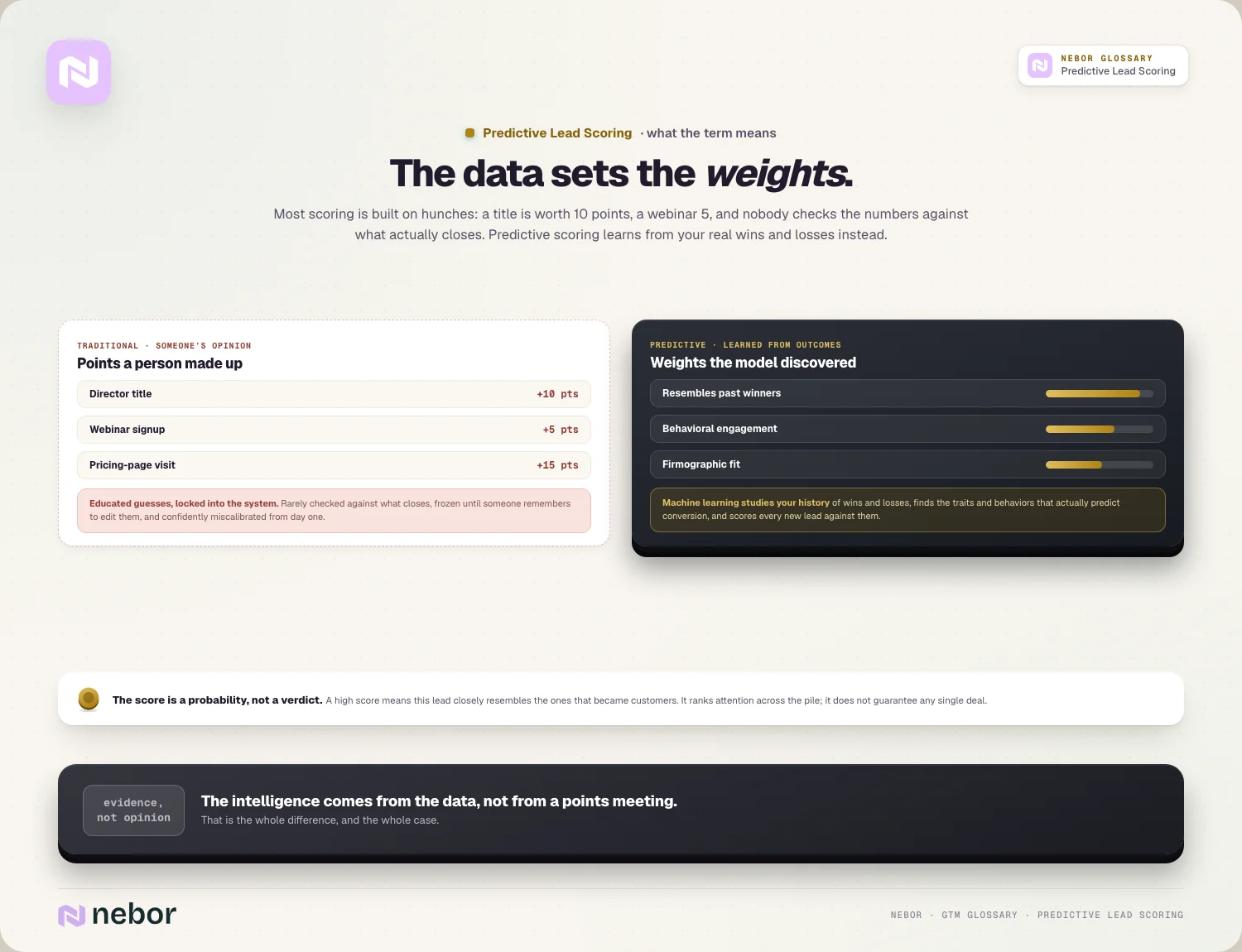
The model weighs all of that automatically and produces a score for each new lead. A high score means this lead closely resembles the ones that became customers in your past.
The key difference is where the intelligence comes from. The data decides the weights instead of a human, which removes the guesswork that makes traditional scoring so unreliable.
One clarification saves a lot of confusion later. The score is a probability based on resemblance to past winners instead of a guarantee that a lead will buy, so it's a way to rank attention across your list.
How is predictive scoring different from traditional lead scoring?
The cleanest way to understand predictive scoring is next to the traditional kind. They aim at the same goal, ranking leads, through completely different methods.
Traditional lead scoring is rule-based at its heart. A person sets fixed if-then rules, like add 10 points for a director title, and those rules stay put until someone manually changes them.
That approach is easy to set up but rigid. The rules reflect one team's assumptions at one moment, and they don't adapt as your market, product, or buyers shift over time.
Predictive scoring is model-based instead, learning the weights from data and adjusting them as new deals close, so the scoring stays current without anyone editing rules by hand.
The practical upshot is accuracy and adaptability. Traditional scoring slowly drifts out of date, while predictive scoring improves as it sees more outcomes, and that gap widens as your volumes grow.
Why does traditional rule-based scoring break down as time passes?
The reasons rule-based scoring fails explain the whole case for predictive, and in our experience the problems are baked into the method itself. We tell clients this is rarely about effort, because even a carefully maintained point system carries the same flaws.
Subjectivity is at the root of it, because the points are someone's opinion about what predicts a sale, and opinions are often wrong, so the model can be confidently miscalibrated from day one.
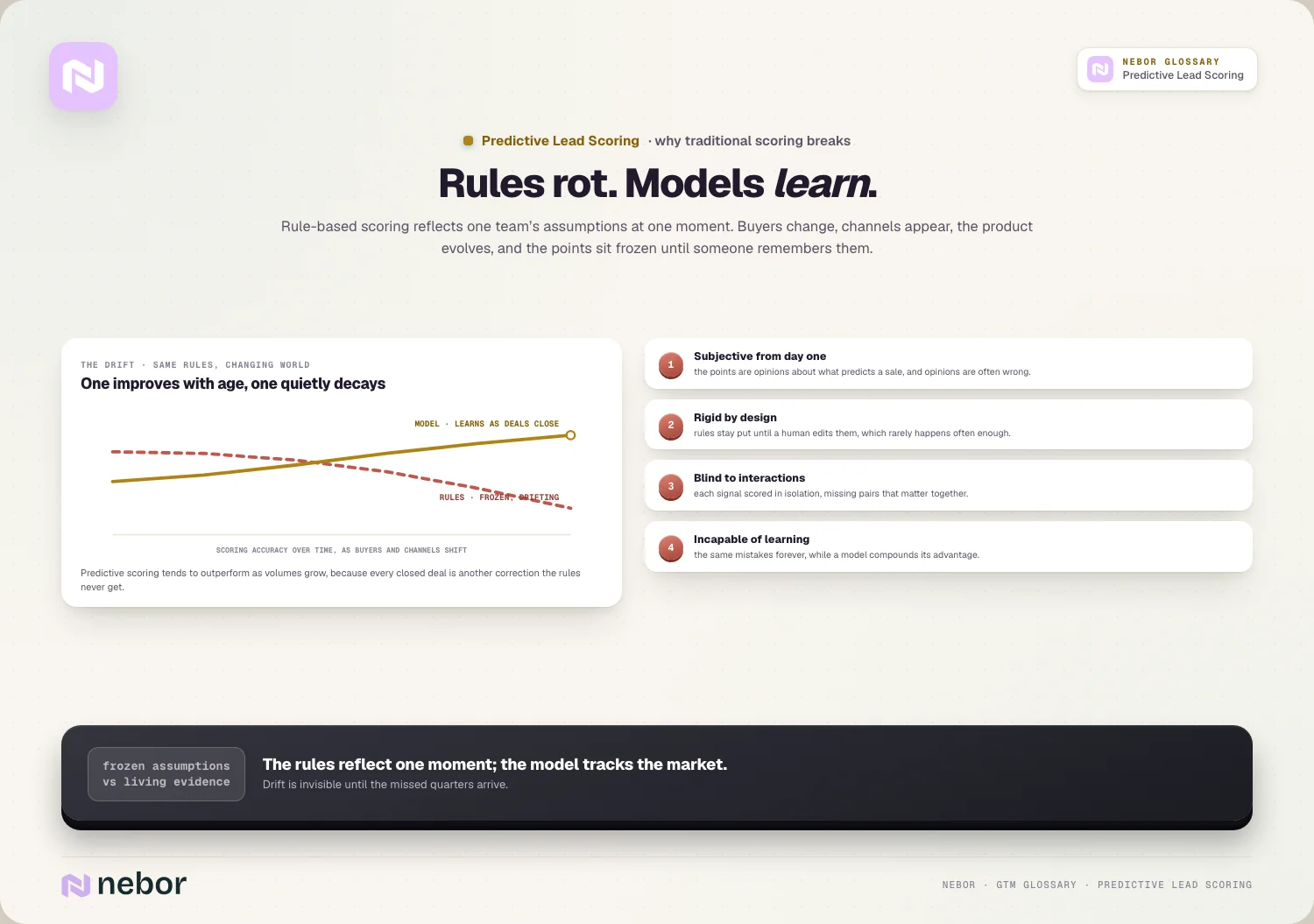
Rigidity follows close behind, because buyer behavior changes, new channels appear, and your product evolves, but the rules stay frozen until a human remembers to revisit them, which rarely happens often enough.
Blindness to interactions is the subtler flaw, because a simple point system treats each signal in isolation, missing the fact that two signals together can mean far more than either alone.
And the deepest problem is that it never learns. A rule-based system makes the same mistakes forever, while a predictive model gets sharper every time a deal closes, which compounds into a real advantage.
How does a predictive model learn what to score from your history?
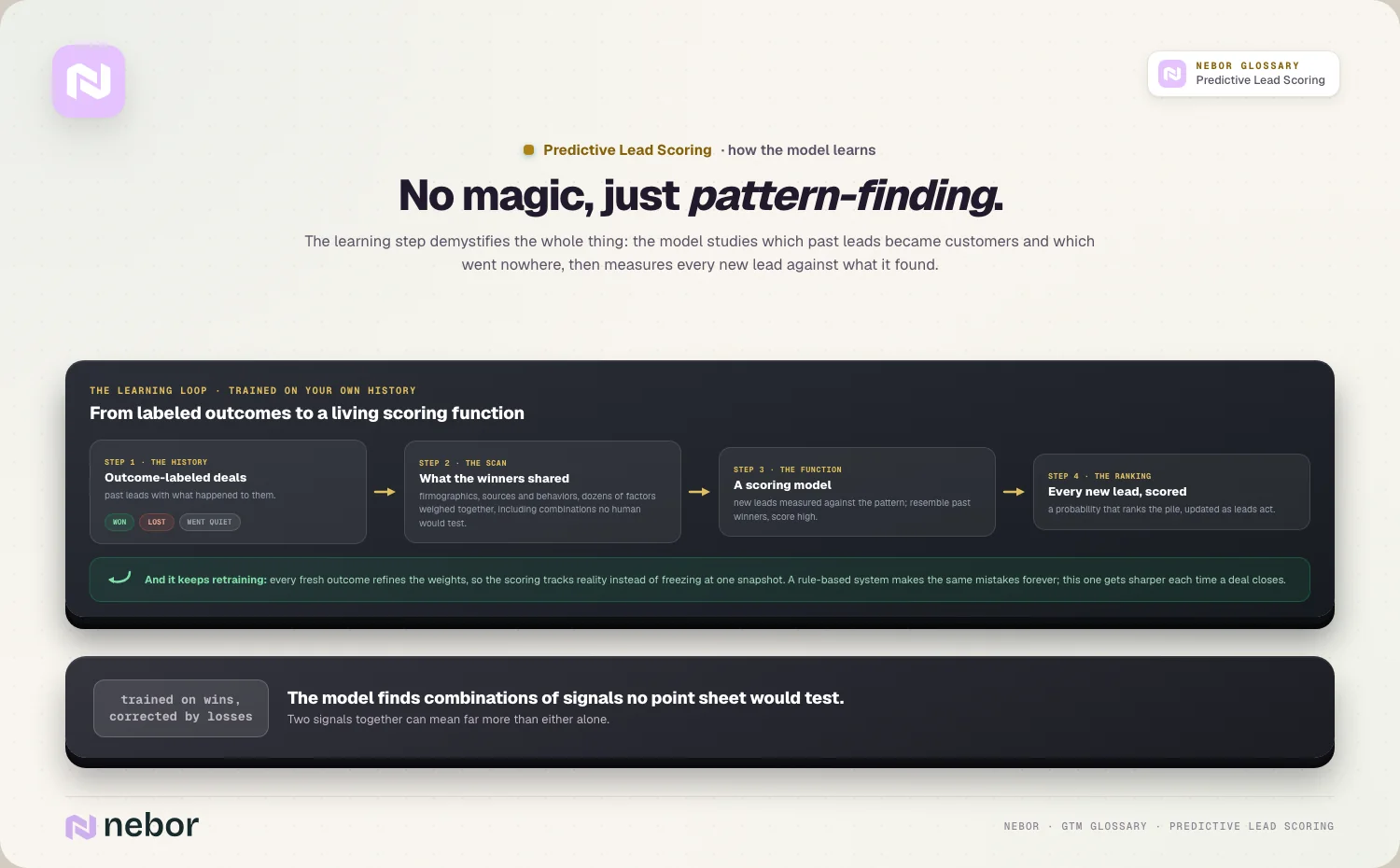
Understanding the learning step demystifies the whole thing, because there's no magic involved, just pattern-finding across your own deal history.
It starts with your historical data, the record of past leads and what happened to them. The model needs to know which leads became customers and which went nowhere, because that record is what it learns from.
Then it looks for what the winners had in common. It scans across firmographic traits, sources, and behaviors to find the combinations that show up disproportionately in deals that closed.
From those patterns it builds a scoring function. New leads get measured against it, so a lead that matches the profile of your past winners gets a high score automatically.
And it keeps updating as it goes, because as fresh outcomes arrive, the model retrains and refines its weights, so the scoring tracks reality instead of freezing at one snapshot in time.
Why is good data the real make-or-break for predictive scoring?
Here's the honest catch nobody selling a tool emphasizes. Predictive lead scoring is a data exercise first, and a weak data foundation makes it useless or misleading.
The model learns from history, so it needs enough past deals to find real patterns. A company with only a handful of closed deals doesn't have the volume for the math to mean much yet.
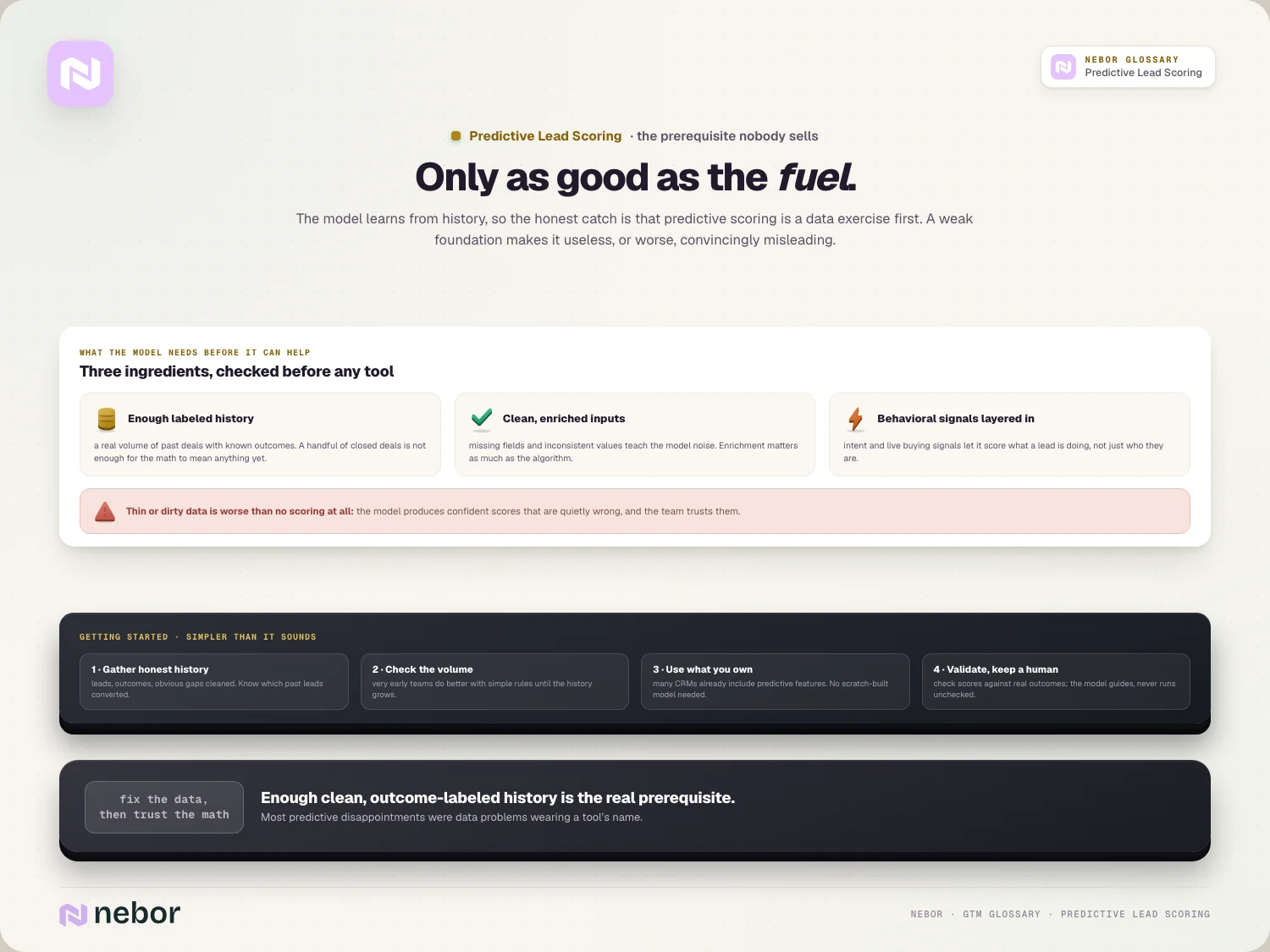
It needs clean inputs just as much. If your records are full of missing fields and inconsistent values, the model learns from noise, so data enrichment matters as much as the algorithm does.
The richest models pull in behavioral signals too. Layering in intent data and live buying signals lets the model score not just who a lead is but what they're actively doing.
So before chasing a predictive tool, look at your data. Enough clean, outcome-labeled history is the real prerequisite, and a common reason predictive scoring disappoints is data that was never ready.
How does predictive scoring weigh fit and intent signals together?
One thing predictive models do well is blend signals that humans tend to score separately. The clearest example is fit and intent.
Traditional setups often track these on parallel tracks, which is the heart of the fit score versus intent score distinction. One measures how well a lead matches your ideal, the other measures how interested they are.
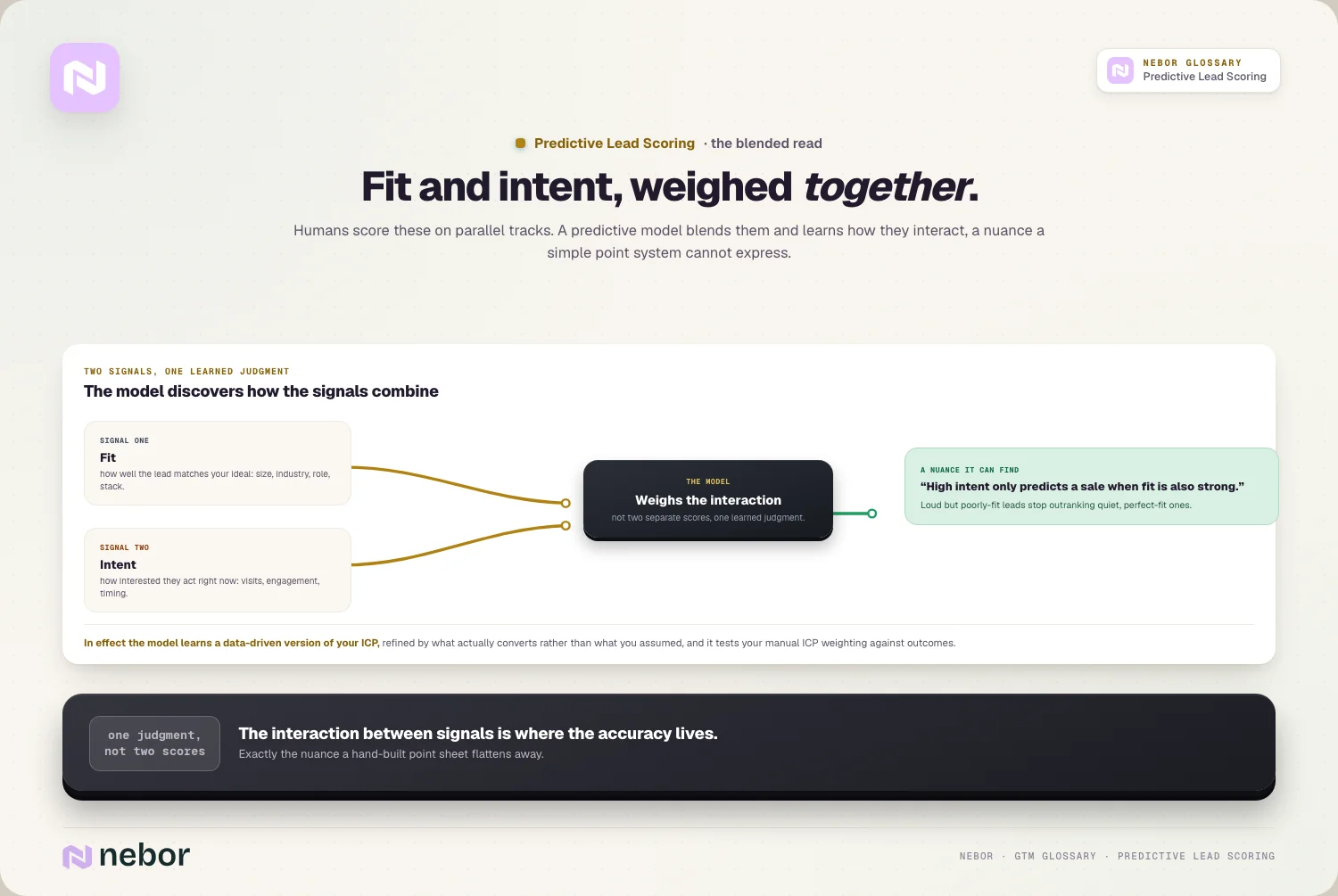
A predictive model can weigh both at once and learn how they interact. It might discover that high intent only predicts a sale when fit is also strong, a nuance a simple point system would miss.
This connects directly to your ideal customer profile. The model effectively learns a data-driven version of your ICP, refined by what converts instead of what you assumed.
It can also sharpen a formal ICP scoring model. Where a manual ICP score reflects your beliefs, a predictive layer tests those beliefs against outcomes and adjusts the weighting accordingly.
What does predictive lead scoring change about how reps work?
The point of a better score is a better-spent day. Predictive scoring changes where reps put their limited time.
The obvious win is prioritization of the day itself. When leads are ranked by real likelihood to convert, reps work the best ones first instead of treating every lead as equal or chasing the loudest one.
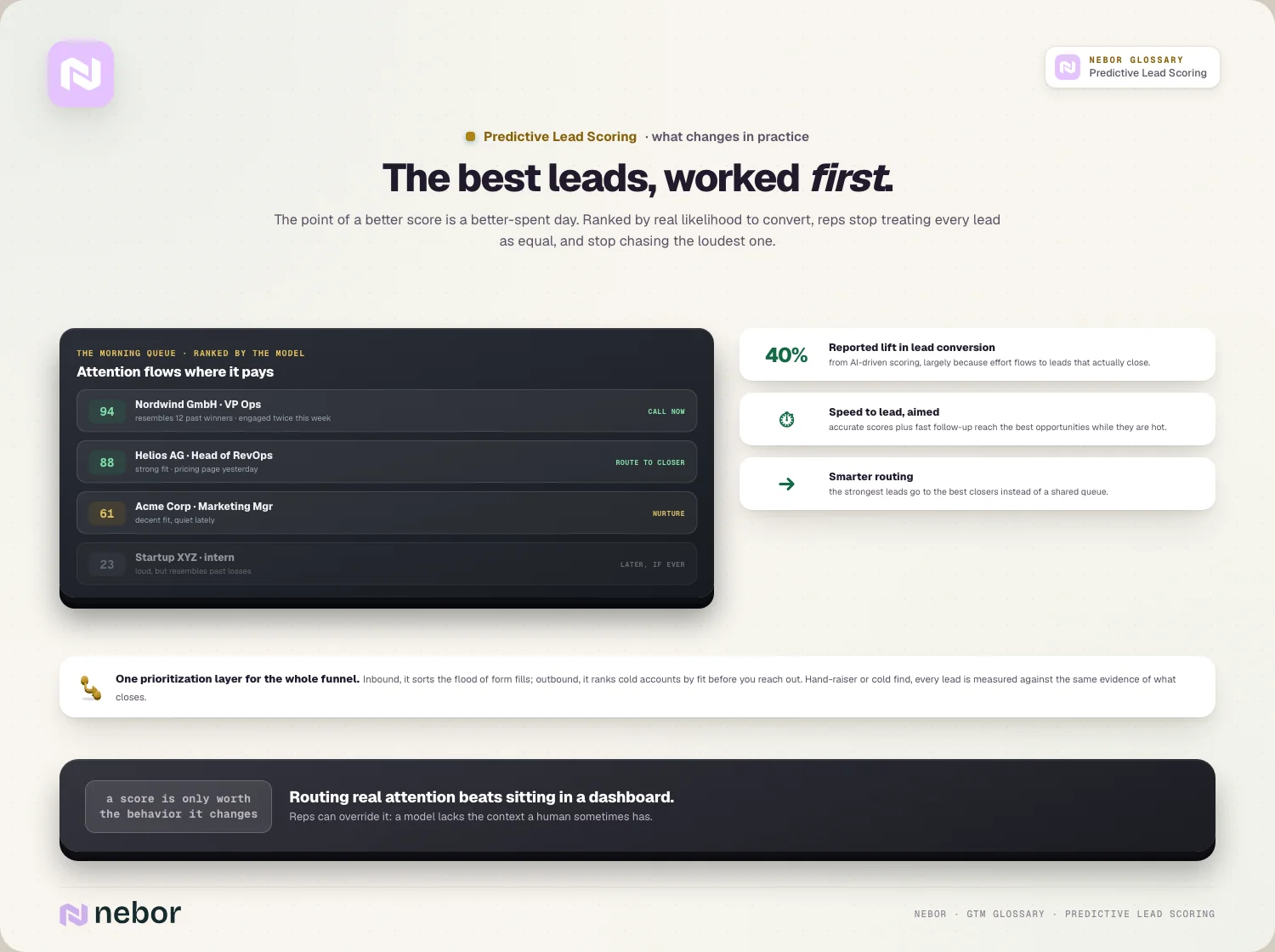
That focus shows up directly in conversion. Companies adopting AI-driven scoring have reported up to a 40% boost in lead conversion rates, largely because effort flows to the leads most likely to close.
It also speeds response on the leads that matter. Pairing accurate scores with fast follow-up, the heart of speed to lead, means your best opportunities get reached while they're still hot.
And it feeds smarter routing downstream, because accurate scores let you send the strongest leads to your best closers, so the right opportunities reach the right reps instead of waiting in a shared queue.
How does predictive scoring fit the rest of your go-to-market?
Predictive lead scoring works best understood as a piece of intelligence that makes the rest of your motion sharper, wired into everything around it.
It improves what happens downstream of it. Better-prioritized leads convert at higher rates and move faster, which lifts your pipeline velocity by raising win rates and shortening cycles.
It also depends on automation to be useful at scale. Scores only help if they trigger action, so the same systems that automate sales prospecting can act on predictive scores automatically.
And it slots into the broader engine. Inside a connected go-to-market system, predictive scoring is the layer that decides where attention goes, so the whole machine spends effort where it pays off.
The theme is that a score is only valuable if it changes behavior. Predictive scoring pays for itself when it routes real attention and action, and a score that just stalls in a dashboard changes nothing.
Does predictive scoring work for inbound and outbound leads alike?
People usually associate lead scoring with inbound, ranking the flood of form fills and signups. Predictive scoring helps there, but it's just as useful on the outbound side.
On inbound, it sorts the incoming flow of interest. When dozens of leads arrive, the model tells you which ones resemble past customers, so reps chase the promising ones instead of working the list top to bottom.
On outbound, it sharpens targeting before you ever reach out. The same model that scores inbound leads can rank cold accounts by fit, so your outbound effort goes to the prospects most likely to convert.
That makes it a bridge between the two motions. Whether a lead raised their hand or you found them cold, predictive scoring measures them against the same evidence of what closes.
So it works as a prioritization layer for your whole funnel. It ranks attention across inbound and outbound alike, and that shared ranking is what keeps a busy team focused on the deals worth their time.
How do you get started with predictive lead scoring without a data team?
The idea can sound like it requires a data science team, but most companies can start more simply than they fear, and the path we walk clients through is incremental.
Honest data comes before anything else you might buy. Gather your history of leads and outcomes, clean up the obvious gaps, and make sure you know which past leads converted, because that record is the fuel the model needs.
Confirming you have enough volume comes next, because predictive scoring needs a reasonable number of past deals to find patterns, so very early-stage teams may do better with simple rules until their history grows.
Then lean on the tools you likely already have, because many CRMs and marketing platforms include predictive scoring features, so you often don't need to build a model from scratch to begin.
Validation is what closes the loop on all of it. Check whether the scores line up with real outcomes, and keep a human involved, so the model guides decisions rather than making them unchecked.
What are the common mistakes teams make with predictive lead scoring?
Predictive scoring can disappoint, and we keep seeing it fail in the same few avoidable ways across the setups we audit. Knowing them upfront helps you get real value from it.
Deploying it on thin or dirty data tops the list, because a model trained on too few deals or messy records produces confident scores that are simply wrong, which is worse than no scoring at all.
Treating it as a black box you never check comes next, because even a good model needs monitoring, and you want to know whether its scores still predict outcomes as your market moves.
Expecting the tool to supply strategy is the deeper one, because a frequent reason Clay and similar implementations fail is teams hoping software will replace thinking they never did, and scoring is no exception.
And ignoring the human layer rounds out the set, because predictive scores should guide reps without handcuffing them, and a rep's direct knowledge of an account can rightly override a model that lacks that context.
Why letting your own history rank your leads beats another round of guessing
Predictive lead scoring matters because it answers a question teams have been guessing at for years, which is which leads deserve your time. It trades opinion for evidence, and that trade pays every day.
Its real strength is that it learns. Instead of freezing one team's assumptions into static rules, it studies what truly converts and keeps adjusting, so the scoring gets smarter as your business does.
The honest qualifier is that it lives or dies on data. With enough clean history and real signals, it sharpens your whole motion, and without that foundation, it just dresses up bad inputs in confident numbers.
So if your team is drowning in leads and unsure which to chase, the fix usually isn't more leads or more rules. It's letting your own history tell you where to look, which is exactly what predictive lead scoring is built to do.
The payoff is quieter than a flashy new channel, but it lasts. A team that consistently works its best leads first will outperform one that treats every lead the same, quarter after quarter.
Share this post
AI
Data
RevOps
Glossary
Related glossary items
Understanding the core GTM concepts




Ready to build your pipeline











