

In this post:
Net revenue retention gets all the attention, and it can hide a serious problem. A company can post a healthy net retention number while bleeding customers underneath, because a few big expansions mask all the churn.
Gross revenue retention strips that disguise away. It measures only what you kept, ignoring expansion entirely, so it can't be inflated by upsells. That makes it the more honest read on whether your customer base is truly holding together.
Gross revenue retention, or GRR, is the percentage of recurring revenue you keep from existing customers over a period, after subtracting churn and downgrades but excluding any expansion. It shows how much of your base you retain, full stop.
GRR reveals the stability of your revenue base. Where net retention asks whether your existing customers are growing, GRR asks the more fundamental question of whether you're keeping them in the first place.
TL;DR
Gross revenue retention measures the share of recurring revenue you keep from existing customers after churn and downgrades, with expansion excluded entirely.
It's the honest retention number, because unlike net retention, GRR can't be inflated by upsells, so it shows whether your base is genuinely stable.
It caps at 100%, because it only counts losses. The best you can do is keep your whole base, which makes GRR a pure measure of how much you're losing.
The rule to hold onto is that GRR and net retention must be read together. A strong net number can hide a weak gross one, where expansion masks heavy churn underneath, which is a dangerous combination.
So what is gross revenue retention, exactly, and what does it exclude?
Gross revenue retention measures how much of your existing recurring revenue you hold onto over a period. It counts only the losses, churn and downgrades, with no credit for growth.
The formula takes a minute to work out. You take your starting recurring revenue, subtract what you lost to churn and downgrades, and divide by the starting figure, which gives the percentage you retained.
The defining trait is what it excludes. GRR deliberately ignores expansion revenue, so it isolates pure retention without any offsetting growth from upsells or cross-sells.
This is why it caps at 100%. The best possible GRR is keeping everything you started with, and with no expansion to push it higher, it can only land at or below 100%.
So GRR amounts to a measure of leakage from your revenue base. It tells you what fraction of that base you held onto over the period, which is the cleanest possible read on pure retention.
How is GRR different from the net revenue retention next to it?
The distinction between GRR and net retention is the whole point, and precision here pays, because they measure related but different things.
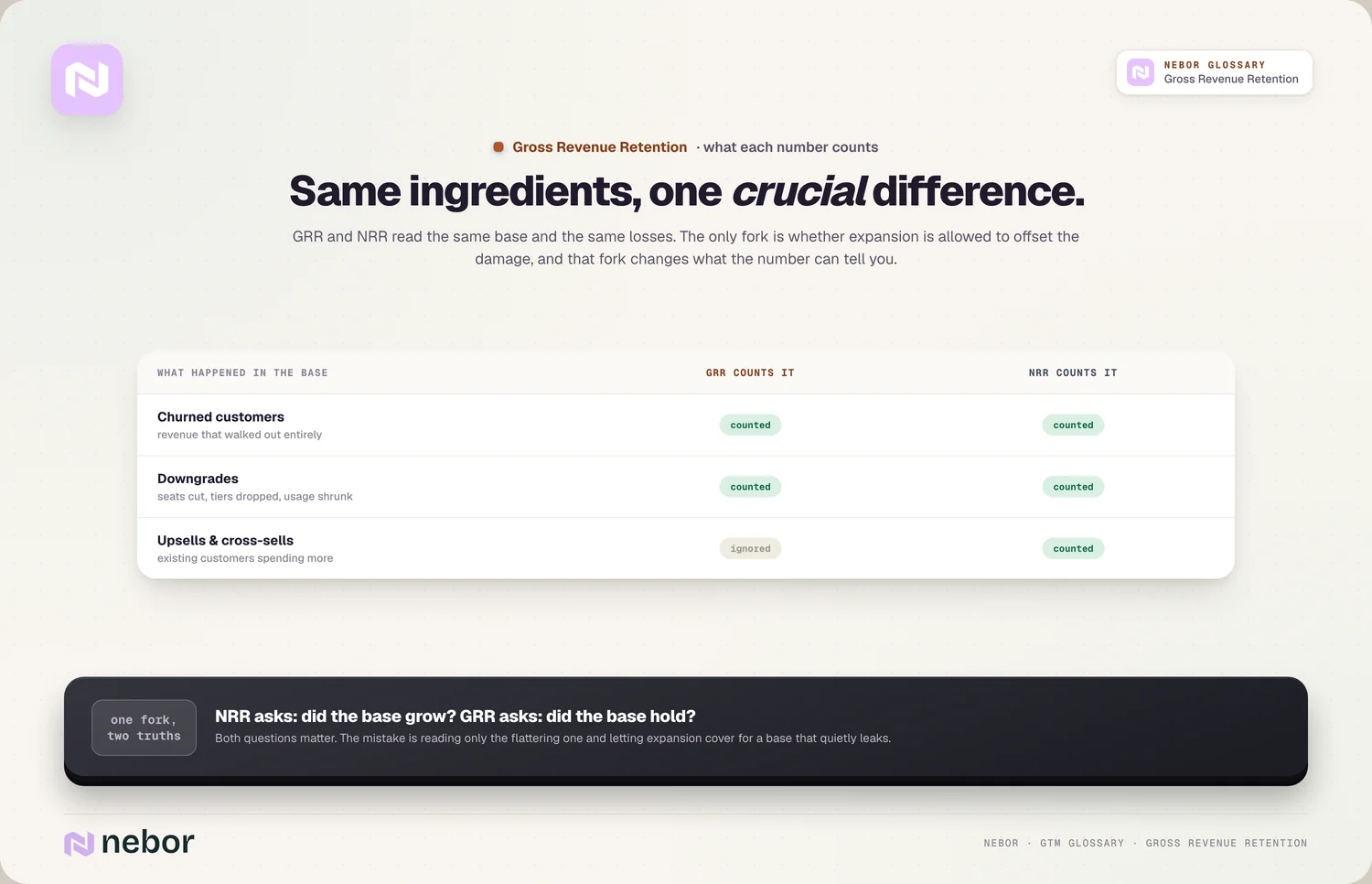
Net revenue retention includes expansion in the math. It counts churn, downgrades, and upsells together, so it can exceed 100% when existing customers grow.
GRR excludes expansion from the picture completely. It counts only the losses, so it can never exceed 100% and reflects pure retention without any growth masking it.
A useful metaphor captures the difference between them. If net retention tells you whether your boat is moving forward, GRR tells you how fast it's taking on water, and you can be moving forward while sinking.
So the two answer different questions about the same base. Net retention asks whether your base is growing, GRR asks whether you're keeping it, and a healthy business needs good answers to both.
Why is GRR the more honest of the two retention numbers you track?
GRR is harder to fool than net retention, and that's its main value, because it can't be dressed up by expansion. We tell clients to check it first for exactly this reason.
Net retention can hide real churn underneath. A few large expansions can push net retention above 100% even while you're losing many customers, so the headline number looks fine while the base erodes.
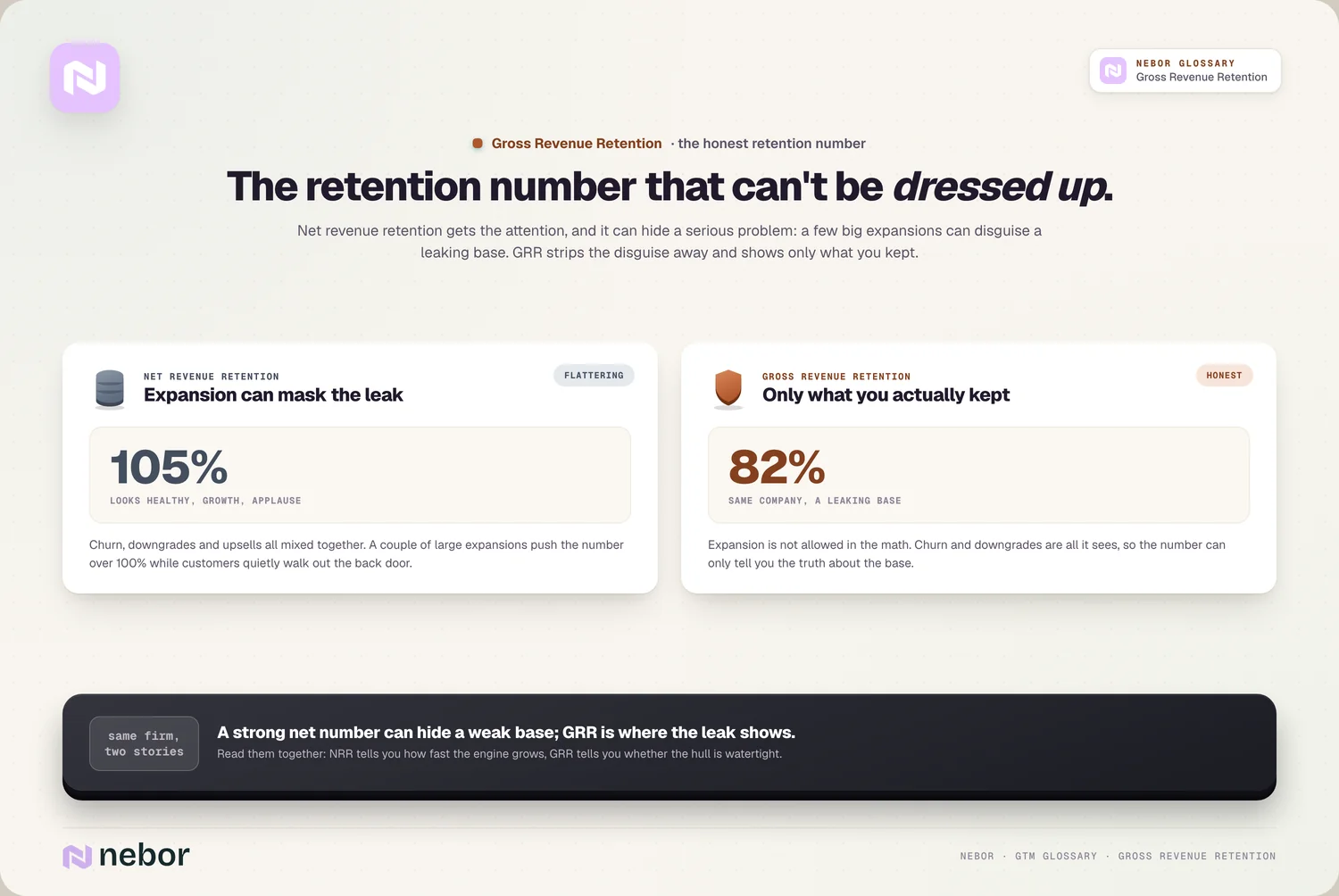
GRR exposes exactly that kind of masking. Because it ignores expansion, GRR shows the churn directly, so a weak GRR alongside a strong net number reveals the masking immediately.
The dangerous combination is visible only in GRR. Strong net retention with weak GRR means expansion is papering over heavy churn, which is a fragile position that net retention alone would hide.
So GRR is the honesty check on your retention. It's the one number that can't be inflated, so you read it alongside the more flattering net figure.
What counts as a good GRR for a business shaped like yours is?
Benchmarks help you judge your number, and they vary by who you sell to, though the bar is fairly clear.
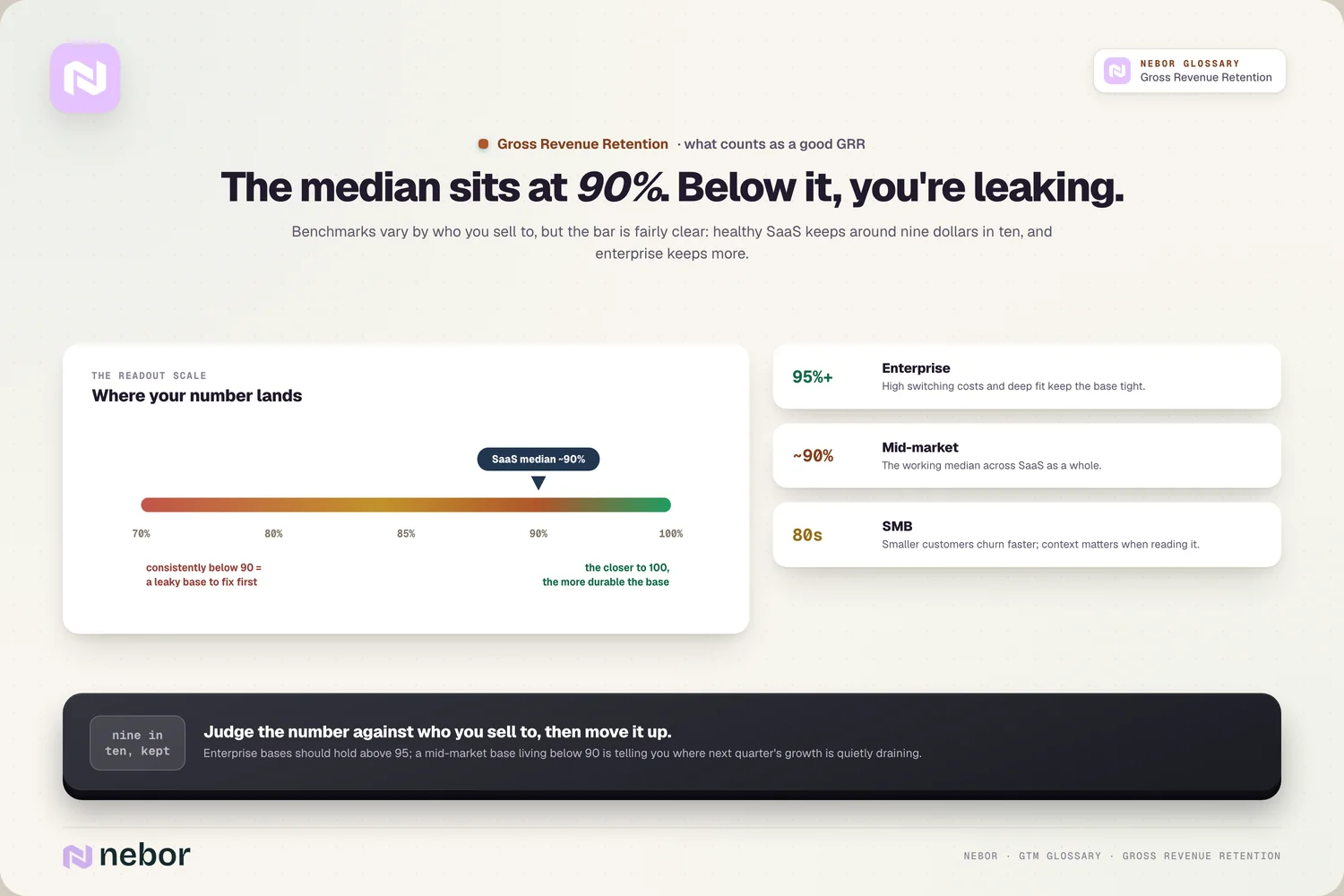
The median is higher than many expect. Across SaaS, the median gross retention rate is around 90%, so consistently below that signals a real retention problem.
It varies by segment in predictable ways. A good GRR is around 90% or higher for enterprise, 85 to 90% for mid-market, and 80 to 85% for SMB, because smaller customers churn more.
Contract value matters alongside the segment you serve. GRR tends to improve as average contract value rises, partly because larger deals produce better-fit, stickier customers, so retention and deal size are linked.
So judge GRR against your own segment and aim as high as you can. Because it caps at 100%, every point of GRR is a point of revenue you didn't lose, which makes even small improvements truly valuable.
How does GRR relate to the churn numbers you're already tracking?
GRR and churn are closely connected, because GRR amounts to churn expressed as retention.
GRR is the mirror image of revenue churn. Where revenue churn measures the revenue you lost, GRR measures the revenue you kept, so they're two views of the same reality.

It reflects the customer churn in your data too. A high customer churn rate drags GRR down, because losing customers means losing their revenue, though GRR weights losses by dollars rather than logos.
The two together tell the fuller story. Customer churn shows how many you lose, GRR shows how much revenue that costs, and reading both reveals whether you're losing small accounts or large ones.
So GRR is the revenue-weighted view of retention. It captures the dollar impact of churn and downgrades, and that dollar impact is what ultimately matters most for the health of the business.
Why does GRR depend so heavily on customer fit at the point of sale?
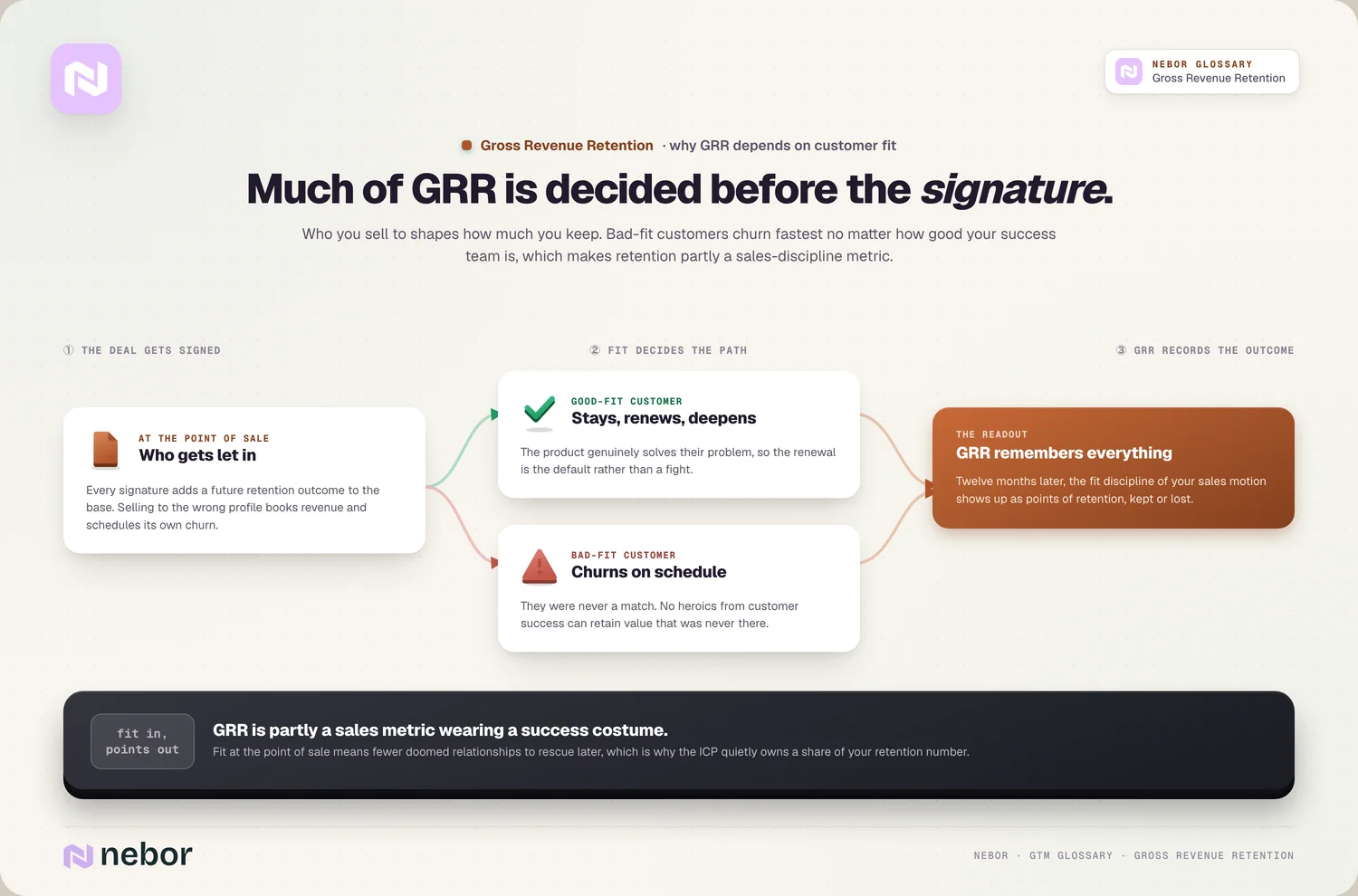
A subtle truth about GRR is that much of it is determined before a customer ever signs. Who you sell to shapes how much you keep.
Bad-fit customers are always the fastest to churn. If you sell to customers who were never a great match, they leave or downgrade quickly, dragging GRR down no matter how good your retention efforts are.
This traces straight back to your targeting. A sharp ideal customer profile keeps doomed-fit deals out of the base, so the customers you keep are ones likely to stay.
It shows up in qualification as well. Weighing fit properly, the heart of the fit score versus intent score distinction, prevents acquiring customers who erode GRR later.
So strong GRR starts at the point of sale as much as in customer success. You can't fully retain your way out of having sold to the wrong customers, which makes targeting a real GRR lever.
How do you improve GRR once you know where yours currently stands?
Improving GRR is about reducing churn and downgrades, because those are the only things it measures, and in our experience a few levers do the work.
Fit at the point of sale is the cheapest lever, because selling to well-matched customers means fewer doomed relationships eroding the number later.
Onboarding to value comes next, because customers who reach real value early stay, so getting them going fast directly reduces the churn that erodes GRR.
Catching risk early gives your team time to act, because watching a customer health score for cooling accounts lets you intervene before they churn or downgrade.
And preventing downgrades rounds out the set, because GRR counts downgrades as losses, so keeping customers on their plans matters as much as keeping them at all.
How does GRR fit into the wider growth picture around your base?
GRR works as a foundation the rest of your growth is built on, and it connects to everything around it.
It underpins your entire lifetime value math. Strong GRR means customers stay longer, which raises customer lifetime value by keeping revenue from leaking away.
It's the floor that expansion stands on. Expansion revenue builds on top of retained revenue, so a leaky GRR undermines the base that expansion is supposed to grow.
It keeps the whole engine efficient. A revenue engine with high GRR loses little, so more of its growth compounds, which feeds a healthier GTM flywheel.
So GRR is the stability layer underneath your growth. It's the foundation everything else builds on, and a weak GRR undermines even a business that looks like it's growing fast.
How do you calculate GRR step by step with a worked example?
Working through the calculation makes GRR concrete, because the formula is easy once you see it worked through.
Start with your beginning recurring revenue for the period. Say you began the year with a million dollars in recurring revenue from existing customers.
Subtract what the year cost you in losses. Over the year you lost $80,000 to churned customers and $20,000 to downgrades, for $100,000 in total losses, with no credit for any expansion.
Divide and convert the result to a percentage. The retained revenue of $900,000 divided by the starting million gives a GRR of 90%, which lands right at the median.
So GRR is just retained revenue over starting revenue, counting only losses. The simplicity is the point, because excluding expansion is what keeps it honest about how much you kept.
Why does GRR matter so much when investors look at your business?
Beyond operations, GRR carries real weight when a company raises money or sells, because investors scrutinize it closely.
It signals stability to anyone reading the numbers. A high GRR shows that revenue stays even without expansion, which means the base is durable, and durable revenue is what makes a business valuable.
It's harder to game than net retention. Because GRR can't be inflated by a few big expansions, investors trust it as a cleaner read on the underlying health of the customer base.
A weak GRR is a red flag. Even with strong net retention, a low GRR tells a buyer that the business leaks badly and depends on expansion to stay afloat, which lowers confidence.
So GRR is a valuation metric as much as an operating one. A strong gross number signals a stable, defensible business, and that stability is exactly what raises the value of the company.
How does GRR vary across different business models and segments?
GRR behaves differently across business types, so context matters when reading it, and a few patterns stand out.
Enterprise models retain the best of all. Larger customers with higher switching costs and better fit tend to post the highest GRR, often above 90%, because they're stickier and harder to lose.
SMB models retain noticeably worse by comparison. Smaller customers churn more easily, go out of business more often, and switch more readily, so SMB-focused companies naturally see lower GRR.
Contract length shapes the number as well. Annual contracts in your accounts tend to show higher GRR than month-to-month plans, because the commitment reduces casual churn within the period.
So a good GRR is relative to your model. The right benchmark depends on your segment and contract structure, so comparing your GRR to the wrong peer group misleads you.
What are the common mistakes teams make when they read their GRR?
GRR gets misused in a few predictable ways, and we keep seeing the same ones in the metrics clients share with us. Avoiding them keeps it the honest number it's meant to be.
Watching only net retention is the classic one, because tracking net retention without GRR lets expansion hide churn, so you miss a leaking base until it's serious.
Treating GRR as a success-only problem misreads the cause, because much of GRR is set by fit at the point of sale, so blaming only customer success misses the upstream driver.
Ignoring downgrades leaves a blind spot, because focusing only on outright churn while letting customers slide down plans misses a real source of GRR loss.
And comparing across segments carelessly distorts the verdict, because SMB GRR is naturally lower than enterprise, so judging your number against the wrong benchmark misleads you.
Should you optimize for GRR or NRR first when both need work?
A natural question is which retention number to prioritize, and the answer is that they serve different purposes, so you sequence them instead of choosing.
GRR comes first in that sequence every time. You can't build durable growth on a leaky base, so getting GRR healthy, meaning stopping the churn and downgrades, is the foundation that has to come before anything else.

NRR builds on top of that foundation. Once your base is stable, expansion through strong net retention turns that solid foundation into compounding growth, but only after the leaks are sealed.
Chasing NRR while ignoring GRR is where teams go wrong. Pushing expansion to prop up net retention while the base churns badly is unsustainable, because you're growing on a foundation that's washing away.
So the order is fix GRR, then grow NRR. A stable base earns the right to expand, so the honest gross number deserves attention before the flashier net one.
Why the retention number that can't be flattered deserves your attention
Gross revenue retention is valuable because it's the honest retention number. Unlike net retention, it can't be inflated by expansion, so it reveals whether your customer base is stable or leaking underneath the growth.
The deeper point is that GRR and net retention must be read together. A strong net number can hide a weak gross one, where expansion masks heavy churn, which is a fragile and dangerous position.
The honest reality is that much of GRR is decided at the point of sale. Selling to well-fit customers, onboarding them to value, and catching risk early are what keep revenue from leaking away.
So if your growth looks healthy but feels fragile, check your GRR against your net retention. A strong gross number is the foundation durable growth is built on, which is exactly the stability a modern go-to-market system is meant to protect, even as you automate sales prospecting to keep filling the top of the funnel.
Share this post
RevOps
Glossary
Related glossary items
Understanding the core GTM concepts




Ready to build your pipeline