

In this post:
Every customer you lose is one you have to replace just to stand still. Before any new sale grows the business, it first has to backfill the customers who walked out the door, which means churn is a tax on everything you do.
That tax is invisible in the excitement of new logos, but it decides whether your growth compounds or stays on a treadmill. A company adding customers fast can still be flat or shrinking if churn is eating your wins just as quickly.
Customer churn rate is the percentage of customers who stop doing business with you over a period, calculated by dividing the customers lost by the customers you started with. It measures how fast your customer base leaks.
Churn caps your growth from below, and that shapes everything. You can pour customers in the top, but a high churn rate drains them out the bottom, so reducing churn is often the cheapest way to grow.
TL;DR
Customer churn rate is the share of customers who leave over a given period, found by dividing customers lost by customers at the start. It measures how fast you lose customers.
Churn works as a tax on growth, because every lost customer must be replaced before new sales add anything, so high churn cancels out your acquisition as fast as you build it.
The benchmarks leave little room for comfort. For B2B SaaS, good annual churn is generally under 5%, and the gap between low and high churn drives huge differences in growth and valuation.
The nuance is that customer churn counts logos instead of dollars. A few large accounts leaving can hurt far more than the logo count suggests, so you read it alongside revenue churn.
What is customer churn rate, and what does the percentage measure?
Customer churn rate measures how many customers you lose over a period. It's the share of your existing customers who cancel, don't renew, or otherwise stop being customers.
The formula takes only seconds to work out. You divide the number of customers your team lost during a period by the number you had at the start, then express it as a percentage.
It works as a logo metric, counting the number of customers who left and treating each one equally regardless of how much they paid, which is both its simplicity and its limitation.
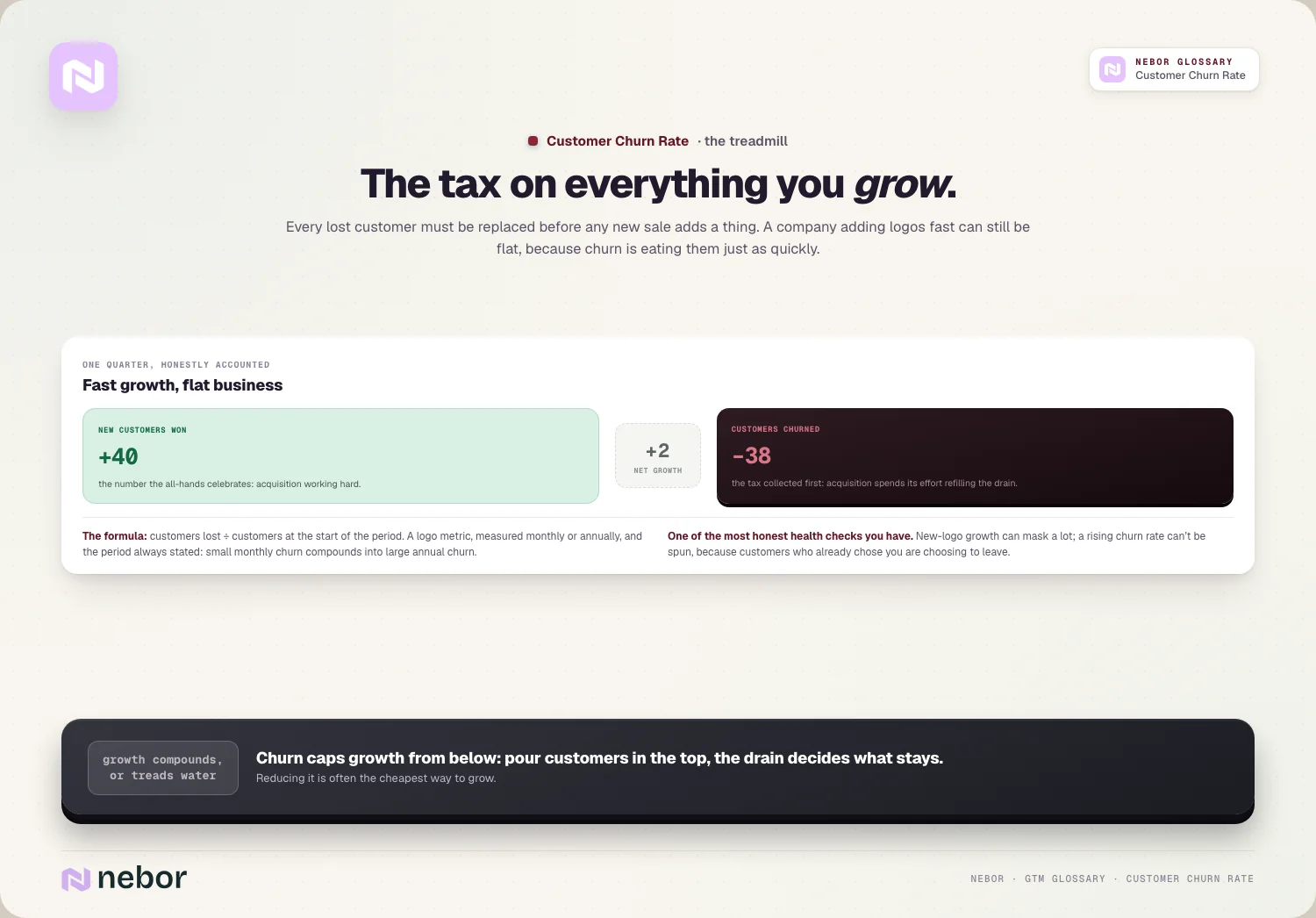
It's usually measured monthly or annually, and the period matters, because a small monthly churn rate compounds into a much larger annual one, so you always state the timeframe.
So customer churn rate is really a measure of how leaky your customer base is. It tells you what fraction of customers you fail to keep, which is the starting point for understanding retention.
It's also one of the most honest health checks you have. New-logo growth can mask a lot of problems, but a rising churn rate is hard to spin, because it means customers who already chose you are choosing to leave.
How is customer churn different from revenue churn in practice?
Churn comes in two flavors, and confusing them leads to bad conclusions. The distinction is about what you're counting.
Customer churn counts logos, treating every lost customer the same, so losing a tiny account and a huge one both count as one churned customer.
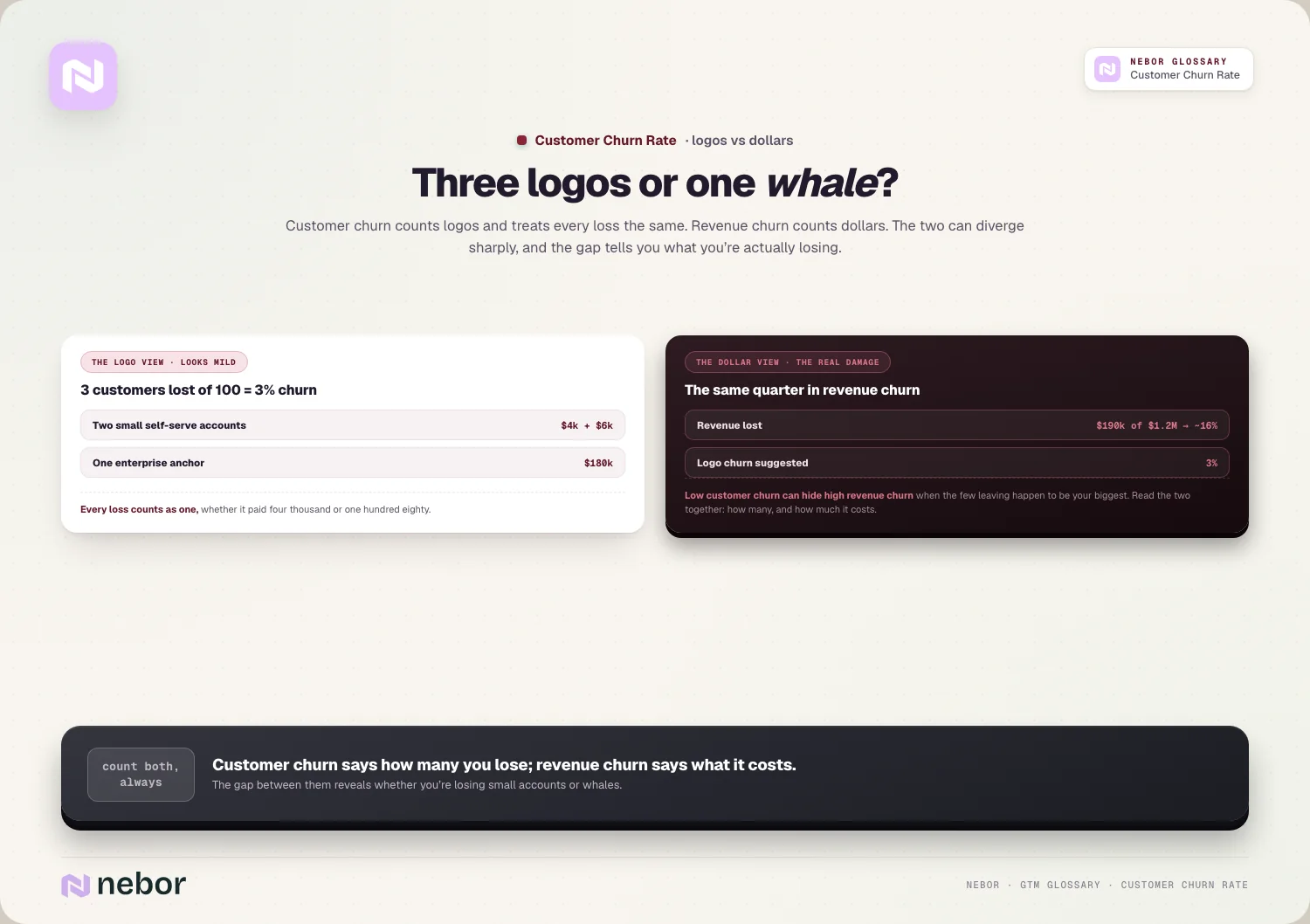
Revenue churn counts dollars instead, measuring the revenue lost from departing or downgrading customers, which weights each loss by how much money it represents.
The two can diverge sharply, because you might have low customer churn but high revenue churn if the few customers leaving happen to be your biggest, which logo churn alone would hide.
So the two numbers deserve reading side by side. Customer churn tells you how many you're losing, revenue churn tells you how much that costs, and the gap between them reveals whether you're losing small accounts or whales.
Why is churn such a powerful drag on everything you're building?
Let's be concrete about the drag, because churn's effect compounds in ways that are easy to underestimate, working against you every single period.
It forces constant replacement first, because before new sales grow the business, they refill the customers churn took away, so a chunk of your acquisition effort just maintains the status quo.
It compounds over time too, because a customer base losing a steady percentage each period shrinks faster than the raw number suggests, with the losses stacking month after month.
And it wastes acquisition spend outright, because every churned customer represents customer acquisition cost you already paid, so churn throws away money you spent to win them in the first place.
So churn goes beyond lost revenue into a compounding drag that cancels out growth. Reducing it is often more valuable than acquiring more, because you keep what you already spent to win.
What counts as a good churn rate for a company shaped like yours?
Benchmarks help you judge your own number, though they vary by segment, and in our experience the bar for healthy churn is stricter than most teams realize.
For B2B SaaS, the broad target is low. A good annual churn rate is generally under 5%, or below 1% per month, with the best companies doing far better.
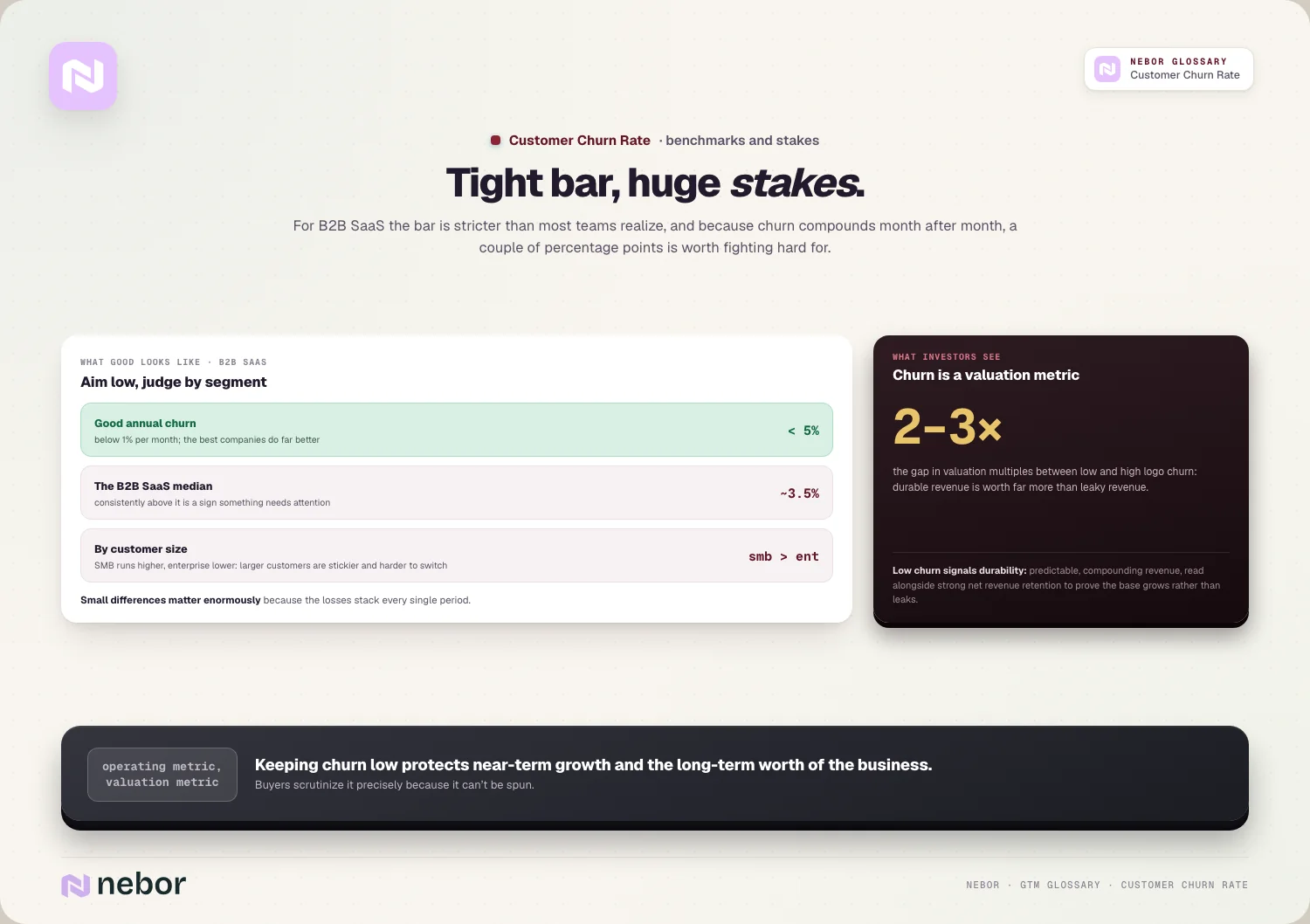
It varies a lot by customer size, because monthly churn tends to land higher for SMB and lower for enterprise, given that larger customers are stickier and harder to switch.
The median confirms the tight bar, with B2B SaaS median annual churn at around 3.5%, so consistently above that is a sign something needs attention.
So judge churn against your own segment and aim low. Small differences matter enormously here, because churn compounds month after month, so even a couple of percentage points deserves fighting hard for.
Why does churn matter so much for what your company is worth?
Beyond day-to-day growth, churn has an outsized effect on what a company is worth, and investors and buyers scrutinize it closely.
Low churn signals durability, because a company that keeps its customers has predictable, compounding revenue, which is exactly what makes a business valuable and safe to bet on.
The valuation gap is larger than most founders expect, where the difference between low and high logo churn can mean a 2 to 3x gap in valuation multiples, because durable revenue is worth far more than leaky revenue.
It pairs with the retention metrics too, because buyers want low churn alongside strong net revenue retention, which together prove the customer base grows instead of leaking.
So churn works as a valuation metric on top of an operating one. Keeping it low protects not just your near-term growth but the long-term worth of the entire business.
What's the difference between voluntary and involuntary churn?
Not all churn is the same, and the distinction changes how you fix it. There are two underlying causes worth separating.
Voluntary churn is when customers actively choose to leave, cancelling because they're unhappy, found a better option, or no longer see value, which points to product and experience problems.
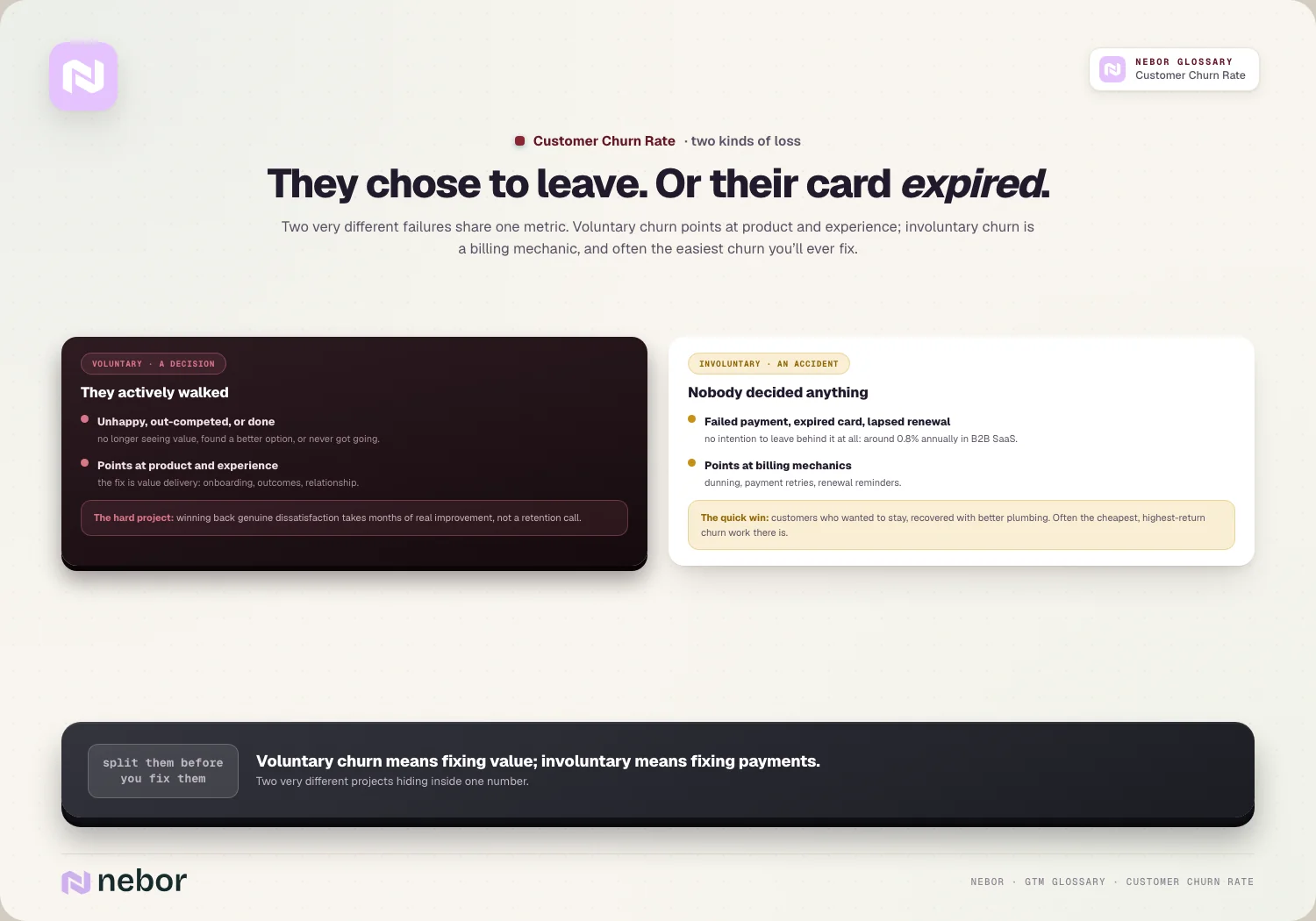
Involuntary churn is accidental instead, happening when a payment fails, a card expires, or a renewal lapses unintentionally, with no actual decision to leave behind it at all.
Involuntary churn is surprisingly common too, at around 0.8% annually in B2B SaaS, and unlike voluntary churn, it's often fixable with better billing and dunning processes.
So splitting the two tells you where to act first. Voluntary churn means fixing value and experience, while involuntary churn means fixing your payment and renewal mechanics, which are two very different projects.
Why does churn so often start long before the sale even closes?
A counterintuitive truth about churn is that much of it is determined before a customer ever signs. Who you sell to shapes who churns.
Bad-fit customers churn fastest of all, because if you sell to companies that were never a great match, they never get full value and leave quickly, no matter how good your product or support is.
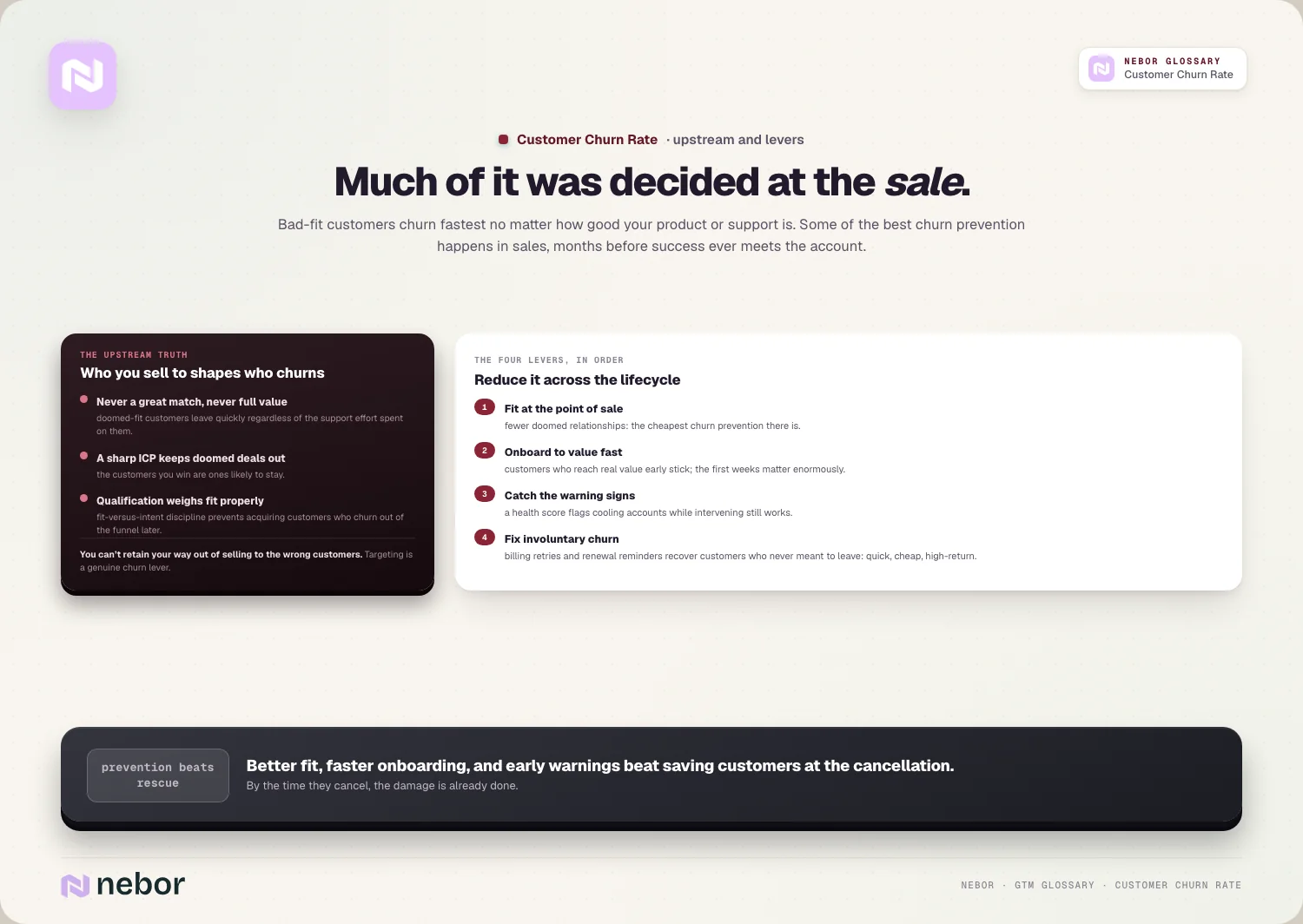
This traces straight back to your targeting, where a sharp ideal customer profile keeps doomed-fit deals out of the base, so the customers you win are ones likely to stay.
It shows up in qualification as well, because weighing fit properly, the heart of the fit score versus intent score distinction, prevents you from acquiring customers who will churn out of the funnel later.
So some of the best churn prevention happens in sales rather than success. You can't fully retain your way out of having sold to the wrong customers, which makes sharp targeting a genuine churn lever.
How do you reduce churn without waiting for the cancellations?
Lowering churn takes work across the whole customer lifecycle, and in our experience a few levers do most of it for your pipeline and your base alike.
Fit at the point of sale comes first, because selling to well-matched customers means fewer doomed relationships, which is the cheapest churn prevention there is by far.
Onboarding to value fast comes next, because customers who reach real value early stick, while those who never get going churn, so the first weeks matter enormously.
Catching the warning signs is the ongoing one, and we tell clients to watch a customer health score for accounts that are cooling off, so you intervene before they cancel rather than after.
And fixing involuntary churn rounds it out, because better billing, payment retries, and renewal reminders recover customers who never meant to leave, which is often quick, cheap, and surprisingly high-return.
How does churn fit into the rest of your whole revenue picture?
Churn isn't an isolated customer-success metric, it shapes your whole growth model and connects to everything around it.
It caps your growth math first, because high churn means your revenue engine has to work harder just to stay level, with acquisition refilling losses before it adds anything.
It determines lifetime value too, because lower churn means customers stay longer, which raises customer lifetime value and lets you afford to spend more acquiring them.
And it feeds the flywheel, because retained, happy customers refer others and expand, which powers a GTM flywheel where growth compounds instead of leaking.
So churn is a hinge for the whole business. It links retention to acquisition economics and to overall growth, and that's the reason a consistently low churn rate makes everything else easier.
How does churn rate relate to the retention rates you report?
Churn and retention are two sides of the same coin, measuring the same thing from opposite directions.
Retention rate is churn's mirror image, because if your annual customer churn is 5%, your customer retention rate is 95%, given that every customer either stays or leaves.
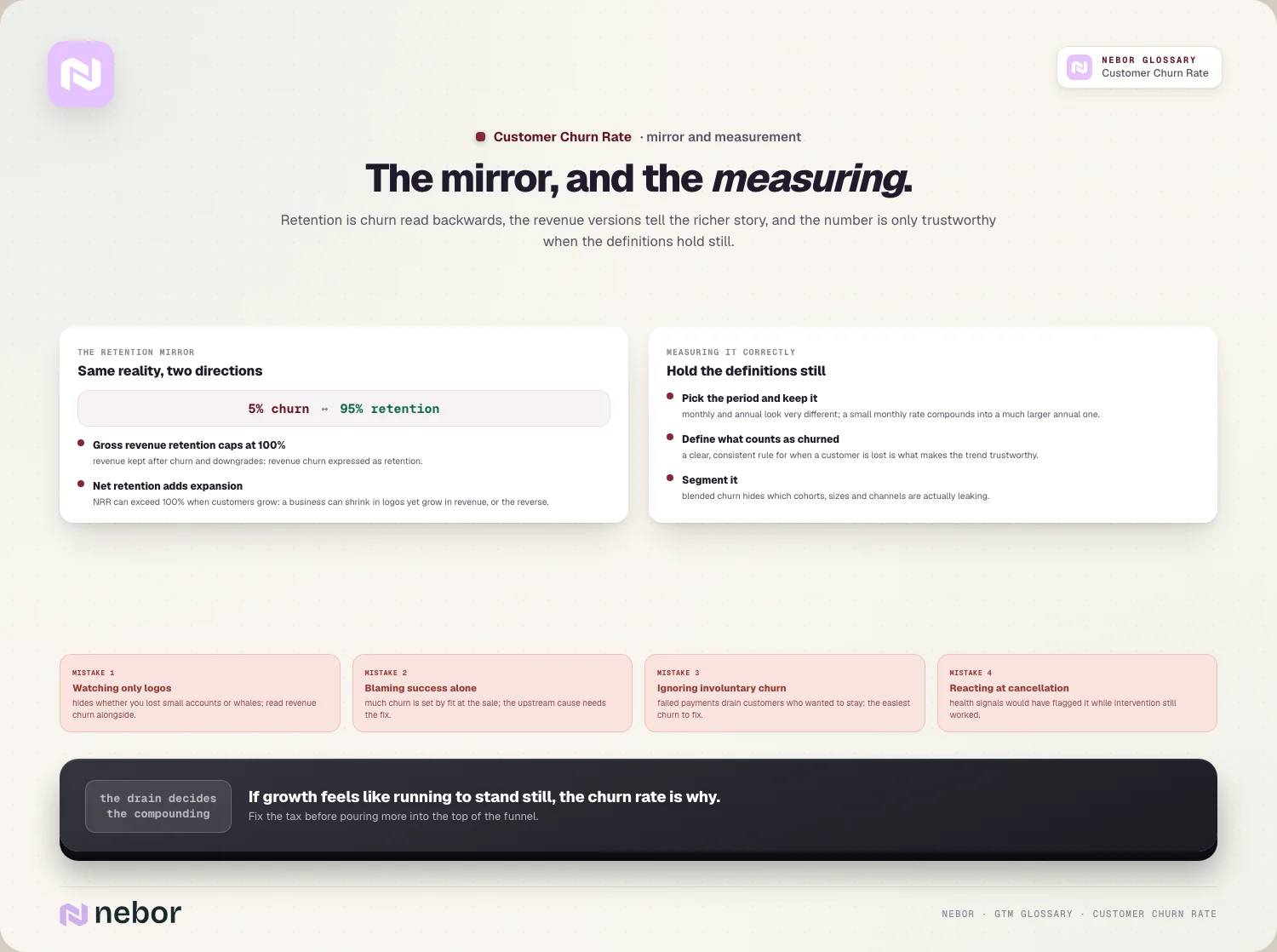
The revenue versions carry even more weight. Gross revenue retention measures how much revenue you keep after churn and downgrades, capping at 100%, and it's really revenue churn expressed as retention.
Net retention adds expansion into the picture, because net revenue retention can exceed 100% when existing customers grow, and that's how a business can shrink in logos but still grow in revenue, or the reverse.
So churn and retention are the same reality viewed from two directions. Watching both the churn you suffer and the retention you keep gives you the complete picture of how your customer base holds up.
How do you measure churn correctly and keep the number honest?
Measuring churn sounds simple, but a few choices change the number a lot. Getting them consistent is what makes it trustworthy.
The time period needs picking and holding, because monthly and annual churn look very different, and a small monthly rate compounds into a much larger annual one, so you state and keep the timeframe.
What counts as churned needs defining too, because a clear rule for when a customer is considered lost, like a cancellation or a lapsed renewal, keeps the number consistent instead of fuzzy.
The segments deserve separating as well, because churn often differs hugely between SMB and enterprise customers, so a blended rate can hide a serious problem in one segment.
And the tracking should happen automatically, because systems that handle the data, the same ones that automate sales prospecting and revenue operations, keep churn measured consistently so you can spot shifts early instead of far too late.
What are the common churn rate mistakes that hide real problems?
Churn gets mishandled in a few predictable ways. Avoiding them keeps the metric honest and useful.
Watching only logo churn tops the list, because counting customers without weighing revenue hides whether you're losing small accounts or your biggest ones, so revenue churn belongs alongside it.
Treating all churn as a success problem comes next, since much churn is set by fit at the point of sale, so blaming only customer success misses the upstream cause.
Ignoring involuntary churn is the easy one to fix, where failed payments drain customers who wanted to stay, often recoverable with better billing alone.
And there's reacting too late, because waiting until customers cancel to address churn means the damage is done, when watching health signals would have let you intervene earlier.
Why churn is the tax rate your growth pays whether you watch it or not
Customer churn rate deserves the attention because it's the tax on all your growth. Every customer you lose must be replaced before new sales add anything, so churn decides whether your growth compounds or just treads water.
The deeper point is that churn counts logos, so you read it alongside revenue churn to see whether you're losing small accounts or whales. The two together tell the real story of what you're losing.
The honest reality is that much of churn is decided early, at the point of sale, and a lot of it is preventable. Better fit, faster onboarding, and catching warning signs beat trying to save customers at the moment they cancel.
So if your growth feels like a treadmill, churn is often why. Lowering it through better targeting, onboarding, and early intervention is frequently the cheapest path to growth, because keeping a customer you already won costs far less than replacing them.
That durable economics is exactly what a modern go-to-market system is built to protect. Acquisition gets the attention, but retention is what turns all that effort into a business that compounds.
Share this post
RevOps
Glossary
Related glossary items
Understanding the core GTM concepts



Ready to build your pipeline











