

In this post:
Look at the handful of customers you wish you had a hundred more of. The ones who closed fast, stuck around, and use the product every week. They almost certainly share a pattern, even if you've never written it down.
A B2B lookalike audience is a way to find that pattern and act on it. You hand a system a list of your best accounts, and it goes and finds other companies that resemble them, so your prospecting starts from proof instead of a guess.
A lookalike audience is a set of prospect companies that share the key traits of your best existing customers. You build it by feeding a seed list of those customers into a model that finds others like them.
In B2B, the match happens at the company level, on firmographics and technographics, instead of on individual consumer behavior. The model reads the pattern in your winners and returns more companies that fit it.
Think of it as reverse-engineering your own success. Instead of describing your ideal buyer from intuition, you let your actual winning accounts define the target, then go find more of them.
TL;DR
A B2B lookalike audience clones the traits of your best customers to surface new companies that resemble them, so your prospect list is grounded in who already buys.
Unlike consumer lookalikes, the B2B version matches on company-level data, firmographics, technographics, and growth signals, instead of individual behavior.
The quality of the output depends almost entirely on the seed. A tight list of 50 to 200 of your best accounts produces a far sharper model than a grab-bag of every customer.
One warning deserves heeding early, which is that ad-platform lookalikes mostly fail for B2B. The results that hold up come from tools that model directly on your CRM and enriched account data.
What a B2B lookalike audience is once you set aside the consumer hype
A lookalike audience starts from a seed and expands outward. You give the model examples of companies you want more of, and it returns others that share their defining characteristics.
The seed is usually your best customers. High lifetime value, fast sales cycles, strong adoption, the accounts you'd happily clone, because those are the traits you want the model to chase.
The output is a ranked set of similar companies. The model scores the wider universe of businesses against your seed and surfaces the ones that resemble it most, which becomes your prospect pool.
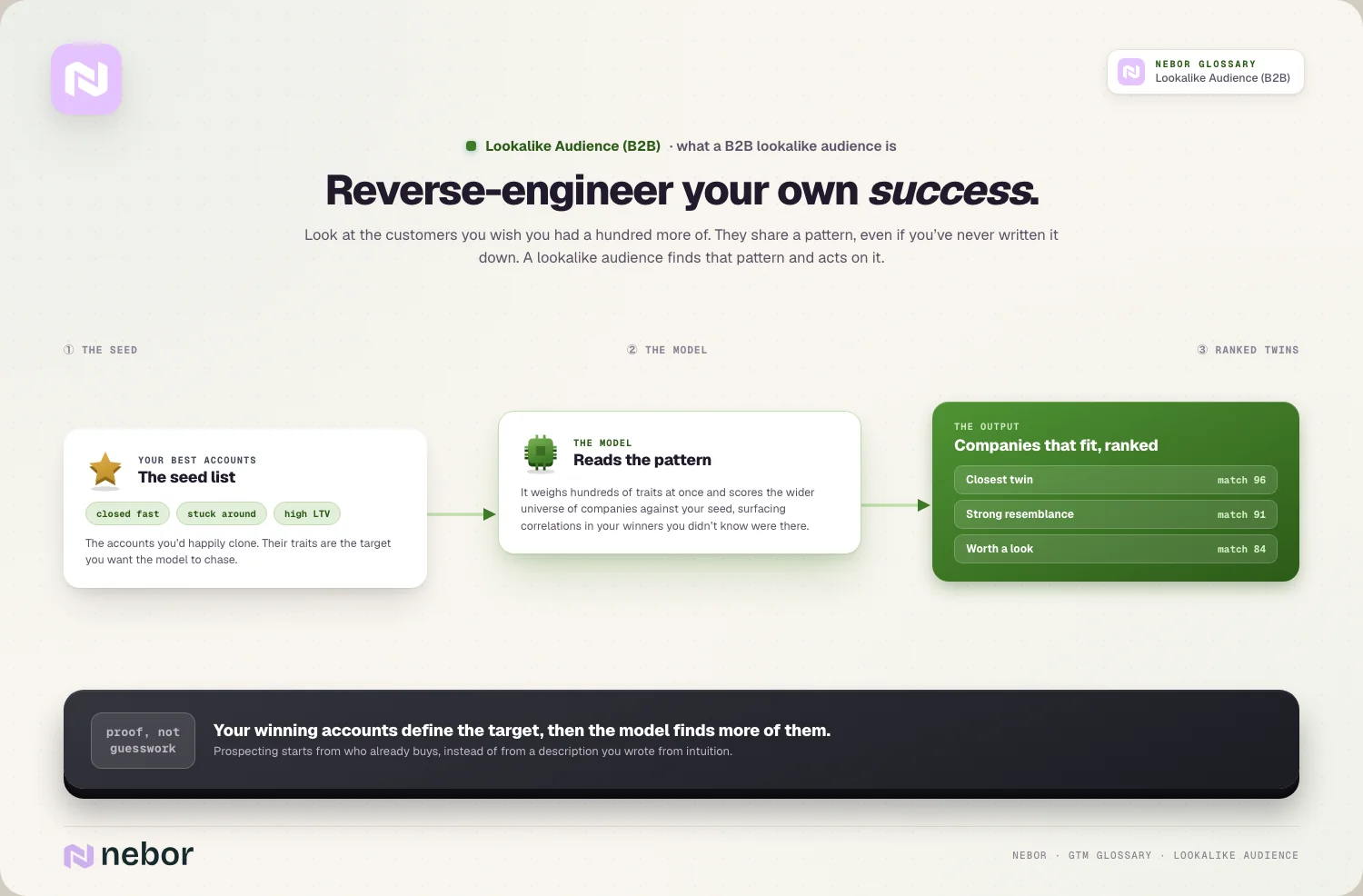
The ranking matters as much as the list. A good model doesn't just say which companies match, it says how strongly, so you can start with the closest twins and work outward.
What makes it powerful is that it learns from reality. Instead of you guessing which traits predict a good customer, the model reads them off the customers you already closed and kept.
It also surfaces patterns you'd never spot by eye. A human can hold a few traits in mind, but a model can weigh hundreds at once, so it often finds correlations in your best accounts you didn't know were there.
Why B2B lookalikes work completely differently from the consumer ones you've seen
Most people first meet lookalike audiences through consumer ad platforms, where they match individual people by behavior. The B2B version is a different animal.
In B2B, you're matching companies instead of people. The unit is the account, so the model compares businesses on shared firmographic and technographic traits instead of personal browsing habits.
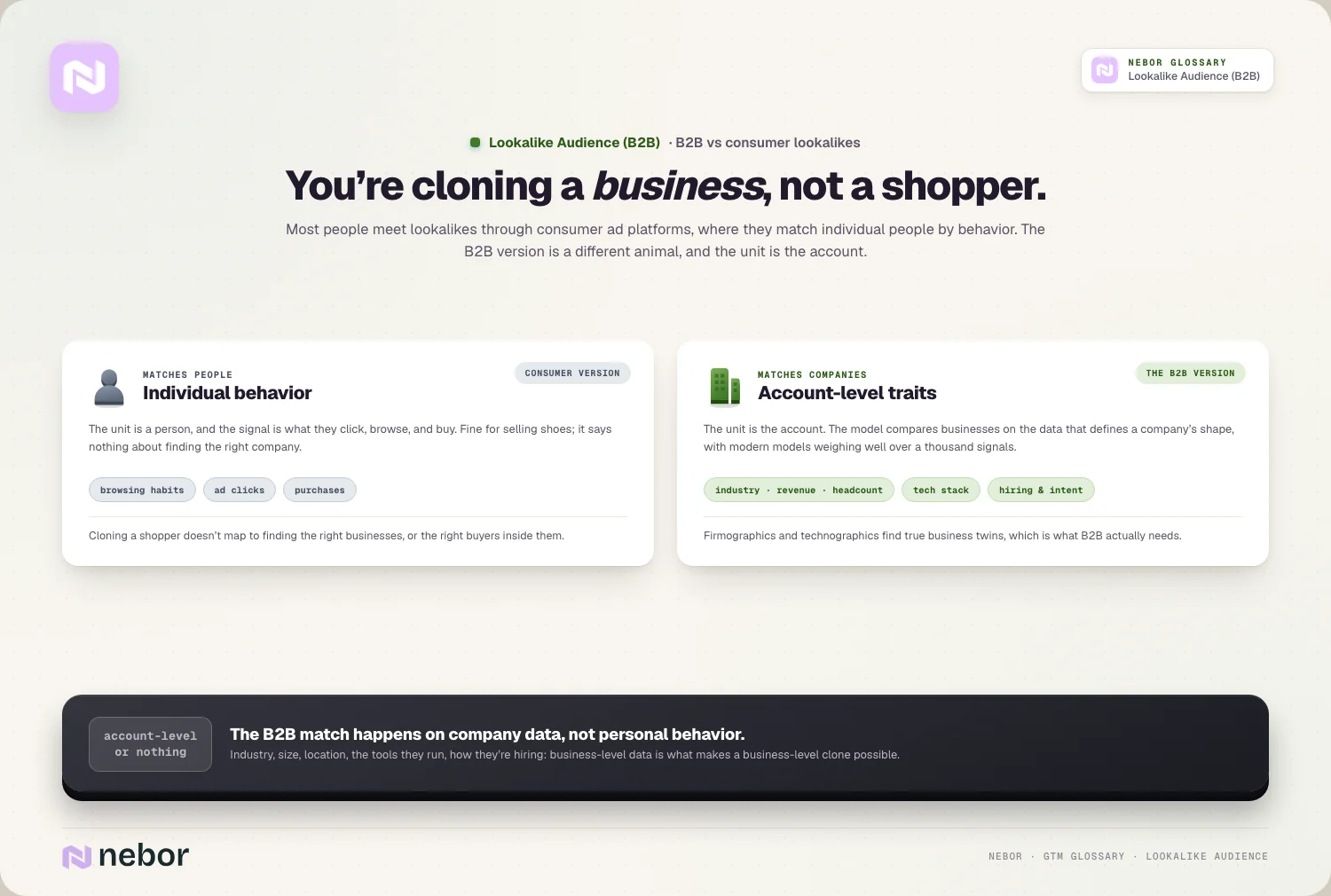
The core data points are firmographic to start. Industry, revenue, headcount, and location define the shape of a company, which is the foundation of any B2B firmographic data match.
Tech and growth signals sharpen it further. Modern models layer in technographic data like the tools a company uses, plus hiring and intent, comparing well over a thousand signals to find true look-alikes.
That account-level focus is why a consumer-style approach falls flat in B2B. You're cloning a business instead of a shopper, and that takes business-level data.
How a lookalike audience relates to the ICP you've already written down
A lookalike audience and an ideal customer profile are close cousins that approach the same goal from opposite directions. One is written, the other is computed.
An ICP is the profile you define. You decide the industries, sizes, and traits of your ideal buyer, usually from a mix of data and judgment, and write it down as a target.
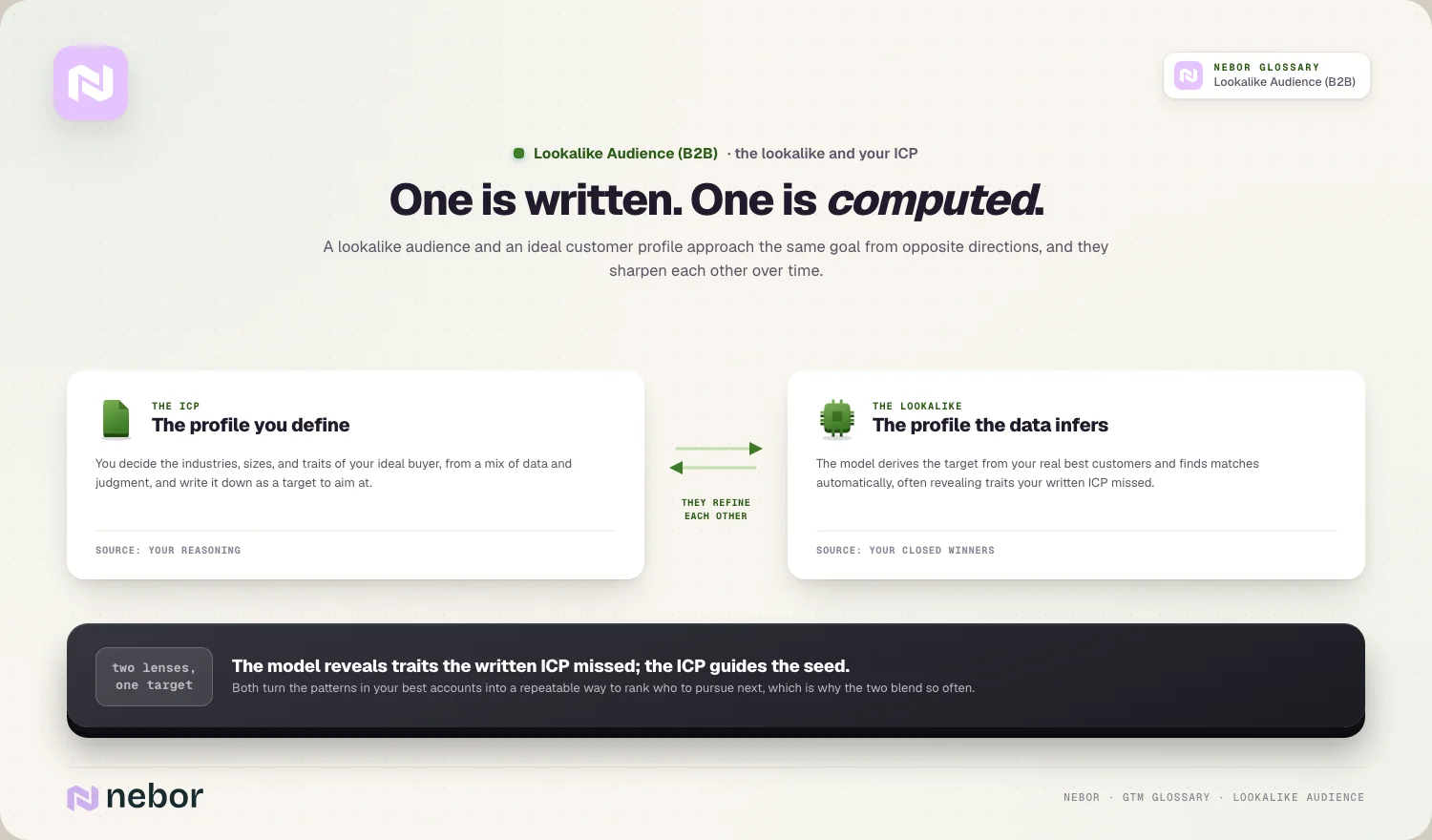
A lookalike audience is the profile the data infers. Instead of you describing the target, the model derives it from your real best customers and finds matches automatically.
The two strengthen each other over time. A lookalike model can reveal traits your written ICP missed, and your ICP can guide which seed accounts to feed the model, so they refine one another over time.
This is also why a formal ICP scoring model and a lookalike approach often blend. Both turn the patterns in your best accounts into a repeatable way to rank who to pursue next.
Why the seed list you choose decides almost everything about the result
The seed list is the single biggest lever in the whole exercise, and it's where most lookalike efforts go wrong first. Garbage in, garbage out applies with full force.
A great seed is your best accounts and never all of them. Picking the 50 to 200 customers with the highest lifetime value and strongest fit gives the model a clean target to chase.
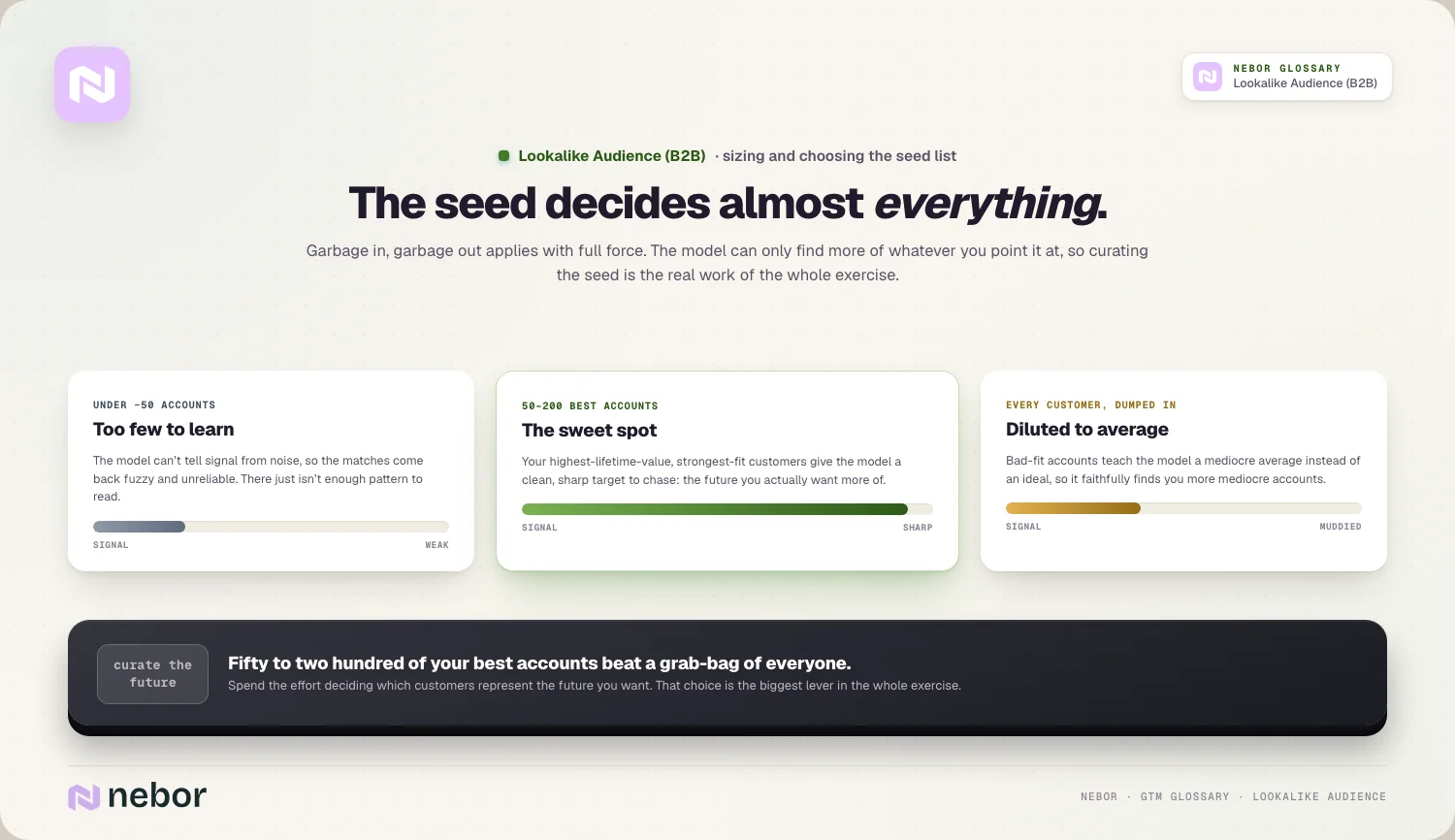
Too few accounts simply break the model. Feeding fewer than about 50 leaves the model unable to tell signal from noise, so the matches come back fuzzy and unreliable.
A bloated seed dilutes it just as badly. Dumping in every customer, including the bad-fit ones, teaches the model an average instead of an ideal, so it finds you more mediocre accounts.
Choosing the seed is the real work, and we tell clients to spend most of their effort there. Curate which customers represent the future you want, because the model can only find more of whatever you point it at.
Where ad-platform lookalikes fall apart, and why they keep burning B2B budgets
There's a common, expensive mistake worth calling out directly, because it burns budgets every day. Not all lookalike tools are built for B2B.
Ad-platform lookalikes are mostly broken for B2B. The big consumer ad networks model individuals on behavior, which doesn't map to finding the right companies and the right buyers inside them.
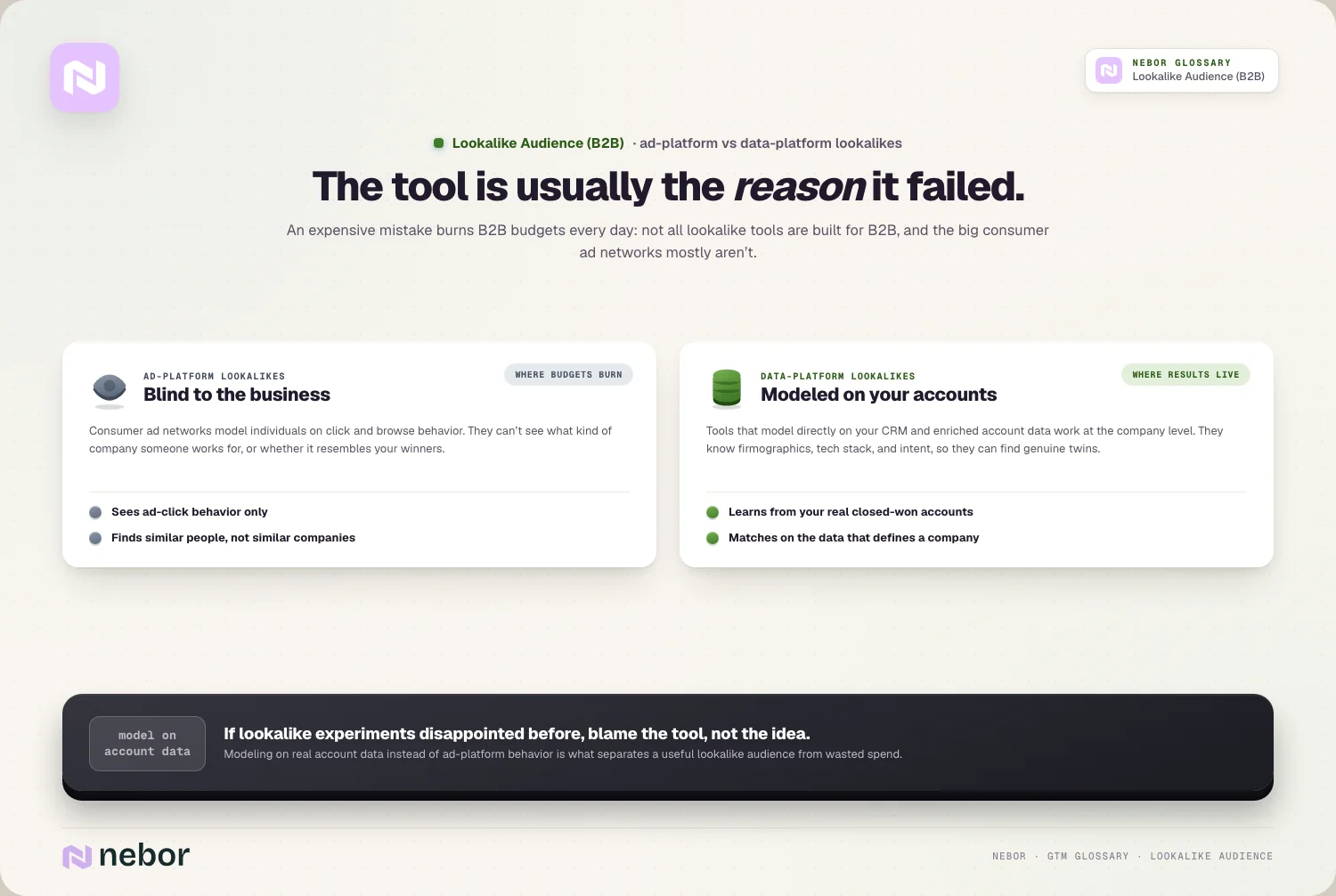
Data-platform lookalikes are where the results live. Tools that model directly on your CRM and enriched account data work at the company level, which is what B2B genuinely needs.
The difference is the data they see. A platform that knows firmographics, tech stack, and intent can find genuine business twins, while one that only sees ad-click behavior cannot.
If your lookalike experiments have disappointed before, the tool is usually the reason. Modeling on real account data instead of ad-platform behavior is what separates a useful lookalike audience from wasted spend.
How a lookalike audience feeds the rest of your prospecting motion
A lookalike audience is the front of a prospecting motion rather than an end in itself. The model produces a list, and the list has to become outreach.
It supercharges your list building at the top. A lookalike model is effectively a smart way to do list building, starting your target list from companies that resemble proven winners.
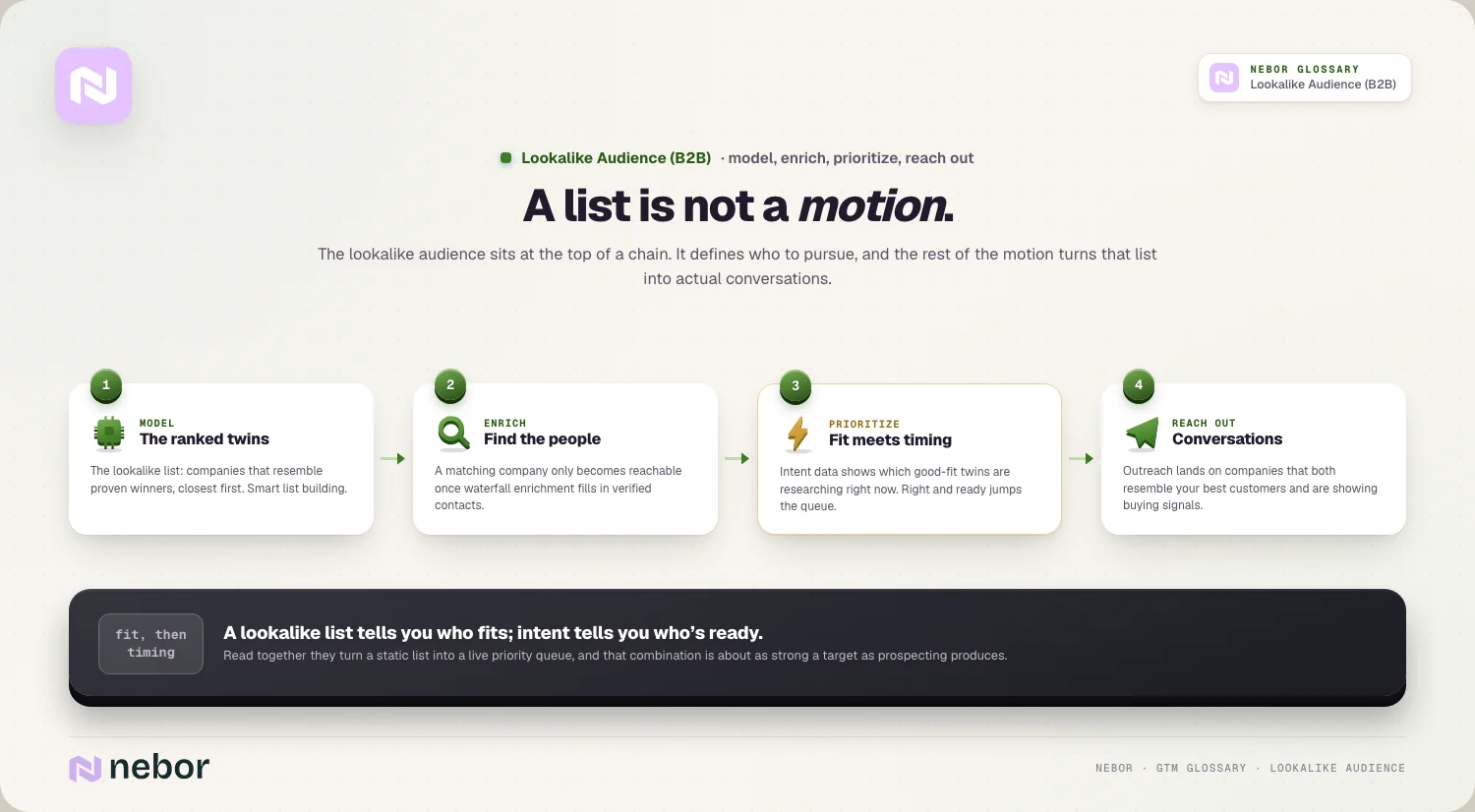
It needs contact data before you can act. A list of matching companies is only useful once you enrich it with verified contacts, often through a waterfall enrichment that fills in the right people to reach.
It pairs with prioritization once the list exists. Ranking the matches by readiness, using account scoring and live signals, tells you which look-alikes to contact first instead of working the list blindly.
So the lookalike audience is the top of a chain that goes model, enrich, prioritize, reach out. It defines who to pursue, and the rest of the motion turns that into conversations.
When intent data turns a lookalike list from cold names into warm priorities
A lookalike audience on its own tells you who fits, without telling you who's ready. Layering intent on top is what makes it timely.
Fit and timing are two different questions. A company can be a perfect look-alike yet not in the market today, so fit alone leaves you guessing on when to reach out.
Intent answers the timing question for you. Combining your lookalike list with intent data tells you which of those good-fit companies are actively researching, which is when outreach lands best.
The combination of the two is the sweet spot. A company that both resembles your best customers and is showing buying signals is about as strong a target as prospecting produces.
Read together, fit and intent turn a static lookalike list into a live priority queue. You stop working the list top to bottom and start working the accounts that are both right and ready.
Where a lookalike audience helps you beyond just finding new prospects
Finding new prospects is the obvious use, but a good lookalike model pays for itself in a few other corners of go-to-market too. The same "find more like these" logic travels.
It sharpens your advertising spend as well. Pointing programmatic and account-based ads at a lookalike list focuses spend on companies that resemble your best customers instead of a broad, wasteful audience.
It guides your expansion priorities as well. Knowing which traits define your strongest accounts helps you spot existing customers who share them and may be ready to grow.
It informs strategy at a higher level. The traits a lookalike model surfaces can reveal a segment you're winning in without realizing, which is worth feeding back into your wider targeting and positioning.
A model built once for prospecting can quietly improve your ad targeting, expansion focus, and market strategy at the same time. The pattern in your best customers is useful far beyond the next cold list.
Are lookalike audiences and account-based marketing the same thing?
These two get mentioned in the same breath, and they fit together, but they answer different questions, and in our experience keeping them straight saves confusion.
A lookalike audience decides who you target. It builds the list of companies worth pursuing by modeling on your best accounts.
Account-based marketing decides how you pursue them. It's the coordinated motion of marketing and sales going after specific high-value accounts with tailored plays.
They chain together more naturally than they compete. A lookalike model is a strong way to choose the account list that an ABM program then works, so one feeds the other instead of competing.
Used together, a lookalike audience picks the right accounts and ABM gives them the focused attention they deserve. The model finds the targets, and the motion converts them.
How to build a lookalike audience and keep refining it as you sell
Building a lookalike audience is a repeatable process once you see the steps. None of them are complicated, but each one shapes the result.
Start by curating the seed with care. Pull your 50 to 200 best-fit, highest-value closed-won accounts, because this is the example the model will learn from.
Model on account-level signals and nothing weaker. Push that seed through a data platform that matches on firmographics, technographics, and growth signals, instead of an ad network that matches on behavior.
Prioritize the output by how ready each match is. Rank the resulting companies by fit strength and live intent so your team works the most promising matches first.
Then refine the seed as you learn. As new accounts close, feed the winners back in and drop the misses, so the model keeps sharpening toward the customers you want more of.
What signals a good lookalike model reads when it scores companies
It helps to know what the model is comparing, because that tells you what makes a strong match. The best B2B models read far more than industry and size.
Firmographics form the base layer of any match. Industry, revenue, headcount, and location describe the shape of a company, which is the first layer any match rests on.
Technographics add a layer of precision on top. The tools a company uses, and the migrations it's making, often predict fit better than size alone, because they hint at how the company operates.
Growth and intent finish the picture off. Hiring trends, funding, and active research tell the model which look-alikes are not just similar but moving, which separates a static match from a timely one.
The richer the signal set, the truer the look-alikes. A model comparing a thousand-plus signals across these layers finds genuine business twins, while one looking at a few crude traits finds only rough approximations.
The mistakes that ruin a lookalike audience before it ever helps you
A few predictable errors turn a promising lookalike effort into a disappointing one, and we keep seeing the same ones in the builds clients show us. Most trace back to the seed or the tooling.
The most common one is seeding with everyone. When you feed the model your whole customer base instead of your best accounts, it learns an average instead of an ideal, so it returns more average-fit companies.
The opposite mistake is seeding with too few. If you go under roughly 50 accounts, you starve the model of data, and the matches come back fuzzy enough that you can't trust them.
Plenty of teams also lean on ad-platform lookalikes. Relying on consumer ad networks for B2B targeting wastes budget on a method built for a completely different problem.
Another is treating the list as final. A lookalike audience should evolve as your customer base does, so a model you never refresh slowly drifts away from who you really win.
The last one is trusting the model over your reps. If the model loves a company your team knows is a poor cultural or use-case fit, that account still deserves a human gut-check before it eats real outreach time.
The real payoff of cloning the customers who already work for you
Cold prospecting asks you to guess who might buy. A lookalike audience replaces that guess with evidence, pointing you at companies that resemble the customers who already proved the model.
If your seed is clean and your tooling models on real account data, the approach compounds over time. Every new closed-won account you feed back makes the model a little sharper, so your targeting improves as you sell rather than going stale.
The one constant is that the model only ever finds more of what you point it at. That's why the seed deserves real care, and why the ad-platform shortcut should be refused even when it looks easier.
When you handle both well, a lookalike audience becomes one of the most efficient targeting tools in a modern go-to-market system. It turns your best customers into a map for finding the next ones, at a scale you can automate sales prospecting around.
Share this post
Prospecting
Data
ABM
Glossary
Related glossary items
Understanding the core GTM concepts




Ready to build your pipeline