

In this post:
A single contact downloads your ebook and your scoring system lights up, flagging them as a hot lead. Meanwhile, five other people at that same company have been quietly researching your category for weeks, and your system has no idea they're connected.
That blind spot is the problem account scoring solves. In B2B, deals are decided by groups instead of individuals, so scoring one person at a time misses the bigger picture of whether the whole company is ready to buy.
Account scoring is the practice of ranking entire companies by how well they fit your profile and how likely they are to buy, based on signals across the whole organization rather than a single contact. It scores the account as a whole instead of one lead at a time.
B2B buying is a team sport, and that's exactly what makes the account the right unit. A purchase usually involves a committee, so the thing that buys is the company, and the company is what deserves the score.
TL;DR
Account scoring ranks whole companies by fit and buying readiness, combining firmographic fit, intent signals, and engagement across the entire organization into one account-level score.
B2B deals are made by committees, so scoring at the account level captures the full picture that lead scoring, focused on one contact, misses.
It blends fit and intent into one view. Fit comes from your ideal customer profile, and intent comes from research and engagement signals across the account, together telling you which companies to prioritize.
The hard requirement is good data across many signals. A score built on thin or stale data just ranks companies wrong with confidence, so the inputs matter as much as the model.
What is account scoring, and what does the number tell your team?
Account scoring is a way of prioritizing companies by assigning each one a score that reflects how worth pursuing it is. The higher the score, the more your team should focus on that account.
It evaluates the whole organization instead of judging a single contact, looking at the company's fit, the buying signals coming from anyone there, and how the account as a whole is engaging with you.
The output is a ranking rather than a flat list, with your target companies sorted by readiness, so your team works the most promising accounts first instead of moving through the list in random order.
Two big ideas combine inside the score. Fit tells you whether a company is the right kind of customer, and intent tells you whether they're showing signs of being in-market right now.
So account scoring is really about focus at the company level. It answers which accounts deserve your attention, which is the question that matters most in any account-based motion.
The value is that it makes prioritization objective. Instead of your reps chasing whichever account feels promising, a score gives the whole team one consistent way to decide where the effort goes, and in our experience that consistency is half the value.
How is account scoring different from lead scoring on individuals?
These two are easy to confuse, so it helps to separate them clearly. They score different things at different levels.
Lead scoring evaluates individual contacts, ranking a single person based on their demographic fit and how they've engaged with you, which is useful but narrow.
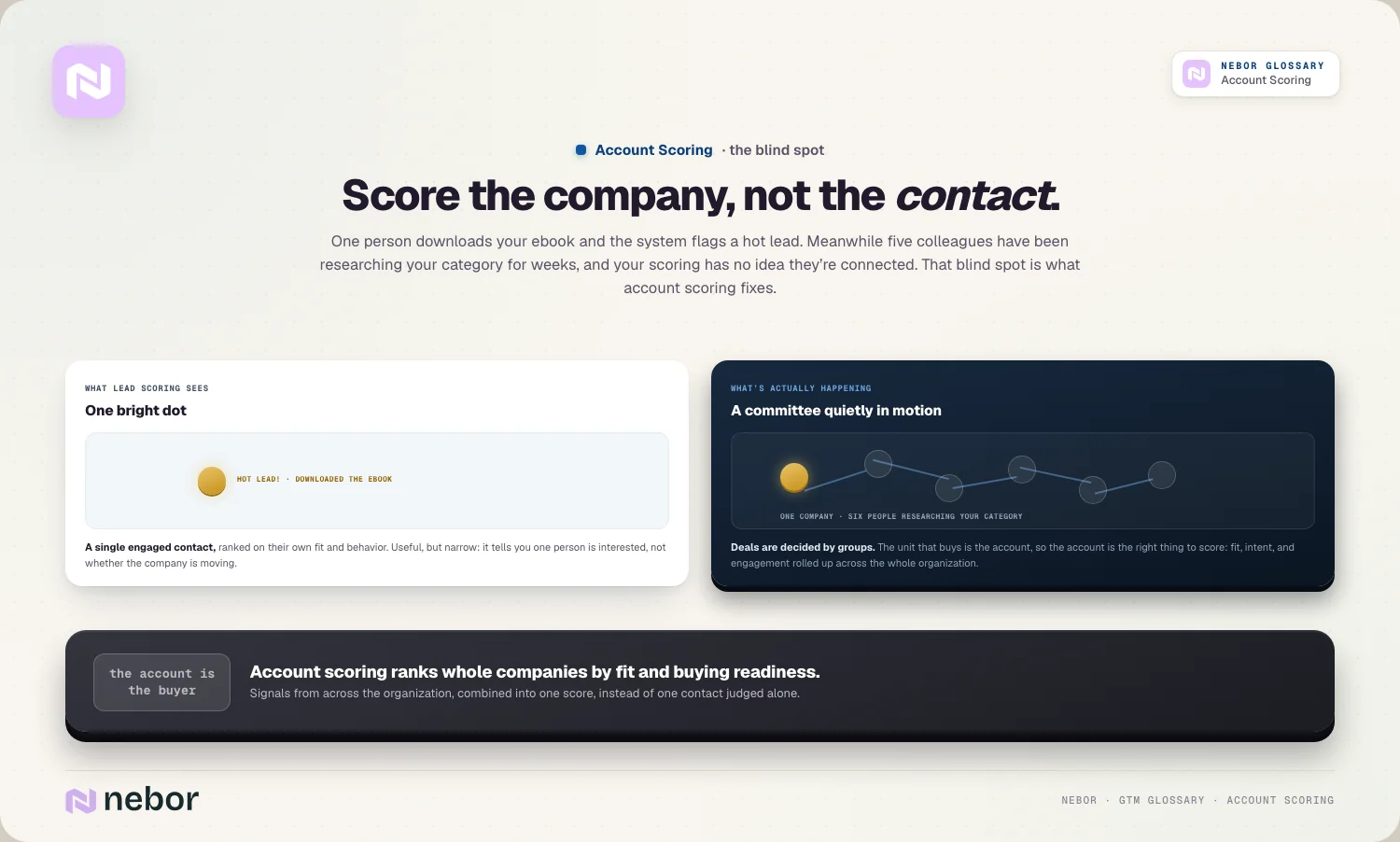
Account scoring evaluates whole companies instead, rolling up signals from everyone at the account, plus the company's firmographics and intent, into a single score for the entire organization.
The difference matters because of how B2B buys. A purchase decision involves a committee, so a hot individual lead means little if the rest of the account is cold, and vice versa.
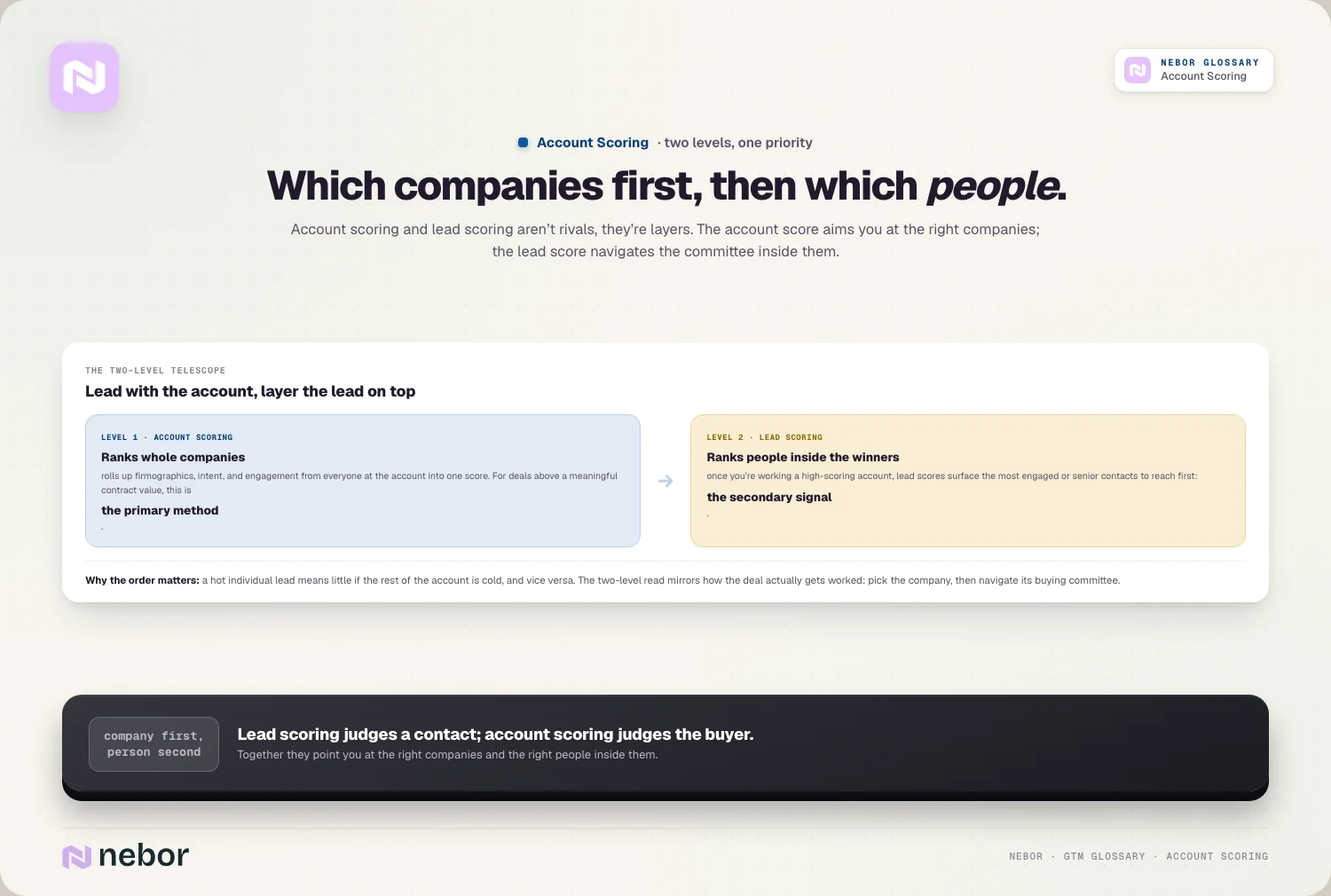
This is why most teams selling larger deals lead with account scoring. For deals above a meaningful contract value, account scoring should be the primary method and lead scoring a secondary signal.
Why is the account the right unit to score in the first place?
Account-level scoring deserves a moment of justification, because it reflects how buying really works. The logic is about who really decides.
B2B purchases are group decisions, and a typical deal involves multiple stakeholders, so the meaningful unit isn't any one person, it's the whole buying group at the company.
Scoring one contact misses that group entirely, because a single engaged lead tells you one person is interested, without telling you whether the committee that controls the decision is moving.
Account scoring captures the collective signal instead. When several people at a company engage, or the firm shows broad intent across teams, that's far stronger evidence than one individual acting alone.
This connects directly to the logic of multi-threading. Just as you sell across a buying committee instead of leaning on one champion, you score the account instead of one person, because both reflect that the company is the thing doing the buying.
What actually goes into an account score, one layer at a time?
A good account score blends several kinds of signals. Each contributes a different piece of the picture.
Fit is the foundation of the whole score. Your ideal customer profile defines whether a company is even worth pursuing, using firmographic data like size, industry, and revenue.
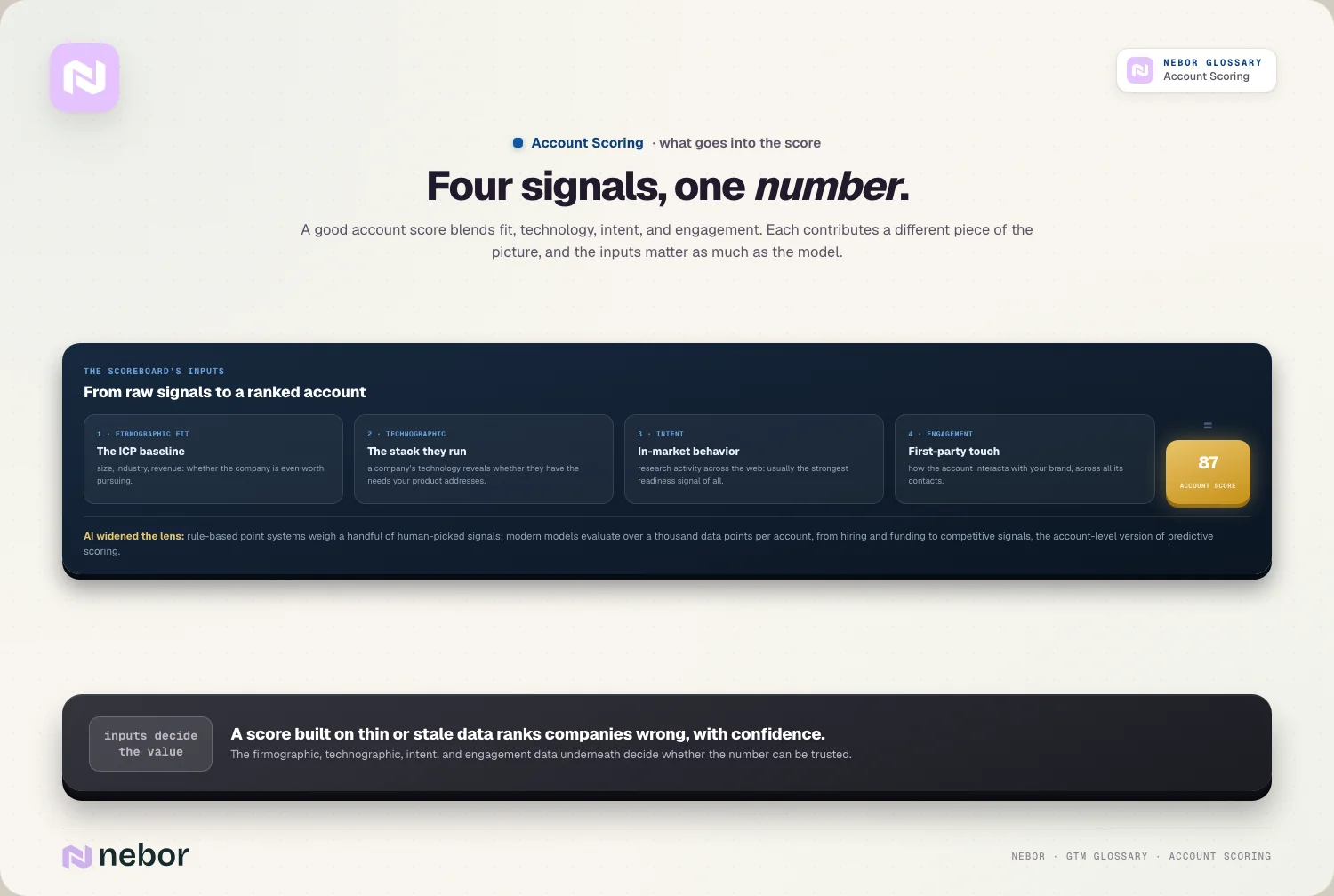
Technology adds a second fit layer, because technographic data about a company's tech stack reveals whether they have the specific needs your product addresses.
Intent arrives on top of the fit layers. Intent data and research behavior across the web show whether the account is actively in-market, which is usually the strongest readiness signal of all.
Engagement closes the loop, since how the account interacts with your brand, across all its contacts, rounds out the picture with the direct first-party signals you can see yourself.
How do fit and intent work together inside an account score?
Fit and intent are the two pillars of account scoring, and neither is enough on its own, so understanding how they combine is key.
Fit without intent is a good target that isn't ready. A company that matches your profile perfectly but shows no buying signals is worth pursuing eventually instead of urgently.
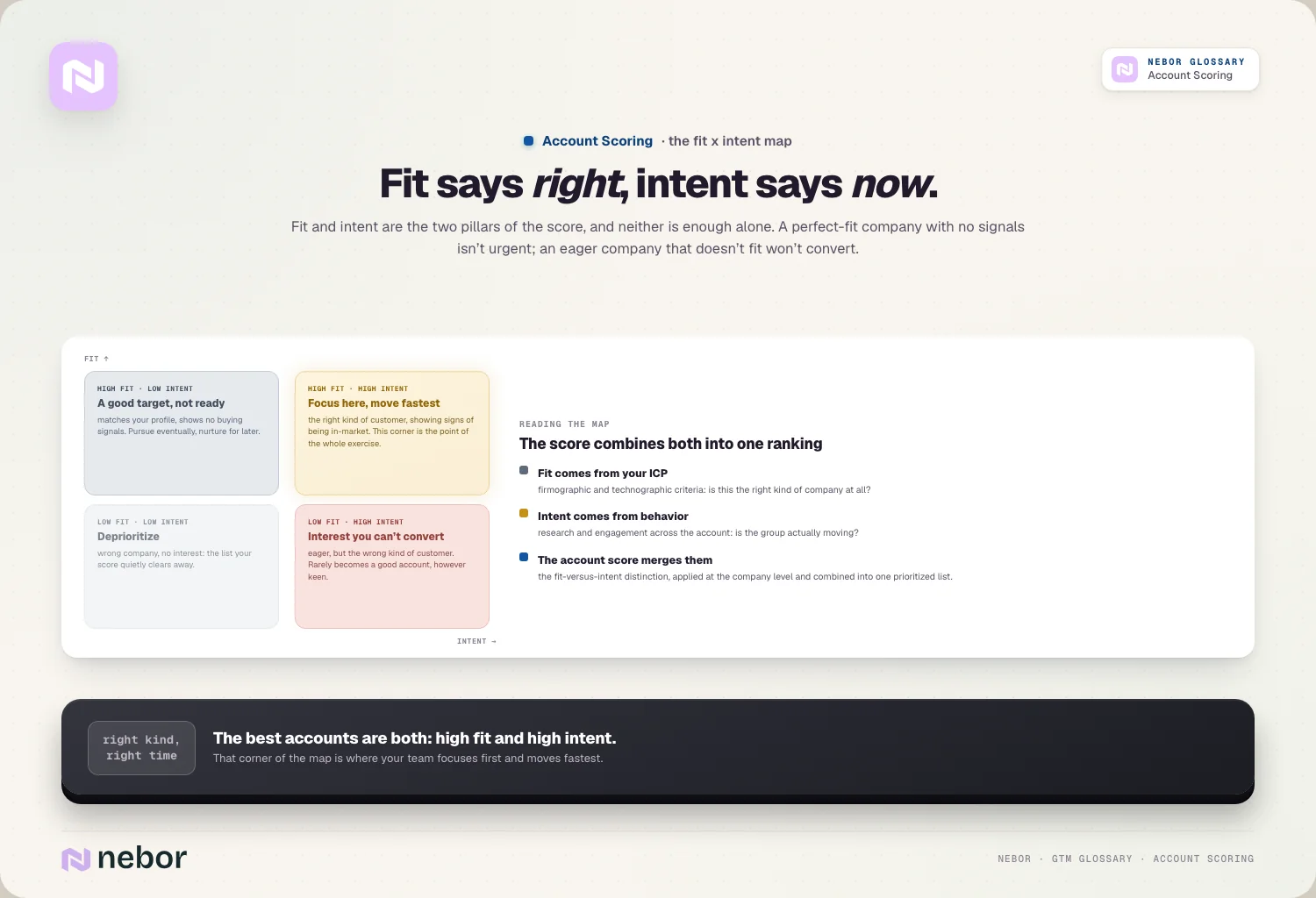
Intent without fit is interest you can't convert. A company showing strong intent that doesn't fit your profile will rarely become a good customer no matter how interested they seem.
The best accounts score high on both at once. High fit plus high intent means a company that's the right kind of customer and showing signs of being in-market, which is exactly where your team should focus first and move fastest.
This is the same logic as the fit score versus intent score distinction, applied at the account level. Account scoring is where fit and intent get combined into one prioritized ranking.
How does account scoring power your account-based marketing?
Account scoring and account-based marketing go hand in hand, because one makes the other possible.
Account-based marketing focuses your effort on a defined set of target accounts. Account scoring is how you decide which accounts make that set and how to rank them within it.
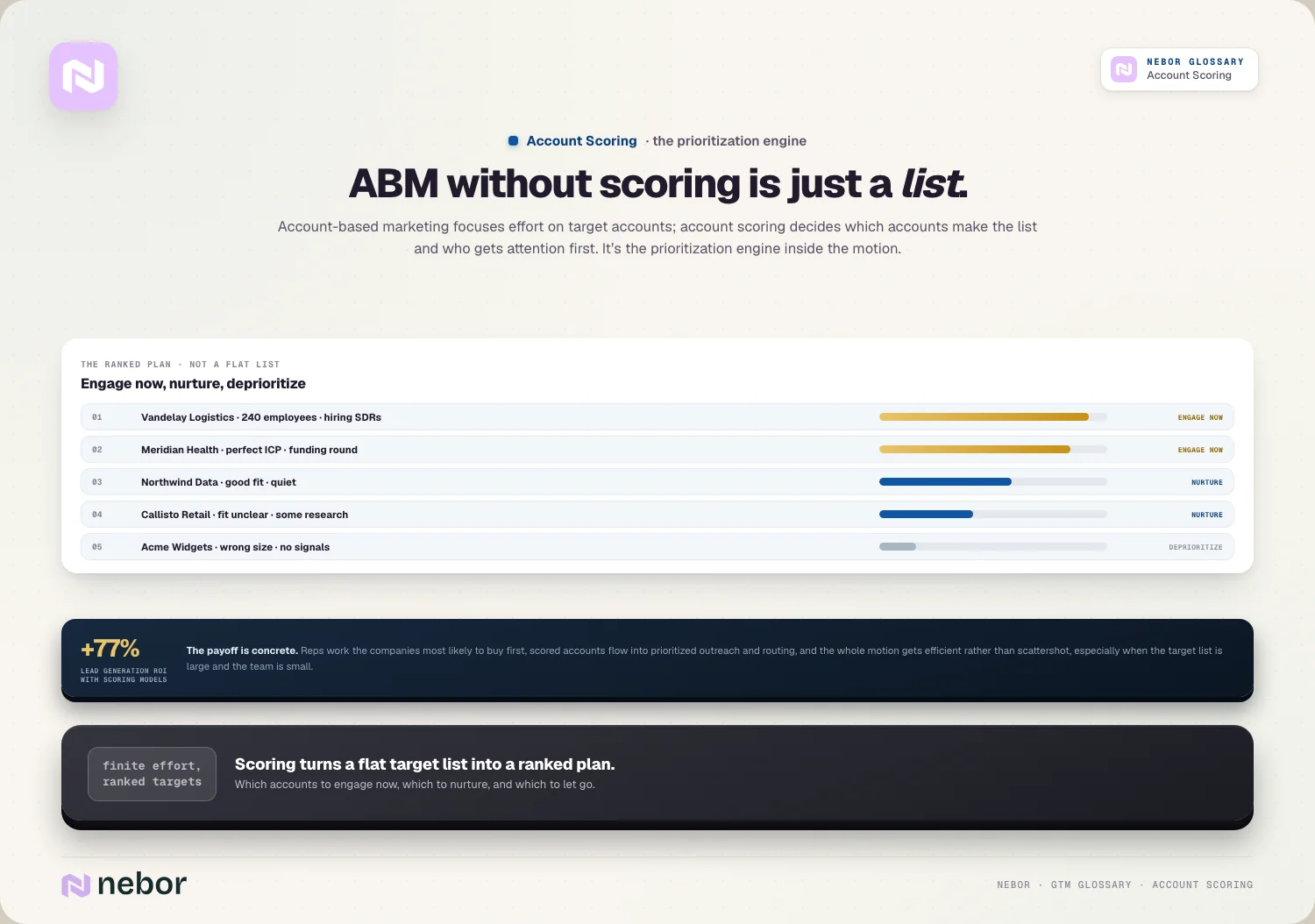
Without scoring, ABM is just a list, and we've watched teams treat every target account the same when some were far more ready than others.
Scoring brings prioritization into ABM, telling you which accounts to engage now, which to nurture, and which to deprioritize, so your finite effort goes where it pays off.
So account scoring is the prioritization engine inside ABM. It turns a flat target list into a ranked plan, which is what makes an account-based motion efficient rather than scattershot, especially when your target list is large and your team is small.
How does AI change what an account score can actually capture?
Account scoring used to mean simple, rule-based point systems. AI has expanded what the score can hold.
Rule-based scoring hits limits fast, because a person assigns points to a handful of signals, which means the model reflects assumptions and can only weigh a few factors at once.
AI scoring weighs far more at once. Modern systems can evaluate over a thousand data points per account, from firmographics and technographics to hiring, funding, and competitive signals.
That breadth makes the scores more accurate, because instead of a human guessing which signals matter, the model learns from patterns across many factors, which is the account-level version of predictive lead scoring.
So AI raises account scoring from a rough heuristic to a data-driven ranking. It captures the complexity of a real account in a way a simple point system never could.
How does account scoring connect to the results you can measure?
Account scoring isn't an abstract exercise, it shows up in real outcomes. The point is to spend effort where it converts.
It focuses your team's time first of all, because ranking accounts means reps work the companies most likely to buy first, instead of treating every target equally.
The efficiency payoff is concrete too, with businesses using lead and account scoring models reporting around a 77% boost in lead generation ROI compared to those without.
It also feeds the rest of your motion. Scored accounts flow into prioritized outreach and routing, which is the kind of work that lets you automate sales prospecting around the best opportunities.
So account scoring works as a lever on results instead of a filing system. It directs your effort toward the accounts most likely to convert, which is where its value shows up most clearly over a quarter.
How do account scores and lead scores work together in practice?
Account scoring and lead scoring work as layers instead of rivals, and each answers a different question, so combining them is where the power is.
Account scoring tells you which companies to pursue, ranking the organizations by fit and intent so your team knows where to aim at the company level.
Lead scoring then tells you who to engage within them. Once you're working a high-scoring account, lead scoring helps you find the most engaged or senior contacts to reach out to first.
Together they form a two-level priority, where the account score points you at the right companies and the lead score points you at the right people inside them, which beats either alone.
So the smart setup uses both layers together. You lead with the account score to choose targets, then layer lead scores on top to navigate the buying committee, which mirrors how the deal gets worked in the real world.
How do you build an account scoring model your team can trust?
Building an account score is a design exercise, and a clear process keeps it grounded through a few dependable steps.
You start with fit, defining the firmographic and technographic criteria that mark a good-fit account, which becomes the baseline any account has to clear to be worth pursuing.
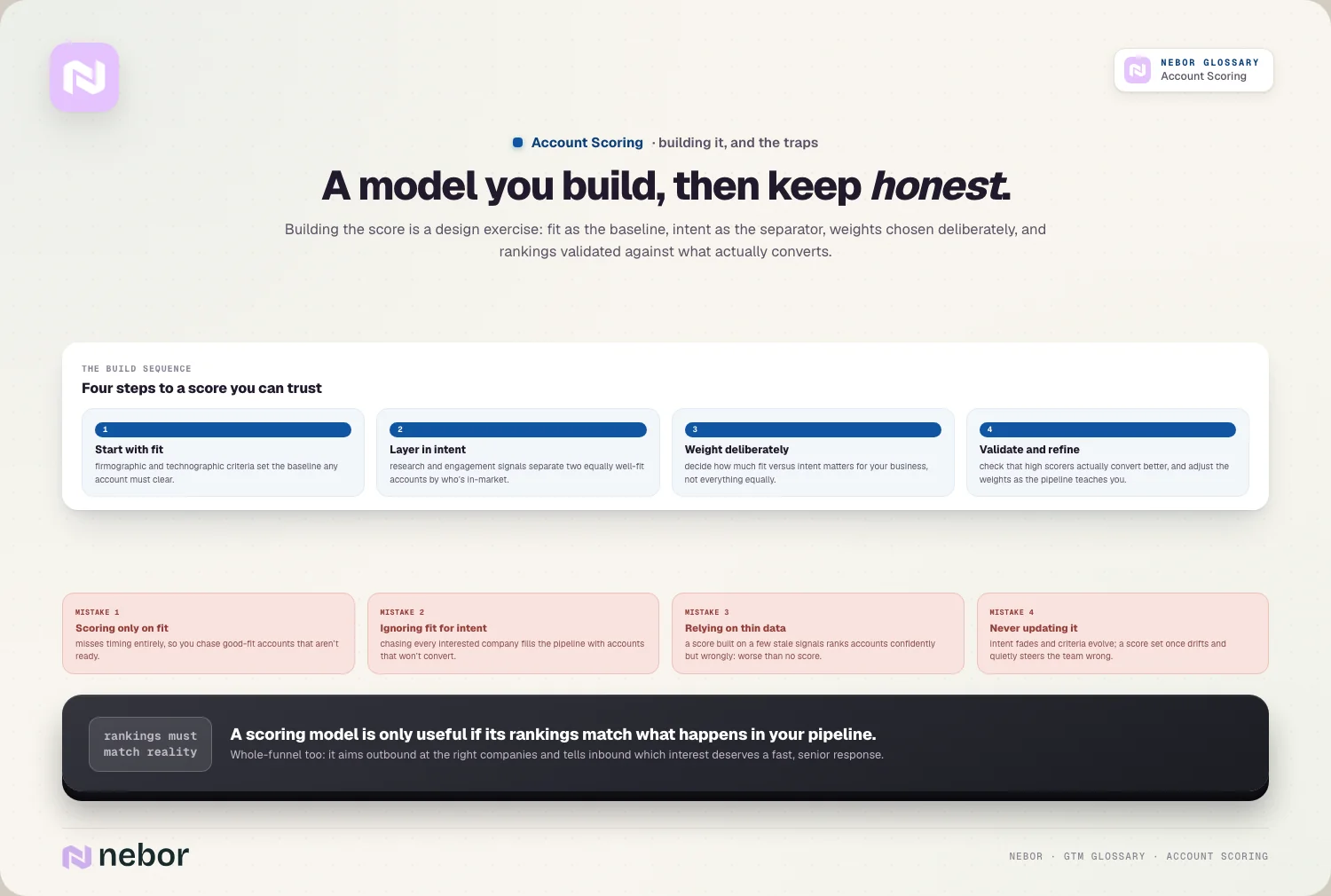
Intent comes next, layering in the research and engagement signals that show readiness, so two equally well-fit accounts can be separated by which one is currently in-market.
The weighting deserves deliberate choices, deciding how much fit versus intent matters for your business, and which specific signals carry the most weight, instead of treating everything equally.
Validation is the step that closes the loop. You check whether high-scoring accounts convert better, and adjust the weights over time, since a scoring model is only useful if its rankings match what really happens in your pipeline.
Does account scoring work for inbound as well as it does outbound?
Account scoring is often framed for outbound targeting, but it sharpens inbound too. The moment interest appears, an account score helps you respond well.
On outbound, the score chooses your targets, because you rank your whole addressable market and focus your proactive effort on the highest-scoring accounts first.
On inbound, the score prioritizes the interest that arrives. When leads come in, the account score tells you which belong to high-value companies worth a fast, senior response versus a lighter touch.
It also connects the two motions, because a known high-scoring account showing up on your site is a strong signal, blending account fit with live behavior into one clear prompt to act quickly.
So account scoring is a whole-funnel tool. It directs outbound toward the right companies and helps inbound treat interest from those same companies with the urgency it deserves.
What are the common mistakes with account scoring to watch for?
Account scoring can mislead if built carelessly, and the same few mistakes show up in most of the models we've audited.
The most common is scoring only on fit, where a model that ranks accounts purely by profile match misses timing entirely, so you chase good-fit accounts that aren't ready.
Its mirror image is ignoring fit for intent, chasing every account showing interest regardless of whether they fit, which fills your pipeline with companies that won't convert.
Thin data causes the third, because a score built on a few stale signals ranks accounts confidently but wrongly, which is worse than no score whatsoever.
And then there's the model nobody updates. Accounts change, intent fades, and fit criteria evolve, so a score set once and left alone drifts out of date and starts steering your team toward the wrong companies.
Why scoring the account means scoring the thing that really buys
Account scoring makes sense because it scores the thing that buys, the company itself instead of any single contact. In a world where committees make decisions, ranking accounts captures a picture that scoring individuals can't.
The deeper idea is combining fit and intent at the account level. The best accounts are the right kind of customer showing signs of being in-market, and scoring is how you find them.
The honest requirement is good data across many signals. A score is only as trustworthy as the firmographic, technographic, intent, and engagement data underneath it, so the inputs decide the value.
So if your team still prioritizes by individual leads, you're scoring the wrong unit for how B2B buys today. Scoring the whole account is how you focus your effort on the companies most ready to move.
That prioritization is exactly what a modern go-to-market system is built to act on. It's also the first step toward reaching the right people, once you find the decision makers inside the accounts your score surfaced.
Share this post
ABM
Data
RevOps
Glossary
Related glossary items
Understanding the core GTM concepts




Ready to build your pipeline











