
In this post:
Some email addresses are doomed before you ever hit send. The domain behind them has no mail server set up to receive anything, so every message you send bounces straight back, damaging your reputation for a delivery that was never possible.
MX validation is the check that catches those addresses. It looks up a domain's mail records to confirm there's a real server ready to receive email, so you can drop the hopeless addresses before they ever cost you a bounce.
MX validation is the process of querying a domain's DNS to confirm it has valid mail exchange (MX) records, meaning the domain is set up to receive email. A domain with no MX records cannot accept mail, so anything sent to it bounces.
The check comes early in the chain that keeps your sending clean. It's a small, fast lookup, but it filters out a category of address that would otherwise guarantee a bounce, so it belongs in any serious list-cleaning process.
TL;DR
MX validation checks a domain's DNS for valid mail exchange records, confirming the domain has a server configured to receive email in the first place.
It exists to prevent the guaranteed kind of bounce. A domain with no MX records cannot accept mail, so sending to it wastes a send and harms your reputation for nothing.
It's one layer of full email validation instead of the whole thing, because a domain can have valid MX records while a specific mailbox on it still doesn't exist.
For cold email it doubles as intelligence, because a domain's mail setup can hint at what tools a company uses and how seriously it takes email.
What MX validation checks against a sending list
MX validation checks whether a domain can receive email in the first place. It queries the domain's DNS records and looks specifically for the mail exchange entries that route incoming mail.
The check targets the MX records specifically. These are DNS entries that tell the internet which servers handle email for a domain, so their presence means the domain is set up to receive messages.
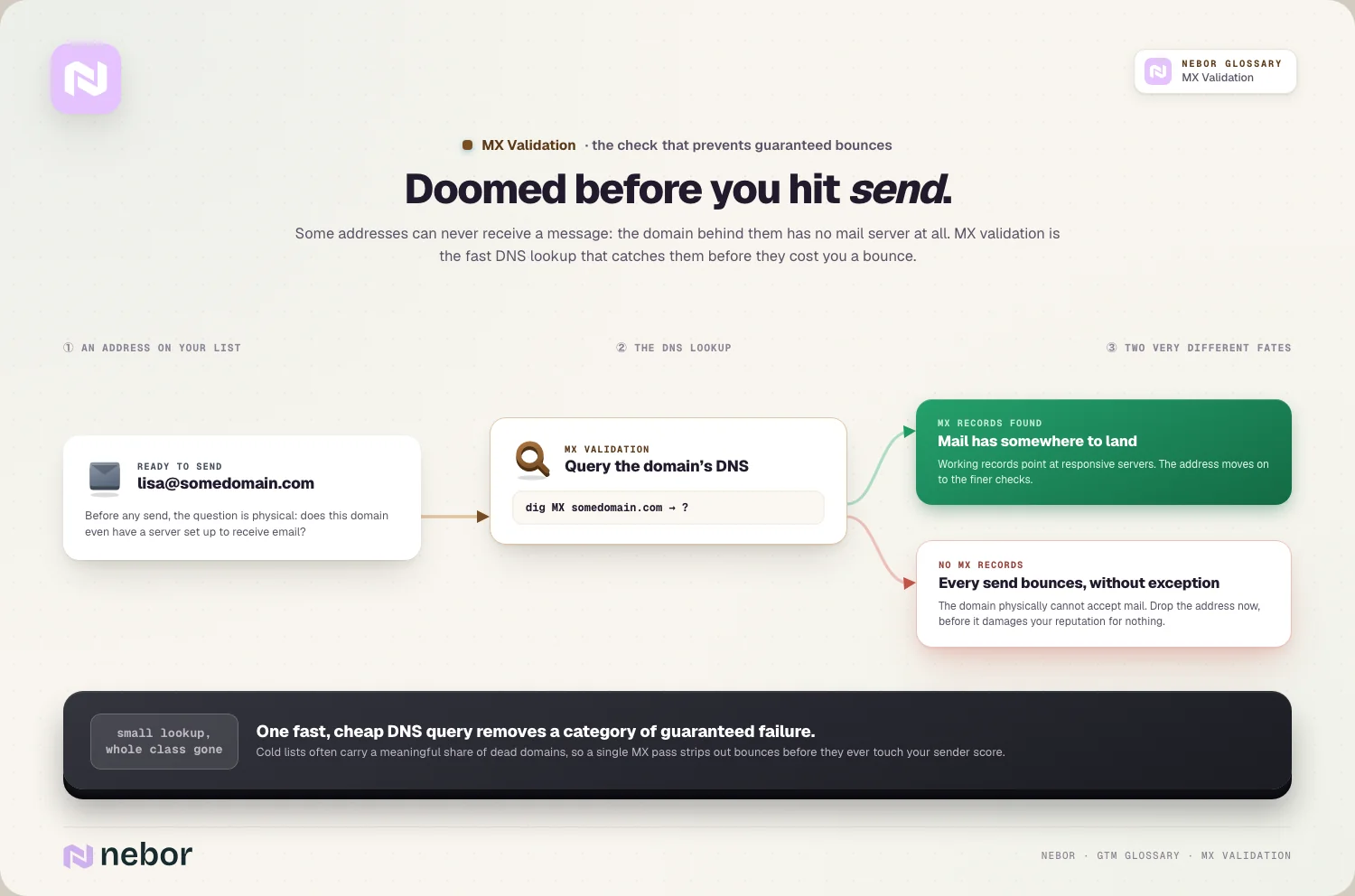
A valid result means mail can arrive there. When a domain has working MX records pointing at responsive mail servers, email sent to that domain has somewhere to land.
An empty result means guaranteed failure instead. A domain with no MX records has no way to accept mail, so any email sent to it will bounce without exception.
That yes-or-no answer is what makes the check useful. It separates domains that can physically receive your email from ones where sending is pointless, before you spend a send finding out.
How MX records work behind the scenes of every email you send
To see why the check matters, it helps to understand what MX records do. They're the signposts that route email across the internet.
An MX record names a mail server for the domain. It's a DNS entry listing which server is responsible for receiving email there, so sending systems know where to deliver.
Every send starts with exactly this lookup. When a server sends mail to an address, it first looks up the domain's MX records to find out which server to hand the message to.
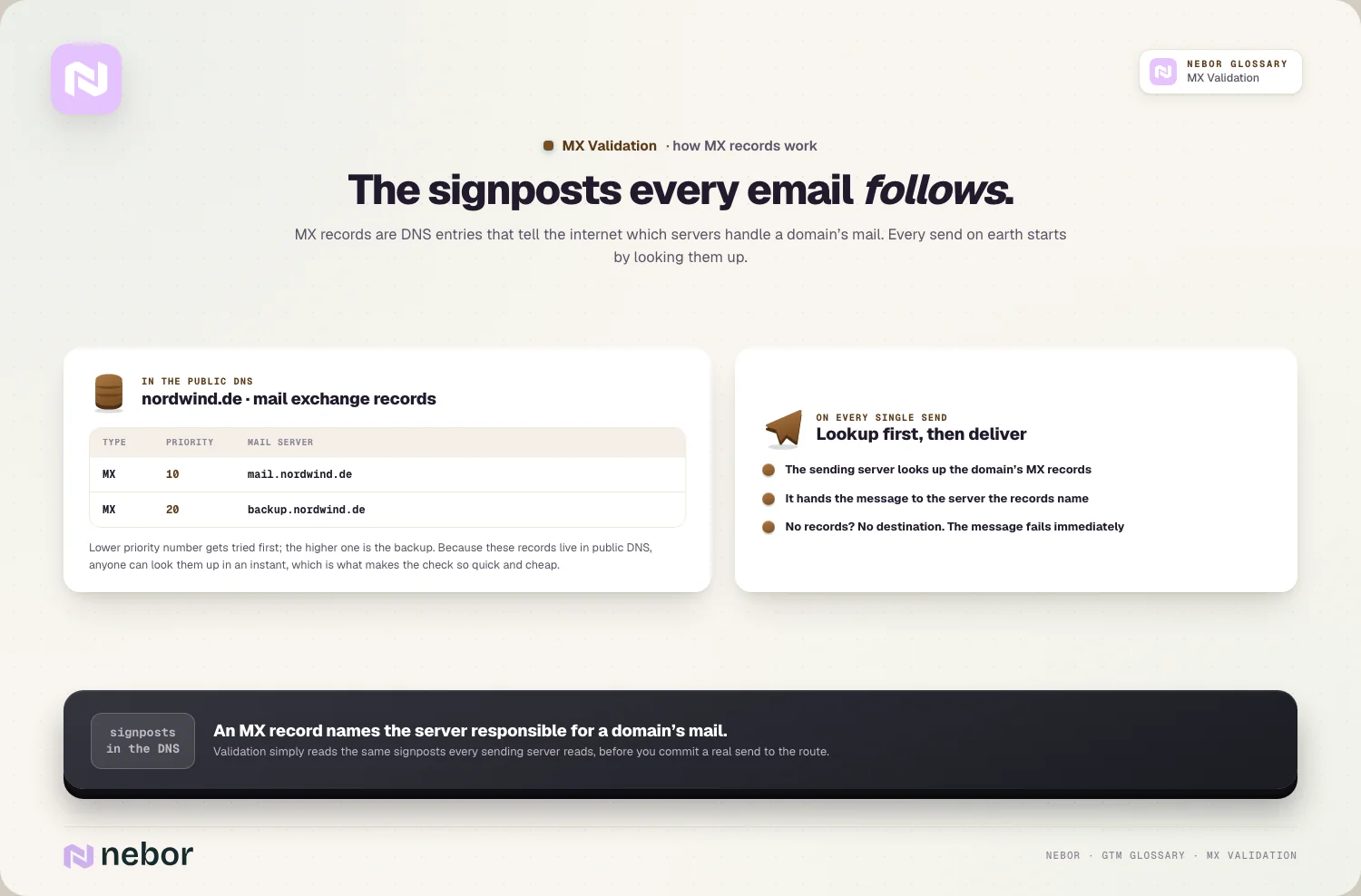
The records carry a priority as well. Each MX record has a priority number and a hostname, and sending servers try the lower-priority numbers first, which lets domains set backups.
Without these records, mail has nowhere to go. A domain missing MX records gives sending servers no destination, so the message fails immediately instead of reaching an inbox.
The whole system is built on public DNS. Because MX records live in the same public DNS that powers the rest of the internet, anyone can look them up in an instant, and that openness is what makes validation so quick and cheap.
Why a missing MX record guarantees a bounce every single time
The core value of MX validation comes down to one hard fact about how email works. No MX record means no possible delivery.
A bounce is the only possible outcome. If a domain has no mail server configured, the sending system has nowhere to deliver, so the message returns as a hard bounce.
Those bounces are waste in its purest form. You spent a send on an address that could never receive it, gaining nothing while adding to your bounce count.

Bounces damage your standing with the mailbox providers. A high bounce rate signals to mailbox providers that you send carelessly, which drags down deliverability for your good emails too.
Catching these early protects everything further downstream. Removing no-MX domains before a campaign keeps your bounce rate low, which is one of the cheapest ways to protect your sending reputation.
The savings add up across a list, and in our experience they surprise most teams. Cold lists often carry a meaningful share of dead domains, so a single MX pass can strip out a chunk of guaranteed bounces before they ever touch your sender score.
How MX validation fits inside the wider email validation process
MX validation is one step in a larger checking process, and mistaking the part for the whole gets teams in trouble, because full validation goes further.
It's an early, coarse filter in that process. MX validation confirms the domain can receive mail, which is a necessary first check before you look at anything more specific.
Full email validation goes several layers deeper. Beyond the domain, it checks whether the specific mailbox exists and whether the address is likely to accept mail, which MX validation alone cannot tell you.
The steps build on each other in order. There's no point checking a mailbox on a domain that can't receive mail, so MX validation goes first and the finer checks follow.
So MX validation is the foundation layer instead of the finished job. It rules out the domains that can never work, leaving the harder question of individual mailboxes to later steps.
Why valid MX records still do not guarantee a real, working mailbox
A common misunderstanding is treating a passed MX check as proof an address is good. The check is necessary but far from sufficient.
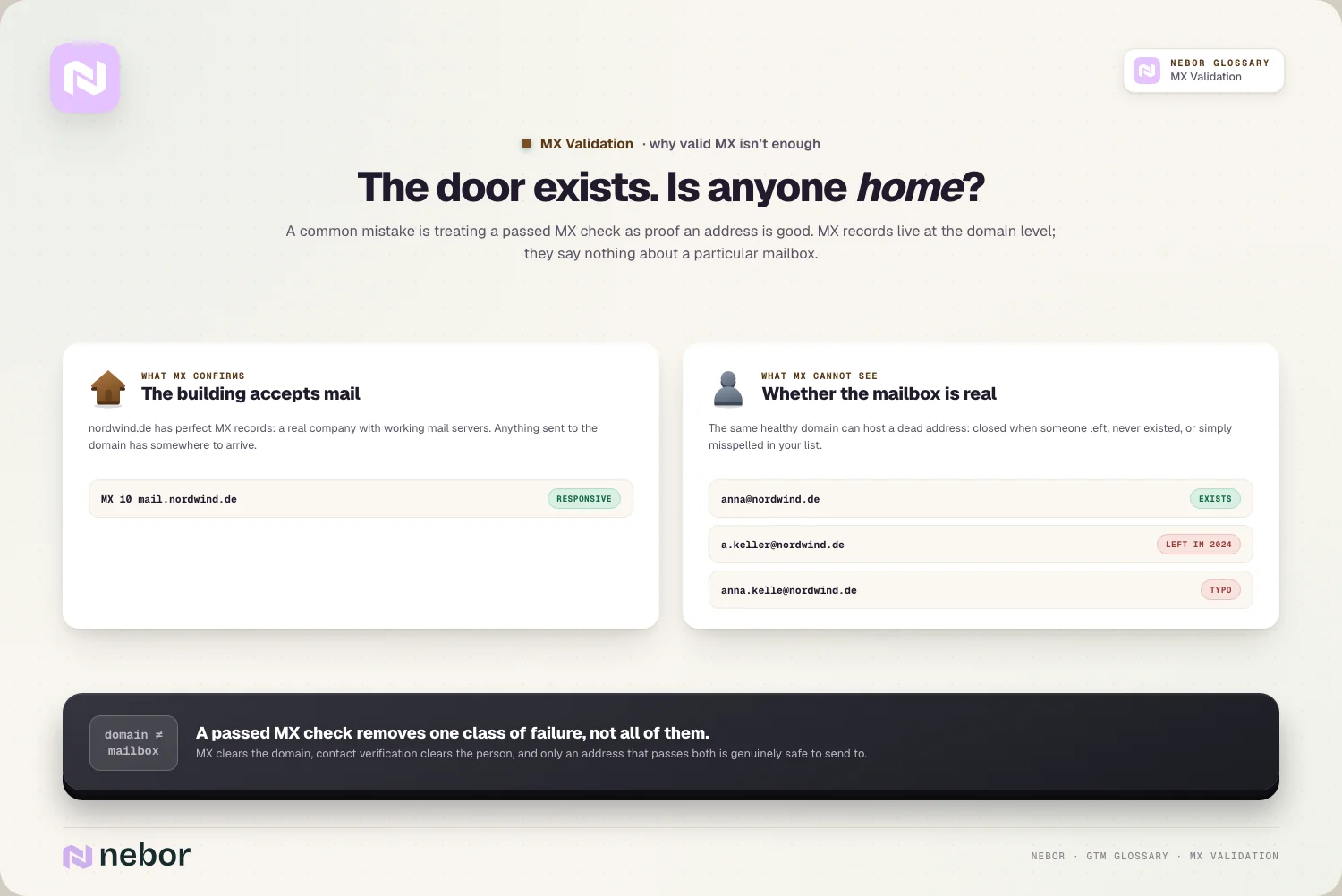
MX records live at the domain level only. They confirm the domain can receive mail, but say nothing about whether a particular address on that domain exists.
A valid domain can host a dead address. A company can have perfect MX records while the specific person's mailbox was closed, has since disappeared, or is misspelled in your list.
This is exactly why deeper checks exist. Confirming a real, active mailbox needs contact verification that goes beyond the domain to the individual address.
So a passed MX check means the door exists, without promising anyone's home. It removes one whole class of failure, but you still confirm the specific mailbox before trusting the address.
Thinking of it in layers helps here. MX validation clears the domain, mailbox checks clear the person, and only an address that passes both is genuinely safe to send to, so each layer narrows the risk a little further.
How MX validation doubles as light intelligence about a company
For cold outreach, MX validation delivers more than a pass or fail. A domain's mail setup reveals useful signals about the company behind it.
The mail host hints at the tech stack. A domain hosted by a major cloud email provider suggests the company uses modern cloud tools, which is a small piece of technographic data.
Security posture shows through in the records too. A domain with strict mail security configured tells you the company takes email seriously, which shapes how carefully you should send to it.

Odd setups raise their own quiet flags. A domain with active mail records but no real website can hint at a shell or holding entity, which you'd want to know before investing effort.
So the check pays a bonus beyond hygiene. The same lookup that prevents a bounce also hands you a few clues about who you're about to email.
None of this replaces real research, of course. The signals are light and circumstantial, but because you're already doing the lookup to protect deliverability, reading them costs nothing extra and occasionally tells you something useful.
How MX validation works for real-time checks and bulk cleaning
MX validation shows up in two different moments, and each serves a distinct purpose. The lookup is the same, but the timing changes how you use it.
Real-time checks guard your inbound forms at the door. Checking MX the moment someone enters an email catches a dead domain instantly, so bad addresses never enter your system as part of inbound enrichment.
Bulk checks clean the lists you already have. Passing a whole list through MX validation before a campaign strips out the no-MX domains in one pass, protecting the send.
Both moments feed the same good hygiene. Whether at entry or before a campaign, MX validation is part of the ongoing data hygiene that keeps your CRM sendable, and in our experience both moments deserve wiring in.
So the check works both as a gatekeeper and a cleaner. It stops bad domains coming in and clears out ones already there, which are two sides of keeping a list healthy.
How MX validation relates to the DNS records that authenticate you
MX validation looks at one type of DNS record, but a domain's mail setup involves several, and they're easy to confuse. Keeping them straight is worth a moment.
MX records handle the receiving side of email. They tell the world which server accepts mail for a domain, which is exactly what MX validation checks.

Authentication records handle the trust side instead. Separate DNS entries prove a sender is allowed to send for a domain, which is the job of DNS authentication instead of MX records.
The two record types answer entirely different questions. MX validation asks whether a domain can receive email, while authentication asks whether email claiming to be from a domain is genuine.
So MX validation is one reading of a domain's DNS among several. It confirms the receiving side works, while authentication records confirm the sending side is legitimate.
How MX validation supports cleaner list building from the start
MX validation is most useful when it happens early, ideally as you build a list instead of after. Catching dead domains at the source keeps the list clean from day one.
It filters at the point of collection. Checking MX records as addresses are gathered during list building stops dead domains from ever entering the list.
It saves your team cleanup work later. A list built with MX validation baked in needs less cleaning before each campaign, because the guaranteed bounces were never added.
It compounds with your enrichment as well. When you enrich and validate together, the addresses you keep are both complete and reachable, which raises the quality of the whole list.
So the earlier you do it, the more it helps. Building it into collection means your list starts clean instead of needing rescue before every send.
Why MX validation matters more for cold outbound than warm lists
MX validation deserves extra attention in cold outbound specifically, because the risk profile there is different and cold lists carry more hidden failures.
Cold lists are riskier by their nature. You're emailing people who never opted in, often from purchased or scraped data, so dead and malformed domains are far more common.
Reputation is more fragile in cold sending too. Because sender reputation is precious and easily damaged in outbound, every avoidable bounce matters more than it would for a warm list.
The check scales cheaply across any list. An MX lookup is fast and inexpensive, so validating an entire cold list costs little compared to the reputation damage a wave of bounces causes.
So the colder your list, the more MX validation pays off. It's a low-cost filter against exactly the kind of guaranteed bounces that cold data tends to hide.
The common ways teams overlook or misuse MX validation in outbound
MX validation goes wrong in a few quiet ways, usually by being skipped or over-trusted, and we keep seeing the same errors in the lists clients send us.
The biggest mistake is skipping it entirely. Sending to a list without checking MX records lets guaranteed-bounce domains through, which is an avoidable hit to your reputation.
Another is trusting the check too far. Treating a passed MX check as proof the address is good ignores that the specific mailbox may not exist.
A third is checking once and forgetting. Domains change, and their mail setup can lapse, so a list validated long ago can drift out of date through ordinary data decay.
The last is checking without acting. Flagging no-MX domains but still sending to them defeats the purpose, so the check only helps if you remove what it catches.
A subtler slip is over-relying on it as a quality gate. MX validation confirms a domain can receive mail, but it says nothing about whether that domain belongs to a good-fit prospect, so it protects deliverability without saying anything about targeting.
Why MX validation is a small, quiet check that protects quite a lot
MX validation never gets much attention, and that's exactly the point. It's a quiet, mechanical lookup that prevents an entire category of wasted sends.
The check itself is trivial. A DNS lookup takes moments and costs almost nothing, yet it removes addresses that would otherwise bounce with certainty.
The payoff shows up in your reputation. By stripping out guaranteed bounces before they happen, MX validation protects the deliverability that every other part of your outreach depends on.
The habit is what matters in the end. Building MX validation into how addresses enter your system and how lists get cleaned makes bounce prevention automatic rather than a scramble after the damage is already done.
Treated as routine plumbing, MX validation is one of the cheapest safeguards in a modern go-to-market system. It clears the hopeless addresses out of the way so the outreach you automate sales prospecting around reaches domains that can receive it.
Share this post
Deliverability
Verification
Glossary
Related glossary items
Understanding the core GTM concepts




Ready to build your pipeline











