

In this post:
Two reps email the same prospect on the same day. One writes a generic pitch that could go to anyone, and the other opens by referencing the three SDRs the company just hired. Only one of those emails gets a reply, and it's rarely the generic one.
Prospect research is what separates those two reps. It's the work of learning enough about an account and a person before you reach out that your message speaks to their actual situation, instead of sounding like it was blasted to a thousand people at once.
Prospect research is the practice of gathering relevant information about a target account and the individuals in it before making contact, so your outreach can be specific and truly relevant. It's the homework that turns a cold message into one that lands.
The payoff is concrete enough to measure. Outreach that references a specific signal or a real initiative at the account sees around 28 to 30% higher response rates than generic personalization, which is the difference research makes.
TL;DR
Prospect research is the homework you do on an account and its people before reaching out, so your message speaks to their real situation instead of sounding generic.
It's what makes personalization real, because referencing a specific signal or initiative earns far higher response rates than a name-and-company template ever will.
The most valuable research is behavioral, because what a prospect recently did, like hiring or launching something, beats static firmographic detail for relevance.
AI now does the heavy lifting of research and drafting, but the winning teams still human-edit their highest-value messages, because unedited AI openers underperform.
What prospect research covers before you ever make first contact
Prospect research is the information-gathering step that comes before outreach. You learn about the company and the person so your first message can be relevant rather than generic.
It spans the account and the individual. You research the company's situation and the specific person's role and priorities, because both shape what will resonate.
It looks for reasons to reach out. Beyond basic facts, you hunt for a hook, a recent event or need that gives your message a genuine reason to exist right now.
It informs the whole approach you take. What you find shapes the opener but the angle, the channel, and the value you lead with, so research guides the entire outreach.
So prospect research is the groundwork that makes outreach land. It's the difference between a message built for one person and one that could have gone to anyone with a pulse.
Research deserves separating from finding prospects in the first place. Building a list decides who to contact, while research decides what to say to them, so the two are distinct steps that both have to be done well.
Why prospect research is what makes personalization actually real
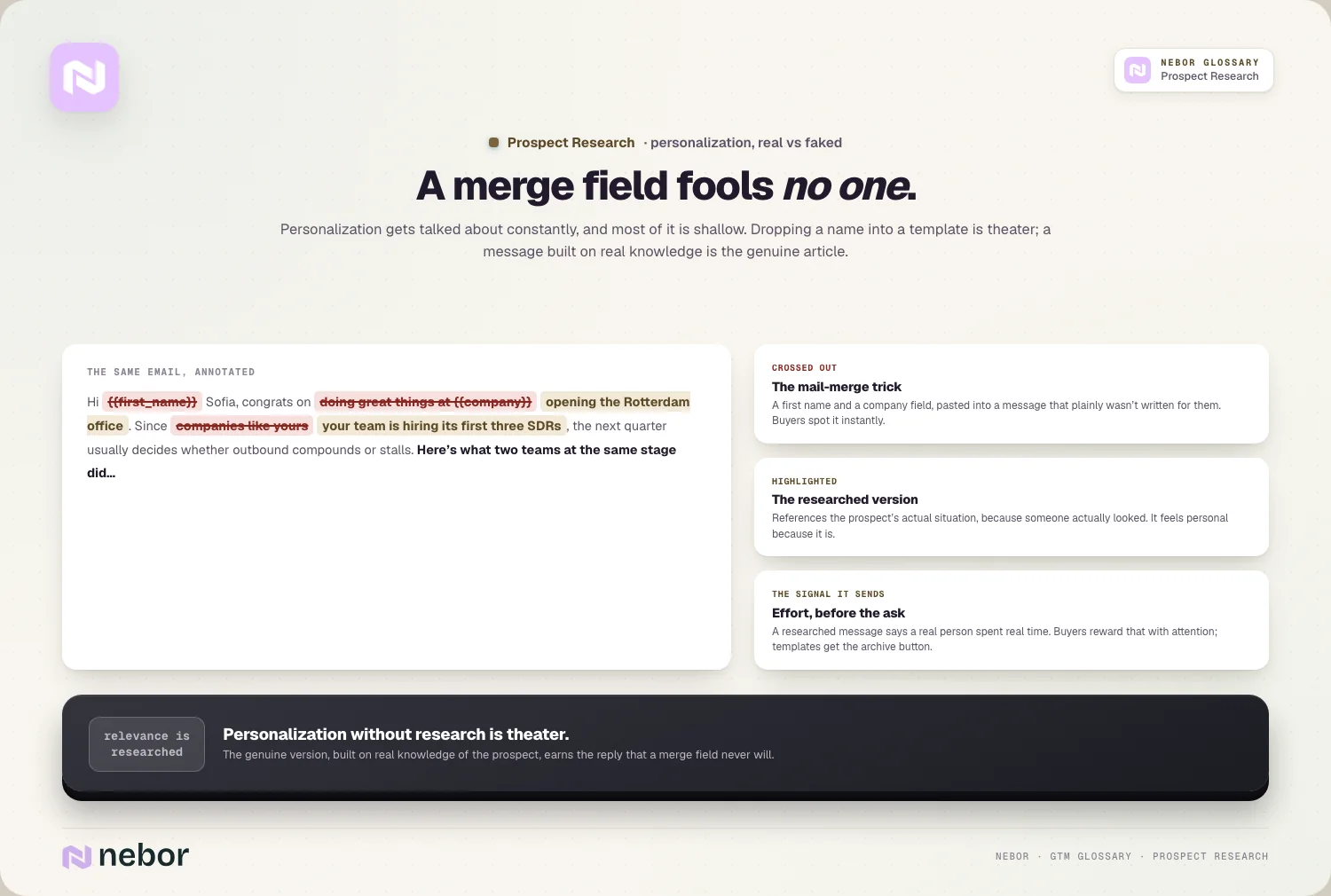
Personalization gets talked about constantly, and most of it is shallow. Real prospect research is what separates genuine relevance from a mail-merge trick.
Inserting a name is a long way from personalization. Dropping a first name or company into a template fools no one, because the rest of the message clearly wasn't written for them.
Relevance comes from the research and nowhere else. A message that references the prospect's real situation feels personal because it is, and that authenticity is what research provides and templates can't fake.
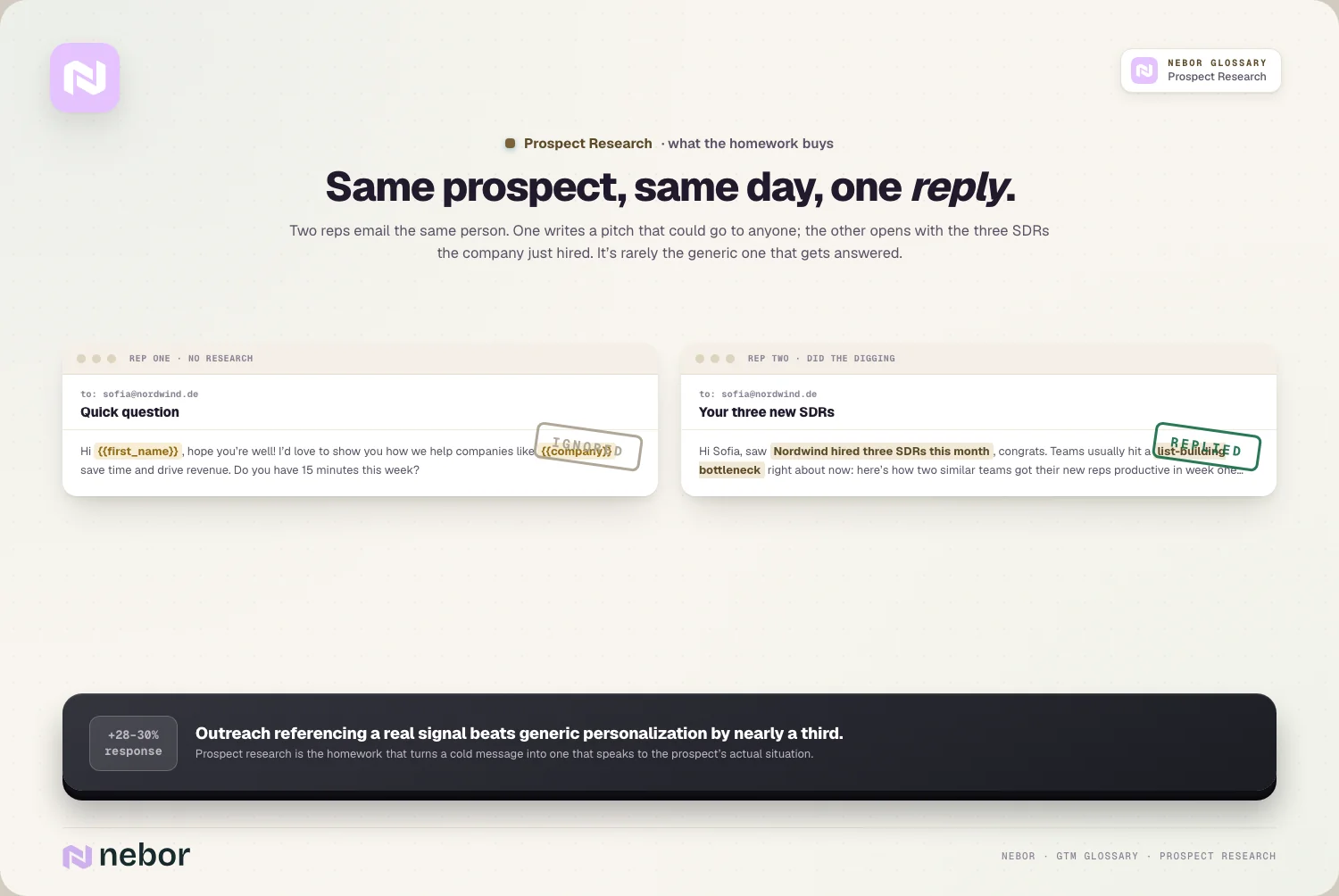
The response gap is a wide one. Context-anchored outreach that references real signals and account context outperforms generic personalization by wide margins, which is the whole reason research pays off.
So personalization without research amounts to theater. The real version, built on knowledge of the prospect, is what earns the reply that a merge field never will.
Prospects can tell the difference in a second. A researched message signals that a real person spent real effort, while a templated one signals the opposite, and buyers reward the former with their attention.
Why recent behavior beats static firmographics for real relevance
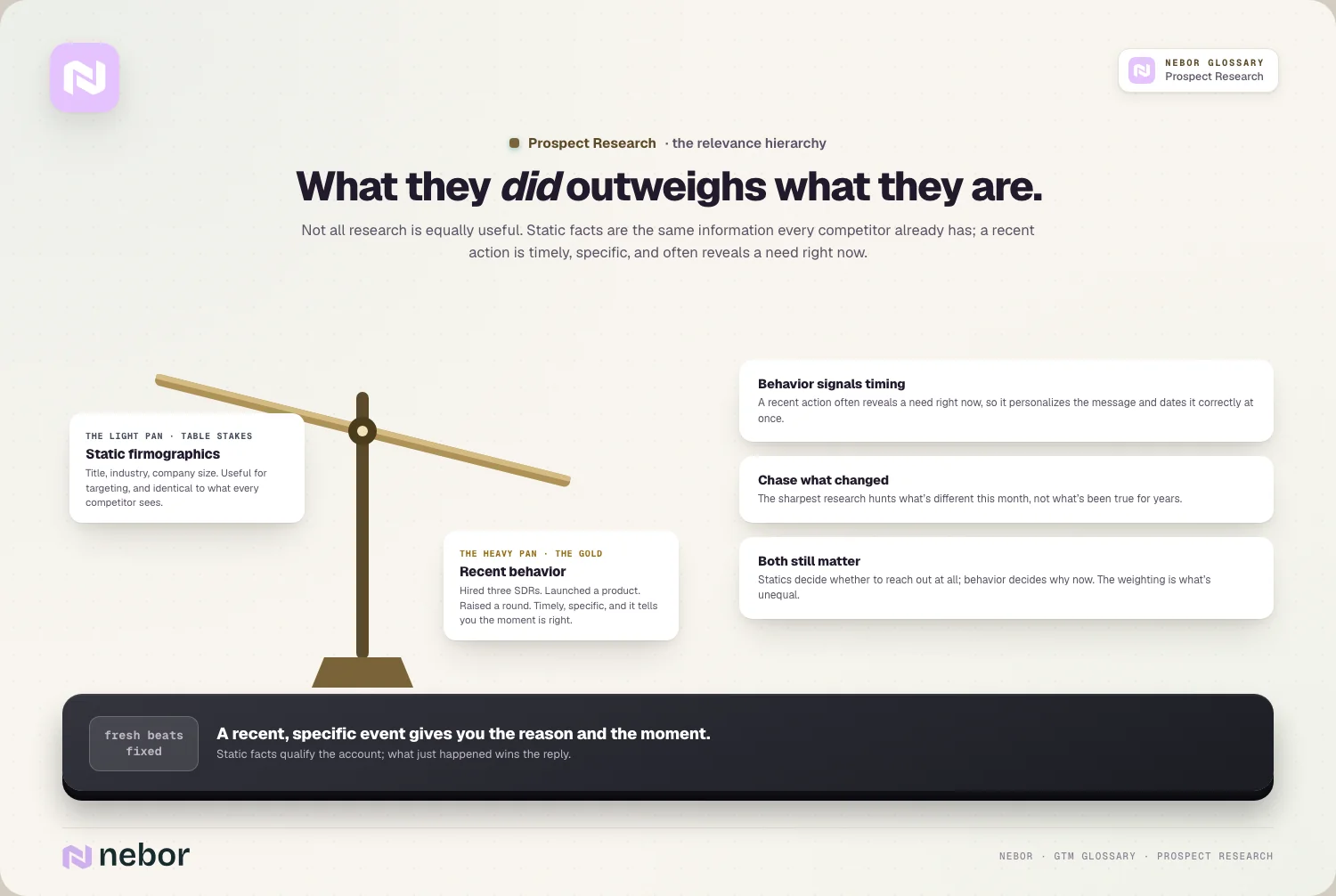
Not all research is equally useful, and there's a clear hierarchy. What a prospect recently did matters far more than what they simply are.
Static facts are only the table stakes. Knowing a prospect's title, industry, and company size is useful for targeting, but it's the same information every competitor already has.
Recent behavior is where the gold is. Knowing a company just hired three SDRs or launched a product tells you something timely and specific, which makes outreach truly relevant.
Behavior signals the timing at the same time. A recent action often reveals a need right now, so behavioral research personalizes the message and tells you the moment is right at the same time.
So the sharpest prospect research chases what's changed as much as what's fixed. A recent, specific event gives you both a reason to reach out and a moment that makes the reach welcome.
What information the strongest prospect research gathers first
Effective prospect research collects a specific mix of information, and in our experience a few categories do most of the work.
Firmographics frame the account for your team. The firmographic data of industry, size, and funding stage tells you whether the company fits and shapes what will matter to them.
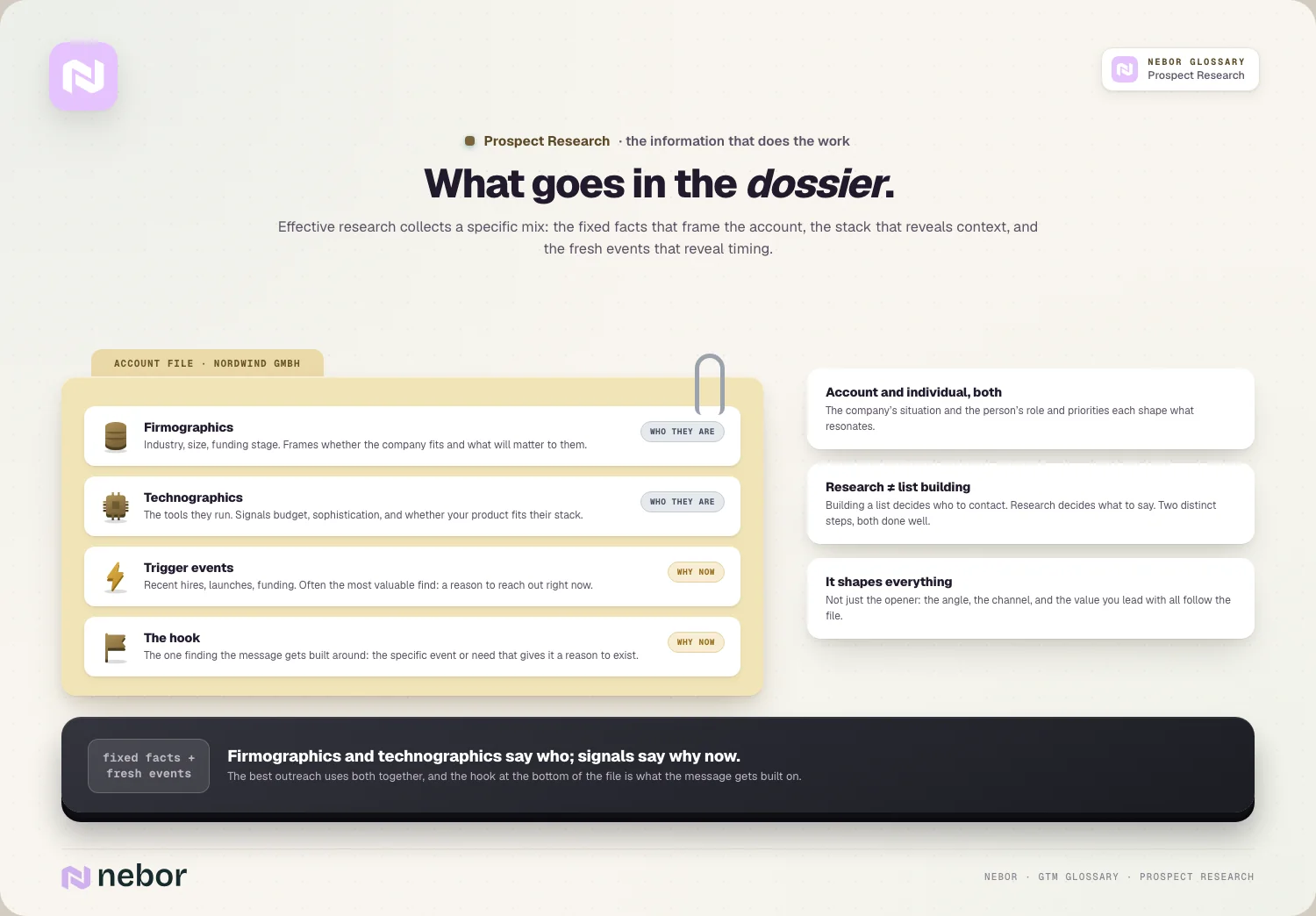
Technographics reveal how the company operates day to day. The tools a company uses, the domain of technographic data, signal budget, sophistication, and whether your product fits their stack.
Signals reveal the timing of the need. Recent hires, launches, funding, and other events are the trigger events that tell you a prospect may need you now, which is often the most valuable find.
So strong research blends the fixed and the current. Firmographics and technographics tell you who the prospect is, while signals tell you why now, and the best outreach uses both together.
How prospect research connects to your ideal customer profile
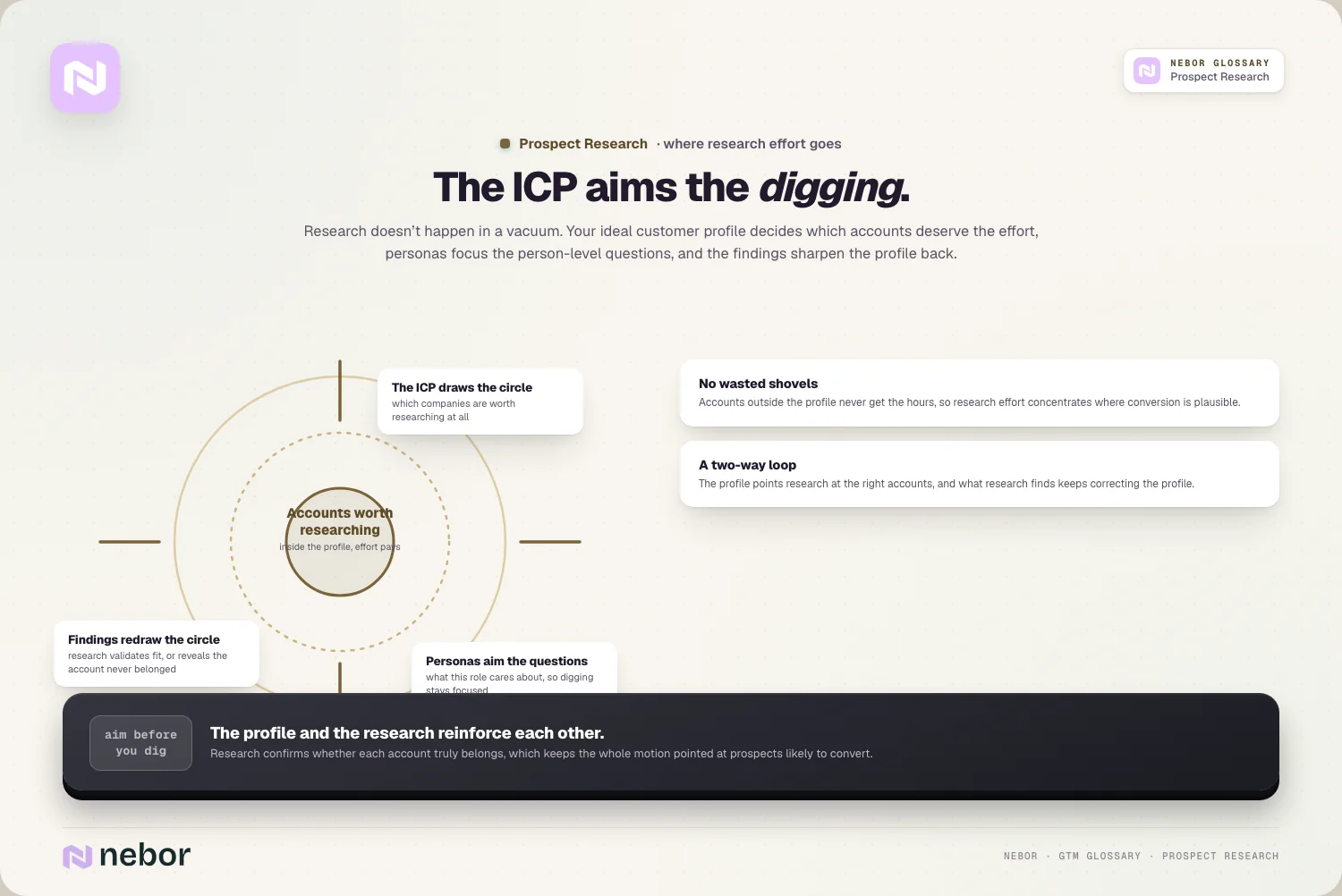
Research is guided by who you're trying to reach, because your profile of the ideal buyer directs where research effort goes.
The profile sets the boundaries of the target. Your ideal customer profile defines which companies deserve researching, so you don't waste effort on accounts that will never fit.
Personas guide the work at the person level. A clear buyer persona tells you what a given role cares about, which focuses your research on what will land with them.
Research then confirms and sharpens the fit. Digging into an account either validates it as a real match or reveals it isn't, which keeps your effort on the prospects most likely to convert.
So the profile and the research reinforce each other. The profile points research at the right accounts, and the research confirms whether each one truly belongs, so effort stays focused.
How prospect research turns into a cold email that gets answered
Research is only useful if it changes the message, so the link to the actual outreach matters. Good research reshapes a cold email from the first line.
The opener carries the research most visibly. A strong cold email opens with something specific to the prospect, and that specificity is what research provides and what earns the read.
The angle follows whatever the research found. What you learn shapes which problem you lead with, so research determines not just the hook but the whole pitch's relevance.
The ask stays grounded in the same context. Even the call to action feels more natural when the whole message is clearly built around the prospect's real situation.
So research and the message are inseparable. The point of the digging is a message that reads as written for one person, which is what a researched cold email delivers and a template never can.
How AI changed prospect research without replacing the human part
AI has transformed how prospect research gets done, and understanding the shift matters. It handles the heavy lifting while leaving the nuance to people.
AI accelerates the research work itself dramatically. Modern tools gather and summarize account information fast, cutting personalization time by around 90% while surfacing insights reps would miss manually.
It finds patterns a human would overlook. Most sales professionals say AI uncovers insights they'd never have found manually, because it processes far more data than a person could.
But it doesn't write the final nuance. AI-generated openers without human editing underperform human-written ones by 30 to 40%, so the last mile still needs a person.
So AI reshapes research as an accelerator instead of a replacement. It does the gathering and drafting, while the human judgment that makes a message land stays exactly where it always was.
Why the smartest teams edit only their highest-value prospects by hand
Given that AI drafts well but humans finish better, teams face a real trade-off on where to spend human time, and the winning answer is selective instead of all-or-nothing.
Hand-editing every single message simply refuses to scale. Personalizing each one by hand caps how many prospects you can reach, which is the old bottleneck AI is meant to break.
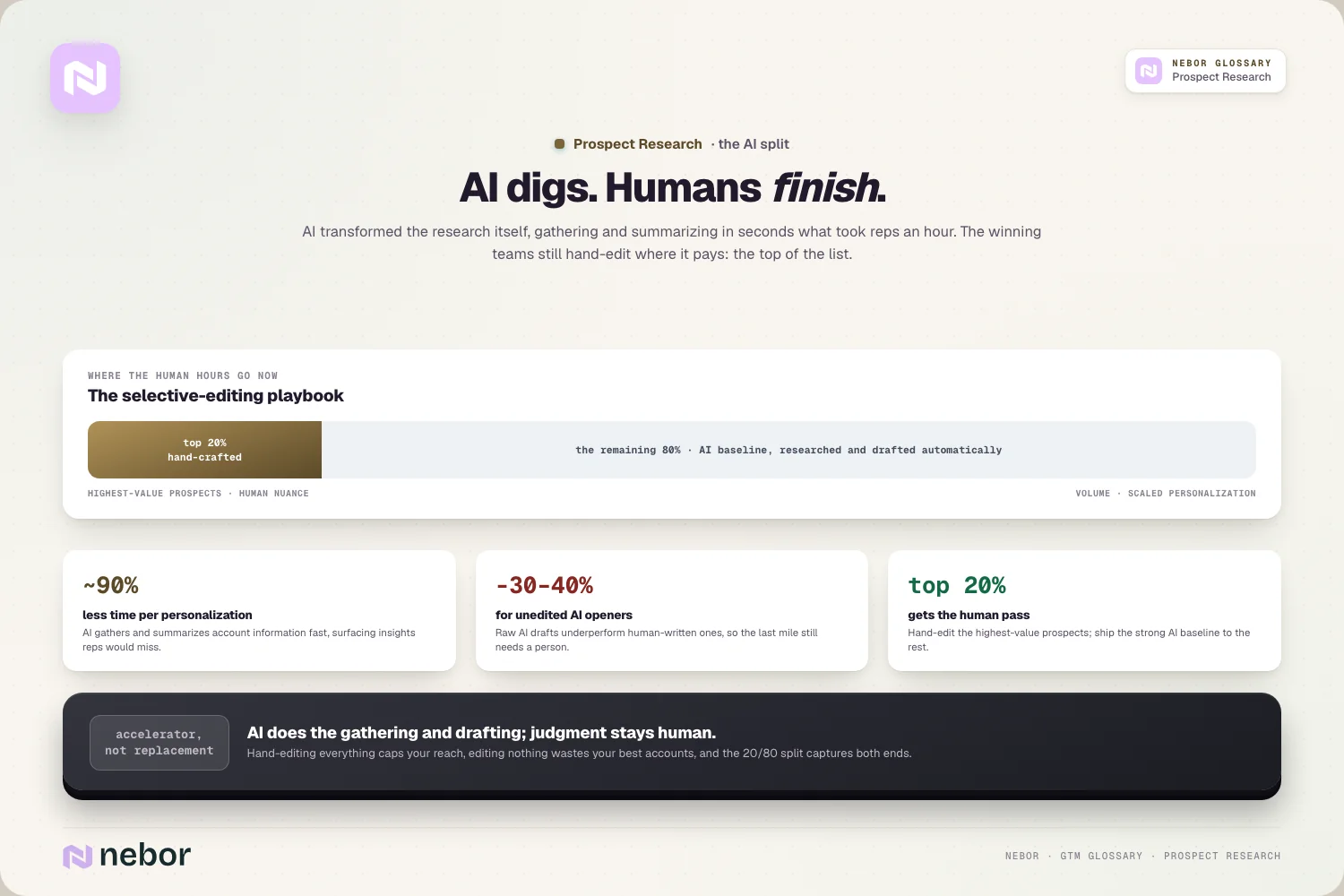
Editing nothing underperforms just as clearly, though. Shipping raw AI drafts to everyone leaves the response-rate gains of human nuance on the table for your best accounts.
The split between the two is the practical answer. Strong teams human-edit the top 20% of prospects and ship the AI baseline to the rest, which is a core idea in personalization at scale.
So the smart move is to spend human effort where it pays most. Your highest-value prospects get hand-crafted messages, while the long tail gets a solid automated baseline, which balances reach and quality.
How prospect research fits inside a signal-based selling motion
Prospect research and modern signal-driven outreach are deeply connected. Research is often how you act on the signals that trigger outreach in the first place.
Signals point the research where to dig. When an intent signal lands, research fills in the context around it, turning a bare signal into an account you understand.
It supports the whole signal-based motion directly. The practice of signal-based selling depends on research to turn a detected signal into a relevant, informed message.
It sharpens your list building on top. Research validates and enriches the accounts on a target list, so list building produces prospects you know something real about.
So research is the connective tissue of modern prospecting. Signals say who and when, and research supplies the what, and that combination makes signal-driven outreach relevant as well as timely.
How much prospect research each account deserves before you send
A real tension in prospect research is how deep to go, because time is finite and accounts vary in value, so the answer is to match effort to the prize.
High-value accounts justify the deepest digging you can do. A major target worth a large deal earns real, manual digging, because the potential return covers the hours spent understanding it.
Smaller accounts need a much lighter touch. For a long list of lower-value prospects, a quick pass on the key signals is enough, because deep research on each would never pay off.
Tiering is what makes the whole thing manageable. Sorting prospects by value and assigning research depth accordingly lets you spend your hours where they matter, instead of treating every account the same.
So the right depth is a judgment about return. The best researchers go deep where the deal is big and stay efficient everywhere else, which keeps the effort sustainable across a full pipeline.
Why prospect research keeps paying off long after the first message
The value of research doesn't end when you hit send on the first email, and we tell clients to treat what they learn as an asset for the whole relationship.
It informs every follow-up after the opener. Knowing the prospect's situation lets each follow-up stay relevant, so your persistence feels helpful rather than like empty bumping.
It prepares you for the first call too. The context you gathered means the first conversation starts informed, which builds credibility and saves the prospect from re-explaining their world.
It compounds into your reply rates over time. Consistently relevant outreach lifts your reply rate across a whole campaign, because prospects engage more with messages that clearly understand them.
So research is an investment with a long tail. The homework you do before the first touch keeps paying off through follow-ups, calls, and the trust that carries a deal forward.
The common mistakes that make prospect research a waste of time
Prospect research can be done badly, and we keep seeing the same mistakes turn the effort into wasted time, so avoiding them keeps research paying off.
The biggest is confusing facts with relevance. Collecting a prospect's title and company and calling it research misses the recent, specific detail that earns the reply.
Another is over-researching every account to the same depth. Spending an hour on every prospect doesn't scale, so research depth should match the account's value instead of being uniform.
A third is researching but not using it. Gathering great context and then sending a generic message wastes the whole effort, so the finding has to reach the message.
The last is trusting information that's gone stale. A signal from months ago may no longer be true, so research has to be current to be relevant rather than awkward or plainly out of date.
Why prospect research is the quiet edge behind strong outbound
The reps who consistently win replies are usually the ones who did the homework, well ahead of the ones with the cleverest templates, and that homework is what prospect research really is.
The effort compounds into trust you've earned. A prospect who sees you clearly understand their situation is far more willing to engage, because your message proves you paid attention.
It scales once the right tools carry it. Modern research lets you gather deep context fast, so the relevance that once took an hour per prospect can now reach far more of them.
The judgment stays human all the way through. Deciding what matters about a prospect, and how to say it, remains a person's job, so research assists the rep instead of replacing them.
The teams that treat prospect research as a consistent habit make it one of the highest-return investments in a modern go-to-market system. It's the quiet work behind every message that lands, and the reason the outreach you automate sales prospecting around still feels human.
Share this post
Prospecting
Data
Enrichment
Glossary
Related glossary items
Understanding the core GTM concepts




Ready to build your pipeline











