

In this post:
You hired a promising account executive in January, and by April they still haven't closed much. It's tempting to panic, but that quiet stretch is often normal, because almost no salesperson walks in the door and immediately performs at the level you eventually expect from them.
The length of that stretch has a name, and measuring it honestly changes how you hire, plan, and forecast. Rep ramp time is how you put a number on the gap between a new hire's start date and the point where they're truly pulling their weight, so you can plan around it instead of being surprised by it.
Rep ramp time is the amount of time it takes a newly hired sales rep to reach full productivity, usually measured from their start date until they consistently hit a set share of their quota, commonly around 80%, across several months. It captures how long the investment in a new hire takes to start paying back.
Knowing this number shapes almost every planning decision a sales org makes. If you don't know how long reps take to produce, you can't forecast when new hires will contribute, size your team correctly, or tell the difference between a rep who's struggling and one who's simply still ramping on schedule.
TL;DR
Rep ramp time is how long a new sales rep takes to reach full productivity, typically measured from start date until they sustain roughly 80% of quota across consecutive months.
It exists because almost no rep produces at full capacity immediately, so treating a new hire as a full contributor from day one badly overstates what your team can deliver this year.
Benchmarks vary by segment, with SMB reps often ramping in three to four months and enterprise reps taking six to nine, and the industry average has been climbing as products and buying get more complex.
It drives real planning decisions, because accurate ramp assumptions are what let you forecast new-hire contribution, size the team, and judge whether a rep is behind or simply on the normal curve.
What sales ramp time measures from a rep's first day to full quota
Ramp time measures the lag between when a rep starts and when they reach the productivity you hired them for. That first period covers learning the product, the market, the sales process, and the tools, none of which produces revenue immediately but all of which is necessary before a rep can sell effectively.
The clock starts on the rep's first day and stops when they hit a defined bar of productivity. Everything in between is the ramp, a stretch where the rep is consuming coaching, building early pipeline, and working their first deals through a cycle that hasn't had time to close yet.
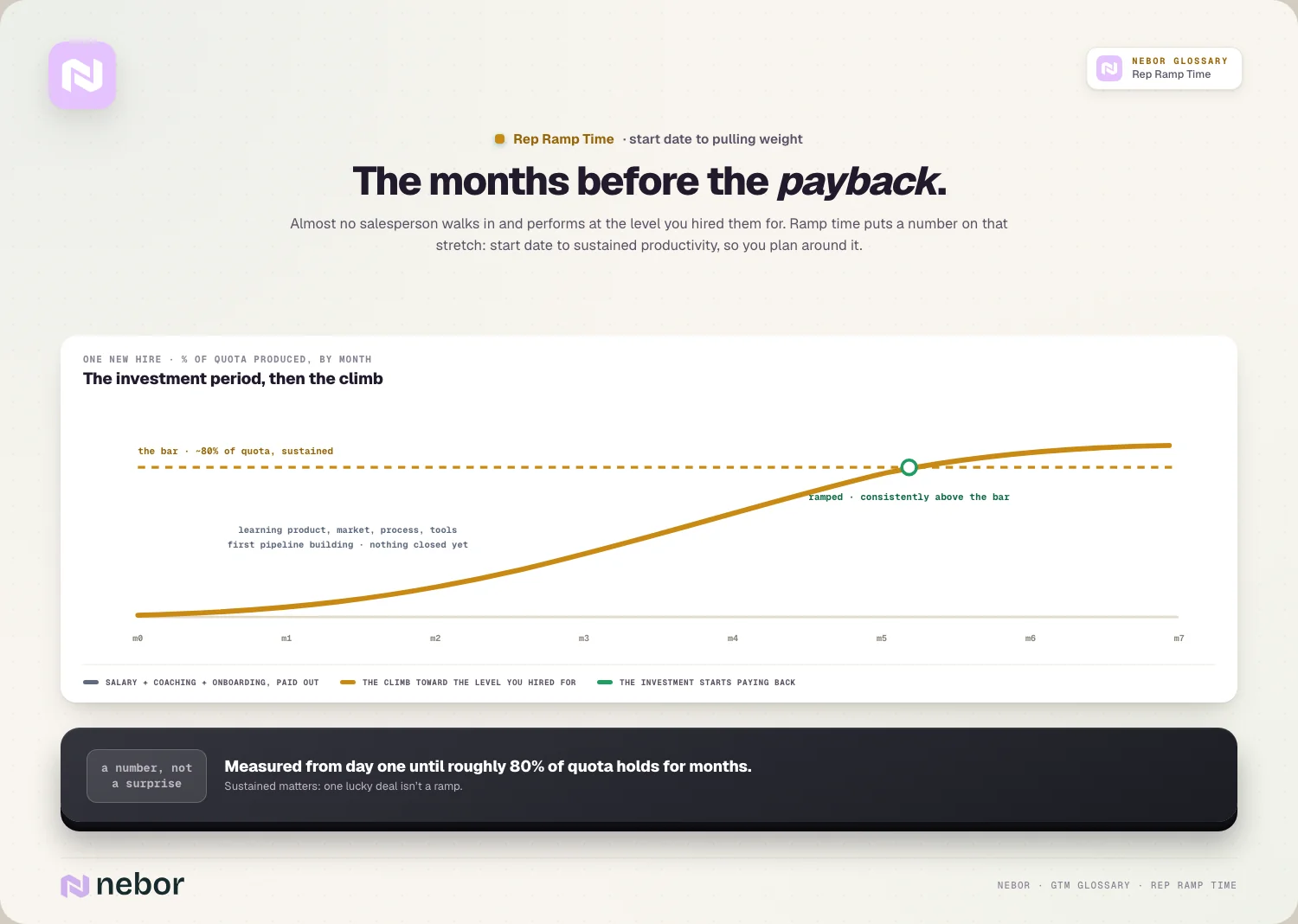
Thinking of it as an investment period makes the concept click. You're spending salary, management time, and onboarding effort before any return arrives, and ramp time is simply how long that investment takes to start paying back once the rep begins closing at the level you planned for.
Why full productivity usually means about eighty percent of quota sustained over months
Defining the finish line is the tricky part, because full productivity is a threshold instead of a single moment. Most teams treat a rep as ramped once they sustain roughly 80% of full quota across consecutive months, because that level of quota attainment shows real, repeatable performance instead of a lucky one-off.
The word sustained matters as much as the number. A rep who hits quota once and then drops off hasn't really ramped, so the bar is about consistency over several months, which filters out a single big deal that happened to close early and doesn't reflect steady capability.
Using a share of quota instead of the full number also accounts for normal variation. Even fully ramped reps miss quota some months, so setting the ramp bar a bit below 100% recognizes that a rep operating at 80% and climbing is effectively productive and past the learning stage.
How to calculate ramp time without fooling yourself about the answer
The most direct method is quota-based, where you measure the months from a rep's start date to the first month they sustain your productivity threshold. When you work it out across many reps, this gives you an average ramp that reflects what really happens instead of what you hoped would happen.
A quicker estimate ties ramp to your sales cycle, because a rep can't close faster than a deal naturally moves. A common rule of thumb adds about 90 days to your average sales cycle length, so a team with a two-month cycle might expect roughly five months before a new rep is properly productive.
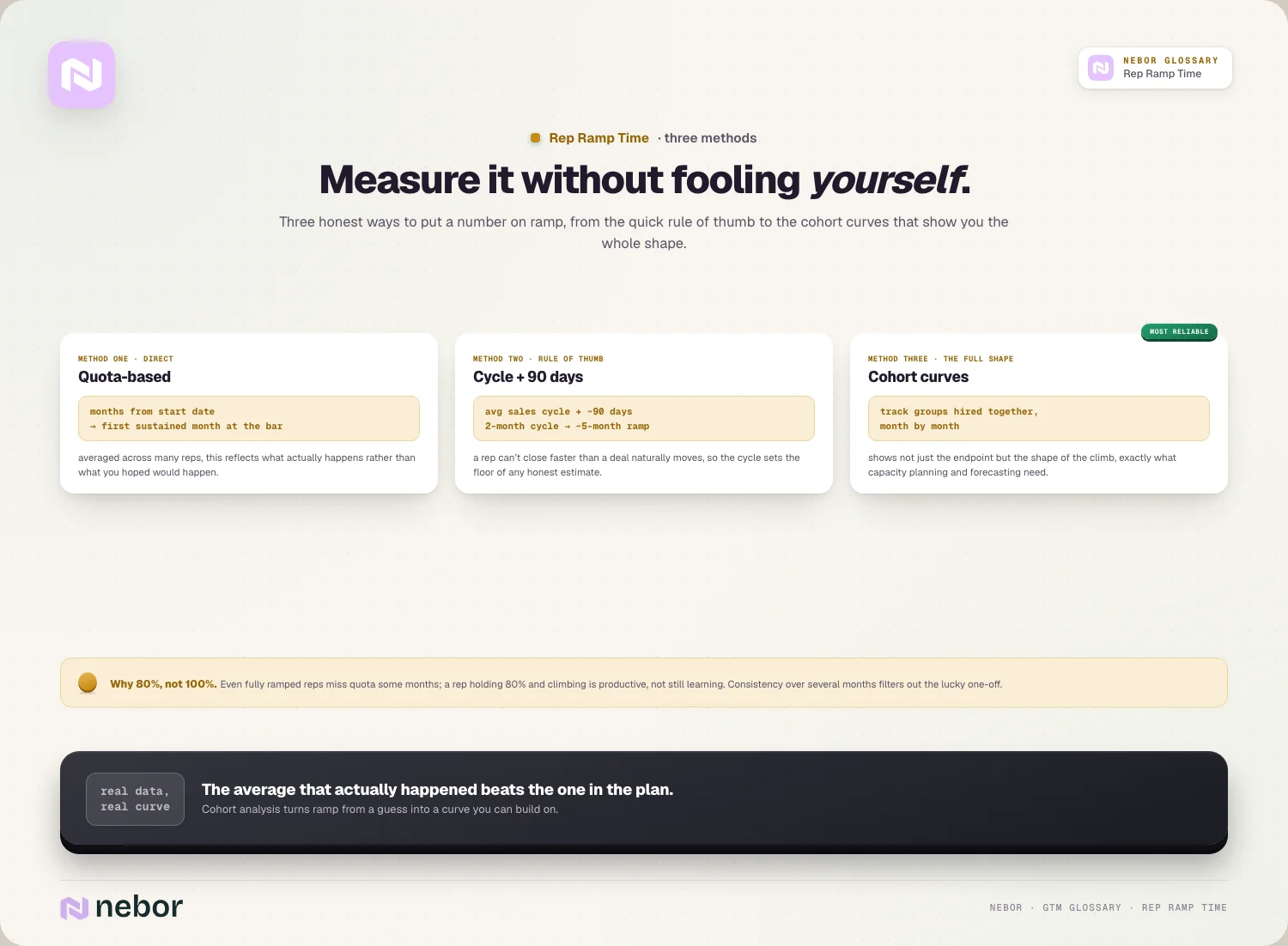
The most reliable approach is cohort analysis, and we lean on it with clients wherever the data allows. It tracks groups of reps who started around the same time.
Building a month-by-month productivity curve from real cohort data shows you the shape of the ramp as well as the endpoint, which is exactly what you need for accurate capacity planning and stronger forecast accuracy.
What normal ramp time looks like across SMB, mid-market, and enterprise segments
Ramp time varies widely by what a rep is selling, so benchmarks only make sense within a segment. Reps selling to small businesses tend to ramp fastest because deals are simpler and cycles shorter, often reaching productivity in three to four months, while the learning curve is smaller and feedback arrives quickly.
Mid-market reps land in the middle, usually taking four to six months to ramp. The deals are larger and involve more stakeholders, so a rep needs more time to learn the buying process and work several longer cycles before they've proven they can consistently close at the expected level.
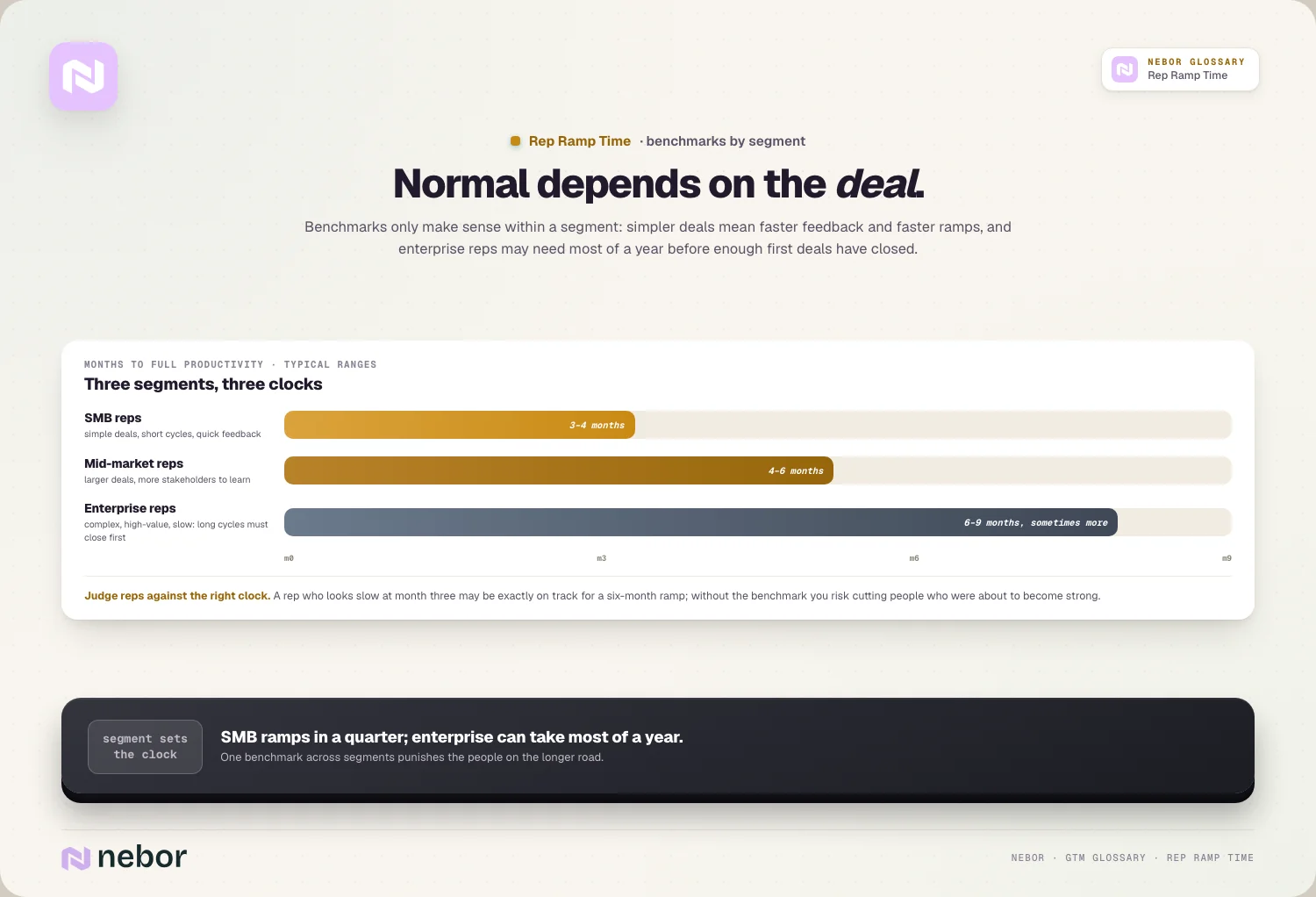
Enterprise reps take the longest, commonly six to nine months and sometimes more. Enterprise deals are complex, high-value, and slow, involving many stakeholders and long cycles, so a rep may need most of a year before enough of their first deals have closed to show they've truly ramped.
Why ramp time has been getting longer across the whole industry
An uncomfortable trend is that ramp times have been rising instead of falling, even as sales tooling has improved. The average SaaS ramp has climbed to around 5.7 months, up from 4.3 in 2020, a meaningful increase over just a few years that cuts against the assumption that better tools make reps productive faster.
The causes are on the buyer's side more than the seller's. Buying committees have grown, deals involve more stakeholders and more scrutiny, and products have become more complex to explain, so a new rep simply has more to learn and more people to win over before they can close.
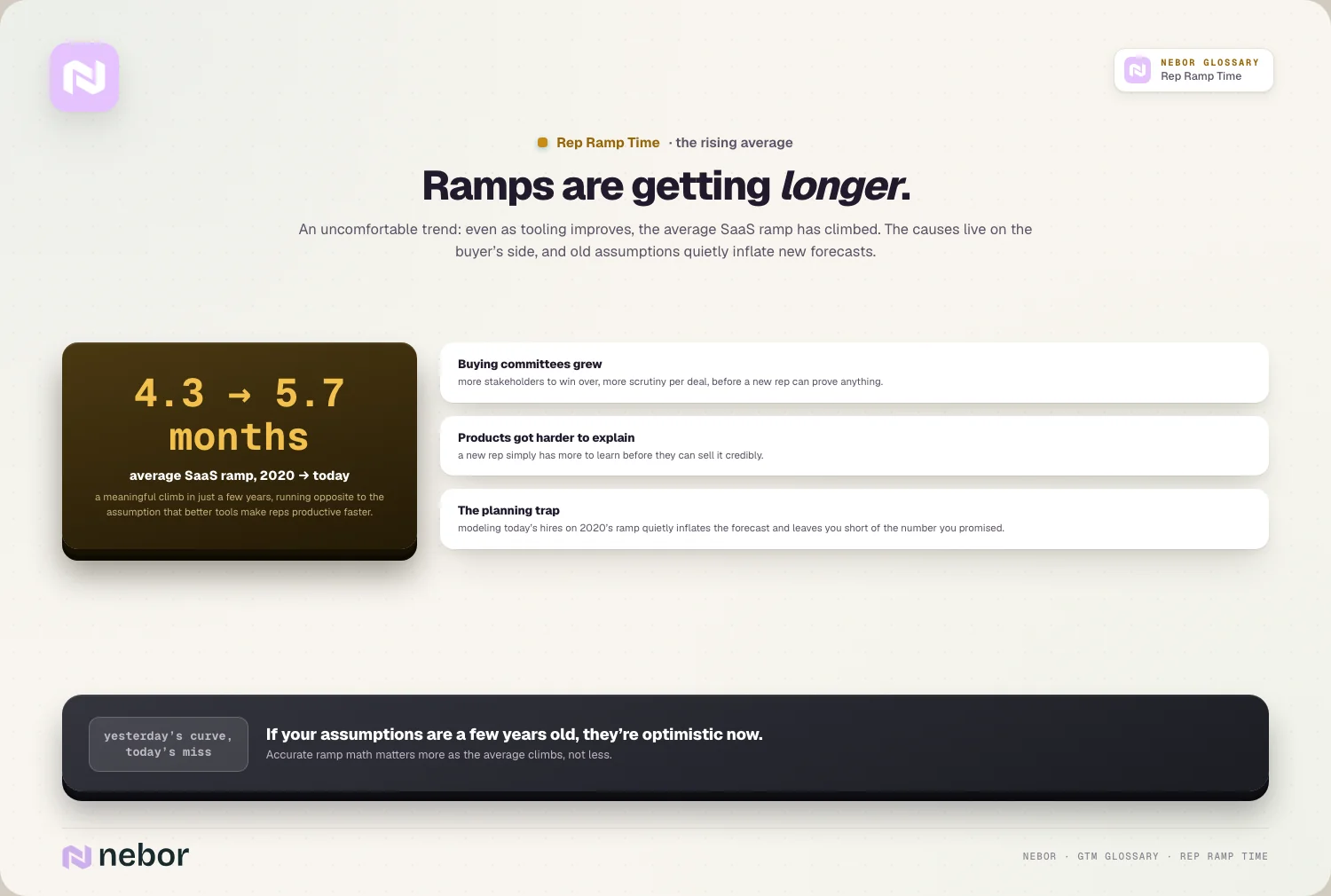
This trend makes accurate ramp assumptions more important rather than less. If you're still planning around the ramp times you saw a few years ago, you're likely underestimating how long new hires take now, which inflates your forecast and leaves you short of the number you promised.
How ramp time feeds directly into your hiring and capacity planning math
Ramp time is one of the core inputs to figuring out how many reps you need and when to hire them. A rep who takes six months to ramp contributes far less in their first year than a fully productive one, so treating new hires as immediately productive overstates your capacity and sets you up to miss.
The timing of hires becomes a planning problem once ramp is factored in.
If you need more capacity by a certain quarter, you have to hire far enough ahead to cover the ramp and keep pipeline coverage intact, because a rep hired the same quarter you need them will still be learning instead of closing when the number comes due.
This is why ramp is at the heart of quota capacity planning and any credible hiring plan. Building the real ramp curve into the model is what connects headcount decisions to the revenue they'll produce, so the plan reflects when new reps contribute instead of assuming they arrive at full speed.
What shortens ramp time without cutting the corners that matter most
The single biggest lever is a structured onboarding program instead of leaving new reps to figure things out. A clear plan across the first 30, 60, and 90 days, covering product, ideal customer, and process, gets reps to competence faster than an unstructured start where they piece the job together on their own.
Giving new reps early pipeline is one of the most effective accelerators, and it's the first thing we advise teams to set up.

Handing a new hire a small set of qualified leads from day one, instead of making them build a pipeline from scratch, means they can start moving real deals through a cycle immediately instead of waiting weeks for opportunities.
Consistent coaching in the first few months compounds all of this. Frequent one-on-ones, shadowing experienced reps, a clear sales playbook, and a compensation plan that rewards early progress all shorten the learning curve.
The payoff is measurable, because one program that combined these levers reportedly cut average ramp to about 4.5 months and saved 90,000 dollars per rep.
Why the environment you drop a new rep into shapes their ramp as much as they do
A rep's ramp depends heavily on the quality of the system around them, well beyond their own ability. A rep dropped into clean territory with strong support ramps faster than an equally talented one handed a messy patch and left alone, so ramp is partly a verdict on your onboarding instead of the individual.
The pipeline a rep inherits matters enormously here. A new hire given a fair, well-defined territory through thoughtful territory carving has a real shot at early wins, whereas one handed a picked-over or poorly matched patch can look like they're ramping slowly when the territory is the actual problem.
The steady flow of opportunities into their world matters just as much. When the top of the funnel keeps producing so that reps you automate sales prospecting to feed always have fresh accounts to work, a new rep gets more at-bats sooner, which accelerates the learning that turns into consistent closing.
The common mistakes teams make when they measure or manage rep ramp time
The most common mistake is not measuring ramp at all and treating every new hire as instantly productive. Building a plan on that assumption guarantees a shortfall, because the reps you counted on for a full year of production spent months of it still learning, which shows up as a gap you didn't see coming.
Another is pulling the plug on reps too early because you don't know your own ramp curve. A rep who looks like they're failing at month three may be exactly on track for a six-month ramp, so without a benchmark you risk cutting people who would have become strong performers had you given them the normal runway.
The subtler mistake is blaming slow ramp entirely on the rep when the system is the cause, and we keep seeing this one in the teams we review.
When many reps ramp slowly, the problem usually lives in onboarding, territories, or pipeline instead of in the people, so treating ramp as a coaching issue misses that it's often a revenue operations problem to fix at the system level.
Why rep ramp time is really a measure of how well your whole sales engine onboards
The deepest way to read ramp time is as a scorecard for your system instead of a stopwatch on individuals. A team where reps ramp quickly has strong onboarding, clean territories, and reliable pipeline, while one where ramp drags has a weakness in that machinery no amount of hiring talent will fix.
Shortening ramp compounds in a way that few other levers do, because every rep who reaches productivity a month sooner adds a month of full contribution. Across a growing team, trimming average ramp even slightly frees up meaningful capacity and improves the odds of hitting the number without simply hiring more people.
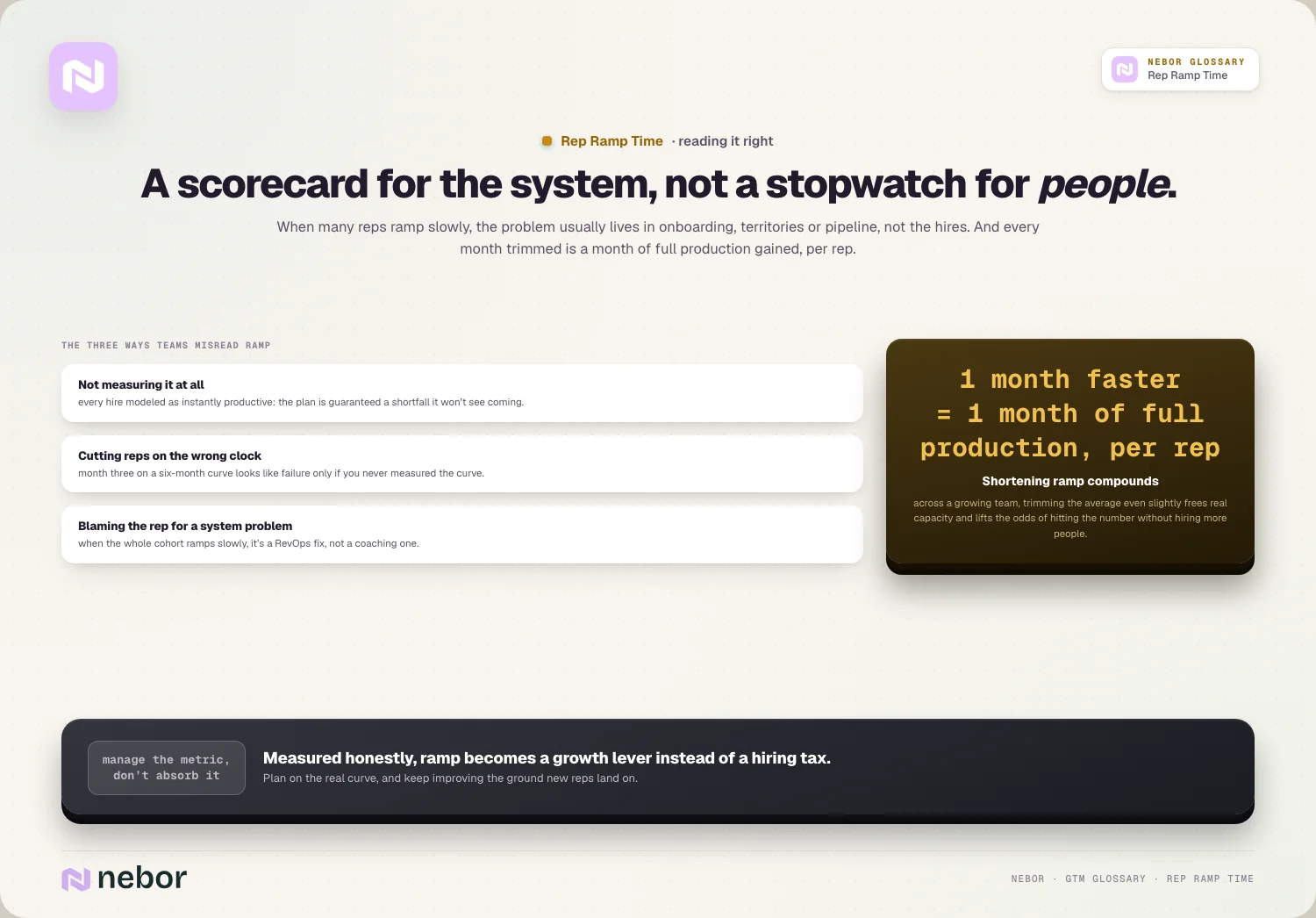
A go-to-market system built to onboard reps well treats ramp as a metric to manage instead of a cost to absorb. When you measure it honestly, plan around the real curve, and keep improving the environment new reps land in, ramp becomes a lever for growth instead of a tax you pay on every hire.
Share this post
RevOps
Glossary
Related glossary items
Understanding the core GTM concepts




Ready to build your pipeline