

In this post:
In most sales teams we meet, the knowledge that wins deals lives in a few top reps' heads. They know which prospects to chase, what to say, and how to handle the hard moments, but none of it is written down.
When those reps leave, that knowledge walks out with them, and new hires start from zero.
A sales playbook fixes that by capturing what works and making it shared. It writes down the process, the messaging, and the plays that win, so the whole team can sell the way the best reps do instead of each figuring it out alone.
A sales playbook is a comprehensive, living document that codifies a company's sales process, methodology, buyer personas, messaging, plays, and metrics across the entire sales cycle. It's the operating manual for how the team sells, from first contact to closed deal.
The value shows up in consistency and speed. When the winning approach is documented, new reps ramp faster, every rep follows a proven process, and the team improves the playbook over time instead of relearning the same lessons.
TL;DR
A sales playbook is a living document that codifies your whole sales process, personas, messaging, plays, and metrics, so the team sells consistently.
It captures what works and makes it shared, so knowledge lives in the organization instead of only in a few top reps' heads.
It covers the entire sales cycle, and that breadth distinguishes it from a narrower outbound playbook focused only on prospecting and first contact.
It only works if reps truly use it, so a playbook has to be a practical, living tool instead of a polished document that gets written once and ignored.
What a sales playbook contains from the first page to the last
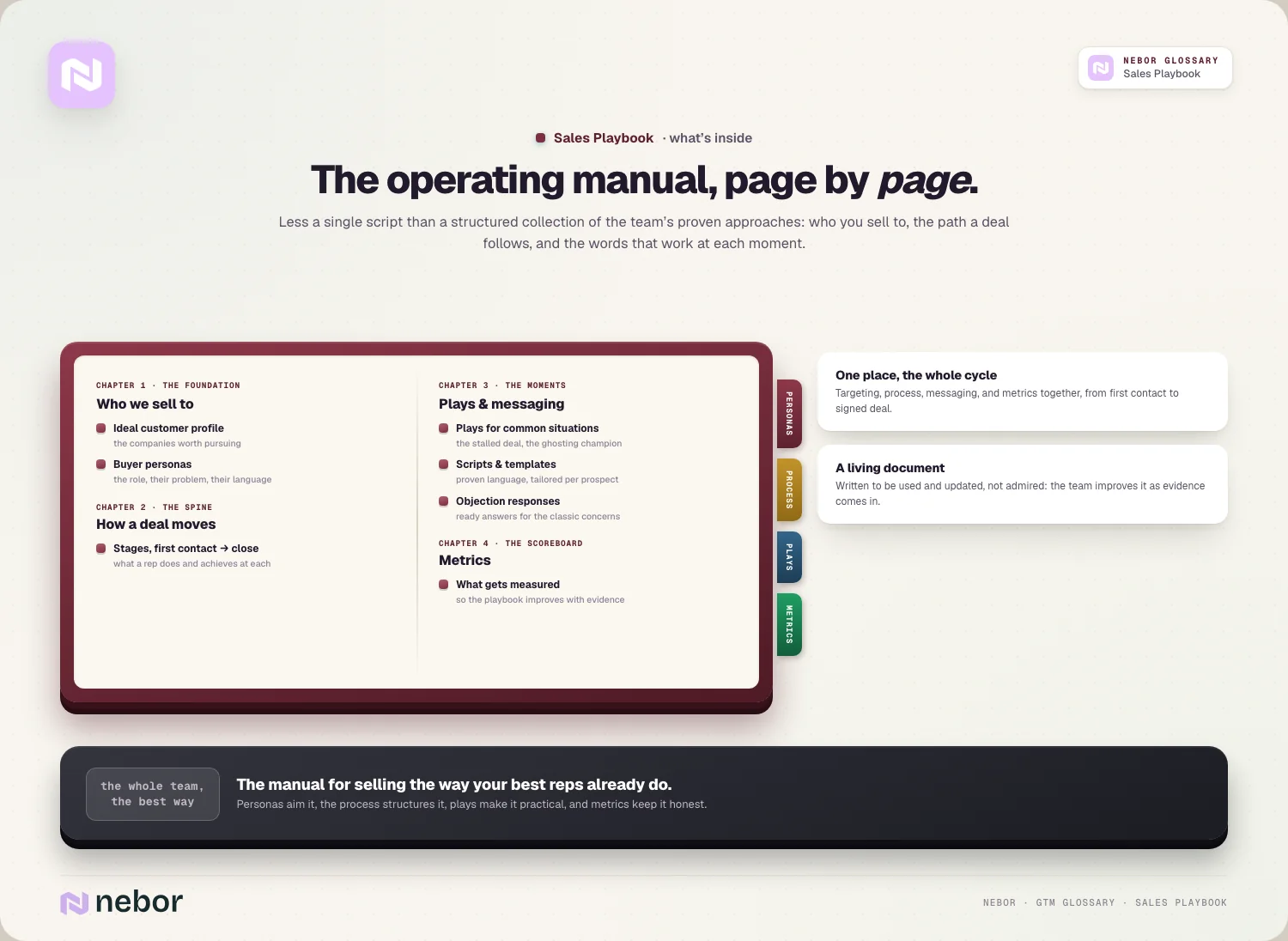
A sales playbook documents everything a rep needs to sell effectively. It's less a single script than a structured collection of the team's proven approaches.
It defines exactly who you sell to. The playbook lays out your ideal customer profile and personas, so every rep targets the same right customers instead of guessing.
It maps the whole sales process end to end. It covers each stage a deal moves through, from first contact to close, so reps follow a consistent path instead of improvising every deal.
It supplies the plays and the messaging. Step-by-step guidance for common situations, plus scripts and templates, gives reps proven language for each moment of the sale.
So a sales playbook is the full operating manual for selling. It brings targeting, process, messaging, and metrics into one place, and that collection is what lets a whole team execute the same proven approach.
How a sales playbook differs from a narrower outbound playbook
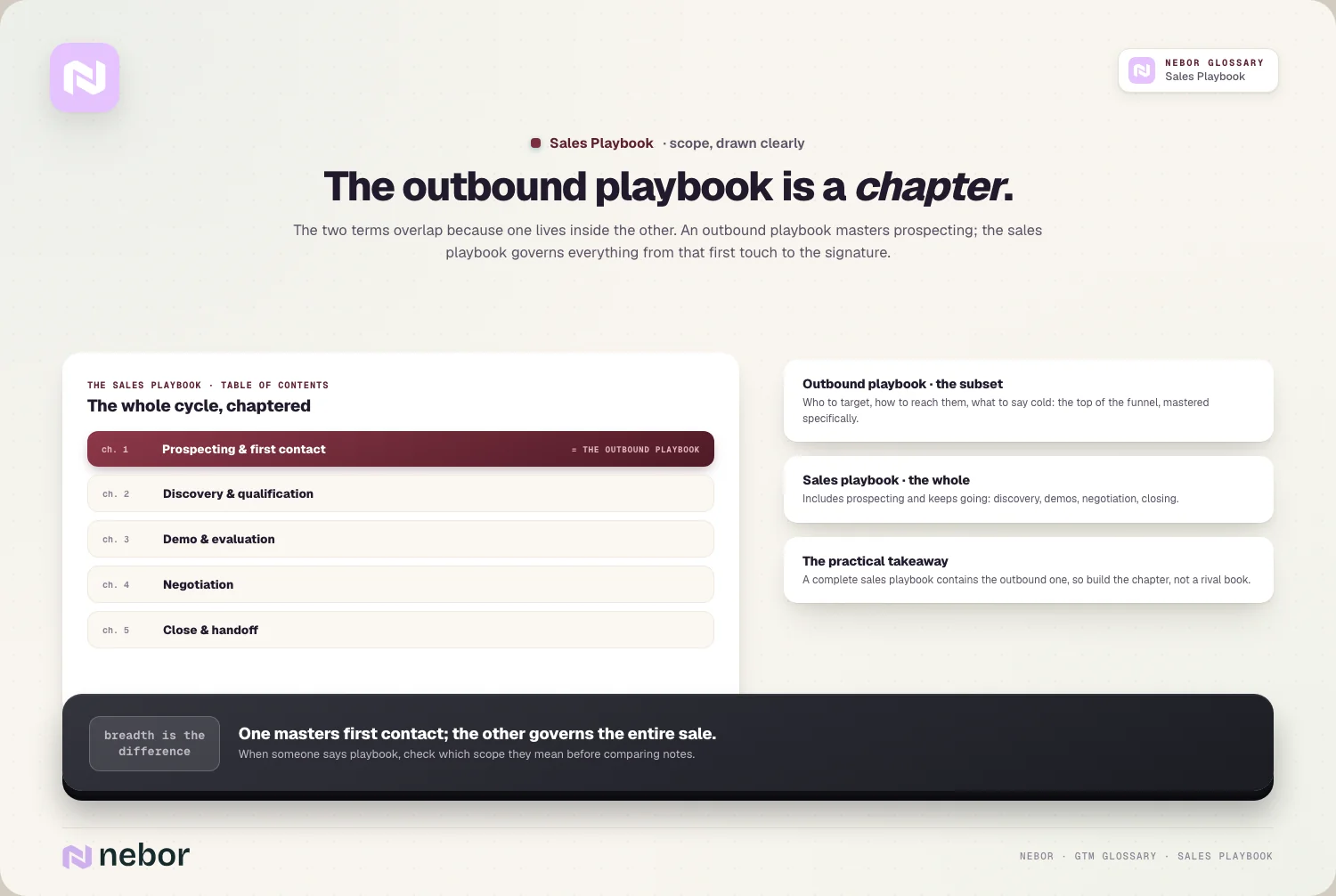
Because these two terms overlap, it helps to draw the line clearly. The difference is mostly one of scope, because one is a subset of the other.
An outbound playbook focuses on prospecting alone. It covers who to target, how to reach them, and what to say in cold outreach, which is the top of the funnel specifically.
A sales playbook covers the whole cycle. It includes prospecting but goes further, into discovery, demos, negotiation, and closing, so it spans the entire sale instead of just the first touch.
One lives inside the other quite cleanly. The outbound playbook is effectively the prospecting chapter of a full sales playbook, so a complete playbook contains the outbound one.
So the distinction between them is breadth. An outbound playbook masters proactive first contact, while a sales playbook governs everything from that first contact all the way to a signed deal.
Why a sales playbook matters most when knowledge lives in heads
The deepest reason to build a playbook is that undocumented knowledge doesn't scale. A team relying on what's in a few reps' heads is fragile in ways that catch up with it.
Top performers can't be everywhere at once. The best reps know what works, but that knowledge helps no one else until it's written down and shared across the team.
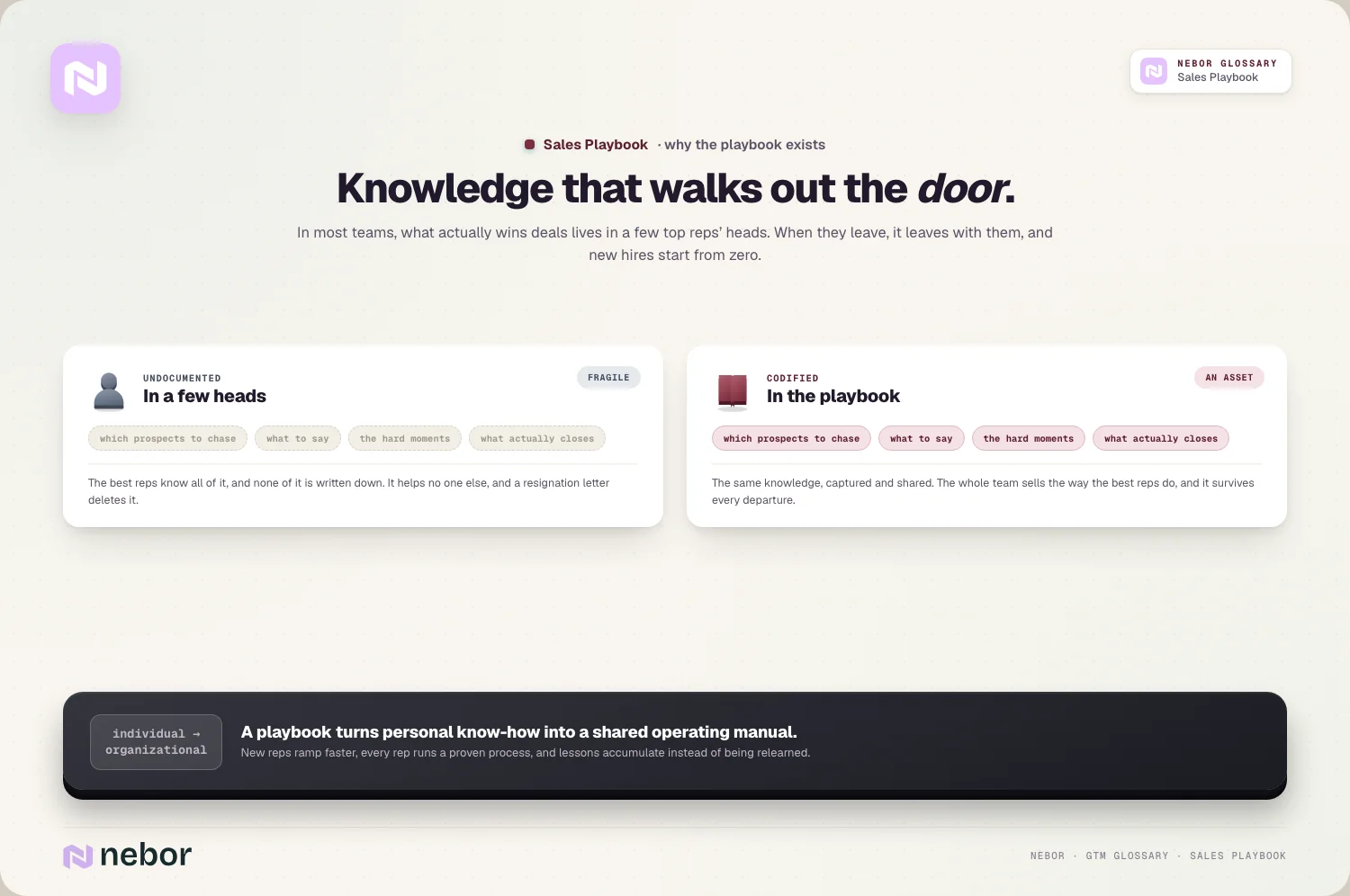
Departures cause damage that lingers for quarters. When a strong rep leaves, an undocumented approach leaves with them, so the team loses hard-won knowledge it has to rebuild from scratch.
New hires ramp painfully slowly without it. A rep left to figure everything out alone takes far longer to become productive than one handed a proven playbook to follow.
So a playbook turns individual knowledge into an organizational asset. It captures what the best reps know so the whole team can use it, and that capture is what makes selling repeatable instead of dependent on a few people.
How a sales playbook makes selling consistent across the whole team
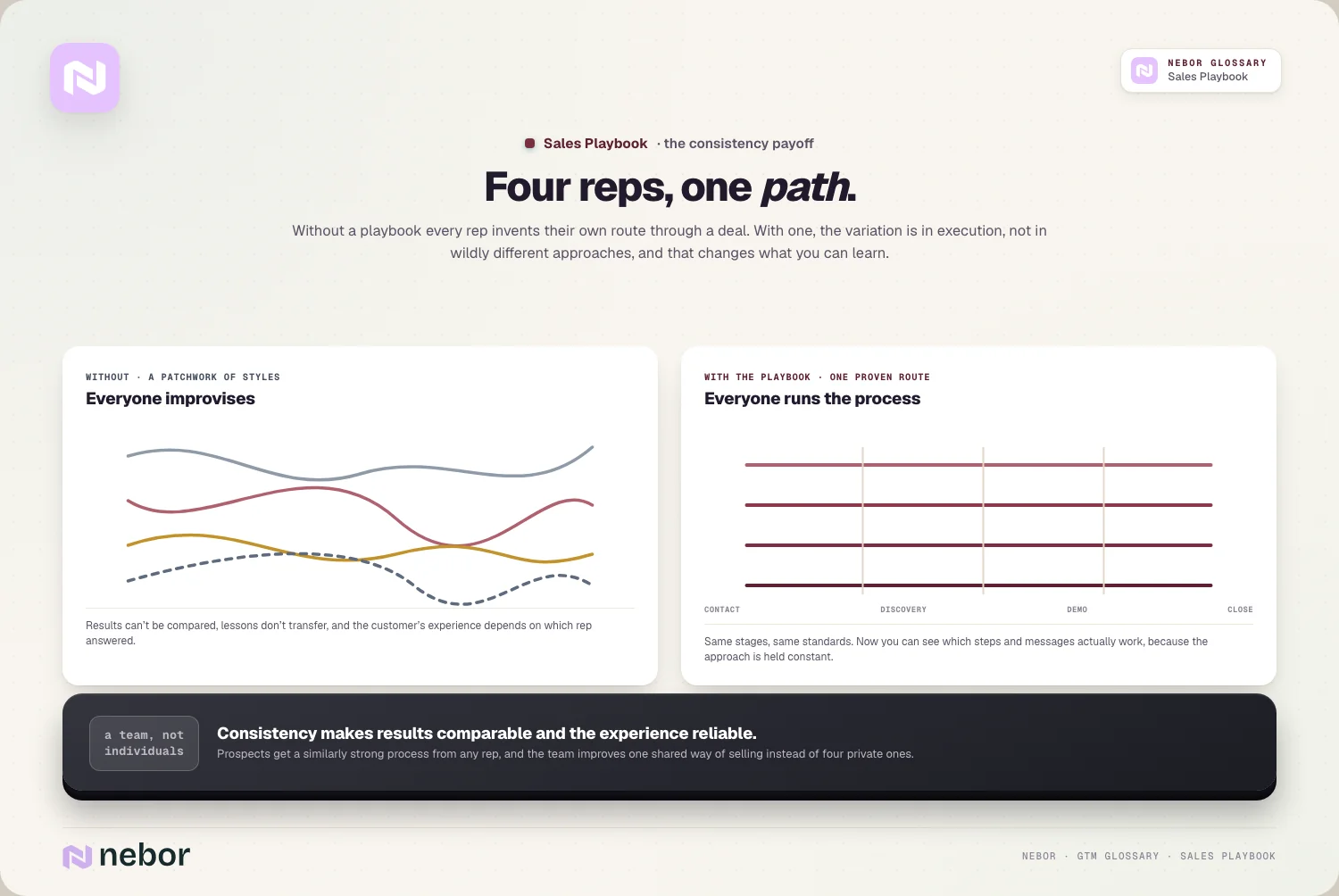
Consistency is one of the playbook's biggest payoffs, and it shows up in ways that compound. A shared approach beats a patchwork of individual styles.
Every rep follows the same proven process. Rather than each rep inventing their own path, the playbook gives everyone a proven process, so deals are handled consistently regardless of who owns them.
It makes results comparable from rep to rep. When everyone follows the same process, you can see which steps and messages work, because the variation is in execution instead of in wildly different approaches.
It protects the customer experience as well. A consistent process means prospects get a similarly strong experience from any rep, instead of a great one from some and a poor one from others.
So consistency turns a team of individuals into a system. The playbook is what aligns everyone on a shared, proven way of selling, so the team's results become predictable.
Why buyer personas are the very foundation of the playbook
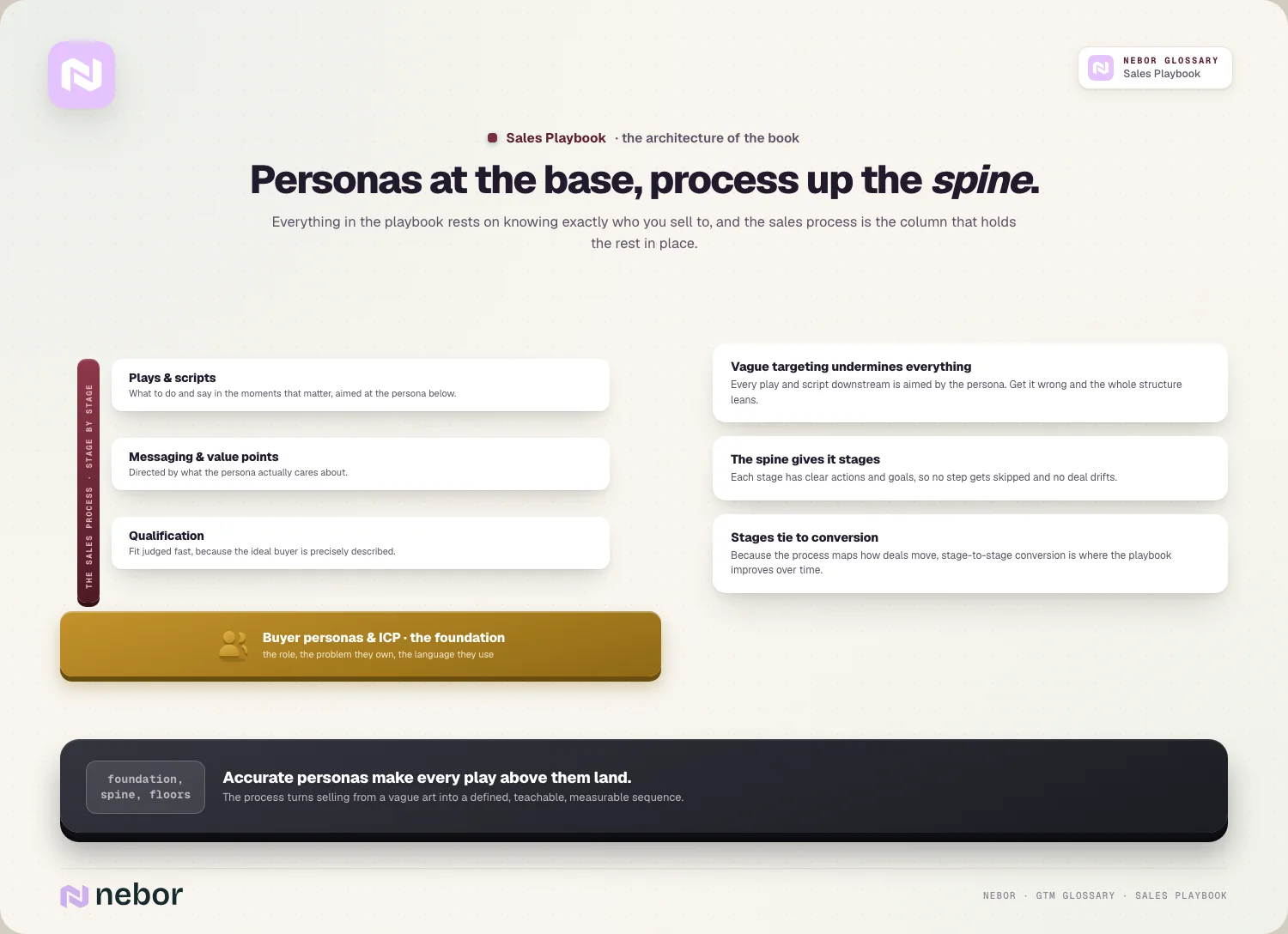
Everything in a sales playbook rests on knowing exactly who you sell to, so personas come first, because vague targeting undermines every play built on top of it.
The persona defines the target with precision. A clear buyer persona captures the role, the problem they own, and the language they use, so reps know precisely who they're selling to.
It shapes all of the messaging further downstream. Since a persona describes what a buyer cares about, it directs the scripts and value points the rest of the playbook provides.
It sharpens the qualification criteria along the way. Knowing the ideal persona helps reps judge fit fast, which feeds the lead qualification the playbook should guide.
So personas are the foundation the whole playbook builds on. When they're accurate, every play, script, and process downstream is aimed at the right person, and that aim is what makes them land.
How the sales process forms the structural spine of the playbook
If personas are the foundation, the sales process is the spine that holds the playbook together. It defines the path every deal follows.
It breaks the sale into defined stages. The process lays out each step from first contact through close, so reps always know where a deal is and what comes next.
Each stage carries clear actions and exits. The playbook defines what a rep should do and achieve at every stage, so no step gets skipped and no deal drifts.
It ties directly to your conversion numbers. Because the process maps how deals move, it directly shapes the conversion rate from stage to stage, and that link is where the playbook improves over time.
So the sales process gives the playbook its structure. It turns selling from a vague art into a defined sequence of steps, making it teachable and measurable at once.
Why plays and scripts turn the strategy into words reps can use
A playbook is only useful if it tells reps what to do in real moments, and that's the job of plays and scripts. They bridge strategy and the words a rep uses.
A play is a guide for a situation. It lays out the steps to take in a specific scenario, like handling a stalled deal, so reps aren't improvising in the moments that matter most.
Scripts supply the actual language to use. Templates for emails, call openers, and value points, often organized into a sales cadence, give reps proven words to start from, which they then tailor to the prospect.
Objection handling is right at the center. Documented objection handling responses give reps ready answers to the concerns that most often stall deals.
So plays and scripts are where the playbook becomes practical. They translate the strategy into the specific actions and words a rep uses, and they're what reps reach for in the moment.
How a sales methodology fits inside the broader sales playbook
Many playbooks are built around a sales methodology, and understanding the relationship helps. The methodology is the framework, and the playbook is how you apply it.
A methodology is a structured selling approach. Frameworks like the ones used to qualify complex deals give a consistent way to assess and advance opportunities.
The playbook is what turns it into daily practice. It takes the chosen methodology and turns it into the specific steps, questions, and plays your reps use, so the framework becomes daily practice.
It guides the hardest deals most of all. For complex sales through a buying committee, a methodology baked into the playbook helps reps work through many stakeholders consistently.
So the methodology is the theory and the playbook is the practice. A playbook without a methodology can feel ad hoc, while a methodology without a playbook stays abstract, so the two work together.
How a sales playbook connects to your everyday tools and channels
A modern playbook isn't separate from the systems reps use, it's woven into them. The plays live in the tools and channels that execute them.
It defines which channels to use and when. The playbook specifies how you use email, phone, and social in a coordinated multi-channel outreach approach instead of leaving each rep to choose.
It lives inside the sequencing tool day to day. Much of the playbook's outreach goes out through a sales engagement platform, so the plays are built into the system reps work from.
It keeps the execution consistent across the whole team. Wiring the playbook into the tools means reps follow it by default, instead of the playbook being a document separate from their daily work.
So the playbook and the tools reinforce each other. The playbook defines the approach, and the tools make sure reps follow it, and that pairing is what keeps documented strategy from becoming shelfware.
How a sales playbook speeds up new-rep onboarding and ramp time
One of the most concrete payoffs of a playbook shows up the moment you hire. A new rep with a playbook becomes productive far faster than one without.
It gives new hires a complete map. Instead of shadowing top reps and piecing the job together, a new rep can study the documented process, personas, and plays from day one.
It shortens the time to full quota. Because ramp is largely about learning what works, a playbook that hands over that knowledge directly cuts the months it takes to reach full productivity.
It standardizes the whole training program itself. Every new rep learns the same proven approach instead of absorbing whichever habits their onboarding buddy happened to have, so quality stays consistent as the team grows.
So a playbook turns onboarding from an apprenticeship into a curriculum. New reps ramp on documented knowledge instead of osmosis, and that grounding lets a team scale hiring without diluting its standards.
Why a sales playbook has to stay a living, evolving document
The most common way playbooks fail, and the one we keep seeing, is by being written once and forgotten. A playbook only stays valuable if it keeps evolving with what works.
Markets and buyers keep changing underneath you. What worked last year may not work now, so a static playbook slowly drifts out of date and reps stop trusting it.
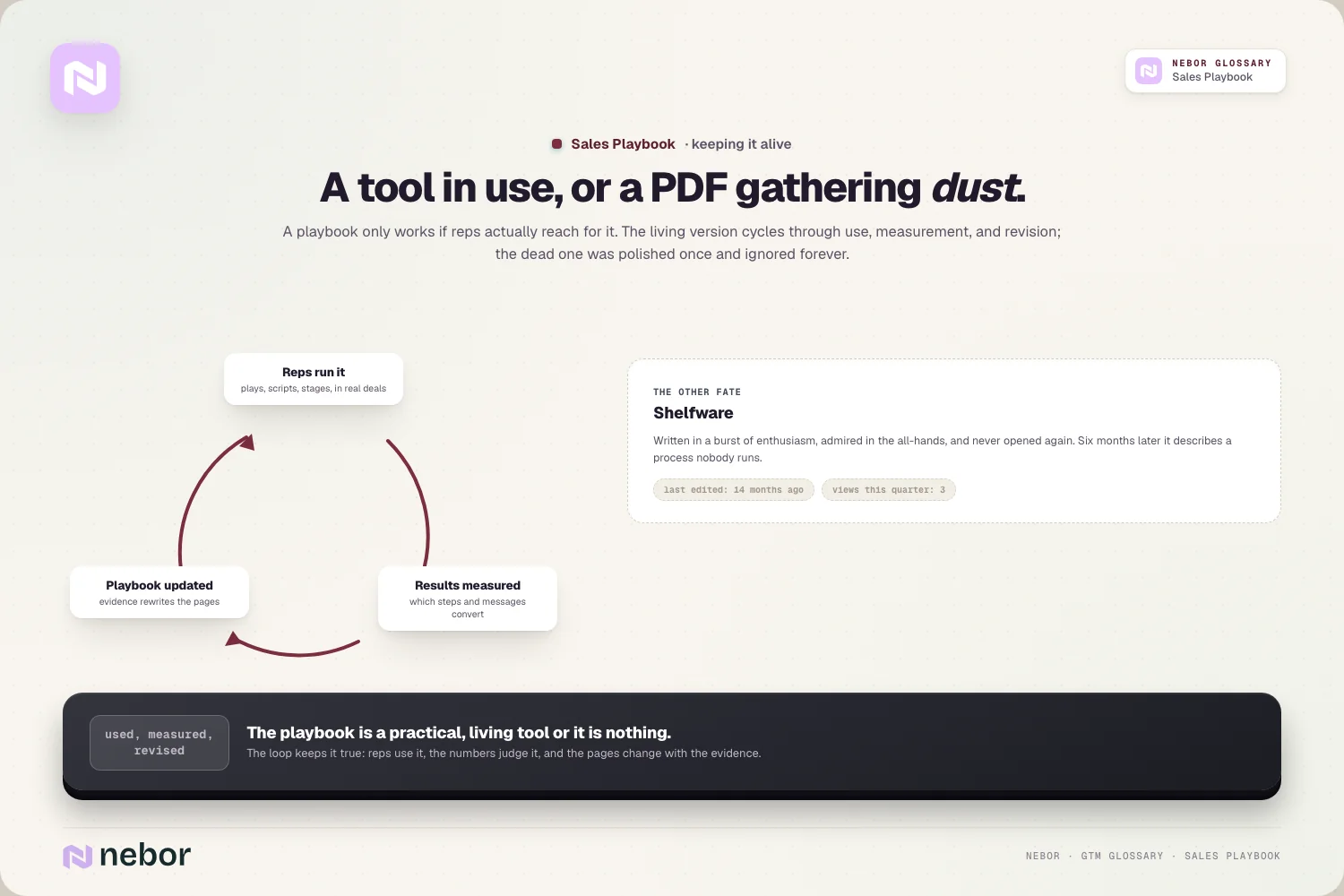
Results should feed back into it constantly. As you learn which plays and messages win, the playbook should be updated to reflect them, so it captures your current best approach.
Reps have to genuinely use it, day to day. A playbook nobody opens helps no one, so it has to be a practical working tool instead of a polished document made to impress.
So a playbook is a process more than a project. Keeping it current and used is what separates a playbook that lifts a team from one that gathers dust, and that maintenance is where many efforts fall short.
The common mistakes teams make when building a sales playbook
Sales playbooks fail in a few predictable ways, and we keep seeing the same ones when clients show us theirs. Avoiding them keeps the playbook a living asset.
The biggest is writing it and forgetting it. A playbook that isn't updated as things change quickly becomes outdated and ignored.
Another is making the document too academic. A polished document reps never open helps nobody, so a playbook has to be practical and truly usable.
A third is over-scripting every single word. Turning reps into robots reading rigid scripts kills the judgment that closes deals, so the playbook should guide instead of dictate every word.
The last is building it without the reps. A playbook imposed from above, without input from the people who sell, tends to miss what works in the field.
Why a sales playbook is what ultimately makes a team scalable
The real payoff of a sales playbook is that it makes a sales team something you can grow and improve, instead of a collection of individuals. It turns selling into a repeatable system.
It makes each new hire pay off faster. New reps handed a proven playbook ramp quickly, so growth doesn't mean starting each person from scratch.
It compounds everything your team learns over time. Because the playbook captures what works, every lesson gets baked in for the whole team instead of lost, so the team keeps getting better.
It reduces your key-person risk by a wide margin. When the winning approach lives in the playbook instead of a few heads, the team is resilient to any single person leaving.
A living, well-used sales playbook is one of the highest-return assets in a modern go-to-market system. It's how a team turns its best selling into a repeatable process, even as it grows and layers automation to automate sales prospecting on top.
Share this post
Guide
Outbound
RevOps
Glossary
Related glossary items
Understanding the core GTM concepts




Ready to build your pipeline