

In this post:
You think you're selling to one person. You have a great contact, the conversations are going well, and it feels like the deal is yours. Then it stalls for no clear reason, and you never find out that three people you never met decided against you.
That hidden group is the buying committee, and not seeing it is one of the most common ways B2B deals die. The person you talk to is rarely the only one who decides, and the people you never talk to can kill the deal without you hearing a word.
A buying committee is the group of people at a company involved in making a purchase decision, including champions, decision-makers, end users, finance, and others who influence or approve the deal. It's the real unit that buys, whatever single name appears in your CRM.
Modern B2B purchases are group decisions, and that changes how you sell. Selling to one person while ignoring the committee means you're working a fraction of the people who determine whether you win.
TL;DR
A buying committee is the group of stakeholders involved in a B2B purchase, from champions and end users to finance, security, and the economic buyer who approves it.
Deals get decided by the group instead of any individual, and the typical B2B committee now involves around 6 to 10 people, so selling to one contact leaves most of the decision uncovered and unargued.
Winning means engaging the whole committee instead of just your champion. Each member has different goals and concerns, so you need a relevant approach for each role.
The tricky part is that committees are larger and more hidden than they look. Many members never talk to you, and that's the reason mapping and reaching the full group is the real work of complex sales.
So what is a buying committee, and who ends up on it?
A buying committee is the collection of people at a company who take part in a purchase decision. Rather than one buyer, it's a group whose combined judgment determines whether a deal happens.
The members play different roles, with typically a champion who wants the solution, an economic buyer who controls budget, end users who'll live with it, and gatekeepers like finance, legal, or security who can approve or block.
Not everyone carries equal weight, because some members drive the decision while others mainly need to sign off, but each can influence the outcome, and any of them can stall or kill a deal.
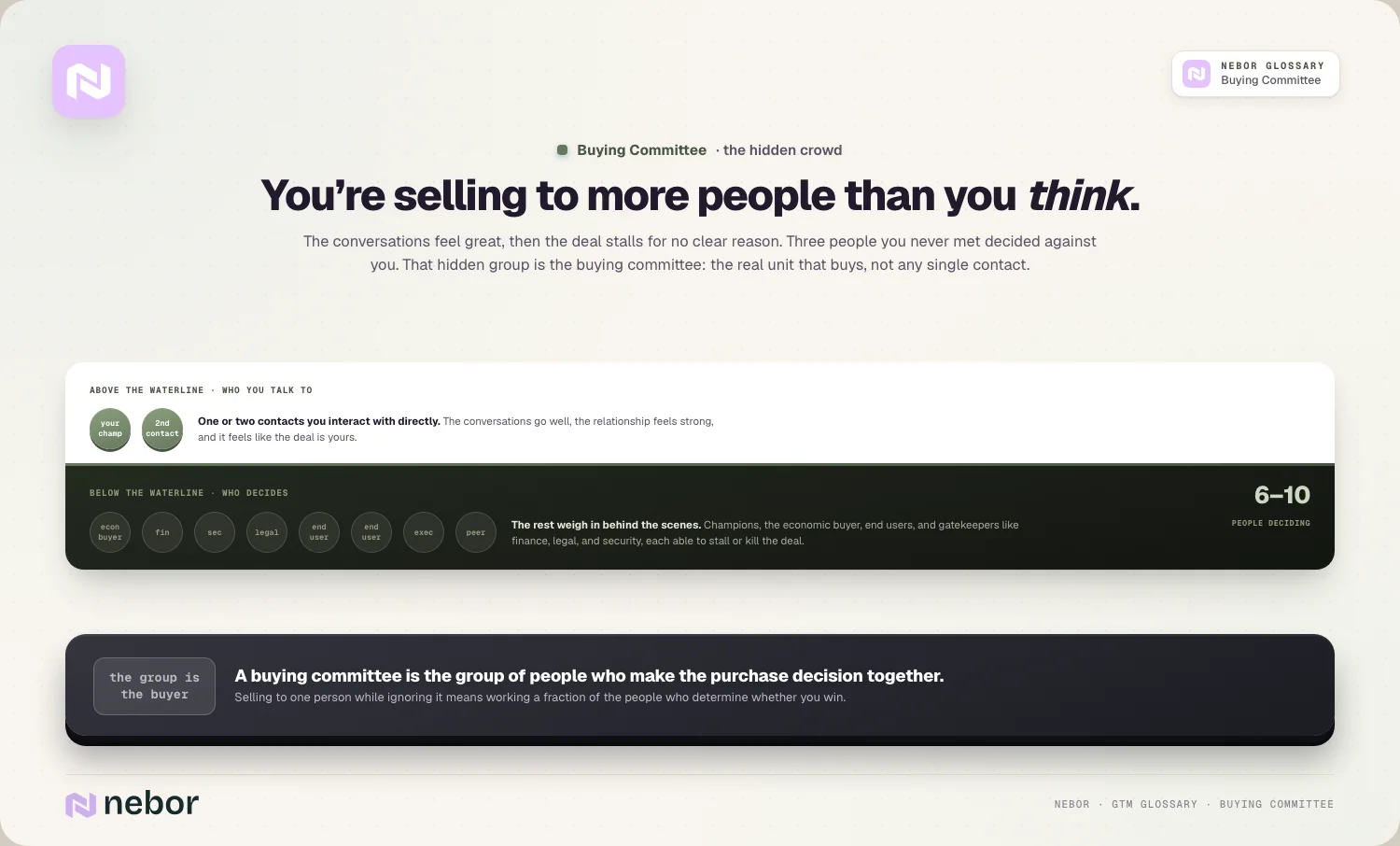
The committee also tends to be invisible. You usually interact with one or two members directly, while the rest weigh in behind the scenes where you can't see them.
So a buying committee is really the decision-making group behind a purchase. Understanding who's on it, and what each person cares about, is what separates a deal you can steer from one that happens to you.
The committee has also grown over time. As purchases get more expensive and more scrutinized, more people get pulled in to weigh in or sign off, so the group keeps expanding instead of shrinking.
How big is a buying committee really, once you count everyone?
The size of the modern buying committee surprises people, so the numbers deserve a look. Decisions involve far more people than they used to.
The typical B2B purchase now involves around 6 to 10 decision-makers, according to Gartner. For larger or more complex deals, that number climbs higher still.
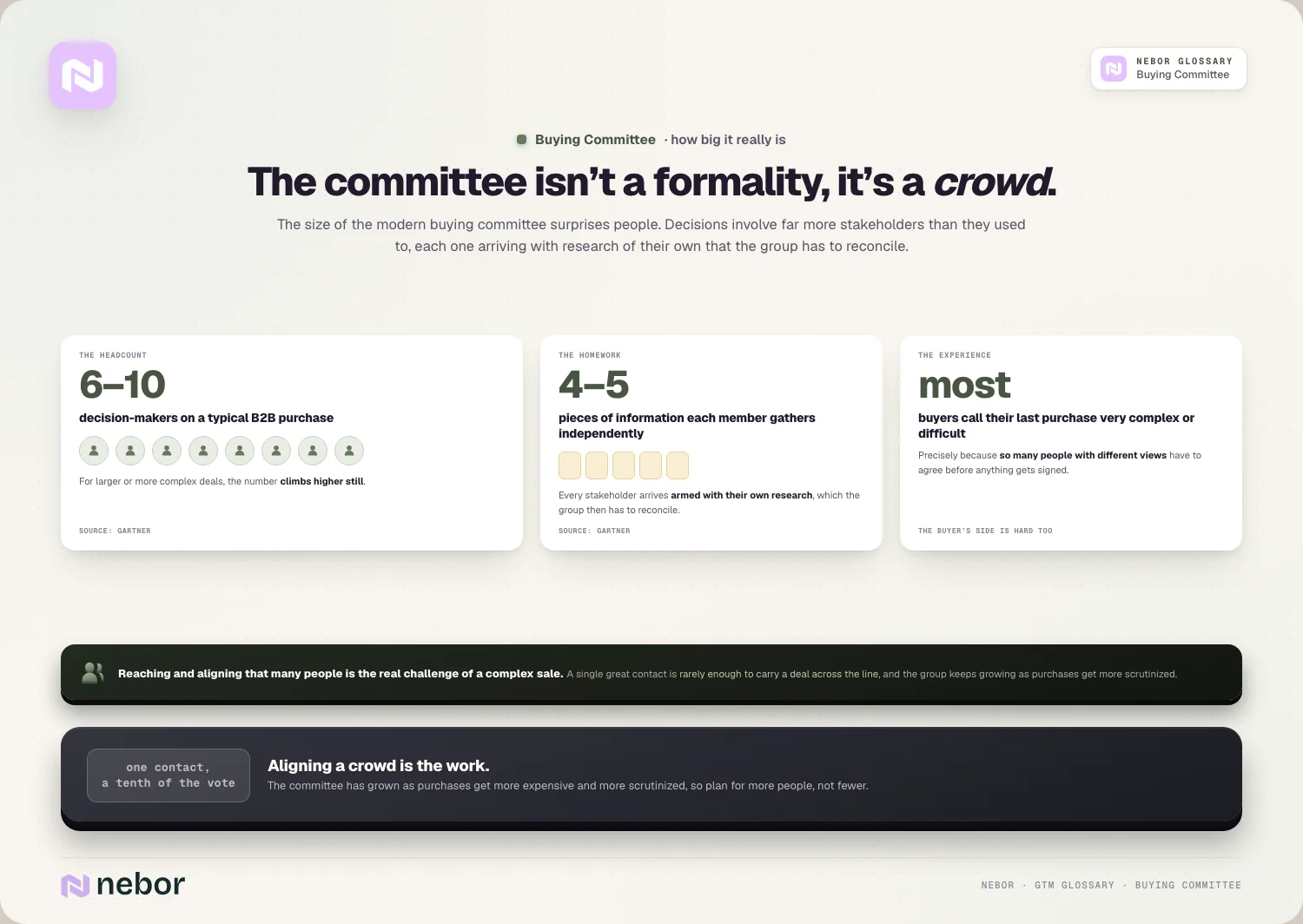
Each member arrives armed with their own information. Gartner finds that each of those stakeholders typically brings four or five pieces of information they gathered independently, which they then have to reconcile.
That complexity makes buying genuinely hard, with a large majority of buyers describing their most recent purchase as very complex or difficult, precisely because so many people with different views have to agree on one answer.
So the committee isn't a formality, it's a crowd. Reaching and aligning that many people is the real challenge of a complex sale, and that's the reason a single great contact is rarely enough to carry a deal across the line.
Why do single-threaded deals keep dying in committee meeting rooms?
Let's trace exactly how deals fail when you ignore the committee, because the pattern is so common, and the failure usually happens out of sight.
When you work one contact, your whole deal depends entirely on them. They have to sell your solution internally to the rest of the committee, which they rarely do as well as your team would.
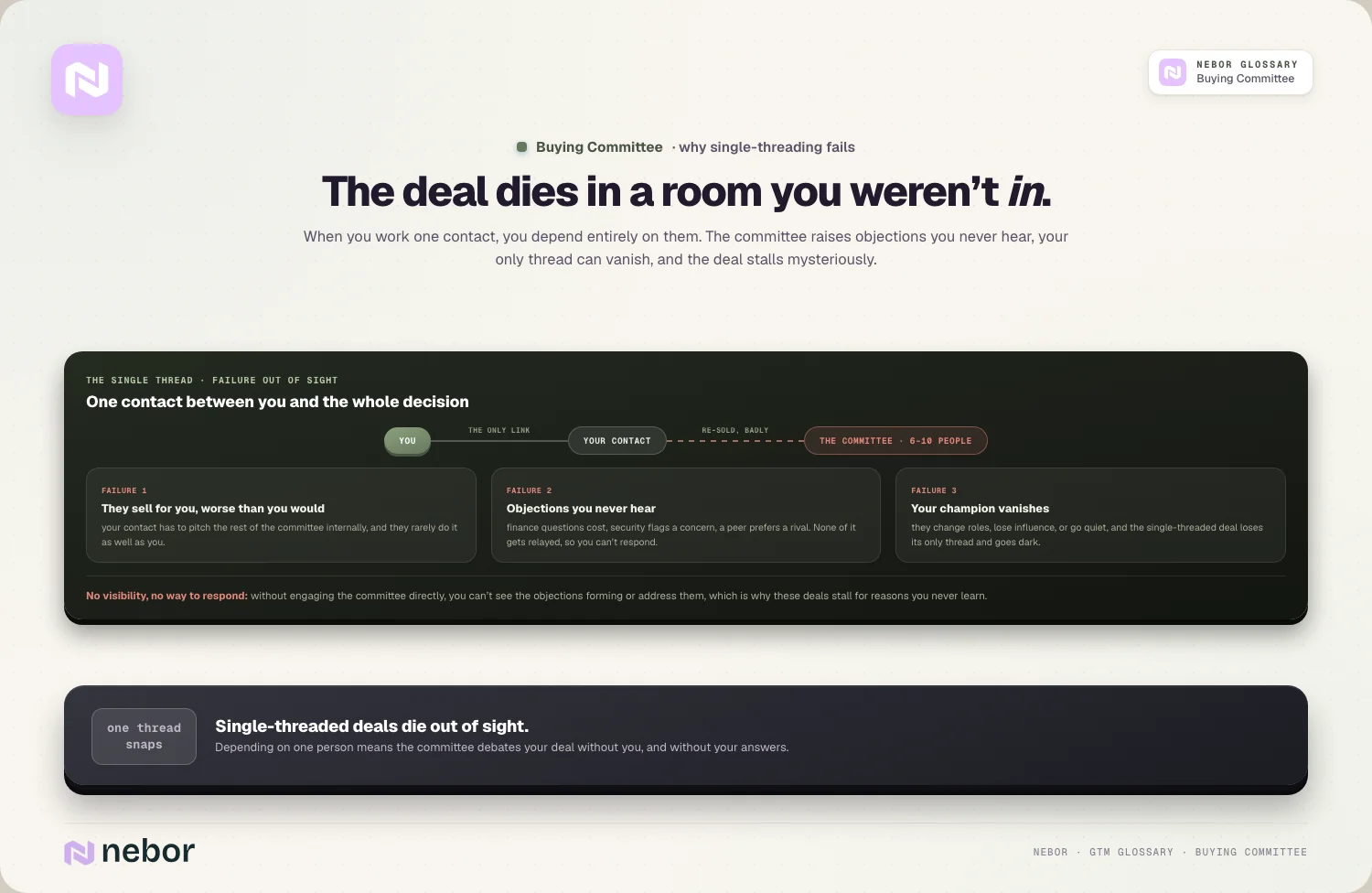
The committee raises objections you never hear. Finance questions the cost, security flags a concern, a peer prefers a competitor, and your single contact may not even relay these, so you can't respond.
Your champion can also vanish, because if they change roles, lose influence, or simply go quiet, a single-threaded deal loses its only thread and goes dark.
So the deal dies in a room you weren't in. Without engaging the committee directly, you have no visibility into the objections forming and no way to address them, which is why these deals stall mysteriously.
How is a buying committee different from a buyer persona then?
These two concepts are related but distinct, because one is the group and the other is the individual.
A buyer persona is a profile of a single type of buyer, capturing one role's goals, pains, and objections, so it describes one kind of person.
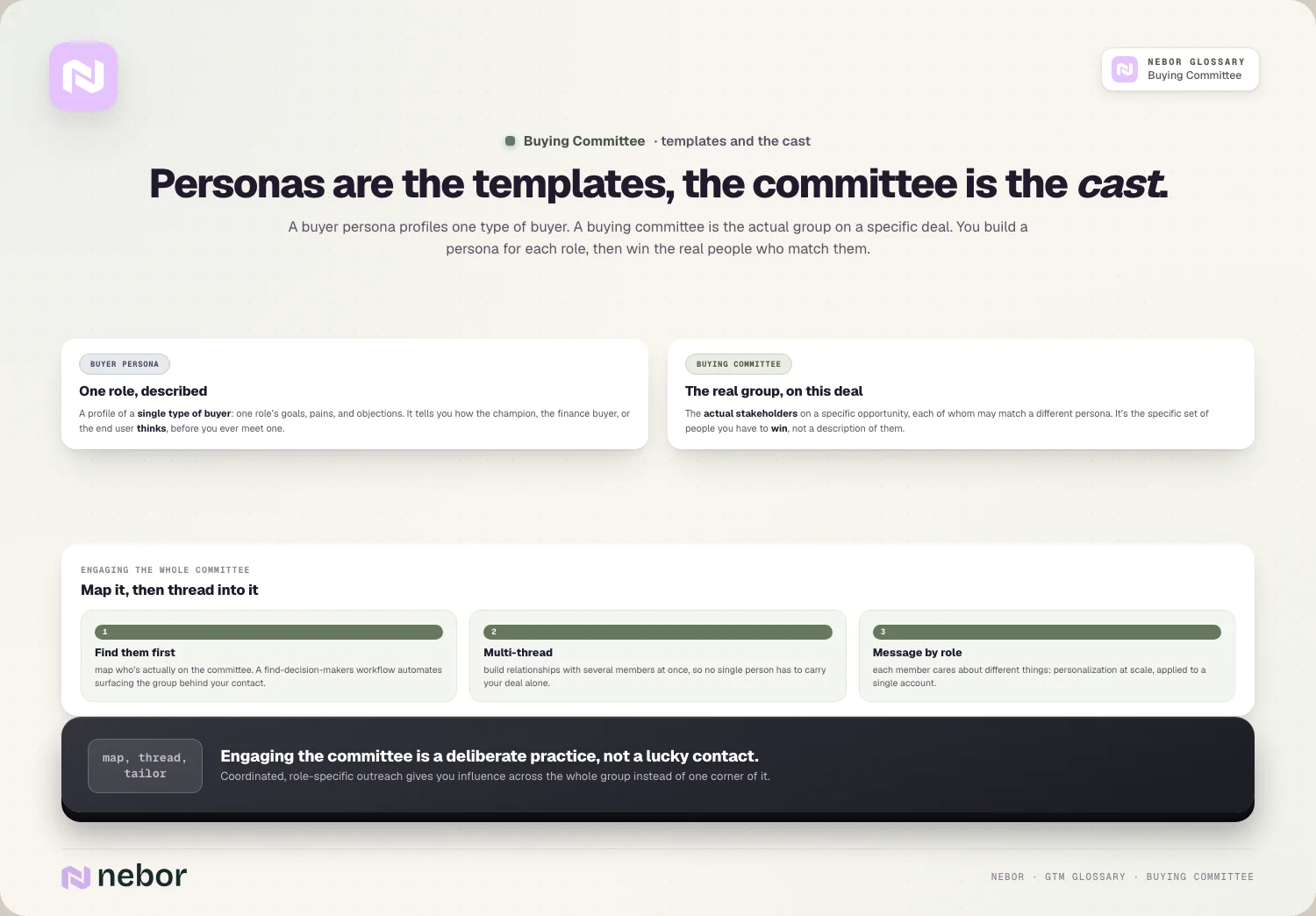
A buying committee is the actual group of people on a specific deal. It's the collection of real stakeholders, each of whom may match a different persona.
The two work together on every real deal. You build a persona for each role on the committee, so you understand how to speak to the champion, the finance buyer, and the end user as distinct people.
So personas are the templates and the committee is the cast. Personas tell you how each type of buyer thinks, and the committee is the specific set of those types you have to win on a given deal.
How do you engage the whole committee instead of one contact?
Knowing the committee exists is one thing, and reaching it is another, and in our experience engaging the full group is a deliberate practice you have to build.
The core tactic is multi-threading, building relationships with several committee members at once rather than relying on a single contact. It's how you stop depending on one person to carry the deal.
Each member needs a message that fits their role, and since the committee spans different jobs, you tailor your approach to each, which is personalization at scale applied to a single account.
You also have to find them first. Mapping who's actually on the committee, then reaching them, is the job a workflow to find decision makers automates.
So engaging the committee means mapping it, then threading into it with role-specific outreach. That coordinated effort is what gives you visibility and influence across the whole group instead of one corner of it.
How does the buying committee connect to ABM and account scoring?
The buying committee is the reason account-based thinking exists, so it helps to draw the connection. The committee is the reason you work accounts instead of leads.
Account-based marketing treats the account as the unit because the committee is. You target and engage the whole company precisely because the call gets made by a group instead of one person.
The committee is also the reason you score whole accounts, because account scoring rolls up signals from across the group, and several people engaging is a far stronger signal than one contact acting alone.
It reaches into your targeting as well, because in that pairing, your ideal customer profile defines the companies worth pursuing, and the committee is the set of people inside each one you'll need to win.
So the committee is the thread tying all of these together, the human reality that makes account-level targeting, scoring, and engagement the right approach for complex B2B sales.
How do you prepare for a committee you can't ever fully see?
A hard truth we tell every client is that you'll never see all of a buying committee. Preparing for the hidden members is part of the skill.
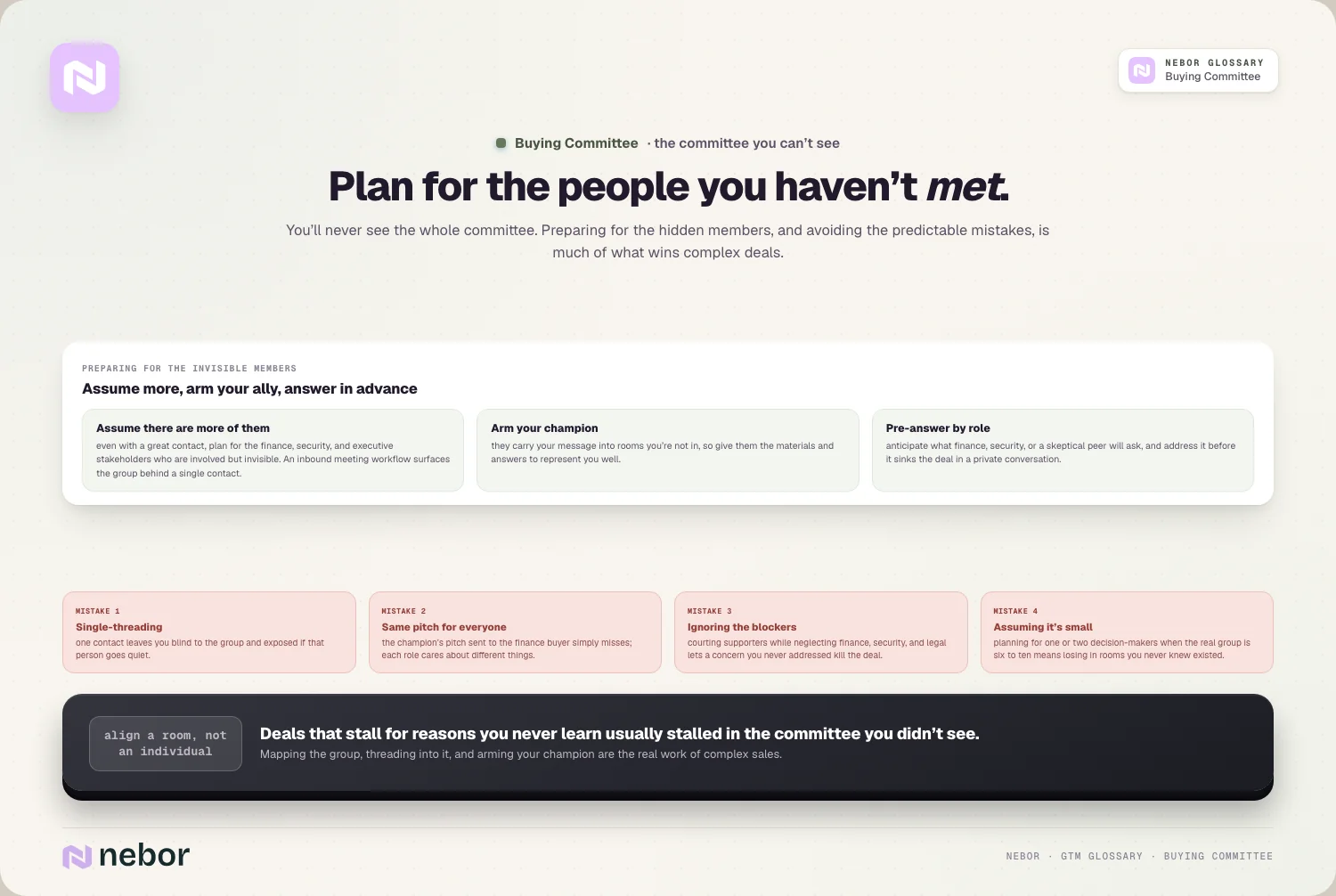
You assume there are more people than you've met so far. Even with a great contact, you plan for the finance, security, or executive stakeholders who are probably involved but still invisible to you.
You arm your champion to sell inside their own walls. Since they'll carry your message into rooms you're not in, you give them the materials and answers to represent you well to the rest of the committee.
You prepare for common objections by role. Anticipating what finance, security, or a skeptical peer will ask lets you address those concerns in advance, before they sink the deal in a private conversation.
This is exactly what a strong inbound meeting workflow helps with, surfacing the buying committee behind a single contact so you walk in already aware of the group. It turns a hidden committee into a visible one.
Who are the key roles you'll meet on a typical buying committee?
It helps to know the typical roles, because each one influences the deal differently. Most committees include some version of these.
The champion comes first, the person who wants your solution and pushes for it internally, and they're often your main contact, but they rarely hold final authority on their own.
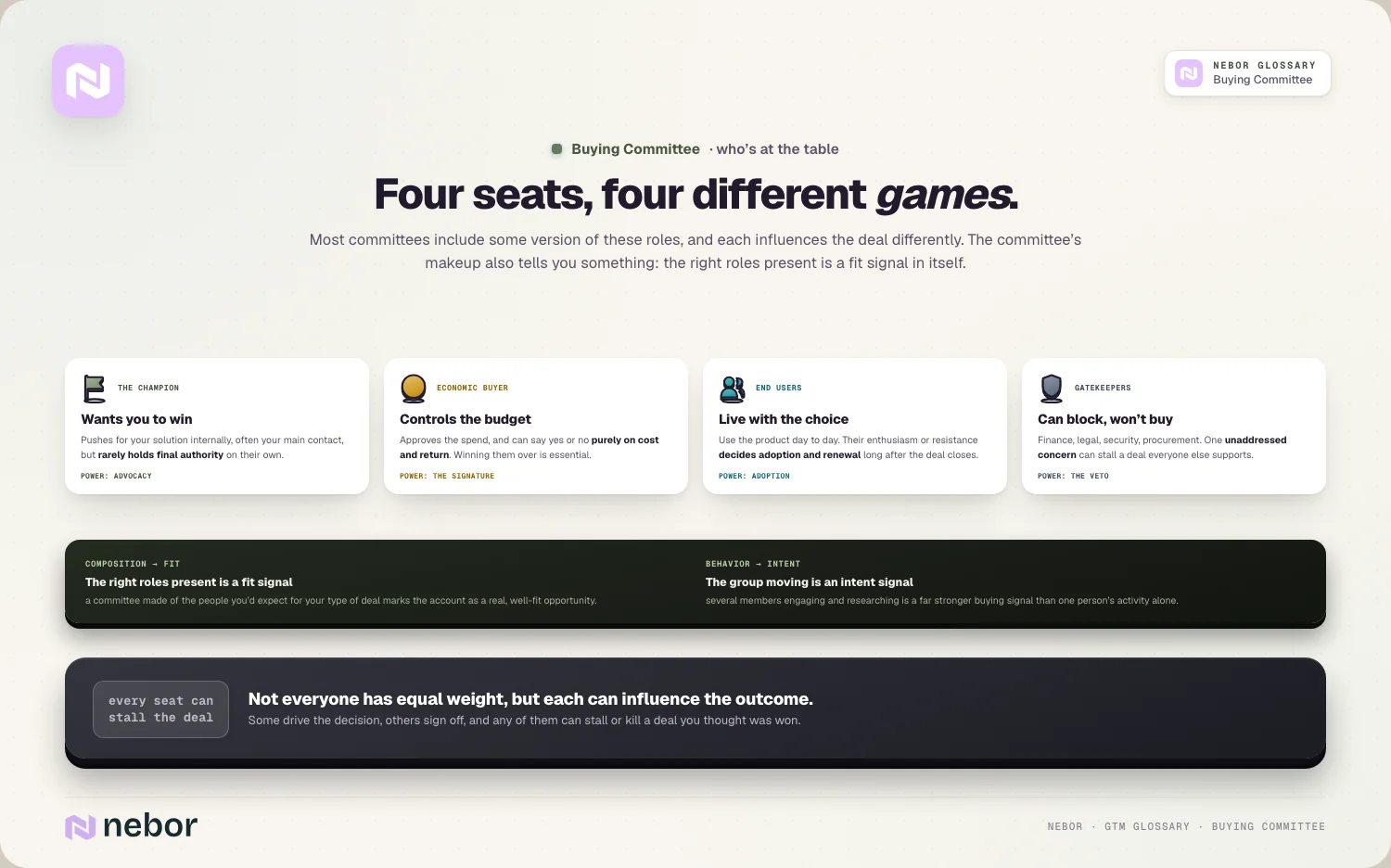
Beside them is the economic buyer, the person who controls the budget and approves the spend, and winning them over is essential, because they can say yes or no purely on cost and return.
The end users round out the core, the people who'll actually use your product day to day, and their enthusiasm or resistance carries real weight in whether it gets adopted and renewed later.
And then come the gatekeepers, where finance, legal, security, and procurement don't buy your product but can block it, so an unaddressed concern from any of them can stall a deal that everyone else already supports.
How does the buying committee relate to your fit and intent read?
Reading a committee well means watching both who they are and what they're doing, because the committee shapes both your fit and your intent signals.
Fit looks at whether the roles match. A committee made up of the kinds of people you'd expect for your type of deal is a sign the account is a real, well-fit opportunity.
Intent looks at how the committee behaves. When several members engage, research, or show interest, that collective activity is a far stronger intent signal than one person's.
This is the fit score versus intent score distinction at the committee level. You want both the right people involved and signs that the group is moving toward a decision.
So the committee feeds both halves of your read on an account. Its composition tells you about fit, and its collective behavior tells you about intent, which together tell you how hard and how fast to pursue it.
How does inbound-led outbound help you reach a whole committee?
One of the best ways to engage a committee is to start from a signal, which connects to inbound-led outbound. Interest from an account opens the door to the whole group.
When one person at an account shows inbound interest, that's a way in. You can use that signal to map and reach the rest of the committee, turning one warm contact into a path to the group.
This is the heart of inbound-led outbound. A single hand raised is a reason to engage all the colleagues around them, going well beyond replying to the one person who reached out.
It also warms the whole approach, because reaching committee members at an account that's already showing interest lands far better than cold-targeting an unfamiliar group from scratch.
So inbound signals are a lever on the committee. They give you both a reason and a relationship to expand outward from, which is often the easiest way to engage a whole group you'd struggle to reach cold.
What are the common buying committee mistakes that lose deals?
Teams mishandle buying committees in a few predictable ways, and we've watched each of these lose real deals. Avoiding them is much of what wins complex ones.
Single-threading tops the list, because relying on one contact leaves you blind to the rest of the committee and exposed if that single person goes quiet on you.
Treating everyone the same comes next, where sending the champion's pitch to the finance buyer ignores that each role cares about different things, so the message simply misses.
Ignoring the blockers is quieter but just as costly, since focusing only on supporters while neglecting the finance, security, or legal gatekeepers lets a deal die on a concern you never addressed.
And there's assuming the committee is small, because planning for one or two decision-makers when the real group is six to ten means you under-engage the account and lose in rooms you never knew existed.
Why the committee is the real buyer, whoever answers your emails
The buying committee matters because it's the real unit that decides a B2B purchase. You may talk to one person, but a group determines the outcome, and ignoring that group is how good deals die without an explanation.
The deeper point is that modern buying is a crowded, complex group decision. With several stakeholders each bringing their own information and concerns, winning means aligning a room instead of convincing an individual.
The honest reality is that much of the committee stays hidden. Mapping who's involved, threading into the group, and arming your champion to represent you are the real work of complex sales.
So if your deals keep stalling for reasons you never quite learn, the cause is usually the committee you didn't engage. Treating the purchase as a group decision, and reaching the whole group, is what turns mysterious losses into deals you can steer.
That account-level thinking is exactly what a modern go-to-market system is built around. It matters even more once you automate sales prospecting into accounts, because the system has to engage a group instead of just a name.
Share this post
Guide
Outbound
Conversations
Glossary
Related glossary items
Understanding the core GTM concepts




Ready to build your pipeline