

In this post:
The most important person in a complex deal is often someone you'll never directly persuade. They are in meetings you're not invited to, answer questions you'll never hear, and argue for you in rooms you can't enter.
That person is your champion, and in B2B sales they're frequently the difference between a deal that closes and one that fades out with no explanation. You can work a flawless process and still lose if nobody inside the account is fighting for you.
A sales champion is a person inside the buyer's organization who has influence and credibility, believes in your solution, and actively advocates for it internally to move the deal forward. They sell for you when you're not in the room.
The reason champions matter so much is that you can't be everywhere in a complex sale. A buying committee makes the decision in private, and a champion is your representative in those private conversations.
That's why finding and developing one is central to winning bigger deals, where most of the real decision happens far from your meetings.
TL;DR
A sales champion is an internal advocate at the buyer who has real influence, genuinely wants your solution, and actively pushes it forward inside the organization on your behalf.
They matter because complex deals are decided in private. A champion sells for you in the rooms you can't enter, works the internal process, and keeps the deal moving when you can't.
The key traits are influence, credibility, and effort. A real champion has internal pull, is trusted by their peers, and visibly works to advance the deal instead of just nodding along politely.
The caution is that not every friendly contact is a champion, and relying on one is fragile. You have to identify a true champion, develop them, and still multi-thread in case they lose influence or leave.
So what is a sales champion, and what do they do for your deal?
A sales champion is someone within the buying organization who actively advocates for your solution. They want you to win and use their influence inside the company to help make it happen.
The concept is central to enterprise sales frameworks. The champion is the C in the MEDDIC methodology, reflecting how important an internal advocate is to qualifying and closing a complex deal.
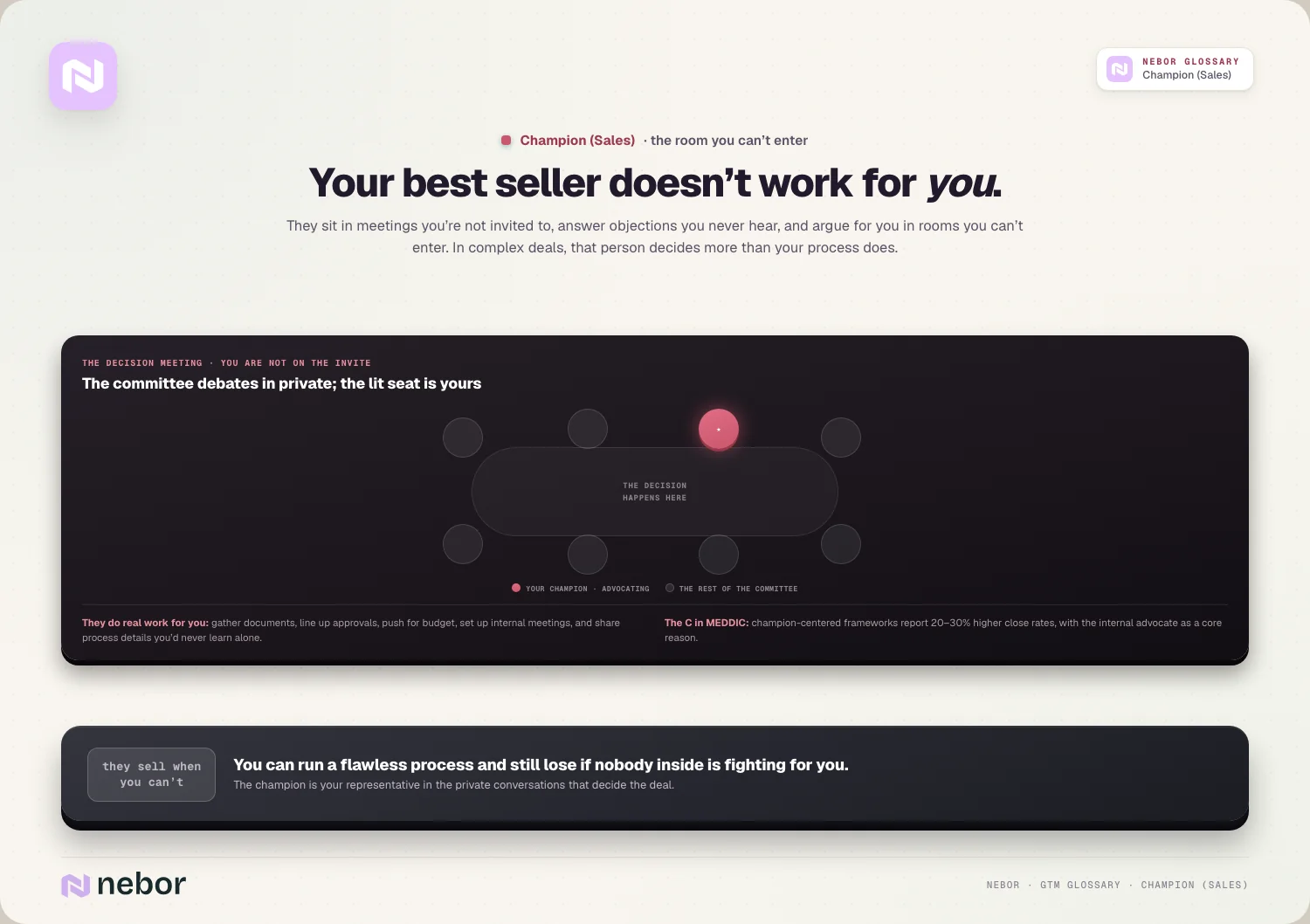
A champion does real work for you. They gather documents, line up approvals, push for budget, set up internal meetings, and share details about the process your team would never learn on its own.
Effort is the defining behavior, because a real champion puts in more work than other contacts to move the deal forward, which is the clearest sign that they want your solution to win.
So a champion is your inside advocate. They're the person who carries your case into the parts of the decision you can't reach, and that reach is what makes them so valuable in any complex sale.
What makes someone a real champion instead of a friendly face?
Plenty of contacts seem supportive, but few are real champions, and in our experience three traits separate a champion from a friendly face.
Influence comes first, because a real champion has internal pull, so when they advocate for you, people listen, while a supportive contact with no influence can't move the decision.
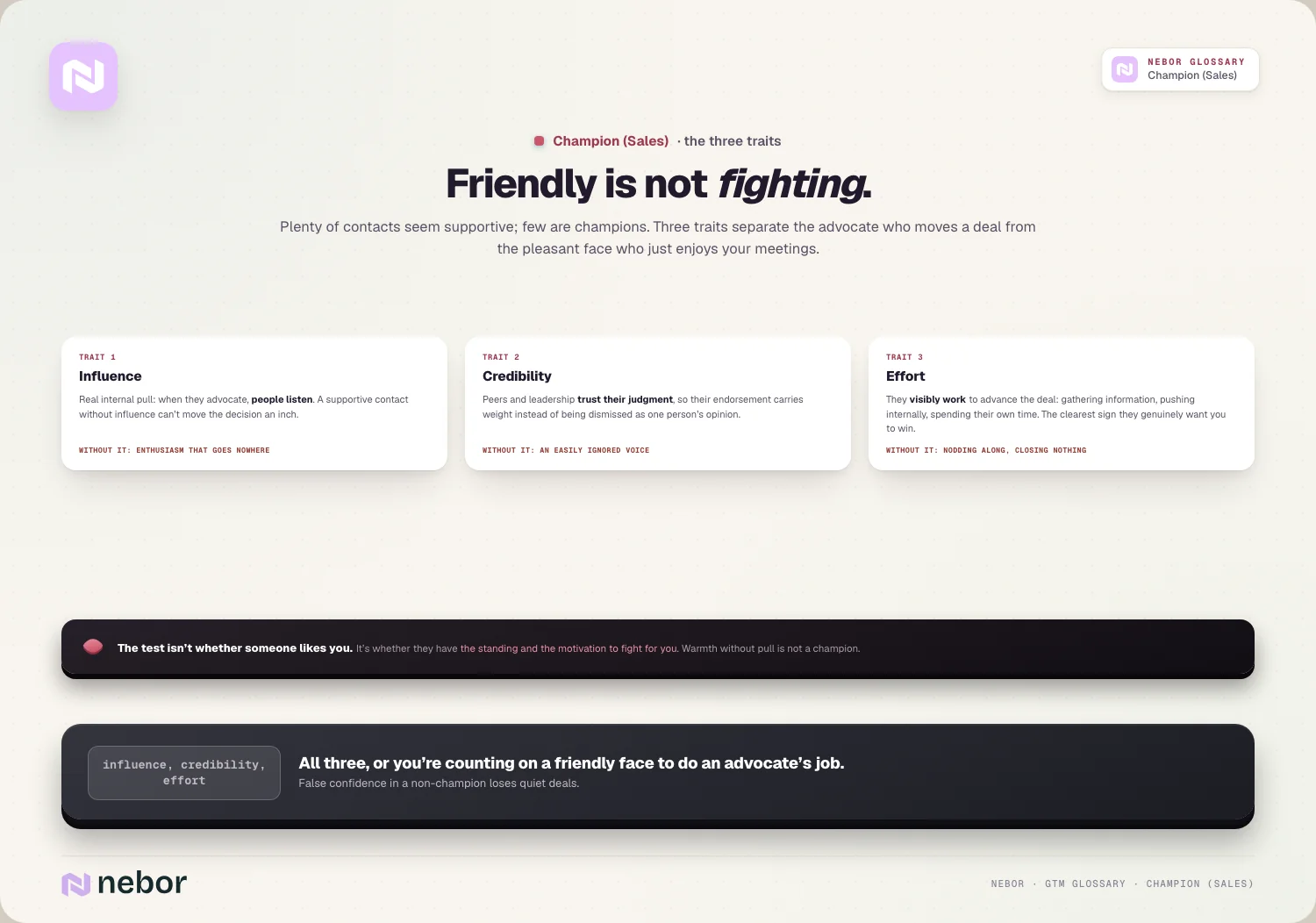
Credibility comes second, since their peers and leadership trust their judgment, so their endorsement carries weight instead of being dismissed as one person's opinion.
And effort completes the picture, with a champion visibly working to advance the deal, gathering information and pushing internally, well beyond agreeing warmly in your meetings.
So the test isn't whether someone likes you, it's whether they have the standing and the motivation to fight for you. A pleasant contact who can't or won't push is not a champion, no matter how warm the conversation.
Why is a champion so important to closing the complex deals?
Let's get concrete about why champions decide deals, because the impact is large, and they solve a problem you can't solve yourself.
You can't be in the room when the decision happens. The buying committee debates, objects, and decides in private, so without an advocate inside, you have no voice in those conversations.
A champion becomes that voice for you. They answer objections you never hear, counter competitors you don't know are bidding, and keep your solution top of mind when the committee deliberates.
The effect shows up plainly in the results, with frameworks built around champions, like MEDDIC, reporting 20 to 30% higher close rates than traditional approaches, and the champion is a core reason.
So a champion is an advantage you can't get any other way. They extend your influence into the private parts of the deal, which is exactly where complex sales are won or lost.
How is a champion different from the rest of the buying committee?
These two concepts are closely related, so it helps to separate them. The champion is one role within the larger group.
The buying committee is the whole set of people involved in the decision, from the economic buyer to end users to gatekeepers, the full cast of the deal.
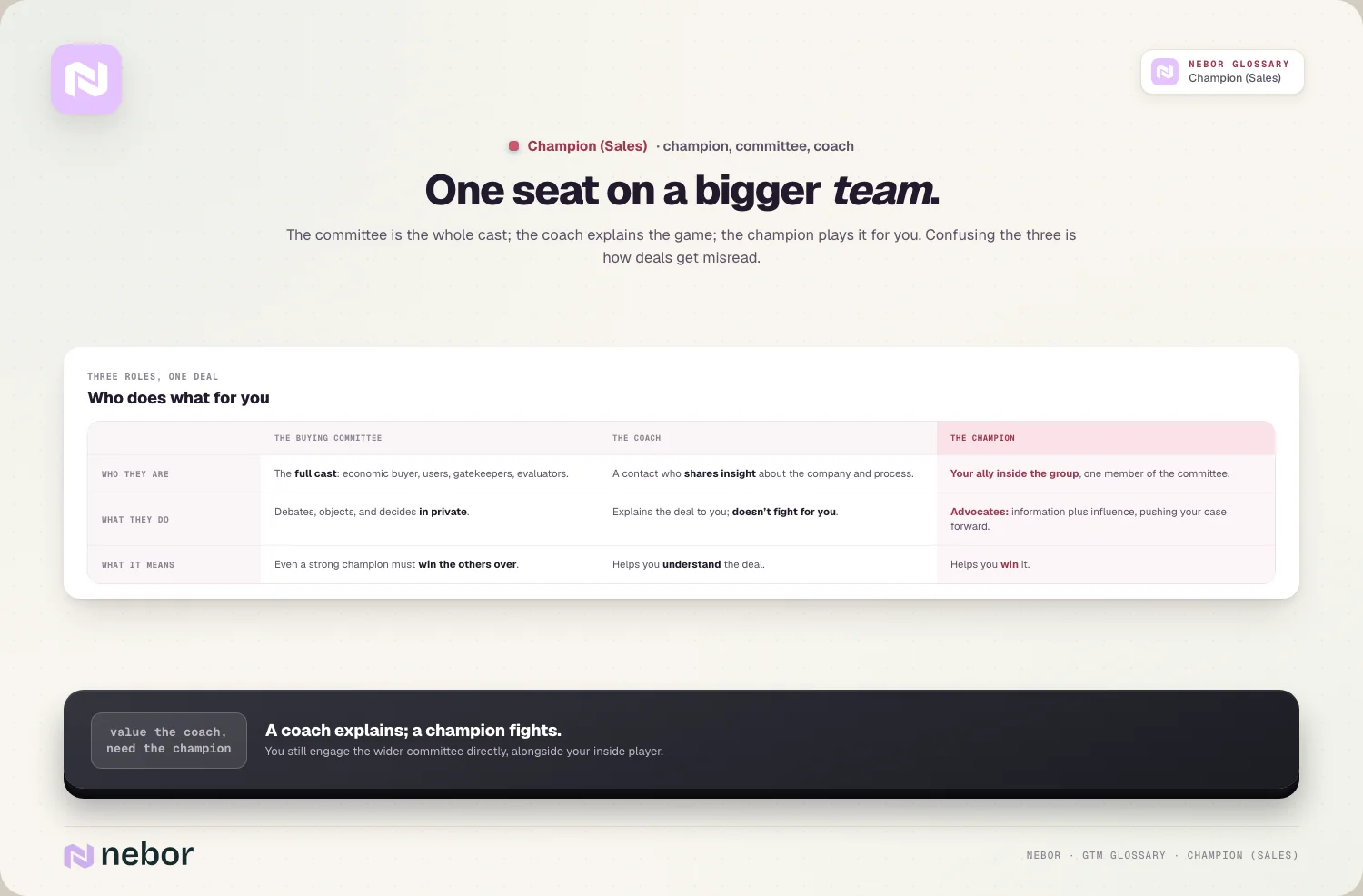
The champion is one member of that committee, specifically the one advocating for you, so they're your ally inside the group rather than the group itself.
This is why a champion alone isn't enough. Even a strong champion has to win over the rest of the committee, so you support them while also engaging other stakeholders directly.
So the champion is your inside player on a larger team. They help you reach and influence the committee, but they're one role on it, which is an important distinction for how you work the deal.
How does a champion fit into your buyer persona thinking overall?
A champion is a specific kind of person, and they usually map onto one of your personas.
A buyer persona describes a type of buyer by role, goals, and motivations. The champion is usually a particular persona, often someone who feels the pain your product solves most directly.
Understanding that persona helps you spot champions. Knowing which role tends to advocate for solutions like yours tells you where to look for a champion inside an account.
It also tells you how to motivate them. A champion has personal reasons to want you to win, like making their job easier or advancing their standing, and understanding their persona reveals those motivations.
So personas and champions connect at every step. The persona tells you who's likely to champion you and why, which guides both finding and developing the advocate you need.
How do you find a champion and then develop them into an advocate?
A champion isn't usually handed to you, you have to find and build one, and a few practices make that work.
Identifying the right person is the first move. You look for someone with influence and credibility who feels the pain your product addresses, because that combination is what makes a potential champion.
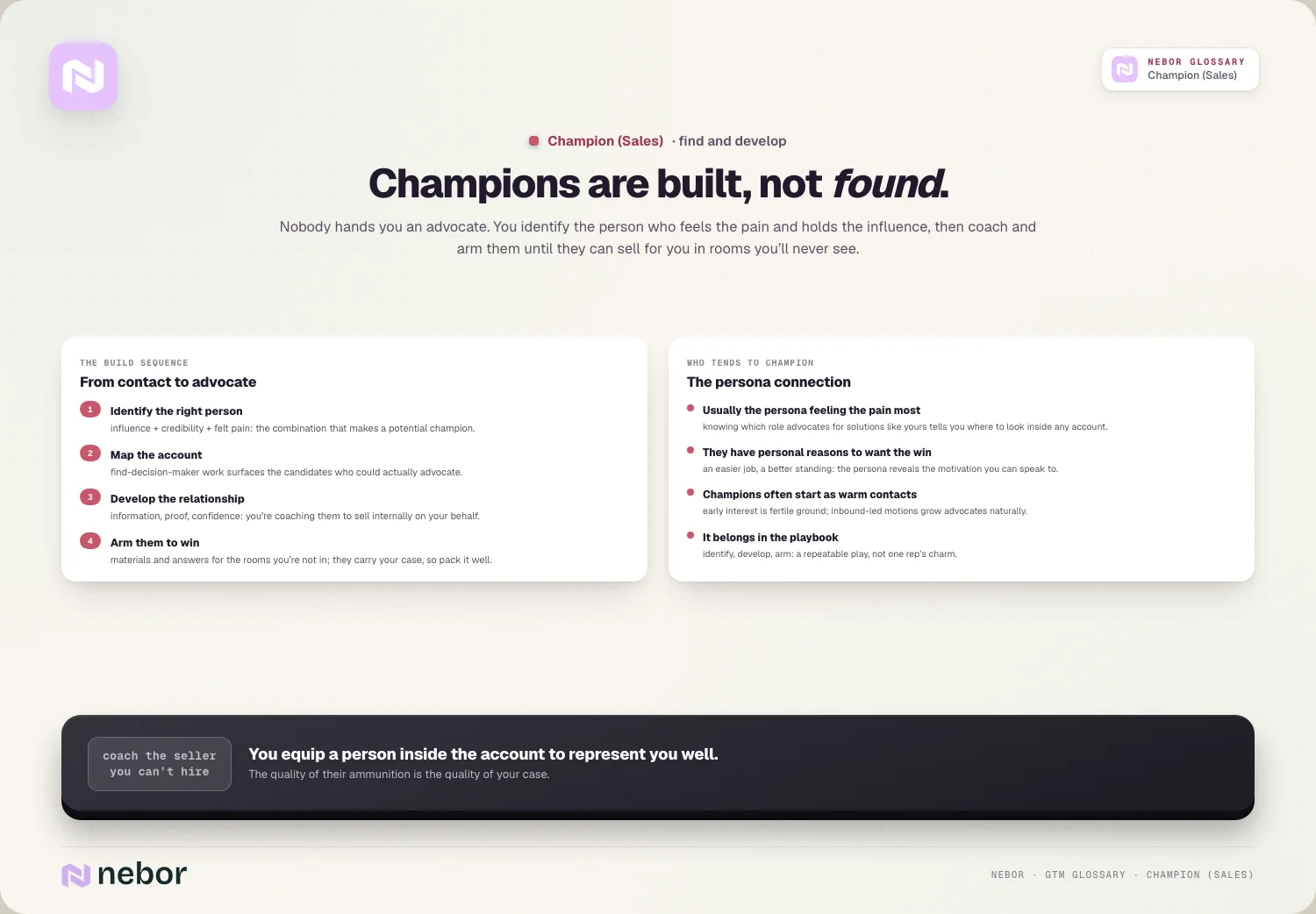
Then you have to find them across the account. Mapping the people who could advocate for you is part of the work a workflow to find decision makers supports, so you reach the right candidate.
Developing the relationship comes next, where you give them the information, proof, and confidence to advocate for you, effectively coaching them to sell internally on your behalf.
And finally you arm them to win, because they'll be making your case without you present, so you hand them the numbers, the proof, and the answers their colleagues will demand.
How do you avoid over-relying on a single champion in a deal?
A real danger in complex sales is leaning too hard on one champion, and we tell clients to hedge from the start.
The risk is fragility, because if your only champion changes roles, loses influence, or leaves the company, a single-threaded deal loses its advocate and can collapse.
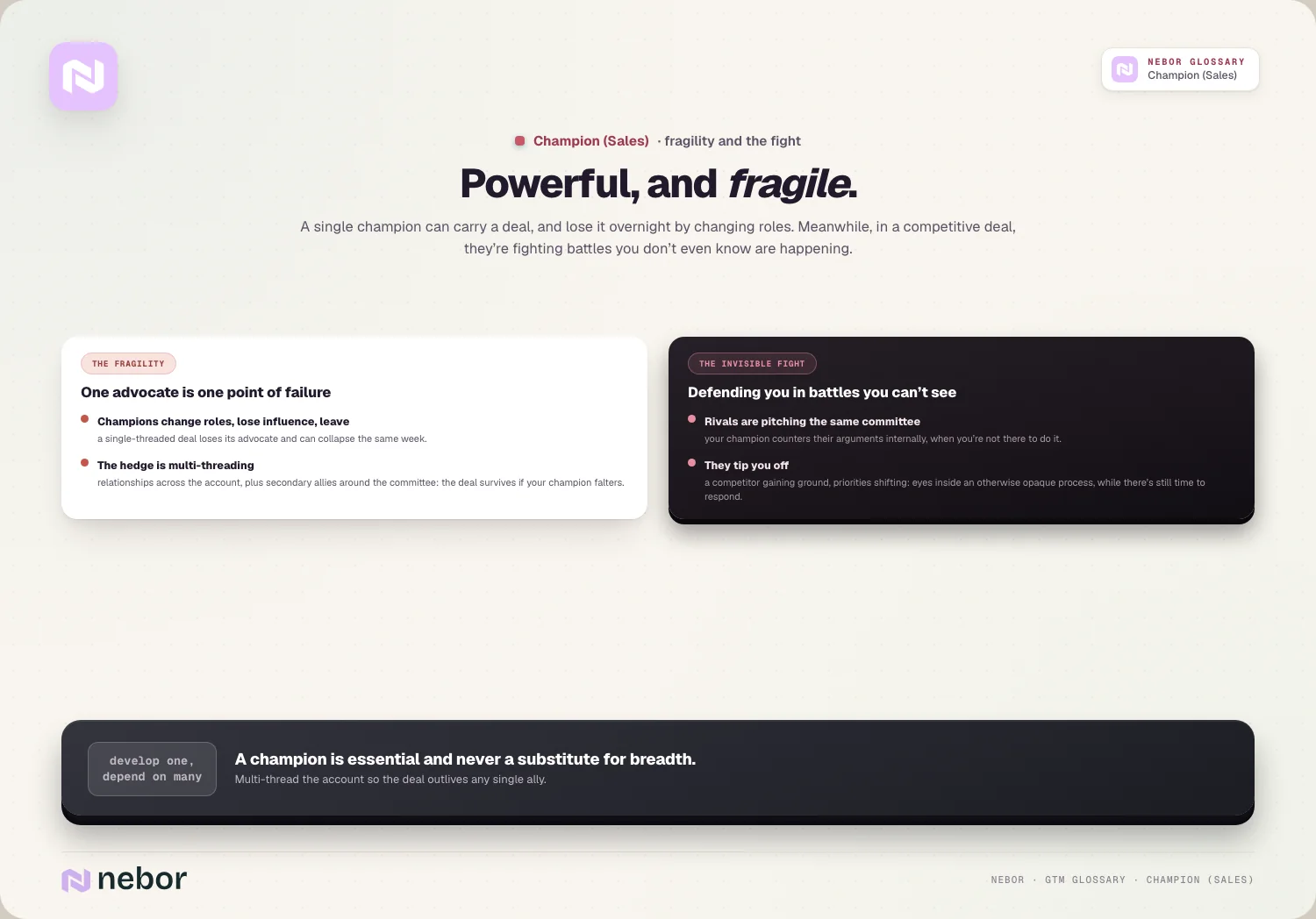
Multi-threading is the protection that holds up. Building relationships across the account through multi-threading means the deal doesn't depend entirely on one person, even a strong champion.
It also helps to cultivate more than one supporter. A primary champion plus a few secondary allies across the committee makes your position far more resilient.
So a champion is essential but not a substitute for breadth. You develop a strong advocate while still engaging the wider committee, which protects the deal if your champion falters.
How do champions connect to your wider go-to-market motion then?
Champions aren't only a late-stage closing tactic, because they show up across your whole motion, and a few connections deserve drawing.
They shape your targeting, because knowing which accounts have potential champions feeds into account scoring and your ideal customer profile, and accounts with a likely advocate are better bets.
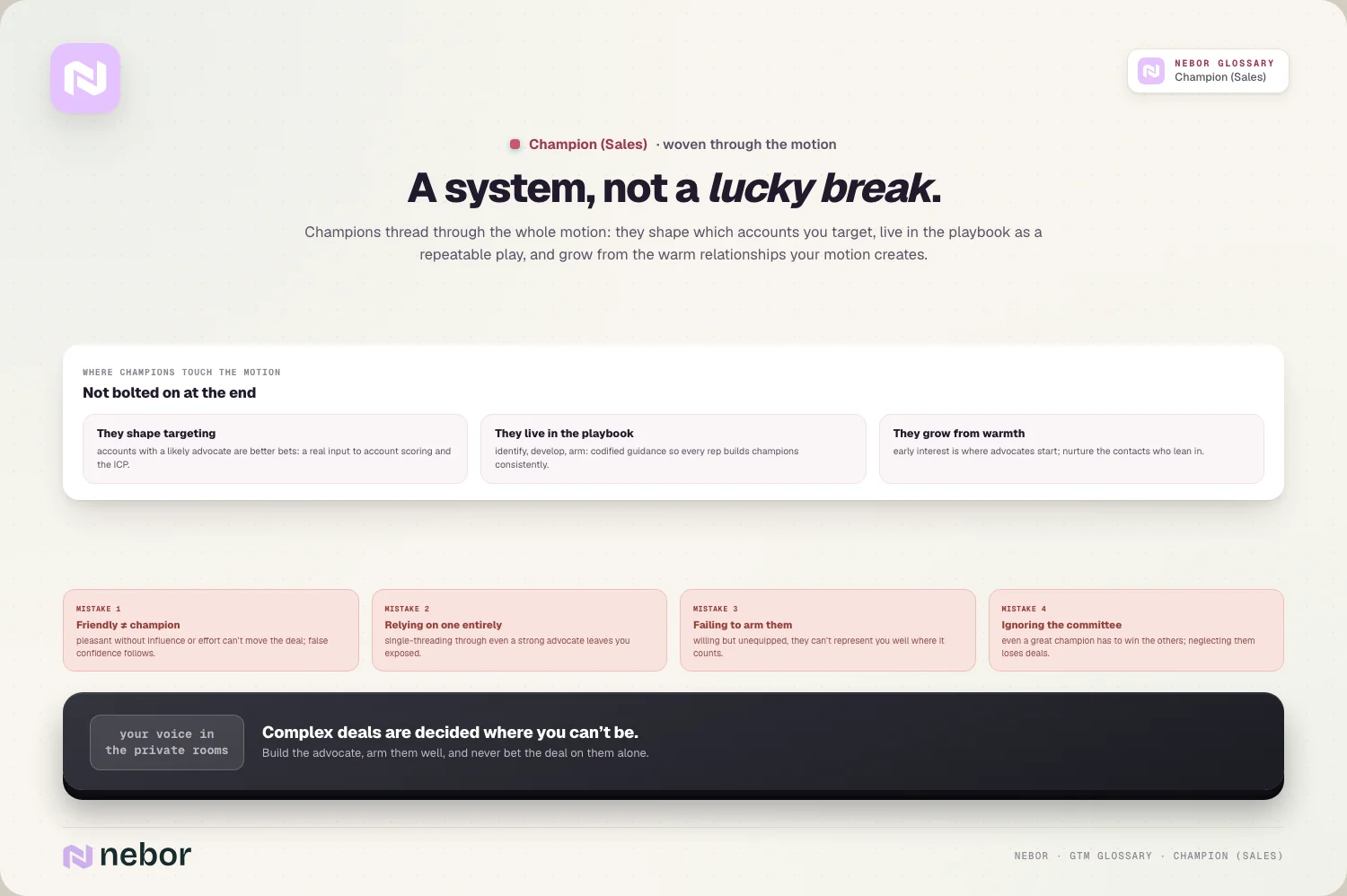
They belong in your playbook too, since how to identify, develop, and arm champions is exactly the kind of guidance an outbound playbook should contain, so reps build champions consistently.
They start with warm relationships as well, because a champion often grows from a contact who showed early interest, and that's the reason an inbound-led outbound motion that engages interested people is fertile ground for champions.
So champions thread through the motion instead of getting bolted on at the end. They connect to targeting, playbooks, and how you nurture relationships, and that's the reason developing them works as a system instead of a one-off move.
How do you tell a real champion from a merely helpful coach?
A useful distinction in complex sales is between a champion and a coach, because they're easy to confuse and they help in different ways.
A coach gives you information, sharing insight about the company, the process, and the competition, which is valuable, but they don't fight for you with the rest of the committee.
A champion does both jobs at once, giving you information and advocating, using their influence to push your solution forward inside the organization.
The difference matters for how you rely on them. A coach helps you understand the deal, while a champion helps you win it, so you value a coach but you still need a true champion.
So don't mistake a helpful coach for a champion. Both are useful, but only a champion has the influence and the will to advance the deal in the rooms you can't reach.
How do champions help you against competitors you can't see?
One of a champion's most valuable roles is invisible to you, which is defending you against competitors. They fight battles you don't even know are happening.
In a competitive deal, rivals are making their own case to the committee. A champion counters those arguments internally, pointing out why your solution fits better when you're not there to do it.
They also tip you off early, because a good champion tells you when a competitor is gaining ground or when the committee's priorities shift, so you can respond before it's too late.
This is part of why champions lift win rates so much. Beyond advocating, they give you eyes and a voice in a competitive process that would otherwise be opaque.
So a champion is your competitive edge inside the account. They defend your position and warn you of threats, which is often what decides a deal between close competitors.
What's the connection between champions and account-based selling?
Champions are a core reason account-based approaches work, so it helps to connect them. They're built into how you engage whole accounts.
Account-based marketing treats the account as the unit and engages multiple stakeholders, and a champion is the relationship at the center of that effort, anchoring your presence in the account.
It shapes how you personalize as well, because tailoring your outreach to the champion's specific motivations, meaning personalization at scale applied to one key person, is how you turn a contact into an advocate.
So champions and account-based selling reinforce each other. You engage the whole account while developing a champion at its center, which gives your effort both breadth and a dedicated inside advocate.
What are the common champion mistakes that cost you real deals?
Champions get mishandled in a handful of repeatable ways, and each one shows up constantly in the deals we watch stall.
Mistaking a friendly contact for a champion tops the list, because someone pleasant who lacks influence or effort feels like an ally but can't move the deal, which breeds false confidence.
Relying on one champion entirely comes next, because single-threading through even a strong advocate leaves you exposed if they leave or lose standing.
Failing to arm them is subtler, where a champion who wants to help but lacks the materials and answers can't represent you well in the rooms you're not in.
And there's ignoring the rest of the committee, because even a great champion has to win others over, so neglecting the broader group while leaning on one advocate loses deals.
Why a champion is the voice you need in rooms you'll never enter
A sales champion carries so much weight because complex deals are decided in private, and a champion is your voice in those rooms. They advocate for you, work the internal process, and keep the deal alive when you can't be there.
The deeper point is that a real champion brings influence, credibility, and effort, which go far deeper than friendliness. The test is whether they have the standing and the motivation to fight for you, and that test separates an advocate from a pleasant contact.
The honest caution is that a single champion is powerful but fragile. You develop a strong advocate, arm them to sell internally, and still multi-thread across the committee so the deal survives if they falter.
So if your complex deals keep stalling out of view, the missing piece is often a real champion. Finding one, developing them, and supporting them across the whole committee is what turns private decisions in your favor.
That relationship-driven work is exactly what a modern go-to-market system is built to support, especially when paired with a workflow that maps the committee behind every inbound meeting.
Share this post
Outbound
Conversations
RevOps
Glossary
Related glossary items
Understanding the core GTM concepts



Ready to build your pipeline











