

In this post:
Not every lead deserves the chase it gets. Some are perfect-fit buyers ready to move, and some will never buy no matter how hard you work them. Treating both the same way wastes your most limited resource, which is your sales team's time.
Lead qualification is how you tell them apart. It's the process of deciding which leads are worth pursuing and which to set aside, so your reps spend their hours on the prospects most likely to become customers.
Lead qualification is the structured process of evaluating whether a lead is a good fit and worth pursuing, based on factors like their fit with your market, their level of interest, and their readiness to buy. It's the filter between a raw lead and a real opportunity.
Sales time is finite, and the numbers show how badly it gets spent. Research shows most teams still pass nearly every lead to sales while only around 27% are actually qualified, so without qualification, reps drown in leads that were never going to close.
TL;DR
Lead qualification is the process of deciding which leads are worth your sales team's time, based on their fit, interest, and readiness to buy.
Sales time is finite, so without qualification, reps waste hours on leads that were never going to buy, while real opportunities get the same treatment as dead ones.
It works in stages and uses frameworks. Leads progress from marketing-qualified to sales-qualified, evaluated with frameworks like BANT for fit and readiness.
The skill lies in where you set the bar. Qualifying too loosely wastes sales time, and too strictly discards real opportunities, so the bar has to be set carefully.
What is lead qualification, and what exactly does it evaluate?
Lead qualification is the work of judging whether a lead deserves your sales effort, separating the leads worth pursuing from the ones that aren't. In our experience it's the discipline teams skip longest and regret most.
It evaluates a few things at once. Whether the lead fits your market, whether they're genuinely interested, and whether they're ready to buy all factor into whether they qualify.
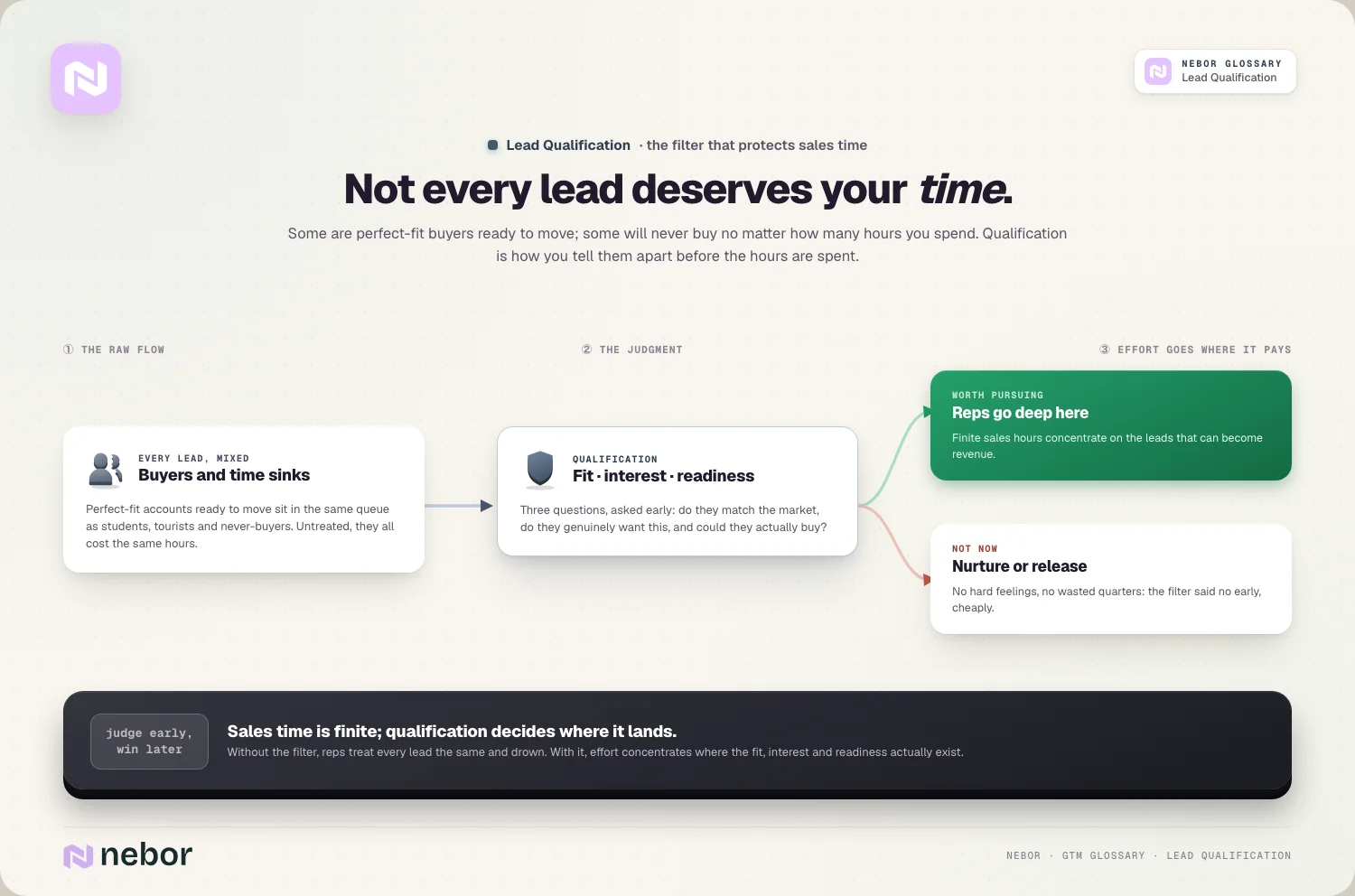
It works as a continuous filter, though. Qualification carries from the first touch through the whole funnel instead of one yes-or-no moment, with the bar rising as a lead moves closer to a deal.
It protects your team's actual selling time. By filtering leads before and during the sales process, qualification ensures reps focus on prospects with a real chance of closing rather than chasing everyone.
So lead qualification amounts to a series of gates a lead passes through. Each gate raises the bar, so by the time a rep spends real time on a lead, there's good reason to believe it can become a deal.
How is lead qualification different from the lead scoring beneath it?
These two are constantly confused, but they're different layers of the same system, and separating them clears up a lot.
Lead scoring is the automated ranking layer. It assigns leads a number based on fit and behavior, so it's a fast, systematic way to prioritize many leads at once.
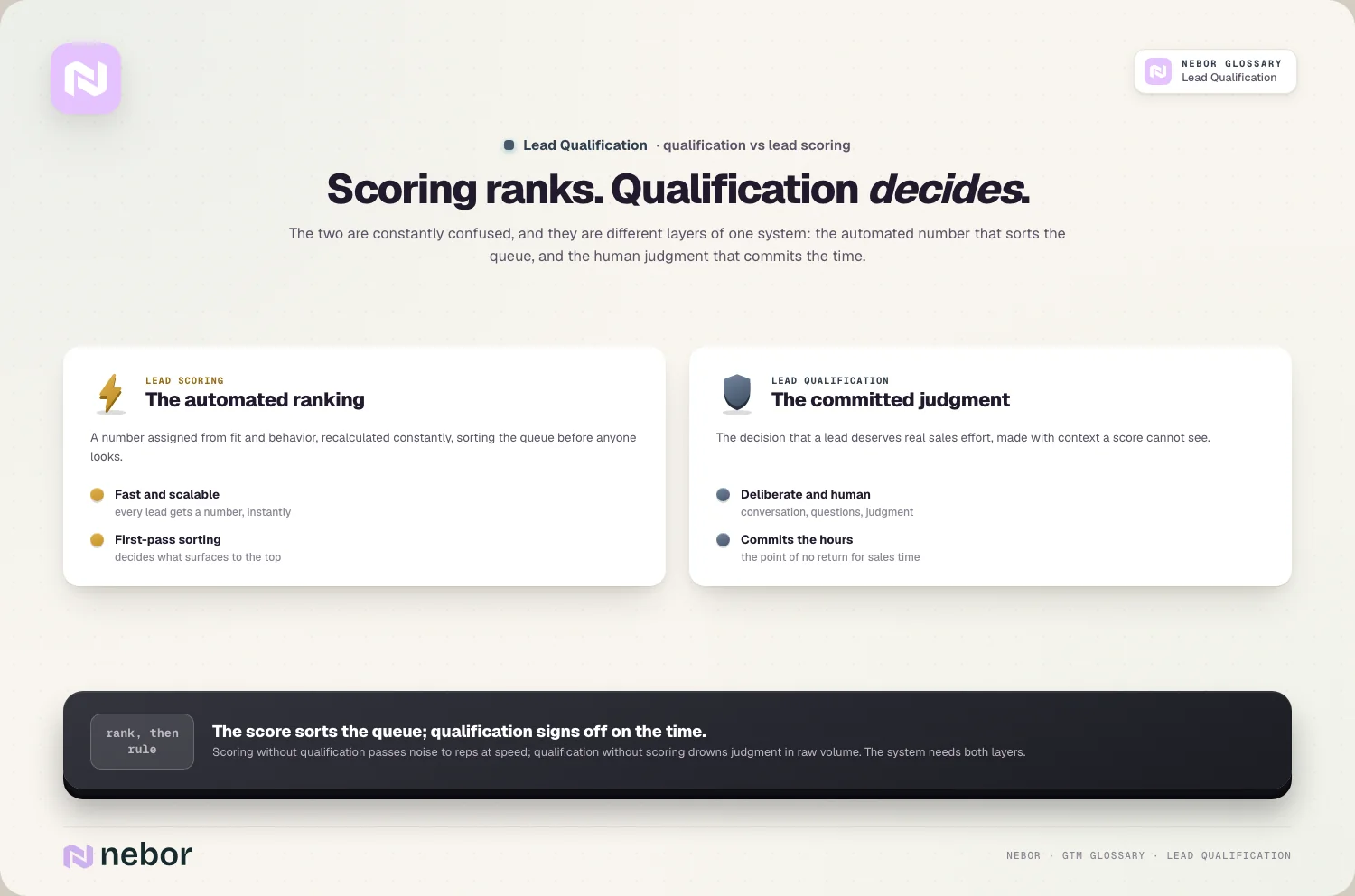
Lead qualification is the decision on top. It's the judgment about whether a lead is worth pursuing, which scoring informs but a process and often a human ultimately make.
The two layers work together through the whole funnel. Scoring, including account scoring at the company level, surfaces the likely-good leads automatically, and qualification confirms whether they're truly worth sales time.
So scoring ranks the leads while qualification decides on them. A score is an input to qualification, which is the broader process of judging and confirming whether a lead should move forward.
What are the stages a lead moves through as it gets qualified?
Qualification tightens in stages as a lead moves down the funnel, and each stage raises the bar.
A marketing-qualified lead comes first in the sequence. An MQL fits your market and has shown enough engagement to suggest active interest, so marketing judges it ready to hand to sales.
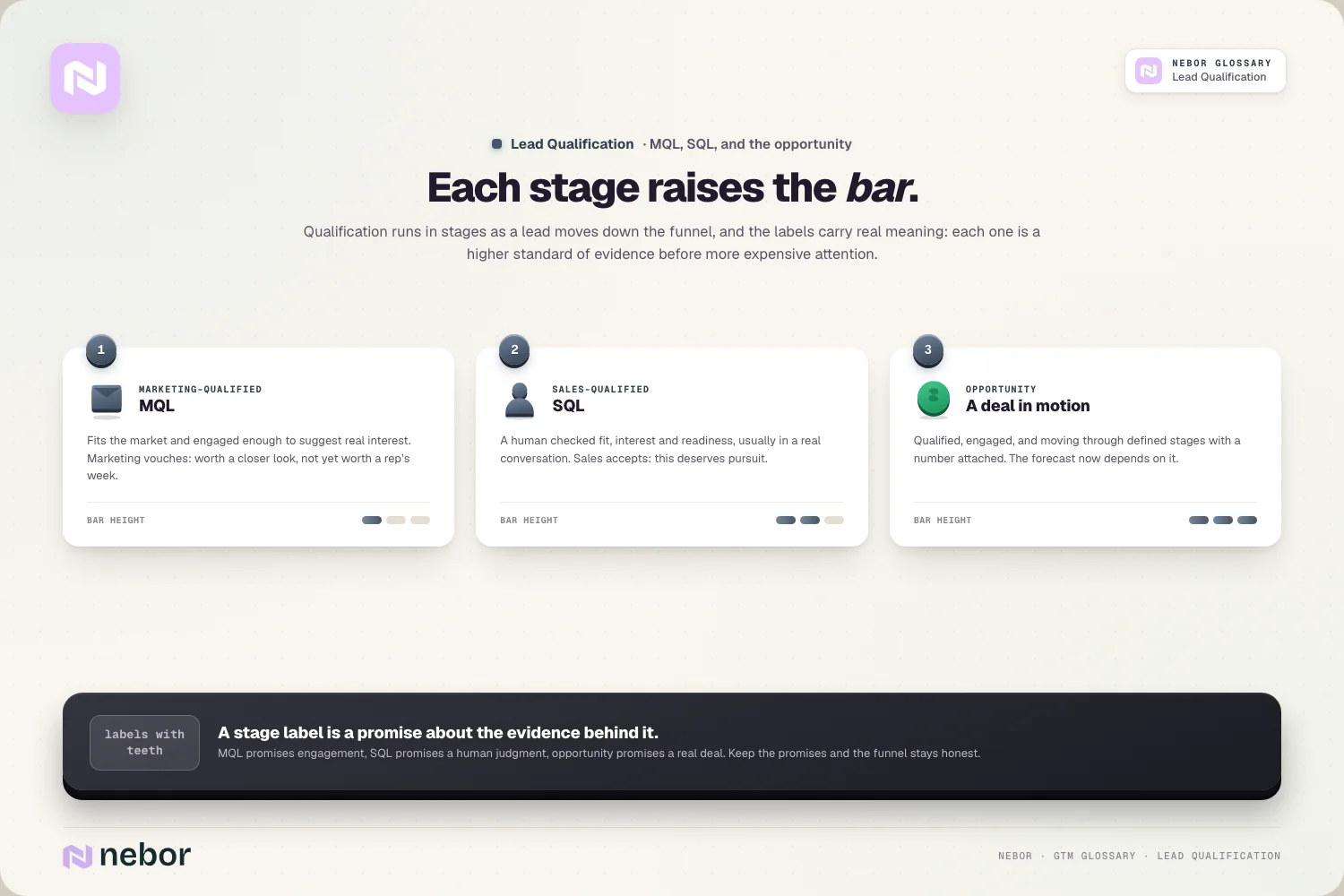
A sales-qualified lead is the next gate up. An SQL is an MQL that sales has independently evaluated and confirmed as worth pursuing, usually against a fit-and-readiness framework.
An opportunity is the deepest stage of the three. Once a qualified lead shows real buying potential, it becomes an opportunity, qualified more rigorously because a real deal is now on the line.
So qualification escalates from MQL to SQL to opportunity. Each handoff raises the standard, and that escalation keeps low-quality leads from consuming the expensive, late-stage attention reserved for real deals.
What is BANT, and when does the classic framework still work well?
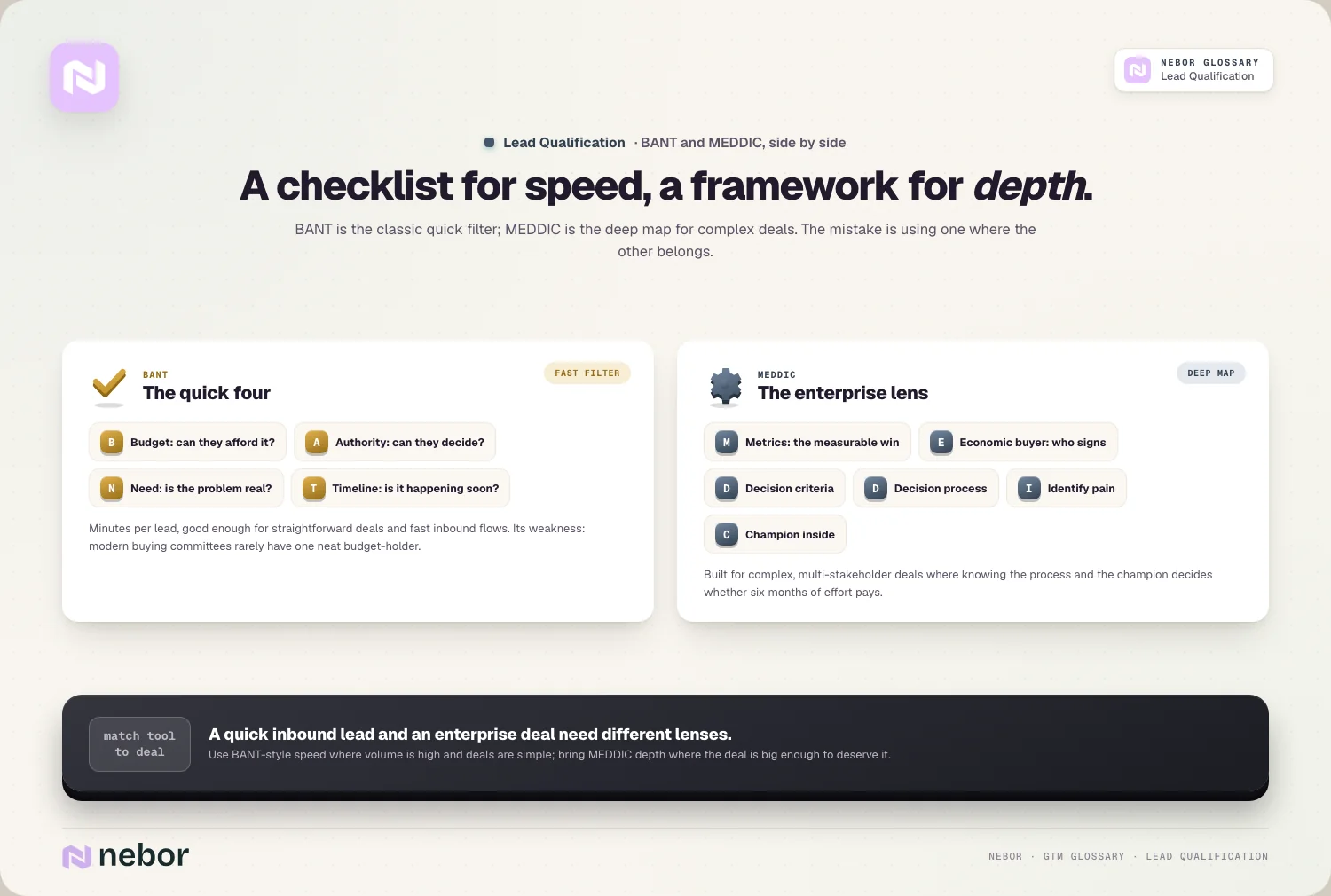
BANT is the classic qualification framework, a quick checklist for whether a lead is worth pursuing.
BANT stands for four things a rep can check. Budget, Authority, Need, and Timeline, meaning can they afford it, can the person decide, do they truly need it, and when will they act.
It came out of IBM decades ago. It endured because it's simple and fast, giving reps a quick way to gauge whether a lead is worth deeper investment.
It fits the simpler end of deals. BANT works well for transactional and mid-market sales with shorter cycles, where a quick read on budget and authority is enough to qualify.
So BANT is a fast, practical filter for straightforward deals. It's less suited to complex enterprise sales, but for many B2B leads it's a quick, effective way to separate serious prospects from the rest.
What is MEDDIC, and when does a deal need the heavier framework?
For complex deals, BANT lacks depth, which is where MEDDIC comes in as the heavier framework for bigger sales.
MEDDIC goes considerably further than BANT does. It examines metrics, the economic buyer, decision criteria, the decision process, identified pain, and a champion inside the account.
It fits the complex enterprise deals best. When a deal involves many stakeholders and a long cycle, MEDDIC's depth helps you understand how the decision really gets made.
It maps the whole buying group for you. Because enterprise deals go through a buying committee, MEDDIC's focus on the economic buyer and decision process is built for that complexity.
So MEDDIC is the heavier framework for high-stakes deals. It takes more work than BANT, but for complex sales that effort prevents pouring months into deals that were never going to close.
Should you standardize on one framework or blend several together?
A common question clients ask us is which framework to standardize on, and the best answer is often more than one, because different deals need different rigor.
No single framework fits every kind of deal. A quick inbound lead and a complex enterprise deal need different levels of scrutiny, so forcing one framework on both serves neither well.
Hybrids tend to win out in practice. Many strong teams use a lighter BANT-style filter for early lead qualification and a deeper MEDDIC approach once a deal becomes a real opportunity.
The stage determines the right level of depth. Early qualification can be quick, while later qualification of a live opportunity deserves the deeper framework, because the stakes and information both grow.
So match the framework to the deal and the stage. A blended approach, light early and rigorous later, qualifies efficiently without either wasting time or missing the detail complex deals require.
How do marketing and sales align on what qualified actually means?
Qualification only works if marketing and sales agree on what qualified means, because disagreement here causes real damage.
The classic problem is a pair of mismatched definitions. Marketing passes leads it considers qualified, sales rejects them as junk, and the friction wastes effort and breeds distrust between the teams.
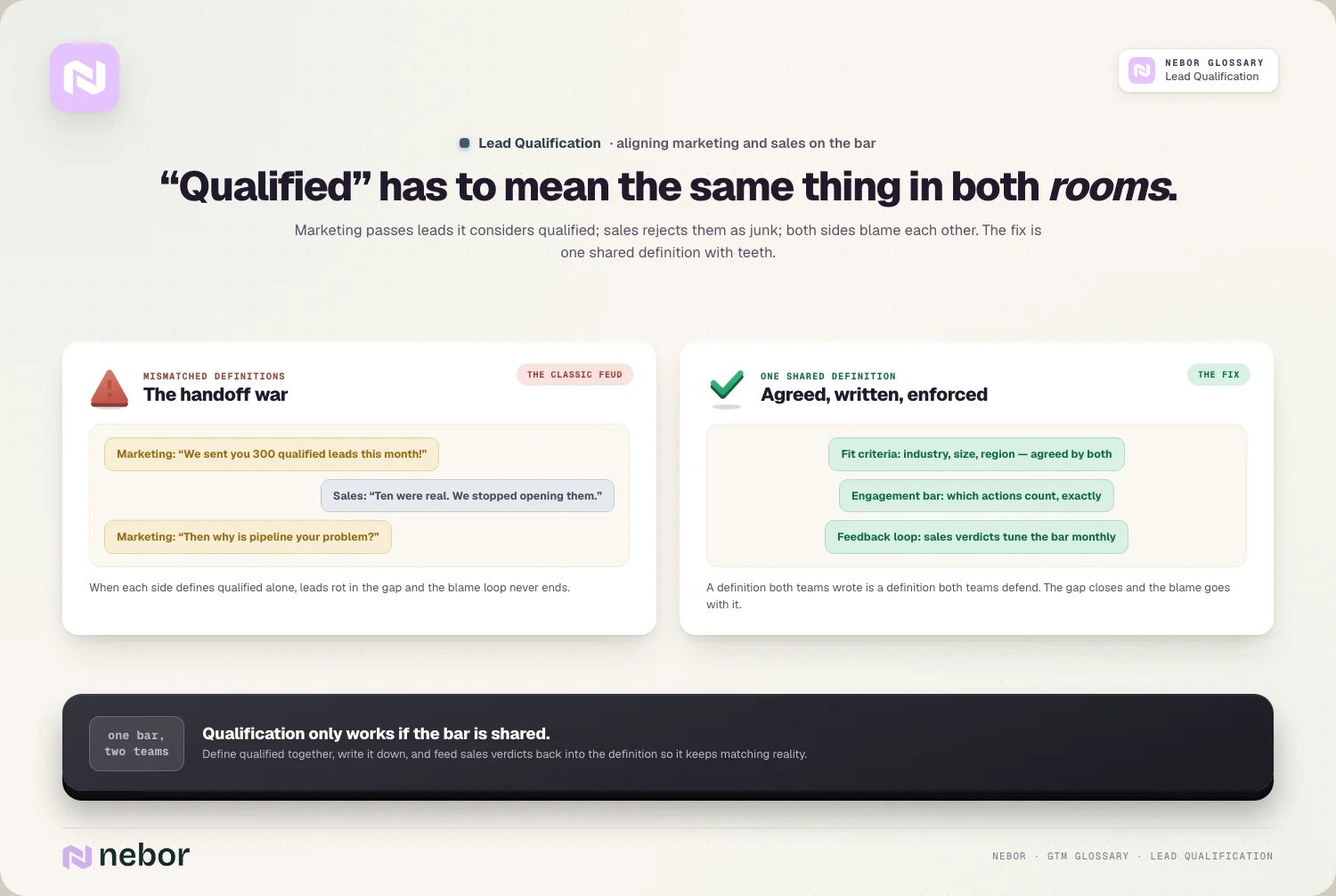
A single shared definition is what fixes it. When both teams agree on exactly what makes a lead qualified, marketing sends better leads and sales works them properly, which lifts conversion across the handoff.
It's measurable as well as fixable, which helps. Tracking what share of marketing's leads sales accepts, and how many convert, shows whether the shared definition is working or needs tightening.
So qualification depends on a tight marketing-sales agreement. The handoff between them is where good leads either flow through or fall through, which makes a shared, enforced definition of qualified critical.
How does qualification connect to fit and intent working together?
Modern qualification leans heavily on two ideas, because fit and intent together decide whether a lead qualifies.
Fit is whether they match your market. A lead that matches your ideal customer profile clears the most basic qualification bar, because fit is the foundation everything else builds on.
Intent is whether they're looking right now. Signs of active research, the substance of signal-based selling, tell you a fitting lead is also ready, and that readiness is what makes them worth pursuing now.
Together the two are what qualify a lead. Fit without intent means a good account that isn't ready, intent without fit means a poor account that's looking, and qualification wants both.
So qualification is increasingly about combining fit and intent. A lead that both matches your market and shows real interest is the one worth your fastest, most serious attention.
How does speed affect qualification and the leads it produces?
Qualifying leads is urgent work, because leads decay fast, and speed is part of doing it well.
Fresh leads qualify far more accurately than stale ones. Reaching a lead quickly, the heart of speed to lead, lets you qualify them while their interest is still high rather than after it fades.
Slow qualification loses deals you'd have won. A lead that waits unqualified for days may go cold or pick a competitor, so qualification that drags wastes the very opportunities it's meant to surface.
Automation helps with every part of it. Scoring and routing leads automatically, the kind of work you can automate sales prospecting around, gets qualified leads to reps fast enough to act.
So qualification has to be fast as well as accurate. The goal is to identify and reach worthy leads while they're still warm, because even a well-qualified lead converts poorly if you're slow.
How does qualification relate to the lead generation feeding it?
Qualification and lead generation are two ends of the same pipe, with one creating leads and the other filtering them.
Generation fills the top of the pipe. It produces the flow of raw leads, but on its own it says nothing about whether those leads are any good.
Qualification sorts that flow as it arrives. It takes the leads generation produces and decides which deserve sales time, so the two only work well together.
Better generation makes the qualifying job far easier. When generation targets well-fit accounts from the start, a larger share of leads qualify, so sharp targeting upstream means less waste downstream.
So generation and qualification work as partners. Generation creates volume and qualification turns that volume into focus, which is what keeps a full pipeline from becoming a busy but unproductive one.
Can product usage qualify a lead better than a form ever could?
In product-led businesses, qualification often comes from how people use the product as much as what they say, because usage becomes the signal.
Usage shows intent you can verify directly. Someone actively using a free trial or freemium tier is demonstrating interest far more convincingly than someone who merely filled out a form.
This is the idea behind the product-qualified lead. A product-qualified lead is qualified by behavior in the product, which is often a stronger signal than traditional marketing engagement.
It changes where the qualification bar lands. For product-led companies, the key question shifts from fit and stated interest to whether the person is getting real value from the product itself.
So product usage can be the sharpest qualification signal of all. When someone is already succeeding with your product, much of the usual qualifying is answered by what they're doing already.
How does qualification improve conversion across the whole funnel?
Good qualification shows up directly in your numbers, and the payoff is concrete.
It focuses effort where it pays off. By concentrating reps on well-fit, ready leads, qualification raises the share of pursued leads that close.
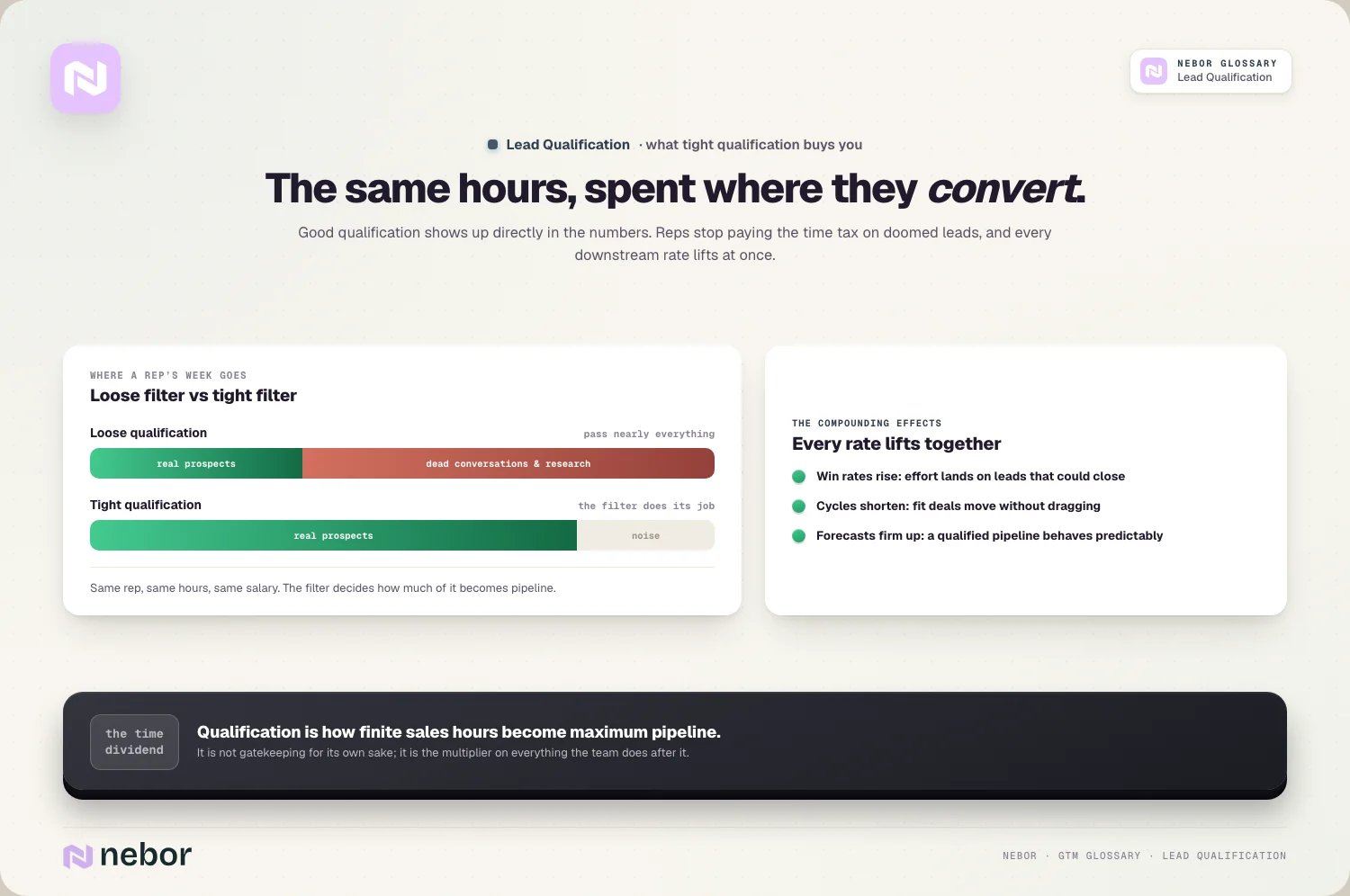
It improves the quality of your pipeline. A pipeline of qualified opportunities converts at a far better conversion rate than one stuffed with unqualified leads, because the deals in it are real.
Behavioral signals sharpen the filter further still. Qualifying on behavior as well as demographics has been found to push MQL-to-SQL conversion to around 39 to 40% for B2B SaaS, far above weaker methods.
So qualification works as a conversion lever on top of a filter. Cleaner inputs produce better outcomes, and disciplined qualification lifts the performance of the entire sales process.
What are the common mistakes teams make with lead qualification?
Lead qualification goes wrong in a few predictable ways, and we keep seeing the same ones in the funnels we review. Avoiding them keeps it a sharp filter instead of a blunt one.
Qualifying too loosely is the most common, because passing nearly every lead to sales buries reps in unqualified leads and wastes their time.
Qualifying too strictly costs just as much, because setting the bar so high that you discard real opportunities throws away deals that could have closed.
Misaligned definitions break the handoff, because when marketing and sales disagree on what qualified means, good leads fall through the cracks and trust between the teams erodes.
And qualifying once and forgetting misses the movement, because a lead that looked weak early can strengthen, and one that looked strong can fade, so the judgment has to keep updating.
Why deciding who deserves your time is the highest-return sales habit
Lead qualification matters because sales time is finite. Without it, reps treat every lead the same, drowning in prospects that were never going to buy while real opportunities get no special attention.
The deeper point is that it works in stages with frameworks. Leads progress from marketing-qualified to sales-qualified to opportunity, evaluated with the right depth, light early and rigorous once a real deal is on the line.
The honest caveat is that qualification is a balance. Too loose wastes sales time, too strict discards real deals, so the skill is setting the bar where it catches genuine opportunities without letting junk through.
So if your reps feel buried in leads that never close, the problem is usually qualification. Building a clear, shared process for deciding which leads deserve attention is one of the highest-return things a modern go-to-market system can put in place.
Share this post
Inbound
RevOps
Glossary
Related glossary items
Understanding the core GTM concepts




Ready to build your pipeline











