
In this post:
You can do everything right on a cold email, pass every authentication check, warm your domain, and write a truly relevant message, and still have it vanish before the prospect sees it.
When you email into a large company, your message often has to clear a security layer in front of the inbox that decides, unseen, whether it gets through at all.
That layer is a secure email gateway, one of the least understood reasons cold email fails to reach enterprise buyers. It inspects every message arriving at an organization before the mailbox does, and if a message looks risky, it can quarantine or reject it without the sender or recipient ever knowing.
A secure email gateway, or SEG, is a security system that stands between the internet and an organization's mail servers, filtering all incoming email to block threats like phishing, malware, and spam before they reach anyone's inbox.
Many companies, especially larger ones, route their email through a SEG as an extra line of defense.
For outreach, the point is that a SEG is a second, often stricter gatekeeper beyond the standard filters at Gmail or Outlook. Your email can satisfy the mailbox provider and still be stopped by the company's gateway, so enterprise outreach faces hurdles that email to small companies never hits.
TL;DR
A secure email gateway is a security layer that filters all of an organization's incoming email to block threats before messages reach the inbox.
It acts as an extra gatekeeper beyond Gmail or Outlook, so a message can pass the mailbox provider's checks and still be blocked by the company's gateway.
Large and security-conscious companies are the ones most likely to deploy a SEG, so enterprise cold email faces filtering that smaller targets don't.
You can't control a prospect's SEG, so in our experience the only levers are the fundamentals, because strong authentication, clean reputation, and truly relevant content are what get you through.
What a secure email gateway actually is and where it fits in the flow
A secure email gateway is essentially a checkpoint every inbound message must pass before delivery. It stands between the internet and the organization's mail system, inspecting each message and deciding whether to let it through, quarantine it, or reject it.
Its whole purpose is security instead of convenience. The gateway exists to stop phishing attempts, malware, business email compromise, and spam from ever reaching employees, because email is the most common way attacks get into a company in the first place.
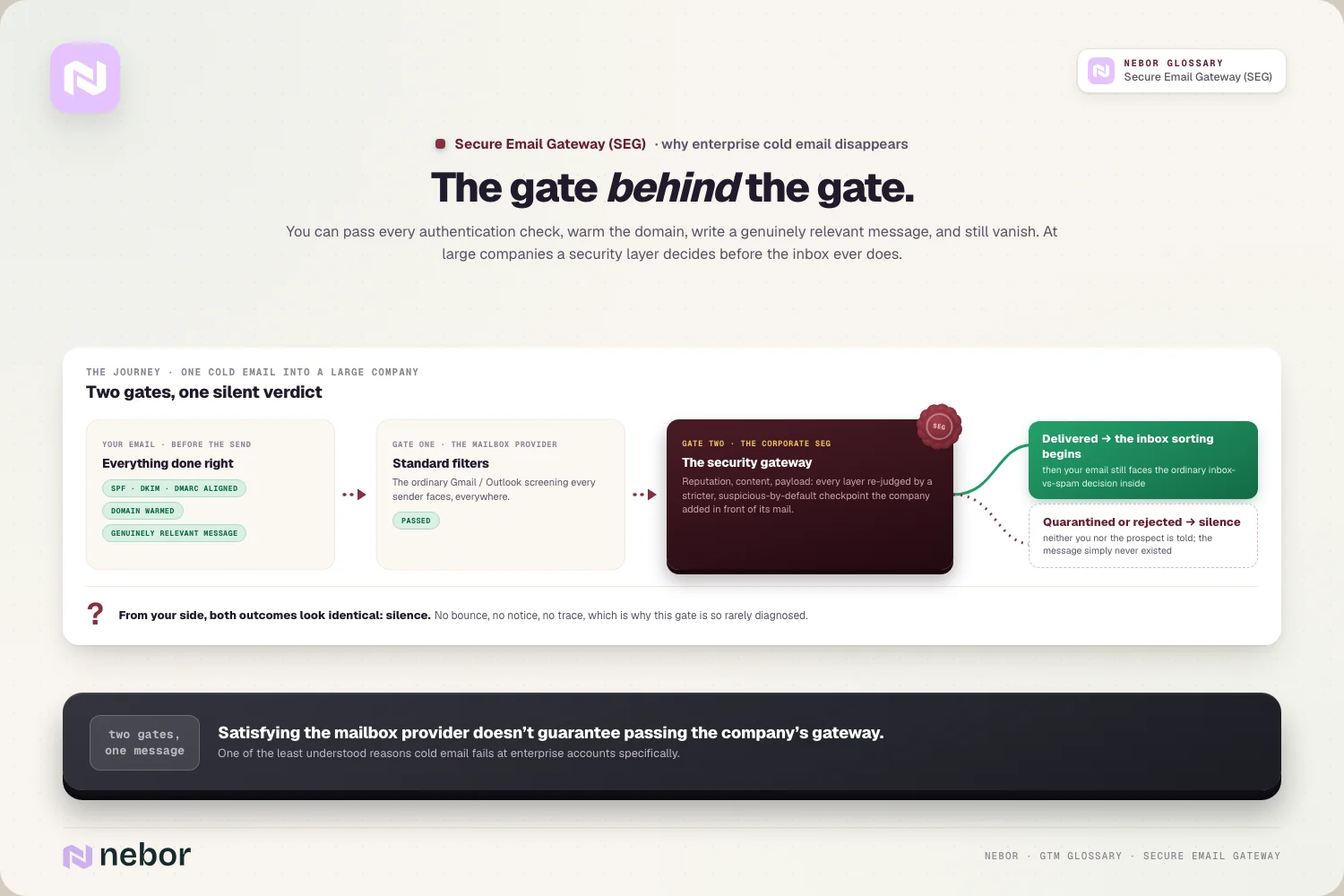
Companies usually route email to a SEG in one of two ways, either by pointing their mail records at the gateway so all traffic flows through it, or by connecting it to their cloud email through an integration. Either way, the effect is the same, every message an employee receives has already been screened.
How a secure email gateway decides what to block or let through
A SEG makes its decisions using several layers of inspection stacked together, instead of a single rule. It checks the sending source, scans the message itself, and weighs the result against known threats before deciding a message's fate.
The first thing it usually checks is the sender's reputation. The gateway compares the sending address against blocklists and reputation databases, and a message from a source with a poor history can be rejected at the connection stage before its content is even examined.
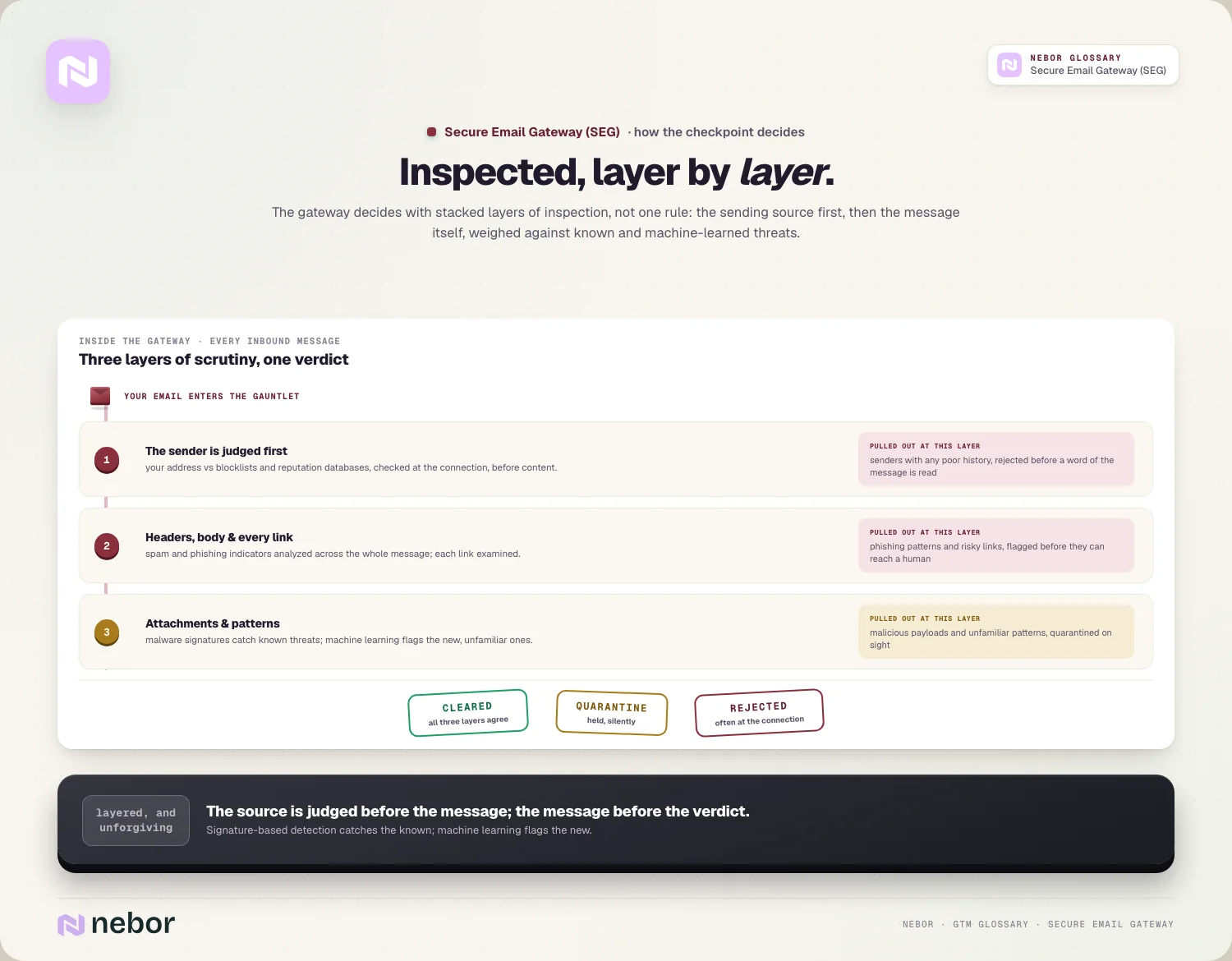
Beyond reputation, the gateway scans the actual message for warning signs. It analyzes the headers and body for spam and phishing indicators, examines any links, and inspects attachments for malware, combining signature-based detection for known threats with machine learning that flags newer, unfamiliar patterns.
Why a secure email gateway is a second gatekeeper beyond the inbox
The key thing to grasp is that a SEG layers on top of the filtering the mailbox provider already does, as an addition to it. Your email may first clear the gateway, then still face the ordinary inbox-versus-spam sorting inside the mail system, so there are effectively two gates instead of one.
This is why passing Gmail's checks doesn't guarantee delivery to an enterprise, and why overall email deliverability to big accounts lands lower.
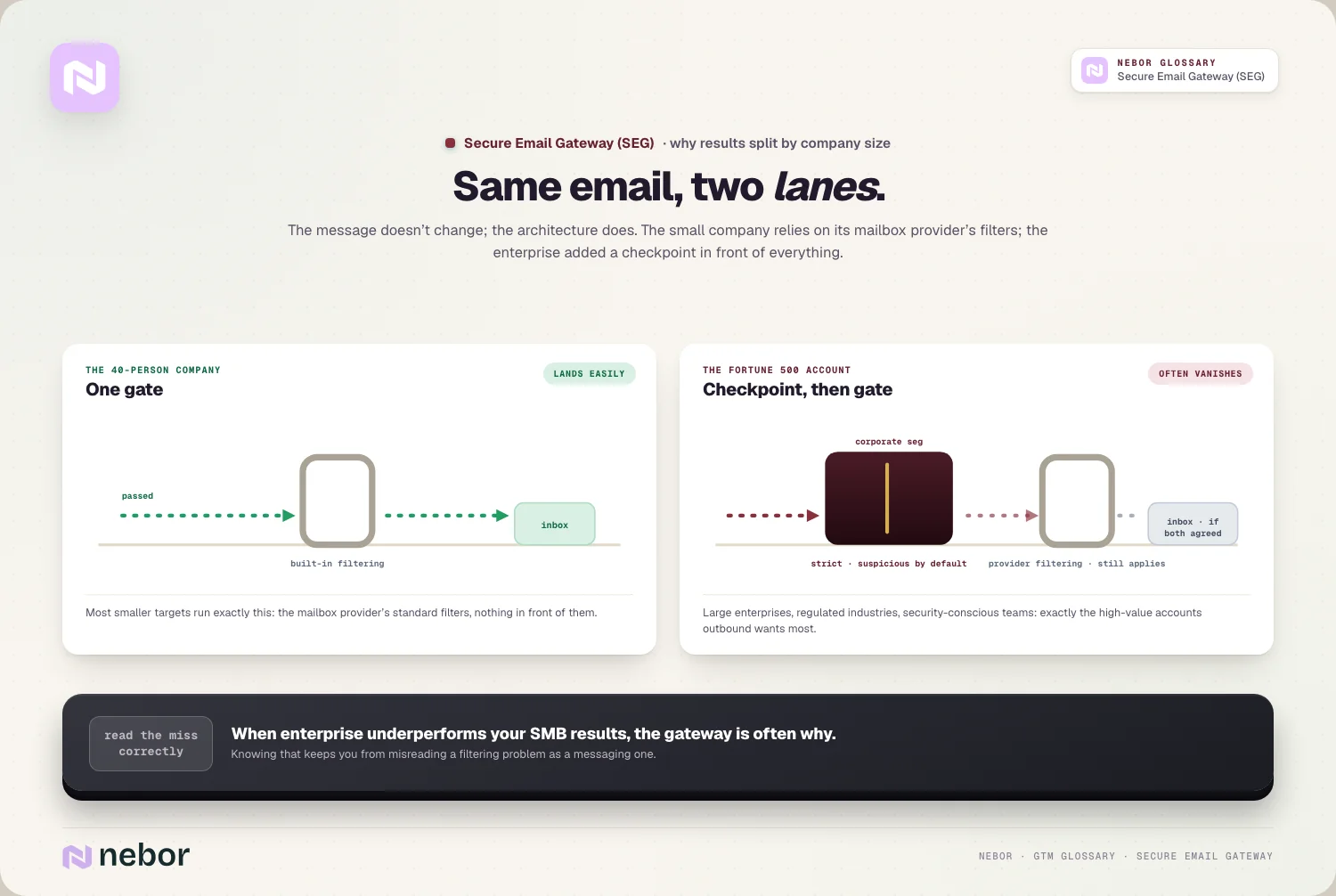
A message can be acceptable to the underlying mail platform yet get stopped by a corporate gateway whose rules are stricter, because its job is to be more cautious than a consumer inbox.
The practical result is that the same email can land easily at a small company and disappear at a large one, and we watch this exact pattern in the campaigns clients bring us.
The difference is that the large company added a security layer the small one didn't, a distinction most senders never realize is affecting their results.
Why enterprise and security-conscious companies are most likely to deploy one
The companies most likely to hide behind a SEG are exactly the high-value accounts many outbound teams most want to reach. Large enterprises, regulated industries, and any organization that takes security seriously tend to deploy a gateway, because they're the biggest targets for email-based attacks.
This creates a predictable pattern in outreach results. Cold email into smaller companies, which often rely only on their mailbox provider's built-in filtering, tends to land more easily than the same email sent to a Fortune 500 account protected by a strict gateway.
Knowing this helps set realistic expectations instead of blaming your own setup. When enterprise outreach underperforms your results with smaller targets, the gateway is frequently part of the reason, and understanding that keeps you from misreading a filtering problem as a messaging one.
Why you cannot control a prospect's gateway, only your own signals
The uncomfortable reality of a SEG is that it belongs entirely to the recipient's company, so you have no direct control over its rules or how aggressively it filters. Unlike your own sending setup, which you can tune, a prospect's gateway is a black box you can only influence indirectly.
What you can control are the signals the gateway evaluates when it decides about your message. Strong authentication, a clean sending reputation, and content that doesn't resemble spam or phishing are exactly the things a gateway weighs, so getting those right is how you give yourself the best chance of passing.
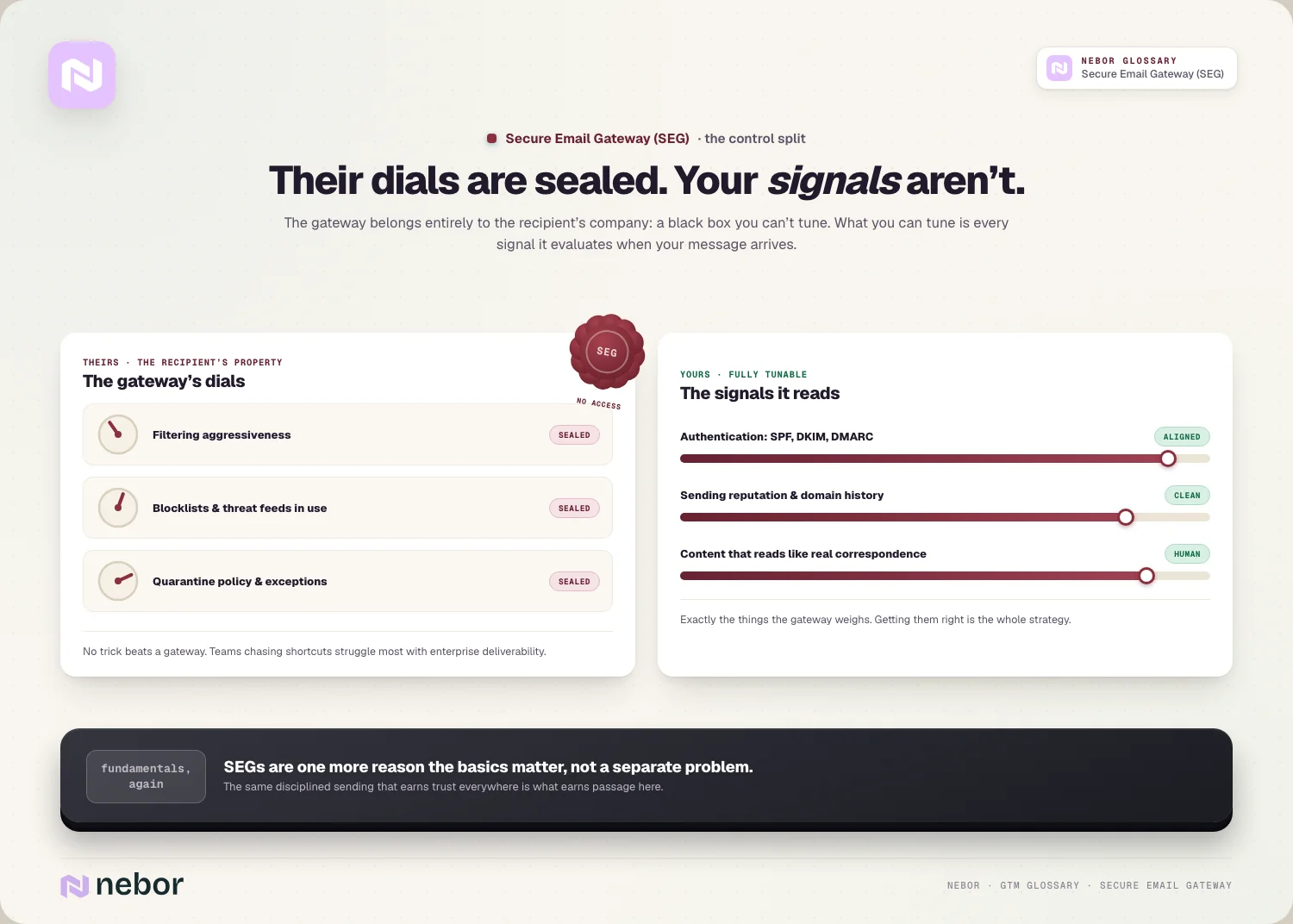
This reframes SEGs as one more reason the fundamentals matter instead of a separate problem to solve. There's no trick that beats a gateway, only the same disciplined sending that earns trust everywhere, and that's the reason teams chasing shortcuts struggle most with enterprise deliverability.
How authentication helps your email clear a secure email gateway
Because a gateway is built to catch impersonation, proving your email is really from you is one of the most important ways through. Passing SPF and its companion checks tells the gateway your message came from an authorized source, removing one of the biggest reasons it might block you.
Full authentication carries even more weight with a gateway than with a consumer inbox. Since spoofing and business email compromise are exactly what a corporate SEG exists to stop, complete and aligned DNS authentication, including DMARC, is close to mandatory for reaching enterprise recipients.
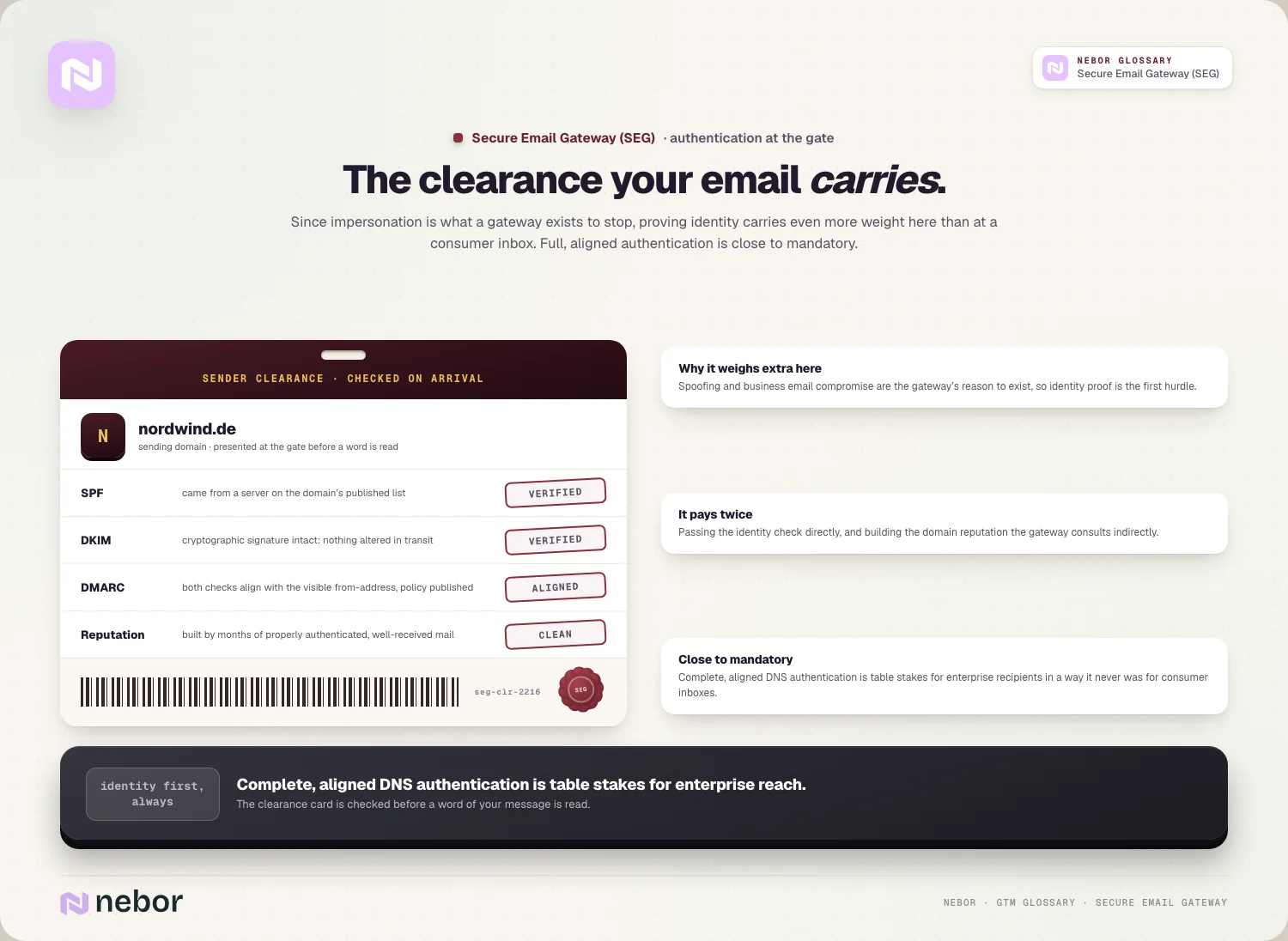
Authentication also supports the reputation the gateway checks. Properly authenticated mail builds the domain reputation that gateways weigh heavily, so getting the technical foundation right pays off both directly, by passing the identity check, and indirectly, by strengthening how trusted your domain looks.
Why sending reputation carries extra weight with a corporate gateway
A gateway leans on reputation even more than a consumer inbox does, because a corporate security layer is tuned to be suspicious by default. Your sender reputation is one of the first things it checks, and a domain or IP with any negative history can be stopped before the gateway even looks at what you wrote.
This makes the discipline that protects reputation especially important for enterprise outreach. Avoiding a spam trap, keeping bounce and complaint rates low, and warming your domain properly all feed the reputation a gateway consults, so the same habits that help everywhere help most here.
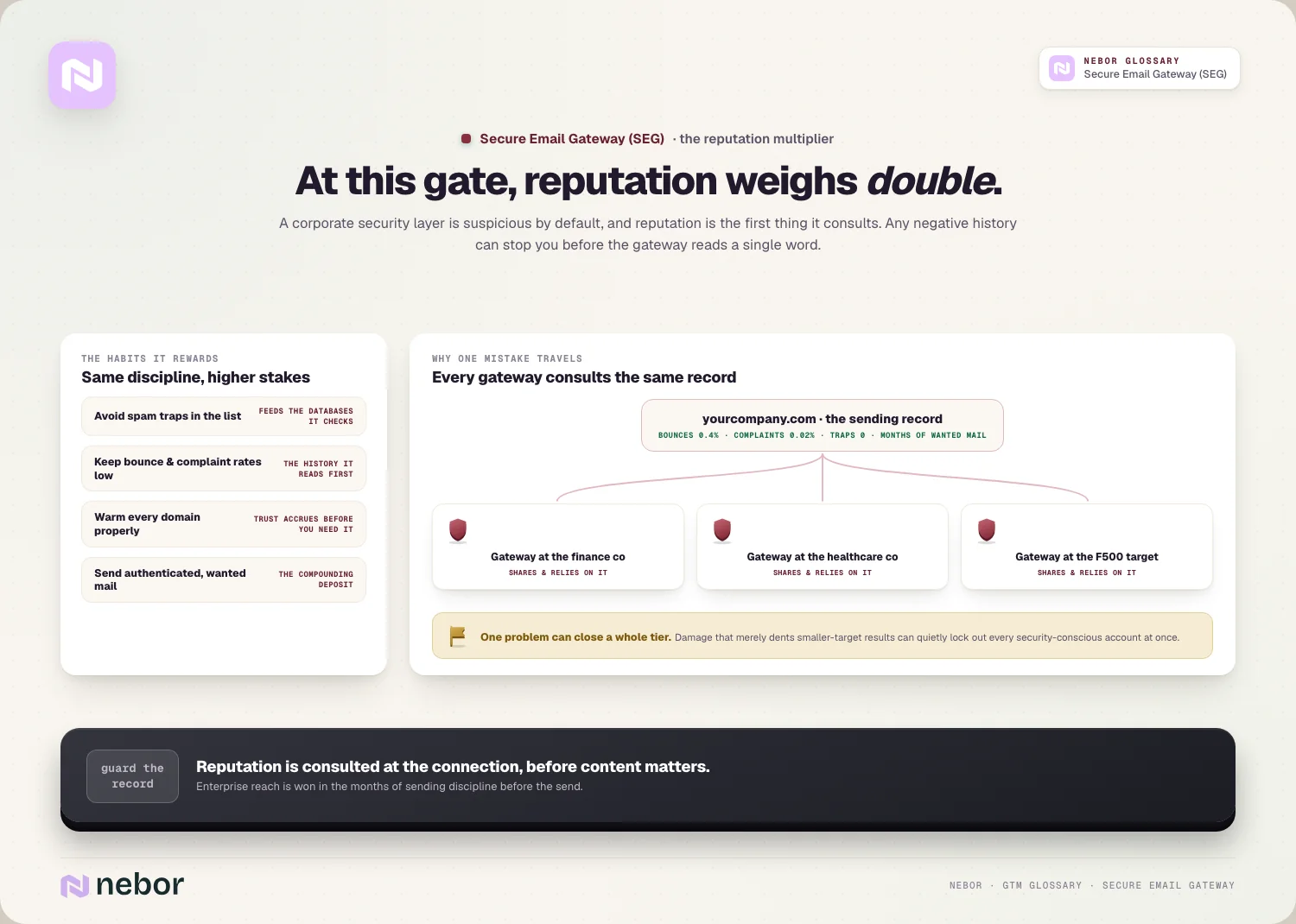
A single reputation problem can close off a whole tier of targets without you noticing. Because gateways share and rely on reputation data, damage that might only dent your consumer-inbox performance can effectively lock you out of the security-conscious companies you most want to reach.
How relevant, non-spammy content helps you get past the filter
Beyond the technical signals, a gateway also judges the message itself, so content that reads like genuine business correspondence clears more easily than anything resembling spam. A relevant, specific cold email that avoids the hallmarks of bulk marketing gives the gateway fewer reasons to flag it.
The things gateways treat as warning signs are often the same things that make outreach ineffective anyway. Aggressive sales language, misleading subject lines, risky links, and heavy image or attachment use all raise a gateway's suspicion, so cleaner email helps deliverability and response at once.
This is another case where doing outreach well and getting past security overlap. A message written to help a specific person tends to look nothing like the mass phishing and spam a gateway is built to catch, so relevance works as a deliverability asset as well as a response one.
How a secure email gateway fits your wider deliverability picture
A SEG is one more layer in the stack of things that decide whether your email arrives, standing alongside authentication, reputation, and content instead of replacing any of them. It's the receiving-side counterpart to all the sending infrastructure work you do, and both sides have to line up for a message to land.
Seeing it this way keeps you from treating enterprise blocking as a mystery. When email to big accounts underperforms, an outbound deliverability audit that checks your authentication, reputation, and content is the way to find whichever signal is giving gateways a reason to stop you.
It also explains why there's no single fix for enterprise deliverability. Because a gateway weighs everything at once, only a sound overall setup gets you through consistently, and the teams that reach enterprise inboxes are the ones who got every layer right instead of one clever thing.
How to tell whether a prospect's company has a gateway
You can't see a company's security stack directly, but a few signals hint at whether a gateway is likely in the way. Large size, a regulated industry like finance or healthcare, and a generally security-mature reputation all raise the odds that a company routes its mail through a SEG.
The technical fingerprints show up in the domain's mail records, where the presence of a well-known gateway provider in the mail routing is a strong tell. A rep who checks this before a big enterprise push can set realistic expectations and lean harder on the fundamentals for accounts that are clearly gated.
None of this lets you bypass the gateway, but it does help you interpret your own results honestly. When outreach to a gated account goes quiet, knowing a strict filter is probably involved keeps you from wrongly concluding the message or the person was the problem.
Why quarantine and false positives are the real risk for legitimate senders
The specific danger a SEG poses to good-faith outreach is not outright rejection so much as quiet quarantine, where a legitimate message gets held or diverted without a clear bounce. From the sender's side this looks identical to being ignored, so the leak is invisible and easy to misread as a lack of interest.
This false-positive problem is a known tension even for the companies that buy gateways, because overly aggressive filtering blocks wanted email alongside the threats. It's why gateway buyers increasingly ask for better allowlisting and clearer handling of legitimate mail, a small comfort but a real trend.
For a sender, the practical lesson we tell clients over and over is that a silent non-response into a gated account deserves careful interpretation. It may be disinterest, but it may equally be a filter that never let your message through, which is a reason to vary your channels instead of conclude the account is dead.
Why understanding SEGs changes how you approach enterprise outreach
The most useful thing about understanding secure email gateways is that it reframes enterprise deliverability from bad luck into something you can work on. Once you know a gateway often stands between you and a large account, you stop guessing and start strengthening the specific signals it evaluates.
It also sets fair expectations for what outreach into big companies requires. Reaching enterprise inboxes really is harder than reaching small ones, and the cause is an extra, stricter layer of defense in the way that only disciplined sending gets through, whatever the quality of your message.
Treating that reality as a reason to get the fundamentals right, instead of a wall to resent, is what separates teams that reach enterprise buyers from those that get filtered in silence.
In a modern go-to-market system, respecting the gateway is part of what lets the outreach you automate sales prospecting around actually arrive where it's meant to.
Share this post
Deliverability
Glossary
Related glossary items
Understanding the core GTM concepts



Ready to build your pipeline











